NO DOUBT many of our brethren in America think it strange that I do not report oftener through the REVIEW. I wished to wait until I should obtain some information from experience, when I should be able to report more intelligently. Life in Matabeleland is quite different from what I had expected, although I was prepared for a great change from my former experiences during my fifteen years' connection with the work. I often smile out loud when I contrast the ideas I once held in regard to this country and the people in general with the real facts as I find them. The people in America believe many things about this country that are not true.
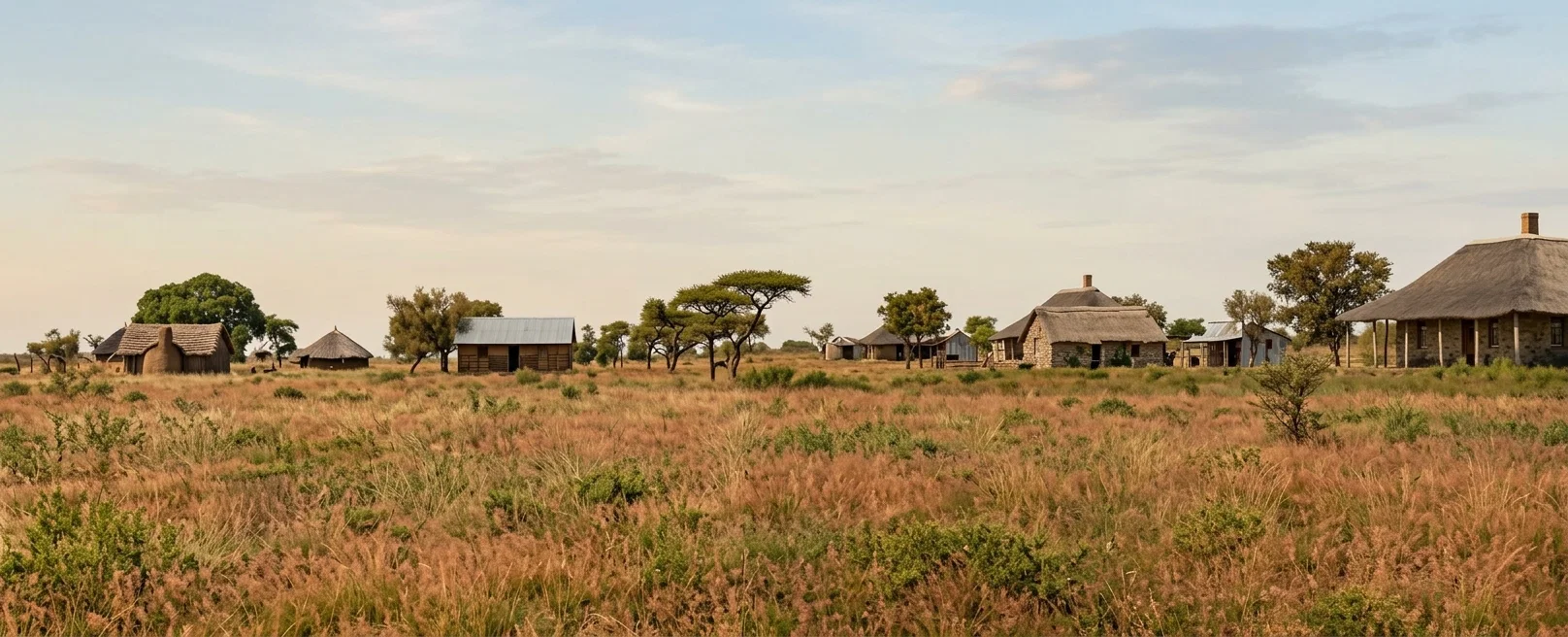
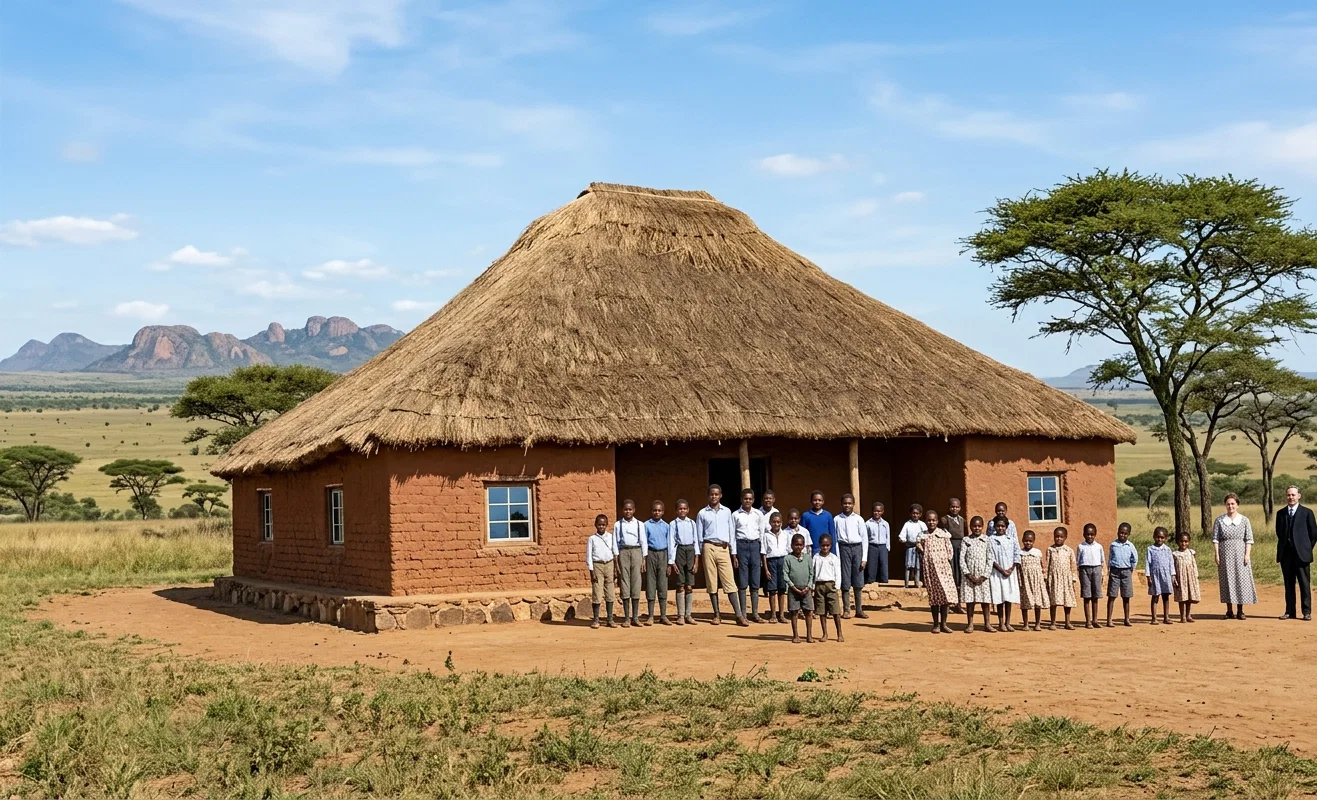
Blacksmith's Shop. The First House. Old Church. Store. Brother Armitage's House. Children's Home. Brother Armitage's First House. Brother Mead's House.
Matabeleland is level in some parts, and rolling in others. It is impossible to describe the scenery. The most peculiar feature is the prevalence of large piles of rocks, from twenty to one hundred and sixty feet high, and from four rods to two or three miles long; these huge piles are called kopjes (pronounced “coppies”). The soil is reddish sand and clay. The sand predominates, and is very coarse, so water drains out quickly, and crops suffer for lack of richness and moisture. In some lowlands, or ravines, the soil is richer. On this farm of twelve thousand acres there is probably two hundred acres worth cultivating; but it is scattered in small patches, from one-half to five acres in a place, and from two hundred rods to six miles from the home station.
There is nothing around here that would be called timber in America. The trees are short, crooked affairs, with flat tops, and trunks from two to ten inches through. I hauled a stick nearly twenty miles for a wagon tongue, and was glad to get it at that price. I have not seen half a dozen trees that would make a saw log twelve feet long and one foot through.
The grass, except on lowlands, is a coarse, joint variety, and grows from three to eight feet tall, covering about one fourth of the ground. The stock do not eat it except some short shoots at the base. The stock find feed in the ravines; they also eat a short grass on high ground, which closely resembles buffalo-grass in the States. After the natives have gathered their grain, the stock find feed for several weeks in these gardens. During the months of September and October the grass and water get rather short; but when the rains begin, the new feed starts very quickly.
There are but few native fruits that are suitable for food, most of them being sour, bitter, or in some other way undesirable. There are two seasons, the wet and the dry. From November to April is the wet, and from April to November the dry, season. The weather is changeable; one day it may be so hot that one can not work in the sun during the middle of the day; and the next day one will need extra clothing in order to be at all comfortable. One trying feature of the climate is the great contrast between the temperature during the day and that during the night. A change of thirty or forty degrees is a common thing. In traveling, as I have been much of the time since I came here, my heavy ulster has been my daily companion. No matter how hot it is in the sun, it is cool in the shade, even if the shade is produced by a piece of canvas spread for a covering. The climate is such that a person can not stand the same amount of work here that he can in America.
For agricultural purposes, I would prefer a farm in western Kansas or Nebraska, poor as they are, to a farm here. As a business enterprise, I would not give a dollar for this big farm of twelve thousand acres, and be obliged to live on it a year. As a mission station and a missionary field, that is quite a different question. This is, however, a fairly good grazing country; and if we had two or three hundred young cows, we could, no doubt, do well raising stock; for stock of any grade at the present time brings a good price; but what the future will be I am not able to tell. Stock raising for self-supporting work is far ahead of anything we can do at the present time. If each year we had one hundred cattle to sell, you can see how our work could be made self-supporting with far less hard labor than it can be done under present plans. But we can not sell cattle unless we have stock to raise them. Diseases among cattle have largely disappeared since the plague of rinderpest.12
The principal crops are corn, called mealies; kaffir corn; and enyout. The latter is a small grain extensively used by the natives for porridge. A native cultivates about two acres of ground, and, from the time his crop is planted until it is harvested, watches it night and day to protect it from numerous pests, which would otherwise destroy it. These two acres will raise about eight hundred pounds of grain, worth perhaps ten dollars in trade; among the grain, pumpkins are raised, also a kind of citron called jodas, and an inferior quality of beans. This constitutes their year's living, except as they earn something elsewhere. Owing to the barrenness of the soil and the lack of manure, the land is used only about three seasons. After several years' rest the land is again cultivated by succeeding generations.
To make a road, we simply go for a time in one place on the veldt (prairie) or through the bushes; and when that place gets too badly worn by hauling heavily loaded wagons over it, we deem it time to turn out and make another track. The rivers are crossed where we can find the best place. There are no bridges, at least I know of only one in Rhodesia, and that is in Buluwayo; but no heavy wagons are allowed to cross it. The rivers are dry most of the year. Being fed by the rains, they quickly dry out when the rainy season is over. Some of the rivers are hard to cross on account of steep banks and sand beds.
A native man has as many wives as he can buy, and a wife costs from two dollars and a half to twenty-five dollars. The wives do the most of the work, raising the children, and cultivating a large share of the crops, while the man bosses the job. There was a time when these natives had an unwritten code of laws and morality that would put to shame the white persons who have come here, and pose as civilizers of the country and promoters of “commerce,” liberty, and equality. The natives are imitating all the vices of the whites, and, generally speaking, they have seen little else to copy. The civilization brought by the whites who are here to make money is simply a curse to these poor ignorant souls. Oh! it makes my blood boil to see how these dark-skinned people have been and are now being wronged by wicked, designing white persons.
Our houses are made of brick, with thatched roof. A veranda extends on all sides. There are two outside doors, but no doors are hung inside as yet, although there are places for them. The house in which we live has no ceiling except the roof, but Brother Armitage's house has a cloth ceiling. The partitions are made of brick, plastered with mud; a poor kind of cement was used for the floors, which are so badly worn that they are no better than a dirt floor. While the house is not all we would desire, we are nevertheless comfortable. Our fuel is wood, and there is plenty of it.
It being necessary for me to go to the out-stations occasionally, also to do the buying in Buluwayo, I needed a team at my disposal. When I came here, there was one team of eight mules, and another team of twelve donkeys. I drove the mules for a time, but have now made a change, and have two ox teams; a good team here consists of from twelve to eighteen bullocks. I have also a horse and saddle, which I use considerable. I have been to Buluwayo, on an average, twice a month. It is no small job to drive twelve or sixteen oxen with a load over these sandy wastes, improperly called roads. Sometimes I have had a native driver to swing the large thirty-foot whip and handle the oxen for me.
Going to Buluwayo, thirty-five miles away, means to leave home Sunday afternoon, and reach home the following Thursday afternoon or Friday morning, sleeping on the wagon or on the ground, and eating cold food, only as I can make coffee or something after that order. I have often eaten with my overcoat and gloves on; and while this may sound like a cold story for tropical Africa, it is no colder than the reality. Everything here costs from two to five times as much as it does in America. People, in speaking of prices, talk of pounds sterling (five dollars) as freely as dollars are spoken of in the United States of America.
I will mention a few things that we have, by the blessing of God, been enabled to accomplish since we reached the mission farm: Opened two out-stations; built brick houses at each station, fourteen by thirty feet; built a brick church here at the home station, twenty-six by thirty-six feet; erected a building, fourteen by twenty-four feet, for an office and treatment room for Dr. Green's use; built a house, fourteen by twenty-four feet, for the hired help to occupy; have bought about eight hundred bags of grain, weighing two hundred pounds each. We had hoped to sell this grain at a fair profit, but the war in the Transvaal is stagnating business, and the outlook is rather dark. At one time Buluwayo had about six thousand inhabitants; now it has not over fifteen hundred, or possibly two thousand. Business is flat. It was good up to the first of July, but since that time it has gone down rapidly. Buluwayo has all the appearance of an American boom-blasted town. Since the war opened in the Transvaal, we are cut off both by railroad and telegraph, and the situation in Buluwayo is bad.
Some have an idea that emigration is pouring into Rhodesia as it used to into America a few years ago. This is a mistake. There is, however, quite an exodus out of this country. That is all the emigration I know of. There is no encouragement offered to remain; and all people can see is to get out before things are worse.
We have opened a school for the native children, who come from the kraals, and spend two hours each morning learning to read; and have also begun school work at a few of the kraals on the farm. We hope that this is but the beginning of the educational work among this people. Our prayers ascend daily that a desire may be created in the hearts of this people to learn to read; and if this is realized, then we hope that a knowledge of God's word can be brought to them as a nation. Each morning, worship is conducted with the hired native help. A native young man, who was herding donkeys when we came, shows signs of real Christian experience. He has become interested in learning to read, and has made such progress that already we have started him out among the kraals to spend a few hours each day with his own people. Sister Taba, the wife of the native teacher who died soon after Elder Tripp's death, is also interested in laboring among the kraals a few hours each week. Her regular work is sewing for the children in the “home,” and she does the home washing.
MATABELE MISSION CHILDREN.
Self-supporting missionary work is a fine thing to talk about, and it is what we are trying to do; but the most conspicuous thing around is our inconveniences, and these are so prominent that it requires about twice as much time and labor to accomplish a given amount of work here as it does in the States. We are about as well equipped for self-supporting missionary work as a carpenter would be if his tools consisted of a saw, an ax, and a jack-knife.
We often wonder when the Mission Board will send us more help. If helpers could reach us each year about April 1, they could, while becoming acclimated, learn the language, and also assist at the home station; and as soon as their knowledge of the language would permit, they could begin work among the natives. Our company were all plunged into hard manual labor as soon as we reached the farm, and we have been at it ever since, with no time for study; and because of our lack of ability to talk with the natives, we have labored under great embarrassment, such as I would not like to see others meet. We need married men and their wives, from twenty to thirty years of age,—men and women of good common sense, who are used to hard work, and are not afraid of trying experiences, persons who can keep sweet-tempered under difficulties. We need men and women of a high-school education, who are adapted to learning a new language, and who, after learning the language, could become efficient teachers. We don't ask for doctors (we have one good one), nurses, preachers, or farmers; but we do need teachers with adaptability and willingness to do anything, willing to lay aside many things that they think they know, and to learn from those who have spent a little time here.
It would not be wise for persons to come here for their health or for romance. This country is no health resort; and as for romance, there is but little of that. On the other hand, there is a large amount of hard work and many inconveniences to grapple with.
I know that many of our friends think that we have come to a heathen country, where people go nearly or wholly naked. They pity us, and think we must be very homesick. Yes; we have come to a heathen country, and that is why we are needed here. It is quite true that people go around with but few clothes on, but we don't mind that. I am led to believe that the clothing piled on many a white person's back often covers more impurity and immorality than we have yet discovered among this dark-skinned people. Homesick?—No; we don't know of a place where we would rather be than right here. We know that the Lord brought us here, therefore we are happy in being right where we know the Lord wishes us to be.
Our anxiety is to learn the best way to bring the light of the gospel to these natives, and the dear Lord is helping us in learning how to reach them. In our school work among the natives we are using a little book printed in the Matabele language. It was translated by Mr. Carnagie, the missionary nearest to our station, but under the London Missionary Society. He has also translated the book of Matthew, and is at the present time translating77the book of Acts. We have a few of his little native song-books, and the natives have learned the words to a few of the hymns. You see we are trying to be aggressive in our work, even if we do not have many conveniences, to say nothing of luxuries, and live on dirt floors under thatched roofs with no ceilings, no electric lights, no street cars nor side-walks, neither bicycle paths nor public water works.
On the Sabbath, after our Sabbath-school and native meeting in the church, the white people gather at our house, and we spend an hour together. For a few weeks we read the Bible studies in the General Conference Bulletins. Sometimes we have prayer and social meetings; and as we have sought the Lord, he has come very near. We are able to testify that the blessing of the Lord is not confined to numbers or places. The good REVIEW is greatly prized, although it is six weeks old when it reaches us. We are very thankful for the good reading we have in our various periodicals, and we hope to keep pace with the message of truth, even if we are isolated from the majority of our brethren and sisters. Letters from our friends are appreciated, but we hope no one will think that he is neglected if we do not answer at once. The days go by as rapidly as they ever did in America, and weeks pass before we accomplish what we planned to do in much less time.
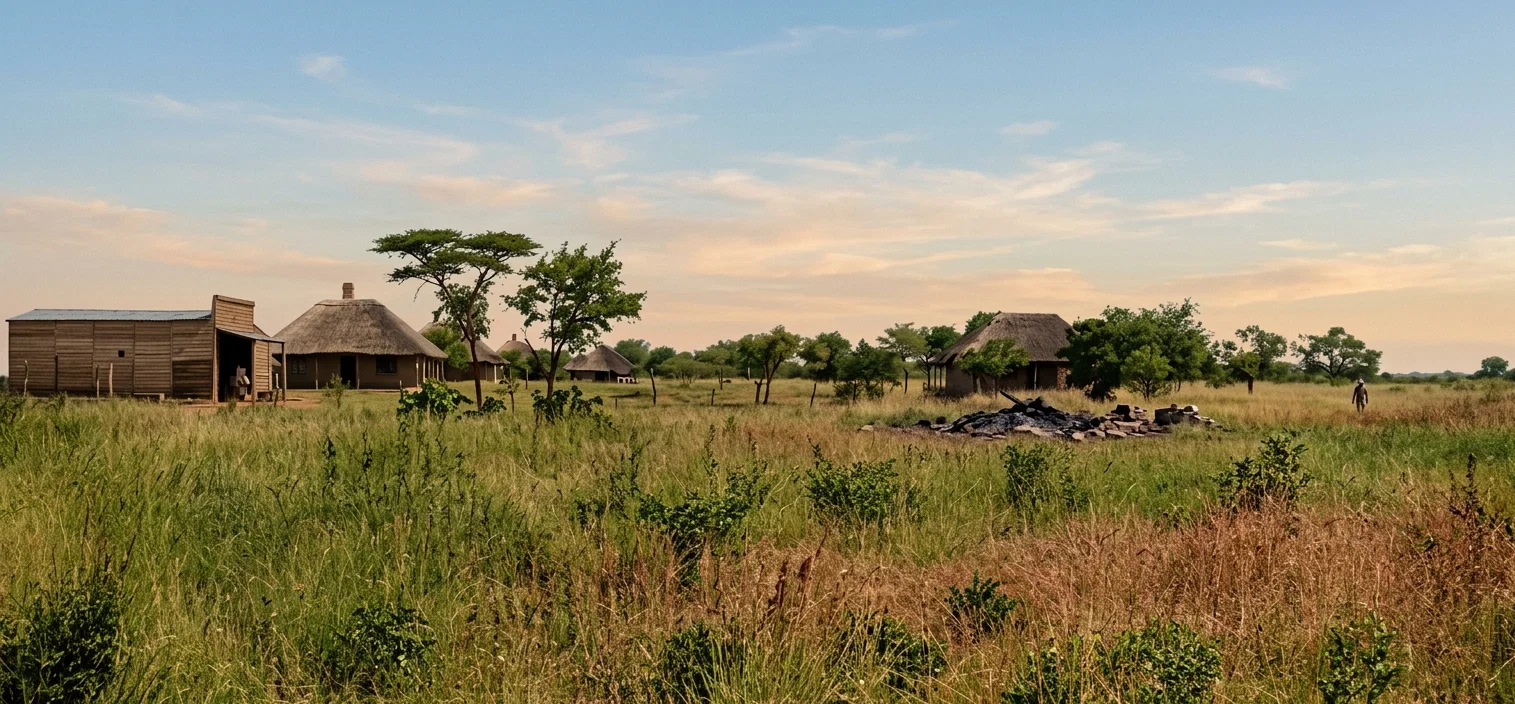
The Store. Brother Armitage's House. Children's Home. Brother Mead's House. Brother Anderson's House (recently burned).
I suppose you have learned about the loss we have had here by fire. It happened the morning of September 27. The house occupied by Brother Anderson and Dr. Green caught fire from the chimney flue, and it was not many minutes until the whole structure was in flames, the thatched roof going like tinder. They lost practically everything. All of Dr. Green's books, medical works, etc., went in smoke. He felt it keenly; indeed we all felt very sad; for we knew something of what it means to replace necessary articles in this country. We are not where we can step into stores and get whatever we need. Although at the best we have none too much room, we have made all as comfortable as we can, and hope in time to build another house. It will take some time to replace the articles that Brother and Sister Anderson had worked hard for, during their stay in Matabeleland; but in order to keep house and have food properly cooked, it will be necessary to have them. Dr. Green and his wife brought many things with them, and now these will have to be replaced.
As a family we have all been quite well since we left America, one year ago the thirtieth of this month. We acknowledge the goodness of the Lord to us, and daily dedicate ourselves anew to his service.
F. L. MEAD.
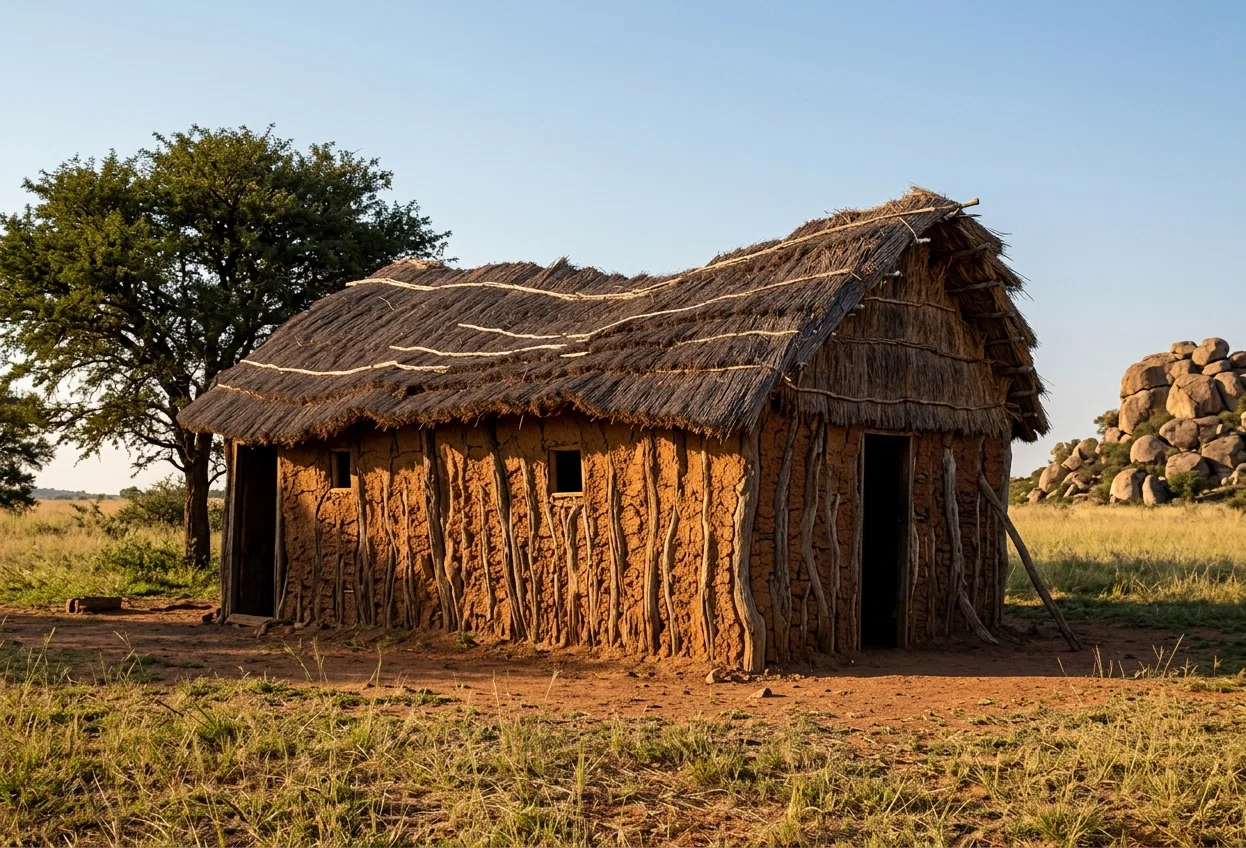
ELDER TRIPP'S FIRST HOUSE.
Items of Current News
For Week Ending January 27, 1900.
—The Canadian Pacific Railroad has sent a check for $15,000 to the South African war fund.
—The largest part of Dawson, Alaska, was wiped out by fire the evening of January 10. Loss, more than $500,000.
—The Trappist monks, the most austere of all the Catholic orders, are to build two monasteries in Massachusetts.
—Three hundred automobile cabs are in service in New York City, at twenty-five cents a mile, or seventy-five cents an hour.
—Many Buddhists are protesting against the Japanese government bill for the regulation of religions, as under the new law all religions will be equal.
—January 11 the number of deaths at Bombay, India, due to the bubonic plague, increased from 282 to 376. The normal death-rate is seventy-five a day.
—The German government has called upon Krupp & Co. not to furnish war materials either to Great Britain or to the Transvaal Republic during the progress of the war.
—January 16, in a battle between Americans and Filipinos, sixty Spaniards and $20,000 were captured by the Americans, and fifty Filipinos were killed or wounded.
—President McKinley has created a new military department, consisting of the Territory of Alaska, and has assigned Col. George M. Randall, Eighth Infantry, to command.
—Malietoa Tanus, the Samoan chief, has addressed protests to the United States, Great Britain, and Germany, against the partition of Samoa, which he declares is a crime against the law of nations.
—It is said that President Kruger will tell Adelbert Hay, the newly appointed United States consul to Pretoria, that he is persona non grata, and at liberty to return to Washington at his own convenience.
—The United States troops are still attempting to “surround” and “destroy the rebel forces” in the Philippines, while the Filipinos continue to “escape,” or to “elude the vigilance of their pursuers.”
—The claim of Admiral Dewey and the officers and men of the United States Asiatic Squadron, for bounty for the destruction of the Spanish fleet at Manila, was recently argued before the United States Court of Claims.
—The British forces, according to latest reports, are pushing on to the rescue of Ladysmith. Their progress is slow, owing to the fact that the Boers are contesting every inch of the ground. The main position of the Boers has not yet been taken by the British.
—The movement in Chicago in favor of the Sunday closing of stores is growing rapidly. Sunday, January 14, for the first time in the history of the city, nearly all the retail grocers and butchers closed their shops, and many other dealers have promised to do so hereafter.
—A pro-Boer mass meeting in Washington, D. C., January 21, was addressed by Senators Mason, Allen, and Hale, and several representatives in Congress. A like meeting was also held in Faneuil Hall, Boston, the 17th inst., George F. Hollis, ex-United States consul at Pretoria, and George Fred Williams being the chief speakers.
—John Ruskin, the famous English philosopher and art critic, died January 20, of influenza, in his native city, aged eighty-one years. He was born in London in 1819, and devoted his entire life to the study of art and to literature. W. E. Gladstone considered Ruskin second to no English prose writer on account of his pure English and his lucidity of expression.
—In December, 1899, the United States government receipts were $7,613,000 in excess of the expenditures; for the last six months the surplus was $21,026,000, as against a corresponding deficit of $83,719,000 for the corresponding period of 1898. The public debt of the country, Dec. 30, 1899, less cash in the treasury, amounted to $1,134,300,007, a decrease for the month of $5,791,824.14
—Kwang-Chau-Wan Bay, a disputed territory in China, has been seized by France.
—On the reassembling of Parliament, England will ask for a further war credit of £20,000,000.
—Sousa’s band has been designated as the “Official American band” of the Paris Exposition.
—Queen Victoria has notified the king of Belgium that she is not ready to mediate the war in South Africa.
—Thousands of head of stock perished, and many persons lost their lives, in the blizzard that swept over New Mexico, January 10.
—The British losses in South Africa, all told, in killed, wounded, and captured, according to General Buller’s last list, are 8,216 men.
—The Atlantic liner “Kaiser Wilhelm Der Grosse” crossed the ocean in five days, fifteen hours, and fifty minutes, beating her own previous records.
—Under an old law, which has been revived, no person can enter the Transvaal without declaring, before his consul, that he has no intention of fighting for the Boers.
—Dr. Elie Metchnikoff, of Paris, says that he expects to discover serums that will feed the human cells so accurately that the life of man may be prolonged to 250 years. So he says.
—A private of the Irish Rifles, who has fought at Stormberg, says that when General Gatacre saw the trap into which the guide had led his troops, he shot the guide dead on the spot.
—A dispatch from Berlin, dated January 24, says that the German bark “Hans Wagner,” stopped, December 19, in South African waters, by the British gunboat “Peerless,” has been released.
—A call is now being made for a United States telegraph cable from San Francisco to Hawaii, and thence to the Philippines. This country is now paying foreign cable companies $400,000 per annum for messages to and from Manila alone.
—No definite late news has been received from the seat of war in South Africa. Both British and Boer victories are reported, but no reliable news. However, heavy fighting is going on as the British push their way slowly toward Ladysmith.
—The republican element in Portugal is working up an agitation against the present monarchy, on the basis that England’s interference in Delagoa Bay violates Portugal’s neutrality, and is “due to the weakness of the existing régime of government.”
—Beginning with March 13, 1900, Rev. C. M. Sheldon, author of In His Steps, will edit the Topeka Daily Capital, for one week only, on “What-Would-Jesus-Do” lines. There will be no police or sporting news in the paper during that time, nor objectionable advertisements.
—Among the bills to be presented in the French Chamber of Deputies is one carrying out the views communicated by the Superior Committee of Hygiene, which asked the populace to abstain from spitting in the streets and public places, in order to avoid the diffusion of microbes.
—The New York Observer points out the fact that “the Jews taught that God had more regard for adverbs than for any other part of speech, because adverbs describe the manner in which a thing is done.” However, the word “very,” as an adverb, is found less than twenty times in the King James version of the Bible.
—A recent dispatch from Durban, South Africa, states that “the German bark ‘Marie,’ loaded with sulphur, which was captured by the British cruiser ‘Fearless’ and taken to Port Elizabeth, has been unconditionally released by the British authorities.” This pacifies the ruffled feelings of the German people not a little.
—The empress dowager of China recently issued “a secret decree, holding her provincial governors to strict responsibility for the immediate defense of their respective provinces, should any attack be made upon them.” In this decree she says: “The various powers are casting upon us looks of tiger-like voracity, hustling each other in their endeavors to be the first to seize on our innermost territory. They think that China, having neither money nor troops, would never venture to go to war with them.”
—With the arrival at Manila of the transport “Grant,” which left San Francisco, December 21, with the Forty-eighth Volunteer Infantry, General Otis will have command of a force of 65,000 men. The army now in the Philippines aggregates 62,500 men, of whom 31,000 are regular troops, and 31,500 are volunteers. With the arrival of the “Grant” the entire United States volunteer strength of 34,000 men will be in the Philippines.
—Last year some Missouri farmers were persuaded to sell their possessions, and go to Jerusalem “to see Christ come again,” in his glory. It is reported that they are now without money, and crowded into one small house, but still expectant. Commenting upon this, the Congregationalist says: “It is more than eighteen hundred years since Christ told his disciples to go out from Jerusalem, and bear witness to him unto the uttermost parts of the earth. It would be hard to find a place in the earth to-day less attractive than Jerusalem, yet several colonies of Americans are waiting in and around it, expecting to meet Jesus there.”
HEALDSBURG COLLEGE.
By M. E. Cady
The school opened Oct. 18, 1899, with an attendance of about one hundred and thirty students, but the attendance rapidly increased until, at the present time, we have an enrollment of about two hundred and twenty-five students. This is the largest enrollment that the college has had for several years, and is a cause of rejoicing on the part of those who are deeply interested in the progress and success of Healdsburg College.
Throughout the district a spirit of faith and courage is manifesting itself in the educational work. The California Conference furnishes a large majority of the students who attend the college. There is no reason why the school should not be full to overflowing every year. There are several hundred young men and women in California, alone, who ought to be earnestly engaged in the work of preparing themselves for the place the Lord would have them occupy in this closing work.
There has been a good spirit in the school from the first. Most of the students have come to the school with the strong desire to prepare themselves for some work in the Master's service.
During the last summer the brethren and sisters have responded nobly to the calls that have been made to relieve the college from its heavy debt of about thirty-five thousand dollars. Already twenty-two thousand dollars of this amount has been contributed, and it seems very reasonable to suppose that in a year's time the entire debt will be lifted by pledges and donations. It is the desire of the management of the college to make it a school where the principles of Christian education shall be taught and practiced. As the faculty has led out in the different branches of the work, the spirit of the Lord has come in and blessed abundantly. The week of prayer was a season of great refreshing for the college and the church. Young men and young women who came to the school in a backslidden condition, and also those who were unacquainted with the Lord, yielded to the influence of the Spirit of God, which visited the school many times in a marked way. Surely the Lord would have his schools at this time like the school of the prophets.
Character building is the great work to be done in our schools. When young men and women have gained strength of character that will enable them successfully to resist the enemy of their souls, then the Lord can use them as instruments through which his precious messages of truth may be carried to others.
One hour each week at the chapel period is devoted to missionary meeting. At this time the different phases of our work, both at home and abroad, are considered. The students also report experiences gained in practical home missionary work, in holding Bible readings, and visiting from house to house. Some of the young men who are preparing for the ministry are holding meetings in halls or schoolhouses in the rural districts. When we consider what the Lord has done for the school thus far, we are led to believe that the work of this school year will see marked indications of the presence and blessing of the Lord. May the time be hastened when the words of Isaiah the prophet shall receive their complete fulfillment: “They shall be all taught of God.”
Those desiring to learn more about the college and its work should address the writer at Healdsburg College, Healdsburg, Cal.
M. E. CADY.
KENTUCKY.
By S. OSBORN
LOUISVILLE.—Sabbath, December 2, was a day appointed to receive Brother and Sister Shellberg into the church, and to baptize him, Sister Shellberg having been baptized. But about four hours before the time, she passed calmly away.
On the following Monday I spoke words of comfort from Rev. 11:13, to the bereaved friends and to a large concourse of people, who had assembled to pay the last tribute of respect to the deceased. She was buried in Cavehill Cemetery, there to remain a little time until the Life-giver shall come. She was a great sufferer for years, and her one strong desire and prayer was to live to see her husband converted to God; and when she learned that he was converted, she said that her work was now done. She leaves a husband and two children to mourn their loss.
December 9 Brother Shellberg, his niece, and Sister Todd, who was formerly a Catholic, were baptized in the pool in the Christian Church, which had been kindly granted to us for the purpose.
The Lord came near to his people in their meetings in Louisville. Praise his name.
S. OSBORN.
WISCONSIN.
By Charles Gilchrist
LOYAL.— The mission school at this place opened October 1, with an attendance of thirteen. At present the attendance is sixteen. All connected with the school are of good courage. We realize that a preparation to meet our Lord is the greatest education we can have.
Of course, this work, like all works of righteousness, has a great enemy, but let us put on the whole armor of God, and fight the good fight; for we have a Commander who will guide to victory.