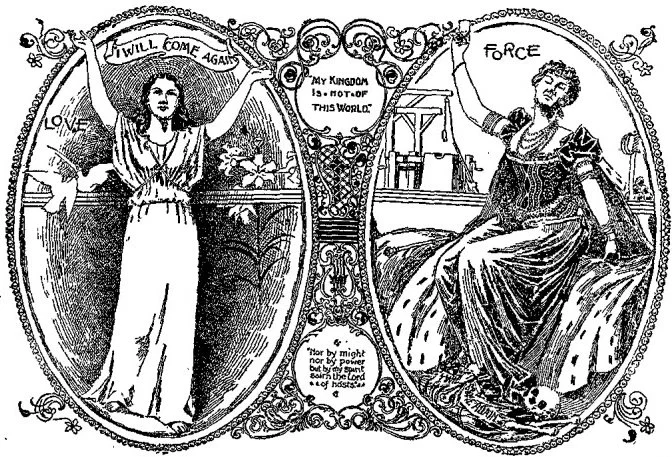
The White and the Scarlet, the Conflict of Colors.
By A. F. B.
“THE marriage of the Lamb is come and his wife hath made herself ready. And to her was granted that she should be arrayed in fine linen clean and white.”
White is the royal color of the kingdom of heaven. “The Ancient of Days did sit whose garment was white as snow.” “And he was transfigured before them. And his raiment became shining, exceeding white as snow, so as no fuller on earth can white them.” “The angel of the Lord descended from heaven . . . his raiment white as snow.” “He that overcometh shall be clothed in white raiment.” “I counsel thee to buy of me . . . white raiment that thou mayest be clothed.” Thou hast a few names even in Sardis which have not defiled their garments, and they shall walk with me in white.” “Though your sins be as scarlet they shall be white as snow.” “Wash me and I shall be whiter than snow.” “I beheld, and lo, a great multitude which no man could number, of all nations, and kindreds, and tongues, stood before the throne, and before the Lamb, clothed with white robes and palms in their hands.” “And white robes were given unto every one of them.” “And unto her was granted that she should be arrayed in fine linen clean and white, for the fine linen is the righteousness of saints.”
From this it is plain that the white robe is heaven’s symbol of power and purity. It is the only robe which the Lord, the lawful husband, ever places upon his wife, the Church. In this white robe she faithfully waits the return of the Lord. To accept any robe from the hand of another is to be untrue to her absent Lord.
“I saw a woman sit on a scarlet colored beast. . . . And the woman was arrayed in purple and scarlet color, and decked with gold and precious stones and pearls.”
Purple and scarlet are the royal colors of earthly rulers. “If thou canst read the writing and make known the interpretation thereof, thou shalt be clothed with scarlet and have a chain of gold about thy neck, and thou shalt be third ruler in the kingdom.” “Purple raiment that was on the kings of Midian.” “And the soldiers . . . put on him a purple robe, and said, Hail, king of the Jews.” “And they stripped him and put on him a scarlet robe, . . . and mocking him said, Hail, king of the Jews.”
“And the woman was arrayed in purple and scarlet color, and decked with gold and precious stones and pearls.” Where did this woman get her gaudy attire? Not from the lawful husband of the Church, for he clothed his bride in white raiment. “They which are gorgeously apparelled . . . live in kings’ courts.” The sad truth is, the woman has forgotten her lawful Lord and has exchanged her white robe of heavenly purity and power for the purple and scarlet robe of earthly kings. And what did this earthly power cost this fallen woman? She paid an infinite price. It cost her all. She is now only a harlot, soon to be hated even by those who now share her shame.
What a faithful picture of the apostate church of the Dark Ages. She deliberately solicited civil power at the hands of the Roman emperors. She disdainfully doffed the pilgrim white and donned the purple robe. She threw away the “sword of the Spirit” and grasped the sword of civil power. Thus attired she sat no longer in “heavenly places in Christ,” but in earthly palaces arm in arm with Caesar.
No longer in possession of the Holy Spirit, the shield against heretics (Acts 5:9–13), she now sought the civil arm. She passed from the “everlasting arms” of her lawful Lord into the arms of earthly emperors. Let her tell the shameful story herself:—
“For many ages after the conversion of Constantine it was easier for the church to repress heresy by invoking the secular arm than by organizing tribunals of her own. . . . But in the thirteenth century a new race of temporal rulers rose to power. . . . Philip Augustus was refractory toward the Church in many ways. . . . The Church was as clear as ever upon the necessity of repressing heretics, but the weapon, secular sovereignty, which she had hitherto employed for the purpose, seemed to be breaking in her hands. The time was come when she was to forge another weapon of her own; . . . which in the task of detecting and punishing those who mislead their brethren should employ all the minor forms of penal repression while still remitting to the secular arm the case of obstinate and incorrigible offenders. Thus arose the Inquisition.”
The reader is now invited to look in another direction, and with Christian candor see if he does not discern some traits of the mother of harlots in popular Protestantism of to-day. Bear in mind that the “mother” began to fall when she became worldly, when the church began to be filled with unconverted men and women. Wealth and luxury and fashion took the place of poverty, plainness and purity. Let the author of the Fletcher Prize Essay, Rev. George Guirey, a prominent member of a popular Protestant church, point out the similarity between the mother and the daughters:—
“Is there not some reason for the common impression that the worldly spirit in the Church is weakening her power with the public. Are there not evidences at hand that seem to confirm the impression that the Church in the Roman empire in the fourth century is repeating itself in the United States to day? . . . The enervating influence of wealth, luxury and fashion tells upon the church, producing spiritual declension, neglect of holy vows, and indifference to responsibility. The blandishments of the world are too much for human nature to withstand. And we see the sad spectacle of the great moral and religious activities of the Church dropped down into the rut of the ordinary routine of mere business officers, while her beautiful and glorious life is shorn of its spiritual power.”—The Hallowed Day, pp. 57, 58.
It was after the Church of the fourth century was “shorn of spiritual power” that she sought the civil power. It is the inexorable logic of cause and effect that the Church “shorn of spiritual power” should grasp after the civil power. This is certainly what the Church of to-day is doing, and strange to say, this is just what this Protestant clergyman advocates. On the same page he thinks that the Church “with her vast resources and advantages” consecrated to the service of God, “and with the leverage of civil law in her hands,” could accomplish great things for God.
To-day the lobbies of the halls of legislation are fast being crowded as in Constantine’s day with clergymen in quest of the purple and scarlet robe—the leverage of civil power. Within a few years this sentiment has been reinforced by what is known as the “Christian Citizenship” movement. A few of many quotations from its advocates will show that the Church is seeking civil supremacy now as in the fourth century. The following from a prominent speaker at the Boston Christian Endeavor convention shows that the fatal fall of the Church of the fourth century is regarded as a triumph:—
“In less than three centuries from the ascension of Christ, Christianity, in the person of Constantine the Great, had ascended the throne of the Cæsars and wrapped itself in the royal purple and ruled the Roman empire.”
With the false idea that the Church triumphs when she wraps herself in civil robes and rules the nations, the reader will not be astonished at the following utterances from the leaders in the new movement called Christian citizenship. They are all, save one, quoted from official reports of speeches made at International Christian Endeavor conventions held in Boston and Washington:—
“Taking an interest in politics does not mean that the minister of the gospel should bring politics into the pulpit, but it does mean that he should take his pulpit into politics. It does not mean that he should bring politics into the church, but it does mean most emphatically that the church should be translated into political power.”—Official Report, Washington Convention, p. 109.
“Christians must arise in the interests of righteousness and take control of civil affairs.”—Official Report, Boston Convention, p. 103.
“We have a right to make and enforce human laws that shall call for the observance of the laws of God.” Official Report, Washington Convention, p. 304.
“When the primary and the prayer-meeting are held on the same night the true prayer-meeting is the primary. ”—“Christian Citizenship,” by Rev. Carlos Martyn, p. 65.
Pages of such quotations might be presented, but these must suffice.
Oh, where are the Spirit-filled men and women who will call the churches to repentance,—call them away from the political primary back to the prayer-meeting of Pentecost? Where are the men and women clothed with the “power from on high” who will persuade them to turn from the purple and scarlet of political power to the snow white robe of the Prince of Peace? These are perilous times. Reader, have you received “power from on high?”
A. F. B.
Duty of Obedience to Civil Rulers.
“Bible Echo,” Melbourne, Aus.
Of the Christian’s duty to respect, obey, and pray for civil rulers, the Bible speaks in plain terms. It says: “Let every soul be subject unto the higher powers. For there is no power but of God; the powers that be are ordained of God.” “I exhort, therefore, that first of all, supplications, prayers, intercessions, and giving of thanks be made for all men; for kings, and for all that are in authority; that we may lead a quiet and peaceable life in all godliness and honesty.” “Honor all men. Love the brotherhood. Fear God. Honor the king.” “Put them in mind to be subject to principalities and powers, to obey magistrates, to be ready to every good work.” “Submit yourselves to every ordinance of man for the Lord’s sake; whether it be to the king as supreme; or unto governors, as unto them that are sent by him for the punishment of evildoers, and for the praise of them that do well.” “Seek the peace of the city whither I have caused you to be carried away captives, and pray unto the Lord for it: for in the peace thereof shall ye have peace.”
LIMIT OF OBEDIENCE TO CIVIL RULERS.
But it should ever be remembered that honor and obedience to earthly rulers are always to be rendered in subjection to the will of God. While they are the “higher powers,” they are not the highest. “If thou seest the oppression of the poor, and violent perverting of judgment and justice in a province,” says Solomon, the wisest king who ever sat on a throne, “marvel not at the matter: for He that is higher than the highest regardeth; and there be higher than they.” Eccl. 5:8. While the law of the king is supreme in civil things, the law of God is over and above all law. In any case of conflict between the two there is but one course left for Christians to pursue,—“we ought to obey God rather than men.” Acts 5:29.
It is too evident to need discussion that the law of Him who made us must stand first. Therefore, if civil rulers require idolatrous worship, all men have the right, with the three Hebrew captives, to say, “We will not serve thy gods, nor worship the golden image which thou522hast set up.” If they forbid the worship of the true God, all, like Daniel of old, may fearlessly continue to worship him. If they require the observance of some other day as the Sabbath than the one ordained by God, all have a right to disregard such requirement, and to keep the day divinely set apart and blessed. Nay, more; it is the duty of all to do so.
The Authority for Sunday.
It is not often that the advocates of Sunday rest feel called upon to bring forth out of its obscurity the Scriptural authority for Sunday, being for the most part content to rest upon the assumption that the day so generally observed throughout the Christian world must be the Scriptural Sabbath. Occasionally, however, the disembodied spirit, as it were, of Sunday authority is called upon to materialize, for the edification of its adherents and the discomfiture of those who believe in the day set apart by the Creator. The results obtained are not always satisfactory to the former.
One occasion of this kind is reported from Ellis Mound, Ill. Two members of the Missionary Baptist church at that place, Messrs. Denson and Atteberry, by name, were put on trial for heresy, in having ‘gone off with the Advents.’ The former is an adult, possessing a good knowledge of the Scriptures and ability as a speaker and writer, while the latter is a youth of sixteen years, who at the time of his trial had been studying the Bible only a few weeks. Accordingly, Mr. Denson’s case was disposed of by simply calling upon him to state whether he kept Saturday or Sunday, after which he was expelled from the church by a vote,—only four voting out of a membership of one hundred and twenty. The consideration of young Mr. Atteberry’s case, however, was deemed a fitting opportunity to “expose the fallacy of the seventh-day theory,” which the pastor of the church, or “moderator,” proceeded to do, as follows:—
Moderator.—“Willie, did you ever work on the first day of the week, the Lord’s day?”
Willie.—“I have worked on the first day of the week.”
Mod.—(After expressing some regret and making some further remarks) “Willie, don’t you believe the Saviour rose from the grave on the first day of the week?”
Willie.—“Yes.”
Mod.—“Did he not meet with his disciples on the same day?”
Willie.—“Yes.”
Mod.—“If they met for worship on the first day of the week, should we not do the same?”
Willie.—“They didn’t meet for worship.”
Mod.—“Then what did they meet for?”
Willie.—(Quotes from the Bible) “They were assembled, the doors being shut for fear of the Jews.” (Laughter at the moderator’s expense.)
Mod.—“Did not Paul meet with the church at Troas and break bread on the first day of the week?”
Willie.—(After opening Bible and reading from Acts 2:46) “If breaking bread makes a day sacred, then all days are sacred.”
Mod.—“There; that will do. Sit down. As I said before, we don’t want to discuss this subject. I only ask these few questions to show the fallacy of the seventh-day theory. Sit down.” (Mr. Atteberry’s case was laid over for further consideration.)
Those in the audience who were not entirely satisfied with this materialization of evidence for Sunday’s claims, could reflect for their consolation that this was but a small part of the evidence that might have been given,—that there was much more that might have been brought out, just as good as this!
Should They Not Be Ashamed?
By C. F. Adams
BY C. F. ADAMS.
“Now in the first year of Cyrus, king of Persia, that the word of the Lord by the mouth of Jeremiah might be fulfilled, the Lord stirred up the spirit of Cyrus, king of Persia, that he made a proclamation throughout all his kingdom, and put it also into writing.” The proclamation that he made was for the restoration and rebuilding of Jerusalem. (At the time mentioned, the Jewish nation was subject to the Medo-Persian kingdom.)
Upon Ezra, the priest, rested the burden of this work. When they had chosen from all the tribes of Israel, men fit for the work, and all was ready for their journey to Jerusalem, “then,” writes Ezra, “I proclaimed a fast there, at the river of Ahava, that we might afflict ourselves before our God, to seek of him a right way for us, and for our little ones, and for all our substance. For I was ashamed to require of the king a band of soldiers and horsemen to help us against the enemy in the way: because we had spoken to the king saying, The hand of our God is upon all them for good that seek him; but his power and his wrath is against them that forsake him. So we fasted and besought our God for this; and he was intreated of us.”
The principles of the gospel have been always the same. The people of God back in that day professed to523that earthly kingdom that God would protect them against their enemies. They now saw that their path was beset with foes and they must either depend wholly on God, as they said they would, or go to the king for protection, thus denying their profession.
Ezra says, “We fasted and besought our God for this: and he was intreated of us.”
The church to-day claims the Lord as her glory and strength and that she must, in her controversy with evil, use the “sword of the Spirit, which is the Word of God.”
Notwithstanding this, a large portion of it, associated in organizations, such as the “National Reform Association,” “American Sabbath Union,” “Women’s National Sabbath Union,” etc., are saying in word or action what was said in a speech by W. F. Crafts, in a plea for legislation in behalf of the church, made before a committee of Congress in 1888. He said, “What we ask for, is law;” and why do they ask for law? It is to furnish them power to overcome the world; yet all the while they are professing that “This is the victory that overcometh the world, even our faith.” All this they do and are not ashamed.
“O, Consistency, thou art a jewel!”
If the church would but practice what she preaches, and possess what she professes, the world would see her good works and be led to glorify our Father which is in heaven.
Hastings, Iowa.
Russian Czar Decree Enforcing Sunday Rest
THE Czar, or rather, the church authorities by whom the Czar is controlled, have taken the matter of Sunday rest in hand, and advices from St. Petersburg report him as “promulgating a decree prohibiting under severe penalty any form of labor on Sunday or on the fourteen principal Russian feast-days.” The Greek Catholic church, like the Roman Catholic, understands that Sunday, as a religious day, rests upon precisely the same authority as do the other feast-days of the church. The authority for one and all is church authority, and nothing more.
A Baptist Clergyman on Sunday Laws.
In pleasing contrast with what is usually put forth from the “orthodox” pulpit on the subject of Sunday laws, is the following from a recent discourse by Rev. Dr. Read, pastor of the First Baptist church of Los Angeles, Cal. His reasons for opposing the Sunday crusade certainly commend themselves to the candid judgment:—
“First, this movement is contrary to the plain teachings of the Bible. In Luke 20:25, our Lord said: ‘Render therefore unto Caesar the things which be Caesar’s, and to God the things which be God’s.’ This divine law is our warrant for a complete separation of Church and State. Jesus himself would not allow the sword to be used in his defense.
“Religious duties should be enforced only by religious motives and moral means. The observance of the Lord’s day is a religious duty, and hence should not be enforced by civil penalties. All that the State should be asked to do for Christians in anything pertaining to religion is to afford them protection, in the exercise of their natural and inalienable rights.
“And it is self-evident that in this respect all persons have equal rights. The Jew has as good a right to worship on the seventh-day Sabbath as the Christian has to worship on the first day, . . . and any civil statute which imposes any disability upon the Jew or upon any Sabbatarian is obviously wrong.
“It is claimed by the advocates of this movement for Sunday laws that it is wholly as a rest day, and not as a religious day that they ask the State to require the observance of the Lord’s day. But I ask these men if they would consent to have the State pass a law requiring all business to be suspended on Wednesday instead of Sunday? Having conscientiously observed the first day, . . . would they be willing to lay aside their business for another day and so forego all the profits of their business for one sixth part of their secular time? But this is precisely what they propose to compel every conscientious Jew and Seventh-day Adventist and Seventh-day Baptist to do! Thus this proposed law interferes not only with religious obligation, but also with one’s duty to support his family, by honest toil. When the citizen shall rest, how he shall rest or where, is a question with which the State has nothing to do, any more than it has with the ways and times of his activity. If the State may prescribe when the citizen shall rest and how long, on the ground that such rest promotes health and morality, then it should go farther and prescribe what church he shall attend and what forms of religious worship he shall observe!
“Again, this proposed Sunday-closing law is in direct conflict with the First Amendment to the Constitution of the United States, which guarantees religious liberty to all citizens.
“And yet again this proposed law is in direct opposition to all our Baptist principles and our splendid history in the past. From the beginning we have been the champions of freedom and we shall be to the end. During the last two years in our own beloved land under the Stars and Stripes of our beautiful flag, there have been more than one hundred cases of relentless persecution in Tennessee and Maryland. Godly men have been fined, put in prison, and even in the chain-gang with the worst of criminals; all, and only, because they did not observe the first day of the week as their day of rest and worship.
“And last, I believe that all such efforts to promote religion and morality are not merely failures, but are worse; they are criminal blunders, inasmuch as they do most certainly exasperate and disgust many citizens who are not Christians, and turn them away from the churches, and from the Bible, and make it very much more difficult to bring them under the influence of our holy religion. Moreover, such a resort to force in efforts to secure the proper observance of the Lord’s day is a virtual confession of the inadequacy of moral motives and moral suasion. And let it be known that any observance of the Lord’s day which is not the free choice of the soul itself is not pleasing to God and will not receive His blessing!
“As Christians let us be faithful in testimony for the truth and for duty, and live right lives, and then leave every man with his God and his own conscience; let us ask protection and only protection from the State, rendering to Caesar the things which be Caesar’s, and to God the things which be God’s.”
Spanish Bishops Appeal Against Protestant College in Madrid
THE Independent (N. Y.), of August 12, gives the following item of news from Spain, which contains a lesson in religious liberty:—
“For many years Pastor Fritz Fliedner, son of the famous Kaiserswerth reviver of the order of deaconnesses, has been the leading missionary of Protestantism in524Spain. Among his successful operations has been the establishment of a Protestant college in Madrid, costing $50,000, which is now under roof and rapidly approaching completion. This success has aroused the opposition of the clericals, and the bishops of Vitoria, Santander, Leon and Valencia, together with the archbishop of Burgos, have united in a strong appeal to the government, demanding that this insult to the religion of the State be stopped, and that the noble sacrifices of the people for the preservation of the integrity of the State be rewarded by such protection to their religious rights. At latest reports the government has ignored this appeal.”
Trial of Mr. Bell, of Tupperville, Ont., for Sunday Desecration.
THE following notes relative to the trial of Mr. Bell, at Tupperville, Ont., for Sunday work, as announced in our last issue, are from a letter by Eld. P. M. Howe, a member of the Adventist community at Chatham, Ont. Elder Howe was present at the trial, and sends the following under date of August 11:—
“Brother Bell asked me to talk for him in the case. They brought only three witnesses against him. The constable laid the complaint. The chief witness, Mr. McKay, swore that he was forty rods or more away from Mr. Bell at the time, and that he thought Mr. Bell was working. When I asked Mr. McKay what he was doing so far back on his farm on Sunday, he replied, ‘I was salting my sheep.’ He thought that was a work of necessity and did not think Mr. Bell was doing work of necessity, for he had a horse in the field. The justice refused to take any of the testimony in cross-examination. The whole matter was illegally conducted from start to finish.
“We explained Brother Bell’s reasons for pleading ‘Not Guilty,’ and held that the enforcement of the statute as now amended would involve every farmer in trouble if he had an enemy who wished to take advantage of it to get revenge.
“All testified that Brother Bell was a kind, good neighbor, and very accommodating. He had furnished wheat for seed and flour for bread for a long time to the chief witness who came into court to swear him into jail if possible. It is a singular fact that Sunday laws are all based on false premises, and when enforced, nearly every case is so obscure that men must be found who will swear falsely to secure conviction.
“Brother Bell works every Sunday, but has been careful to go back into his fields. I visited his place yesterday, and the potato patch where he was seen July 25th is about eighty rods back from the road. It is fifty-five rods from where his neighbor was salting sheep, with several rows of thick high corn growing between.
“The justice in summing up the case said that this trouble had all arisen over a little matter of difference in religious belief; but in his mind he believed that the testimony taken showed that Mr. Bell had worked on the sabbath, the 25th of July, and other sabbaths. I asked him if he was trying Mr. Bell for sabbath breaking; so he corrected himself and called it the ‘Lord’s day.’
“He said he felt like being very easy with Mr. Bell, because of his peculiar belief about keeping Saturday, but the law of the land must be obeyed. Therefore he would only fine Mr. Bell $5 and costs, or fifteen days in jail, with ten days to pay fine or take an appeal.”
Upon notice being given that the case would be appealed, the justice concluded to dismiss the case, without costs, which was accordingly done.
Elder D. F. Curtis Praises the Sentinel Subscription Offer
ELD. D. F. CURTIS, of Wasioja, Minn., a veteran minister and staunch friend of the SENTINEL, in sending in his third subscription order, says: “I rejoice to learn of525the additions to your list under the special offer, and could but wish that it might increase to 100,000. May the Lord bless the SENTINEL to the good of the people everywhere.”
National Reform Association Calls Philadelphia Convention for Religious Amendmen
The National Reform Association is in the field again with a call for a national convention to be held in Philadelphia, December 7–9, for the furtherance of National Reform plans. This means that another special effort will be made this winter to force the Government to profess Christianity, by act of Congress.
Atlanta Druggist Arrested for Sunday Work
THE Atlanta Journal (Ga.), of August 2, makes mention of the arrest of Dr. Joseph Jacobs, proprietor of a drug store in Atlanta, for doing work in his store on Sunday. The Sunday law of Georgia has been quite generally disregarded by merchants and business men throughout the State, and the case of Mr. Jacobs will test the practicability of enforcing it to the letter upon all classes of citizens.
Sunday at Atlantic City.
ATLANTIC CITY, N. J., is enforcing a Sunday-closing ordinance which “regulates” the running of amusements on that day. The following cases of arrest have been reported:—
G. DeDoneau (Parisian Illusions); convicted and sentenced to ten days in the city jail.
John T. Flood & Co. (Merry-go-Round); bound over to court.
Haines & Clements (Toboggan Slide), H. Gable, manager; tried and sentenced but served with writ of certiorari, and case will be reviewed in the Supreme Court.
This list is furnished by the mayor of Atlantic City.
Missouri Subscriber Secures Five Subscriptions for Sentinel
THE following letter from a subscriber in Missouri is appreciated: “I am seventy-six years old, and am afflicted in many ways, but when I received your invitation to kindly aid in securing a few subscribers under your special offer, I thought how pleased I would be if I could send you even one subscription, but I am glad to tell you that I have been able to secure five, for which I enclose the money, and I hope to send you others before the offer closes. I have been a constant reader of the SENTINEL ever since its first issue, and I prize it highly. My prayer is that God may bless it and every one employed thereon.”
The Last Call.
By Editor
IN accordance with the usual custom of the office, no paper will be issued next week, hence this is the last opportunity we will have of speaking a word concerning our special offer before reaching the limit of its duration. To say that we have been gratified at the response fails to express our feelings; and more when we say that there seems to be no abatement of interest, but rather an increase. As we go to press, we are close to the three thousand mark of new subscriptions, and nearly all have been received in a little over two weeks. We wish that the SENTINEL family could have an opportunity to glance over our daily mail, and note the sentiment pervading the letters containing subscriptions.
Something of the interest manifested may be judged when the fact is known that nearly two hundred individuals have sent in clubs, some of them containing as high as thirty-five and forty names. One man in Montana forwards a list of thirty-six subscriptions as the result of two afternoons’ effort among the business men of his town. An old lady over eighty years of age, who was an eye-witness of the thrilling scenes surrounding the martyrdom of Elijah P. Lovejoy, and in whose breast beats as strongly as ever the true principles of religious liberty, writes that she could not keep her room when she read our special offer, but felt impelled to go out and work in its behalf, and as the result forwards us a nice list of subscribers. We might multiply incidents of this character to almost any length, but it is not necessary. We simply mention them to emphasize the character of the constituency back of the SENTINEL.
And now less than two weeks remain before our special offer closes. Will not those who have not, as yet, because of force of circumstances, done anything in its behalf, secure for the paper at least one new subscriber? Is this unreasonable? Is it asking more than we can expect?
Jefferson in his day declared the time would come when the people would grow careless of their liberties. Will any one, alive to the events transpiring around us, deny that that time is now here? Certainly not; and it therefore behooves every lover of his country who prizes liberty of conscience to keep his eyes open and help to tell the people what all these things mean. So, under these circumstances, every effort made to circulate the AMERICAN SENTINEL is but a labor of love put forth to bless humanity. Who would hesitate to lend a helping hand? We believe not one; and therefore we confidently expect that the next ten days will roll up a list exceeding what we have already received. Shall it not be so?
Just Our Aim.
MR. A. P. BRANAMAN, of LeRoy, Illinois, in remitting for a club of SENTINELS, says: “I am glad to tell you that the SENTINEL is gaining ground here. Wage the battle on the strongest foundation, which is the plain truth; give the people to understand the times in which we live, and what manner of men we ought to be.”
Canvassing for the Sentinel Subscriptions Among Workers
A WARM friend of the SENTINEL writes us from one of the western States saying, that in conversation with a member of the conference committee, it was thought feasible to recommend that the workers throughout the conference be invited to devote two or three hours each day for several days canvassing for subscriptions to the SENTINEL under its special offer. Is not this an idea worthy of consideration?
Remember This.
By Editor
REMEMBER our special offer closes September 1st, and in order to secure its advantages our friends must not wait until that date before sending in their orders.
TO OUR PATRONS:
By Editor
Write names plainly.
Remit by P. O. Money Order, or Express Order, or by Bank Draft on New York. Personal checks are not desired.
Make all Orders and Drafts payable to Pacific Press Publishing Co., not to the editor or any other individual.
We will receive Postage Stamps in small quantities and any kind of good money. Defaced coins will not be taken. If paper money or coin is sent, register the letter.
THE WHIRL of the CYCLONE CONTINUES.
The people are looking for a perfect washing machine. It is found only in the Cyclone, and it is so easy to demonstrate the fact to intending purchasers that agents for it are reaping a rich harvest. Write for terms and territory to Coon Bros., 18-20 Hanover St., Battle Creek, Mich.
“I am surprised,”
Says Prof. E. A. Sheldon, President of the State Normal School, Oswego, N.Y. “that so much that is valuable for one to know is brought into so small a compass and sold at so small a price.”
THE NEW Webster Dictionary AND Complete Vest-Pocket Library
is full of happy surprises. It successfully combines a Dictionary of 45,800 words; a complete Parliamentary Manual; Literary Guide, etc. Positively the only pocket dictionary giving the full pronunciation of words.
*_Over 300,000 copies sold._*
“I shall give this book a place in my vest pocket, a place that no other book thus far has had.”—C. C. Gaines, Pres. of Eastman Business College.
192 Pages, 5⅜ x 2⅝ in., Weight, 2 ounces.
Should be owned by every Student, Business Man, and Person of Intelligence.
Cloth, 25 cents; Morocco, 50 cents; Extra Quality with Three Years’ Calendar, Perpetual Memorandum, and Safety Postage-Stamp Holder, 60 cents.
Address all orders to
PACIFIC PRESS PUBLISHING CO., 39 Bond St., New York City.
SOUTH LANCASTER ACADEMY,
Is most healthfully located. Combines religious and industrial with intellectual training.
Thoroughness of instruction, solidity of character and usefulness in life are the principal objects of attainment.
Board and Tuition Only $120 Per Year.
For further particulars and calendar, address, J. H. HAUGHEY, Principal, South Lancaster, Mass.
THE STORY OF PITCAIRN ISLAND.
By Rosalind Amelia Young
(SECOND EDITION.)
BY ROSALIND AMELIA YOUNG, A Native Daughter.
Pitcairn Island, one of the volcanic gems of the Pacific, has been heard of wherever the English language has been spoken. The story of the working out of the problem of human life on its limited territory reads stranger and more thrillingly in many respects than a romance. But most, if not all, of the tales told and books printed have either been too fragmentary or incorrect and misleading. It will be interesting to the friends of that miniature world to know that an authentic history has been written, and that by a native of the island, one to the manor born. Miss Rosa Young is one of the direct descendants of the mutineers of the Bounty. The book is a plain, unvarnished tale of Pitcairn and its inhabitants from its settlement to the year 1894. It is written with a charming simplicity of style which refreshes the reader and invites a continual perusal. Illustrated with 26 engravings by the half-tone process, and its 23 chapters have each a neatly engraved heading.
Price, . . . $1.00
PACIFIC PRESS PUBLISHING CO., 39 Bond St., New York City, N. Y. Kansas City, Mo. Oakland, Cal.