The Samoan, or Navigators, Islands are a group of islands in the western Pacific Ocean. They are about five hundred fifty miles north of Tonga, and about four hundred miles northeast of Fiji. The group consists of nine principal islands. All, with the exception of Rose Island, are of volcanic formation, and for the most part are surrounded by coral reefs. They are mountainous, but well wooded. Savaii, Upolu, Tutuila, and Manua are the largest islands.
The town of Apia is the center of political and commercial life in Samoa. At Pago Pago the United States government has installed an extensive naval station.
THE SEA BOILING, SAMOAN ISLANDS
Caused by lava from a volcano eight miles distant
The climate of Samoa is variable and moist. The rainfall for the last five years averaged one hundred twenty-six inches. The most pleasant time of the year is from May to November, when the southeast trade winds prevail. The products of the island are chiefly vegetable. Cocoanut, cocoa, and rubber are the chief articles of production.
The population of the German colony consists of about four hundred whites, five hundred half-castes, and thirty-three thousand natives. In the American colony there are about six thousand natives, one hundred whites, and as many half-castes. The hard labor of German Samoa is performed largely by Chinese coolies, of whom there are about five hundred.
The gospel was first carried to Samoa by Messrs. Williams and Barff, of the London Missionary Society, with some Tahitian teachers, in the year 1830. In 1836 six missionaries from the same society joined them, and for many years they worked hard, and built up what is seen to-day—large training-schools in different islands, preparing workers for the other groups of the Pacific. Their present membership is stated to be 27,004 in all Samoa. They have also twenty-eight churches and schools in the Gilbert and Ellice groups.
In 1835 the Methodist Missionary Society of Australasia began work in these islands, and now has churches and training-schools in different parts of both German and American Samoa, with a membership of about five thousand. The Roman Catholic Church began work in 1845. It has built up schools and churches in many places, and has a membership of five thousand, but many children of other denominations are attending its schools.
Early in 1891 the “Pitcairn” visited Samoa on her first voyage. Five years later, Dr. F. E. Braucht began labor in the medical institution at Malaulu. He afterward went to Apia, where he labored for a number of years. Other workers were added to the mission—Delos Lake, W. E. Floding, Drs. Vollmer and Gibson, and others; but on account of the trying nature of the climate, they had to leave, one after another, until at last Samoa was left without a recognized worker bearing the last message.
At the Australasian Union Conference council of 1907, the writer and his family were asked to reopen the work in Samoa. It was through trust in Him who has called us, that we consented to pick up the fallen threads in Samoa. After bidding good-by to our fellow laborers in Australia, and enjoying a pleasant stay of two months in Fiji, we reached Samoa just a year ago, and found that a few of the little flock were trying to hold up the banner of truth. A church was organized by Brother Parker, who accompanied us to Samoa from Fiji. We found that, as far as the natives were concerned, very little had been done for them. “Christ Our Saviour,” and a few tracts, the supply of which was almost exhausted, was all the literature translated into the Samoan language.
By the help of a young man, now connected with the message, we set to work to prepare literature for the natives. As a result, we have now either printed or in the hands of the printer, “The Sabbath,” “The Coming of Christ,” “The New Testament Sabbath,” “The State of the Dead,” “Immortality,” and “Who Changed the Sabbath?” This will give us some seed to sow. Very little can be done anywhere till we have the truth in the language of the people. During the time we have been here we have scattered considerable reading-matter among the white people. We often have an opportunity to place reading-matter on the small vessels that visit other islands. If any wish to help the work in Samoa, they can do so by sending us literature bearing on the message, either in German or in English. We will promise to use it to the best advantage. If we sow the seed, Israel’s God will bring the increase.
Apia.
W. J. TANNER
By W. J. Tanner
Haiti
W. J. TANNER
Our work in Haiti has been hindered during the year 1908 by two revolutions and by hard times. Nevertheless, we can record progress, the total number of baptized Sabbath-keepers growing from eighty to one hundred two, with ten or twelve to be baptized during the first month of the new year.
We are also glad to report that our members seem to be growing spiritually. It is a hard task to get people who have all their lives been accustomed to Roman Catholicism and other pagan superstitions, to come up to the high standard that our message calls for. But what would be impossible by human effort we see gradually taking place as a natural fruitage, as a legitimate and logical result of the message itself.
The fluctuations of the value of the Haitian money have been remarkable the past year, and have reduced the people to a state of poverty that means hunger and nakedness. This condition of things has made it nearly impossible to dispose of our literature, and has also affected our tithe receipts, especially when we reckon in gold.
We feel that we have great reason to be thankful for the protecting hand of the Lord that has been over the work during the last few months. Notwithstanding the fact that nearly every provision of the constitution was ruthlessly disregarded, the constitutional guaranty of religious liberty, upon which the prosecution of our work so much depends, was faithfully observed. That this one point in the fundamental law of the republic was maintained, while all the others were ruthlessly put aside, may not seem so remarkable to some, but to us it is a direct intervention of the Lord in behalf of the advancement13of the third angel's message in this field.
Personally, we are grateful that the same protecting hand that has cared for the work has been over his servants.
On four different occasions it seemed as if we were going to find ourselves in the midst of bloodshed, and we kept our cellar in constant readiness as a place of refuge from bullets; but each time this local trouble was averted, and with the exception of being deprived of moving about freely for two months, we have enjoyed the fullest liberty possible.
Cape Haitien.
In Southern Germany
By Guy Dail
GUY DAIL
The eighth annual meeting of the South German Conference closed this evening (January 3) after a successful four days' session here in Mannheim, on the Neckar and the Rhine. This is a fine city of 176,000 inhabitants, many of whom are engaged in the large spinning factories, or in conducting the trade of this, one of the most important of the inland harbors in the German empire.
Our readers may remember that it is not long since we were granted religious toleration in Bavaria. Our work has become well known. The religious and the political press is now doing all within its power to misrepresent our message, and to prejudice the minds of the people against it. However, two hundred fifty-three were added to our membership in the South German Conference during 1908, increasing its membership, after making up for some inevitable losses, from eight hundred three to ten hundred thirty-seven. Three new companies were received at the meeting—one in Offenbach, one in Pirmasens, and one in Tuebingen. Our brethren here are actively engaged in the service. During the fourth quarter of 1908, the income of the tract societies of our thirty-two churches and companies in this field was over four thousand marks [about one thousand dollars]. They have been putting forth special efforts to circulate our truth-laden literature.
The Spirit of God was also present to impress upon the minds of the three hundred brethren and sisters at the meeting the importance of the foreign work. They gave fifteen hundred marks, and expressed their willingness to give one of their best young men, for the assistance of the Austrian Mission. Ten hundred fifty-nine marks in cash and pledges came in for the new school building in Friedensau. They were also willing to turn over to the West German Conference that part of Hessia which is in the territory of the South German Conference; and so henceforth the South German field will be composed of the kingdoms of Bavaria and Wurtemberg, of the duchies of Baden and Luxemburg, and the provinces of Alsace-Lorraine, with a population of nearly thirteen million.
The thirty-two canvassers present were much encouraged in their work by a personal acquaintance with Brother P. John, the representative of the Hamburg House, who assisted the state agent in every way he could. The book sales for the year amount to 71,584 marks, against 70,316 marks for 1907. The other visiting brethren were: Elders H. F. Schuberth, E. Frauchiger, J. G. Oblander, and Dr. E. Meyer. The health reform was well represented, and the demonstrations as to the value of our health food products were made practical, the prepared foods being passed around during the lecture, that all might sample them.
Brethren Wm. Staubert, K. Kamm, and H. Steiner were ordained to the gospel ministry, Sabbath afternoon. In all, there are six ministers, five licentiates, and eight Bible workers engaged in the service of the South German Conference. Elder J. H. Schilling was chosen president. Four were baptized at the meeting. The outside attendance was fair, the holidays interfering somewhat; there were about two hundred strangers at the evening lectures.
The work for the children and youth took up its share of the time and attention of the delegates. We have not found it possible as yet to organize young people's societies in all parts of Europe; but the children of the Southern German Conference were the first to take a bold step in the right direction by distributing our German Little Friend, which is one of the best children's papers in Germany. Hundreds of marks are annually collected for missionary work in this way. The experiences of the little ones are often exceedingly interesting and encouraging. In this manner, it may be, God will train workers for himself, who will be able to labor when older persons have no longer liberty to do so.
All the brethren of the South German field go back to their homes better prepared for another year's duties than before, and they expressed their joy for the blessings God so richly gave at this conference. Pray for them.
Hamburg.
C. L. BUTTERFIELD
By C. L. Butterfield
Korea
C. L. BUTTERFIELD
Two months have passed since our arrival in this interesting mission field. During this time we have been busy in getting located for the winter, in the organization of our mission, and in looking for a suitable location for our headquarters. We are now giving our attention to the study of the language, and we find that it is no easy task.
During our journey here, the sea was smooth, and we were sick only a short time. Other missionaries were on the same boat with us, and we had interesting Bible studies each day. In this way I was able to bring some of the points of our faith before missionaries who have been in the field for several years, and they promised to study further.
Our boat stopped at Yokohama two days, and we visited Tokyo, and spent one night with Elder F. W. Field, and one night in Yokohama. At Kobe we stayed at the sanitarium about five days, and then came to our field of labor. We enjoyed our stop in Japan very much. We found the workers there busy, and enjoying much blessing in their work.
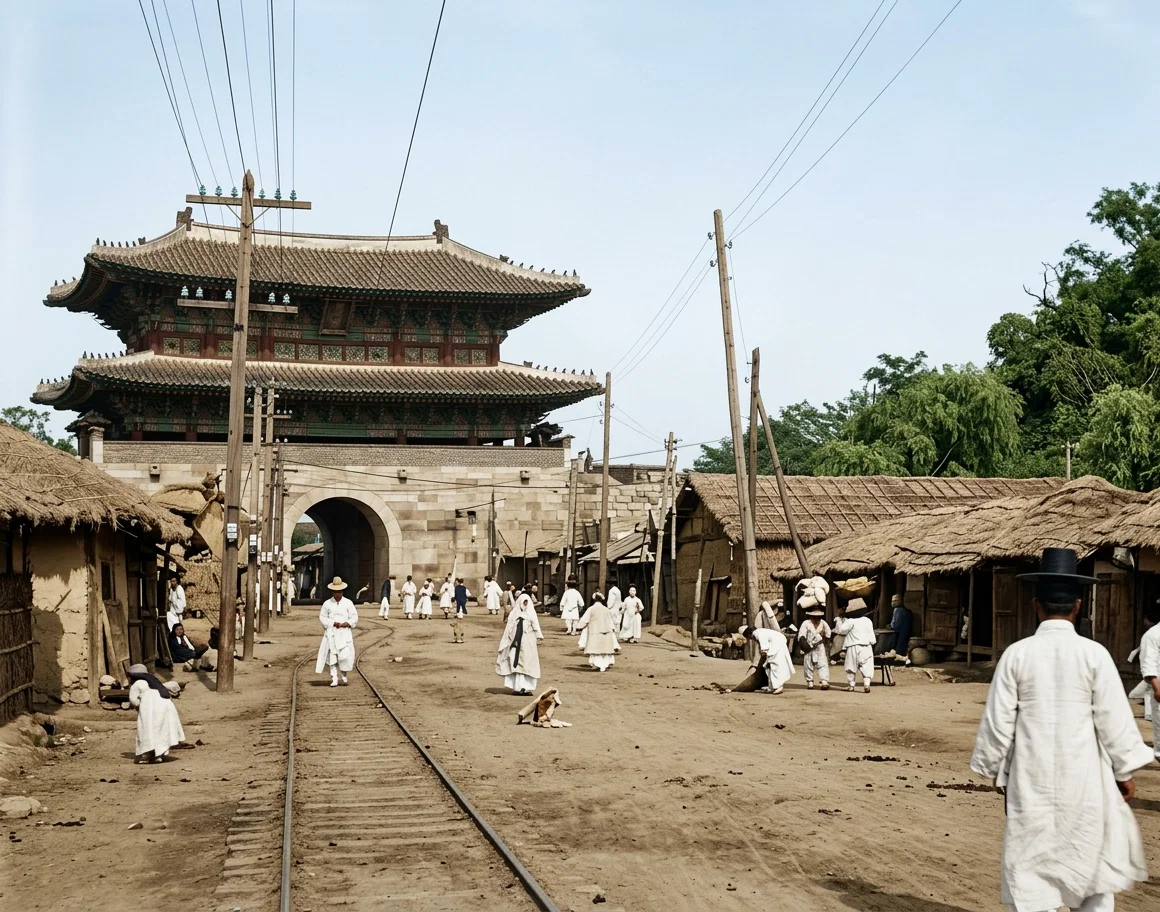
WEST GATE OF SEOUL, KOREA
When we arrived here, we were met at the station by the workers and a goodly number of native believers. We were indeed thankful to God for the safe journey we have had, and for the privilege of working for him in this field.
While it did not seem best to make this place the permanent headquarters of our work, yet as all our work at present is here, and near here, it seemed best for us to locate here for the present. To do that, it was necessary to build a small house to live in. This now seems to all to be a step in the right direction. Whenever it seems best to move to some other place for the center of our work, this house can be taken down and moved with little expense.
The Koreans are certainly an interesting people to work for. When we first came, there was some difficulty among the native workers, and they were not in full harmony with our work. But at present there seems to be harmony among them, and they are now in full sympathy with our work, and wish to do all they can to give this message to their people. For this we are thankful.
Elder I. H. Evans was with us ten days. We much appreciated his counsel and help.
When you receive this, we shall be entering on a two-months' institute for our native workers. Remember us in prayer that God may bless us, and that these workers may be prepared for more efficient service.
Soonan.
The Hearing on the Johnston Sunday Bill
By W. W. P.
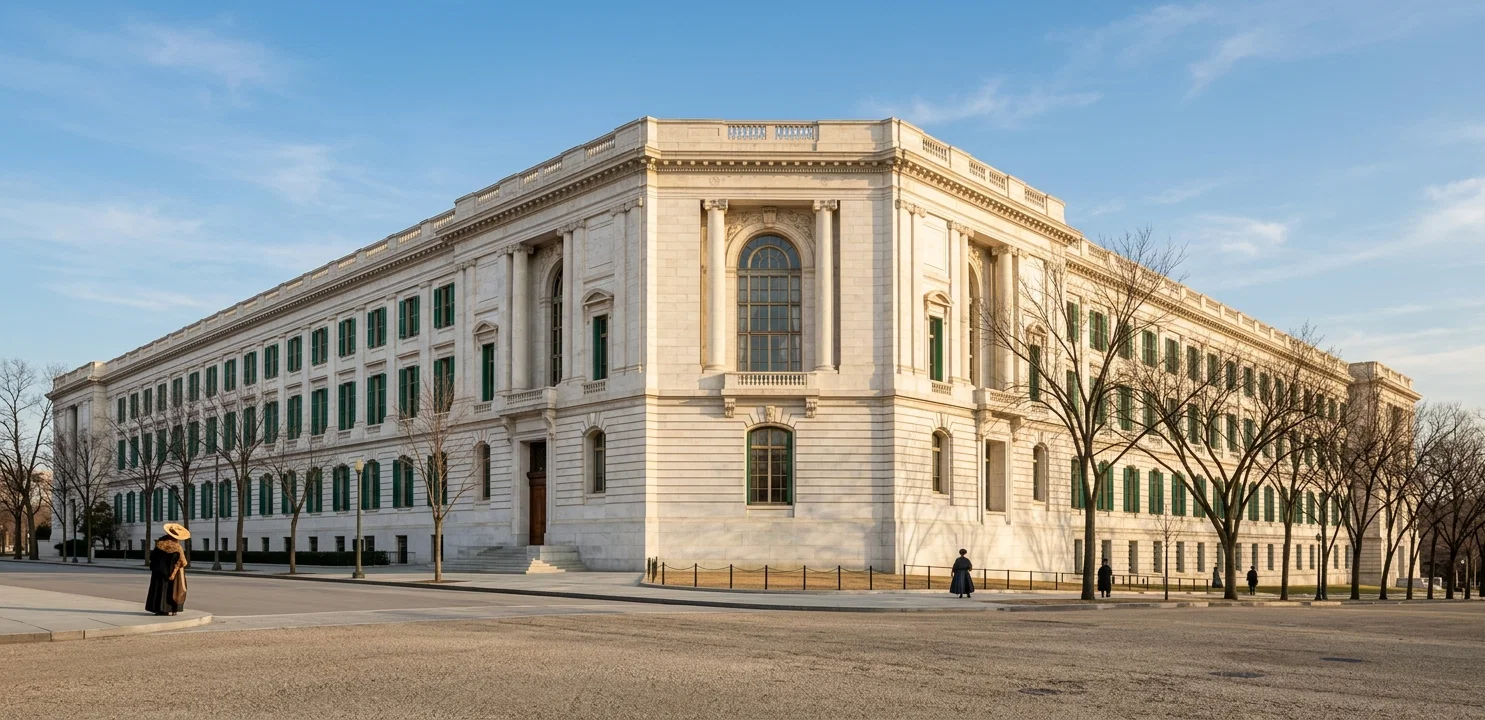
ANNOUNCEMENT has already been made that a hearing on the Johnston Sunday bill had been granted, and that it was appointed for Monday, February 15. This hearing was held in the room of the House Committee on the District of Columbia in the new office building of the House of Representatives. Every seat in the main committee room was occupied, while many stood, filling the doorways and the adjoining space.
The time was granted to the opponents of the bill, but through their courtesy, several speakers who favored the measure were accorded the privilege of speaking.
The bill, which has already passed the Senate, is a substitute for the one originally introduced by Mr. Johnston, and reads as follows:—
“A BILL.
“For the proper observance of Sunday as a day of rest in the District of Columbia.
“Be it enacted by the Senate and House of Representatives of the United States of America, in Congress assembled, That it shall be unlawful for any person or corporation in the District of Columbia, on the first day of the week, commonly called Sunday, to labor at any trade or calling, or to employ or cause to be employed his apprentice or servant in any labor or business, except in household work or other work of necessity or charity, and except also newspaper publishers and their employees, and except also public-service corporations and their employees, in the necessary supplying of service to the people of the District.
“Section 2: That it shall be unlawful for any persons in said District on said day to engage in any circus, show, or theatrical performance: Provided, That the provisions of this act shall not be construed so as to prohibit sacred concerts, nor the regular business of hotels and restaurants on said day; nor to the delivery of articles of food, including meats, at any time before ten o’clock in the morning of said day from June 1 to October 1; nor to the sale of milk, fruit, confectionery, ice, soda and mineral waters, newspapers, periodicals, cigars, drugs, medicines, and surgical appliances; nor to the business of livery stables, or other public, or the use of private, conveyances; nor to the handling and operation of the United States mail.
“Sec. 3: That any person or corporation who shall violate the provisions of this act shall, on conviction thereof, be punished by a fine of not more than ten dollars, or by imprisonment in the jail of the District of Columbia for not more than ten days, or by both such fine and imprisonment, in the discretion of the court: Provided, That persons who are members of a religious society, who observe as a sabbath any other day in the week than Sunday, shall not be liable to the penalties prescribed in this act if they observe as a sabbath one day in each seven, as herein provided.
“Sec. 4: That all prosecutions for violations of this act shall be in the police courts of the District of Columbia and in the name of the District.”
The first argument against the proposed legislation was made by the editor of the REVIEW, who occupied fifteen minutes in bringing to the attention of the committee a number of reasons why the bill should not be favorably reported.
The following is a brief outline of these reasons, which were developed in the argument:—
1. There are a large number of associations and alliances pledged to secure the passage of State and national Sunday laws throughout this country.
THE HOUSE OF REPRESENTATIVES’ OFFICE BUILDING
The hearing on the Johnston Sunday bill was held in an office in this building
2. These organizations have declared their purpose to secure a Sunday law for the District of Columbia.
3. In one of their official documents credit is claimed for the preparation of such a bill as the one now before the committee, and for bringing to bear “the influence of the federation wherever possible in favor of the passage of the bill.”
4. The advocates of the enforced observance of the first day of the week desire to secure the action of Congress making a distinction between the first day of the week and other days, being assured that the influence of such legislation will be helpful in securing and enforcing State legislation upon the same subject.
5. Those who are demanding Sunday laws for the ostensible purpose of securing one day of rest in seven for the working-men are not satisfied with a law which provides this very thing, unless that day of rest be specified as Sunday. This is shown by the present agitation for a Sunday law in California.
6. The representatives of over thirty Protestant denominations constituting the Federal Council of the Churches of Christ in America have declared in favor of Sunday laws, and have refused to adopt a resolution disclaiming their intention to do anything which would interfere with the convictions of those who conscientiously observe another day.
7. The exemption clause in the bill before the committee is most convincing proof of the religious character of the bill.
8. Prominent Sunday-law advocates have made most unseemly statements concerning their control of Congress, and their purpose to bring to an end the career of every politician who will not grant their demands.
9. The famous Sunday Mail Report adopted in the United States Senate in 1829 sounds a timely warning against permitting the influence of extensive religious combinations to control the action of Congress.
10. If the laboring men desire to rest upon one day of the week, they should assert their right to do so: no employer can compel them to labor against their will.
Referring to the exemption clause which was attached to the bill when reported by the Senate committee, the editor said: “An examination of this exemption clause will throw much light upon the real character of this proposed legislation. The clause reads thus:—
“‘Provided, That persons who are members of a religious society, who observe as a sabbath any other day in the week than Sunday, shall not be liable to the penalties prescribed in this act if they observe as a Sabbath one day in each seven, as herein provided.’
“The conditions herein prescribed should be carefully noted. In order to be exempted from the penalties of this act:—
“1. One must be a member of a religious society which observes as a sabbath some other day than Sunday.
“2. He must observe as a sabbath one day in each seven, ‘as herein provided.’
“Interpreting the bill in the light of this exemption clause, it is perfectly clear that it is religious in its character, and that its intention is to require the observance of Sunday as the sabbath. The words ‘as herein provided’ are of no force whatever unless they mean that this act provides for the observance of one day in each seven as a sabbath. This conclusion is so clear that it requires no argument to establish it.
“Furthermore, although it is claimed in behalf of this bill that its purpose is to secure for employees that measure of rest which their physical nature demands15yet from the penalties of this act certain persons are exempted, not because they have had the benefit of the required physical rest on some other day, but because ‘they observe as a sabbath one day in each seven, as herein provided.’ That is to say, the purpose of this act is to require the general observance of the first day of the week, commonly called Sunday, as the sabbath, but the observance of some other day of the week as the sabbath will be accepted as a sufficient compliance with the general spirit of the bill. It is plain upon the face of it that such legislation as this is religious, and from the evidence already submitted it is certain that if the religious bodies now seeking the passage of Sunday laws could have their own way in the matter, even the observance of another day of the week than Sunday as the sabbath would not be allowed as a compliance with the legislation asked for in behalf of the so-called Christian sabbath.”
At the conclusion of this argument, W. A. Colcord, secretary of the Religious Liberty Bureau, presented a clear and forcible protest against the bill, of which the following is a brief outline:—
Referring to the statement in the famous Sunday Mail Report that ‘if Congress shall, by the authority of law, sanction the measure recommended [prohibiting the transportation and handling of mails on Sunday], it would constitute a legislative decision of a religious controversy, in which even Christians themselves are at issue,’ he declared:—
‘I bring the direct charge, therefore, that this proposed legislation is religious; that its principal promoters and supporters are religionists; that if passed, it will be the beginning of a religious establishment in the United States, and that in the end, as with all other religious establishments, it will result in religious oppression and persecution.’
Convincing proofs were set forth in support of this charge:—
1. ‘The Sabbath itself is a religious institution.’
2. ‘The chief promoters and supporters of this legislation are religious people.’
3. ‘The movement in the District has been placed in the hands of the ‘Interdenominational Committee upon Sunday Observance in the Capital.’’
4. ‘The bill permits only ‘sacred concerts’ to be given on Sunday.’
5. ‘It exempts upon religious grounds.’
6. ‘Dr. W. F. Crafts said: ‘A weekly day of rest has never been permanently secured in any land except on the basis of religious obligation. Take the religion out, and you take the rest out.’’
As to the province of civil government, the speaker said:—
‘From the civil standpoint, the only standpoint from which civil government has a right to deal with any question, a man has as much right not to be religious and not to observe a day of rest as he has to be religious and to observe a day of rest.’
As to the need of any legislation in behalf of religion, the speaker quoted Benjamin Franklin:—
‘When religion is good, it will take care of itself; when it is not able to take care of itself, and God does not see fit to take care of it, and it has to appeal to a civil power for support, it is evidence to my mind that its cause is a bad one.’”
In answer to some of the arguments urged in behalf of Sunday legislation, the following statements were made:—
‘It is asserted that the right of each to rest demands a law of rest for all. This may be good rhetoric, but it is poor logic. Two million Jews and a hundred thousand Christian observers of the seventh day in this country, without a law compelling others to observe it, disprove the statement.
“‘It is claimed that Sunday laws are essential to religion and the stability of government. In reply, we need but cite the fact that Sunday laws did not save the Roman empire, nor make a nation of saints. Rome fell, and the Dark Ages followed.
“‘It is urged that the majority should rule. Not in religious matters, we reply.’
Other considerations were urged against the measure, some of which are:—
‘All Sunday legislation is a violation of that general constitutional principle so frequently expressed in American law, that ‘no preference shall be given by us to any religious sect, society, or mode of worship.’
“‘No man has the right to compel another man by law to do in religious matters as he does, simply because he believes he is right, or because he may be in the majority.’
As to the wide-reaching influence which would be exerted by the passage of this bill, the speaker, in conclusion, said:—
‘If, in response to the wide-spread demand, Congress yields and enacts a compulsory Sunday law, it will in this act reverse the course it has for so long consistently and persistently pursued, and repudiate one of the fundamental and most cherished principles of the national government. It will be the first fatal step in the downward course of uniting church and state, and will open the floodgates to a tide of evil, the results of which many little realize.’
A report of the other arguments presented against the bill, and of the speeches intended to be in favor of the bill, which, however, were turned against it, will be given in next week’s paper.
W. W. P.
Danish West Indies
By H. C. J. Wallekar
St. Croix.—I came to this place on the second of December, and set up my tent the next day, and had it seated and everything in order to hold our first meeting Sunday night, December 6. The government gave us the use of a good place for the tent, in a grove of mahogany trees, near the fort, where the soldiers and police are located.
As soon as it was known that we intended to pitch a tent and hold meetings, we were told that the government would not allow any tent-meetings. Upon inquiry, I learned that some individuals belonging to a class of jumping, shouting religionists came to this place about three years ago, pitched a tent, and gave the police considerable trouble, and that the chief of police had said he would not allow any more such meetings. I talked with the officials in their own language, however; and after some inquiry as to how we conducted our meetings, they gave me the very spot I asked for. Owing to the fact that there is a rough element in the town, it seems remarkable that we have never had any trouble. Some of the police have come to me and expressed themselves as pleased with the good order maintained, both in and around the tent. From the first, our meetings have been well attended. The tent will seat from two hundred fifty to three hundred, but we often have as many or more outside. The ministers have kept very quiet, and some have even attended the meetings, standing outside at a distance, that they might not be seen. Some have spoken well of us, while others whisper that we are “false prophets.” About two weeks ago a minister spoke on the Christian sabbath. We went to hear him, and after he was through speaking, he came and shook hands with us. We told him we would speak on the same subject the following night, and invited him to come and hear us. He came, and sat on the front seat. There were about one thousand people present that night, and the Lord greatly blessed. I spoke for nearly three hours, and then the people did not want me to stop.
December 26 we had our first public Sabbath service. Fifty-eight adults and seventeen children attended our Sabbath-school, and the number has steadily increased until now the attendance is over ninety. Thirty have signed the covenant, and desire to unite with us. This week we organized a class of thirty-five to prepare for baptism.
We can see that God is working for us and for the salvation of the people. He has mercifully spared our lives when wicked men have sought to do us bodily harm. The message is going with power in all parts of the world, and soon the honest in heart will all be gathered out, and we shall go home. May the glad day quickly come. H. C. J. WALLEKAR.
A New Conference Organization
By G. B. Thompson
WHEN the General Conference headquarters was removed from Battle Creek, Mich., to Washington, D. C., the territory included within the District of Columbia and the corporation of Takoma Park, Md., was set apart as General Conference territory, instead of being connected with one of the adjoining local conferences. This seemed to be, and doubtless was, the best arrangement for that time. A large part of the membership being composed of those who were here as a direct result of the locating of the headquarters of our work in this place, it seemed but just that some of the funds should be under the direction of the General Conference, to be used in the carrying forward of the message in “the regions beyond.” Since this time the work in the District has been managed by a committee composed of members of the General Conference Committee, and those representing the various churches.
But the work grew, and the details of carrying it forward increased. Prior to the time of the removal of our headquarters to this place, we had but one church in the District, which paid, in tithes and offerings, about two thousand dollars a year. At the present time we have a membership of about five hundred sixty, with perhaps one hundred others who keep the Sabbath. There are five churches, and one company not organized into a church. The total amount of tithe paid in 1908 was $11,168, or about twenty dollars a member. Other offerings for home and foreign work raised16during the year brought the total given for all purposes up to $18,378. More than ten cents a week for each church-member was given to foreign missions.
This development of the work made it apparent that, in order properly to carry forward the work for the future in an aggressive way, it would be best to organize a conference. At a meeting of the constituency held Sunday, Feb. 14, 1909, representing all the churches and various departments of our work in the District of Columbia, it was voted that the churches in this territory be organized into a conference, to be called the District of Columbia Conference. This was done, and a full set of officers was elected. Prof. B. G. Wilkinson was elected president; H. E. Rogers, secretary; and S. E. McNeil, treasurer.
WORKERS WHO ATTENDED THE BIENNIAL CONFERENCE, DECEMBER 25 TO JANUARY 4, LUCKNOW, INDIA
In the constitution adopted it was specified that one third of the tithe received shall be turned over to the General Conference for work in foreign fields. As the work in the District develops, it is expected that this requirement will be changed, and a larger amount be used in the general work.
This new conference requested admission into the Columbia Union Conference, which will be materially strengthened by this addition to it.
A great future is doubtless before the work in Washington. Here some of the vital issues connected with the closing work of God in the earth will be met. Let all pray that the work in this field may be especially directed by the Lord.
G. B. THOMPSON.