The Youth’s Instructor, Vol. 30, No. 11.

FANNY J. CROSBY

The Youth’s Instructor

Mar 15, 1882

S. D. A. Publishing Association · Battle Creek, Mich. · Mar 15, 1882

FANNY J. CROSBY.

There are so many girls and boys that like to find the name of Fanny J. Crosby at the head of the songs they sing, that perhaps they would like to hear a true story about this lady. Some of you may not know that she is blind, and has been ever since she was a very small child. For all that, she is one of the happiest women you can know. She says that when she was a little girl, it suddenly came to her mind that she was not like other children, and must always live in a dark world of her own; but she made up her mind then and there not to be unhappy about it, but to take all the good she could get, and give as much to others as possible. And so she has.
Well, last winter she was invited to speak in one of the industrial schools of New York City. About two hundred children, who came from the poorest and most destitute of homes, were gathered in the school-room at Cottage Place that afternoon to hear the “blind lady,” and quite a number of ladies and gentlemen were on the platform.
First the children sang very heartily and sweetly several songs, and spoke several “pieces,” and then Miss Crosby gave them one of her own “stories in verse,” in which she imitated the various street-calls so naturally that the children shouted with laughter. Then they had different exercises, free gymnastics and “kitchen-garden” songs, until Miss Crosby told them it was time for a sober story, and she began by saying—how that more than fifty years before, a little baby girl was born up in Connecticut, who seemed very bright at first, but when she was about six weeks old, a great misfortune happened to her, and she lost her sight. “That was just like myself,” Miss Crosby said, and the children smiled. Then she told how the baby girl grew, and what nice times she used to have sliding down hill in the winter, and playing in summer with her mates, who were always very kind to her. But when this blind girl was eight years old, she was sent to New York to learn to read in the Institute for such afflicted ones. She cried at leaving her mother, but she wanted to go, so as to know something like other girls. There she grew up, and finally became a teacher in the Institute, and had always remained in the city; but though she had been blind, she believed she had had as many happy hours as many who could see, for she trusted God that he knew what was best for his child.
When Miss Crosby sat down, a gentleman who had been quietly listening to the story, stepped forward and said he had a story to tell. He said that nearly fifty years ago, he, too, had lived up in the State of Connecticut, and among his child friends and playmates had been one little girl who, strange to say, had been just as the lady had told, entirely blind; but he said he always liked to draw her about, she was so happy and cheery, and never allowed any quarreling or disputing. Then he said, “very strange,” but that little girl, too, came to New York into the same Institute the lady had mentioned, and he did not see her again for thirty years. Then he visited the Institute, and saw his little playmate grown into a busy, happy woman, and spent a very pleasant hour with her, talking over old times and friends. And again, he said, years went by, and he had never met his friend since until—and there he stopped.
Miss Crosby was sitting leaning toward the speaker, her face shining with emotion and hands trembling with eagerness.
“Children,” said the Principal, stepping forward, “who were this little girl and boy?”
“This lady and gentleman!” shouted the quick-sighted children.
And then the gentleman came up to Miss Crosby. “It’s George K., isn’t it? I knew the voice,” she said, while they stood shaking hands very heartily, and the children clapped their hands in joyful sympathy, and the older people waved their handkerchiefs, and tried to cough to hide their tears.
When all was quiet again, Miss Crosby recited one very sweet poem she had written for New Year’s, the children sung their “Holy, holy, holy,” and went away, leaving the blind author and her old-time friend to have a quiet little chat of the way in which God had led them.
But these poor children had learned one new lesson from Miss Crosby,—that a person does not need to live an unhappy or useless life, even if God has sent some great and sad misfortune into it,—and the next time any of you sing that sweet song:—
“All the way my Saviour leads me; What have I to ask beside?”
remember that it is not only the song of the author’s pen, but of all her bright, helpful life as well.—Howe Benning.

THE GREAT WALL OF CHINA.

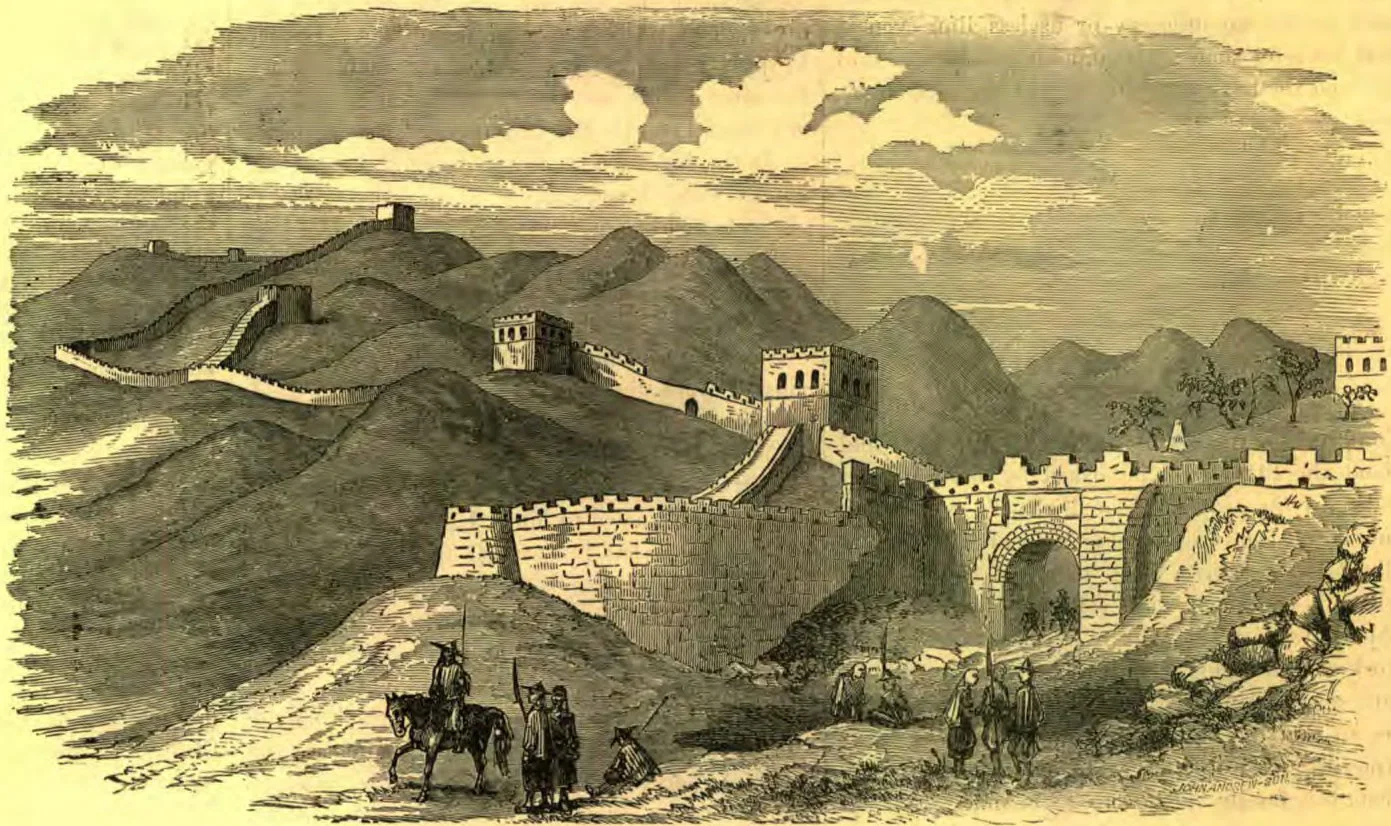
This famous wall is, next to the pyramids, the oldest piece of man’s workmanship on the earth, and was at one time regarded as among the wonders of the world. The wall extends along the whole northern border of the Chinese Empire, and was built by the first emperor of the Tsin dynasty, to protect the empire against the invasions of the fierce Tartar tribes. It was completed more than two hundred years before Christ, and for some time proved a useful defense against the invaders. The length of this great barrier is variously given as from twelve to fifteen hundred miles. The average height of the wall is about twenty feet, its thickness at the base twenty-five, and at the top, fifteen feet, or broad enough for six horsemen to ride abreast. On the top of the wall, about one hundred yards apart, are towers, or bastions, which rise some forty-five feet. The body of the wall itself is made of earth inclosed between walls of brick, and during quite a portion of the length, it is said to be little else than a heap of gravel and rubbish.
The building of this immense wall, as may well be imagined, was a long and difficult undertaking. The way which the emperor took to obtain enough workmen for so great an enterprise, seems very cruel. He ordered that every third laboring man throughout the empire should be compelled to enter his service; and they were made to labor like slaves, receiving no pay except a scanty supply of food. The wall was carried over the tops of the highest hills, descended into the deepest valleys, crossed upon arches over rivers; and in important places it was built double. Our picture gives quite a good idea of how all this was done. One of the most elevated ridges crossed by the wall is five thousand feet above the level of the sea.
As we read about this and other great works of man, and think of the patience, perseverance, and hard toil given to them, this thought naturally comes to mind: If we would but bestow the same strength of purpose and labor in putting away our bad habits, what pure, strong, and enduring characters we might develop! E. B.

“THE WAY TO WEALTH.”

In a recent sketch of the life of Benjamin Franklin, the readers of the INSTRUCTOR were told about the little book published by this man, and called by the people “Poor Richard’s Almanac”; and how, after visiting thousands of homes annually for twenty-five years, many of the maxims which it contained were collected into one pamphlet entitled “The Way to Wealth.” This little work was so highly prized that it was translated into several languages, and many of its sayings are to this day quoted as proverbs throughout America and Europe. Probably most of the INSTRUCTOR family care more to become good and useful, than to become wealthy; but some of these maxims will, if heeded, help them just as much as they will those who care mostly for the good of this life. Hence we will write out a few of them.
Concerning industry he says: “He that riseth late must trot all day, and shall scarce overtake his business at night, while laziness travels so slowly that poverty soon overtakes him;” and again,
“Early to bed, and early to rise, Makes a man healthy, wealthy, and wise.”
He says further: “Diligence is the mother of good luck; then plow deep while sluggards sleep, and you will have corn to sell and to keep. If you were a servant, would you not be ashamed that a good master should catch you idle? Are you then your own master? be ashamed to catch yourself idle. It is true there is much to be done, and perhaps you are weak-handed; but stick to it steadily, and you will see great effects; for continual dropping wears away stones, and light strokes fell great oaks.”
He further says: “If you would have your business done, go; if not, send; for—
He that by the plow would thrive, Himself must either hold or drive.
The eye of the master will do more than both his hands. Want of care does us more hurt than want of knowledge. If you would have a faithful servant, and one that you like, serve yourself.”
Concerning frugality he says: “Think of saving as well as of getting. Beware of little expenses; a small leak will sink a large ship. Buy what thou hast no need of, and ere long thou shalt sell thy necessaries. Silk and satins, scarlet and velvets, put out the kitchen fire. Pride is as loud a beggar as Want, and a great deal more saucy. When you have bought one fine thing, you must buy ten more, that your appearance may be all of a piece. It is easier to suppress the first desire than to satisfy all that follow it. And it is as truly folly for the poor to ape the rich, as for the frog to swell in order to equal the ox.
Vessels large may venture more, But little boats should keep near shore.
“Experience keeps a dear school; but fools will learn in no other, and scarce in that. They that will not be counseled, cannot be helped. If you will not hear Reason, she will surely rap your knuckles.” C. H. G.

SCENES IN THE LIFE OF CHRIST.

LESSON 60.—THE SEVENTY SENT FORTH.

At this time our Lord chose seventy of his disciples to go out and preach to the people. He sent them forth two and two into every city and place whither he intended in a short time to go himself. He said, “The harvest truly is great, but the laborers are few; pray ye therefore the Lord of the harvest that he would send forth laborers into his harvest.” By this figure he meant to teach that there were many people who were ready to receive the truth and obey it, just as the ripened grain is ready to be harvested; and that there were but few who could go out and preach his gospel, thus gathering souls into the kingdom of God just as laborers gather in the grain.
Again he said, “Go your ways; behold, I send you forth as lambs among wolves.” His disciples were to be gentle and peaceable as lambs; but among the people where they went, they would find enemies who would be as fierce and cruel as wolves. He told them to carry neither purse, nor scrip, nor shoes; and to salute no man by the way. They were not to carry money, because they were to get their living among the people where they preached. Perhaps by going to the homes of the people they would become better acquainted with them, and so be more likely to convert them. It was now only about six months before our Lord was to be crucified, and it was necessary that everything should be done as speedily as possible. The time for these disciples to preach was so short that they would need no clothes but what they had on. So they were not to be delayed by making preparations, or by carrying any burden, such as a scrip, or even an extra pair of shoes. Neither were they to be hindered by saluting people by the way. He probably did not mean to forbid their speaking politely to those whom they met, but merely to teach them that their business was so urgent that it would not be proper for them to go through the long ceremony of a formal salutation in the East.
Wherever these disciples went, they were not only to preach the good news of salvation through Christ, but they were also to heal the sick among those who would receive them. When they were rejected in any city, they were to go to another; but Jesus said it would be more tolerable in the day of Judgment for Sodom than it would be for the cities that rejected the preaching of these disciples. He then referred to some of the cities that had been so favored with his own teaching and miracles, and said, “Woe unto thee, Chorazin! woe unto thee, Bethsaida! for if the mighty works had been done in Tyre and Sidon, which have been done in you, they had a great while ago repented, sitting in sackcloth and ashes. But I say unto you, It shall be more tolerable for Tyre and Sidon at the day of Judgment than for you. And thou Capernaum, which art exalted to heaven, shalt be brought down to hell; for if the mighty works which have been done in thee had been done in Sodom, it would have remained until this day. But I say unto you that it shall be more tolerable for the land of Sodom in the day of Judgment than for thee.”
Then speaking to the disciples, he said, “He that heareth you heareth me, and he that despiseth you despiseth me, and he that despiseth me despiseth him that sent me.”

QUESTIONS.

1. For what purpose did our Lord select seventy of his disciples? Luke 10: 1.
2. How did he send them forth?
3. Whither did he send them?
4. What did he say about the harvest?
5. What did he mean by saying that the harvest was great?
6. What did he mean by saying that the laborers were few?
7. What did he ask his disciples to pray for?
8. What did he say to them about the dangers and difficulties they would meet?
9. Explain the figure.
10. How did he intimate that they ought to start immediately, and make haste on their journey?
11. Why was it not necessary for them to take money?
12. Why might it be better for them to get their living among the people where they preached?
13. Why was it necessary to do everything as speedily as possible at this time?
14. Why was it unnecessary for them to be burdened by carrying a scrip, or shoes, or anything of that kind?
15. How were they to avoid being hindered by those whom they might meet on the way?
16. Do you think our Lord meant to forbid their greeting people in any way?
17. Why, then, was the caution necessary?
18. What were these disciples to do wherever they went?
19. What were they to do when they were rejected in any city?
20. What did Jesus say about the cities that should reject their preaching?
21. To what cities did he then refer?
22. What did he say about Chorazin and Bethsaida? Matt. 11 : 21.
23. What mighty works had been done in these cities?
24. What did he say about Capernaum?
25. What mighty works had been done in Capernaum?
26. What did he then say to his disciples? Luke 10 : 16.

“A PLEASANT GIRL.”

A TRAVELER in Norway last summer came to a village early one morning, and was struck by the air of gloom which pervaded the streets. Unable to speak a word of the language, he could not ask the cause of this, and concluded that some sickness or financial trouble had fallen upon the community.
As the day wore on toward noon, however, the houses were closed, shop windows were covered; all trade and business ceased. It was death, then.
Presently he saw the people gathering for the funeral. There were the village official, the nobleman from the neighboring chateau, and apparently every man, woman, and child in the village. It must be some dignitary of the church who is dead, or some other country official.
As he stood watching the crowds passing down the little, rocky street, he caught sight of the face of a German known to him. He beckoned to him.
“The town has lost a great man, apparently?”
“Ah, no. It is only a young maiden who is dead. No. She was not beautiful nor rich. But, oh, such a pleasant girl, monsieur. All the world seems darker, now that she is dead.”
It is a singular fact that when we reach middle life, and look back, it is not the beautiful, nor the brilliant, nor the famous people whom we have known that we remember with the keenest regret, but some simple, sincere, “pleasant” soul, whom we treated as an everyday matter while she was with us.
Go into a family or social circle, or even into a ball-room, and the woman who has the most friends there, as a rule, is not the belle, nor the wit, nor the heiress, nor the beauty; but some homely, charming little body, whose fine tact and warm heart never allow her to say the wrong word in the wrong place.
The “pleasant women” are the attraction that everywhere holds society and homes together. Any woman, however poor and ugly, may be one of them; but she must first be candid, honorable, unselfish, and loving. If she is this, the world will be happier and better for every day of her life, and as in the case of this poor Norwegian, it will seem darker when she is dead.—Evangelist.

Advice on Making Corrections Courteously

Do not contradict. In making a correction say, I beg your pardon, but I had an impression it was so and so. Be careful in your corrections, as you may be wrong yourself.

Doing One's Best, However Little

He who always does his best, however little, is distinguished from him who does nothing.

TWO IMPORTANT PARABLES.

Both parables given in the above lesson relate to the use and value of property. The first shows how we may use worldly wealth so as to secure eternal good. The second teaches that with abundance of riches, without God’s acceptance, a man will be lost forever; while he may be in utter destitution in this world, and if true to God, have eternal life in the world to come. Hence it is better to be poor with the favor of God, than rich without it. In the first parable (verses 1-7) the unfaithful steward found he was about to be deprived of his position and salary. As he still had legal control of the property, he shrewdly used this power to provide himself with future support. The owner, though unjustly treated, admired his sagacity. Christ then draws most important lessons from the parable. Worldlings show more wisdom in the use of means for temporal objects, than Christians do to secure eternal good. In verse 9, he instructs us that it is our privilege and duty to make our property a means by which we may secure future and everlasting life. Verses 10 and 11 teach us that God places worldly wealth in our hands as a test, that we may show whether we are faithful or unfaithful, as a man who thinks to give his son a great fortune, first places in his hands a small sum to see what use he will make of it. If he should put the small sum to a bad use, he would not dare to intrust him with a far greater sum. So God places worldly good in our hands. If we use it for high and noble purposes, he will give us eternal riches, but if for low and selfish objects, he will not intrust us with the life to come. Verse 12 proves that earthly means are not ours. We are but stewards of the Lord, and must give account to him. If we use his means faithfully and please him, he will freely give us a rich and noble portion to be our own eternally. How dare men to use and abuse God’s means as they do?
Verses 19-31 contain the parable of the rich and the poor man. In verse 14, it is stated that the covetous Pharisees derided Christ because of his cutting words relative to unjust gain. They believed if men were rich in this world, that it was an evidence of God’s special favor, and vice versa; hence the rich would have God’s favor in the world to come because he gave them such tokens of it here. They also believed that he had little regard for the poor. In this parable he draws the greatest possible contrast between the rich and the poor. Lazarus, a beggar in the deepest affliction, with no friend but the dumb brute; the rich man rolling in wealth, with all that heart could wish. Wholly selfish, he had no regard for the poor beggar at his gate. Probation closes, and the scene changes. Are the views of these covetous Pharisees correct concerning the future state? Is the rich man still to be the favored one? Ah, no! He must go into the torments of the damned, while the poor sufferer goes to a place of bliss. He had been true to God in the deepest affliction. The rich man had been unfaithful in the use of the means entrusted to him. Worldly wealth can save none of us, unless used for noble objects. Verse 25 teaches the solemn truth that riches used for selfish purposes, only add to our anguish in the day of wrath. This parable should greatly encourage the Christian, struggling with poverty, and alarm the rich sinner. Many pervert this parable, and try to sustain from it the false doctrine of consciousness in death. We may draw important moral lessons from parables, but they are not designed to teach religious doctrines. These must be sustained by plain, clear statements, in order to be a proper foundation for our faith. Figurative language is hardly sufficient, unless explained by inspired testimony. The dead are unconscious. They sleep in the grave till the resurrection. Job. 14; Psa. 146: 3, 4; Eccl. 9: 3-10; Isa. 38: 9-19; 1 Cor. 15. This parable of the rich man and beggar does not contradict these plain scriptures, and many others of similar import. How, then, is the rich man represented as speaking and suffering? On the well-known principle of many other parables which attribute power of speech even to inanimate objects, to teach moral lessons. Gen. 4: 10; Judges 9: 7-15; Hab. 2: 11; Isa. 14: 4-17; Eze. 32: 17-31. The rich man was buried. In Hades he lifted up his eyes. This is the grave, not the place of torment. The torment will be real finally, when he shall again be made conscious in the second resurrection. The parable will be substantially true. But it would be folly to make out of this a literal history. How could a spirit without body or parts, if such a thing there be, have a tongue to be cooled with literal water? Could heaven and hell be within speaking distance, and friends talk back and forth, one pleading with the other for help? How could heaven then be a happy place? This is a parable, and simply teaches the great moral lesson above stated, showing the worthlessness of riches without virtue; the certainty of punishment for a life of selfishness, however rich we may be; and the certainty of bliss to the truly good, however poor they may be.
G. I. B.

NEW-TESTAMENT HISTORY.

LESSON 73.—THE UNJUST STEWARD; DIVES AND LAZARUS.

“And he said also unto his disciples, There was a certain rich man, which had a steward; and the same was accused unto him that he had wasted his goods. And he called him, and said unto him, How is it that I hear this of thee? give an account of thy stewardship; for thou mayest be no longer steward. Then the steward said within himself, What shall I do? for my lord taketh away from me the stewardship: I cannot dig; to beg I am ashamed. I am resolved what to do, that, when I am put out of the stewardship, they may receive me into their houses. So he called every one of his lord’s debtors unto him, and said unto the first, How much owest thou unto my lord? And he said, An hundred measures of oil. And he said unto him, Take thy bill, and sit down quickly, and write fifty. Then said he to another, And how much owest thou? And he said, An hundred measures of wheat. And he said unto him, Take thy bill, and write fourscore. And the lord commended the unjust steward, because he had done wisely; for the children of this world are in their generation wiser than the children of light. And I say unto you, Make to yourselves friends of the mammon of unrighteousness; that, when ye fail, they may receive you into everlasting habitations. He that is faithful in that which is least is faithful also in much; and he that is unjust in the least is unjust also in much. If therefore ye have not been faithful in the unrighteous mammon, who will commit to your trust the true riches? And if ye have not been faithful in that which is another man’s, who shall give you that which is your own?
“No servant can serve two masters; for either he will hate the one, and love the other; or else he will hold to the one, and despise the other. Ye cannot serve God and mammon. And the Pharisees also, who were covetous, heard all these things; and they derided him. And he said unto them, Ye are they which justify yourselves before men; but God knoweth your hearts, for that which is highly esteemed among men is abomination in the sight of God.” “There was a certain rich man, who was clothed in purple and fine linen, and fared sumptuously every day; and there was a certain beggar named Lazarus, who was laid at his gate, full of sores. And desiring to be fed with the crumbs which fell from the rich man’s table; moreover the dogs came and licked his sores. And it came to pass, that the beggar died, and was carried by the angels into Abraham’s bosom; the rich man also died, and was buried; and in hell he lifted up his eyes, being in torments, and seeth Abraham afar off, and Lazarus in his bosom. And he cried and said, Father Abraham, have mercy on me, and send Lazarus, that he may dip the tip of his finger in water, and cool my tongue; for I am tormented in this flame. But Abraham said, Son, remember that thou in thy lifetime receivedst thy good things, and likewise Lazarus evil things, but now he is comforted, and thou art tormented. And besides all this, between us and you there is a great gulf fixed; so that they which would pass from hence to you cannot; neither can they pass to us, that would come from thence. Then he said, I pray thee therefore, father, that thou wouldst send him to my father’s house; for I have five brethren; that he may testify unto them, lest they also come into this place of torment. Abraham saith unto him, They have Moses and the prophets; let them hear them. And he said, Nay, father Abraham; but if one went unto them from the dead, they will repent. And he said unto him, If they hear not Moses and the prophets, neither will they be persuaded, though one rose from the dead.”

QUESTIONS.

1. What accusation did a certain rich man bring against his steward? Luke 16: 1.
2. What did the steward say within himself, when he was thus accused?
3. What did he do?
4. Why did he take such a course?
5. How did the rich man regard the course of the unjust steward?
6. What lesson may be learned from this parable?
7. What advice did Jesus give to his disciples? Verse 9.
8. What remarks did he make on faithfulness?
9. What about serving two masters?
10. How did he apply this last remark?
11. How did the Pharisees receive these sayings?
12. What reproof did Jesus then give them?
Verse 15.
13. Describe the rich man and Lazarus as introduced in the parable beginning with the nineteenth verse.
14. What is said of their condition after death? Verses 22, 23.
15. What did the rich man say when he saw Lazarus in Abraham’s bosom?
16. What is the first reason given for not granting this request? Verse 25.
17. What is the second? Verse 26.
18. How did the rich man then show his anxiety for his friends?
19. How was this petition answered?
20. What plea did the man then make?
21. What reply was made to this plea?
22. What proof can you give that this narrative is not a literal description, but a parable designed to teach important truths?
23. What practical lessons are to be learned from it?

NOTES.

The mammon of unrighteousness.—Mammon is a Syriac word meaning riches. It is also used as meaning an idol, the god of riches. These words are a Hebrew expression for unrighteous mammon. It here stands opposed to the “true riches” in the 11th verse. Unrighteous here means deceitful, false, not to be trusted. It does not necessarily signify that the property is obtained unjustly, but that riches in themselves are deceitful, and not to be trusted.
When ye fail.—When ye are left, or when ye die. The expression is derived from the parable as referring to the discharge of the steward, but it here refers to death, as if God then discharged his people, or took them from their stewardship and called them to account.—Barnes.
They may receive you into everlasting habitations.—This is a form of expression denoting merely, that you may be received. The plural form (they) is used merely because it was used in the corresponding place in the parable, verse 4. Everlasting habitations.—Heaven, the eternal home of the righteous, where all our wants will be supplied, and where there can be no more anxiety, and no more removal from enjoyments. 2 Cor. 5: 1.—Ibid.

THE INVENTION OF THE TELESCOPE.

Nearly three hundred years ago there lived in the town of Middleburg, on the island of Walcheren, in the Netherlands, a poor optician, named Hans Lippershiem. One day in the year 1608, he was working in his shop, while his children amused themselves with the tools and other things lying on his bench. Suddenly his little girl exclaimed, “O papa! see how near the steeple comes.”
This announcement partially startled the honest Hans, who looked up from his work, curious to know what had caused the child’s amazement. Turning in the direction where she stood, he saw her looking through two lenses, one close to her eye, the other held at arm’s length. He called the child to him, and saw that the eye lense was flat on one side and hollowed out on the other, while the one held at a distance was flat on one side and bulging on the other. By repeating the experiment, he soon discovered that she had chanced to hold the lenses at the exact focus to produce the wonderful effect which she had observed.
Hans’s ready wit and inventive genius soon led him to make use of his newly found knowledge of lenses. Having fashioned a paste-board tube in which to set the glasses firmly at their exact focus, he held in his hand the germ of that wonderful instrument,—the telescope. After some more experiments, Lippershiem sent to his government three telescopes made by himself, and called by him “instruments by means of which to see to a great distance.”
Thus, by mere accident, was made an important discovery, by the aid of which modern science has been enabled to solve many of the great mysteries of creation.
R. B. W.

TWO GENTLEMEN.

I saw two young gentlemen on a street-car to-day. One of them was grown up. He was handsomely dressed in a gray business suit, and had very neat kid gloves and fine boots. The other was about twelve years old. His jacket had several patches, and needed more, and his shirt was of brown cotton, and not very clean. Do you wonder how I knew he was a gentleman? I will tell you.
The boy went through the car to give some message to the driver. As he returned, he gave a little jump through the door, and as he did so, his bare foot touched the grown gentleman’s knee, and left a little mud on it. Turning around on the platform, he raised his straw hat, and said very politely, in a clear tone, “Please excuse me.” Then the other gentleman bowed in his turn—just as he would have done to one of his own age—and said, with a pleasant smile, “Certainly.”
The Iroquois Indians, many of whom are fine gentlemen, say sometimes of a rude person, “His mother did not teach him manners when he was young.” I am inclined to think that the mothers of both these young gentlemen had taken a good deal of pains with their manners, because their politeness came so naturally and easily.

A CONSCIENTIOUS CHILD.

Who does not love conscientious boys and girls? I am sure they are beloved of God and of angels. A little boy once anxiously asked, “Don’t the Bible say anything about children?” It certainly does, and we are thankful for it, too. In Mark 10: 13–16, we learn that little children were brought unto the Saviour, that he might bless them. Of them he said: “Suffer little children to come unto me, and forbid them not; for of such is the kingdom of God.” “And he took them up in his arms, put his hands upon them, and blessed them.”
And the Bible says too: “Even a child is known by his doings, whether his work be pure, and whether it be right.” Prov. 20: 11. Now we hope the little children will think of these things, and ever try to do what is right.
But I wanted to say a word about a conscientious little boy whom I know. He kept the Sabbath with his mother and younger brothers. When he could earn a few pennies or received any money, he was strict to tithe it, or give a tenth to the Lord. Things which he could have bought with his money, had he not tithed it, he would deny himself of till he could get more, not allowing himself to borrow his tithes to use.
This boy belongs to the INSTRUCTOR family, and on one occasion he commenced a letter for the “Budget.” When it was partly finished, he began to reason about his feelings, words, and ways, like this: Now do I live as well as my letter would seem to imply? Is my life what one might infer from what I write?
And here he laid aside his pen to further consider these questions. Dear boy! I hope he has as good or better a conscience to-day, and that he is serving God, remembering his Creator in the days of his youth; for, since the time referred to, he has been baptized and joined the church.
Now allow me to ask: Will each one of the children who may read these lines, aim to cultivate and to preserve a good and pure conscience by always doing right, and by bearing in mind at all times, “Thou God seest me”?
It may help your good resolutions to commit to memory the following verses:—
“I’m not too young for God to see: He knows my name and nature too; And all the day he looks at me, And sees my actions through and through.
“He listens to the words I say, He knows the thoughts I have within; And whether I’m at work or play, He’s sure to know it if I sin.
“So when I want to do amiss, However pleasing it may be, I’ll always strive to think of this— I’m not too young for God to see.”
A. S. HUTCHINS.

Letter Budget.

Christa Pelon writes from Palermo, Oswego Co., New York. She says: “I have never seen any letters in the ‘Budget’ from this place, and I have wanted to write for a long time. We have taken the paper for about eight months, and we all think it is the best child’s paper we have ever seen. We keep the seventh-day Sabbath. I have two sisters; their names are Dora and Celia. We do not go to Sabbath-school, for it is too far for us to go. Please print this, for papa does not know I am writing it, and I want to surprise him. I am trying to be good, and hope to meet the INSTRUCTOR family in Heaven.”
Olive M. James writes from Fruitport, Mich. She says: “When I wrote to you before, I said I would write again soon, but it has been a long time since then. I have a little baby brother, who takes most of my time. He is such a nice baby. I do not go to school, for it is so far, but we study at home. It would be lonesome here sometimes on the Sabbath, if I did not have the INSTRUCTOR, and mamma the Signs. I send my best wishes to the INSTRUCTOR family, and hope they will all remember to pray for me, with the others.”
Nellie E. Clark sends us a neatly written letter from Los Angeles, California. She says: “I have been taking the INSTRUCTOR nearly two years, and like it very much. Mamma and I go to Sabbath-school. She has kept the Sabbath for fourteen years, but papa does not keep it. I am eight years old. I am trying to be a good girl, that I may be ready to meet the Lord when he comes.”

Guarding Against a Hasty Temper

Fight hard against a hasty temper. Anger will come, but resist it stoutly. A spark may set a house on fire. A fit of passion may give you cause to mourn all the days of your life.

Chains of Habit: Breaking Them Early

It was Johnson who said: “The diminutive chains of habit are seldom heavy enough to be felt until they are too strong to be broken.”

THE OLD SUGAR CAMP.

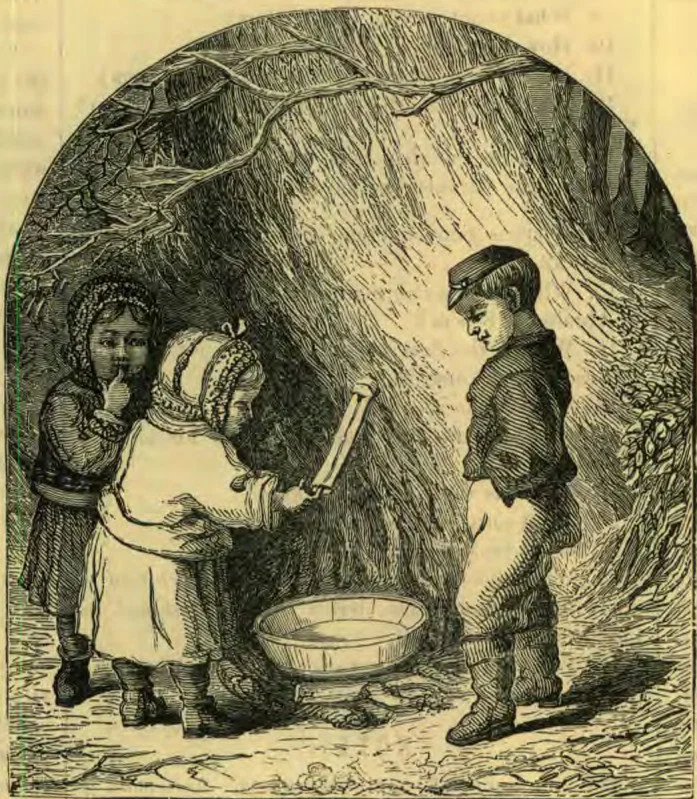
COME, let us away to the old Sugar Camp; The sky is serene, though the ground may be damp; And the bright little streams, as they frolic and run, Turn a look full of thanks to the ice-melting sun; While the warm southern winds, wherever they go, Leave patches of brown ’mid the glittering snow.
The oxen are ready, and Carlo and Tray Are watching us, ready to be on the way, While a group of gay children, with platter and spoon, And faces as bright as the roses of June, O’er fences and ditches exultingly spring, Light-hearted and careless as birds on the wing.
Our cheeks all aglow with the long morning tramp, We soon come in sight of the old Sugar Camp; The syrup already is placed in the pan, And we gather around it as many as can,— We try it on snow; when we find it is done, We fill up a mold for a dear absent one. —Selected.

You have reached the end of this edition.

The Youth’s Instructor · Mar 15, 1882