The Youth’s Instructor, Vol. 65, No. 50.

Purification and Analysis of Water

The Youth’s Instructor

Dec 11, 1917

Review and Herald Publishing Assn. · Takoma Park Station, Washington, D. C. · Dec 11, 1917

Purification and Analysis of Water

WATER is one of the most familiar of chemical substances. Besides covering more than three fourths of the earth’s surface, it enters into the composition of organic matter. Without it animal life is impossible. It is therefore of the greatest importance that we should be able to ascertain the purity of the water we use and know how to purify it.
Water in nature holds many substances. Rain water, though considered the purest, on heating gives air bubbles and ammonium nitrate, besides the dust mixed with it. In well waters we find compounds of calcium and magnesium, iron, bicarbonates, and carbon dioxide. It often contains organic matter from decomposing organic matter teeming with bacteria of putrefaction.
Impurities of water may be divided into two classes,—dissolved and suspended matter. Absolutely pure water cannot exist on account of the great solvent action of water. Even glass dissolves in water to a noticeable extent. Suspended matter can be removed by filtration. The tiny pores of an undersized paper let the liquid go through, but retain the solid matter. Gravel beds are used on a larger scale. Porcelain filters may be had for family use. Dissolved substances may be conveniently removed by distillation and condensation in cold platinum or tin pipes.
To determine the total amount of solids in water, evaporate about 500 cubic centimeters of the water in a weighed platinum or porcelain dish. The water should not be boiled, because some of the solids may be volatile. A double-boiler water bath is the best. When about dry, the dish is transferred to a hot-air oven of 100° F. After half an hour the water will have entirely disappeared. The dish and its contents are then weighed. The increase in weight is the amount of total solids found. The dish may now be held over a strong flame. If it chars and blackens, organic matter must be present. Water containing enough organic matter to cause this charring is unfit for drinking.
When water contains certain salts, it is called “hard.” On adding soap, these salts combine with the fatty acid of the soap, and produce an insoluble, dirty-looking precipitate. If the water contains only bicarbonates, the hardness is said to be temporary. Simple boiling will change the soluble bicarbonate to insoluble carbonates. The water is thus softened. Sulphates or chlorides do not precipitate on boiling, hence water containing them is said to be permanently hard. The usual way to indicate the amount of hardness is to note the quantity of a standard soap solution necessary to produce a permanent lather. Good potable waters show no permanent hardness and very little temporary hardness.
(Concluded on page eight)
(Concluded from page two)
Chlorine will reach water generally through sewage. It is therefore important to know the amount of chlorine present. To detect chlorine, add a few drops of silver nitrate solution. A cloudy precipitate of silver chloride will be formed which will in time darken. To find the amount of chlorine, titration is used, the amount of silver nitrate used to precipitate all the chlorine present determining the amount of chlorine in the water.
Nitrates are formed from nitrogen coming usually from the oxidation of organic matter. Though harmless in themselves, they indicate contamination with organic matter. A delicate test is to dry some of the water to be tested, then add a few drops of phenol-sulphonic acid. After being neutralized with ammonia, the nitrates present will form a yellow precipitate of ammonium picrate.
The presence of nitrates is still more dangerous, because it indicates recent contamination with nitrogenous matter. Its presence is to be determined by acidulating the water and adding a solution of a mixture of aniline sulphonic acid and α-naphthylamine hydrochloride. A pink color will develop with nitrites.
Water always contains some ammonia. A slight amount is not only harmless but even healthful. A larger amount, however, is deleterious. Very minute traces of ammonia can be detected by adding Nessler’s Reagent. A dark brown indicates ammonia.
It is often hard to interpret the results of an analysis. This is due to the fact that many of the substances found are harmless in themselves, and only indicate danger of contamination from their source. The best way is to compare the sample with the normal character of the waters of the region. Any deviation from this should arouse suspicion.
NOAH BAHARIAN.

New Chemical Fly Preventive Used in New York

A new preventive for flies has been put in use in New York by sprinkling the breeding places with a chemical which destroys the egg. Elsie Gibbs.
The city of Cleveland now has a law which requires that when a resident moves he or she must file a report of the change of address with the police.
A large structural steel and bridge company adopted a time dial which shows the number of hours of work done. Zero is at 7 A. M., the start of the day’s work; No. 5 at 12 M. and 1 P. M., the lunch hour; and No. 10 at 6 P. M., the end of the day’s work. A single hand is used, and the hours are divided decimally, simplifying time keeping on the various jobs. Lora Loomis.
New York’s timepiece, St. Paul’s clock, is silent after one hundred and nineteen years of faithful service. It is powerless to tell the time to rushing Broadway; but it will remain an honored guest. It will stand there like a black iron four-poster, bolted to the old hand-hewn beams, to muse another century, if time lasts, on the life of the country. Margaret Jenkins.
The state of war between our country and Germany has not ended the activities of many Christians in America who, through a Swedish committee, are distributing large quantities of Bibles and religious literature among the Russian and Austrian prisoners. Religious societies, from twenty to two hundred in number, have been organized in some of the detention camps in Germany, and the results are in a measure due to the distribution of literature. J. Phillips.
It took two Wisconsin men to solve the problem of inventing a machine to count the number of eggs a hen lays. The mechanism fastens on the hen, and counts the eggs as fast as she cares to put them in the nest. It is worked on the principle of a fare indicator on a street car. Each time a hen lays an egg it is registered, so that the owner can go out and tell exactly which hens are the ones that are doing the work.
One of the latest inventions in bullet-proof armor is that of Dr. Guy Otis Brewster, of Dover, New Jersey. This shield is designed to cover the head and body, and the total weight of the armor is thirty pounds. It is built in a V-section front to present an inclined surface which causes the bullets to strike at an angle. In a recent test Dr. Brewster donned his armor and stood sixty feet in front of an army sharpshooter, who shot at him with a Springfield .30 army rifle. No harm was done to the inventor. Rolla R. Werline.
Professor Elizabeth Sprague, head of the department of Home Economics at the University of Kansas, has succeeded in perfecting an alfalfa flour which is of inestimable food value for man. When it is mixed with whole-wheat flour in the proportion of one to ten, the protein is increased 20 per cent and the ash over 30 per cent. If added in the same proportion to white flour, the protein is increased 25 per cent and the ash 100 per cent. With cornmeal the protein increases 35 per cent and the ash 50 per cent. The alfalfa flour is simply the dried, ground, and finely powdered leaves of alfalfa hay. It is then treated with solvents to refine it and help eliminate the weedy taste. The high percentage of protein and mineral qualities make it a valuable food product. Martha Doege.

H. A. JOHNSTONE

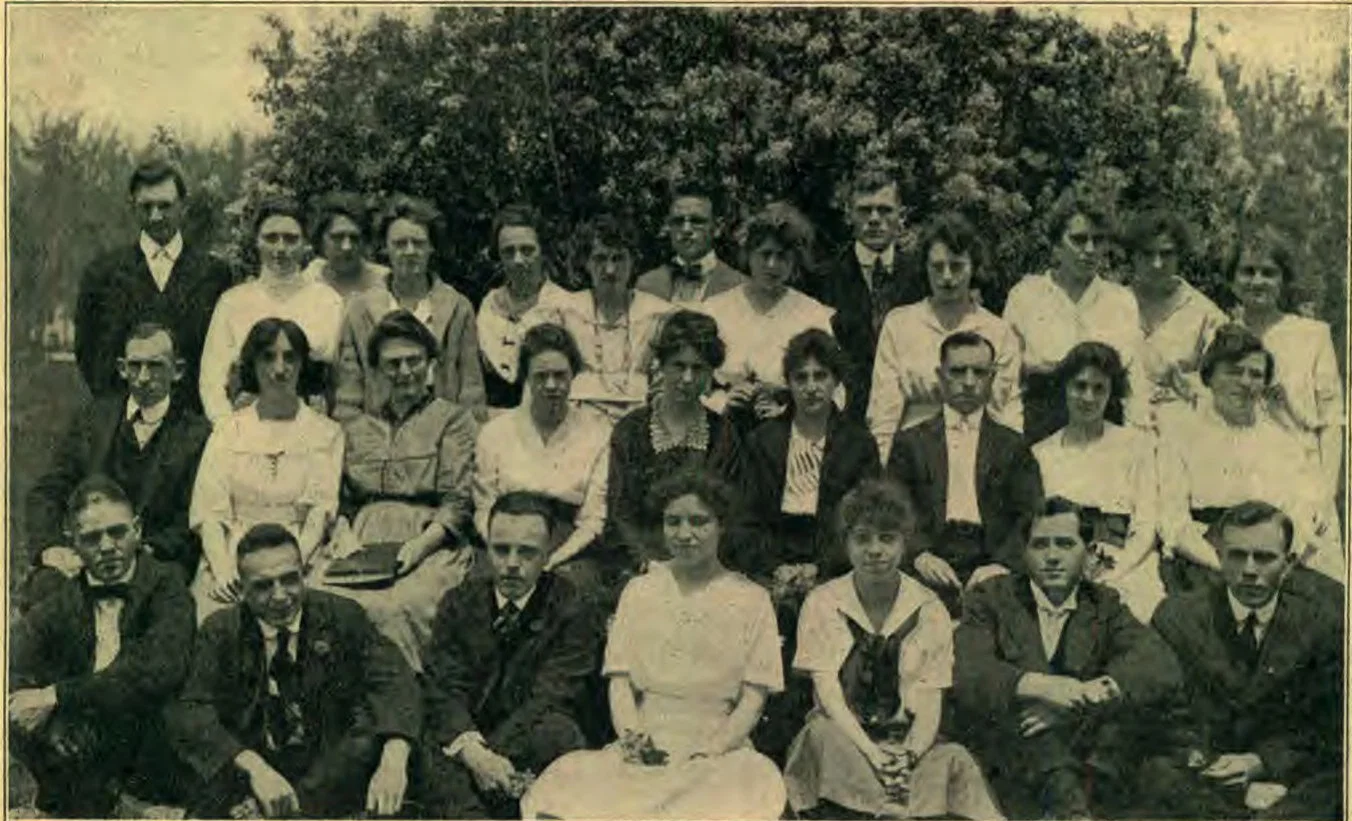
CLASS IN JOURNALISM, UNION COLLEGE

Journalism

H. A. JOHNSTONE

JOURNALISM is the writing and conducting of a journal, newspaper, magazine, or other publication. Journalism is the gathering and presenting of news, and of comment upon the news, of discussion of all that interests, entertains, or instructs. It affords the pictured record and interpretation of human life in every aspect. The journalist is recorder, advocate, buyer, and seller of news; judge, tribunal, teacher, and interpreter. Journalism is in some respects a trade, also a business; but in its highest aspect it is a profession.
The profession of journalism has for its members men and women who do widely different work. It includes reporters, editors, illustrators, special writers, directors, and managers. It includes workers on country newspapers and on city newspapers, on dailies, weeklies, monthlies, and quarterlies. While their duties are widely different in many ways, they have the same common purpose,—to record for the public that which is of public value and interest.
Men write for money, for fame, for dear life; journalists, for all three. He who writes merely for one of these alone, does not achieve the highest professional success. Journalism is a joyful, fascinating service, called by many a grind, involving continuous labor; yet a real journalist never leaves journalism for another vocation.
There is only one kind of real journalism, and that is personal journalism. As one man says, “Journalism that is worth while is personal journalism;” and another, “That which is dominant in real journalism is personality, trained, equipped, experienced.” Journalism in its various branches may properly be divided into four departments: The gathering and preservation of news; the editorial page and policy; the business department; the printing department.
The news is the first essential in the production of a newspaper. The editorial page may be well written and may deal with timely topics in an attractive, convincing way, but the publication will not fill the field of a real newspaper unless it presents the news. Yet a newspaper that is only a newspaper is not in the first sense a newspaper. The department which has to do with the editorial direction and control is the very heart and brain.
There are two legs upon which a publication stands, advertising and circulation. Here, then, journalism is a business.
The printing department is necessary for the production of a paper. The printers carry to completion all the mechanical processes necessary to the issuing of a printed journal. Here journalism becomes a trade.
Much could be said about the style of journalism, but in the last analysis, heart and conscience and manners as well as brain power determine style. Never write anything as a journalist that you would not as a gentleman. The best journalism has conscience in it, and heart, and fine courtesy. It does not wound unnecessarily; it does not cause women to blush. It is never sold to unworthy ends.
For the Seventh-day Adventist youth who feels impelled to use either his pen or his voice in the cause of truth, the study of journalism has many advantages. Through it he can learn to say what he has to say concisely and effectively. He learns how to make every well-edited journal his guide to the hearts and minds of common men and women. Even though he should never be called to the staff of a Seventh-day Adventist periodical, the training in definiteness, conciseness, accuracy, tact, and clever phrasing, provided by his course in journalism, will prepare him for effective presentation of truth in any capacity in which he may labor.

Accuracy in the Use of Quotations

A WOODCHOPPER once said, “I must have an ax that is heavy and sharp, even if it costs me a five-mile walk to borrow one.” Writers have dispositions similar to that woodchopper. If their own words do not carry sufficient weight and are not enough to the point, they go to another and borrow.
The borrowed ax usually bears the owner’s mark or name. So should the borrowed words be marked. The author’s name should follow the direct statements taken from his writings. Also the name and page reference to the book or periodical should be given. But these are not all the marks necessary to be given. Words all look alike to most readers, so far as their authorship is concerned. There must be marks that distinguish the borrowed from the borrower. These are called quotation marks.
Here is a simple rule for the use of quotation marks:
“Use the ordinary double marks to inclose the alternating speeches in a dialogue; also all utterances repeated in the exact language of the original speaker. Where a quotation occurs within a quotation, use the ‘single’ marks to designate it. If you should ever have still a third quotation ‘inside of these “single” marks,’ use double ones again. Where the same speaker continues through more than one paragraph, omit the quotation marks at the end of all paragraphs except the last, but repeat them at the beginning of every paragraph. Be sure not to forget to mark the close of the quotations; this frequent lapse of the literary slattern is extremely annoying to the printer and proof-reader.”—“Practical Journalism,” Edwin L. Sherman, p. 167.
It is a disgraceful deed to borrow a neighbor’s sharp ax and return it with the edge all nicked and dulled. To spoil the edge of a borrowed ax when chopping in moral woods is no less disgraceful. When one writer misquotes another, he alters the edge of the borrowed tool. The effect is the same whether the misquotation is made intentionally, through haste, or by downright carelessness. If the quotation you wish to use must be doctored up before it can serve the purpose, why not leave it alone and doctor up something of your own? What is the use of grinding on your neighbor’s ax when all your own ax needs is to be sharpened?
Once there was a boy who liked to chop with his father’s ax. This ax was always sharp, and it hung perfectly on its helve. While at work one day the father laid his ax down and the boy picked it up and began to chop a limb off the tree that was felled. How he did make the chips fly with that ax! But he was a bit careless and reached too far once, striking the limb with the handle instead of the blade. This blow split and broke the handle off. The father saw at once what was done, and seizing a piece of the broken handle he gave the boy a severe flogging.
That flogging may have been cruel, and again, it may have been what the boy needed. But it must be granted, however, that it is a very great aggravation to have a perfect handle broken out of such a tool.
Now when one writer through any means represents another as saying what he has not said, he virtually breaks the handle out of the ax he has borrowed. If the offense is serious enough, a good sound flogging, figuratively speaking, may be inflicted by law.
Suppose a Protestant clergyman, for instance, should charge a Catholic priest with teaching immoral doctrines; and in citing what the priest had said, should misquote. Then the priest might have recourse to law in defending himself against such public insult and infamy. If the accused in such a case could prove that he never said exactly what he is charged with having said, he could secure action against his accuser, under the law of libel.
The following is an authoritative statement regarding this law:
“Accordingly it may be stated as a general proposition that words written or printed may be libelous and actionable per se, that is, actionable without any allegations of special damages, if they tend to expose plaintiff to public hatred, contempt, ridicule, aversion, or disgrace, and to induce an evil opinion of him in the minds of right-thinking persons and to deprive him of their friendly intercourse and society.”—“Cyclopedia of Law and Procedure,” William Mack editor in chief, Vol. XXV, p. 250.
Truth is a safeguard in exposing wrong. “In civil actions the truth is always a defense, even if the motive is shown to be malicious. The rule is that a man is not entitled to damages for injury to a reputation to which his true character did not entitle him.”—“Practical Journalism,” E. L. Sherman, p. 224.
If we are truthful in using borrowed words, we shall be accurate in quotations. If we are accurate in quotations, such tools will get back to their owners in as good shape as when we borrowed them.
H. F. SAXTON.

H. P. LORENZ

Praise

TODAY my heart is filled with praise To Him who gave his life for me. I would that I my soul could raise, And with him in all ages be.
But while I kneel here at his feet And learn the lessons of his love, It seems to me his eyes I meet, And see his Spirit like a dove.
And as I gaze at him I see A thousand things so pure and clear Which were before a mystery. I want his presence ever near;
For when I turn, there seems to be A world of wickedness and sin,— A dismal cloud which covers me, And hides the light which shines within.
I thank him now for grace and love, The blessings which my soul has sought. For he has left the throne above, And with his blood my life has bought.
I find no words my praise to tell, It is far more than I can say. My Saviour knoweth all things well: Him will I follow day by day.

H. P. LORENZ

The Saviour Comes in the Strength of Righteousness

THE Saviour comes in the strength of righteousness. Righteousness is at the bottom of all things. Righteousness is thorough; it is the very spirit of unsparing truth.—Phillips Brooks.

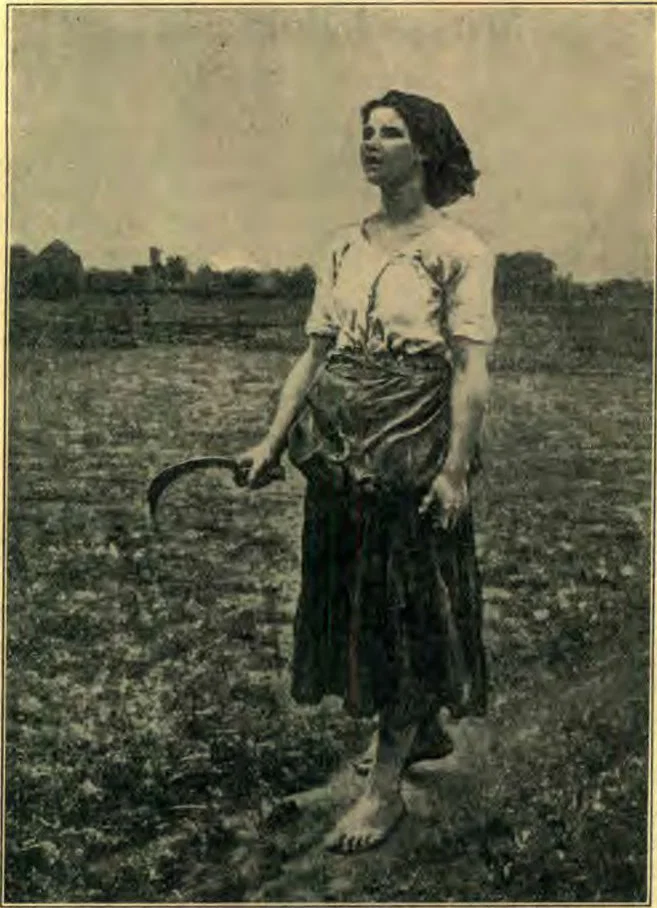
“The Song of the Lark” — Breton

ELSA NORTHRUP WARD
ROBERT BROWNING has said, “We’re made so that we love first when we see them painted, things which we passed perhaps a hundred times nor cared to see.” Surely if we should chance to meet this rude country lass in the field or along the road, we should scarcely care to give her a second glance. Her coarse, ill-fitting garments and her big, rough hands and feet are not likely to attract us as we might be attracted by the prettiness of a graceful, daintily gowned maiden in a pleasant rural landscape. But the artist has shown us something about his uncouth country girl that makes her seem beautiful in spite of her rude exterior. It is the girl’s spirit, her ecstasy (which literally means state of being outside oneself), her unconsciousness of self, and complete absorption in the beauty of the lark’s song—a thing so commonplace that no doubt she has heard it years.
“THE SONG OF THE LARK”—BRETON
The painted, beruffed, becurled town beauty would no doubt scorn this uncouth country lass, as well as the simple song with which she is so enraptured. With other cheap souls she would probably say, “I’ve heard that song before; let’s have something new.” But the country girl has no such superficial notions of taste or conventionality. Her artistic soul is more stirred and thrilled by the lark’s song every time she hears it. She stands transfixed with strained attention, with bated breath, heel raised in arrested motion, arms and hands tense, as if loath to miss a tone or a trill. Although so young, she has discovered one of the greatest joys of life,—the ability to find beauty and pleasure in common things, a gift that, in the words of Lucy Larcom,
“A mine of gold could not buy: Something the soul of a man to lift From the tiresome earth and make him see How beautiful common things can be; How heaven may be glimpsed through a wayside tree.”
This gift, if developed and cultivated, will fill her toilsome life with happiness and crown her old age with the joys of the spirit that “fade not away;” for, as Keats has beautifully expressed it,
“A thing of beauty is a joy forever: Its loveliness increaseth, It shall never pass into nothingness.”
Aristotle many years ago spoke of the enduring quality of esthetic pleasures. He pointed out that in the enjoyment of them we do not destroy or consume them, as is the case with physical pleasures. To enjoy a luscious peach you must consume and destroy it. If you share it with another, your own enjoyment is decreased. If you indulge too often, your appetite is satiated and you cease to enjoy. The older you grow the less keen is your enjoyment of the pleasures of appetite. Not so with esthetic pleasures, which grow by the using, and increase in inverse proportion to the decrease of the physical appetites. The more often we hear or see a truly beautiful work of art, the more we share with others the spiritual pleasures derived from it, the more delight we shall find in it ourselves. And the more the physical pleasures become dulled with age, the keener will be the joys of the spirit if the sensibilities of the soul have been attuned to the appreciation of them.
Even if our artist never intended to teach such a deep philosophy of life as the old Greek scholar formulated, he has at least painted for us a very charming and interesting scene from a very simple and commonplace subject. The broad expanse of field and effect of atmosphere in the picture are fine. Early morning is suggested not only by the rising sun just peeping above the distant tree tops, but by the dewy mists of the humid morning atmosphere and the caroling birds that may be dimly discerned in the distant sky.

Peace

THE willows glimmer in the sun, The aspens tremble on the breeze, The singing ripples gently run Within the shadows of the trees.
The quiet, meditative kine, The steady granite in the wall — What peace, contenting and benign, Enfolds and crystallizes all!
Rebuked, ashamed, the faithless fret, The childish worry, fall away; My empty fear and vain regret Dissolve in God’s assuring day.
If peace on earth so fair and sweet Is gladly, freely, fully given, What joy some day our souls will greet.— The unimagined peace of heaven!
— Amos R. Wells.

Marks of Efficiency

JOSEPH PHILLIPS
Much is said today of the gospel of labor. More needs to be said to show the dignity of labor. Some one has said, “The gospel can be preached by the hoe handle.” In an accommodated sense this is true, and there are many occupations which can be made to produce elevated results. What the world needs today is people who are not afraid of work; who are willing to work for pay, but who work not merely for the pay received. There is nothing humiliating about working for pay. The main thing is to give an honest equivalent for what you receive. Take no man’s money for which you have not rendered a full return; and if you happen to give a little more than you get, in that should be your happiness. Don’t be a sponge or a parasite.

Putting in Overtime Without Thinking of the Watch

There are some who cannot work overtime with any degree of pleasure. They will be seen to pull out their watches frequently. Others do not go quite so far; they try to content themselves with thinking of the watch and figuring up the time which they are practically wasting, as they think of it. The usual designation for these persons is time-servers. They have more interest in the time they are putting in and the money they are making than in the work they are doing. Their hearts are not in their work. The service that counts is that which leads to the performance of more than ordinary effort, which causes the doer to take a live interest in his business and to be willing to sacrifice gladly that the part he is caring for may meet with a good share of prosperity. Workmen with this spirit in them are not constantly watching the time, but are giving one hundred per cent on the dollar. It is well to remember that the overtime usually brings the best dividends.

Being Dissatisfied with the Mediocre

A locomotive fireman once said, “I am getting more than one hundred dollars a month, and am satisfied, perfectly satisfied. I know I could get something better, but I guess I’ll just stay by my old job.” Men and women everywhere, who are less communicative and frank, are riding in the cab with the fireman down the road of self-satisfaction. They are content with present attainments, although they well know that greater heights can be reached. They think the mediocre good enough for them. True, to pass the mediocre one has to struggle hard. But greater heights display loftier sights and the struggle alone brings additional strength. “Be satisfied with nothing but your best” is worth adopting as a motto. Many an advantage has been lost on the field of battle by resting at the point of seeming triumph. Don’t stop doing your best rather than the mediocre until the triumph in your battle for supremacy has been completely won.

Learning to Be Systematic

It is often said that order is heaven’s first law. What wonderful systems of order are in evidence in the starry heavens, in the growing plant, and in man’s own organism! It is only through the exercise of system that harmonious action is secured both in animate and inanimate creation. Man has been slow to learn the lesson of systematic work. System must be employed in the proper use of time, so that each waking moment may be filled with that which will be of greatest gain. Work must be planned in advance. Each part of the day should be set apart for a specific task and no other task allowed to interfere; that is, under ordinary circumstances. It is said of Thomas Jefferson that he planned each day’s work before retiring the previous night. Make a system for your endeavor, and follow your system with a bit of red-hot iron in the will. Plan to rise at a certain time each day, and to attack your work in detail in accordance with what remains to be done. Have in your mind each morning an outline of the tasks for the day. The results of such a course bring nothing but rapid development and a degree of satisfaction to the worker.

Having a Reading Course

The reading person becomes a thinking person, and the thinking person generally becomes the active person. Reading and intelligent action go hand in hand, for through reading one comes in touch with the best of thought in every department. “Few men are self-made men,” as some are so wont to call themselves. The truth is, that by far the greatest part of what the average person knows, has been brought to him through communication with his fellow men. But it is in the power of reading to put a person in touch with mankind’s loftiest thought and action. Examine the lives of the most successful individuals in this world today, and you will find that almost invariably they are profound readers. William Gladstone has been looked upon as a prince among statesmen. What of his reading? The “grand old man” took a book with him wherever he went, thus making provision for mind improvement in case the train should be a few minutes late or engagements leave a little leisure time to spend. Read only the best. There may be grains of gold in the trash pile, but the greater part of the pile is utterly useless. The same is true of cheap, sentimental literature. Get the books containing the pure gold, and read regularly. Try to squeeze in a little time for reading each day, if it be no more than fifteen minutes. “Reading,” as Bacon says, “maketh a full man.”

Having an Aim in Life

All the previously named marks of efficiency amount to very little if there be not a definite aim in life. Aim at the highest, the noblest, the best; and bring every power of your being into play in an effort to reach your mark.
“Have a purpose, And that purpose keep in view. Drifting like a helpless vessel Thou canst not to life be true. Half the wrecks that strew life’s ocean, If some star had been their guide, Might have still been riding safely; But they drifted with the tide.”

The Power of Purpose

FARA WHITLOW
One evening in 1853 some gentlemen of New York met at the home of Cyrus Field, and for four successive evenings considered a project to extend a line of telegraph between Europe and America by the way of Newfoundland. On paper it made a pleasing plan. There was New York and there was St. Johns, only twelve hundred miles apart. It was easy to draw a line from one point to another, but none of these men had seen the country between these points, and they had no idea of the obstacles to be overcome. They thought they could build the line in a few months, but it took two and one-half years. These men never asked for help outside their own circle. It would have helped them little if they had, for few had any faith in their scheme. Every man that first entered the work stood faithfully by it to the last.
For two years and a half this work was carried on wholly as an American enterprise. The little company raised and expended more than one million and a quarter dollars before the English paid a cent. The only outside aid they had was that given by the Newfoundland government in granting them exclusive rights to lay the cable on their coast. One link in the chain was completed in 1855, when after a second attempt the cable was taken across the St. Lawrence. The next thing was to get the main cable from Newfoundland to Ireland by way of the Telegraphic Plateau.
In 1865 Cyrus Field started the enterprise in London by organizing the Atlantic Telegraphic Company. The governments of Great Britain and the United States offered ships to aid in laying the cable.
Disappointments and misfortune seemed to waylay their enterprise on every hand during the years 1857 and 1858. On the third trial a brief success was gained. The cable was laid, and for a few weeks it worked, but yet without great success, for it spoke in broken sentences. About four hundred messages were sent across the Atlantic, great enthusiasm was excited, and for a few weeks the public went wild about it. When it stopped working the enthusiasm died down, and people grew dumb and suspicious.
After the failure in 1858, came the darkest days. It was harder to revive the old enterprise than to start a new one. Several causes delayed the work. The freshness and novelty had worn off, and the previous disappointment discouraged further effort. This country was involved in war and could think only of struggling for its life.
The project was kept alive in England, and the Atlantic Telegraph Company kept its organization. The British government appointed a commission that carefully investigated the matter. They decided that it was possible to lay the cable. The work started afresh in 1863, and by hard pulling more capital was subscribed, the company reorganized, and the improved cable manufactured. To lay this cable the “Great Eastern,” then and for many years the largest vessel afloat, was secured, and special machinery and cable tanks were fitted to it.
On July 23, 1865, the “Great Eastern” sailed from Valentia and successfully laid twelve hundred miles of cable, there being only six hundred more miles to go. At this point a break occurred, and in hauling the cable in to remedy the fault, it parted and went to the bottom. The men paced the deck in despair, looking out over the great sea that had swallowed their hopes. Nine days and nights were spent in dragging the bottom of the ocean for the lost treasure. It was grappled three times, but every effort failed to bring it to the surface. The workers returned to England defeated, yet with the determination to begin the battle anew. Measures were taken at once to make a new cable and fit out a new expedition.
For another attempt further capital was necessary, and it again took hard pulling to raise it. The Atlantic Telegraph Company was united with the newly formed Anglo-American Telegraph Company. Again the “Great Eastern” set forth from Valentia, carrying not only a new cable of improved design, but also a sufficient length to complete the 1865 cable, which was to be discovered and a new length laid from the splice.
In both of these attempts the engineers on the “Great Eastern” were successful. On July 27, Heart’s Content Harbor, Newfoundland, was entered, and the cable was soon landed and connected with the shore.
The “Great Eastern” returned to mid-ocean, and after a series of trials the broken cable was found. When the lost cable had been taken on board, the “Great Eastern” bore herself proudly through a terrible storm, as if she knew that she carried the vital cord which was to join two hemispheres. On September 17, the cable was brought safely to shore, thus completing the circuit to Newfoundland.
This was a long, hard struggle, nearly thirteen years of anxious watching and ceaseless toil for Cyrus Field and his men. Often Field’s heart was ready to sink. Many times when he was wandering in the forests of Newfoundland in a pouring rain or on the decks of ships on stormy nights, alone and far from home, he would almost accuse himself of madness and folly to sacrifice the peace of his family, all the hopes of his life, for what might turn out to be only a dream. He saw some of his companions falling by his side, and feared lest he too should not live to see the end. After the work was finished he made this statement:
“And yet one hope has led me on, and I have prayed that I might not taste of death till this was accomplished. That prayer is answered; and, now, beyond all acknowledgments to men is the feeling of gratitude to Almighty God.”

EUGENE ROWELL

Pathmates

With every man wherever he goes, By the broad or the narrow way, Through Southern fields or in Northern snows, At night or in open day, Let him turn as he will, there goes with him still, Through turmoil or calm or din, A shadow grim keeping step with him — The man that he might have been.
With the beggar's plod goes the kingly stride, The loftiest fares with the low. With poverty riches, and shame with pride, As shadow and substance go, Though the world's dull eye sees but one pass by, As each hurries out or in, Yet close at his heels there marches or reels The man that he might have been.
O boy, you man that is yet to be, You must choose for yourself today Whether beggar or lord shall the great world see As you go on your manhood's way, Shall the good or the bad be the shadow, lad, Shall the base or the noble win? Shall you prosper and lead, or sigh in your need, For the man that you might have been?

EUGENE ROWELL

Continue reading: Character-Telling Bones