The Youth’s Instructor, Vol. 43, No. 38.

NUGGETS FROM THE GOLDEN WEST

The Youth’s Instructor

Sep 19, 1895

S. D. A. Publishing Association · Battle Creek, Mich. · Sep 19, 1895

NUGGETS FROM THE GOLDEN WEST.
IN FIVE PARTS.—PART V.
We admire some flowers for their color, others for their fragrance, and still others for their symmetry; but there are flowers which are seen in great abundance in California, which we love not simply for what they are, but for what they promise. We would not search for them in our dooryards, nor yet in the forests, expecting to find them peeping out through the thick underbrush, nor scattered along the streams, stooping to kiss their shadows in the brook. We would not wander in the meadows expecting to see the green floor carpeted with their floral beauty; but we would hasten to the valley or plain, where hundreds of acres of trees have their branches draped with this clinging beauty.
This scene is one of enchanting beauty to all. The child goes into ecstasies over the “big patch of flowers.” The artist’s eye sees these attractions of absorbing beauty, while the horticulturist beholds not alone the blossoms, but the clusters of tempting, luscious fruit.
While the flowers of which we are now speaking are just as symmetrical as those already spoken of, we prize them for different reasons. The one blooming in all the freshness and beauty we esteem for the material good it will sometime furnish us, the other coming forth in its blushing loveliness is admired but for a time by the more esthetic and artistic natures, and then having reached its state of perfection, withers and decays.
California has been called “the flower garden of the world,” but this is not her only appellation, for she is also known as “the orchard of the United States;” yet when we think that her fruit products are even now well known in Europe, Asia, Africa, and the islands of the sea, and she is still reaching out to the remotest corners of the earth, we are tempted to call her the “orchard of the world.” This extensive orchard embraces over five hundred thousand acres of land, in which are found oranges, figs, lemons, olives, pomegranates, and many other fruits brought from the genial southern clime; while apples, pears, apricots, peaches, cherries, and prunes are from the more rugged climate of the north.
The trees of our orchards begin to bloom very early; the almonds budding in January are in February completely covered with their garments of purest white. To one who is accustomed to dwelling in a clime where at this time of year all nature is robed in a mantle of white, it would appear as if the branches were heavily laden with fresh, drifted snow. In March, April, and May the peaches, prunes, and other early spring fruits are in bloom.
It is a scene never to be forgotten to gaze across one of these immense orchards just as the sun is fading from sight; apparently it smiles into a bed of pink and cream, while its last rays seem as the reflection from nature’s daintily painted canvas beneath. This we might call the poetical side of the scene, while that of a more practical nature comes a little later when these blossoms have matured, and the fruit is ready for harvest. In the former scene all was quiet and calm; now all is alive with busy workmen, preparing the fruit for canneries, dryers, and packing houses. These establishments are found in all important fruit sections, giving employment to over fifty thousand people, largely women and children. As fruit naturally follows the blossoms, when we see the trees covered with them, we are led to conclude that an abundance of fruit will be the final result; but I wonder how many have ever seen a fig-tree in blossom. But you say, “The fig-tree has no blossoms; it never blooms.” You know the saying, “We cannot always judge by outward appearances,” and I think it applies particularly in this case, for outward appearances to the contrary, the fig-tree has a blossom.
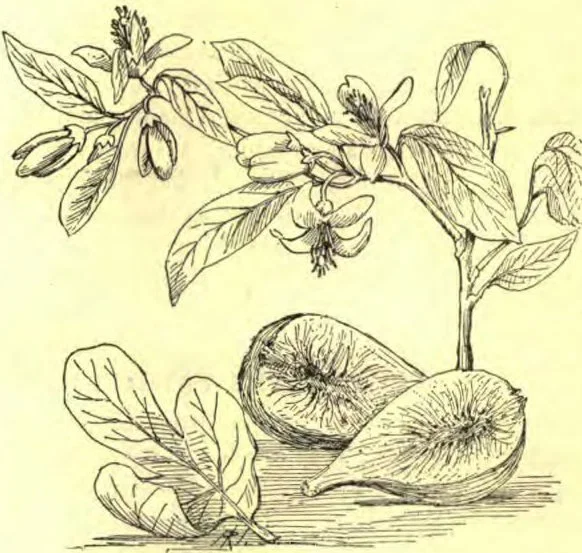
One of the first signs of spring is the appearance of the baby figs on the bare limbs of our fig-trees. The fruit grows, and later the leaves are put forth, concealing the fruit with dense foliage. What about the blooms? The artist has helped us to solve the problem, and given us a hint that to find the blossom we must look inside the fig. Lining the entire inner surface of the fruit are very minute flowerets, in each of which, when the fig is ripe, we find a seed.
To some the orange blossom may be a novelty, while others constantly breathe the air laden with its fragrance. Doubtless many have seen orange trees, bearing both blossoms and fruit, in greenhouses; but to see them in all their beauty and sweetness, one must see them growing in their native soil.
Orange trees may be found growing in almost all parts of the State, but our large groves, covering hundreds of acres on a stretch, are found in the southern part. We have many varieties, the most common of which are the Mediterranean Sweets, Washington Navels, and Jaffa, the last being transported from Joppa, in Syria.
The first growth is from the seeds, which are put to soak in water until they turn black, when they are planted in sand beds. Having sprouted and begun to grow, they are taken from the sand and placed in long nurseries. On reaching the height of about two or three feet, these seedlings are again transplanted and grafted with the choice varieties named above. The trees begin to bloom the following year, and bear some fruit, but a full crop is not gathered until the seventh or eighth year, when the trees are laden with this golden fruit. The trees are in bloom from April until July, at the end of which time the fruit begins to appear, and is left on the trees during the summer and part of the winter months to ripen, and is gathered the following February and March. The harvest time is so late that very frequently the trees are seen in full bloom while as yet the ripened fruit hangs thickly on its boughs. The creamy flowers among the green leaves, the green fruit growing on the same branch with the golden clusters, present a scene of attractive beauty. Involuntarily in fancy we wander through the beautiful gates of pearl to view the delights of that Eden “blossoming with gladness,” where grows the tree of life, which bears twelve manner of fruit, and yields her fruit every month.
KITTIE WAGNER.
FIG AND ORANGE BLOSSOMS.

HYMN TO THE FLOWERS.

’NEATH cloistered boughs, each floral bell that swingeth And tolls its perfume on the passing air, Makes Sabbath in the fields, and ever ringeth A call to prayer.
Not to the domes where crumbling arch and column Attest the feebleness of mortal hand, But to that fane, most catholic and solemn, Which God hath planned;
To that cathedral, boundless as our wonder, Whose quenchless lamps the sun and moon supply; Its choir the winds and waves, its organ-thunder, Its dome the sky.
There, as in solitude and shade I wander Through the green aisles, or, stretched upon the sod, Awed by the silence, reverently ponder The ways of God,
Your voiceless lips, O flowers, are living preachers, Each cup a pulpit, every leaf a book, Supplying to my fancy numerous teachers From loneliest nook.
· · · · · · · · · ·
Were I in churchless solitudes remaining, Far from all voice of teachers or divines, My soul would find, in flowers of God’s ordaining, Priests, sermons, shrines! — Horace Smith.

BE NOT WISE IN YOUR OWN CONCEIT.

“Thus saith the Lord, Let not the wise man glory in his wisdom, neither let the mighty man glory in his might, let not the rich man glory in his riches: but let him that glorieth glory in this, that he understandeth and knoweth me, that I am the Lord which exercise loving-kindness, judgment, and righteousness, in the earth: for in these things I delight, saith the Lord.” Divine knowledge must be combined with human education in order that the gospel may not be hid. The apostle says, “The god of this world hath blinded the minds of them which believe not, lest the light of the glorious gospel of Christ, who is the image of God, should shine unto them.” God has given us warning that we shall not lean to our own understanding. If we do, we shall be in constant danger of being misled and misdirected by the god of this world. Those who know Jesus Christ as their personal Saviour have the privilege of being educated and trained in a higher school than that of men, and of being tutored under higher wisdom than that of finite beings. They may come under the tutorship of the greatest Teacher the world ever knew, and partake of the same knowledge that he gave to Daniel. Those who are humble in heart, those who feel their need of higher wisdom, and do not rely upon their own finite judgment, but search earnestly to know the will of God, may draw from the source of all knowledge, and obtain grace, prudence, discretion, and judgment. They will realize the fulfilment of the assurance of God’s word: “The entrance of thy words giveth light; it giveth understanding unto the simple.” Those who are meek and lowly in heart, will learn of Christ, and find rest unto their souls.
Young men and young women will often be brought into positions where they are uncertain what to do. Their inclination leads them in one direction, and the Holy Spirit of God draws them in another direction. Satan presses his temptation upon them, and urges them to follow the inclinations of the natural heart. But those who desire to be true to Christ, will listen to the voice that says, “This is the way, walk ye in it.” They will decide to take the course of the righteous, although it is more difficult to pursue, more painful to follow, than the way of their own heart. But they will also realize the fulfilment of the promise: “Blessed is the man that endureth temptation: for when he is tried, he shall receive the crown of life, which the Lord hath promised to them that love him.” We need to receive divine wisdom in the daily concerns of life, in order that we may display sound judgment, and choose the safe path because it is the right one. He who acts upon his own judgment will follow the inclination of the natural heart; but he whose mind is opened to the word of God, will prayerfully consider every way of his feet, so that he may honor God, and keep the way of the Lord. He will remember that “even Christ pleased not himself,” and he will consider it a great privilege to follow in His steps. He will take his perplexities to God in prayer, and ask the guidance of him whose property he is. He will realize that he belongs to God, soul, body, mind, and strength. The apostle says, “What! know ye not that your body is the temple of the Holy Ghost which is in you, which ye have of God, and ye are not your own? For ye are bought with a price: therefore glorify God in your body, and in your spirit, which are God’s.”
Let those who are perplexed with temptation, go to God in prayer. The Lord says: “Ask, and it shall be given you; seek, and ye shall find; knock, and it shall be opened unto you.” The promises of God are unfailing. The word of God is not yea and nay; but yea and Amen in Christ Jesus. Persevere in prayer, and watch thereunto without doubting, and the Holy Spirit will work in the human agent, bringing heart and mind into subjection to right principles. Repeat over and over the promise, “If any of you lack wisdom, let him ask of God, that giveth to all men liberally, and upbraideth not; and it shall be given him. But let him ask in faith, nothing wavering.” When tempted, fasten your faith firmly upon the promise of God, and thank him for the grace and mercy that he has so freely bestowed.
Let every youth train himself in practical lines,—to trust the Lord, and not to follow his own ways. “Trust in the Lord with all thine heart; and lean not unto thine own understanding. In all thy ways acknowledge him, and he shall direct thy paths. Be not wise in thine own eyes: fear the Lord, and depart from evil. . . . Happy is the man that findeth wisdom, and the man that getteth understanding: for the merchandise of it is better than the merchandise of silver, and the gain thereof than fine gold. She is more precious than rubies: and all the things thou canst desire are not to be compared unto her. Length of days is in her right hand; and in her left hand riches and honor. Her ways are ways of pleasantness, and all her paths are peace. She is a tree of life to them that lay hold upon her: and happy is every one that retaineth her.” MRS. E. G. WHITE.
(To be concluded.)

THE LOVE OF THE FATHER.

In the first verse of the fifth chapter of Ephesians we find these words: “Be ye therefore followers of God, as dear children.” The words “dear children” are very precious to the Christian, in that they represent the endearing relation which he sustains to his Father in heaven as his redeemed child; but to one who has never tested the love of God for himself, has not accepted the offer of salvation which the Father has so freely made, and been adopted into the redeemed family of God, these would seem like idle words. There is another earthly relationship which the Lord has made use of to show the devotion and constancy of the divine love which might throw some light upon this subject for the benefit of such a one. It is that of the mother. (See Isa. 49: 15.) Although these words refer to the church, or his redeemed children, I think there is no way by which the love of God for his disobedient children can be so clearly illustrated as by the love of the mother for her wayward child.
In yonder cottage dwells a mother whose son has long since left the parental roof, after causing his parents great anguish of spirit by his evil course. All through his downward career he treated her unkindly, but she says it was the influences that surrounded him. It is not like my boy to do so. She dwells, with fond mother love, upon his innocent childhood, when he returned her affection; but as sin began to make its inroads upon his character, and he became estranged from her, her love took on a more tender, pityful, sympathizing character; and although he tore himself from his home without one token of affection for her, she will say, “O, if my dear boy could only know how much I love him!”
This is but the natural affection which the Creator has implanted in the bosom of a finite being; but “as high as the heavens are above the earth,” so much higher, and deeper, and stronger is the love of the infinite Father, which he bears toward his rebellious children.
Jesus came to this earth to show to the world the love of the Father for the sinner. By his life, suffering, and death he represented that love. The tender, pitying love of the Father is beautifully expressed in that sad lamentation over Jerusalem. In expressing his own love, Jesus showed forth the Father’s too. As he was riding into the city, and the people were rejoicing, his heart was sad. He remembered how he directed that people forty years in the wilderness, and how they rebelled against him; and all their evil ways since that time loomed up before him, and now they were about to crucify him. His heart of love overflowed, and he wept as he exclaimed: “O Jerusalem, Jerusalem, thou that killest the prophets, and stonest them that are sent unto thee, how often would I have gathered thy children together, even as a hen gathereth her chickens under her wings, and ye would not.” May it not be said of us that we “would not.” The Father loved us so much that he withheld not his only begotten Son, that we might be saved; and to-day he is waiting to receive us. Jesus is pleading the merits of his blood. The Spirit is calling to you through his word and by his providences, saying, “Come, for all things are now ready.”
MRS. JULIA LOOMIS.

NOT TO BE DENIED.

Professor Henry Drummond, the author of the “Natural Law in the Spiritual World,” has been very earnestly at work in the revival in the Edinburgh University. His addresses have been intensely evangelical, and have been wondrously powerful in their effect on the students. Says the London Christian:—
“One anecdote seems to have touched them deeply. Substantially it was to this effect: Some years ago, in the university, there was a fine, manly fellow, a medical student, a very Hercules in strength, but as gentle and lovable as he was strong. He was immensely popular, the captain of the foot-ball club, and not a cricket-match was considered complete without him. He was a man of good intellectual gifts as well. He caught typhoid fever while attending the royal infirmary, and soon he lay dying in a private ward. One of the house-physicians, an earnest Christian and successful soul-winner, spoke to him about God and eternity. The dear fellow listened, became anxious, and eagerly heard the story of redeeming love.
“‘Will you give yourself to Jesus?’ asked the doctor.
“He did not answer for a space, and then earnestly regarding the man of God, he said, ‘But don’t you think it would be awfully mean just to make it up now, at my last gasp, with One I have rejected all my life?’
“‘Yes, it would be mean; but, dear fellow, it would be far meaner not to do it. He wants you to do it now, for he has made you willing, and it would be doubly mean to reject a love that is pursuing you even to death.’
“The dying man saw the point, and, apprehending the excess of that exceeding love, he launched his soul into the ocean of it.”

A PAPAL LEGATE IN MEXICO.

Pope Leo XIII is reported to have in mind the sending of a papal legate, or pontifical mission, as it is called, to Mexico. A papal legate to the Catholic Church in Mexico may be allowed by the Mexican government, but anything like an attempt at papal representation to the government will be resented. Mexico had Rome’s rule for three centuries, and the intelligent portion of her people, who are really the ruling class in Mexico, have made the state independent of the church, and they are determined to keep it so. The invasion and subjugation of Mexico by Louis Napoleon, and the setting up of Maximilian as emperor, was done in the interests of the church party. They supported the invaders. At that time it looked as though freedom was about to perish in her great stronghold, the United States of America, and the papacy was anxious to establish a monarchy on this continent which would sustain the Catholic Church.
Thanks to a kind providence, the great country of freedom did not fall, but the scheme of the papacy did. The peremptory demand of the United States government sent the French troops home, and Maximilian, looking calmly into the muzzles of sixteen rifles, met his fate with a courage worthy of a better cause.
Since then Mexico has steadily opposed the reinstatement of the Catholic Church to the position she formerly held. A late Mexican paper refers to things both past, present, and future in the following vigorous language:—
“The Conservative party and the clergy, in order to regain power which had escaped from their hands, asked Napoleon III for the support of the bayonets and the influence of his ambition. As in those times they brought here under the French flag despotism and disgrace, they now hope to bring back a clerical reaction under the flowing robes of Mgr. Satolli. The French journal had better recall the humiliations inflicted on France through its interference in Mexican affairs at the instigation of the Catholic clergy and the Conservative leaders. Napoleon’s action here was a prelude to the wreck of France in 1871.”
To this a correspondent of the New York World adds:—
“That reflects the Liberal sentiment here regarding the proposed pontifical mission. The party is determined to resist any attempt at an alliance between the government and Rome.”

CHINESE AND OTHER BARBARIANS.

THE newspapers of this country fairly teem with gory editorials, urging the United States government to lose no time in bringing China to her knees for the maltreating of the Americans in that country and the destruction of their property, by some of the barbarians of the interior provinces. There is no doubt that the missionaries deserve redress, but considering the slowness of the means of communication in China, it would seem that the latter government has acted with commendable promptness. The French government, which made its complaint a little before we did, has received eight hundred thousand francs with which to reimburse the missionaries of that nationality for their losses, and our government has been promised that those who killed the Americans shall be brought to trial and punished, and an indemnity equal to the damage shall be paid. Moreover, at this early day four of the murderers have been found guilty, and as a suitable punishment, they have been deprived of that useful portion of the body known as the head.
Now it is a fact that the Chinese have been attacked in this country. In 1885, at Rock Springs, Wyo., an assault was made by a party of American miners upon some Chinese, and the casualties reported by our own papers had a much more sanguinary hue than the reports which have come to us of the attacks upon Americans at Chengtu. At Rock Springs the Chinese were killed in every brutal way from the bludgeon to burning. About fifty were put to death at that time and place. At several places and at other times similar scenes have been enacted, and this government has paid indemnity to China for the same; but as far as we know, no one has been hanged for crimes committed against the Chinese in these times of frenzy. So we should not get excited even if every guilty Chinese is not found and personally punished. Americans should remember that barbarous acts are not confined to China. Race hatred is so strong here among our own citizens that about every week some one is hanged without judge or jury, and then filled with lead. The Chinese are an astute race; they read the papers, and they have some very good reasons for thinking that this is a barbarous country. Citizens of the United States have treaty rights in China, and Chinese have certain rights here. Neither country can boast that they have always been respected, and a careful examination of the books will show as bad things charged to us as we can show charged to them.

NEWFOUNDLAND

THIS island colony of Great Britain, so near to our shores as to be an object of especial interest to us, has more than its share of trouble. Not only has it had famine and fires, but it seems to be a perpetual sufferer from an incompetent administration of the government. Then it has another grievance, known as the French shore question. Upon a thousand miles of its shore the French government has rights equal to those of the people of the island. This was conceded by a treaty long ago, by England, when those who did it were not aware what they were doing. Now the colonists desire to build a railway around this shore, for trade purposes, but the polite Frenchman, with the treaty as it reads, and an interpretation of it by a former king of England, which gives still more to France, stands in the way and says, “No, not until you satisfy my government.” Imagine the eastern coast of the United States from Maine to the Carolinas under the partial control of a foreign nation, and you have the unfortunate position of the colonists of Newfoundland. No doubt France holds this claim subject to sale to England, when the latter country shall be willing to pay what it will be worth to the colony to make France relinquish her hold. As things are now, there is a constant source of irritation and annoyance that is not conducive to the growth and prosperity of the colony.

THE WAY OF REFORM.

Not long ago we read a humorous sketch of the way a wave of reform spread through a mining camp known as “Bloody Gulch.” The people were remarkable for lynching those suspected of crime, and those who entered upon the task of reforming the place thought that lynching must be stopped, and finding a party about to lynch a man for horse stealing, they stopped them by promptly lynching the would-be lynchers!
There is a good deal nowadays that is called reform, or rather which is bold to call itself so, that proceeds upon a similar principle. People, in their great anxiety to pose as reformers, actually commit crime themselves. Like the man who said he would have peace, if he had to fight for it, they are perfectly willing to break the law in one way if they can thereby be enabled to enforce it in an other.
This way of reform was illustrated a few days ago at Harvey, Ill. A prohibition war against the saloon is on there. August 26 a large party of enthusiasts went to a saloon and filled it full, praying and singing meanwhile. After a while the saloon-keeper invited them outside. They had no business in the saloon, and they certainly should have gone out upon his invitation; but one very ardent reformer declined, and engaged in a fight with the saloon-keeper, and was very promptly and properly thrown out door. Now they have begun suits against each other, but it is not clear that the cause of true reform will be advanced thereby. When right methods of reform shall be adopted, then we may see real reforms, but the majority of so-called reformers need reforming, at least in their methods, before the world will be bettered by their efforts.

CUBAN PROSPECTS.

THE prospects for Cuban independence are not quite so flattering as they were a while ago. Lately the victories have generally been won by the Spanish troops. More soldiers have now arrived from Spain, and others are expected. It is very difficult for irregular and undisciplined troops to carry on a war for any length of time with regular and disciplined armies, well supplied and armed. The American patriots did this in the war of the American Revolution, but this is one of the marvels of history, and we may well say that there were “giants in those days.” The war in Cuba has been but a guerrilla warfare throughout. We read of battles fought where only half a dozen were killed and wounded! A foot-ball game or a bicycle meet in the United States is about as dangerous as many of these so-called battles! The defeat of such poorly armed and worse organized men as are the Cubans will reflect little luster upon the Spanish arms.
Should the uprising be put down and the hope of Cuban independence not now be realized, it is not certain but that a step in that direction will still be taken. It is said that General Campos is decidedly in favor of giving to Cuba some measure of self-government. If this could be done, probably the Cubans would be satisfied for a time. Spain has always denied this rightful privilege to her colonies, and the result has been that they have nearly all rebelled and gained their independence but Cuba, and she has repeatedly tried to do so. The day for arbitrary rule is past. England learned by her experience in America that if colonists are not given their just rights, they will take them by force if possible. Spain seems slow to learn this lesson, but perhaps the continual Cuban uprisings will make the necessary impression.
M. E. K.

AMUSEMENTS

TALKS WITH BOYS AND GIRLS.—NO. 3.

AMUSEMENTS

DEAR CHILDREN: This week we will have a talk on amusements. Most children love to be agreeably entertained. This is what amusement does. It occupies the attention with something pleasing that will help to pass away the time, or divert the thoughts from some hard task, thus resting both mind and body. It is not good for boys and girls to apply themselves for hours, without cessation, to hard study, or other mental employment. Often the eyes or the nerves are injured by so doing.
In our schools we have certain hours or parts of hours set apart for amusements. Sometimes it is the ball game, and sometimes it is skipping the rope, while at other times it may be some indoor game. This diverts the mind, making it easier to engage in the study afterward.
We use several words in speaking of amusements, such as pastimes, recreation, entertainment. While all these words are used to express the same thing, our dictionaries define them as having a slight difference in their meaning; and they should not be used interchangeably. Amusement and pastime are nearly the same, the latter being probably the lighter word. Many slight things may be pastimes, while the more dignified things in this line should be called amusements. “We are amused by that which occupies us lightly and pleasantly; entertained by that which brings our minds into agreeable contact with others, as conversation or a book; diverted by that which draws off our thoughts to something of livelier interest, especially of a sportive nature, as a humorous story or a laughable incident.” It will be interesting and instructive for each boy and girl to look up all these words, so as to know when to use each in its proper connection.
Sometimes young people think the only way to be amused is by something which will make them laugh. Too often some witty boy or girl is encouraged to say foolish things to cause laughter. Slang phrases, clownish expressions, and personations of different characters, are studied so as to amuse the company that delights in such things. Is this right?
The wise man said, “The thought of foolishness is sin.” Prov. 24:9. We should be so gentlemanly or ladylike in our character that anything that is foolish in its nature would be disgusting rather than amusing. Anything of the clownish nature is low and lowering in its effects. Boys and girls who allow themselves to be drawn into this net are not so dignified in their characters as those who turn away from these things.
All amusements should be of a character to cultivate manly and womanly principles. There should be an aim in all our recreations to receive new strength for improving the mind. If we go to the sea-side, the lake, or the mountains, we may find plenty of material that will be of great service to us in our duties that are to be taken up on our return. If we engage in some game, it can be made a source of education as well as mere amusement. If we read a story, we should seek to connect some of its thoughts with our studies and our daily work. Testimony No. 20 says: “It is right that we should choose such places as this grove for seasons of relaxation and recreation; but while we are here, it is not to devote our attention to ourselves merely, and fritter away precious time in amusements which will encourage a disrelish for sacred things. We have not come here to indulge in jesting and joking, in foolish talk and senseless laughter. We are here to behold the beauties of nature. And what then? Shall we fall down and worship them?—No, indeed. But as we behold these works of nature, we should let the mind be carried up higher, to nature’s God.”
We are instructed in the Bible: “Whether therefore ye eat, or drink, or whatsoever ye do, do all to the glory of God.” 1 Cor. 10:31. This will apply just as well to our amusements as to our work. We should remember that the all-seeing Eye is upon us, to guide us if we will be guided. Let the boys and girls of the INSTRUCTOR family engage in no amusements in which they cannot ask the Lord to direct them and go with them. J. H. D.

UNSEEN THINGS.

Speaking of the hope which animates a Christian, the apostle has said: “For which cause we faint not; but though our outward man perish, yet the inward man is renewed day by day. For our light affliction, which is but for a moment, worketh for us a far more exceeding and eternal weight of glory; while we look not at the things which are seen, but at the things which are not seen: for the things which are seen are temporal; but the things which are not seen are eternal.”
The lesson of truth to be drawn from this statement is that with the natural eye we can see only natural and temporal things,—that is, the things of this world. Men can see with the natural eye and consider with the natural mind anything and everything which is presented before them. They can see and take an interest in houses and lands, business prospects, and everything that pertains to the things of this world. This is looking at the things which are seen. Nearly all the attention of the world is absorbed in looking at and taking an interest in these things which the natural senses see and understand.
The Christian has another way of seeing; not that he sees with his eyes, as we see a tree; but he has another sense of perception. Even naturally we have several ways of seeing or perceiving things. We may see, hear, feel, etc. All these ways are joined together in the spiritual understanding of the Christian by which he perceives and understands the reality of unseen things. He hears the word of God, perceives the effect it has upon those that receive it, and feels within his own soul a new power to abhor the evil and cleave unto the good. All the promises of God to him are true; they are yea and Amen. The world to come is as real to him as is this present life. Heaven is as much a country as is Germany or England; and Jerusalem, which is above, the city of the great King, is as really a city to him as New York or London.
This is seeing the invisible things. Not long since we saw a picture which beautifully illustrated this idea. The picture consisted of two men. One had a telescope, looking at the planets. The other man was at prayer. The man looking through the telescope saw the moon and the planets; but before the man at prayer, rose, in all its beauty, the city of God, resplendent with God’s own glory. Beneath the picture was this inscription, “A spiritual man can see farther on his knees than a natural man can see with a telescope.” This is true, because the spiritual man sees by faith, and faith is stronger than sight.
The things which are seen are not lasting; change is written upon everything here below. In the forest the new growth rises upon the ruins of the old. Humanity presents the same spectacle of change. Even the mountains are crumbling, and the continents and islands are undergoing a change; but the things which are not seen—the Father, the Son, the city of God, the inheritance of the saints, the sure promises of God—remain forever unchanged and unchangeable. Let us fix our minds and our hearts on these enduring treasures a little longer; they are ours, and soon we shall realize the full possession of them.
M. E. K.

NOTHING BUT LEAVES.

Those who read the article upon the first page of this paper, describing the fig-tree, will notice the statement of the writer that the fruit is the first thing that appears upon a fig-tree. Little “baby figs” appear and continue to grow, and then the leaves put forth and shelter the fruit from the sun. This fact throws light upon the narrative in the Scriptures of Christ seeing the fig-tree, and upon finding no fruit, declaring that no fruit should ever be found upon it. Here is the record: “And on the morrow, when they were come from Bethany, he was hungry: and seeing a fig-tree afar off having leaves, he came, if haply he might find anything thereon: and when he came to it, he found nothing but leaves; for the time of figs was not yet. And Jesus answered and said unto it, No man eat fruit of thee hereafter forever.” Mark II:12–14. Again: “And in the morning, as they passed by, they saw the fig-tree dried up from the roots.” Verse 20.
Cavilers at the Bible declare that Christ had no right to look for figs at that time, and that to curse the tree under such circumstances was nothing but a display of petulance. But this objection is based upon a misunderstanding of the nature of the fig-tree. The very presence of the leaves, which follow the appearance of the fruit, was a pledge—a promise—of fruit.
“But,” says one, “the text says that the time of figs was not yet, and what right had he to expect fruit before the time?” This is also easy to be understood. The time evidently refers to the time of gathering. Here was a fig-tree whose foliage, according to the nature of the fig-tree, gave promise of fruit; and as the time of gathering had not arrived, there was reason to believe that fruit would be found thereupon.
As for the claim that Christ manifested petulance, there is no proof of it. The inanimate tree did not suffer, but Christ made of it an illustration of the danger and folly of profession without possession. “Master,” said Peter, “behold, the fig-tree which thou cursedst is withered away.” Said Christ, “Have faith in God.” Without faith, our profession will be but as a tree promising fruit, but bearing nothing but leaves. Such are many professed Christians. Now divine mercy says, Wait a little longer; but by and by divine justice will say, “Cut it down; why cumbereth it the ground?”
“Nothing but leaves! No gathered sheaves Of life's fair ripening grain: We sow our seeds; lo! tares and weeds,— Words, idle words, for earnest deeds,— Then reap with toil and pain, Nothing but leaves! Nothing but leaves!” M. E. K.
Continue reading: LESSON 1.—THE AUTHOR OF LIBERTY