12. What is selfishness?—Ans. The love of self to the disregard of the rights of others. (See note .)
13. Since selfishness is sin, and Christ came to save men from sin, what is comprehended in his mission?—Ans. Salvation from the love of self, and teaching men to recognize and respect the rights of others.
14. What are the rights of others?—Ans. The same as our own. Matt. 7:12. (See note .)
16. What then must men have taken from their hearts before they will recognize the equal rights of their fellow men?—Ans. Selfishness.
17. Who alone can cleanse the heart from selfishness, or sin? Acts 4:12; 1 John 1:9.
18. Who alone, then, can give real freedom? John 8:36.
19. If all men were thus cleansed, could there be any tyranny or persecution?
20. Would there not be perfect and universal liberty?
21. Who, then, is the author of perfect, universal, and lasting liberty, or freedom indeed?
BOOKS OF THE BIBLE.
By F. D. Starr
MEANING OF THEIR NAMES.
The names and order of the books of the Bible furnish an interesting and profitable subject for study. It is a very convenient thing to know the location of all these books, so that one can turn to them without delay; indeed, this is a matter of real necessity if one would be a thorough Bible student. It is a deplorable fact, however, that some who profess to take God’s word as their guide, and even to teach it to others, are so ignorant on this point that they do not know in what part of the Bible to look for some of the books when they wish to refer to them. We trust none of the readers of the INSTRUCTOR will permit such a defect in scriptural knowledge to exist in their cases, and thus hamper their usefulness in divine things.
A knowledge of the meaning of the names of these books is also very helpful in becoming acquainted with their location. In the Old Testament there are thirty-nine books, and in the New Testament twenty-seven. It is not a great task to learn to repeat the names of these sixty-six books in their exact order.
The first five books of the Bible are known as the five books of Moses. In the German Bible these books are known exclusively by this title, being named First Moses, Second Moses, etc. Of course, this is because Moses wrote these books.
The name we apply to the first book, “Genesis,” is of Greek origin. It is the word from which the terms “generate,” “generation,” etc., come. It will readily be seen that this name was given to this book because it describes the creating or generating of the world and all things connected with it. The expression, “Let there be,” in Gen. 1: 3, 6, 14, etc., is from the same term, and really expresses the meaning of the word from which Genesis comes. It is very appropriate to give this name to the book that tells about the calling of all things into existence.
The name of the second book, “Exodus,” is also a Greek term. It means “the way out,” “the departure.” This name is given this book because it tells about the way out of Egypt, the departure from that land of bondage. The end of the year is called in the Greek version of the Scriptures the “exodus” of the year (see Ex. 23: 16), and the feast held at that season of year is called “the feast of the exodus,” as will be seen by consulting the Septuagint rendering of Lev. 23: 36. This feast of tabernacles would keep in mind the exodus from Egypt when all dwelt in tents.
The name “Leviticus” is given to the third book, as may readily be discovered, because it gives in detail the duties of the Levites and priests in ministering to the physical and spiritual wants of the people.
Numbers, the fourth book, is largely devoted to the numbering of the people, describing the order of their services, marches, encampments, the division of the land, etc. The next time you take up your arithmetic, please remember that you have before you the Greek name of this book, Arithmoi, and remember also that God is the author of the interesting science of arithmetic, just the same as he is of the book (Arithmoi, Numbers) of the Bible. God can be known by the devout student of arithmetic, whether it be by studying the inspired book that deals in numbers, or the science as considered from a more ordinary point of view. The arithmetic of the Bible is a profitable topic.
The name “Deuteronomy” is distinctly a Greek name. The meaning of this term can be readily ascertained by turning to Deut. 17: 18. The copy of the law there mentioned that the king should write for himself, is thus mentioned in the Greek version: “He shall write for himself this deuteronomion” (deuteronomy),—repetition of the law, from deuteros, second, and nomos, law. The fifth book of Moses being made up so largely of what had been given in the preceding books, it is called Deuteronomy, the repetition of the law. If kings, and even common people, would write for themselves a copy of the law, a deuteronomy, it would help them to remember it better.
F. D. STARR.
GROWING IN GRACE.
GROWING in grace means resisting temptation, choosing the right because it is the right, cultivating the love and the practise of sincere piety,— in a word, becoming more like our Master and model, Jesus Christ. There is nothing sentimental or effeminate about it. It is a robust, virile development, which calls into action and cultivates symmetrically the sturdiest, noblest qualities of human nature, and also purifies and ennobles character and adorns life. It is a process which we can see going on conspicuously in Christians whom we know, and which every believer in Christ exhibits in some measure. It has transformed many a character and life which had been supposed too deeply tainted by evil to be altered for the better.
Whether our heavenly Father estimates its results positively or comparatively, we may not assume to determine too positively; yet it would be in accord with his unerring justice not less than with his merciful love, were he to value it more with reference to the attainment made than to the degree of moral and spiritual excellence actually attained. Some start lower down on the scale of spiritual culture than others. This is not due to any fault in them, and they may grow more in goodness, and illustrate a more difficult and creditable fidelity to duty, than others who appear more commendable because they have had less to overcome. Only our Creator knows how our different lives appear when compared with one another, but we may safely trust him to deal with us in absolute fairness and in tender affection.
We are apt to look too much upon growing in grace as a duty. Let it be regarded more as a sweet privilege. God gives us ample helps both within the heart and in the conditions of our lives. Let them be appreciated and used with thankfulness. The beauty of a Christ-like life is too apparent not to seem inviting when it is appreciated. It may be acquired with divine help by any one.—Exchange.
THE UNIVERSITIES OF THE MIDDLE AGES.
By C. B. Morrill
I.—THEIR ORIGIN.
The universities, like most historical institutions, were not made out of hand, but grew. The name itself was a growth; it was only by gradual modification of sense that it came to its final meaning. At first a university (universitas) was a body of persons, a corporation or association. The word signifies, etymologically, simply a number of persons or things making one whole. We find in the middle ages universities of tradesmen, universities of churchmen; and, in some cases, the commune, or town corporation, is called a university. The scholastic university was either the whole body of teachers and students, or the teachers alone, or the students alone. The term never carried the idea of a university of studies. That was a later development.
Thus it came about that there was at the middle of the twelfth century a university of law at Bologna, in Italy; a university of philosophy at Paris; and a university of medicine at Salerno, before there was a complete university of all subjects in any of these places.
The medical school at Salerno had existed probably longer than any of the others. It originated with a single man, Constantine Africanus, a physician, who began to teach his art to whoever might come. His surname seems to suggest that he had at least lived in Africa, and it is doubtless there that he learned his profession, for the Arabs were far in advance of the Europeans in the science of medicine. The school continued to grow in spite of the fact that the middle ages did not supply the greatest amount of encouragement to the medical profession. It was thought that healing belonged in some way to the church, and that more help was to be obtained from prayers, exorcisms, pilgrimages, touching the bones of saints or the persons of kings or holy men, or from garments possessing miraculous powers, than from medicines or science. Physicians were, in fact, often regarded as possessed of supernatural powers, and, where they were laymen, it was not seldom supposed that they were in league with the powers of darkness. Yet the monks did not despise the healing art, and both they and laymen, in spite of superstition, swelled the numbers in attendance at Salerno until it came to enjoy the privileges of a university.
The study of Roman law, the only body of law that was in shape to be studied, was centered at Bologna. The individual name associated with this foundation is that of Irnerius, who was to the University of Bologna what Abelard was to the University of Paris. Like Abelard, he was without a master, sine magistro; that is, he had not learned from any one man the great knowledge which he certainly possessed, but was self-taught. It is worth noting, as an instance of the change of priestly sentiment toward learning, that the church opposed the study of law at first, as being a heathenish study, likely to lead the minds of men away from sacred things, and from established institutions. But she soon saw her true interest, and encouraged what she at first condemned. At a time when all was disorganized, the papacy saw the great gain in turning to its own purposes the organized body of the Roman law, and thus securing an advantage over its disunited antagonists, the civil rulers. To make more sure of the advantage, the study of canon law, or the law of the church, was added to that of the civil law.
The character of the University of Paris was determined by the teaching of Abelard. It was thus for a long time the most important school of theology and philosophy in Europe. There was something about the teaching of Abelard which appealed to the imagination of the young men of his day; this is evident from the great throng of pupils with which he was always surrounded. His reputation drew to Paris the nucleus of a university. After his death his place was supplied by his pupils, Peter Lombard and Gilbert de la Porrée. Both of these men were able to hold the audience which Abelard had called together. The part which universities were to play in the life of the world was well foreshadowed in the fact that the alumni of Paris in these early times included twenty cardinals, fifty archbishops and bishops, and a pope, Celestin II, as well as the ill-starred reformer, Arnold of Brescia. Most of these were pupils of Abelard himself. The influence of the universities, thus showing itself in the church, in time extended to the state and to private life; for it was not long before the sons of noblemen and princes elbowed the sons of peasants and artisans in the streets of university towns.
When the universities had begun to give promise of their future power over the thought of Europe, both popes and kings sought to attach them to themselves by patronage. The papacy “invested,” and the kings “chartered,” the institutions which had grown up without the aid of either.
The university of Bologna was thus instituted by the emperor Frederick Barbarossa in 1158. In the act of granting the charter he gave a hint of what he expected the university to accomplish: “Their science [that of the masters and disciples of Bologna] illuminates the entire world, and, thanks to it, subjects learn how to live in obedience to God and to the emperors, who are the ministers of God.”
The papal expectation is expressed in the language of the invitation in which Honorius III asks the professors of Paris to go and teach at Toulouse. It was after the south of France had been converted from the Albigensian heresy by the extermination of the heretics. The pope calls the professors of Paris to teach “in that country whose inhabitants wish to return to God; where it is necessary to prevent venomous serpents from entering; and where it would be fitting to transplant certain men, who by their lectures, their preaching, and their exhortations, would ardently uphold the cause of God.”
That the universities might the more efficiently fulfil the hopes of their patrons and founders, both pope and king provided for their entire freedom, the freedom still so characteristic of the universities of Germany. The popes even protected the universities, as they did the monasteries, from the encroachments of the church; for the papacy, the central government of the church, was at this time very jealous of the local power of bishops and synods, and sought to weaken it by every means. Thus the papacy and the royal power built up, each for its own interest, the institutions which were to be both the nurseries and the strongholds of intellectual and civil liberalism.
As the gathering of pupils about a master became the nucleus of a university, so the gathering of professors about a center of learning, attractive because of the protection and privileges which it enjoyed, was the germ out of which developed the university of studies, with its faculties of philosophy, of medicine, of law, and of theology.
C. B. MORRILL.
HYGIENE OF CLOTHING.
By David Paulson
If we bear in mind the fact that clothing protects us from the cold by not allowing the heat of the body to pass off too freely, we shall also understand the necessity of clothing the body as nearly as possible uniformly in every part. The face is an exception to this rule, as nature has provided that with a much richer supply of blood-vessels than any other part of the body, so a corresponding greater supply of heat is brought to it, thus making external protection unnecessary in ordinary temperatures. The feet, on the contrary, being so far removed from the centers of circulation, are very apt to become cold, and instead of being clothed as warmly as other parts of the body, we often find them incased in shoes so tight as almost to obstruct the already feeble circulation caused by the habitual cold to which they are subjected. By this usage the blood-vessels gradually contract so that only a small supply passes through the limbs, even when they are warm. The blood which should be circulating there is accumulating in the internal organs, and causes congestions of various sorts upon the least exposure. Those who do not clothe their limbs properly in the cold seasons will do well to remember that nature will arouse and utter her protests in no uncertain manner.
Clothing should never obstruct the normal circulation of the blood in any part of the body. How many a student has sat studying intently, with his head bent so far forward that his collar restrained the free return of the blood from the head, which was being called there in more than the usual amount on account of the activity of the brain; and as his mind became dull and stupid over his books, he has become almost discouraged at his progress. The blood enters the head through blood-vessels which are deep set in the tissues, and returns by those that are more superficial. This accounts for the clogging of blood in the brain when there is a constriction about the neck.
There are no “rooms to let” in the human body. God arranged man to occupy the least possible space, and yet allow each organ to do its appointed work, and so when clothing becomes so arranged as to encroach on the room that nature has allotted to each of them, then their function begins to be sacrificed, and worst of all, the large blood-vessels in the interior of the body being more yielding than the other more solid organs, they suffer the most from the pressure. That means unbalanced circulation, and when the victims of such cruel habits suffer from dizziness, palpitation of the heart, congestions, aches, and pains, they sometimes almost murmur at providence, that seems to be blighting all their fairer prospects for life. How unkind to charge to a merciful heavenly Father the sure results of our own course!
DAVID PAULSON, M. D.
Blessings Promised to Those Who Hearken to God
AND it shall come to pass, if thou shalt hearken diligently unto the voice of the Lord thy God, . . . blessed shalt thou be in the city, and blessed shalt thou be in the field. Deut. 28:1-3.
— Longfellow
By Longfellow
FROM "THE BIRDS OF KILLINGWORTH."
THINK, every morning when the sun peeps through
The dim, leaf-latticed windows of the grove,
How jubilant the happy birds renew
Their old, melodious madrigals of love!
And when you think of this, remember too
'T is always morning somewhere, and above
The awakening continents, from shore to shore,
Somewhere the birds are singing evermore.
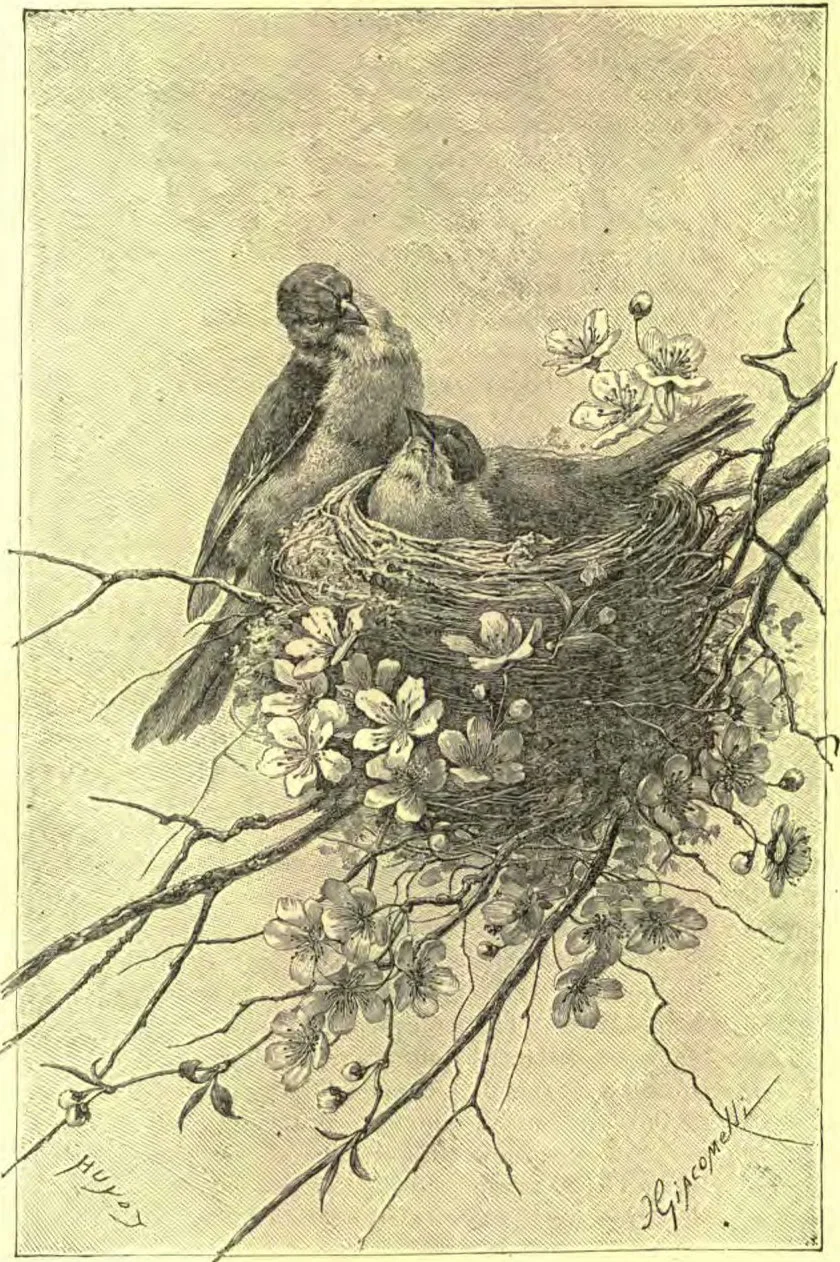
Think of your woods and orchards without birds!
Of empty nests that cling to boughs and beams
As in an idiot's brain remembered words
Hang empty 'mid the cobwebs of his dreams!
Will bleat of flocks or bellowing of herds
Make up for the lost music, when your teams
Drag home the stingy harvest, and no more
The feathered gleaners follow to your door?
What! would you rather see the incessant stir
Of insects in the windrows of the hay,
And hear the locust and the grasshopper
Their melancholy hurdy-gurdies play?
Is this more pleasant to you than the whir
Of meadow-lark, and her sweet roundelay,
Or twitter of little field-fares, as you take
Your nooning in the shade of bush and brake?
You call them thieves and pillagers, but know,
They are the winged wardens of your farms,
Who from the cornfields drive the insidious foe,
And from your harvests keep a hundred harms.
— Longfellow
BIRD LAWS.
By Myrta B. Castle
LINNETS.
The other day while reclining in an easy chair behind the vines on my porch, I indistinctly saw something fall with a flutter into the dusty road. It looked like a big, loose wad of brown paper, and when some six or eight boys began pelting it, I thought it must be paper. After a few minutes it flew dizzily into the shrubbery of the opposite yard, and thither the boys pursued it. It was a robin.
Now I love robins, and their cheery songs, and their nests, and their friendly ways, and their red breasts; and indignation and pity hurried me from my chair. I let dignity go to the winds, and I swooped down upon those boys in a way they remember yet, I know; for one of them passed me in the street since, and his cruel eyes shrank from me as if he thought I might have a sling for boys as he had for birds.
Having in my memory that cruel sight, I was glad to see the Youth’s Companion speaking earnestly on the protection of birds. The following is from the article in that paper:—
“As a rule, State statutes protect not only game-birds, but song-birds and birds of beautiful plumage. The game-birds may be shot in their season, and certain birds of prey may be killed at any time, but the other birds cannot lawfully be killed at all. Their nests and eggs also are protected. ”
“Though some of the States have been lacking in their duty in this regard, it is safe to say that any one may assume that he has no lawful right to kill birds or collect eggs unless he has a permit to do so, in the interest of science, from the proper State official, or from some authorized scientific institution.
“This is certainly as it should be everywhere. Apart from all considerations of sentiment,—which, however, are not to be disregarded,—the great majority of birds have a decided economic value to the country. They are the natural enemies of insects and other vermin.
“The estimated annual destruction of crops by insects in the United States is more than four hundred millions of dollars. The State of Illinois lost in one year by damage to wheat by insects seventy-three million dollars. At the same time, we have the estimate of careful ornithologists that a woodcock will eat its own weight of insects in a single night; and a pair of birds of the sparrow species—not English sparrows—have been known to destroy thirty-five hundred caterpillars in a week.
“We have thirty species of insects which subsist on our common garden vegetables. Our apple orchards have fifty kinds of insect enemies. Against these regular enemies, the woodpeckers, native sparrows, orioles, bluebirds, thrushes, robins, nuthatches, vireos, and other birds, are making steady warfare. They certainly deserve protection, and it is well that they are to receive it.
“Under the ordinary form of these statutes, a person who takes birds, nests, or eggs unlawfully may be arrested without a warrant, and is liable to fines, and, in certain cases, to imprisonment.”
Even owls and some species of hawks are exceedingly valuable on account of their destruction of moles, mice, snakes, etc.; and in English parks and forests the owls breed in the same “owl tree” for generations, where their possession is carefully protected by the game-keepers.
But our laws for the protection of birds are tolerably complete; what we want is a public sentiment which will see that the laws are enforced. A prominent professor in one of the oldest colleges in Michigan protested with all his native vigor of utterance, just this summer, against the payment of English-sparrow bounty on the bruised and disfigured bodies of bluebirds, native sparrows, and other song birds; but the official knew nothing of birds, and “didn’t know what to do but pay,” and so he paid. Those birds had been drawn through the dust of the street till their species was unrecognizable to any one but an ornithologist. So great is the popular ignorance in regard to birds and bird laws, that several years ago a famous preacher of New York killed thirty robins on one gunning trip—and had to pay the State twenty-five dollars apiece for them! It is safe to say that there is one man in the United States who will not kill song birds any more.
MYRTA B. CASTLE.
SOME ANIMAL HUMBUGS.
In military stables horses have been known to pretend to be lame in order to avoid going to a military exercise. A chimpanzee had been fed on cake when sick; after his recovery he often feigned coughing, in order to procure dainties. The cuckoo, as is well known, lays its eggs in another bird’s nest, and to make the deception surer, it takes away one of the other bird’s eggs. Animals are conscious of their deceit, as shown by the fact that they try to act secretly and noiselessly; they show a sense of guilt if detected; they take precautions in advance to avoid discovery; in some instances they manifest regret and repentance. Thus, bees that steal hesitate often before and after, as if they feared punishment. A naturalist describes how his monkey committed a theft. While he pretended to sleep, the animal regarded him with hesitation, and stopped every time his master moved.— Public Opinion.
Small Creatures and Their Great World-Work
We arrogantly call many creatures “little” whose world-work is nevertheless large. Beavers created many of the lakes and marshes of Canada by their dykes and lodges. The arable land of the globe is almost wholly due to earthworms. The city of Paris is built mainly of infusoria, and all the peninsula of Florida consists of small shells and coral crust, the remnants of sea-lice.— Sir Edwin Arnold.
Proverbs on Doing Favors Without Remembrance
INSTEAD of saying, “When thou doest alms, let not thy left hand know what thy right hand doeth,” the Arabs say: “When you have done any one a favor, throw into the sea the remembrance of it; and if the fishes devour it, God will remember it.”
AFRICAN FRUIT.
THE name “Africa” is generally suggestive of a vast and but partially explored wilderness, in which the largest and most dangerous animals roam at will,—a dark continent. This is true in regard to many parts of Africa, but many people do not realize the great inroads which civilization has made in Africa during the last decade. The great nations of Europe are entering it in many directions, and slowly but surely the country is undergoing a change. Nowhere in Africa is this more apparent than in South Africa, where an energetic and able government, combined with the efforts of an intelligent and progressive people, have wrought wonders.
If we may credit the reports in the papers, this part of Africa bids fair to be a second California. The first great industry of Africa was mining. This drew a large population there. Now fruit is engaging the attention of the people, and it is believed by those qualified to know that Africa will follow California in this respect. The weather of South Africa is very similar to that of California. Ships fitted up with chemical refrigerators will preserve the fruit until it is unloaded in Europe or America. The resources of Africa are too vast to be comprehended, and they will add a mighty increase to the earth’s harvests. It is to be hoped that the people of Africa will be allowed to possess their own land, and that they will advance in civilization and Christianity.
JAPANESE LEATHER PRESS.
Some years ago the Japanese government established an imperial press, which does all the printing work of the government, from the alphabets ordered by the minister of public instruction and the postage stamps and post cards, to the paper money, of which so much use is made in trade. One of the specialties of the establishment is the manufacture of leather papers, which has been brought to a great degree of perfection, and is so distinctly Japanese. The Japanese, taking as a pattern some of the finest European leathers, have succeeded in applying their own peculiar methods of manufacture, and fashion them according to the Japanese taste. Papeterie has published some details of this essentially artistic industry. The first step is the engraving of a block, consisting of a large, hard wooden cylinder, hung on to a frame, which is engraved with a knife or chisel, the worker following the model with such precision and exactitude that the least wrong stroke is considered sufficient to spoil the whole block. When the block is ready, it is covered with moist paper, which is folded and pressed on to the mold, then taken off and hung across a bamboo to dry. When it is thoroughly dried, by exposure to the air, decoration is commenced.
The paper is now spongy, and almost as absorbent as blotting paper. It is now covered with several coatings of glue, which make the surface smooth and nonabsorbent. The paper is then figured, metallized, and varnished, and the figured design then stands out, as is gilt. The Japanese have the monopoly of the best lacquer varnish. It is this lacquer varnish which gives a golden appearance to the metal, and the exact color is at the discretion of the worker. The final operation consists in the arrangements of border patterns, by means of stencil plates. This is done by young girls, who cut out the stencils with marvelous cleverness and exactness, and wield the brush with great dexterity. The same girls touch up the border work, erasing all smudges and filling up blank spaces, etc. The rolls of paper are then hung up again, and when dry are ready for the market. They are sent first to Yokohama, and thence all over the world.
One other remarkable fact about the Japanese imperial press is, that it was the first experiment in Japan of industrial organization on a large scale, at least so far as concerns the regulating of hours of labor. Since then labor has been organized and regulated in the same manner in the private factories of the country, to the mutual profit of the producers and the workmen employed.—Scientific American.
NAPOLEON’S HAPPIEST DAY.
WHEN Napoleon was in the height of his prosperity, and surrounded by a brilliant company of the marshals and courtiers of the empire, he was asked what day he considered to have been the happiest of his life. When all expected that he would name the occasion of some glorious victory or some great political triumph, or some august celebration, or other signal recognition of his genius and power, he answered without a moment’s hesitation: “The happiest day of my life was the day of my first communion.” At a reply so unforeseen there was a general silence, when he added, as if to himself: “I was then an innocent child.”—Wellspring.
LACE-BARK TREE OF JAMAICA.
THE department of agriculture, forestry division, at Washington, has a collection of rare trees and plants second only to that belonging to the famed Kew gardens, London. A recent addition to this dendrological museum is a “lace-bark tree” from Jamaica. The inner bark of this queer tree is composed of many layers of fine and intricately woven fibers which interlock with each other in all directions. Caps, ruffles, and even complete suits of this curious vegetable lace have been made. It bears washing with common laundry soap, and when bleached in the sun acquires a degree of whiteness seldom excelled by artificial laces made of cotton, linen, and silk. The intricate web of this unique bark makes it compare favorably with the last-mentioned productions for both beauty and durability. It is to be sincerely hoped that the agricultural department will see that the Jamaica lace tree is introduced into the United States, and its cultivation carefully fostered.—St. Louis Republic.
A NEW INDUSTRY.
MONAZITE is a rare metal, found hardly anywhere except in Russia, Norway, and Bohemia, and even in these places in small quantities. Slight traces are found in the State of Connecticut and in Brazil, but not enough to pay for working. Monazite has a brownish-red color, a vitreous luster, and comes in the form of oblique, rhombic prisms. The Piedmont belt in the western edge of the Carolinas is celebrated for poor land and moonshiners. The reddish sand, about a foot below the surface, heretofore regarded as very worthless, is found to contain large quantities of this rare metal, which is proving to the people a mine of wealth. Some of the little farmers sell the right to dig for two hundred dollars an acre, while others receive a royalty or work the new industry themselves. The top soil is removed, and the metal is obtained by washing it in a long trough, the monazite settling to the bottom. The mining of monazite has brought not less than one hundred thousand dollars to the region the past year. The sand passes current at six cents a pound, and serves as local currency. The discovery acts like the opening of a gold mine in attracting the curious from all lands. The hands average about one dollar a day. The value of the metal is found in the thorium contained in it. Thorium is indispensable in the manufacture of incandescent gas burners.—Zion’s Herald.
THE MAN HE WANTED.
How much General Grant appreciated the value of total abstinence is shown by the following anecdote related by a contemporary:—
When General Grant was in command of the army before Vicksburg, a number of officers were gathered at his headquarters. One of them invited the party to join in a social glass; all but one accepted. He asked to be excused, saying he “never drank.” The hour passed, and each went his way to his respective command. A few days after this, the officer who declined the drink received a note from General Grant to report at headquarters. He obeyed the order, and Grant said to him, “You are the officer, I believe, who remarked the other day that you never drank.” The officer modestly answered that he was. “Then,” continued the general, “you are the man I have been looking for to take charge of the Commissary Department, and I order that you be detailed to that duty.” He served all through the war in that responsible department, and afterward, when General Grant became president, the officer who never drank was again in request. The president, needing a man on whom he could rely for some important business, gave him the appointment.—American Youth.