How old is the law of God? When was it enacted? and why? Did it exist before man? Was it applicable to the angels?
These are queries which arise in the minds of many, and over some of which the opponents of the Sabbath attempt to wax facetious. “Think of angels,” they say, “killing or stealing? Think of them as having men-servants and maid-servants, to command, and cattle to team about through all the week, except on the Sabbath.”
It looks to us that all trouble over these questions, is unnecessary, and any levity betrays a view of the subject that is painfully superficial. Think a moment. What is God’s law? and how broad is the ground it covers?
1. Expressed in one word, which is applicable to all circumstances, and to all duration, from eternity to eternity, we may say that it is that principle which governs a righteous relationship between all the intelligences of the universe, whenever such relationship exists, wherever it exists, and to whatever extent, and in whatever particulars, it exists. Thus it governs the relation of all created intelligences, including man, to God, the Creator; and the relation of all creatures to each other—as angels with angels, angels with men, and men with men. Such is the law of God—the moral law—and such is the ground it covers, no more, no less. As applied to mankind, it covers our relation to God, and our relation to one another. As applied to any other intelligences, it covers the same ground—their relation to God and to one another.
2. The extent of the relationship governs the extent of the law, and the particulars of the relationship determine its specifications. It stops at the impossible. It expands only as the relation expands. That is to say (by way of illustration), if there were but one created being in the universe besides the Creator, from the very nature of the case there would spring from the relationship between them the law to govern it; for it would be the duty of the creature to render love supreme to the Creator. And if there were no other object which the creature could possibly have as a god before Jehovah, and nothing which could be bowed down to as an idol, the law could not take the form, under those circumstances, of a prohibition of these sins. But potentially those very prohibitions exist in that supreme law of love; and the moment circumstances so change that it becomes possible for the creature to have other gods and bow to graven images, the law shows itself in an aspect to cover that possibility.
And so when two or more creatures exist together, the law governing their relation—that each shall love the other as himself—springs into existence from the very nature of the case. But if it were not possible that they could kill each other, or wrong each other in property, the law could not take the form of a prohibition against murder and stealing. It would take such form just as soon as such sins in their case became possible.
Before sin came into our world, this law of love to God and love to man, held our first parents in its welcome bonds of peace and happiness. How far God had instructed them in regard to the special channels through which this love should manifest itself, we do not know. We do know, however, that God had given special instruction in reference to the Sabbath, and he had probably done so in respect to other matters pertaining to his own worship. If murder, adultery, theft, and other specifications of the second table of the decalogue, they would of course know nothing till, by disobedience, the barrier had been broken down which made these particular forms of transgression possible.
God, as was proper, gave to Adam a test through which he might manifest his disposition to love and obey him,—the prohibition of the tree of knowledge of good and evil,—and this test was so comprehensive that it embraced the principles of nearly every one of the ten precepts of the decalogue. The evil immediately possible was the entrance of sin through disobedience to God in reference to that test; other specific acts were only remotely possible through that; for he would not be liable to fall into any of them as long as he obeyed this. And in so far only were these potentially involved in that law under which Adam stood.
But when man transgressed, and sin came in, then death, adultery, theft, and all other sins, became the immediate possibilities in the prospective development of the race; and through these very circumstances the law immediately adapted itself to cover them. The law against murder was not enacted after Cain slew Abel; but it was there before, and branded upon him the guilt of murder, when he committed the act.
Illustration.
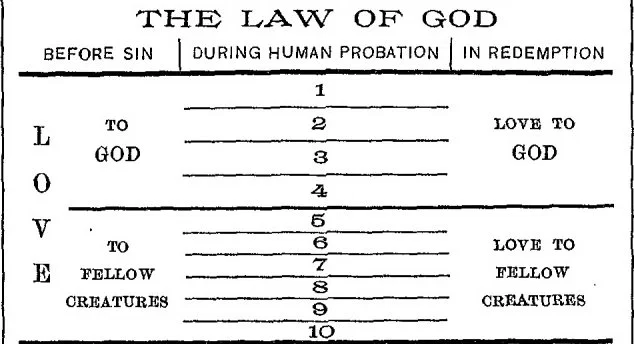
To bring out perhaps more clearly the idea, let us liken the law of God to a river. Its fountain was love, and in one volume of love it began its flow. As soon as God had brought other beings into existence, who were to love each other, as well as himself, the stream took two channels: “Love to God” and “Love to fellow-creatures.”
We at length come to a time when the bed of the river forms itself into ten distinct channels. The water of the river adapts itself to this feature, and immediately flows in and fills them all. But it is the same water and the same river, only flowing now in ten channels instead of two. These correspond to the ten precepts enjoined upon man during the period of his sinful probation. And after probation is ended, and the redeemed enter the kingdom of God, and cannot die, and are beyond the reach of sin, and their circumstances are all changed, the form of the law will change accordingly, and the ten streams will coalesce again into their two great channels, “Love to God,” and “Love to fellow-creatures;” for the positive duty of love will ever remain; and the stream will thus flow on through eternity. But in these two channels there will be all that was ever in the ten; for none of the evils prohibited by the ten can ever exist in that element of love, and every positive service of love will be rendered to its fullest extent.
In this state the prophet (Isa. 66: 22, 23) assures us that the Sabbath will be kept while the new heavens and new earth remain; and that Sabbath we can keep, though the circumstances that exist here, of men-servants and maid-servants and cattle and strangers within our gates, may not attend us there. From month to month, according to the prophecy last quoted, as the tree of life yields her fruit (Rev. 22: 2), will the nations of the redeemed gather at the New Jerusalem to eat thereof, and from Sabbath to Sabbath will all flesh come to worship before the Lord of hosts. All Sabbath-keepers there, praise his name!
PRESS AND PEOPLE.
Rising Voices on the Sunday Movement.
As promised last week, we herewith present a few more extracts from current newspapers and other sources, showing the opposition that exists in many sections to the vigorous attempt now being made to connect religion and the State in this country.
The Mancelona (Mich.) Herald, calls the object which is designed to be secured by the Blair bills, “infamous.” In its issue of Jan. 17, 1889, it says:—
“Petitions remonstrating against the passage of the infamous Blair bill have been circulated freely about town during the past few days, and we have yet to hear of but one who refused to sign it. When our legislators at Washington find it necessary to amend the Constitution of the United States, it will not be for the purpose of forming a combination between church and state that will prove obnoxious to the masses. The passage of such a bill as Mr. Blair has introduced under the guise of ‘educational,’ . . . might not have been out of place in the 14th, 15th, and 16th centuries, but in this enlightened age the people have no use for a law that advocates and upholds religious intolerance.”
The “Turn-Verein” of Peoria, Ill., received from the national head-quarters of the order, recently, the following instruction in regard to this movement:—
“We herewith call the attention of all our societies to two measures, introduced in the United States Senate, to-wit: First, the so-called National Sunday bill, and second, the concurrent resolution, proposing an amendment to the federal Constitution, the object of which seems to be the establishment of the Christian religion as a national religion.
“We consider these propositions as an infringement of the liberty of conscience and a violation of the spirit of our Constitution.”
After giving a brief synopsis of the Sunday bill, it adds:—
“Taking it all in all, this bill is the boldest assault upon political liberty of the people, yet attempted.”
The circular concludes as follows:—
“The majority of citizens know what endless complications the sacrifice of those provisions of our Constitution which guarantee the liberty of conscience and religion to our citizens, would lead to, and we therefore deem it our duty to protest against such reactionary assaults upon our institutions.
“We call upon our societies to submit this remonstrance to the members of Congress of their respective districts immediately, with the request to oppose Mr. Blair’s measures by every means within their power.”
Bro. R. M. Kilgore writes us that a meeting of this order was held in Aurora Feb. 3, 1889, in response to this call, at which he was present. The meeting was large, and a protest to be presented to Congress was enthusiastically adopted. Of the tone of the meeting, Bro. K. says:—
“From the animus displayed by both speakers and audience, and the vim with which remarks were made and responded to, I judge . . . there will be no end just yet so far as they are concerned.”
American citizens of the Jewish faith are also raising their voices against the measure. Dr. David Philipson delivered a lecture at Cincinnati, O., before the “Congregation B’ne Israel,” Jan. 25, 1889, from which we make a few extracts. He thinks those who are urging on the Sunday movement are actually “delirious;” for he opens his discourse with these words:—
“Periodically there breaks out in this country an excited feeling that puts those whom it affects into a high state of delirium, in which condition they see and imagine things in a very distorted light, and feel that unless they do something to recall the people from their waywardness, and save them from the evil courses whereinto they have fallen, the souls of millions will be lost forever and eternally. At this period such a feeling is again asserting its sway, and is well nigh at its height.”121
In the second paragraph he gives his conclusions as to the result of the movement, in these words:—
“In short, to overthrow one of the bulwarks of our Constitution, and hence undermine that personal liberty which is the condition and the safeguard of our grand and glorious institutions.”
Then, referring to the great interest taken in this matter by other bodies, and their discussions of the question, he continues:—
“I feel it necessary that we also as Jews, who belong neither to the one wing nor the other, except in so far as we are all citizens of this one great land,—that we as the Jews of this community, now that the agitation has also reached this city,—that we as Jews, the confessors of the religion that gave the Sabbath as the day of religious observance to the world, although as a day of rest it was known already among other peoples in ancient times, have our word in this most interesting, nay, not only interesting, but vital discussion,—vital in as far as it affects the very bone and sinew of the body constitutional of the United States.”
On page 4 of this published discourse he makes a striking statement of the fact that the movement has now come to be one of national proportions. We quote:—
“The reason of the greater attention paid to the present movement and the greater alarm it excites is the fact that for the first time it has definitely assumed national proportions. Senator Blair, who appears to have the stuff of a fanatic in him, if we can judge from the exhibitions he has given of himself both on the Senate floor and elsewhere,—he having appeared as the supporter of well nigh every eccentric movement wherein this country seems to be especially productive,—set the ball a rolling by his Sunday bill; and at once, as though at a given signal, this small beginning, fathered by the New England senator, grew into vast proportions; meetings were called in many places, and the agitation kept up; a national convention assembled, and a complete organization for the accomplishment of the purposes of the bill effected. One preacher of New York City even resigned his large pastorate to accept the position of Field Secretary, and devote himself entirely to the work.”
In regard to the effect of such legislation upon the liberties of the people, should it succeed, he speaks as follows (p. 9):—
“There are within the United States hundreds of thousands, aye, perhaps millions, to whom the establishment of any such laws as these bills propose, means the infringement of free action as much as would a law forbidding free speech and free thought.”
We have space to quote further from this discourse only the solemn closing “protest,” in these words:—
“In the name of an Almighty God, creator of all creatures alike, whose souls, the impress of the divine, stamp them as equal, as far as the right to live and be free is concerned; in the name of mankind, whose progress would be retarded for centuries, should any such retro-active measures as these Sunday blue laws intend, be indeed incorporated into the statute books; in the name of personal and individual liberty, which in being deprived of any one of its rights is in danger of losing them all; in the name of enlightened religion, whose watchword is tolerance for all, we protest against any attempt to force any such laws upon the Government of this country.”
The St. Louis (Mo.) Republic, of Jan. 24, 1889, published the following “special” from Sherman, Texas:—
“A petition was circulated in this city to-day, and was largely signed to be sent to Congress, asking that body not to pass what is known as the Blair educational bill. Similar petitions are being circulated throughout the State, and the people of Texas appear to be generally opposed to the passage of the bill.”
The St. Louis (Mo.) Post-Dispatch, of Dec. 29, 1888, said:—
“It is right and a duty to give thanks to God and to worship him; bodies of people may properly agree on a day or days to be set apart for that purpose, and they have a right to be secure from interruption therein. But one body of people has no just right to insist on compliance with their ideas in this matter by other bodies of people. One has no right to say to another, ‘This shall be your day of thanksgiving and worship;’ nor, indeed, has any person or association of persons any right to say to another person or persons that he or they shall have or observe a day of worship in any particular manner, or go on Sunday to hear any set of dogmas expounded. Here is the domain of conscience, and in it each man is answerable for himself.”
The Evening Expositor (Fresno City, Cal.) of Jan. 17, 1889, says:—
“Roger Williams, banished for his Baptist principles, said: ‘The public or the magistrates may decide what is due from men to men; but when they attempt to prescribe a man’s duty to God, they are out of place, and there can be no safety.’ All of this we respectfully commend to Senator Blair and his friends. Would that our words could be transformed into trumpet tones, that the people of this nation might be aroused to the danger germinant in these bills. This hateful, meddling spirit bears with it the same old earmarks that attached to ecclesiastical despotism all along the way from Constantine the Great down to and through the twelve centuries of popish domination, and from Star-chamber times and Salem-witchcraft courts on to the end of the chapter. We protest and repeat, There is danger in the Blair measures, although they are of Protestant birth and in the tutorage of Protestant ecclesiastics!”
“Friends of civil and religious liberty everywhere, PROTEST! PROTEST!! PROTEST!!! We are not alarmed over a small matter. Every despotism that ever cursed the world began in an innocent way, but the beginning was not the end.”
The Vineland (N. J.) evening Journal of Jan. 26, 1889, gives an account of a meeting held in the Presbyterian church of that place, Jan. 24, in behalf of the Sunday movement. The different papers read contained the following suggestions: 1. That ministers observe Sunday better themselves,—for instance, by not riding on trains to their appointments; 2. That candidates for the ministry be ascertained to be sound on the Sunday question; 3. That trustees sustain the pastor in preaching against Sunday desecration; 4. That church members who are manufacturers, give their employees a half holiday on Saturday; 5. That Sunday newspapers be not bought nor read by church members; 6. That all the churches unite for the preservation of the Sabbath (Sunday); 7. That the law should be more specific in regard to what work is “necessary” on Sunday; 8. That citizens should not be so “cowardly” in entering complaint against Sunday desecrators; and 9. That Sunday-schools have special days set apart for special instruction in this matter. The Blair petitions were then circulated for signatures.
At this point there was found one man who had the courage to express his convictions even against a majority. A “Dr. McKyes” spoke in reference to the bill, and his remarks are quoted as follows:—
“He said that if the bill had not been rushed upon the public so suddenly, a good many who have now signed it, would not have done so, if they had properly considered and examined it. He said the Protestants could never pass it without the co-operation of the Catholics, . . . and that if the Protestants join hands with the Catholics in securing this bill, God will pour out wrath upon them.”
And he will.
The Transcendent Power of Example
—There is a transcendent power in example. We reform others unconsciously, when we walk uprightly.—Mme. Swetchine.
PRAY FOR THE RULERS IN THE NATION.
By Stephen N. Haskell
“I EXHORT, therefore, that first of all, supplications, prayers, intercessions, and giving of thanks be made for all men; for kings and for all that are in authority; that we may lead a quiet and peaceable life in all godliness and honesty. For this is good and acceptable in the sight of God and our Saviour.” 1 Tim. 2: 1-3.
There is no duty enjoined upon Christians in any plainer terms than the one just quoted. The people of God are described as being the light of this world. They are the salt of the earth. They possess the saving influence that leads God to extend mercy to the wicked inhabitants of this earth. After Lot’s hasty exit from Sodom, the wrath of God fell at once upon the city, and it was overthrown, with the other cities of the plain, and their inhabitants. It was the same when Noah entered the ark, and the Lord shut the door. Then the time of the Lord was fixed, and destruction came upon the inhabitants of the earth. It is by the infinite mercy of God extended to those who are anxious to do his will, that he spares not only them, but those around them. It would not be the good pleasure of God to extend the miseries of this world after he has gathered from it those who can be saved. It is their faith in God, and prayers offered to him, that lead him to turn the tide of events, and deliver his people.
No greater mistake could ever be made than for God’s people to quietly fold their arms, and conclude that God “doeth all things well,” and therefore they have nothing to do in seeking him by prayer, and putting forth efforts to stay the tide of calamities which would come upon this earth. This is very forcibly illustrated in the case of Esther. Mordecai had great faith to believe that the Lord would work for the deliverance of his people; but he did not rest on his faith without corresponding works. It would have proved the destruction of himself and his people. When Esther shrank from going in before the king at a time when it would have proved her death, had not the king held out the scepter, Mordecai said: “Think not with thyself that thou shalt escape in the king’s house, more than all the Jews.” Esther 4: 13.
Three days of fasting and prayer were appointed, and then Esther went in before the king. After the king had received her with favor, she appointed a banquet two successive times for the king and Haman. When circumstances appeared favorable, she presented her request to the king. The Lord’s providence interceded for her, and wrought deliverance for the Jews.
A responsibility rests upon the people of God in all important crises, that they not only pray to God in faith, but at the same time put forth such efforts as God can approve. Not only should they pray for themselves, their families, and those for whom they have a special interest, but for all men, and especially for those in authority, that God might stay the tide of evil, and work for the deliverance of his people. The injunction to Timothy is very forcible when we consider that it was a very wicked and godless nation in which the early apostles lived. It was a monarchical form of government. They did not have such favorable laws as have existed and still exist in this country. It was a wicked king who sat upon the throne. They were wicked rulers; and yet the apostle enjoined upon the people of God the duty of praying for kings and those who are in authority, that they might lead a quiet and peaceable life.
God as yet has not forsaken the nations of the earth, even if the men who bear rule may be of the wickedest class. He suffers their existence for the accomplishment of his own purpose in the earth. The strength and hope of the people of God is in him who can control the hearts of men, and turn them whithersoever he will. Prayer is their connecting link with the Power that upholds the universe. Nations in his sight are but as a drop in the bucket, and prayer to him may lead to the sending of angels, who will so control circumstances that great deliverances will be wrought for the people of God. We do not call to mind a single instance in the past in which God has interfered in behalf of his people, but what prayer, and works corresponding to it, have been connected with those deliverances. Daniel prayed for the people of God while in Babylon. God heard his prayer, and sent an angel from heaven to answer it. The angel first had to move upon the mind of the king of Persia; but when the king resisted, then the Lord Jesus Christ himself descended from heaven to answer Daniel’s prayer. The prayer was answered, and Daniel’s people released from Babylonish captivity.
But how many prayers are offered by those who expect the time of trouble a little in the future?—prayers that God will control the minds of the leading men of the nation, and lead them to make laws122that will grant us favorable circumstances under which to spread the truth? Are any so foolish as to reason that the time of trouble must come, and therefore we would better fold our hands, and let it come, and take the consequences? Do you think it will the sooner be over? Let such consider that God’s mercy is extended toward this world for the salvation of its inhabitants. There is but one reason why the winds, or elements of war, are held in check; namely, that the servants of God may be sealed. The truth must go to every nation, kindred, tongue, and people. What we do not do in a time of peace and safety, under favorable circumstances, we shall have to do under the most trying circumstances that ever came upon men. What we do before that time will save that amount of trial, and God will accomplish his object in warning the world.
Is it not a matter of interest that we pray for a lengthening of our tranquility? and in connection with these prayers put forth such efforts as we never have in the past? Should we not look these questions fairly in the face? and ask God to interfere in the nations of the earth, and raise up such men as will stem the tide of evil? Ought we not to see that opposing influences are raised up to hinder the progress of persecution that will come from the nations of the earth, and especially in this country? And while we do this, is it not equally important that we put forth renewed efforts to get the light before our neighbors and friends?
Very few, except those who understand the prophetic word, will take a correct view of religious legislation. And while we see this matter in its true light, ought it not to lead us to renew our earnestness? Ought we not to lay aside every worldly interest, and begin to consider what is best to be done to carry forward this work? We have spoken to many who have not before thought of the question from the stand-point from which the Scriptures present it, and how this union of church and state will affect the liberties of the people; but in many instances an interest has been awakened on the subject, and men have confessed that they had received new light in the matter. “Darkness is upon the earth, and gross darkness upon the people.” Satan has woven his net of deception over the mass of the people who are sincere, until they cannot see the monster of persecution that is hidden under the smooth exterior of this National Reform movement. There are thousands of American people who know nothing of present truth, but yet the pure blood of American patriotism still courses through their veins. They cannot be reached by presenting the Sabbath to them directly, but at once take an interest in this movement, when they see the true bearing of the question. Therefore the mission of the Sentinel is one of great importance.
There are many reasons why we should study this question, and look upon it in its true light. The world is not yet left in the hands of Satan, without an interfering influence from Heaven. There are many men among those of influence who will be used to advance this truth and work. If they are enlightened as to the real issue of the present day, and the Sunday bill which is now before Congress, we shall have their aid in its opposition. We believe that this question has been brought up for the purpose of teaching us a lesson. There is always an inclination in mankind to run in certain ruts of custom. We have been thinking of the message, and planning to carry it forward in a certain way, and our minds have become grooved in certain channels. We have adopted certain methods, feeling sure that we had about all that is necessary, and understood the best means of presenting the truth; and yet the work is now assuming a magnitude of which we never dreamed. It is reaching men who cannot be reached in any other way than by viewing the light which the Bible sheds upon the proper relation between the church and the state.
If we take this matter to God in prayer, and become in earnest that he should interfere, he will so illuminate the minds of men that they will discern the truth, and the proper course of action. If we as a people had prayed to God as we should, that he would control in the affairs of this nation, who knows but that we should have seen this phase of the subject long before this? and our hearts been prepared to receive it, and we to acquiesce in it? We cannot ignore any duty enjoined upon us in God’s word. In nearly all the established churches of the Old World, so far as we know, they pray for their rulers. It is right that every Christian should do it. The circumstances of the present time demand it, the history of the past teaches us lessons in regard to it, the providence of God indicates it, and the Bible teaches it. In our travels through this country, we have heard comparatively few prayers for those who are in authority; and yet if there was ever a time when such a prayer was proper, it is now, in view of the times in which we live, and the faith which we profess. The angel ascending from the east, and crying to the four angels to hold the four winds, doubtless represents the people of God as much as the angels of Rev. 14:6, 8, 9, where it is speaking of the messages. No doubt there are angels who are controlling the work in the earth, but these in Revelation 7 and 14 are not literal angels, but represent messages. If we believe the promises of God, if we have faith in the efficacy of prayer, let us pray for the rulers, that the winds may be held until the servants of God are sealed. S. N. H.
NATIONAL REFORM ITEMS.
By L. A. S.
With two such measures pending in the halls of national legislation as the Blair Religious Amendment and the Sunday-rest Bill, it could not well be otherwise than that the cause of National Reform should be inspired with unwonted zeal. The reports which come to us from all directions show that such is the case. The leaders of the National Reform party are straining every nerve to improve the advantage which is afforded by the introduction of the Sunday question into Congress, and its consequent agitation throughout the country. They are fully alive to the utility of striking while the iron is hot, and there is no question of their determination not to let the matter drop. Seventh-day Adventists, for reasons equally if not more important, cannot be indifferent to the situation. It is the purpose of the REVIEW to keep its readers informed of what is being done by these enemies of American liberty, to as great an extent as it has such knowledge to impart.
The quotations given in the following items are taken from the last number of the Christian Statesmen.
A hearing will be granted by the Senate Committee on Education and Labor to the friends of the School Amendment on Friday, the 15th inst., at 10 o’clock A. M. An influential delegation from Philadelphia will be reinforced by gentlemen from New York, Brooklyn, Pittsburg, and perhaps other places. Friends of the cause who may be in Washington at that time, by inquiring at the Senate Reception room at the hour named may possibly gain admission to the hearing.
This means that the Blair Religious Amendment is now to follow in the wake of its twin measure, the Sunday-rest Bill, in going before the Senate Committee. It is known that the latter measure has not met with the success that was desired by its supporters, five of the committee being against the bill, and only four in its favor, a division which the most persistent lobbying has not thus far been able to change. Under such circumstances it would of course be useless to report the bill to the Senate. The Religious Amendment is not so objectionable on the surface, and its supporters doubtless hope to make it succeed better. The result will soon be known.
The determined spirit which now actuates the leaders of the National Reform movement may be gathered from the following appeal printed in the Statesman of Feb. 7:—
Every energy of every lover of the Sabbath should be devoted during this month, before Congress adjourns, to securing, by petitions and in every other wise and lawful way, the passage by the Senate of the proposed National Sabbath Law. No more effective force can be brought to bear than brief, well-written personal letters to senators from citizens of their own States. A Christian congregation can do nothing wiser than by formal vote to indorse the brief petition set forth on another page by Dr. Crafts, and to request their pastor to forward this for presentation to Congress, with an earnest accompanying letter. The time is short, and the opportunity is most inviting.
The “brief petition” referred to is as follows:—
TO THE UNITED STATES SENATE:—
The undersigned adult residents of the United States, hereby petition your honorable body to pass a law forbidding needless Sunday work in the United States mail and military service and in interstate commerce.
It would seem that the advocates of Sunday legislation intend to compress their demands more and more within the bounds of brevity and modesty until they get something so humble and backed up so powerfully by the “formal vote” of all the churches in the land, that Congress will not dare refuse to grant it. Then they will call a halt, and with the legislative machinery of Congress once set in motion for their ends, they will see to it that it does not stop until their demand for “more, more,” so forcibly voiced by Dr. Crafts in a recent speech in Washington, has been fully satisfied.
So urgent is the necessity, from the “reform” stand-point, of attending to the work of these petitions, that even churches in the midst of a revival effort are urged to devote a portion of their time to the matter. Dr. Crafts says in the Statesman: “It is felt by some pastors that a revival season is not the best time to preach on Sabbath observances and get indorsements of Sabbath petitions, but it is at just such times that this educator of conscience, the Sabbath question, can be most easily introduced.” Dr. Crafts does not have all the confidence imaginable in these modern revivals, and thinks something should be done to make them more effective. He says, “We catch too many jelly fish in the church net in proportion to the vertebrates,” a figure which he explains by saying that “when so many professed Christians cannot be distinguished from professed worldlings without a microscope, attending balls and theaters and reading Sunday papers, using Sunday trains and Sunday mails like those who make no profession of godliness, it is evident that attention needs to be given to quality as well as quantity in our religious harvesting.” Of course, then, the remedy for these ineffectual revival efforts is to put something into them which will give the converts a more vivid idea of the sin of Sabbath desecration, and bind them more closely to its observance; and what, therefore, could be more appropriate than to devote a portion of the time on such occasions to the consideration and indorsement of petitions for the Sunday-rest Bill? It would not be likely to hurt the revival, and it might give it some additional virtue.
The great labor organization familiarly known as the Knights of Labor, is beginning to take an active interest in the church and state campaign. Daniel J. McKay, Recording Secretary of Local Assembly 3,602, of Newburgh, N. Y., has addressed to the clergymen of that city on behalf of the assembly, a circular letter requesting them to appoint a Sabbath in the near future on which all will do their utmost to show to the public the necessity of stopping all unnecessary work on the “Lord’s day.” They speak of the immoral effect of Sunday work on the youth of the country, and say that one-third of the fifteen millions of merchants and laborers are compelled to work on that day.
While the Statesman party are exerting themselves to spread the principles of National Reform among all classes, statesmen and political leaders are the especial objects of their solicitude. To any such person the Statesman is to be sent one year for half price, and if not designated by the one who sends the money, the Statesman kindly offers to make the selection for them. It is to be hoped that our national representatives will be equally well supplied with the literary antidote.
L. A. S.
NEW YORK.
By J. E. Robinson
BROOKLYN.—We closed our labors in this place Dec. 24, having been here a little more than eleven months. In looking over the field, we cannot but rejoice that the truth has gained so good a foot-hold in this great city. Late in August the way opened quite providentially for us to secure a small church used by the Reformed Catholics, Pastor Walch, an ex-monk, granting us the privilege. Three meetings were held each week during September and October. There was an interest from the first, as some missionary work had been done in the neighborhood, and a few Bible readings held. The result was that nine were added to those already in the truth. Some in the church had never heard a connected course of lectures, and they showed a commendable zeal in attending the meetings. This gave character to the work, and I trust, greatly strengthened their faith. The Lord is blessing the books that have been sold, to the salvation of souls. Fruit of past labors begins to appear. Nearly one-fourth of the Sabbath-keepers are Scandinavians.
One case of especial interest I will give for the encouragement of others. Among those embracing the truth during our meetings, was a widow lady above sixty years of age. She had no means of support, and it was suggested that she try canvassing. She shrank at the thought of meeting strangers, and said she was too old for such work. But she finally decided to make the trial, believing strength would be given as needed. The result was the sale and delivery of $212 worth of books in about two months. She will soon begin work with the “Great Controversy” or with the “Bible Readings for the Home Circle.”
All seem interested in the Sabbath-school work, and contribute quite liberally. The Christmas offerings amounted to $68.80. May the Lord keep faithful those who have accepted the present truth, and add to their numbers many of such as shall be saved. J. E. ROBINSON.