“Such a rainy day!” said little Susie, as she stood by the window watching the drops of rain pattering against the panes. “I wish I was one of those ducks out in that big puddle, or else that dinner was ready, or Aunt Lucy would come home, or somebody tell me a story.”
Annie was holding a skein of silk for her mother to wind, and Robert was writing his composition by the table. Everybody was busy; Aunt Lucy couldn’t come home in the rain, and dinner wouldn’t be ready for an hour, and as for being a duck, Susie knew well enough that her mother wouldn’t even let her go out and play she was one, so she turned from the window, and asked, “Mother, what can I do?”
“There are your dolls, Susie,” suggested her mother, working away at an ugly tangle in the silk.
“Fido gnawed Judy all up,” said Susie; “and Sally is out on Arthur’s camp-ground, you see she was a nurse in the hospital; and Jenny and Rose are up garret in a bandbox, I’m playing they’re gone to Saratoga; and any way, I can’t play without Annie.”
“Why don’t you ask me to tell you a story?” said Robert. “I can tell you just as good a one as Aunt Lucy.”
“O Robert!” said Susie, “will you truly tell me a story! and what will it be about?”
“It is about a king,” said Robert, “and I shall call it the story of King Corn.”
“Is it true, Robert?” asked Susie as she seated herself on the carpet at his feet.
“Partly true, and partly not true. When I get through, then you will know;” so Robert began his story.
Once there was a very pleasant country that was called the Sunset Land. Flowers of all kinds grew on its beautiful hills and plains; in its forests lived the wild deer, and its lakes and rivers were full of all sorts of fish.
A great many people lived in this beautiful country—men, women, and little children—and they would have been very happy, only they had one thing to trouble them. Somewhere, in a cave among the mountains, lived a dreadful robber called Famine; and he would sometimes come down from his hiding-place, and kill even the little, innocent children.
The people tried every way to drive him off, and sometimes he would not trouble them for a few years, and they would think he was surely dead. But whenever there came a bad season, so that the crops did not grow, and the grass dried up in the fields, then the Famine was sure to come back and prowl around their houses all winter.
At last they heard of another country where a very strong king was living, whose name was King Corn, and they sent some men to him to beg him to send an army and drive this robber out of the land. So the next spring, King Corn sent a great army, thousands and thousands of soldiers, but Oh! such little mites of men, all dressed from head to foot in a shining armor of gold. They set up little brown tents all over the hill-sides and in the valleys, and shut themselves up close in them, without so much as a single sentinel to keep watch. When the robber heard that a great army had come against him, he sent some of his men to see, and they told him they could find nothing but little brown tents too small for a fairy. So the robber laughed, and went back to his cave.
For a long time the brown tents were all quiet; but one beautiful morning there came out from every one of them four little soldiers, all dressed in green. All day and all night they stood there, right in their places; in the sun and in the rain it was all the same; but all the time they grew bigger and bigger, till, by and by, instead of the brown tents was a great army, with shining lances, and nodding plumes, and broad, green banners. When the autumn came, the robber crept out of his cave to see if there were any poor, feeble bodies among the people, that he could kill; but as soon as he came in sight of the army with banners, he was frightened almost to death. So he called his men together, and took his wife Poverty, and they all went away from the country.
Then the people gave a great shout, and ever since then King Corn has ruled the Sunset Land.
“Is that all?” asked Susie.
“Yes, that is all,” said Robert; “wasn’t it a nice story?”
“Yes; but I don’t quite understand,” said Susie, a little doubtfully.
“I do,” said Annie, shaking the last turn of the silk from her fingers. “Famine means when people can’t get enough to eat, and die because they are hungry; and King Corn means”—
“Oh yes,” said Susie, “I know now. The little brown tents are the hills of corn, and when the corn comes up, that is the little green soldiers that grow and grow. It’s true about the corn, but you made up the story part, Robert.”
“But, Robert, was there ever a time when corn didn’t grow here,” said Annie; “and did people really have to send away for it?”
“I suppose they did,” said Robert, “but it was a long time ago. When the white people first came to this country, they found it growing here.”
“Who used to plant it then?”
“The Indians planted it, and the squaws used to hoe it and take care of it.”
“But where did they get it in the first place?”
“I don’t know. Some people think it grew wild here, but it isn’t likely, for no one ever saw any growing so. I’ve read that it grows wild in some countries of Europe, but I don’t know about it. You must ask Aunt Lucy when she comes home.”—Emily Huntington Miller.
Letter Budget.
ELLA J. NICCUM writes from Terre Haute, Ind. She says: “I am staying with my aunt and uncle in Terre Haute. We are the only Sabbath-keepers in the city that we know of. Although we are deprived of Sabbath-school and meetings, yet we read the Bible, Review, INSTRUCTOR, and many good books, and have prayers at the beginning and close of the Sabbath. I began with the new year to read the Bible through. I intend to make the year 1884 the best year of my life. I am twelve years old. I was baptized at the Bunker Hill Camp-meeting, and joined the church in October, 1883. I love the truth, and try to live it faithfully.”
We would say to Ella that the editor of the INSTRUCTOR who signs “M. J. C.” was once the only Sabbath-keeper living in Terre Haute, and she is glad to learn that there are some there now who observe the true Sabbath. In so large a city the Lord must have some jewels to be gathered out, and may you be successful in finding some of them. Will you try?
CORA LEE LEWIS, of Farnham, Va., says: “I am ten years old. I have four sisters and one brother. We have kept the Sabbath with papa and mamma four years. I have been reading the INSTRUCTOR, and like it very much. I send money to renew our club.”
GOOD BOOKS.
Sabbath-Readings. In four volumes, containing moral and religious reading for the Home Circle. Vols. 1, 2 and 3, each 60c.; Vol. 4, 75c.
Life of Elder Joseph Bates, relating his experience of twenty-five years on ship-board, with incidents of his rise from cabin-boy, up to master and owner. The closing chapters relate to his labors in the ministry and in the cause of temperance and other moral reforms. 352 pp. $1.00
Week-day Religion, by the Rev. J. R. Miller, is a handsomely bound book, printed on fine calendered paper, in large clear type. It is eminently practical in matter, and no one can fail to be benefited by reading so pure and earnest a book. 315 pp. $1.00
Home-making is a book of the same size and style, and by the same author as the one above. It aims to mark out the duties and responsibilities of each member of the household, and to suggest how each may do a part in making the home-life what God meant it to be. 310 pp. $1.00
David Livingstone: The Story of One Who Followed Christ. By Louise Seymour Houghton. This book tells in an interesting style the life of the great missionary traveler and explorer of the dark continent. 330 pp. $1.25
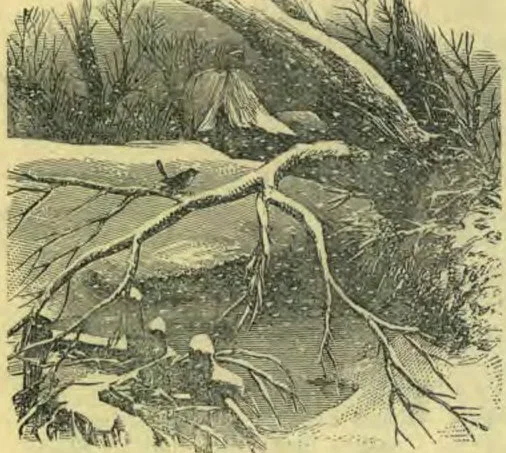
THE SNOW-BIRD.
By Augusta Moore
Where doth the snow-bird sleep?
The stormy winter’s night comes on apace;
Thick falls the snow—knows it a sheltered place,
Where it can snugly creep,
And, safe and warm, its dusky pinions fold?
Where doth He hide his snow-birds from the cold?
All day the dark-winged flock,
About my window hopping, chirping, come,
Asking of Tiny Lu, a seed, a crumb,
From his abundant stock.
With small, faint song,
With twitter, and with low and pleasant hum,
Hungry and bold, nimble and brave, they come,
Swept with the snow along.
They frolic in the snow,—
They dance with the white flakes,
And every small foot makes
In the pure covering its tiny track,
While stars and spangles deck each little back.
They frolic in the snow
That falls so thickly round
O’er all the frozen ground;
But do the gay ones know
Where they this freezing night may hide away,
And all securely until morning stay?
Close to the glass they creep:
In at the panes they peep,
Holding strange Masonry with Tiny Lu;
And their enticing ways,
And all their antic plays,
Are full in the lone captive’s charmed view.
They see the shadows fall,
And to each other call,
And Tiny Lu replies and tries to go
Out to the hardy brood,
With whom he shares his food,—
The little dusky elves that haunt the snow,
Eagerly, but in vain,
He smites the window-pane.
O foolish little bird, where wouldst thou fly?
Thy nest is safe and warm,
Nought shall my birdie harm,
But out in the cold snow he soon would die.
Where do the snow-birds sleep?
Where doth He safely keep
His hardy, happy little winter sprites?
I know their haunts by day—
But see—they haste away—
Where does He shelter them these stormy nights?
—Augusta Moore.