Brother L. I. Sage, who is in the music business at Ventura, California, has agreed to sell pianos, organs, and small instruments on easy payments at one-third discount to all readers of the SIGNS OF THE TIMES. Direct all correspondence to L. I. Sage, Ventura, California.
Choose Ye This Day
Presents in an impressive manner the fact that it is ours to choose whom we will serve, and represents what will be the result of our choice. A. G. L. No. 14. 50 cents per 100.
PACIFIC PRESS PUBLISHING CO.
New York City Oakland, Cal. Kansas City, Mo.
A HINDU MELA.
The mela is a great religious festival among the Hindus. A party of missionaries recently attended a mela held on Sangor Island, at the Hooghly mouth of the sacred Ganges. Their purpose was to study the natives and their religious ideas, and if possible to reach them with the Gospel. The following spirited account of the festival was written by Mr. Wroten, one of these missionaries. It shows in a strong light the debasing influence of heathenism. In contrast with this picture consider what the Bible and Christianity do for a people, and you will surely say with the psalmist, “Happy is that people whose God is the Lord.”
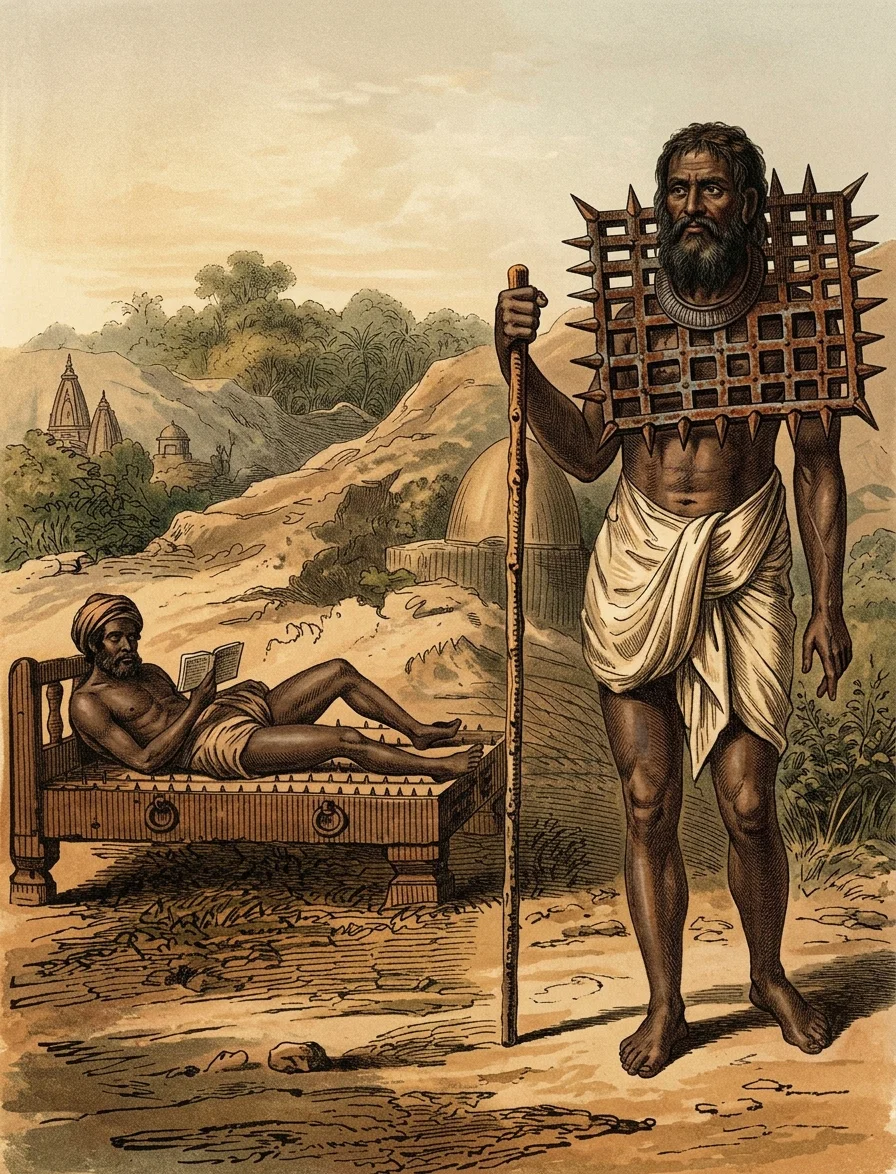
Hindu Tortures.
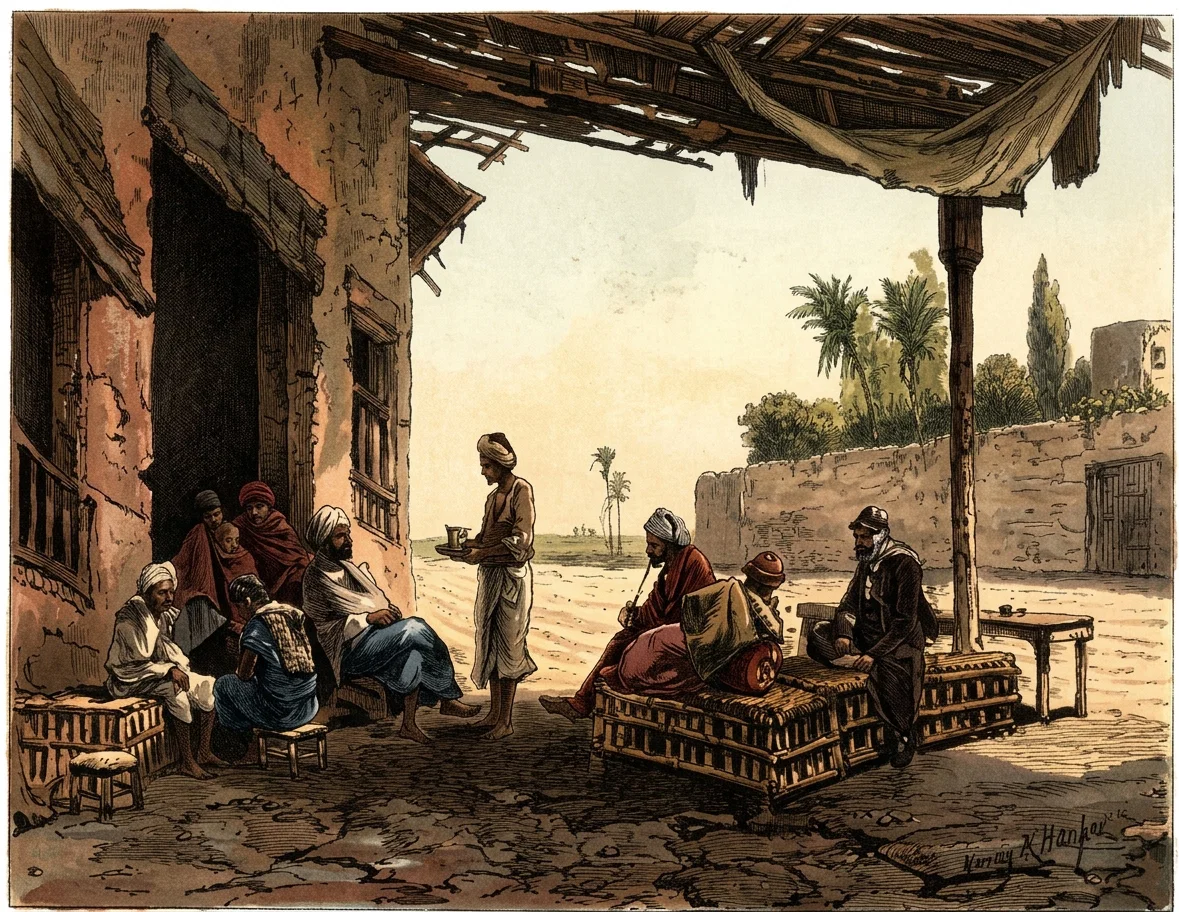
A Native Household, India.
Mr. Wroten says:—
“Sangor Island is densely covered with jungle, offering cover for tigers, cobra, etc., so that people do not wander far from the beach.
“The people come from great distances, at enormous expense and trying experiences, reminding one of the crusades, only perhaps not on so grand a scale. If one dies on such a pilgrimage, he is sure to escape being born into this world again. The one aim of the Hindu seems to be to escape being born into the world again, and if he can not escape another world-life, at least to escape being born the second time a woman. Poor pilgrims are on this journey to whom twenty-five rupees (about $8) would be a small fortune. The cost of the pilgrimage represents the savings of many long and weary months.
“I saw poor human creatures who had been brought down sick to the water’s edge, where the tide might play with their feet, in the hope that, if they died, they might pass away with their feet in the holy water. Shriveled old women and decrepit old men are conducted thither by children and grand children, who believe that death on such a journey would mean immediate absorption into the supreme God.
“As they come, many of the more earnest of them fast, and arrive weak and emaciated. The climate is delightful for a European or an American at this season [mid-winter], yet even he must clothe himself very warmly. These poor unfortunates come with less clothing than they ordinarily wear, and they are pinched and humped up with suffering from cold. The amount of merit accumulated is commensurate with the intensity of the suffering. After such experiences, lasting a month in some instances, they return with the good gods ready to bestow favor, and the bad ones all satisfied.
“I suppose at this mela there must have been thirty or forty thousand worshipers, altogether, and of this number a thousand were fakirs. Such a sight I never saw, and am wholly unable to describe. The fakir is the ascetic of Hinduism, who denies himself and sacrifices in every possible way—always publicly and with great ostentation. They beg and wander about and keep themselves in the most unkempt way, becoming objects that the dirtiest animals might well scorn. To grant them a crust of bread, or serve them in any manner, procures favor, so that they are never at a loss for means to live. These beastly fellows gathered in Calcutta from various directions, and from that place a wealthy native merchant chartered a small steamer to bring them on down to the island. He would surely get some return from the gods for such encouragement and help to these holy men; perhaps larger gains in his business than ever before. To help them out of the ship into the smaller boats and get covered with the ashes and filth of their bodies is meritorious. Their hair and whiskers are never cut nor cared for. The hair becomes long, tangled, matted, and bleached in the sun until it is the most ugly and unsightly head imaginable. At death this wealth (?) of hair is presented to the gods. A piece of cloth, perhaps twelve inches square, serves for raiment entire.
“I saw many of them lying on beds of spikes, which are made and brought along especially for the occasion, and located in the most conspicuous places. Here women come and touch their feet, and then their own tongues and foreheads in adoration. I saw some of them even getting down on their knees and bumping their foreheads on the ground in reverence to these frightfully degraded men. I saw two men who had held their right arms in an upright position until they had become withered and permanently stiff; and I saw one man who had both arms erect and semi-petrified. What untold agony it must have cost no one can estimate. The nails on the fingers were never pared, until they had grown to a length of seven or eight inches, and had curled all about the fingers and hands. In one place I saw fifty-two of them sitting in a circle on the sand eating from pieces of banana leaves something which some benevolent native had furnished, and among them was one with a rigid arm. As I came near them, he motioned with his other hand, asking me to stay back; for they were holy, and I would defile them with my presence.
“From the appearance of these so-called holy men one would gather that their conception of God is the most horrid imaginable. We gather the Hindu’s idea of God from their holy men and their methods of worship. Their temples and idols re-enforce this conclusion that the Hindu deities are horrible objects. To me their presence makes hell instead of heaven.
“Every monstrosity and deformity which could be found was brought along as an object of worship. Idols big and little, gods and goddesses, animals and inanimate,—before them all they cast their sweets, rice, and flowers. A man with a deformed leg, and foot with only two toes, stood with the help of a crutch and received their gifts and veneration. A blind man lay on the ground beating his chest with his hands and pounding his head into the sand, calling upon Ram, while the people showered him with rice—a man sitting near to take care of the money. Some had their heads buried in the sand, and some were entirely under, with the exception of a hand with which they were telling their beads in prayer, and all these received donations from the pilgrims.
“Of course there was more or less chicanery about it, but the ignorant and superstitious believed all they saw and contributed accordingly. There were several calves and cows with extra legs or humps on the back, and, adding this deformity to the sacred ness of the animal as generally received, they were sources of large income to the owners. A commercial aspect pervaded the entire system; nearly everybody appeared to be endeavoring by ‘hook or by crook’ to get money.
“I have said nothing about the obscenity connected with the whole festival, because much of it was deplorable beyond mention. The natural man is not bad enough according to Hinduism, but there is need of manufactured representations to give his evil propensities an added impetus. Men and women before unnamable shrines, and all this under the name of religion. Nothing read from books by the Western world can give a true realization of the depravity of the Hindu mela.
“In the midst of the worshiping throng the Christian feels like stopping his ears to keep out the din and jargon, shutting his eyes to save himself the unseemly spectacle, and closing his nose against the nauseating stench. I wondered at the patience and mercy of a tolerating God, and tried to reason out some excuse why He did not take the foundation from under the island, and let the whole disgusting and demoralizing scene drop into the sea and be no more forever. But these races still exist, and mercy bends to save them.”
OPEN DOORS IN INDIA.
In many cases the missionary is unable to present the Gospel message to the people, because he can not speak their language. But there are many thousands of English-speaking people in India.
First, there are the Europeans. They may not seem a large class in that land of teeming millions; but those who go to India, go there, as a rule, in the employ of the government, or to conduct or assist in conducting some important business enterprise, and so they are usually persons of superior intelligence and good habits.
Second, there are the Eurasians, persons of mixed parentage—European and Asiatic. Of these there are a multitude who are intelligent, English-speaking people.
Then there are thousands of natives who speak English. Many of these are students. It is estimated that in Calcutta alone there are 10,000 university13students. “India graduates more young men from its universities than does England, and they are bright youth. The young men there are men of thought.”
There are thus many thousands in India who can read and understand English. Some are Christians, but many are heathen, infidels, or at least irreligious persons. They need Christ, and there is no language-barrier to keep the Gospel from them. The young people in the universities “like to read and talk English, if but for practise; and so they are ready to hear, ready to flock about you, to look into your eyes,” as they listen to the story of Christ.
“CAST THY BREAD UPON THE WATERS.”
By Mrs. S. A. Howard
“Cast thy bread upon the waters; for thou shalt find it after many days.”
“Cast thy bread upon the waters,”
Tho thou may have scanty hoard;
Every crumb may prove a blessing
If you give it for the Lord.
“Cast thy bread upon the waters,”
Tho thy courage sometimes fail
When thou seest it floating outward,
Sweeping onward in the gale.
“Cast thy bread upon the waters,”
Angel eyes will see it go;
They will know its destination
Tho its progress be but slow.
“Cast thy bread upon the waters;”
Soon will come our just reward—
“Inasmuch” as we have done it,
Gladly, freely, for the Lord.
—Mrs. S. A. Howard.
OUR WORK AND WORKERS.
At Albion, Mich., three heads of families have accepted the truth under the labors of Brother L. N. Lane.
The addition of two members to the church at Poplar Bluff, Mo., is reported by Brother A. P. Heacock.
March 16 and 17, eight persons were baptized by Brother G. R. Hawkins, and added to the church at Dubuque, Iowa.
From meetings held in Washburn, Mo., by Brother D. E. Scoles, six converts are reported in the Workers' Record.
Five persons have taken their stand on Bible truth, as presented by Brethren O. F. Butcher and W. E. Videto, at West Olive, Mich.
An effort is being made to erect a house of worship in Birmingham, England, and it is designed to have it completed this summer.
Reporting to Field Echoes, Brother L. A. Kellogg notes the accession of two persons at Howard City, Mich., and two at Howard.
The first effort to sell Present Truth (our London paper) in the city of Birmingham, resulted in the sale of thirty copies in two hours by one person.
A more aggressive effort is to be made in New York City, and to this end, Brother S. N. Haskell and wife have been assigned to that important field.
Concerning the work in and around Stockton, Cal., Brother J. S. Harmon reports the baptism of four candidates on March 30, and four more on April 13.
The annual camp-meeting of Minnesota Conference will be held at Anoka, June 4-12. The regular session of the conference will be held in connection with this meeting.
The General Conference has invited two of its ex-presidents to occupy foreign fields,—Brother O. A. Olsen, to go to South Africa, and Brother G. A. Irwin, to Australia.
The General Conference executive committee is now composed of twenty-five members, of which Brother A. G. Daniells is chairman. He is also president of the Lake Union Conference.
Brother J. E. Jayne, who has been holding the office of secretary of the Foreign Mission Board, returns to his former position of president of Atlantic Conference. Brother A. E. Place, who has been president of Atlantic for the past two years, now becomes president of New England Conference.
Among the many assignments to foreign fields by the late General Conference, we note that of Brother J. N. Anderson and wife, of Harvey, Ill., as missionaries to China. These are the first regular missionaries of the denomination to China proper. Brother A. LaRue has been doing ship missionary work in Hongkong.
The six General Conference Districts in America have been organized into union conferences. District No. 1 is now known as Eastern Union Conference; No. 2, as Southern Union Conference; No. 3, as Lake Union Conference; No. 4, as Northwestern Union Conference; No. 5, as Southwestern Union Conference; No. 6, as Pacific Union Conference.
The executive committee of the Religious Liberty Department of the General Conference is composed of the following persons: A. T. Jones (chairman), E. A. Sutherland, David Paulson, A. Moon, S. H. Lane. The Mission Committee is composed of the following: A. G. Daniells (chairman), J. H. Kellogg, David Paulson, A. J. Read, E. A. Sutherland, I. H. Evans, W. C. White, H. F. Rand, W. T. Knox, A. T. Jones, W. W. Prescott.
A sister in Belfast, Ireland, writes to the Missionary Worker about the blessing attached to the little book, “Steps to Christ.” She says: “I have sold about forty of them to ministers of all denominations, some of whom have recommended the book from the pulpit. In all I have disposed of over four hundred copies, my customers including lords and titled ladies. Some of them have been willing to talk about Jesus. There are houses in which I have sold six books, not in my own strength, but thru the power of God.”
A LATTER-DAY MARTYR.
D. H. CLARE, of Waverly, N.Y., recently received a letter from a friend across the sea, in which the following pathetic incident is related:—
“Never shall I forget the impression made by a wonderful prayer offered by a Chinaman at a meeting in Shanghai just before I left for Japan. He was a member of a native church near Tien-Tsin, and was going back there with every expectation of death at the hands of the Boxers. He prayed, ‘O Lord, we rejoice in persecution, as Thou hast taught us; and as Thou knowest it is harder to live a martyr life than to die a martyr death, grant us grace to offer this smaller service acceptably when Thou shalt call upon us. Should any, like Peter, deny Thee in the hour of trial, O Lord, wilt Thou turn and look upon him as Thou didst upon Peter, and by that look call him into the life of witnessing with power, to which Thy disciples of old were called.’ This man, with sixty others of his church, has since offered that ‘smaller service.’”
India’s Famine Losses and Relief
LORD CURZON, the Governor-General of India, has been reviewing the situation in that country since the famine. He says that a rough estimate places the annual agricultural production of India and Burmah at between 300 and 400 crores of rupees, a little less than $1,500,000,000. A very cautious estimate places the production of the past year at one-fourth, if not one-third, below the average, indicating a loss of at least $250,000,000. Adding to this the value of the millions of cattle lost, some conception may be formed of the destruction of property. He then pointed out the injury done by cholera, dysentery, and the enfeebled condition of the population. He describes the course taken by the government as one of unprecedented liberality, and affirms that there is no parallel in the history of any country in the world to the total of over 6,000,000 persons who in British India and the native States for weeks in succession were dependent upon the charity of the government. The direct expenditures amounted to over $40,000,000, while a large sum was advanced to landholders and cultivators, besides the loans made to native states.
Methodist Mission Work at Inhambane
“INHAMBANE, one of the oldest Methodist mission points of the East African Coast, was for centuries the headquarters for slavery. The town, made up of several hundred Portuguese and a few Dutch, English, and other traders, and many natives, is located on a beautiful bay with two or three hundred miles of inland coast. A mission station is situated on this bay about four miles from the town, in a healthful location. The New Testament has been translated into the Tonga dialect and also into the Sheetswa dialect.
“One of the most interesting phases of the work is that being done by converts from heathenism. A native teacher with his wife, on a salary of a few dollars a month, will establish himself in a town and with the assistance of the natives build a house out of native materials, and here will be parsonage, church, and school-house, abundantly good enough for the people.”
Mission Work in the Madeira Islands
GREAT interest centers in the work in the Madeira Islands, a group off the northwest coast of Africa, which for four hundred years have been dominated by the Roman Catholic Church. The inhabitants are Portuguese white people, with a colony of perhaps 100 Europeans, mostly English, engaged in trade. The city of Funchal, the capital, contains 50,000 inhabitants, and the islands 120,000. The Methodists have rented a mission property in the city, and in the beautiful mountains fourteen miles away, an interesting and growing mission has been established.
African Hospitality and Missionary Health
A LADY missionary in Africa tells this story, which points its own moral:—
“It is a very common thing among the Africans when strangers go among them to make them a present of a chicken, a goat, or a bullock.
“When I went they did not give me anything, and I several times told them they had never treated me right, for they had not even given me a chicken. They always replied: ‘No, and we don’t mean to give you anything either, for when the first white people came here we gave them a sheep and a bullock, and they killed them, and ate so much fresh meat that they died from the effects of it, and we don’t want you to die, so we won’t give you any.’
“It is a remarkable fact that during the last four years there has not been a death among our white missionaries in all Africa. People are learning to take better care of themselves, and in proportion as we do we have better health. There is, no doubt, some truth in what the native said about the death of the two missionaries.”
Woman’s Influence in Mission Work
By Mrs. Duncan McLaren
Our responsibility in regard to mission work is plain and pointed, because of woman's prevailing influence. Superstition forges many a heavy chain, and it is always around woman's neck that the links are most tightly fastened. Clinging with tenacity to customs hoary with age, she comes in many instances to hug these chains; thus we find that in dark heathen lands woman is ever the great obstructor to the spread of the light. It is her hands that raise the highest barriers against the truth; it is from her lips that the poison flows that enters deepest into the life of the nation; for, shut out from all that would enlighten, woman instills into her children's minds the darkness of her own.—Mrs. Duncan McLaren.
Scriptures Printed in Over Four Hundred Languages
THE British and Foreign Bible Society reports that at the beginning of the nineteenth century the Scriptures, in whole or in part, were printed in only thirty-five living languages, whereas the number now is over four hundred. With few exceptions, the great languages of the world have the entire Bible; thus the Word of God is given in the speech of seven-eighths of the population of our globe.—Missionary Herald.
Missionaries Slain in China
The Missionary Review publishes a list of about 180 missionaries, including women and little children, that were slain in China in connection with the Boxer troubles in that country. Nearly all of them perished in June, July, and August, 1900.
The Need for Missionaries in India
It is said that if the people of India stood holding hands, they would form a line that would reach three times around the globe; and “there is only one Protestant missionary to every quarter of a million of the people.”
Missionary Work in the Gilbert Islands
A MISSIONARY who is visiting the different island groups of Micronesia, writes from the Gilbert Islands that there is a “steady improvement in the missionary work, and that heathenism and good laws are each battling for the supremacy.”
Kindness and the True Religion
“A FARMER in the north of India said to a missionary, ‘I believe in Christ and His religion, for it must be the true religion which makes your people so kind to the poor and the sick.’”
Buddhist Prayer to Nobody
“A MISSIONARY asked a worshiper in India, ‘What are you doing?’ He replied, ‘Praying.’ ‘To whom?’—‘Nobody.’ ‘For what?’—‘Nothing.’ This is Buddhism, praying to nobody for nothing.”
Methodist Mission Church Raises $1,200
The Methodist mission church at Monrovia on the West Coast of Africa, raised last year, for all purposes, a fund of $1,200.
Lodging at the Pan-American Exposition
THE managers of the Star of Hope Mission, Buffalo, N. Y., have decided to furnish accommodations to a limited number of visitors at the Pan-American Exposition. The price for lodging will be 25c and 50c per person a night; breakfast 15c. The managers will also furnish lodging in private families at the regular rate ($1.00 per person for lodging, and 25c for breakfast), to those who desire it. Write as soon as possible, stating about when you expect to come, and for how many you desire accommodation. The mission is located a short distance from the depots. Address Star of Hope Mission, 67 Washington St., Buffalo, N. Y.
A RARE OPPORTUNITY.
In consequence of a business transfer, we are prepared, temporarily, to furnish “Coffarine” to SIGNS OF THE TIMES readers at one-half of retail price, which has been 25 cts. per 1½ lb. package. We will fill orders received at once at $3.00 per case, each case containing 24 packages. “Coffarine” is so well known as a pure, delicious, healthful, and nutritious beverage that many will undoubtedly avail themselves of this liberal offer. Therefore order early. Special prices for larger quantities. Helping Hand Mission, 641 Commercial St., San Francisco, Cal.
1 “The former treatise I made, O Theophilus, concerning all 2 that Jesus began both to do and to teach, until the day in which He was received up, after that He had given commandment thru the Holy Ghost unto the apostles whom He 3 had chosen; to whom He also showed Himself alive after His passion by many proofs, appearing unto them by the space of forty days, and speaking the things concerning the kingdom of God; and, being assembled together with them, He charged them not to depart from Jerusalem, but to wait for the promise 4 of the Father, which, said He, ye heard from Me; for John indeed baptized with water; but ye shall be baptized with the Holy Ghost not many days hence. 6 “They therefore, when they were come together, asked Him, saying, Lord, dost thou at this time restore the kingdom 7 to Israel? And He said unto them, It is not for you to know times or seasons, which the Father hath set within His 8 own authority. But ye shall receive power, when the Holy Ghost is come upon you; and ye shall be My witnesses both in Jerusalem, and in all Judæa and Samaria, and unto the uttermost part of the earth. 9 And when He had said these things, as they were looking, He was taken up; and a cloud received Him out of their sight. And while they were looking steadfastly into heaven as He went, behold, two men stood by them 11 in white apparel; which also said, Ye men of Galilee, why stand ye looking into heaven? this Jesus, which was received up from you into heaven, shall so come in like manner as ye beheld Him going into heaven.”
Golden Text: “While He blessed them, He was parted from them, and carried up into heaven.” Luke 24:51.
SUGGESTIVE QUESTIONS.
(1) What former work is referred to in this lesson? Who was the author of the book of Acts? Verse 1. Note 1. (2) What did that “former treatise” include? Verse 2. (3) What proof have we of Christ’s resurrection? Verse 3. Note 2. (4) What command did Jesus give to His disciples at the close of the forty days? Verse 4. Note 3. (5) How did Christ compare John’s baptism with that which He now promised them? Verse 5. (6) What did the disciples ask Him in regard to His kingdom? Verse 6. Note 4. (7) How did Jesus answer this question? Verse 7. Note 5. (8) What were the disciples to receive as a result of the baptism of the Holy Ghost? What would this power enable them to do? Verse 8. Note 6. (9) When Jesus had thus spoken, what took place? Verse 9. Note 7. (10) As the disciples gazed after the ascending Lord, who appeared to them? Verse 10. (11) What did these wonderful beings say? Verse 11. Note 8.
NOTES.
1. The “former treatise” addressed to Theophilus was the Gospel according to Luke. See Luke 1:1-4. This shows that the book of Acts was written by Luke, the “beloved physician” (Col. 4:14), and companion of Paul (2 Tim. 4:11; Philemon 24).
2. “Many Proofs.”—In past lessons several of these evidences have been given. Paul rehearses some of these proofs in 1 Cor. 15:4-7, a very striking one, to the ordinary mind, being that “He was seen of above five hundred brethren at once.”
3. The “promise of the Father,” as shown in verses 5 and 8, was the Holy Spirit. The promise had been made thru the prophet Joel (Joel 2:28, 29) and by John the Baptist (Matt. 3:11).
4. The expected restoration of the temporal kingdom of Israel had yet a strong hold upon the minds of the disciples of Christ, notwithstanding His plain instruction on the subject. It was this ingrained thought that stood in the way of the Jews generally, and kept them from understanding the mission of Christ and the true nature of His kingdom. But this is not nearly so surprising as the present-day delusion among Christians in looking for the same thing—the restoration of a Jewish racial kingdom in Palestine.
5. “It Is Not for You to Know.”—The things that are not for men to know are, as a rule, the very things they are most anxious to know. And this is the cause of much speculation, and “foolish and unlearned questions,” which we are enjoined to “avoid.” 2 Tim. 2:23; Titus 3:9. All that we need to know of God’s ways is revealed in His Word. See Deut. 29:29. But because we know not the time of Christ’s coming, is the very reason we should watch, lest He come and find us unprepared. Matt. 24:42-44; 25:13; Mark 13:32-37.
6. “Power.”—According to Luke 24:49, this power was “from on high.” It came in connection with the Holy Spirit, and the purpose was to enable the disciples to be witnesses for Christ. True witnessing is not only telling the truth to others, but living it before men. It all requires power. Christ says, “Without Me ye can do nothing,” and the Holy Spirit is the presence or representative of Christ, which supplies the needy with power. (See also article entitled, “Ye Shall Receive Power,” on page 6 of this paper.)
7. “While They Beheld.”—Christ did nothing in secret. John 18:20. He was manifested to the world. And especially was everything made clear to His disciples. See John 15:15. So His ascension was no exception; He went up in plain view of the disciples, as far as they were able to see Him.
8. “Why Stand Ye Looking?”—It was hard for the disciples to grasp the situation. They could only gaze after their Lord, and wonder. But He had promised not to leave them comfortless (John 14:18), and already the angelic ministers (Heb. 1:14) were on hand with the same comforting message that He had given them before. This time, however, the exact manner of His coming was given them. If this definite instruction were borne in mind, there would be less false doctrine promulgated in regard to the second advent of Christ. The words of the angels accord with Christ’s previous instruction recorded in Matt. 24:23-27. See also Matt. 25:31-46, and 1 Thess. 4:15.
THE SABBATH SCHOOL
LESSON 8.—MAY 25.—ALTAR OF INCENSE, THE VAIL, AND ARK.
[Note to the Student.—These lessons are not designed to be exhaustive, but suggestive. In references to the “Desire of Ages,” in the lessons, the subscription edition is referred to. Those who have only the trade edition will find the matter in chapters 1, 4, 11, 27, 77, 78; also read “Patriarchs and Prophets,” chapters 5 and 30. “Christ Our Advocate,” Bible Students’ Library No. 120 (price, 10 cents), and “Looking unto Jesus” (price, $1.00) will be found a great help. The SIGNS OF THE TIMES will have an article on the subject of each lesson this quarter by J. O. Corliss. Read these articles in connection with the study of the lesson. We have not space to print all the scriptures. Let the student study them carefully from the Bible. Those printed are from the Revised Version.]
SUGGESTIVE QUESTIONS.
1. Where was the altar of incense placed?
“And thou shalt make an altar to burn incense upon; of acacia wood shalt thou make it.”
“And thou shalt put it before the vail that is by the ark of the testimony, before the mercy-seat that is over the testimony, where I will meet with thee.” Ex. 30:1, 6. (Ex. 40:26.)
2. For what purpose was it used? When was it offered?
“And Aaron shall burn thereon incense of sweet spices; every morning, when he dresseth the lamps, he shall burn it. And when Aaron lighteth the lamps at even, he shall burn it, a perpetual incense before the Lord throughout your generations.” Ex. 30:7, 8.
3. With what was the offering of incense connected? Of what was it a symbol?
“Let my prayer be set forth as incense before Thee; the lifting up of my hands as the evening sacrifice.”
“And another angel came and stood over the altar, having a golden censer; and there was given unto him much incense, that he should add it unto the prayers of all the saints upon the golden altar which was before the throne. And the smoke of the incense, with the prayers of the saints, went up before God out of the angel’s hand.” Ps. 141:2; Rev. 8:3, 4. (Note.)
4. For what purpose was the second vail?
“And he made the vail of blue, and purple, and scarlet, and fine twined linen; with cherubim the work of the cunning workman made he it. And he made thereunto four pillars of acacia, and overlaid them with gold; their hooks were of gold; and he cast for them four sockets of silver.” Ex. 36:35, 36. (Ex. 40:3, 21; Heb. 9:4.)
5. What was connected with the ark that needed to be vailed?
“And the Lord said unto Moses, Speak unto Aaron thy brother, that he come not at all times into the holy place within the vail, before the mercy-seat which is upon the ark; that he die not; for I will appear in the cloud upon the mercy-seat.” Lev. 16:2.
6. What was represented by the vail? Into what place may we now come?
“Having therefore, brethren, boldness to enter into the holy place by the blood of Jesus, by the way which He dedicated for us, a new and living way, thru the vail, that is to say, His flesh.” Heb. 10:19, 20.
7. What was placed within the ark?
“And thou shalt put into the ark the testimony which I shall give thee.” Ex. 25:16. (Deut. 10:4, 5.)
8. With what was the law covered?
“And thou shalt put the mercy-seat above upon the ark; and in the ark thou shalt put the testimony that I shall give thee.” Ex. 25:21.
9. Where was the blood of the atonement sprinkled?
“Then shall he kill the goat of the sin-offering, that is for the people, and bring his blood within the vail, and do with his blood as he did with the blood of the bullock, and sprinkle it upon the mercy-seat, and before the mercy-seat.” Lev. 16:15.
10. Where does our hope center?
“Which we have as an anchor of the soul, a hope both sure and steadfast and entering into that which is within the vail; whither as a forerunner Jesus entered for us, having become a high priest forever after the order of Melchizedek.” Heb. 6:19, 20.
11. What confidence should this give us?
“Let us therefore draw near with boldness unto the throne of grace, that we may receive mercy, and may find grace to help us in time of need.” Heb. 4:16.
NOTE.
“Day and night the holy incense diffused its fragrance throughout the sacred apartments, and without far around the tabernacle.” “The incense, ascending with the prayers of Israel, represents the merits and intercession of Christ.” “In the offering of incense the priest was brought more directly into the presence of God than in any other act of daily ministration.”—Patriarchs and Prophets, pp. 348, 353. So in prayer we are brought nearer to God than in any other act of worship.
When you go East, take
“The Overland Limited”
Via UNION PACIFIC RAILROAD
Less Than Three Days to Chicago
Four Days to New York
Leaves Oakland Daily at 10:36 A. M.
“The Fast Mail”
Three and One-half Days to Chicago
Both Pullman and Tourist Sleepers through to Denver, Kansas City, Omaha and Chicago Daily without Change. Leaves Oakland at 6:44 P. M.
EVERY DAY IN THE YEAR
PERSONALLY-CONDUCTED TOURIST EXCURSIONS TO THE EAST EVERY WEDNESDAY AND FRIDAY EVENINGS
Steamship Tickets to and from all points in Europe by all trans-Atlantic steamship lines
H. V. BLASDEL, Passenger Agent
1160 Broadway, Oakland, Cal.
Good Health
By Editor
Everybody wants it who hasn't it, but it is not always easy to get it
GOOD HEALTH is the leading health journal of the world, and no household should be without it. It is the purpose of this magazine to give scientific instruction to those who are well whereby they can keep well; to the sick whereby they may be able to get well. Subscribers are at liberty to ask questions, which are answered in the correspondence department by the editor.
A special offer is made to subscribers for the next sixty days. Send us a year's subscription to Good Health, $1.00, and the names of five persons who ought to be interested in the question of diet, and we will send you Good Health for one year, postage prepaid, and our
FAMILY BOX FREE
Just think of it! $1.50 worth of Battle Creek Sanitarium Food Co.'s and Sanitas Nut Food Co.'s cereal and nut foods, and other household necessities, and a year's subscription to Good Health, a 64-page magazine, 800 pages a year, all for $1.00. We could not do this only that the manufacturers have made us a present of these articles to use for this purpose, well knowing that the merits of the foods will secure for them sufficient trade to pay their expense. Cut out this clipping and send to us with $1.00 and we will do the rest.
N. B.—We do not pay freight or express charges. Have the goods go by freight. One Family Box weighs 14 pounds. Get six persons to join with you, which will make 100 pounds. Have all shipped to one address, and the expense will be but a few cents each.
GOOD HEALTH PUBLISHING COMPANY
Battle Creek, Michigan