The Youth’s Instructor, Vol. 34, No. 21.

The Silence of the Hills

The Youth’s Instructor

May 26, 1886

S. D. A. Publishing Association · Battle Creek, Mich. · May 26, 1886

The Silence of the Hills.

The windy forest, rousing from its sleep, Voices its heart in hoarse, Titanic roar; The ocean bellows by its wave-beat shore; The cataract that haunts the rugged steep Makes mighty music in its headlong leap; The clouds have voices; and the rivers pour Their floods of thunder down to ocean's floor. The hills alone mysterious silence keep. They cannot rend the ancient chain which bars Their iron lips, nor answer back the sea That calls to them far off in vain. The stars They cannot hail, nor their wild brooks. Ah me! What cries from out their stony hearts will break In God's great day, when all that sleep shall wake!
—W. P. Foster, in Scribner's.

MOUNTAINS

WHY the Creator has heaved up so large a part of the earth into vast mountains it may be hard to tell, but it is certain that in doing so he has given us ideas of grandeur that could not be had from any thing else in nature. The ocean is grand, especially in a storm; but there is such a sameness in it that the eye seems to take in but little. The sky appears to shut down so close, and to leave us such a narrow circle, that we long to have the curtain lifted, and a wider view opened before us. We know rather than see that the ocean is vast, and it is this knowledge that gives us a feeling of solemnity.
But the rugged mountain, with its beetling cliffs, its yawning gulfs, and its summit lost among the clouds, does not deceive the eye like the ocean. We realize the awful magnitude of the object before us. It makes us feel our own littleness, and gives us a glimpse of the power of God.
It may be on account of their awe-inspiring character that mountains have been chosen for the scene of the grandest events of the world's history. It was from a mountain-top that Noah and his family looked out upon the face of the new earth as it rose out of the flood. It was upon the crest of Sinai that the awful presence of the Lawgiver was manifested. Upon Carmel the fire from heaven descended; and it was upon a mountain that the prophet of God heard the “still, small voice.” On a mountain our Saviour was tempted, on a mountain he was transfigured, and from the Mount of Olives he ascended to heaven. We also read that he went up into a mountain to pray, and it was on a mountain that he preached his most memorable sermon.
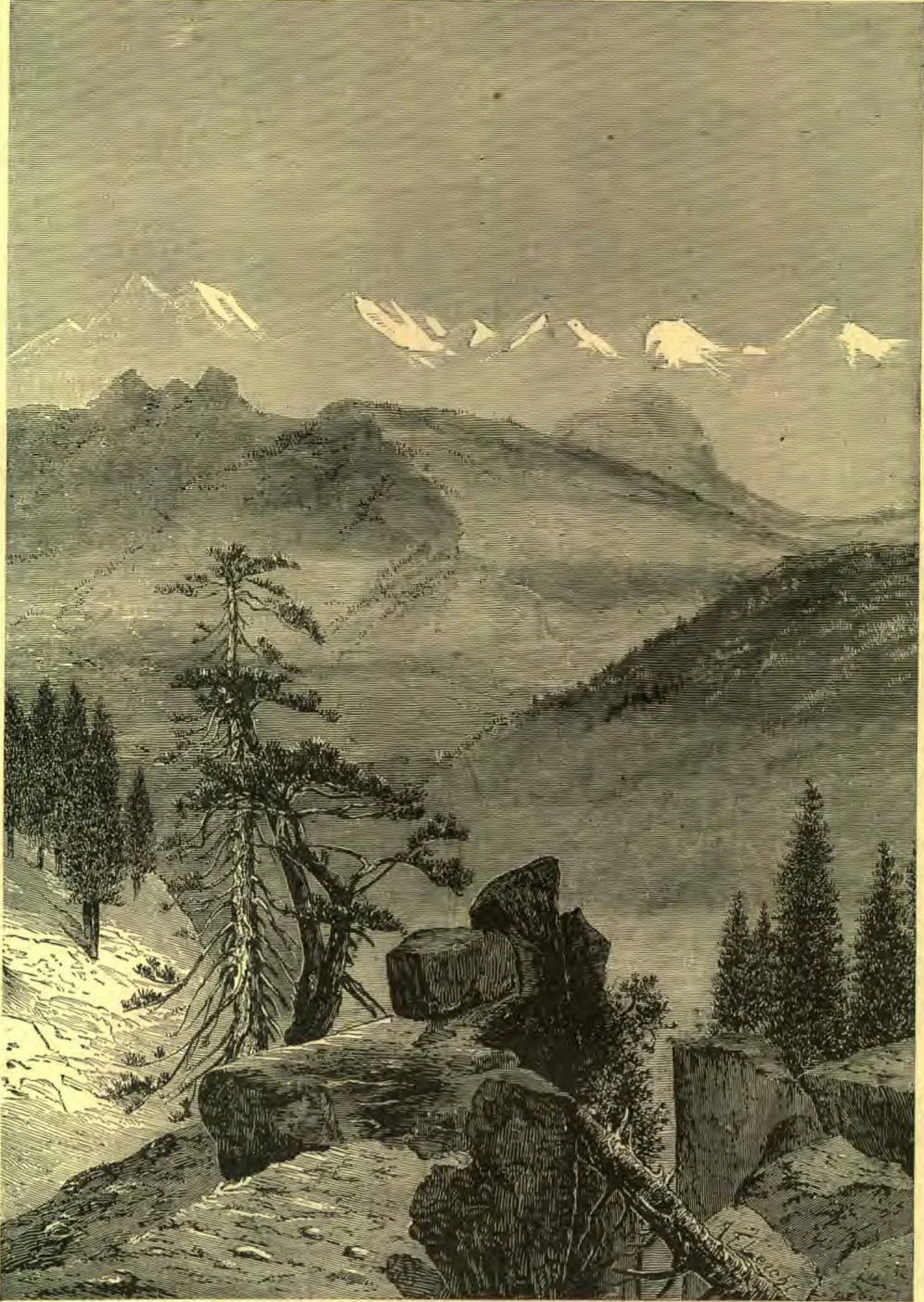
The picture on this page represents a scene among the Sierras [See-err-rahs.] Sierra is a Spanish word. It comes from the same source as serrate, which means “toothed like a saw.” It is applied to a number of mountain ranges, both in Spain and in those parts of America explored first by the Spaniards. Its application to a mountain range seems quite natural, since a long line of peaks seen against the sky, would present, on an immense scale, a toothed edge like that of a saw.
The loftiest group to which this term is applied, is the Sierra Nevada [Nay-vah-dah] range of Spain. Translated into English, the name is the Snowy Range.
Although so near the sea, these mountains are nearly twelve thousand feet above it; and, as a consequence, very abrupt and grand. Their highest summits are always covered with snow for more than two thousand feet from the top. These glistening white peaks can be clearly seen in the back-ground of the picture, with the sun shining brightly on one side of them.
The snow keeps growing deeper and deeper, until great masses of it break away, and slide down the mountain.
By being piled so high, and pressed so hard, the snow becomes almost as heavy as ice; and when a vast amount of it shoots down the mountain-side, it soon gains such speed and force as to sweep every thing before it. Trees, rocks, and great quantities of earth, are carried along swifter than the flight of an arrow, and towns are sometimes buried, or hurled with their inhabitants into the depths below. Such a snow-slide is called an avalanche.
After a time, the great masses of snow gathered in the steep gorges and valleys change to little granules of ice, and the whole body of it is more like a heap of fine hailstones than it is like snow. Now the whole mass, pressed by the weight above, begins to move slowly down the mountain.
The motion is so slow that it cannot be seen, but if a pole is stuck into the glacier (for so this great moving mass of ice is called), it will be noticed, after a few hours, that the pole is several feet lower down the mountain than it was at first. As it reaches the lower slopes of the mountain, where the weather is warmer, the sun melts the ice on the surface of the glacier; and the water thus formed, as it trickles down through the loose particles of the cold layers beneath, freezes, and binds the whole together in a solid mass. Sometimes the glacier reaches the sea, and is pushed way out over the water, until by and by a great lump, hundreds of feet deep, is broken off by its own weight, and moves out to sea,—a floating mountain of ice. It is in this way that icebergs are formed.
G. H. BELL.

OPEN WINDOWS.

Ethel Rand was complaining to her Sabbath-school teacher that things were always going crooked with her.
“I try to be good, but some way, before I think, I am in a bad humor, or am doing something I ought not to do. And it isn't because I don't pray either; I say my prayers every morning and evening, except when I forget, once in awhile.”
“I am sorry you have so much trouble,” Miss Parker said; then, as if changing the subject, added, “When you go down stairs in the morning, do you leave your room shut, or do you open the windows and air it?”
“We always air it well.”
“And at night do you have the windows entirely closed?”
“Oh, no, we always open one window at the top and bottom,” Ethel answered, somewhat surprised at these questions.
“Why do you do that? If the room is once well aired, isn't that enough?”
“No; because when we are in the room so long, we are using all the good air, and need to have more coming in all the time.”
“That is true; if you keep the room tightly closed, you would not rest well, and would waken with a dull, heavy feeling, and probably a headache. Now it is much the same in your spiritual life. Without God's Spirit you will be restless and uncomfortable, continually falling into sin. Just as you open your room wide in the morning to let out the bad air and get a new supply of fresh air, so you should open your heart to God, confessing your wrong-doings and asking his help to keep you in the right way. This earnest prayer—not a thoughtless saying over of a set of words—will drive out impure thoughts and bring you nearer to God, so that his Spirit will strengthen you. But your heart has so much wickedness in it that it is not safe to shut it up as soon as your morning prayers are over. You need to keep it always open to God, so that he may send new strength whenever the evil threatens to overcome you.”
“How can I do that, Miss Parker?” Ethel asked.
“When any trouble or perplexity comes, ask God to help you meet it in the right way, and then do what you think he would like.”
“I suppose that is what has been the matter,” Ethel said. “I'm afraid that when I do say my prayers, I don't think much about them, and I never think of praying about things when they happen. I just fly up and say something cross, or do what I know I oughtn't, and then afterwards, when I think about it, I see I've been a very disagreeable girl.”
“You must pray every day for God's Holy Spirit to take possession of your heart. But Satan always has great power, and he will fight hard against your effort to drive him out. So you will need constant watchfulness and prayerfulness. If your brother teases you, ask for grace to keep your temper. If you feel cross and impatient, ask for strength to overcome the feeling. This continued leaning on God and seeking to be filled with his Spirit, is like leaving the windows open at night to keep the air pure. If your soul is always ready to receive God's Spirit and guidance, you will not have so many fits of passion and selfish acts to be sorry for when night comes.”
“I never thought of it that way,” Ethel said. “Don't it sound easy to be good?”
“Satan keeps it from being easy. He tries to make us careless and forgetful. He tries all the time to keep us from even wanting to be good, and he watches to catch us when we are not suspecting that there is danger of doing wrong.”
“Well, I will try again,” Ethel said. “And when I open the windows, I will ask God to help me keep the windows of my heart open too.”—Youth's Evangelist.

HOW CHAIRS ARE MADE.

A CHAIR is something that each of us uses every day. Do you ever stop to inquire how they are made? who made them? of what they are made? and where? We ought always to inquire about these things; for that is the way to learn. Have people always had chairs? I do not think Adam had any; and doubtless the first ones were very rude. But now they make them very nice and easy. As we have a large chair-factory in Otsego, I went this morning to look it all through, so as to tell the INSTRUCTOR children how a common chair is made. The factory is that of C. D. Stewart and Co. They make nearly three thousand chairs a week and employ one hundred hands. The hands receive from two dollars and a half to twenty-two dollars a week, according to their skill. They have to keep constantly on hand about one million five hundred thousand feet of lumber, and the work requires a capital of about fifty thousand dollars. All the work is done by machinery, and the factory is run by water.
Mr. A. D. Baker, the foreman, very courteously showed me around, and explained every thing. It would make too long an article to tell you all about it, but I will give you a fair idea of it, if you will think carefully of what I say. Beech, elm, hickory, and maple are the woods chiefly used. Examine your chairs, and see if you can tell what kind of wood they are made of. A tree is first cut in the woods, and a log from this is drawn to a mill, where it is sawed into boards about an inch thick. These boards are then taken to the factory, where they are cut up with a rip-saw into pieces from twelve to twenty-two inches long, and from an inch to an inch and a half square.
Now look at the legs or some pieces of the chair. You see they are nicely carved in various ways. It looks as though it would be a long job to make one; but it is not. One of those square, rough sticks is put into a machine called a lathe, which has a peculiar, sharp knife. The lathe runs by machinery, and in a few seconds it will turn out one of these pieces all nicely shaped and molded. A man will do it about as fast as he can pick them up and lay them down. In a similar manner every round piece of the chair is made. Then the pieces are carried into a hot room where they are thoroughly dried.
How are those crooked pieces in the chair made to keep in place? They did not grow so. Well, long, straight pieces are put in a hot place, and are steamed for several hours, until they will bend without breaking, just like a piece of wire. Then they are put into an iron frame crooked in just the right shape. Now they are placed in a dry, hot room, called the kiln, where they remain two days. They are there thoroughly dried. When taken out, they will stay in just the shape in which you have dried them. That is the way all the crooked pieces are made to stay crooked. But the best timber used in making chairs is dried in the open air. In order to become thoroughly dry, it is kept from two to four years drying.
After the separate pieces of the chair are cut, and worked into the right shape, they are yet rough. For the cheaper chairs, these are all thrown into something like a great hogshead, or barrel, which is turned over and over for a long time, and the pieces smooth themselves by rubbing one against the other. Others are smoothed on a sand machine. This is a large wheel, and it looks just like a grindstone. It is turned by machinery, and the pieces of the chair are held on this until they are smooth. But the best chairs are rubbed smooth by hand, with sand-paper.
The seat of a wooden chair is cut in the right shape by machinery. Often the seat is made of two or three pieces carefully joined together. There are machines on purpose for doing this. The holes for the arms and backs are bored by machinery. In fact, all the work on the chair from first to last, is done by machines. There is a planer, jointer, shaper, boring machine, seat digger, and many more. Here is a disk saw. It hollows out the seats of chairs. Altogether there are about fifty different machines used in making a chair. From first to last, a chair goes through the hands of about fifty different persons before it is completed. Each man just does one part and only one. One man makes the back, another saws the bottom, another makes the legs, still another does the gluing, another the sand-papering, another bores the holes, etc. He stands there by his machine, and does the same little thing over and over hundreds of times a day, and all the year round. He could not make a whole chair any more than I could, but he can make his part of it just right. By working at the same thing year after year he becomes very expert at it. We should learn from this to stick to one thing till we have it perfect.
This factory makes some sixty-five different kinds of chairs. I had no idea that there were so many. I thought eight or ten kinds were all. These are sold for from thirty cents to eight dollars apiece. Some are seated with cane, as you see. The frame is made here, the holes are all bored, and then it is shipped to Lansing, and by very cheap labor, the seats are made, and then it is shipped back again. From this factory, they ship these chairs to all parts of our country, even to California, and some to China. Some are shipped all put together, and painted, and ready for use; but many are shipped in what they call, the “knockdown;” that is, the different pieces of the chair are all made ready to put together, but not set up. The separate pieces are packed and shipped that way. This saves space, you see, and makes the freight cheaper. Furniture dealers in different cities buy them that way. By a few minutes’ work, they can put a chair together, and then it is painted and sold. This will give you something of an idea as to how a common chair is made.
D. M. CANRIGHT.

SEED AND WORD.

A WINGED seed went by One idle summer’s day; Unseen of any eye It floated far away, And in a rocky cleft Unnoticed long it lay, Till lo! far up the toilsome height A floweret cheered the traveler’s sight.
A kindly word was said, In happy, careless mood; On viewless wings it sped To do its work of good, And nestled in a heart Where care had come to brood. And lo! ’mid all that would destroy, There bloomed the perfect flower of joy.
—George Cooper.

BOYS WHO KNOW TOO MUCH.

Knowledge is power; but it is possible for men to have more power than belongs to them, and more than they will use rightly.
Some one asked a person employed about an establishment if he knew how to open the money drawer. “I hope not,” said he; for he knew that it was not his business to do that; and he had no right to find out how a thing could be done when he had no business to do it.
Another person could open every money drawer on the premises; he had experimented until he found out how. Indeed, he knew so much that it was found that he could be spared to go elsewhere.
One knowing fellow can open all the locks in the house; he knows too much by half. Another goes poking through desks and letters, reading correspondence which does not belong to him. Another plays the eaves-dropper, and worms out secrets and peddles them around, and prides himself upon his great knowledge.
Trouble began in this world by people’s trying to know too much. Adam lost the best place a man ever had in this world by eating from the tree of knowledge. Many of Adam’s descendants have also lost good positions by knowing too much.
It is as bad to steal knowledge as it is to steal money. A secret or an invention may be worth millions of money; he who steals it may thus steal millions. If it were money, he could repent and return it; but if it is knowledge, it cannot be returned, the thief cannot carry it back.
Do not try to know too much. See that you know your own business, but do not peer into what does not concern you. Forbidden knowledge often brings sorrow and trouble. When a trunk is robbed, the man whose key fits the lock is suspected. When the money is stolen, they accuse the man who knew where it was hidden. Many a man is in prison to-day because he was too handy with a pen, and could write another man’s name so that you could not distinguish it from the man’s own signature.
If you wish peace and prosperity, do not know too much. He who knows how to do a wrong thing is likely to be tempted to do it. He who never has thought how the wrong could be done, certainly never has done it.—Little Christian.

AN EXECUTIONER’S SWORD

Written for the Instructor.

AN EXECUTIONER’S SWORD.

If any of our young readers have access to Dr. Wylie’s “History of Protestantism,” they will find profitable entertainment in reading of the cruel work of the Jesuits in trampling Protestantism from the Bohemian kingdom during the years from 1620 to 1640, or thereabouts. Not that this was the first Protestant blood shed, or these the first martyrs, on Bohemian soil. Far from that was the reality; for many times previous, during different reigns, had the Roman church inflicted cruel persecutions and tortures upon the Protestants, the most severe of which will probably not be revealed till God shall judge the secrets of men. And having just seen a true picture of the identical sword which put out many great lights in this particular persecution, is why we call attention to this portion of their history.
After the severe calamities which befell the Bohemian church when Ferdinand I. came to the throne were past, and during the reign of his son Maximilian II., until Ferdinand II. ascended the throne, the Protestant church was in a flourishing condition. But the election of the second Ferdinand soon resulted in the battle of White Hill, Nov. 8, 1620, when the Romanists gained a decisive victory over the Protestants, and condemned to the sword some of Bohemia’s most learned and noble men, “the lights and pillars of the kingdom.” The sad, tragic scenes through which these martyrs passed, and the calm faith with which they met their fate, stirs one’s feelings to the very depths.
But not the nobles alone were subjected to harsh treatment. Although after the execution of these great men the rulers did not again set up the scaffold, yet they were not the less determined that none but Catholics should have inheritance in the kingdom. Their new policy was to crush the pastors, shut up the churches, and burn the Protestant books, thinking they could then the more easily subdue the remaining population. Accordingly the ministers were compelled to bid farewell to their flocks which they loved so much, and to leave the kingdom forever. It was a sad parting.
Next the school teachers were driven out; and afterward the Bohemian nobles whose lives were spared the sword were cruelly oppressed and finally forced to sell their estates and goods for a paltry sum, and seek a home elsewhere than in their native country, in many instances the Jesuits taking, by force, their sons and daughters and shutting them up in convents and schools. Dr. Wylie says that “hundreds of the aristocratic families followed the nobles into exile; and of the common people, not fewer than 36,000 families emigrated.”
Of the Protestants that remained, several hundred were sent into banishment, and made to suffer poverty and imprisonment, and were literally “worn out” with cruel treatment, until those of the number who did not make their escape, yielded to the Catholic religion.
Accompanying the picture of the sword to which we have already referred, was an interesting sketch from the Edinburgh [England] Children’s Record, from which we copy the following paragraphs:—
“Four young men from Bohemia are students this winter [1885–1886] at the Free Church College in Edinburgh. On December 1, 1885, there was to be sold a curious collection of ancient armor and arms. Two days before, Mr. Gustav Molnar, one of the Bohemian students, went in, as many were doing, to look at the old swords and helmets and coats-of-mail. One of the things to be sold was an executioner’s sword, with a long list of names engraved upon the blade, of persons whose heads had been cut off by that frightful-looking weapon. What was the amazement of the student when he saw, by the inscription on the hilt in the Bohemian language and by the names upon the blade, that this was the very sword by which those noble martyrs had died upon the scaffold at Prague on June 21, 1621—more than two hundred and fifty years ago.”
“The students at once resolved that they must by all means purchase the precious relic of their martyred fathers—this ghastly but most impressive witness to the truth of that terrible history; and so they ‘bid for’ and bought it. What reality it gives to the whole scene to look at and to put one’s finger upon that still-polished blade, once red and reeking with the noblest and best Christian blood in Bohemia!”
“The sword measures over all, three feet six inches in length; the blade, double-edged, is two feet ten inches long, and four and three quarter inches broad in the broadest part. Under the date ‘1621’ there are twenty-four names of that ‘noble army.’”
“On turning to Dr. Wylie’s ‘History of Protestantism,’ we find that every one of the seven names he mentions as the chief among the martyrs is marked on the blade of this ‘sword of doom,’ the first being that of Count Andreas Schlik.”
“Along the handle of the sword, which is covered with leather, is the following inscription, in faded gilt letters, in the Bohemian language: ‘The last sad deed was done June 21, 1621.’”
“Stamped” at the top, within a small ring, are the letters “C. M.,” the initials corresponding to “C. Mydlar,” the name of the man who is known in history to have acted as executioner on that mournfully memorable day.”},{

Sincerity: Speaking, Doing, and Being What We Profess

SINCERITY is to speak as we think, to do as we pretend and profess, to perform and make good what we promise; and really be what we would seem and appear to be.—Tillotson.

APPLE BLOSSOMS.

At early morn, with dew all laden down, The pink-white petals glisten in the sun, And with their fragrance comes the busy hum Of countless bees, their day's work just begun.
Beneath the trees the snowy petals fall; A sweet perfume fills all the air; While birds among the branches carol songs of love Above the nests they guard with jealous care. —Don Jewell Webb.

TWO WORDS FOR THE TEACHER.

WORDS MOST NEEDED ARE OFTENEST SAID: All teachers are not so Athenian in habit that only “some new thing” can catch and hold them; therefore the hope that a little stress laid here on two plain words may be of some service.
One of them is used by Paul in his second letter to Timothy (2:15)—“study.” The exhortation given here by the great apostle to the young “teacher” at Ephesus, suggests some lines of endeavor which are by no means out of date in our time; without which, indeed, real success is impossible to the Bible-teacher anywhere.
We have in the clause, “Study to show thyself approved unto God,” an ideal motive—the spring of true diligence in all directions. Could anything be more worthy of earnest endeavor? Study here will cut right at the root of shiftlessness in preparation, lifelessness in teaching, and carelessness in living. No teacher can afford to “take the chances” in a matter so vital as this. Risk the approval of self, of class, of fellow-teachers, of superintendent, of pastor, of church, if he will; but at any cost let him make sure of being approved unto God. Let him be like the railroad gate-keeper who, when told by an impatient crowd that he was “unpopular,” quietly remarked that there was just one man in this world he cared to be popular with—the superintendent of the road.
Study to be “a workman that needeth not to be ashamed.” If “approved unto God,” the teacher need have no fear. But he must also give diligence to understand the work in which he is engaged—endeavor to realize its character, to grasp its aims and possibilities, to become familiar with its subject, to master its methods. Surely he must earnestly study it.
Study is necessary to “rightly dividing the word of truth.” Weakness here is fatal. So he must give diligence to understand the word as well as the work—endeavor to realize its character, to grasp its possibilities, to become thoroughly familiar with it, to master its arrangement, to be filled with its spirit. He will give it such earnest study as its authorship warrants, its purpose deserves, its right handling demands.
But “study” is not all. There is a subtle “power” spoken of in the Scriptures, without which the most diligent student of both word and work will miss success. The Master possessed it; and in his parting words to the apostles he promised that they, too, should have it. The three thousand of Pentecost, the five thousand of later days (to say nothing of Acts 4:33), prove how well he kept his word. What is this “power”? Whence is it? May I possess it and use it? And how? These questions spring to the lip of the true worker for God.
Certainly its source is not in self. The listening, wondering multitude in Jerusalem knew better than that; the apostles themselves denied any such thought. It is “power from on high” (Luke 24:49); it is the “power of the Spirit” (Luke 4:14; Acts 1:8; 2:4; 4:31); it is the gift of God; and you and I may have it.
How may this “power” be obtained? By contact with its Source. Electrical apparatus is familiar everywhere; pulsing wires web the air above us, and thread the ground beneath our feet. With circuit complete, these slender cords become channels of light, of sound, of power; the circuit broken, they are but dead strands of iron—all the costly machinery connected with them is useless. That “power with God” precedes “power with men,” was a lesson taught at Peniel, not alone to the crafty, conscience-smitten Jacob, trembling because of Esau and his four hundred men; we, upon whom the ends of the world are come, sit at the feet of the divine Teacher, and the same lesson is taught us, enforced by the illustrations of thirty-six hundred years.—Baptist Teacher.

GOLD NUGGETS.

There must be something fascinating in the finding of gold by miners to make them endure so bravely what they have to in their search for it. In a pursuit where so much is risked and so few gain any considerable sum, one would suppose most persons would abandon the effort. The fascination probably comes from some having now and then picked up a single nugget worth hundreds and sometimes thousands of dollars. The lucky find serves as a bait to lure others on in the search for the precious metal, which ignis-fatuus like, very, very often is seen only in the distance. None of us, however, would object to picking up nuggets equal in value to what some of the more fortunate miners have found. J. M. T. Partello, in the Chicago Times, notices the most valuable discoveries. He says:—
“The largest gold nugget ever found in the world was discovered in 1853 in the Ballarat diggings, Victoria, Australia, and weighed 2,166 ounces troy. It was nearly pure gold, and sold for $43,580. This mammoth nugget was called the ‘Welcome,’ and for many years was reckoned one of the modern seven wonders of the world.”
“The first gold discovered in New South Wales was a tremendous nugget, and was found by a shepherd-boy while tending sheep. It was a large mass of quartz and gold, and weighed about a hundred pounds. He at once notified his master, and they broke it up with an ax. It split into three pieces, and out of the largest section was taken sixty pounds of pure gold. From the Victoria diggings were taken many fine nuggets. This colony sent, in 1862, to the London international exhibition an astonishing tower called the ‘Gold Trophy.’ It was an obelisk ten feet in height, representing in bulk all the gold found in the colony for the eleven years between 1851 and 1862.”
“Since the finding of the ‘Welcome,’ many other big nuggets have been picked up in various parts of the world, but none equal to the great wonder of Ballarat. There have been found, however, nuggets varying in value from $21,000, $10,000, $8,000, to nearly all sums below. California must be credited with the greatest number of nuggets, as well as with some of the large ones mentioned above.”
The same writer says that “a dashing Cheyenne came into the post-trader’s store at Ft. Keogh five years ago, holding in his hand a long icicle-shaped pendant of the purest kind of virgin gold, which he said he had broken off from beneath an overhanging rock in the Big Horn Mountains. He would tell no one the exact spot where he found it. How it came to be in the shape described is hard to say, unless the rock containing the gold was struck by lightning, which melted the gold, and it poured from the rock in a fluid state and cooled before falling to the ground.” He also says:—
“The first piece of gold found in California was worth 50 cents, and the second $5. This little treasure is no larger than a pea, but it is perhaps the most remarkable piece of metal in the world’s history. It is the identical glittering particle that first caught the eye of James Marshall in Sutter’s mill-race, in California, thirty-nine years ago. That tiny glittering particle has added to the gold of the world nearly a billion and a half. This historical nugget is now among the collection of gems in the Smithsonian Institute at Washington.”

IMPORTANT BIBLE SUBJECTS.

LESSON 8.—REVIEW OF LESSONS 1-7.

1. State the circumstances under which the law was spoken from Mt. Sinai.
2. Upon what was it written?
3. What other name was given to that which was written on the tables of stone?
4. Where do you find the ten commandments recorded as the Lord spoke them?
5. Where were the commandments placed?
6. Repeat them.
7. How much of our duty do they cover?
8. Give the texts which prove that the ten commandments are the righteousness of God.
9. Then what did we conclude as to their nature?
10. What kind of character will those have who keep the commandments?
11. Prove that the law takes cognizance of what we think, as well as of what we do.
12. What is sin?
13. How much can a person do that is not right before the law will condemn him?
14. Prove that the law existed before it was spoken from Sinai.
15. Prove that it is binding on Gentiles as well as on Jews.
16. State as many arguments as you can, which show the extent of the law’s jurisdiction.
17. Give the arguments by which it is proved that the commandments are the foundation of God’s throne or government.
18. What does this prove as to the jurisdiction of the law?
19. Give as many proofs as you can for the perpetuity of the law.
20. What texts and arguments can you give to show that the law must exist unchanged to all eternity?

THE DANCING BIRD.

A RECENT issue of the proceedings of the United States National Museum contains a very interesting account of a dancer bird, among the collection of birds at Nicaragua, called by the Spanish name “Toledo” (but pronounced “To-lay-do”) on account of a fancied likeness to their whistling note. The natives also call this bird “Bailador,” or “dancer.” The writer states that it was not until he had been in the district some time that he understood why it was given the name. One day, while hunting through the dense forest, the profound silence was suddenly broken by the regularly repeated note of “El Bailador,” and, softly making his way to the spot whence the sound proceeded, he witnessed one of the most remarkable performances he had ever seen. Upon a bare twig which overhung the trail, at a distance of about four feet from the ground, two male “Bailadors” were engaged in a song-and-dance act that astounded the beholder. The birds were about a foot and a half apart, and were alternately jumping about two feet in the air, and alighting exactly on the spot whence they jumped. They kept as regular time as clockwork, as one bird jumped up the moment the other alighted, while each accompanied himself to the tune of “To-le-do, to-le-do, to-le-do,” sounding the word “To” as he crouched to spring, “le” while in the air, and “do” as he alighted. This performance was continually kept up for more than a minute, when they suddenly noticed that they had an observer, and immediately flew off.

CHINESE AND JAPANESE PAPER-MAKING.

The following interesting paragraphs about Chinese and Japanese paper-making we quote from an article describing the manufacture of paper, by Chas. E. Bolton, in the August, 1885, St. Nicholas:—
“The hornet, whose sharp sting is the terror of children, is the recognized pioneer of paper-makers. Eighteen hundred years ago, the Chinese, acting upon the wasp’s suggestion, made paper from fibrous matter reduced to pulp. Now, each province makes its own peculiar variety from the innermost bark of different trees. The young bamboo, which grows six or eight inches in a single night, is whitened, reduced to pulp in a mortar, and sized with alum. From this pulp, sheets of paper are made in a mold by hand. The celebrated Chinese rice paper, that so resembles woolen and silk fabrics, and on which are printed quaint birds and flowers, is manufactured from compressed pith, which is first cut spirally, by a keen knife, into thin slices, six inches wide and twice as long. Immense quantities of paper are used by the Chinese for a great variety of purposes. Funeral papers, or paper imitations of earthly things which they desire to bestow on their departed friends, are burned over their graves. They use paper window-frames, paper sliding-doors, and paper visiting-cards a yard long. It is related that when a distinguished representative of the British government once visited Pekin, several servants brought him a huge roll, which, when spread out over the large floor, proved to be the visiting-card of the Chinese Emperor.”
“Early in the Christian era, the Japanese employed silk faced with linen, and also wood shavings, for writing material. In 610, A. D., they began to make paper from vegetable fiber, and their ingenuity is indeed marvelous. From several hundred varieties of paper they manufacture lanterns, candle-wicks, hair-pins, umbrellas, artificial flowers, fans, handkerchiefs, hats, sword-proof helmets, telescope tubes, water-proof under-clothing, etc. A formal Japanese poet uses in writing, for poetry or songs, four distinct kinds of paper, specially designed. Imitation leather, which we have just begun to make, is old-fashioned with them. The skill of the Japanese in handling long fibers without injury enables them to make their parchment-like paper very tenacious and durable.”
“It is claimed that the Mandarin Tealien invented rag-paper. Whether this is true or not, the Chinese secret was early known in Persia and Arabia, and gradually the Europeans began and rapidly improved the art of manufacturing paper.”

THE ISLE OF JUNE.

“WHAT is the most beautiful place that you have ever visited?” asked a lady of an old English naval officer. “New Providence, in the Bahamas,” was the answer. To this view many travelers would not assent, but Nassau, as the island is popularly called from its principal town, is one of the most beautiful gardens of the sea.
Columbus, who visited the island during his first voyage, called it Fernandia, and Ponce de Leon thought that he had found here the earthly Paradise. An old English adventurer named it New Providence, and tourists of recent years call it the Isle of June, because the winter months are like June in the temperate zones. Nassau is the capital of the Bahamas.
It is a place of old sea romances, from the dramatic pirates to the blockade runners. English naval officers, worn with service, are often sent here to recruit. England holds it to be one of her most health-giving retreats.
The island is some twenty-one miles long and seven wide, and is famous for its cocoa-nut trees and pine-apple farms. The winter market of Nassau is one of the most wonderful in the world, as in it are found all the products of the tropics, together with those of the temperate zones. Mr. Frank Stockton, in a magazine article on the “Isle of June,” once gave a list of the fruits to be found there, an amazing catalogue of familiar and unfamiliar names. It is also famous for green turtles, and the sea is as prolific in food as the land in fruit.—Youth’s Companion.

Why Trees Drip in Cape Mist

At the Cape of Good Hope, near Table Mountain, the clouds come down very low now and then without dropping in rain. At such a time, if a traveler should go under a tree for shelter from the threatening storm, he would find himself in a drenching shower; while out in the opening, away from any tree or shrub, everything would be as dry as a bone.
The cloud, or mist, is rather warmer than the leaves, you see, and so when it touches them, it changes into clinging drops, which look like dew. Fresh drops keep forming; they run together; and, at length, the water drips off the trees like rain. And this process continues until the clouds lift, and the sun comes out again.

Gathering Red Coral Off the Algerian Coast

A LARGE proportion of the red coral used by jewelers in making ornaments comes from the Mediterranean coast of Algeria, where it is gathered chiefly by an ingenious machine. Nets, the meshes of which are loose, are hung on the bars of a cross, and dragged at the bottom of the sea among the nooks and crevices of the rocks. These nets, winding about the coralline growth, break off its branches, which adhere to the meshes. When he thinks it is laden, the fisherman draws the net to the surface and helps himself to the coral, which is sold in various markets and worked into ornaments.—Sel.
Continue reading: LIVING LIGHTS