An interesting colony of sea animals is the genus pyrosoma, so called because it has the property of emitting light. Several species of this genus are known. Louis Figuier, in his “Ocean World,” says:—
“The animal colony which constitutes this genus floats and balances itself upon the waters, being capable of fully contracting and dilating itself. According to the observations of Peron and Lesueur, nothing can exceed the brilliant and dazzling light emitted in the bosom of the ocean by these animals. From the manner in which the colonists dispose themselves, they form occasionally long trains of fire; but it is a singular fact that the phosphorescence presents the same curious characteristics that are seen in the play of colors caused by the rapid movements of the cilia of Beröe; namely, that the colors vary instantaneously, passing with wonderful rapidity from the most intense red to yellow, from golden color to orange, to green, or to azure blue. Von Humboldt saw a flock of these brilliant living colonies floating by the side of his ship, and projecting circles of light having a radius of not less than twenty inches in diameter. He could see by this light the fishes which followed the ship’s track, during many nights, at the depth of from two to three fathoms.”
“Bibra, a Brazilian navigator, having caught six pyrosoma, employed them to light up his cabin. The light produced by these little creatures was so bright that he could read to one of his friends the description he had written of these his living torches.”
A writer in “Marvels of Animal Life,” says the “naturalist Mosely captured a pyrosoma four feet long, ten inches in diameter, with walls an inch in thickness. It was placed upon the deck of the vessel, and for a long time gave out no light; but writing his name upon the animal with his finger, it came out in letters of fire. Each letter then seemed to increase in size until the entire name was lost in a blaze of light that radiated rapidly and soon diffused the entire animal, presenting a marvelous spectacle, as if it had suddenly been heated to a white heat and various chemicals were being thrown on its surface to produce different colors.”
A HOUSEHOLD FAIRY.
By Sidney Dayre
If I were only a fairy—well!
'T would take me ever so long to tell
Of all the beautiful things I'd do
For everybody I loved or knew;
For I'd have a wonderful wand of gold,
Such as fairies had in days of old.
“Mother should have a house as grand
As any you see in all the land;
A cap of lace and a velvet gown,
And a carriage to ride about the town;
She never should do a thing all day
But hold her hands like a lady gay;
And all this tiresome, tiresome work,
Which every day I am glad to shirk,
Would just be done—wouldn't that be fine?
The minute I waved that wand of mine!
“That's what I'd like to do, but oh,
I'm only a bit of a girl, you know!
Working away at homely things,
And not a fairy with shining wings.
I haven't a wand; and if I had,
Perhaps the fairies would think it sad,
If they had a chance to look and see
What a fearfully lazy girl I'd be.
“But I have two nimble hands, that know
How to knit and to mend and sew,
How to cook and to dust and sweep—
Come, and I'll let you take a peep.
So I'll hurry and do my very best,
While mother sits by the fire at rest;
And she will think, if she does not say,
One little fairy's alive to-day.
And for every thing that a girl should do,
Can wave, not one little wand, but two.”
—Sidney Dayre.
THE RODENTS
By W. E. L.
Among the many animals God has made are some that are, in a good many things, a great deal alike; and these creatures that so much resemble one another, naturalists have set apart in groups by themselves. Those I wish to talk about this time are called ro-dents, a name which comes from a Latin word meaning “to gnaw.” This class includes a great many animals that you often have a chance to watch,—mice, rats, rabbits, squirrels, beavers, and many more.
The teeth of these gnawers differ from those of other animals. Some rodents have three pairs of teeth quite like the double teeth in your own head, others have six pairs; and the hard covering, or enamel, on these teeth is wrinkled so that they can easily chew the grain they live on.
But they have another kind of teeth that are really wonderful. These are called in-ci-sors, or cutters. If you have ever been bitten by a squirrel or mouse, you will know how very sharp these little teeth are.
Now the wonderful thing about these teeth is that they always stay as sharp as a knife or a pair of scissors. If you were to gnaw such hard wood as the mice make holes in, I have no doubt your teeth would soon grow so smooth that you could not make very great headway; but these little fellows are not so troubled. The front part of these long, sharp teeth is covered with a hard enamel; while the back part is softer, and wears away with much use, leaving always a knife-like edge. But for all that, the whole tooth would wear away if nature did not continually build it up again.
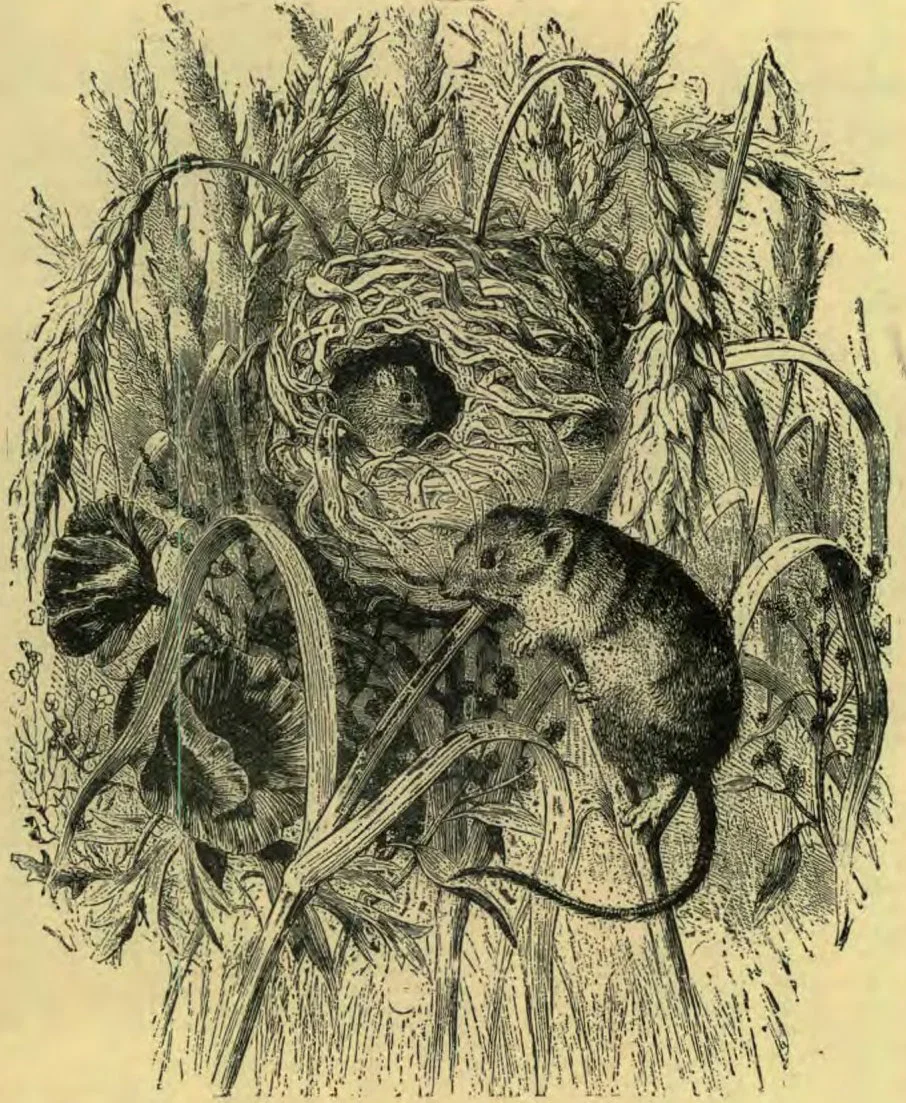
One of the prettiest rodents is the little harvest mouse, which is only half as large as the common house mouse. In the picture on this page you can see them and their home, which is built where three or four long stalks of grain bend over and cross each other. In and out, and round and round, the little fellow weaves his nest of grass and leaves, and binds together the stalks that hold it up; when it is all finished, it is not larger than the ball you toss about in your play. The little mouse, by twisting his long, slender tail around the straws, can climb up and down the wheat stalks at ease. When winter comes, he leaves this summer house, and takes shelter in corn or hay-ricks, or scratches out a burrow, and lines it with wool and hair.
A near relative to this mouse is the rat, one of the most destructive of the family. Because they are such troublesome creatures, most people dislike them very much; but some who have taken pains to get acquainted with them and watch their habits, have found that they really know a great deal.
Over across the ocean, in the city of Paris, is a great prison called the Bastille (bas-teel). A noted prisoner in one of its deep dungeons, was so troubled with the rats that he hardly knew what to do; for they would run over his face when he was asleep, and often bite him. Finding that he could not get rid of them, he undertook to tame them; and at the end of two weeks they would run after him when he called them by name, and would eat out of his hand.
Dr. Benjamin Franklin had a white rat that he called Scugg. Scugg was very fond of its noble master; and once when he was away, became ill because it could not see him. When he came home, the rat was so glad to see him that it died of joy. Rats are also kind to one another. Dr. Franklin tells of an old rat that had grown blind, and could not find its way; and that he saw a young rat place a twig in the old one's mouth, and taking hold of it with its own mouth, lead the old one along.
Away off in that desolate part of Asia, called Siberia, lives a little rodent known as the economic, or saving mouse, because it has a habit in fine weather of hoarding up food for winter. Its house is in a burrow, with runways all around; and here it lays up roots of all kinds, which it has scraped and dried in the sun. Sometimes their food gets damp, and then these wise little creatures take it out and dry it over again. In times of plenty, these mice sometimes lay up as much as fifty pounds' weight of food. The poor people in this country often hunt the burrows of this mouse, and rob it of its supplies, leaving just enough to keep the mice from starving. Sometimes in the spring of the year these mice make long journeys over land; but when winter comes, they return. The people are so glad to see them that they keep a festival in their honor.
W. E. L.
Letter Budget.
We think of the many bright eyes that will peep into this corner first, to find their own letters, and then we think of all the “bother” they have had to make their letters “plain,” as Hilber says in his letter this week, and it makes us real sorry that they have to wait so long. But as they wait, they have a good, full Budget, almost every week, from other little folks, and that is good pay, surely.
CORA B. BOLYARD, writes from Cass Co., Mo. She says: “Dear editor, I have been so much interested in reading the letters in the Budget I thought I would have to write one. I am eleven years old. I have three brothers and two sisters living. We are not Sabbath-keepers. I am David and Daniel Kivett’s little friend. I have been to their Sabbath-school once. I hope this will be printed, and may be I will write again. I send my best wishes to the little folks.”
HILBER G. CROWLEY writes a letter from Ft. Howard, Wis. He says: “I like to read the letters in the INSTRUCTOR so well that I thought maybe some other little boy would like to read a letter from me. I am nine years old, and have a twin brother just the same age, named Wilbur. We have dark brown hair and eyes, and he looks exactly like me. My home is at Windsor, Wisconsin; but nearly every summer I come up to visit my aunt who lives here in town, and my grandpa Godfredson, who lives fifteen miles from here on a farm. Oh, I do like to go out there and drive horses, and get the cows, and watch all the little lambs. But I cannot go till vacation; for I go to select school every day, and have a lovely teacher. I go to Sabbath-school every week, and study in Lesson Book No. 1; but I learn the lesson in the INSTRUCTOR too by hearing the rest study it. I have a little cousin nineteen months old named Willard, who says and does so many cute things. Every morning at family worship he kneels down by a little stool and keeps still until we all are through, when he says, ‘Amen, amen.’ I take him riding in his little carriage after school, and sometimes we go down to his papa’s dentist office. I like to see my uncle pull teeth. I shall be very disappointed if you do not print this letter, for I had so much bother to write it plain.”
The forepart of January, three letters were received in one envelope from Labette Co., Kan. We print first, BLANCHE WYANT’S. She says: “I am going to school this winter and am trying to learn all I can. I am fourteen years old. For three years I have been trying to be a Christian, and I feel more determined than I ever did before to live faithful. I attended the fall camp-meeting. The Lord came very near and blessed all. I have two brothers and two sisters, and they are trying to be faithful Christians too. We have sold our old homestead farm, and expect soon to leave the dear friends here; but we trust the Lord will go with us wherever we go. I send love to all the INSTRUCTOR family.”
GUY WYANT writes: “I am twelve years old, and am large of my age. I have two sisters at home, and one married sister, and I have one brother. We are all trying to live Christian lives so we may be an unbroken family in God’s kingdom. I was baptized at the fall camp-meeting. I go to Sabbath-school every Sabbath and study my lessons in the INSTRUCTOR. My married sister is my teacher.”
The third letter was from MAGGIE KINMAN, who says: “We have taken the INSTRUCTOR three years, and love to read it. I am fourteen years old. I go to Sabbath-school regularly, and study my lessons in the INSTRUCTOR. I am trying to live so I can have a home in the earth made new. I send love to the INSTRUCTOR family.”},{
“THE QUICKEST WAY.”
Mr. Brown wanted a boy; and Charlie Jones wanted the place. When he came, he was told to put a screw in the gate-hinge.
“Oh, yes; I can do that!” and he seized a hammer, and gave the screw two or three hard whacks.
“Stop! stop! that is not the way.”
“That is the quickest way.”
“But the quickest way is not always the right way. I want no boy who puts in screws with a hammer.”
There are a great many boys who drive screws with a hammer, and a great many places where they are not wanted for that reason. There are Charlies and Marys who learn their lessons the “quickest way” instead of the right way. And in everything, whether it is running an errand, sewing a seam, or, as they become older, doing more important things, they are not content with the slower but surer way of one patient turn after another. They skim over the lesson, and then try to make up brilliant answers in class; or double the thread and take one stitch where there should be three; or dash off before they half understand what it is about or how what they say is going to sound. No boy or girl who drives screws with a hammer can ever succeed. The Mr. Browns will not want them nor trust them. If a thing requires patient turning, turn, don’t drive.—Morning Guide.