The International Reform Bureau has, among other things, for its object “the defense of the Sabbath.” “Without debate or division,” Congress passed the law, drawn by the Reform Bureau, closing the exposition on Sunday. Is this legislation a wise precedent? There is a great deal of sentiment, religious and otherwise, and diversity of opinion, about the observance of Sunday. In attempting to further a seemingly moral movement, is Congress, by this law, unwittingly trespassing upon the inalienable rights of conscience? The institution of the Sabbath, and its observance, are evidently founded on the requirements and duties imposed by religion. Whatever the rest day, be it Sabbath, the seventh day, or Sunday, the first day of the week, or the Mohammedan’s Friday, the reverence shown to it is an expression of worship, which the respective adherents pay in honor to their respective faiths. The history of the Sabbath is inseparable from faith and religion. The very acts mentioned in Sunday laws which are said to transgress the sanctity of the day are licensed or considered lawful or commendable on other days. Therefore the object of Sunday legislation is not to regulate civil conduct, which is exclusively the province of the state, but it attempts to prohibit the doing of those acts that are defined to be commercial and worldly, in contradistinction to what is devotional, in order that the sacredness of a certain day may not be disregarded or violated, thus prescribing indirectly the duties we owe to God. Disguised by an apparently harmless mask, this is a sort of church teaching that has crept unawares into our legislative halls. By usage and customary sufferance Sunday legislation has obtained such a hold upon the convictions of the people that its dangers may not be discerned until it is too late.
As there is more than one rest day in which religionists believe, there is consequently no unanimity in the United States, as to either the identical day of the week to be kept as the Sabbath or the manner in which it should be kept. When Congress allows one religious body, or reform bureau, to draft a law designating the observance of a certain day of the week as the Sabbath, and this law is enacted agreeably to its bidding, thereby defining by national law the day of the week that is the Sabbath, is not the arm of the state unnecessarily reaching out and clasping hands with the arm of the church in an unholy alliance, that may be fraught with dissensions, with religious differences, and, possibly, with persecutions? Why not confine the regulation of the Sabbath to the church, where it belongs? Is not the day and its observance as much a question of faith and religion as the manner of baptism, as denominationalism, as Christianity, or as Hebraism? Is not the history of every state that has enforced its religious dogmas one of decay and dissolution, of violence and persecution? Does this republic wish to parallel the republic of Rome, where Paul was beheaded, where Peter and Christ were crucified? Can no harm result from this sort of legislation? Let us reason together.
1. To believe in the Sabbath we must believe in the God who made the Sabbath.
The atheist may say, “What god? Whose god?” Religionists may reply, “This is a Christian nation; we have no room here for the atheist.” Thus an occasion arises for a religious controversy.
2. To believe in the Sabbath we are told to believe that the Creator who made the Sabbath also made the world in six days. The precept enjoining the observance of the Sabbath tells why it should be kept: “For in six days the Lord made heaven and earth, the sea, and all that in them is.” Ex. 20: 11.
There are many theorists and higher critics who will not admit of the creation of the world in six literal days, while there are others who prefer to take the Word of God as it reads without further mental or verbal refinement. Here is occasion for another religious controversy,—a serious difference between two classes of believers of the same Book, which can only be reconciled by the faith of the individual.
3. To keep the Sabbath acceptably to the God who made it we are told to keep it holy. This involves a definition of holiness. The understanding of this one word has given rise to many believers of many opinions. The Christ, in magnifying the decalogue and making it honorable, taught that its precepts were so holy that they could be broken by unholy thoughts,—the overt act is not necessary. Matt. 5: 27, 28. “Whosoever hateth his brother is a murderer.” 1 John 3: 15.
What an undertaking for Congress, or the state, to make the thoughts of people holy by legislation.
The Sabbath can be broken not only by thinking unholy thoughts, but by speaking our own words. “If thou turn away thy foot from the Sabbath, from doing thy pleasure on my holy day; and call the Sabbath a delight, the holy of the Lord, honorable; and shalt honor him, not doing thine own ways, nor finding thine own pleasure, nor speaking thine own words.” Isa. 58:13.
Does this not demonstrate the uselessness of Sunday legislation when tested by the requirements of heaven? No doubt, to meet the demands of this last quotation the blue law was passed which forbids a man to kiss his wife on Sunday.
For breaking the Sabbath are we not answerable alone to God? Can its acceptable observance be wrought out other than by the faith and the conscience of the individual? If transgressors could be legislated into heaven, if they could be ushered into “the beloved city” by the law of the land, would it not have been useless for Christ to have died?
4. To believe in the Sabbath we are told to believe in the sacredness of a certain day of the week. On this identical day all do not agree. The Lord says in his law: “But the seventh day is the Sabbath of the Lord thy God.” Ex. 20: 10.
The majority of the Christian world are keeping Sunday, the first day of the week, for the Sabbath. The different devotees claim a divine right for adhering to their respective days. Both classes are positive to enthusiasm that they are correct. Here is an occasion for a serious religious controversy to arise, which can only be settled by the faith of the individual. An attempt to settle this difference by the law of the land will eventually arouse animosity, and make more divergent the lines of faith that separate the believers.
This law, passed by Congress, closing the exposition on Sunday, is apparently harmless. But as Sunday laws on the national statute books increase, greater liberties may be expected to be taken with religion and with conscience. Doctrines of Sunday faith, championed by reform zealots, may be memorialized, petitioned, crystallized, into law. Will not the scene be a sorry one when the sect that is in the majority will be able to lobby through a law that will coerce the conscience of the few?
Why not listen to the warning and the wisdom of our fathers, who, after witnessing the horrors of religious persecution, incorporated in our organic law that safeguard which is now being insidiously disregarded: that “Congress shall make no law respecting an establishment of religion or prohibiting the free exercise thereof”?
Why not listen to the teaching of that Master Mind who said: “Render therefore unto Cæsar the things which are Cæsar’s; and unto God the things that are God’s,” and keep forever divorced the church from the state?
The coin that was brought to Christ bore the image of the superscription of Cæsar, which showed that it belonged to Cæsar. Matt. 22: 19-21. The Sabbath bears the image of God because it declares its own Creator, the Creator of the world; it bears the superscription of God, because the signature of the divine is engraved in its bosom,—“the seventh day is the Sabbath of the Lord thy God,”—which shows by the same authority that in a special way this day belongs to God. In Isaiah the Lord calls the Sabbath “my holy day.” If the day belongs to God, then, according to the teaching of Christ, the respect and reverence we have for the Sabbath belong also to God, and not to the state, and should be rendered to him.
A Visit to Nyassaland
By W. S. Hyatt
W. S. HYATT
JUNE 26 I left the mission farm, near Buluwayo, and started for Nyassaland. On the way I stopped at Gwelo, and visited the Somabula Mission. I found Brother Armitage and family quite well, but they had been having a hard time with the fever. The work at the mission seems to be prospering, and they are of good courage.
The following Monday afternoon Brother Armitage took his donkey team and started for Gwelo, where I expected to get a train on Thursday morning. Arriving in town, we learned that the trains had changed their time, and I could not get one till the evening after the Sabbath. As the rates at the hotels are very high, Brother Armitage decided that he would leave his wagon in town, and I could camp in it, and he would walk home. So we drove out a few miles with him, and then returned. I was very thankful to have the wagon, as there I could be comfortable and save considerable expense.
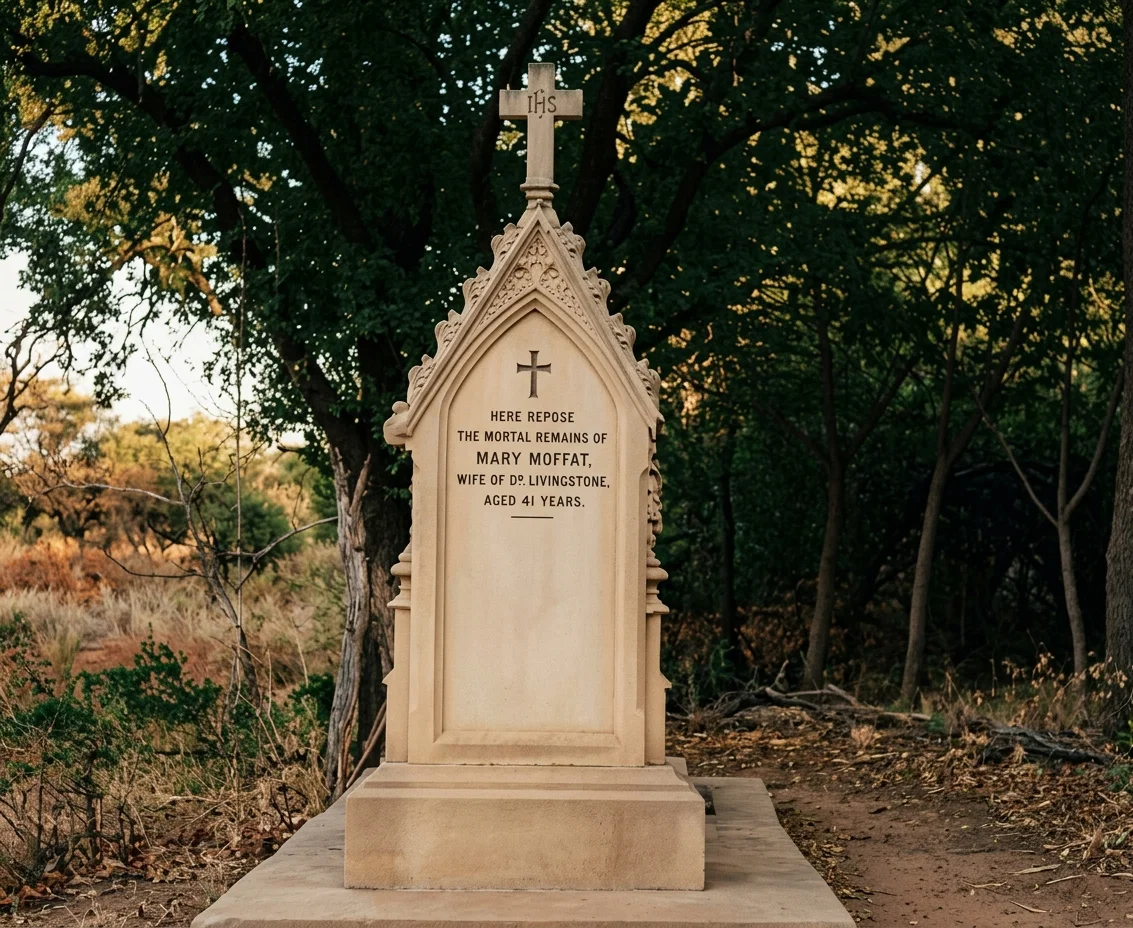
GRAVE OF ‘MARY MOFFAT, WIFE OF DR. LIVINGSTONE
Saturday evening I took the train and arrived in Beira the eleventh of July. I went aboard the steamboat that afternoon, but we did not start for Chinde till the next day. We anchored off the Chinde bar in the morning, but the tug did not come out to us until about dark. We then went aboard and the tug pulled out from the ship a short distance, and there cast anchor. It being dark and the bar very rough, the captain would not attempt to cross till daylight. Well, we had a terrible night of it. The tug tossed and rolled like a cork all night. Like Paul, we “wished for day.” It came, and soon we were safe in the harbor at Chinde. My heart went up to the Lord in thankfulness that he had brought us safely through that experience.
We were soon aboard the river steamer, and that evening started for Chiromo, a distance of two hundred miles. On the way we spent one night at the Shupanga Mission, and there visited the grave of Mrs. Dr. Livingstone, on the bank of the Shire River. She died April 27, 1862, at the age of forty-one years.
She was on her way to join her husband in the great work. My heart was inspired with new courage as I stood by the grave of this noble woman, who, with her husband, did so much for the cause of Christ in South Africa. The words on her tombstone are so expressive that I will quote them: “Here repose the mortal remains of Mary Moffat, the beloved wife of Dr. Livingstone, in a humble hope of a joyful resurrection through our Saviour Jesus Christ.”
When there is plenty of water, the trip is made in four or five days, but we were nine days reaching Chiromo. The next morning I was furnished with a machila team consisting of sixteen boys, and we started on our journey to the Plainfield Mission, a distance of fifty miles. The machila is a canvas hammock fastened to the cross-bars of two long poles. Four men carry at a time, and they go on a slow trot, making about five miles an hour. The journey was made nicely with the exception of the climbing of a mountain to get up to Cholo. I succeeded with the help of the boys, but it was a hard climb of about two and one-half hours. The boys, not understanding just where I was to go, took me to the Nyassa Industrial Mission, which is about six miles from Plainfield. As it was then seven o’clock, and the boys were very tired, we stopped at the mission for the night, where we were kindly entertained.
At daybreak the next morning we were off again, and arrived at the mission in time for breakfast. I was glad to get there, as it had been three weeks since I left the Somabula Mission. I received a hearty welcome from Brother and Sister Branch and family, and everything was done that could be to make my visit pleasant and profitable. I found them well, although they have light attacks of the fever from time to time.
I have now been here three weeks, and have had time to look quite carefully into the work, and I can say that the Lord is truly blessing the labors of this family. The school work is prospering under the management of Sister Mabel Branch, and the native teacher, Edward. He is a great help to them in their work. There are between fifty and sixty in the school, and some of these boys are getting a good start in their studies. There are between fifteen and twenty in the home, and the remainder come to the school from the villages on the estate. On the Sabbath the young men go to the villages near by, and hold services. Last Sabbath they spoke to one hundred and sixty-four adult natives. Thus it is that the natives about us are learning something of Bible truth, and the boys are gaining an experience in working for the people.
The mission farm of two thousand acres is hilly, and there is considerable timber on the land. The soil is good, and the grass grows to the height of eight or ten feet. They have an abundance of rain in this section. Last year the rainfall amounted to over seventy inches. Brother Branch had over ninety acres under cultivation last year. This is a large amount of ground when we consider that all the work has to be done by the natives. There are very few teams and plows in this country.
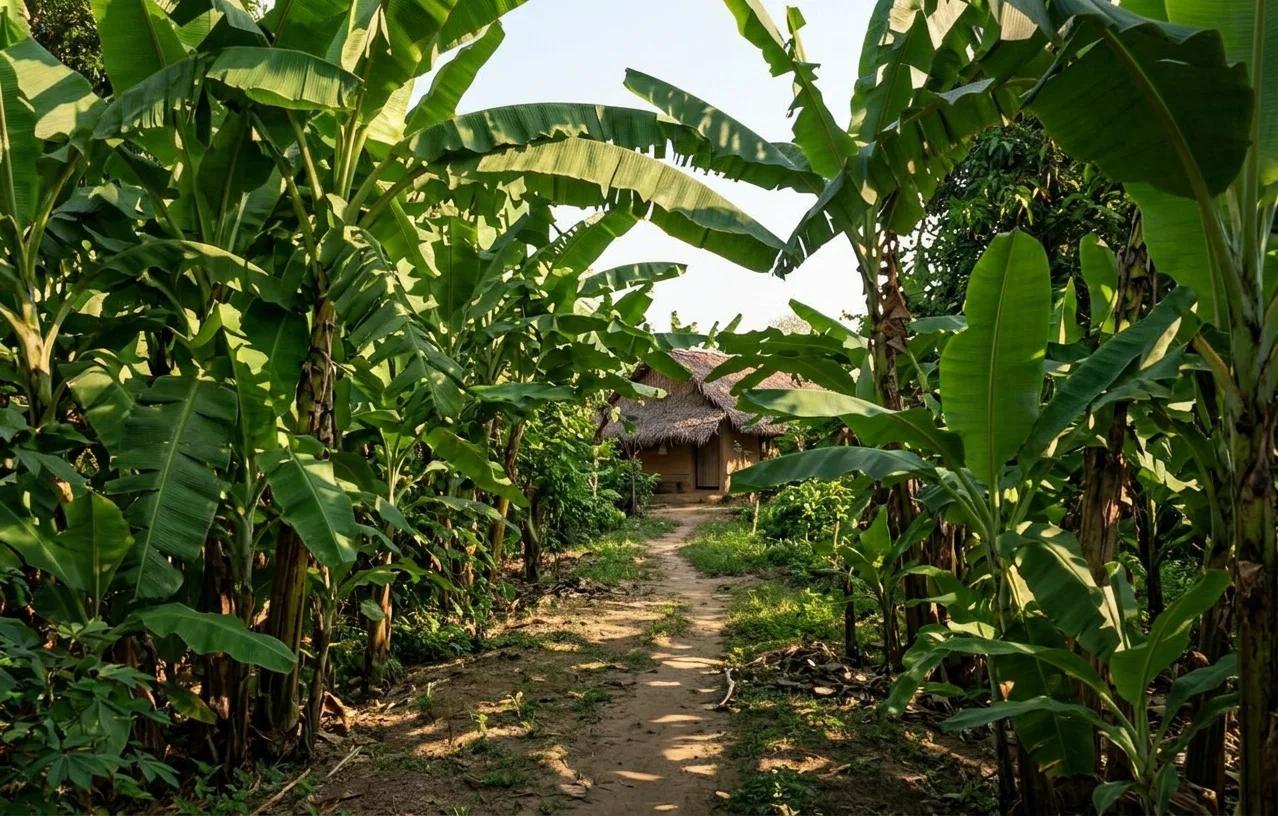
MISSION ROAD AND HOUSE
The natives do all this kind of work, even to the grading on the railroad which they are now building.
Wild beasts and reptiles abound in this country. Cattle and goats have to be kept in enclosed buildings at night. Lions are all about. One was heard roaring not far away a few mornings ago. Some boys had a team of oxen on14the road, and something broke down. While they were fixing it, the oxen were feeding close by, and a lion came and took one of them. About one week ago a lion entered a native village, but a short distance from Blantyre, and carried off a pig. I have seen the skins of three boa-constrictors that were killed near here. These were from twelve to sixteen feet long. The largest one was killed on the estate by a native. The natives do not usually kill them, but this one swallowed a goat belonging to the native, and when it became dormant, about three days later, the native killed it, and sold the meat of both the goat and boa-constrictor.
The Lord is certainly blessing the work of our few missionaries in this country, and we are encouraged to continue the work. My soul is often sad as I think of the little that we are doing in view of the greatness of the work there is to be done, and the short time in which we have to do it. “This generation” is almost passed, and we have made only a beginning in this work. We long to see more done, and are crying to the Lord to open the way for more missions to be started, and for godly men to enter the work. Brethren, remember the work in darkest Africa in your prayers, that God may open the way for the message to go with power in this country.
Plainfield Mission, Cholo, British Central Africa.
Farming in Brazil
By Abel L. Gregory
ABEL L. GREGORY, M. D.
Much of Brazil is rough and mountainous; hence, farming on a large scale is not possible. Stock-raising is not practicable in many parts, on account of the jungles, which prevent the growth of grass until the trees are cleared away. As much rain falls, the clearing soon becomes a jungle again. In some parts there are tracts of land which offer pasture. These are mostly in the small State of Rio Grande do Sul, which is the most southern of the United States of Brazil. Here are raised the greatest number of animals. Being so far south, there are frosts and cold rains nearly every winter. These do some damage to the stock. Occasionally a little snow falls. Seven years ago there was a revolution in this State. At the close of this the prairies were almost destitute of animals.
Corn and black beans are the principal products, though potatoes, both sweet and Irish, do well in soils adapted to them. Rice is grown in the lowlands, and yields well. Sugar-cane is extensively grown for sugar, and for a kind of alcohol, which is much used. Bananas do well. In many places oranges grow wild in the woods. Plums, prunes, and peaches can be grown. A few apples are found in the mountains. Rye, barley, oats, and wheat are planted on the highlands, but are not paying crops, as machinery can not be used to cultivate and harvest them. Most of the flour comes from Argentina.
The staple product is farina. It is made from a kind of potato called mandioc. This plant resembles the castor-oil plant of the United States. In fact, it is botanically a relative, having seed and foliage like it. The roots in two years grow all the way from the size of the arm at the wrist to the size of the leg at the calf. The roots are washed, peeled, grated, the poison pressed out, and then dried in a furnace. This dried product is farina de mandioca. The favorite way of eating it is to mix it on a plate with cooked beans. It is similar to very coarse white corn-meal on beans. As a consequence of eating this raw starch, many have stomach trouble of chronic character.
Small fruits can be grown when the ants can be kept from destroying the trees. Ants and revenue stamps are two hindrances to progress in Brazil. All official papers, receipts of over six dollars, posted handbills, all manufactured articles, etc., etc., must have the regulation stamp, or one is liable to a fine. Interstate revenue, and even county revenue, is collectable on many things. The city tax in our city on cord-wood brought here from an adjoining district is more than we pay for wood. The tax on butter sent into this State from Santa Catharina, the adjoining State on the north, is double the cost there.
Tobacco is extensively raised, and more extensively used; yet a tobacco chewer is seldom seen. It is smoked mostly as cigarettes made of corn shucks. A very few use pipes, and occasionally a snuffler is seen.
The most ordinary farming implements are an ax without a head, a hoe, and a brush-hook. A forked pole makes a plow for some of the more enterprising natives. American-made hand plows are used by the very best farmers, but these are scarce—less than one in a thousand. Neither are these plows the good ones we have in the States.
The amount of land a man cultivates varies from one to about five acres, according to the health of his wife and the number of children. All the family work in the field. To open a farm, the trees are felled, then, when dry, fired. This consumes the small stuff, but the big logs remain as they fell. Corn is planted among the logs, by making holes with a hoe. The weeds and brush are cut out once or twice before it ripens. It is gathered in sacks, and carried home on the back or on pack-mules. When shelled and sacked, it sells for fifty cents a bushel. Other products are in proportion. Beans cost one dollar and a half a bushel. No one need come to Brazil to farm to make money. Yet a man can do well on a farm, if he knows how to manage. Two crops a year can usually be harvested. The native clears his land once a year by fire, hence in a few years the land is worn out.
Living in the large cities is expensive, and especially so to a foreigner who does not know the language. Yet men and women are needed who know and love the truth, to come here and live it before this people. They need to be taught to farm, to use machinery, to economize, and to live for God.
Who will come here for the love of perishing souls? There are people here who are seeking for truth. They are blind, ignorant, and priest-ridden. So were we. They must hear the glad news of a soon-coming Saviour. Who will help us in giving them the good news? Opportunities are now presented, which, if not improved, will soon be gone forever. Brazil is as large as the United States of America, and has but three preachers, three canvassers, and one doctor. How long will it take to warn sixteen million people?
Taquary, Rio Grande do Sul.
The Swedish Meeting
By E. Ahren
E. AHREN
The twenty-third annual meeting of the Swedish Conference was held in Jonkoping, June 21-27, 1904. About one hundred of our people were present. There are thirty churches in the conference, with seven hundred and forty-one members, and in addition to these there are about seventy Sabbath-keepers now ready for baptism. During the past year forty-four have been baptized. We have had seven ordained ministers, two licentiates, three Bible workers, and about twenty-eight canvassers in the field. One ordained minister, Elder Leonard Karlsson, has died. He was one of the first workers in this field.
Our tithe for the year was 63,350 kroner; our book sales, 36,350 kroner. Ten were baptized during the camp-meeting. The outside attendance, especially on Sunday, was good.
The following resolutions were unanimously adopted: —
“1. That the school question be referred to the executive committee of the conference, and the committee of the association Sanningens Harold, and that these committees, together, carefully consider in what way and when such changes may be effected in the Nyhyttan school as would be for the furtherance of the school work, and that said school be continued, we doing all we can to sustain it until these two committees are prepared to present such plans as the conference would unanimously accept.
“2. That steps be taken for the advancement of the health work by the education of nurses, publication of literature, and establishment of health homes as fast as means can be procured for this work.
“3. That an energetic effort be made to revive the tract and missionary work by the circulation of papers and tracts by church-members in general as well as by conference workers, and that this work be reported to the secretary of the Tract and Missionary Department.
“4. That each church establish a15poor fund for the benefit of the poor in the church, and that the conference start a poor fund for the assistance of such church-members as can not be properly aided from the local church.
“5. That our church-members be urged to greater faithfulness in the support of the First-day offerings.
“6. That, as the printed edition of ‘Christ’s Object Lessons’ has not yet been sold, steps be taken by which this book may be sold as soon as possible.
“7. That, regretting the loss the conference has sustained by the death of one of its old and faithful workers, Elder L. Karlsson, we express our deep sympathy for his wife and children in their bereavement.”
Credentials were granted to O. Johnson, J. M. Erickson, E. Ahren, K. A. Farnstrom, F. R. Oberg, A. J. Settergren; licenses to B. J. Karlsson, Birger Andersson; missionary credentials to A. Lundgren, Mathilda Olsson, Anna Forsen, Ole Nelsson, Peter Hedstrom.
The following-named officers were elected for the coming year: President, O. Johnson; Vice-President, K. A. Farnstrom; Conference and Missionary Secretary, J. R. Lindqvist; Sabbath-school Secretary, Ellen Niemann; Canvassing Agent, E. Lind; Auditors, E. Lind, A. J. Settergren; Suppliants, C. Hallberg, K. Palmer; Executive Committee, O. Johnson, K. A. Farnstrom, J. R. Lindqvist, C. Kahlstrom, B. J. Karlsson; members of the association Sallskapet Sanningens Harold, appointed in a meeting of the society: President, O. Johnson; Vice-President, K. A. Farnstrom; Secretary, E. Ahren; Treasurer, E. Lind; Auditors, Jens Olsen (Copenhagen), J. Bergstrom (Nyhyttan); Suppliants, A. Christensen (Christiania), B. O. Olsson (Arnas); Executive Committee, O. Johnson, K. A. Farnstrom, E. Ahren, E. Lind, B. J. Karlsson, J. M. Erikson, J. R. Lindqvist.
We had indeed a good meeting in Jonkoping, and we hope by the grace and help of the Lord that we shall experience more of his blessing, and have still more success in the work this year than we have ever had before.
British Guiana
By D. C. Babcock
NEW AMSTERDAM.— The interest in our tent-meetings is deepening every day. The tent is overflowing each night. The Lord is working mightily. Several have taken their stand for the message. Our principal opposers are the Catholics; yet they are present every night.
Among other interesting incidents is that of a Catholic boy, seventeen years of age, who desires to obey God. His people are devoted Catholics, and came to the tent to take him away by force. They were required to keep quiet during the meeting; but as soon as we dismissed, they rushed into the tent, and endeavored to take the boy out by force. We told them they must not disturb our place of worship. We advised the boy to go, but he utterly refused, and an officer was brought, and the lad was compelled to go.
I believe that the witnessing power of the message has reached the entire city, and when our tent is taken down, our work here will be finished, so far as the public is concerned.
While conducting the meetings, we are also erecting a house of worship. Our one object is to finish the work in British Guiana as soon as possible.
Five members of the Church of England Synod of British Guiana have appealed to the bishop to permit me to present the Sabbath question before the next session of the synod. In their conversation with that official, he confessed that Saturday is the Sabbath, and not Sunday, and remarked that something must be done. He favored the proposition, and said he would confer with the other members of the synod.
D. C. BABCOCK.
Report of Labor
By Daniel T. Bourdeau
As some of us look over the years of a comparatively long life, we can truly say, How swiftly they have passed away! They have been “like a weaver’s shuttle,” like the transits of “swift ships,” “like a vapor,” “like a dream.” And the more we have to occupy us that is of an interesting character, the more rapidly the years seem to pass. And thank God, we have in present truth, in the work that it enjoins, and in the numerous object-lessons taught us by the16great events of the present time, confirmatory of the doctrine of Christ’s speedy return, plenty of that which is eminently interesting to take up our minds and draw out our most earnest and best energies, so that the few years of probation that remain will, as it were, glide away far more rapidly than have even the same number of years in the recent past.
Thus may we, with our minds and energies taken up with the things that now belong to our peace, in a special sense hasten the second coming of our blessed Lord. As we thus have our thoughts and energies bestowed upon the grand truths applicable in our day and their proclamation throughout the earth, we shall easily endure our trials and light afflictions, encouraged by the thought that they are, as it were, “but for a moment,” and will, if improved upon, not only help us to form righteous characters, but also work “for us a far more exceeding and eternal weight of glory; while we look not at the things which are seen, but at the things which are not seen; for the things which are seen are temporal; but the things which are not seen are eternal.” 2 Cor. 4: 17.
The way not having opened for me to labor in new fields since last spring, I have now and then given a practical discourse to believers, labored for some who were in danger of departing from the faith, aimed by correspondence to bring further light to some who are studying the truth, and written for our three leading American papers, especially The Southern Watchman. I have also been drawn out to work for this paper in an especial manner, because I see in its history a duplicate of the early history of our beloved REVIEW AND HERALD, before the Signs of the Times was started as a pioneer paper. I feel especially for The Southern Watchman because its managers put at the front the reasons why we are Seventh-day Adventists; and yet the Lord is, through old pioneers in this cause, as well as through younger writers, giving in the Watchman, not only rich, practical truths, but also precious light on doctrinal themes.
And just here this question urges itself with special force upon my mind. Why should not our brethren and sisters in the North more generally add the Watchman to the list of their periodicals, and thus show an interest in the work in the great South, and help to put that noble paper on a permanent financial basis? Taking this paper, and reading it, our interest will be more fully enlisted in the advancement of the work in the long-neglected South. We shall be more likely to pray for the work and workers in that field, and to contribute to its support, until the entire Southern field shall be deluged with the glorious truth of the third angel’s message.
One week ago an invitation came to me to get our brethren to take the REVIEW, that they might be prepared to engage intelligently in the coming campaign planned in Omaha last spring. At one place I learned that while nearly all the believers were reading the Signs (which I encouraged them to continue doing), but few of them read the REVIEW, our dear church paper. I dwelt upon the importance of taking this paper, and in about one week, by securing addresses and visiting from house to house, I obtained about fifteen subscriptions. This made me think of our experience in the early history of this cause, when our ministers never raised a church without leading at least every head of families embraced in it to take the REVIEW. We then regarded it as a sacred and imperative duty to do this, and did not consider our work as being rounded off until this object was accomplished. And is not this duty as imperative now as it was twenty, thirty, forty, and fifty years ago?
A few weeks ago I had the privilege of spending two days with the church at Lowell, Mich., and speaking to them the words of life. Here I found Elder E. Van Deusen recuperating by indulging in physical exercise, after spending eight years in doing evangelistic work in the West Indies. I found this dear brother fully alive to a sense of the time in which we live, and to the importance of pushing on the aggressive work of the third angel’s message to triumphant, speedy, and final victory. The church of which he has the charge was also imbued with the same spirit, and authorized me to bear this testimony from them: “Tell the brethren whom you may meet that we are perfectly united and of good courage.” And this will be the language of all those who show that they are getting out of self into Christ, by laboring disinterestedly, unselfishly, earnestly, untiringly, and with an undying love for souls, as did Christ and the early Christians.
D. T. BOURDEAU.
Faithful Until Judgment Day
ONE of Bishop Crowther’s converts in the Niger Mission, when put to torture to induce him to recant, said: “I have made up my mind, God helping me, to be in chains, should it so please the Lord, ’till the coming of the judgment day.” — Selected.
The Sudan’s Unreached Millions
A vast new world, almost untouched by Christian missions, is waiting to be won for Christ. The Sudan is as large as the whole of Europe, minus Russia, and has eighty million people. There are ten great kingdoms in the Sudan as large as ours in Europe, but scarcely any mission work is being done in them. Besides these, there are about one hundred distinct free heathen tribes in the Sudan, with not a missionary among them.—Selected.
MRS. F. W. SPIES
By Mrs. F. W. Spies
Brazil
BRUSQUE.— Just before our conference meeting, our canvassers received word from the authorities to discontinue their work. On visiting the authorities the reason for this was found to be complaint against our work by the ministers and others. We had been given permission to canvass without paying license, but we were notified that we would be obliged to pay a license of about five dollars in American money. This was paid, and a canvasser and a Bible worker remained after the conference.
We had good meetings, and in the evenings large numbers of people visited the preaching service. The principal subject was “The History of the World in the Light of Prophecy.” The whole country was aroused, and more thorough work was done than we have ever been able to do before. The opposition on the part of the pastors was as bitter and determined as could be expected under such circumstances. The Lord favored us with beautiful, clear weather, and moonlight evenings. This meeting called to mind the feast of tabernacles. See Lev. 23:34-42. The buildings were made of palm trees, with a roof of the leaves.
My husband is again on the way to Espirito Santo, north of Rio Janeiro. He is accompanied by a young man from our school, who goes there as teacher. They expect to hold some general meetings there, after which we shall probably move from this place farther north, and our work will be more particularly among Brazilians.
MRS. F. W. SPIES
Report From Elder Loughborough
By John Norton Loughborough
My last report through the REVIEW was made in the latter part of June, just after our excellent camp-meeting and yearly conference in Oakland.
For years I have had more or less bronchial difficulty, and on finding that the humidity of Oakland aggravated the trouble, I decided that a change to a dryer, warmer climate with less fog would be beneficial. We, therefore, on July 7, moved our few household effects to Mountain View, where we have lived for over three months in a tent on a lot fifty by one hundred and fifty feet, which, through the kindness of friends, we purchased at very reasonable figures.
The last place I owned was sold in June, thirty years ago; since that date I have sojourned in various climes, in different parts of the world, at times comfortable, and at other times very uncomfortable, oftener the latter. As age advances, it seems proper that I should have a little cottage and a small garden spot for the closing days of my earthly pilgrimage.
I had a little means left from the sale of my former home, which was loaned to one of our associations. Being disappointed in getting this, I was obliged to again take the saw and hammer and go to work with my hands; for I had not the means to hire help. This I have been doing for the last three months. At first I experienced sore muscles, but as I persevered in the work, it has been a physical benefit, so that now I can do quite a day's work without overfatigue. At the present writing our cottage is nearly ready for occupancy, and I am in hopes to get what is due me so as to meet obligations at the proper time. So out of our misfortunes good comes, and verifies the fact that all things work for the good of those who love the Lord.
Our permanent address is now Mountain View, Santa Clara Co., Cal.