The Youth’s Instructor, Vol. 55, No. 13.

A Merry Christmas, or a Picnic in the Rockies

The Youth’s Instructor

Mar 26, 1907

Review and Herald Publishing Assn. · Takoma Park Station, Washington, D. C. · Mar 26, 1907

A Merry Christmas, or a Picnic in the Rockies
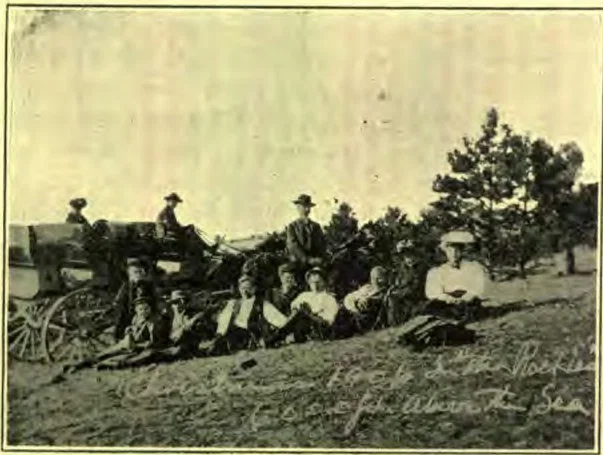
A PICNIC in the Rockies, at an elevation of seven thousand feet, on Christmas day, may seem to some of our readers like a fairy tale, or at least a chilly affair; but such was not the case with the one at Boulder, Colorado, Dec. 25, 1906, of which I shall tell you.
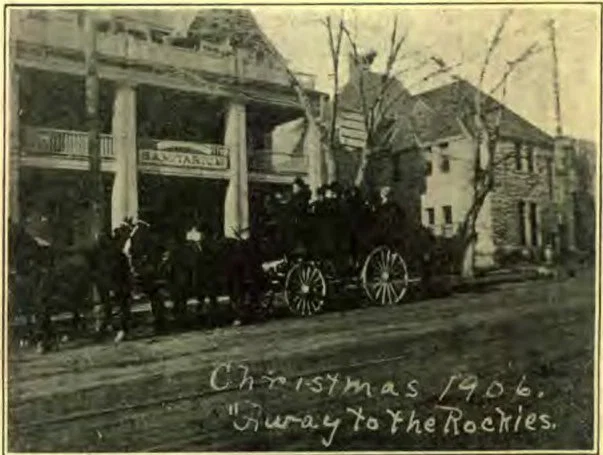
At dinner, December 24, Dr. Place announced to the sanitarium family that we would have our regular Christmas picnic in the mountains, and all helpers who could be spared, and all guests who were able, were invited to be ready at ten o’clock Christmas morning. This caused no little excitement in the dining-room, and furnished a new topic for conversation, also the extra task of preparing a picnic lunch.
Accordingly at ten o’clock next morning a large tally-ho, drawn by four black horses, drove up to the door of the Place Sanitarium, and was very soon filled to its capacity. It was one of Colorado’s bright, beautiful mornings, and we were as hopeful and happy a company of patients and helpers as could be asked for, as we started for the entrance of Boulder Canyon. On the way the doctor went into a store and bought the largest tin horn he could find, which proved to be a small one, troubled with asthma, and more of a “patient” than any one in the load. Its weak falsetto voice, however, sometimes high, and sometimes low, and always unreliable, furnished cause for additional merriment, as we occasionally heard it between the songs of the company, and above the jingle of the bells.
The first impressive experience was that of leaving the city of Boulder and entering the canyon of the same name. This is one of the many beauty spots of Colorado. Every turn in the road which lies by the side of the winding stream, is a surprise bringing forth exclamations of delight even from those who have been over the way before. Occasionally we could see the new large water-pipe which now brings Boulder’s water-supply from the shores of Silver Lake, near the summit of Arapahoe Mountain. This pipe was laid by the side of the old one which took its water from Boulder River, about seven miles above the city. The latter will be kept as an emergency pipe in case anything should happen to the new line. Another feature of interest to the tourist is the large irrigating ditch which is built along the north bank, beginning at the level of the river about seven miles above Boulder, and gradually rising till, at the mouth of the canyon, it is one hundred feet or more above the river. This ditch follows the windings of the canyon, and much of the way it is cut in the solid rock, and in one or more places it passes through tunnels cutting across a short, sharp curve. This helps furnish the water which enables Boulder and its vicinity to look so fresh and full of life during the long, dry, cloudless summer. For four miles up this canyon runs the wonderful railroad, “The Switzerland Trail of America.” In adding these man-made blessings to humanity in this canyon, nature has been disturbed as little as possible.
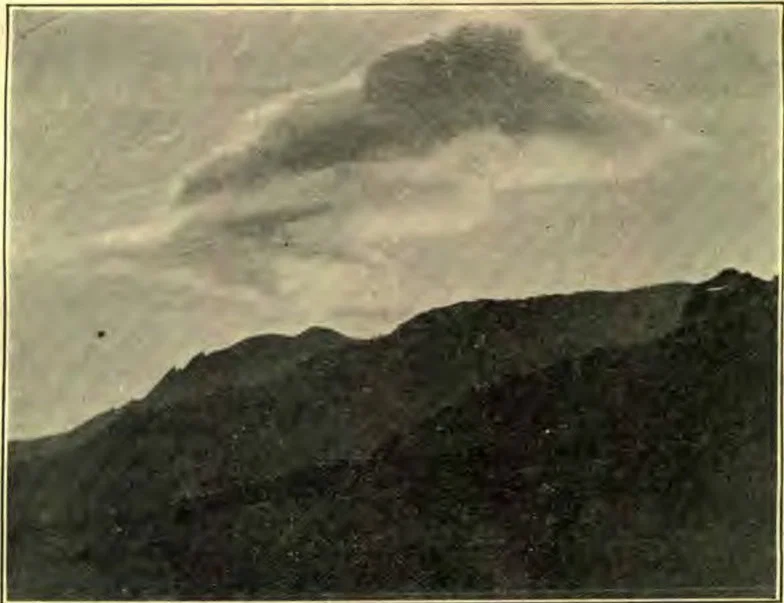
“THE WHOLE CLOUD WAS ENCIRCLED WITH A BAND OF PRISMATIC GLORY”
A trip over this trail constitutes one of the never-to-be-forgotten experiences of life, and I wish every reader of the INSTRUCTOR could take the trip in July or August. One of the characteristics of the road itself, aside from the wonderful scenery which it brings to the eye, is that it never follows a straight course, and one can truly say of it, “All sorts of twisting and turning done here.” The weakness of human language is never felt more than when describing, or trying to describe, I had better say, these mountains and canyons with their kaleidoscopic changes of beauty. At times the way is so narrow that wagon road, stream, and railroad seem to hug each other, the former and latter press closely against the rocky wall which hangs threateningly overhead and rises many feet above. Then a sharp turn is made, and there is room enough for fifty or more roads, with the mountains on either side stretching away in the distance, their sides broken by smaller canyons and deep wooded ravines.
Four miles above the city is “Four-Mile Canyon,” where the Switzerland Trail leaves Boulder Canyon, and follows it as far as Sunshine. There one branch takes the tourist to Ward, and the other to Glacier Lake and Eldora, reaching an elevation of about nine thousand feet above sea-level. During the summer the trains over these lines are crowded daily with tourists and sightseers. We followed Four-Mile up as far as Knox Mine (about two miles) where we branched to the right once more, and began the steep zigzag climb from Four-Mile Canyon to the summit overlooking Sunshine Canyon. All who were able to walk began climbing the steep mountainside to avoid the zigzag of the wagon road. We had gained quite an elevation, when, looking down, we saw the team at a standstill, and knew that something was wrong. The driver had found a large boiler, which had been brought up for use in one of the mines lying in the road in such a position that it seemed impossible to pass. The road was so narrow and the lower side so steep, that it seemed out of the question to turn around. A council was at once held. It was impossible to get above the boiler, and to go below it meant that we must go down a steep embankment about ten feet, where there was a narrow road, and below that an abrupt drop of one thousand feet or more, hence this seemed out of the question, so what should we do? Finally my brother told the driver that we could all take hold of the up-hill side of the tally-ho to keep it from tipping over, and he could turn his horses down that embankment and make it all right. Finally the driver became converted to the plan, and then came the work of converting that four-horse team. They came to the brink all right, but there they stopped, pranced, and pawed the ground, as much as to say, “No, sir!” Happily our driver was a patient, persevering man, and he quietly took his time, and kept talking gently to the horses, calling them by name, and urging them forward a step at a time till finally the leaders stepped over and began the descent in a diagonal way, and when the wheel horses stepped over he turned all straight down the hill. It was an exciting time, but the real excitement came when the wheels of that great wagon left the road; however, every man stood at his post and did his duty. The brake was tightly set so as to make the rear wheels slide and hold back as much as possible, and in less time than it takes to tell it, the wheels had reached the level spot below, the horses had swung around in position, and nothing but some blankets and a box of lunch fell out or was in any way injured, and we went on our way rejoicing.
I could but think of the experience as one worthy of careful consideration, not only by the members of our party, but by any young man or woman climbing the difficult mountains of life. It brought forcibly to my mind the following thoughts: Do not be discouraged and give up climbing because you find an impediment in the way. However impossible seems the way forward, do not consider the question of going back till the last resort has been tried. Till some fixed purpose and decision is reached “stand still,” look, and search for the salvation of God. Do not get excited, it unfits you for the use of your best faculties which are always needed in time of trial. Keep cool, and quietly study and think—then act. Remember the patience and perseverance of that driver of four. When the time comes to go forward, be ready to do your part without flinching. The old saying is, “Fortune favors the brave,” but I would like to put it this way. The divine blessing and help rests upon any man who faces duty bravely and perseveringly. In the face of every difficulty it is well to remember, “It is better farther on.”
Climbing has its difficulties, but every victory gained brings its rejoicing. Every step up lends new beauty to all things earthly, and awakens in the soul a deeper, broader reverence for the Infinite One.
Several of our party entered one of the mines, but no one found a nugget of gold, though we went into a dark hole for a distance of two hundred feet or more, from which we were all glad to come out once again into the sunshine. We had now reached an elevation of about six thousand feet, and another thousand was before us, so we took off our coats, and one lady, who decided to take the climb with us, left her wraps, and on we went once more. I would like to describe to you the beauties and grandeur spread out before us on every side. Even the sun up there seemed more affectionate and grand as its bright rays kissed crest and chasm, rock and shrub, and seemed to say, “I love this old straying world; I still love to help lighten and gladden the sad hearts of its inhabitants,” and as I listened and saw, I said “Thank God for the sunshine.”
Every hill or mountain, no matter how high, has its highest point, and so with our climb that day. Our time had been taken up with calling attention to this or that beautiful view, or listening to another’s call, and almost before we knew it, we heard the doctors who were in the lead, cry out, “The summit! Look toward the east!” We did look, and between two mountains we could see the great plain stretching far away to the eastern horizon. To the north we had a fine view of Long’s Peak, about sixty miles away, but it seemed almost at our feet, and only a short walk would be necessary to enable us to shake hands with that white-haired giant. To the south in full view lay the mountains Flagstaff, Green, and Bear; and to the west, Arapahoe was standing out as a great father of the long snow range stretching far to the south and north.
What a place to halt for rest and lunch! The weather was almost like a summer’s day, and we sat on the moss and rocks, and sang, talked, and threw stones down the mountainside, and took several snap shots with the kodak. But all such experiences must end, and before any one was half ready, the cracked, falsetto-voiced horn began to pipe, “Home, sweet home,” and soon we were once more seated in the wagon, and the descent of about two thousand feet was begun. As the grade increased, the thoughts of nearly all turned toward the wagon brake. “Say, driver, is the brake all right?” we asked, for while there are dangers going up hill, there are sometimes more when going down, and here again we appreciated our patient, steady driver, and good horses. In answer to our question the driver pressed his foot a little harder on the brake lever, and instantly the wheels stopped turning, and began sliding, bringing the wagon almost to a stop. This took the tension from the nerves of the trembling ones, so they could once more enjoy the scenes of Sunshine Canyon. How important that every wagon in this kind of country be provided with good motive power, and a good brake, and how important, too, that every young man and woman be provided with all necessary apparatus for the ups and downs of life. While Sunshine Canyon is not equal in grandeur to Boulder, it is, nevertheless, full of interest. A new road is now almost completed through the most dangerous portion of the way, so that the trip can be made much more easily and comfortably.

“I Do Set My Bow in the Clouds”

We were destined to have our trip crowned with an entirely unexpected cloud of glory, although some who read my description of it may be inclined to think that I am stretching the truth. That would be impossible.
About half an hour before we came out of the canyon our attention was attracted to a large white cloud which was hanging over Green and Bear Mountains. The cloud of itself was a well-formed emblem of heavenly dignity. The sun was just back of and near the upper edge. The first especially impressive appearance was a peculiar lacelike fleeciness of the upper edge of the cloud. These edges began slowly to take to themselves all the tints of the rainbow, most delicate at first, then increasing in beauty and brightness. This gradually spread across the whole top, then down the ends and finally across the base line till the whole cloud was encircled with a band of prismatic glory, most beautiful to behold. This band seemed to be about two feet in width. After a few moments, we began to notice little puffs of fleecy white clouds shoot up from the main cloud, and, far beyond the thrilling effects of the most perfect stereopticon, with its unfolding and dissolving views, the rainbow effects would unfold around these clouds, then gradually work inward till the whole surface would be flecked with colors more beautiful than any pearl I ever saw. Gradually this would fade away, and the cloud would itself fade or dissolve into ether and be gone. Then another would shoot up and seemingly try to eclipse in beauty the one before it. It is useless for me to try to picture to you the varying shapes and ever-changing colorings; pen or brush is not equal to the task. It was a sight to be seen only once in a lifetime, and it was worth living years to see but once.
After a time the lower edge of the large cloud began to show new signs of life and activity. Suddenly there was a breaking into fragments, which could best be described as small coral islands in a sea of deepest blue. Each of these islands was soon skirted with all the most beautiful colors imaginable. Then the large cloud once more took on its tints, and presented the appearance of a great continent, whose shore line rose from the sea, terrace above terrace, each beautified with rainbow beauty, while the inland was here and there flecked with what one could easily imagine to be lakes, with surface like mother of pearl. Do you wonder that we lost sight of the mountain and canyon? Do you wonder that we cried to our driver to stop, and with open mouths, as well as eyes, watched the ever-changing panorama of glory? After about thirty minutes the glory began to fade away, but a portion remained till after we had once more reached the sanitarium. All could truthfully say, “This has been a delightful and glorious Christmas day.”
I have many times pictured to myself scenes which Christ would present to those who will follow him “whithersoever he goeth.” I have pictured cloud effects in which the changing of color would give forth the music of the angelic songsters, but I never expected to see anything in this world equal to what I saw that Christmas day. I recently wrote the following to a friend: “This was the grandest and most gorgeous display of dissolving views that I ever pictured in all my day-dreams of heaven when under the most sensitive inspiration. I have often thought to myself how the Lord would bring ecstacies to his children in the ages to come as they follow him from world to world, and the experience I have just related has deeply impressed me with the wonderful possibilities for the accomplishment of all he desires.”
It seemed sad to see the beauty of this cloud fade away, but with its fading came the thought, so is it with all things earthly. The beautiful things of earth are given as a foretaste of the heavenly. Doubtless the disciples of Christ while in the mount were sad to see the vision pass away, but it went and with it went Moses, Elijah, and the glory, and they “saw Jesus only.” Well, that is enough. When the glories of earth fade away, Jesus is always left, and blessed is the young man or woman who can see him “yesterday, and to-day, and forever.” It was not the glory that shone round about him on the mount that made him Jesus. The glory was but a momentary bursting forth of that which he laid aside that he might walk, talk, and work with men. When we see him glorified, the gorgeous glory of his exterior will be lost sight of in the thought of his inward glory wrought out among sin and sinners. With his children around him, as trophies of his sacrifice and grace, I think of him as represented by that great continent cloud, and we his children, like the little coral islands, ever near him, and ever bathed in the great ocean of his love.
What a blessed Christmas day! A day of real pleasure and recreation, a day of drinking in of the beauties with which a loving Father has clothed the world, a day closing with a blessed call to look up to the skies whence cometh all help, all beauty, all glory,—a day crowned with physical and divine beauty and blessing. Christmas day for 1906, farewell! Thy presence and glory has passed away. It has faded as does all things earthly; but Christ remaineth. Blessed friend of sinners! Blessed bow of the covenant! Blessed star of eternal hope! May each INSTRUCTOR reader be cheered with this thought, and also with the fact that “he ever liveth to make intercession for us,” and is not only able but willing to give us all the help we need to climb the steepest, most rugged mountains between here and paradise. He is also willing to go with us down into the deepest valley of humility, and if we are willing to go with him, and see him, cloud or no cloud, glory or no glory, in the deepest valley he will cause the bow of the everlasting covenant to shine above, with resplendent beauty. Then, when the last day of earth has faded and gone, he will take us upon the glorified mountains of deliverance, where the vision will never pass away, and we shall no more come down to sorrow and disappointment. Till then, may each Christmas day, and every day of each new year be made to resound with the music and song of the angels, “Peace on earth, good will to men.” A. E. PLACE.

An Astronomer’s Work

SIR JOHN FREDERICK WILLIAM HERSCHEL, only son of the astronomer, Sir William Herschel, was born at Slough, 1792, and educated at Cambridge. In 1822 he applied himself especially to astronomy, using his father’s methods and instruments in observing the heavens. As early as 1826 the Royal Society had voted to him a gold medal for observations on double stars, but by 1833 his pre-eminence was beyond the necessity of being marked by acknowledgments. In 1836 appeared his Treatise on Astronomy. At this time Herschel was at the Cape of Good Hope, where he arrived in January, 1834, with the intention of completing the survey of the sidereal heavens, by examining the southern hemisphere, as he had done the northern. Here he established his observatory at a place called “Feldhausen,” [in which identical house this extract is being copied] six miles from Table Bay. On March 5, 1834, he began his observations; and in four years, working all the time at his own expense, he completed them.
Quoting Herschel’s own words on his work in Africa: “I resolved to attempt the completion of the survey of the whole surface of the heavens, and for this purpose to transport into the other hemisphere the same instrument which had been employed in this (the northern) so as to give a unity to the results of both portions of the survey, and to render them comparable with each other.” In accordance with this resolution, he and his family embarked for the Cape on the thirteenth of November, 1833; and on the night of the fourth of March he began a regular course of sweeping the heavens with his telescope.
To give an adequate description of the vast mass of labor completed during the next four busy years of his life at “Feldhausen” would require the transcription of a considerable portion of the “Cape Observations,” a volume which probably is not surpassed in varied interest or astronomical importance by any scientific work in existence. It was published at the sole expense of the late duke of Northumberland, but not until 1847, nine years after the author’s return to England, for the very cogent reasons assigned by himself: “The whole of the observations, as well as the entire work of reducing, arranging, and preparing them for the press, have been executed by myself.” There are one hundred and sixty-four pages of southern nebulæ and clusters of stars. There are then careful and elaborate drawings of the southern appearance of the great nebula in Orion, and of the region surrounding the remarkable star of Argo.
The labor and the thought bestowed upon some of these objects are almost incredible; several months were well spent upon a minute spot in the heavens, containing 1,216 stars, but which an ordinary spangle, held at a distance of an arm’s length, would eclipse. He confirms his father’s hypothesis that those wonderful masses of glowing vapors are not irregularly scattered, without apparent law, higher and higher in the visible heavens, but are collected in a sort of canopy, whose vortex is at the pole of that vast stratum of stars in which our solar system finds its position.
Then follows his catalogue of the relative positions and magnitude of the southern double stars. The double stars and their stately revolutions, and lustrous colors dismissed, in the next chapter he proceeds to describe the observations which he had made on their varying and relative brightness. The variations from time to time, he remarks, in the luster of our sun to the extent of half a magnitude, would account for those strange alterations of a semiarctic and semi-tropical climate, which geological researches have disclosed as having occurred in various regions of our globe.
Herschel returned to his English home in the spring of 1838. He died May 11, 1871, and after his death appeared his catalogue of 10,300 multiple and double stars.
In private life, Sir John Herschel was a firm and most active friend; he had no jealousies; he never discouraged, and still less disparaged, men younger than or inferior to himself. It was said of him by a discriminating critic “his was a life full of the serenity of the sage and the innocence of a child.”
His remains are interred in Westminster Abbey, close to the grave of Sir Isaac Newton.
We are indebted to the Encyclopedia Britannica for the foregoing sketch. G. A. IRWIN.

A Rocking Temple

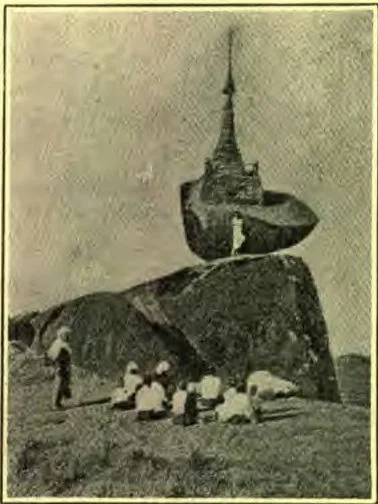
ONE of the curiosities of boulders which rock, oscillate, or move at the touch of the human hand, or simply in the wind, is the rocking stone of Cheyteyo, Burma. The superstitious natives have made of the stone a religious temple, in which they worship their idols, as can be seen by the illustration.
This stone which rocks in a violent gale, has been surmounted by a small pagoda, or boat, which is called the Pagoda of Sampan on account of the general appearance. We do not know the character of the rock, but the smooth and softened outlines would indicate that it is granite.
One of these strange rocking stones is Logan Rock, near Lands End, Cornwall. It is of granite, and weighs nearly seventy tons. In 1824 an English naval officer, Lieutenant Goldsmith, thought to try to upset it. He succeeded in moving it only a few inches, but it cost him ten thousand dollars to put it back as near to its former position as possible. This he was obliged to do by the Admiralty, which took no liking to what they thought a depredation inflicted on the coast of Britain. D. P. ZIEGLER.

A Fortune by Way of the Bath-Tub

Rochfort Maguire, who succeeded the late Alfred Beit as president of the British South Africa Company and as the head of the greatest diamond-mine syndicate in the world, attributes his success in life to a bath. The story is told by a writer in the New York Tribune:—
It was in the days when the late Cecil Rhodes sent him on a special mission to King Lobengula for the purpose of securing certain valuable concessions from the all-powerful ruler of the Matabeles. It was rather a perilous mission, as quite a number of white men had met with death at the hands of Lobengula and his chiefs. However, Rochfort Maguire arrived at Lobengula’s kraal, was received fairly well, and then proceeded to cleanse himself of the dust and grime of his voyage by means of a bath in his traveling bath-tub. This created a tremendous amount of excitement on the part of the natives, and a considerable part of the Matabele nation assembled to witness the proceedings.
Maguire is not a man who loves publicity, but he is a bit of a philosopher, and nothing could be cooler or more deliberate than the way in which he stripped, folded his clothes, and then slipped into the water. The Matabele nation looked on, commenting freely, but, as he could not understand a word, that did not matter to him. Presently he produced a tooth-brush and a box of tooth-powder and started brushing his teeth. There they drew the line. The man who puts strange things into his mouth, who foams at his lips, and turns water to milk, must necessarily be a “mtagati,” or magician. Yells of astonishment rent the air. A party went off to tell the king, taking the Irishman’s paraphernalia, and, what is more, his clothes. Maguire followed, wrapped in philosophic calm, and nothing else beyond his hat, which had been left to him.
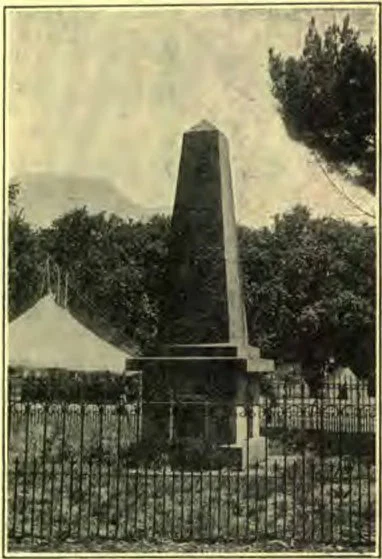
Herschel's monument at Cape Town. Tents of our recent camp-meeting can be seen behind the monument.
The king’s belief that Mr. Maguire was a magician was further confirmed by a number of conjuring and sleight-of-hand tricks which that gentleman had picked up at Oxford and afterward in the Orient, and the king took him into such favor that he not only granted him all he asked, but many other unexpected concessions which proved of immense value to Cecil Rhodes, and founded Mr. Maguire’s fortune.—Literary Digest.

India’s Sabbath-Keepers

In the south of India a company of five hundred or more persons keeping the seventh-day Sabbath has been found. They must be remnants of the old Sabbath-keeping Christians whom the Portuguese navigators found on the southwest Malabar coast when they rounded Africa and discovered India in the sixteenth century. They were astonished to find Christian churches in heathen India with a hundred thousand or more Christians worshiping in them.
The Portuguese priests said, “These churches belong to the pope.” “Who is the pope?” said the Christians. “We never heard of him. Whoever the pope may be, we are Christians. Our fathers came from Antioch, in Syria, where Christ’s followers were first called Christians.”
They had never heard of any pope of Rome, nor of any change of the Sabbath to Sunday, and were keeping the Bible Sabbath.
The pope established the Inquisition in Goa, India, and in the course of years, fifty of these Christians were put to death. They were persecuted until Rome got hold of their churches and people. Since then, shattered and turned from the Sabbath truth, many have broken away from Rome, having a service resembling that of the Greek Church, it is said.
But about 1844 there came in a revival of inquiry and study on the Sabbath truth, among some of the Tamil-speaking native Christians, through the efforts of an old teacher who found the true Sabbath and began to keep and teach it. Now we hear by this letter of hundreds keeping it, and calling to us for help. Let us pray that these representatives of the ancient faith may be confirmed in the old and eternal Sabbath truth as it shines with brighter luster in the new setting of the third angel’s message. The Lord is preparing the way for a quick work in these vast lands where the millions wait.—Monthly Missionary Reading.

Winter Days

“If every little snowflake Declared it wouldn’t fall, And if every little sunbeam Wouldn’t shine at all, Perhaps the little children Would forget the way to smile, And winter days would surely last A weary, dreary while.”
Continue reading: Our Field—The World