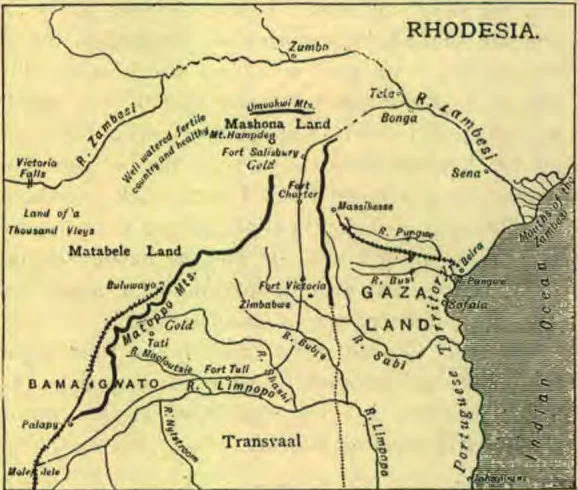
Lying between the Matoppo Mountains and the Zambesi River is Matabele land. Buluwayo, the capital city of this country, is just about half way between Victoria Falls and the Limpopo River.
The great province of Rhodesia which includes Matabeleland has been proclaimed British territory, and the development of its resources has been entrusted to the British South African Company. This country is rich in minerals, and its animal life is abundant and varied. Elephants, lions, rhinoceroses, giraffes, ostriches, hippopotami, antelopes, zebras, and gnus, abound here.
The native inhabitants belong to the Bantu family; the chief tribes are the Matabele and Mashona. The latter tribe is unwarlike, docile, and industrious. They are skilful in smelting and manufacturing; but the Matabele are a wild race, made into a nation by Moselekatsi, the great Zulu chief who fled from Tshaka into this country. They live in small villages enclosed by a strong fence, along the inside of which are packed meanlooking huts and cattle kraals.
Lobengula, the son of the Zulu chief, was for many years their ruler. He resided in Buluwayo, and he and his warriors persisted in making destructive raids in the neighboring tribes, keeping them in constant terror. The Mashona tribe was the chief sufferer at the hands of the Matabele. Finally in 1893 a well-equipped force under the command of the officers of the British South Africa Company entered Matabele territory for the purpose of stopping these raids. The Matabele were defeated, and Buluwayo was occupied by the British. Lobengula fled toward the Zambesi, and on the way died of fever.
Since Lobengula was driven away from Buluwayo, a town has been laid out by the British. Churches, hotels, and newspapers have sprung into existence. Telegraphic communication has been established, and a message can pass from Buluwayo to London in five hours. A railway connects this town with Mafeking where it joins the Cape railway system.
Opening the First Mission
More than ordinary interest centers in Matabeleland, as it was our first mission established in a really heathen country. For some time the Mission Board had desired to open up a mission center in the interior of Africa. The Cape Colony Conference contributed $2,500 toward the enterprise. On May 7, 1894, a company of five brethren met with the little company of Sabbath-keepers in Cape Town for consultation and prayer before starting on their long trip to the interior to seek for a mission site. The congregation accompanied the party to the station; and even the trainmen became interested and wished them success. Those taking this trip were A. Druillard, F. J. B. Wessels, F. Sparrow, E. J. Harvey, and L. Guoff.
At Vryburg, about seven hundred and forty miles from the starting-point, they reached the railway terminal and proceeded with wagons, mules, and oxen for the remainder of the long journey. The monotony of the trip was constantly broken by exciting chases after their straying oxen, heroic exertions in extricating their wagons from muddy pits which seemed to have no bottom, by the work of repairing or replacing axletrees broken in the strain, and by searching for water and game to augment their slender stock of provisions. Each Sabbath day was a season of rest and of spiritual refreshing. They held their little Sabbath-school at the same hour their home school was held, and the Lord came very near as they studied the precious lessons of trust from the life of Christ as given in the book of Luke. After the Sabbath-school, they held a prayer service, and the remainder of the day was spent in reading, singing, and talking of the blessings the Lord was giving them.
July 4, almost two months from the date of starting, they reached the town of Buluwayo, their objective point. To their surprise they found the stars and stripes floating to the breeze in the city; as about thirty Americans were there, determined to celebrate the day.
A letter of introduction to Dr. Jameson enabled our brethren at once to make known their desires to the authorities. When they laid their plans before him, he stated that he would aid them if they would make their mission self-supporting, and teach the natives how to work and be cleanly, to let rum alone, and to build houses and plant gardens for themselves. He offered them twelve thousand acres of land for a mission farm, in any direction where the land had not been taken.
The hearts of these faithful workers were greatly cheered by this bright prospect, and they earnestly sought the Lord for guidance in the selection of the proper location. With light hearts they gratefully accepted the guides offered them by Dr. Jameson and started on the last part of their journey. They were obliged to travel very slowly, as they were not following even the semblance of a road. At every kraal the guide would tell the natives the object of their visit. Without a single exception, the chief would urge them to locate there. After a careful search a location was decided upon thirty-five miles west of Buluwayo, near the Guye River. Eagerly they returned to Buluwayo, fearful lest some more fortunate one had secured the tract of land5they desired.
(Concluded from page four)*
To their delight, not only was this large tract given them, but they were each offered a farm if they would settle there as self-supporting missionaries among the natives. Two of the brethren took up claims near the mission farm.
One hundred head of cattle were purchased, the mission farm was staked off, and Brother Sparrow was left in charge.
The next call was for workers from America.
(To be continued)
MRS. L. FLORA PLUMMER.
Summary of the Young People's Work for Quarter Ending September 30, 1906
By L. Flora Plummer
Name of Conference
No. Societies
Membership
Isolated members
Miss. letters written
Miss. letters rec'd
Missionary visits
Bible readings
Subscriptions taken
Papers sold
Papers given away
Books sold
Books loaned
Pages tracts sold
Pages tracts given away
Hours Christian Help work
Persons fed Clothing given
Used in Home Missionary Work
Given to Mission Fields
Alabama
1
17
...
8
8
16
34
...
...
6
...
1
16
16
40
...
...
...
Alberta
1
25
...
5
...
...
...
6
134
91
139
...
...
540
...
...
$10.00
$7.45
Australasian Union
53
1003
36
764
67
1375
443
62
15448
57143
565
67
1742
36018
573
207
226.21
581.70
British Union
1
17
...
6
3
7
4
...
6
6
5
...
...
2810
...
...
...
...
California
9
329
9
71
34
276
198
6
3784
4042
1911
66
1502
5237
326
30
88.50
48.05
Central New England
1
...
...
...
...
...
...
...
1
22
...
2
...
3100
8
1
.10
.45
Chesapeake
2
78
...
23
3
26
13
...
428
70
1
13
3380
10
7
...
...
4.00
Colorado
19
468
5
154
57
136
46
15
371
1505
7
9
...
9068
131
11
9.00
164.44
Cumberland
3
75
14
108
37
523
83
4
948
2512
10
16
818
519
106
34
14.55
69.71
District of Columbia
2
55
...
...
...
46
12
...
...
1402
...
...
...
3374
...
...
22.12
18.00
Eastern Pennsylvania
3
38
...
12
9
307
25
1
36
241
1
3
954
988
108
6
...
8.50
Florida
...
...
5
16
17
70
...
1
5
142
5
2
...
954
...
1
.50
50.74
Georgia
...
...
2
3
1
76
3
13
69
37
...
1
20
...
...
...
...
...
Greater New York
2
37
...
14
5
36
26
28
543
191
36
8
16
9452
7
2
8.88
7.22
Hawaii
1
7
...
...
...
30
41
...
...
1769
...
...
...
427
...
...
...
...
Indiana
3
85
15
...
...
...
...
...
...
217
...
...
...
...
...
...
...
...
Iowa
11
133
14
75
29
99
38
3
103
738
19
7
...
12632
222
103
14.91
11.05
*Jamaica*
11
179
10
45
24
183
104
138
508
217
34
72
778
1669
61
95
.90
1.32
Louisiana
4
74
3
56
36
134
191
338
684
1726
231
30
74
2063
75
157
13.10
6.60
Maine
2
46
...
68
51
20
...
5
...
119
...
3
...
338
...
1
4.26
...
Mississippi
6
59
6
23
30
365
48
2
302
1250
2
5
304
12275
18
22
3.30
1.25
Missouri
5
107
...
116
16
301
93
195
7747
2349
217
33
2060
11424
122
6
117.62
5.00
New York
5
58
8
18
7
25
1
21
140
96
72
10
6
175
163
10
7.55
2.10
North Carolina
3
53
...
11
3
8
...
...
41
84
36
4
...
72
5
1
.84
...
North Michigan
17
208
7
44
14
74
31
1
...
701
6
25
130
1674
150
91
4.41
1.85
Ohio
9
179
...
59
23
762
355
26
443
8781
23
20
437
99847
130
113
12.39
136.71
Southern California
4
136
...
154
35
137
144
26
3012
21840
1282
747
1751
8318
307
658
6.13
14.42
South Carolina
...
...
1
...
...
30
...
2
...
172
1
3
...
...
1000
...
25.00
...
Southern Illinois
7
91
11
61
4
42
16
12
46
296
211
2
...
700
74
9
2.04
1.25
Tennessee River
3
40
2
24
11
13
40
...
216
263
215
9
...
9274
26
5
4.09
5.44
Texas
4
98
...
31
14
164
44
...
437
118
53
6
...
1768
90
1
1.95
12.75
Upper Columbia
3
148
38
12
5
8
4
1
4
421
16
6
...
477
4
1
1.35
18.44
Utah
2
29
3
28
16
60
...
8
62
219
4
19
...
641
76
4
3.30
...
*West Michigan*
14
166
...
55
20
147
14
2
816
2047
4
28
819
5444
347
23
18.72
10.17
Western Oregon
3
96
5
11
1
1063
34
1
...
600
2034
15
...
852
...
2
17.28
2.00
West Pennsylvania
7
108
10
11
5
21
12
...
...
37
...
...
...
1500
5
...
6.00
...
Western Washington
1
52
...
...
...
6
...
...
...
47
...
...
...
...
...
...
...
...
Totals
222
4294
204
2086
585
6586
2097
917
36334
111517
7140
1232
14807
246656
4581
1594
$645.00
$1190.61
MRS. L. FLORA PLUMMER,
Secretary Young People's Department.
Bible Questions in Instructor Dated Jan. 8, 1907
THE following persons sent in a correct list of answers to the twenty-five questions given by Mr. G. C. Robinson:—
Eula F. Roberts
R. R. Tichenor
Lula Marshall
Flora Maxim
Elmer Anderson
Nellie Ross
Bessie Stanfield
Inez Williams
Bertha C. Lea
Bethel Hunt
Pearl T. Stafford
Lela Warner
Emily M. Wilson
Frank Bennett
Leslie J. Spicer
Ilone Bennett
Eva Sammer
Lizzie Bennett
Vesta Sammer
Mary A. Houghtaling
Glenn Willhelm
Josephine Smith
Imo Abbee6
Master Charles Sterling sent in an excellent list of answers. One question, however, he failed to answer. Miss Annie Roedel answered all except the seventh correctly. Arthur Wheeless and his grandma sent in a good list. All the answers of their list were correct, but there were one or two omissions.
The answers given were not all the same as those given by the author, but were equally correct. Mr. Robinson’s references follow:—
Goldie Dingman, Edith Affolter, and Lela Warner, answered all correctly but the seventh.
Azubah Smith’s Party
By Ruth Hall
“You may go and play,” said George’s aunt, shading her eyes to look at the sun as she followed George out to the porch, “until half-past five, and then you will have to run all the way home to get here before supper.”
“O, I’ll be back,” George answered, “in plenty of time. You see if I’m not.”
Aunt Annie shook her head.
“I am more likely to see you coming in late with an excuse, ‘They hadn’t finished the ball game,’ or, ‘It was too interesting to leave.’ Don’t you remember saying such things to me, and pretty often, too?”
George blushed, for he did remember. He was quick to promise, and equally quick to forget.
He wondered now what made Aunt Annie seem so serious. She seated herself on the veranda bench, and looked off across the garden as if she were thinking of something far away. “I believe,” said she slowly, “that I will try with you what my mother tried once with me; if you are late again to-night, I shall lay down this rule: you can’t go anywhere outside that gate, after school, for a whole week.”
George had been scared by her solemn look, but now his face brightened. He did not think that sounded as if it meant much. Not to go outside the gate for a week was no great punishment.
His aunt saw how he took his sentence. “I ought to warn you,” she said, “that you may be very sorry if you bring this on yourself. Sometime I’ll tell you what happened to me when I was a little girl and I was kept at home.”
George dearly loved to listen to a story. “O, tell it now,” he begged, seating himself beside Aunt Annie on the bench.
“You want to go to play ball.”
“Not yet. I’d rather hear the story first. I’ll have time afterward to go over to the ball ground, and yet not be late for supper.”
“Perhaps,” said his aunt with a wise smile, “if you have heard it, you may not be so likely to be late.”
So she took up the piece of sewing that lay upon her lap, and, while she talked, she set beautiful, small, even stitches in her work. George fumbled with the lining of his cap, and listened eagerly.
“I was only a little child,” she began, “when this happened, not more than seven years old; but it all comes back to me as plainly as if it were yesterday. I never could forget it. I have often heard my mother say that she had more trouble with me than with any other of her family, just because I was so heedless and she could not depend on me.”
“You know I have told you we had to walk about a mile to school. Well, when my brothers and sisters came home at night, very likely I would not be with them, and no one would have any idea where I was. I never did stay out after dark; I hadn’t much sense, but I had enough for that. At twilight maybe I would come running in and begin my excuses: I had been playing coop with Helen Sofield and Priscilla Brown, or I had gone home with Sally Locke to see the new baby, and I didn’t guess it was so late—”
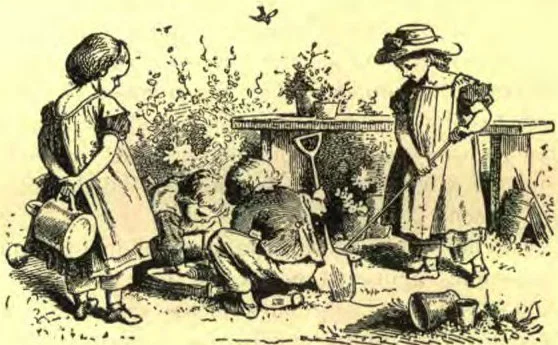
ARE YOU GOING TO PLANT A MISSIONARY GARDEN THIS SPRING?
Here Aunt Annie looked at her nephew, who turned away his head. He knew how to give such reasons for not coming home on time.
“One night,” his aunt went on, “when this had happened over and over, I opened the house door, smiling, thinking it would all be the same as usual; I should have a scolding, and nothing more would come of it. But, instead, I was surprised to hear mother say:—
“‘You may hang up your hat and coat in the entry, Annie. You won’t need them right away again.’”
“That sounded awful to me, as if I were going to die.”
“‘Why, mother,’ I said, ‘why not? I’m well.’”
“‘No, you’re not,’ she said. ‘You’re bad enough. I’m discouraged. I’ve tried kindness with you, and now I am going to try hardness. You can’t go away from the house again for a week.’”
“I didn’t think much of that at first. I had been so frightened by the way she spoke that, when she said this, it seemed to me I was let off, very easily. But it was lonesome to see my brothers and sisters start off in the morning, and run together down the road to school, and I standing by the picket fence, looking after them, those lovely spring days; for mother would not let me even go to school. I was working for a prize, too, and it was a trial to give that up; but, ‘I can’t trust you out of my sight,’ she said. ”
“Well, I did little things about the house and garden. I weeded the strawberry bed, and I sewed on my patchwork. I was too proud to fret, though I did miss the walk to school and the play and the study. I saw mother watched me, looking so sorry all the time. But of course she didn’t give in.”
“My week would be up on Thursday. It was Monday when they all came home from school, so eager to talk that every one spoke at once. There was a great hubbub.”
“‘O mother,’ said my youngest sister louder than any one else, ‘there’s going to be a party at Azubah Smith’s, and she has asked us all!’”
“We hardly ever had company for children in those days, and our family lived so far out in the country that there was less going on than in town. I had never been to a party.”
“I ran up to mother, as excited and happy as the rest, and then I saw her look at me—and I remembered.”
“‘When is this party?’ she said. ‘What night will it be?’”
“You may believe my heart beat fast then.”
“‘To-morrow,’ they called in a chorus. ‘And Annie is asked, too. Azubah asked Annie.’”
“Nobody remembered—nobody but mother and me.”
“We were in the sitting-room. I flew around like a crazy thing, and ran out to the kitchen. I felt as if I must be alone. I threw myself right across the stove—”
“O Aunt Annie!”
“The fire was out. I lay there, and cried and cried. I didn’t want ever to lift up my head again. By and by mother came out to see where I was. She laid her hand on my shoulder, and tried to soothe me.”
“‘Annie, dear,’ she said, ‘don’t take it so hard. One would think you had lost a friend.’”
“‘O mother,’ I said, ‘I don’t believe I could feel worse if I had.’”
“She told me after I was grown to be a woman, that she never was so tempted to break her word. I am glad now that she kept it. Of course I could not be then; that is too much to expect of a child. But, glad or sorry, I did not go to Azubah Smith’s party. Maybe you can guess how it seemed when I went back to school on Thursday to hear them all talking it over, and I the only one left out. It was the hardest thing, I do believe, that ever happened to me in all my life. But it cured me of carelessness.”
It cured George. He came home that night from the ball ground in time for supper. He never was late again.—Ruth Hall in the Junior Christian Endeavor World.
“It Doesn’t Take God Hard”
By Archer Wright
One sultry Sabbath afternoon While shone the July sun, Three little girls went out to see Some things that God had done.
Down past the corn-field’s rustling green They romped in childish glee: Free as the breeze that shook the leaves Their spirits seemed to be.
One was a sweet-faced four-year-old, With blue eyes and dark brown curls, And rosy, sunburned, dimpled cheeks, And teeth that gleamed like pearls.
She looked down at the hard-caked earth, So lifeless and so dry, And then across the waving corn, Up at the cloudless sky.
And then she said, “What lots of corn! How very hard ’twould be If we should have to water it— Such lots of work!” said she.
“But then, it doesn’t take God hard To water it, at all: He blows the big clouds through the sky, And lets the rain-drops fall.”
’Twas long ago. That little maid To taller years has grown. I hope she feels the same sweet faith In God that then was shown.
Ah, sometimes yet, when troubles seem My progress to retard, I hear that childish voice sing out, “It doesn’t take God hard.”
ARCHER WRIGHT.
Letters Sent in for Criticism
By Editor
AFTER Mr. Henry Rose closed his excellent series of articles on letter writing, the editor asked the young people to write letters, allowing the criticisms to be made in the Instructor for the benefit of others. Only a few have had courage or interest sufficient to do this. An honest, fair criticism upon one’s work is something that the most learned men and women are anxious to receive; so those who are just beginning to climb the ladder of knowledge ought to be very glad for any suggestion along any line that will help them to mount the ladder most successfully.
The letters that appear this week have not been carelessly written. The authors have been quite painstaking and thoughtful, but not enough so; for the standard is perfection.
HOLLY MICHIGAN Dec 13 1906
DEAR CHUM—
I will now try and answer your kind and welcome letter, in regard to our young people’s society.
We organized our society eight weeks ago next Sabbath.
We thought it would be best to have our meeting’s separate.
The young lady’s meeting is held in the parlor of the girls home, and ours in the chapel. Our meetings commence at three o’clock and last until four. We have three speakers to talk to us on any subject they choose, each is supposed to talk fifteen minutes.
Every four weeks the societies meet in Union meeting, and have two speakers from each society and we commence our meetings, at two thirty.
We organized our society so as to get practise in public speaking and being able to think what we wanted to say on our feet. We expect to bring in some missionary work in the near future.
We elect our officers, President & Secretary, every four weeks, to take their office the first meeting after the union meeting.
Well I must close and study my Bible lesson.
As ever your chum
HOWARD.
Master Howard Dix has given us an easy, straightforward description of the work of the Young People’s Societies, and I think his friend would be glad to get his letter. It is said that in one of the great insurance suits after the San Francisco fire, the company lost four and one-half million dollars, because of the position of a comma. Our government, too, once lost several thousand dollars because of an error in punctuation; so it may sometime be worth much to the author of this letter to be able to punctuate well what he writes. A period and comma should follow the abbreviation Dec.; a comma should follow 13, and a period should be placed after 1906.
The salutation “Dear Chum” should be followed by a comma and dash at least. Some use a colon.
“I will now try and answer” should be “I shall now try to answer.” The apostrophe should follow the s in ladies, and there should be an apostrophe after the s in the phrase “girls’ home.” The word commence is all right; but begin is considered better than commence, if there is no reason why the substitution can not be made. At the close of the fourth paragraph it would be better to say “at half-past two o’clock” instead of “at two thirty.”
In the fifth paragraph the sentence would be balanced better if it read, “to get practise in public speaking and power to think what we wanted to say while on our feet.” In the seventh paragraph the word and should be used instead of the sign.
Master Howard likes new things, I know, especially if they are better than the old, so does his friend, therefore let him find some new way to end his letter instead of saying, “Well, I must close and study my Bible lesson.” The idea of laying aside the writing of a letter for the study of a Bible lesson may be new to many persons, but the first part of the sentence is familiar to every one.
HOLLY, MICH.
12, 12, 1906.
Miss Lillian Rose,
Loma, Linda, Cal.
MY DEAR LILLIE:—
I have told you about this school and the work here but do not think I have yet told you about our Young Peoples Society and I am sure you will be interested to know what we are doing along that line.
We believe that we have a message to give to the world and we know that the burden will soon fall on us who are now young people; because of this we have banded ourselves together, believing that the training we will receive in our “Self-culture Society” will render us more efficient to co-operate with Christ in the work of spreading this message.
Each Sabbath afternoon at three o’clock we have our meeting. For officers we have a Leader and a Secretary. Each Sabbath we have two or three of the students present a subject, the object being to make them able to “think on their feet.”
We have two divisions to our society,—that is, the young men and young women hold their meetings separately and once every four weeks we have a union meeting.7
As this society is still in its infancy we have seen no marked results as yet, but we are trying to get a training in order that we may be efficient workers and we are praying to grow spiritually so that when the time comes for us to step out in active service for our Master we can enter into the work whole heartedly.
Asking you to remember the work here, I remain,
Yours with kindest regards,
BEATRICE HARTER.
In Miss Harter’s letter there should be a comma after the abbreviation “Mich.” It is better to write the name of the month instead of its number. The apostrophe is omitted in the word “People’s”—Young People’s Society. A comma should follow the word “society,” because of the relation of the two co-ordinate clauses. The expression, “but think I have not yet told you,” would be preferable to “but do not think I have yet told you.”
“To think on their feet” is a common expression, and perhaps its meaning is usually understood; but since it is not intended that “on their feet” shall tell upon what subject they are to think, but rather to suggest that persons are to be trained to think clearly and quickly while standing before an audience, would it not be better to state simply that fact, or at least say “think while on their feet?”
The fourth paragraph would be improved by saying: “We have two divisions to our Society, the young men and women having separate sessions. Once a month a union meeting is held.”
Wouldn’t the thought in the fifth paragraph be more directly expressed, if the sentence read, “but we are trying to get a training that will make us efficient workers. We are also praying that we may grow spiritually so that,” etc?
If Miss Harter would sprinkle in a few more commas, in the right place of course, and omit in one or two places the conjunction and, making a new sentence, her letter would merit the word—dear to every true student’s heart—excellent.
Earnest Work for You
By Editor
For nearly two years Miss Newcomer has been giving you short Bible Readings on different points of Bible truth. Now will not some of you make up a reading on the Sabbath question or the state of the dead and send it in to the editor? The readings must be short, and we want no one above sixteen to send in readings. If there are some really good ones sent, they will no doubt find their way into the INSTRUCTOR.
Power from Sunshine
By George Ethelbert Walsh
ELECTRIC power from sunlight appears more wonderful than harnessing the streams or wind. Yet we know something of the vast heat of the sun.
Solar engines for operating pumps have been in use in different parts of the earth for several years now, and their value in warm climates where the number of days of clear sunshine averages high, must steadily increase. One of the most successful of these solar machines is located near Los Angeles to irrigate fruit-land. An automatic stand carrying great reflectors follows the course of the sun as regularly as the best telescope ever made, and the sun’s rays are thus reflected on a central point where the boiler of a small engine is located. Within an hour after sunrise the heat of the sun raises the temperature of the water to the boiling-point, and thus creates steam; and the pumping machinery begins its day’s work and keeps it up until sun-down.
The power of the sun for heating has been only faintly appreciated by scientists in the past, but the prediction is made now that if all the coal should give out we would soon be able to run much of our machinery from the power of the sun. With five hundred mirrors properly arranged to focus the rays upon one point, a temperature of more than a thousand degrees has been obtained. This almost equals one fifth the highest temperature recorded by the electric furnace, which is considered to-day the most powerful heating apparatus ever discovered. As there is no limit to the number of mirrors that may be employed, and as the intensity of the heat increases in proportion to the number of rays reflected by the mirrors, it is conceivable that a temperature may be obtained in time that will surpass anything ever dreamed of in the past or present.
Hitching the sun to run electric motors for furnishing light and power for our homes and factories is the very latest achievement of the modern work of harnessing the elements to do man’s work; and one square yard of sunshine in the tropics may represent, on the average one-horsepower.—George Ethelbert Walsh, in St. Nicholas.
Great Moments Reveal Men
No man, in any great crisis, shows a gift for speech or action or heroism, unless the germs of those things were already in him. Great moments do not put great qualities into the souls of men; they simply reveal what is already there.—The Outlook.