RECOGNITION AND ENCOURAGEMENT OF THE MILITARY SPIRIT.
By W. N. G.
The present disagreement between the United States and Spain has demonstrated that, with all our peaceful and Christian pretension as a nation, there is a latent desire for military glory in the breasts of the masses that can only be gratified by war. And it would take a very extensive war to satiate the thirst for blood that seems to permeate the people from ocean to ocean. A bill was recently introduced in Congress providing for the enlargement of the regular army in time of war, which has met with vigorous protest, because it will, to a certain extent, cut off the privilege of the State troops to participate in the war in a manner that would add glory to the local organizations. A specimen protest is that which comes from the adjutant-general of Colorado, from which we take the following:—
“Section 3 of the bill provides for increasing the enlisted force of the regular army to more than 100,000 men in case of war. The effect of this section will be to prevent the National Guard of the several States from being called on unless more than 100,000 men are needed. This would seem unjust, for many reasons. The National Guard is organized, equipped, drilled, and disciplined, and its members have devoted a great deal of time and study in order to educate themselves so as to be of assistance to the country in time of need. The organizations of the National Guard would also be imbued with esprit du corps, which is a feature essential to success, and which would not prevail in the case of recruits suddenly added to the forces of the regular army. . . .”
“In the event of war the entire National Guard of Colorado desires to be among the first called for duty, and if you will use your influence to have this desire gratified, you will place under many obligations that portion of your constituency known as the National Guard of Colorado.”
Representative Bell, of Colorado, who presented this protest, made a speech to the same effect. Following is a specimen sentiment:—
“Now, gentlemen, that spirit is in every State in the Union. We do not want any more regular soldiers. The time of war is of all times the period when we least want the raw regular soldier. The regular soldier is a safeguard in time of peace. Not saying anything in disparagement of the regular private, but, generally speaking, many of them drift into the army of necessity. Too often men who have not been able to cope successfully with their neighbors in private affairs seek the regular army in times of peace for food and clothing, and because they are not self-reliant enough to fight their way alone in private life. But when you come to war, if war must be, you will find that the man who has succeeded at home among his fellows in the general avocations of life will be at the front. You will find the young man of the country generally wanting to go with his neighbors and wanting to be officered by his own citizens. You will find miners who want a miners’ regiment. You will find the cowboys wanting a cowboy regiment. You will find that the city boys will want a city regiment. You will find that the farmers will want a farmers’ regiment; and this combination, with the strong emulation it will engender, forms the army that must win our battles now, as they have been won in the past.”
The competitive spirit in war preparation is thus pointedly noted:—
“The National Guard, generally, of the various sections of the country is drilled in competition with the other forces from different portions of the State. There is a competition and a rivalry existing amongst them to secure the best drill and soldierly bearing, and to-day it is safe to say that many of them could make a very favorable competitive showing, as far as drill is concerned, with the United States Regular Army.”
Another expression from his address shows the popular standing of the men thus imbued with the spirit of war:—
“I say if you should fill up the army from 25,000 to 104,000, as is proposed here, the greater part of that army would be totally undrilled and not of the best fighting blood of the country; and such a body of men can not be trained and fitted for service and properly used as an emergency army. The National Guard is drilled, ready for action, and of the best citizenship of the nation.”
Representative Dockery, of Missouri, in the midst of an earnest speech, said:—
“Mr. Speaker, this bill authorizes an increase of the regular army in time of war to the extent of about 78,000 men. I object to it because, to that extent, it stands in the way of the rugged yeomanry from Iowa, from Missouri, from Illinois, from the great Northwest, from the Northeast, and from other sections of the Union, who desire to defend the flag if there is to be war with Spain.”
Delegate Smith, of Arizona, spoke for his section in this strain:—
“Speaking for the free, brave people of Arizona, I do not hesitate to say this bill will not bring one recruit from that Territory. They will not hide their valor and lose their identity by enlisting as privates in some United States Regular Army regiment. But give them the chance in any war against us to enlist as an Arizona regiment under officers of their own selection, and the battle’s edge will never become too perilous for that regiment to pass across it. I do not believe in any great increase of the regular army, and to that extent I oppose this bill. I depend in war on the great mass of the common people, as the government must depend on them in time of peace. Five hundred Arizona boys, well mounted, as they go at home, can drive any two regiments of Spanish soldiers out of the island of Cuba into the sea and under the very wreck that Spain’s unpunished perfidy wrought.”
Representative De Armond, of Missouri, appealed to the sentiment of home pride and social affiliation as a war flame in the following language:—
“If we are to read chronicles of bloody warfare, let us read of the charges of regiments of volunteers from New York, from Ohio, from Missouri, from Texas, and from the several other States of the Union. Let the soldiers from one proud State, the volunteer citizen soldiery answering their country’s call, meet in generous rivalry, under the one flag and for the one cause, the volunteer citizen soldiery from the other proud States. That will be a fitting representation of the American people upon the field of battle, where are to be settled great issues worthy of the nation, worthy of its traditions, worthy of its responsibilities, its hopes. . . . Why ought not the comradeship, the fellowship, of those who go out of the same community be sustained and carried through the trying scenes of war? If playfellows in childhood, schoolboys together, fellow-students in the years of early manhood, associates, aye, bosom friends, with full confidence and trust in one another—if they go to war under their country’s starry banner, why should they not go forward side by side, trusting friends as well as soldiers? Then when the battle rages, when the supreme test is applied, each man will feel that at his side stands a friend. He will feel that if some deadly missile strikes him and he falls, he will fall into the arms of a friend, and that his last words uttered upon earth, some message to his loved ones at home, will drop into the ear of a friend, to be carried, he may fondly hope, to those vainly watching and waiting for his return. Such is the American citizen soldiery; such is the volunteer army that has made this country glorious for a century of war, peace, and progress. Why should we banish that army? I am proud of my State, proud of the glorious record her sons have made on a hundred battle-fields. I wish to see Missourians to the front. I wish to hear and to read of the gallant deeds of Missouri volunteers. I wish to hear and to read of the achievements of the heroes and the sons of heroes from old Virginia, from Texas, Tennessee, New York, Kentucky, Pennsylvania, and Massachusetts. Let each volunteer have the opportunity to gather new laurels from his State at the moment that new laurels are gathered for the United States—his nation. Then your warfare will be truly American, truly republican, truly democratic, really worthy of our great republic.”
Thus we find the appeal made to every sentiment, to every tie, to every feeling that may be aroused, in order to keep aglow the fiery spirit of war in the breasts of the young and the strong. And when we take into consideration that the element popularly recognized as Christian is also arrayed, to a great extent, on the side of war,—from the instruction of the children to the sentimentality of old age,—it would seem that we are rapidly drifting backward to the barbarian ambition to be a warlike people. W. N. G.
“THE LESSON OF THE ROMAN REPUBLIC FOR THE AMERICAN.”
In more ways than one the Roman Republic is a lesson to the great Republic of the West. Under the above title Prof. Louis Du Pont Syle, of the University of California, gave a lecture in Stiles Hall, Berkeley, April 17, reported in the San Francisco Examiner of the next morning. The following is a part of what he said; it is in great part, by undesigned coincidence, an excellent commentary or side-light on certain prophecies of the Word that this paper has often presented:—
“The sudden inroad of corrupting wealth into Rome is paralleled by the amazing material growth of this country in the last fifty years. As Rome subjugated the rich and luxurious East, so did we, by the Mexican War, come into possession of a country which contained and is developing stores of untold riches. We who live in California can realize the direful effects of the gold discoveries upon the moral stamina of this country; the blood of King, murdered in San Francisco, was but one of a long series of tragedies which made thoughtful observers wonder if any greater moral curse had ever fallen upon this land than the discovery of gold on the Pacific Coast. Now, the anarchical state of society produced by the gold discoveries was simply the most violent and open manifestation of the workings of that base and sordid spirit, incompatible with the existence of civic virtue and the healthy growth of free institutions, which Napoleon scored in our English ancestors when he dubbed them ‘a nation of shopkeepers.’ In us the same spirit has been not unjustly called ‘the worship of the almighty dollar.’”
“With shame and sorrow let us confess it. The almighty dollar is the god which too many in this country worship with an intensity of fervor that makes us sigh when we think of what the American nation might become had it but a worthier god. Nor is it confined to any one rank or profession. He is worshiped by the clergyman that leaves a $3,000 church and goes to a $5,000 one, if he cloaks his baseness under the vile pretense of a providential call; he is worshiped by the lawyer that takes a large fee to make the worse appear the better cause; he is worshiped by the newspaper editor that will not speak unpleasant truths to wealthy rascals or to powerful corporations for fear of losing their advertisements; he is worshiped by any man that has no aim, object, or rational enjoyment in life beyond the insane and vulgar desire to be thought richer than his neighbor. The sacrifices which such men offer up to their golden god are often very bloody; they consist of the tired limbs and wearied brains of poor, overworked shop-girls; of the frozen hands and consumptive coughs of motormen and gripmen working fourteen and sixteen hours a day; of the hard lives and agonizing deaths of many a poor railroad and steamship hand, all offered up to the great god of greed.”
“If this spirit continues to grow at its present rapid rate, the fate of the American republic is sealed. Save as a warning to future ages, the book of our history might as well be closed to-day as a hundred years hence. No civil institutions, however good, can long withstand the onslaughts of this base and encroaching spirit.”
“I doubt very much if Rome ever witnessed more open and wholesale bribing of voters than has this country during some of our presidential elections; on both sides it has been practised with a cynical defiance of public opinion that could mean only this—that public opinion was indifferent to it. Two or three generations of this sort of thing and we shall find ourselves possessing all the forms of free institutions but none of the realities.”
“The same causes which led to the fall of the Roman Republic are at work in ours. We have the same sudden increase of enervating wealth, the same influx of foreign-born citizens possessing neither the native feeling nor the native tradition; the same accumulation of unskilled laborers in our great cities—those huge pest-houses where are bred the worst mental and physical diseases to which poor humanity is heir. If we look upon these things with the Roman’s indifference, we shall share the Roman’s fate.”
But with what more reason could we hope for a reform in this republic than in that of the Roman? Moreover, the ultimate fate of this government and all others is clearly indicated in the Word of God. The student of that Word is left neither to conjecture nor fancy.
Christians and War
“It should speedily become disreputable,” says a prominent religious weekly, speaking of the talked-about alliance between England and the United States, “to rail at the nation to which we are so closely related.” This statement is good as far as it goes. But it is no broader than the view of a mere politician. Divest the statement of its partisanship, and widen it into real Christianity, and it would then say, “It should always be disreputable to rail at any nation, or even at any individual of any nation.” Why, even “Michael the Archangel, when contending with the devil . . . durst not bring against him a railing accusation, but said, The Lord rebuke thee.” Jude 9. The idea should be faithfully rebuked that “Christians” in one nation can go to war with “Christians” in other nations, and while brutally killing one another, still at the same time all be Christians in fact. The real Christian has no carnal sword or cannon among his weapons.
War Scare Boosts Factory Work
The factories of the country are working double time on swords, guns, and bombs, and the war scare is thus putting bread and butter into many thousands of mouths. There may be a drop in the agricultural implement market when the swords shall come to be beaten into plowshares; but it is early yet for solicitude on that point.—Philadelphia Record.
DON'T WORRY.
O HEART of mine, we shouldn’t
Worry so.
What we’ve missed of calm we couldn’t
Have, you know.
What we’ve met of stormy pain,
And of sorrow’s driving rain,
We can better meet again,
If it blow.
We have erred in that dark hour
We have known,
When our tears fell with the shower,
All alone.
We’re not shine and shadow blent,
As the gracious Master meant.
Let us temper our content
With His own.
For, we know, not every morrow
Can be sad;
So, forgetting all the sorrow
We have had,
Let us fold away our fears,
And put by our foolish tears,
And through all the coming years
Just be glad.
—Anonymous.
“A SUM IN DIVISION.”
By Kate W. Hamilton
WE were waiting on the shore for our rustic ferry-boat to cross and carry us over for an afternoon in the grove. Mrs. Leighton looked dainty and stylish as usual—the embodiment of wealth, culture, and luxurious ease, I said to myself as I watched her. Her dresses always suited her, and nothing could have been more becoming than this simple one with its collar and vest of soft white silk. I noticed it all with an involuntary sigh.
“You are tired,” she said quickly. “Let me take baby.”
“O, no!” I answered, holding him closer. I felt a half jealousy of her that afternoon—a little feeling of resentment because she had so much. But baby was my treasure; she could not have him.
CALIFORNIA SCENERY, No. 15.—The Russian River rises on the western slope of the Coast Range, in Mendocino County, flows south and west amid diversified mountain scenery, cultivated farms, and through redwood forests, into the Pacific Ocean. The above view is of the river a few miles from its mouth, near Guerneville, Sonoma County, 100 miles north of San Francisco, on the North Pacific Railway. It is one of the many beautiful spots of nature.
She had seemed to me like some tropical bird when she fluttered down into our quiet village that summer. She was a semi-invalid in search of rest and pure air; and she found both at the home of my neighbor, with its old-fashioned rooms, quaint garden, and wide orchard. I had not expected to see much of her, but, tho the advances were all on her side, we grew quite friendly as the weeks went by. She seemed to enjoy coming to our little house. It was pretty and pleasant, and I had thought it almost perfect before she came. I hardly knew why it was that I began to find flaws in it now—to be fretted because the paper was cheap, and the engravings so plainly framed, and to find the planning and contriving to which I had always brought such enthusiasm, growing irksome. I do not know whether Robert noticed the change, but I fear he did. And dear Grandma Ellis—Robert’s grandmother, who had always lived with us—used to watch me with a shadow on her sweet face, and say, “Don’t let your blessings grow dim, child; don’t let your blessings grow dim.”
But they seemed dim that day—pale and faded things scarce worth the counting, and my life pinched and narrow, while others were so full. I had just the monotonous round of home care and enjoyments, and the few social pleasures a sleepy village could offer. Every little luxury in the way of books and pictures must be carefully planned for in our home, and journeys were hardly to be thought of. I felt restless and discontented—“not dissatisfied, but unsatisfied,” I persuaded myself, by way of covering up some thoughts I did not care to own. I loved all beautiful things as well as Mrs. Leighton did, if I could but have leisure and means to enjoy them.
As we sat under the trees that afternoon, I drew from her the descriptions of the places she had visited and the things she had seen. She talked well, and the life she pictured fascinated me.
“You are free, and you have so much,” I cried. “I wish some things could be more evenly divided.”
The laugh with which I spoke could not have veiled the feeling, for she suddenly turned and looked at me.
“Would you care to be so free that your coming or going would make no difference to any one—that no one would miss you or watch for you?” she asked slowly. “I come and go at will because I have no kindred anywhere, no home in any land on earth. But all the marvels I have seen do not seem so beautiful to me as a little home like yours. Sometimes when I have watched you and others like you, I, too, have thought things were not evenly divided.”
All at once the woman’s lonely heart and desolate life stood revealed. Her world looked so wide and empty that I shuddered and clasped my baby closer.
“No, no, not that—I did not know,” I faltered. “I thought you were so happy”—
“Because I did not go about mourning? I must make the most and the best of what I am and have for myself and others. There is many a hungry heart that obeys the command to anoint the head and wash the face, and appear not unto men to fast, but the Father who seeth in secret knoweth how starved it is, for the sweetness it sees all around it.”
She smiled, tho her eyes were wet.
“Little woman, the divisions of this world make a long, hard sum, and only when we reach heaven shall we be sure of the right answer.”—Kate W. Hamilton, in Church Evangelist.
ALCOHOL
Alcohol is, perhaps, the most deceitful drug in the whole materia medica.
All drugs have a primary and secondary effect, and are usually prescribed for the former; but where, as in the case of alcoholic beverages, large quantities are apt to be taken with great frequency, the secondary effects of the remedy become of great importance.
The first action of alcohol is to stimulate the circulation and brain; it borrows from the vital resources a sufficient amount of force to make a display of apparent strength, but at a great cost to the organism, and a too frequent repetition of the draft must eventuate in physical bankruptcy. But, unfortunately, the very process which enables a man to make this display of seeming health and energy soon destroys his ability to correctly gauge his vital reserve, and the neurotic taint, sole inheritance of many, clamors more and more vehemently for the stimulant which shall make its unfortunate possessor the momentary peer of any man.
The inception of the drink habit is the first step in the process of mental, moral, and physical suicide; and the physician whose faulty judgment recommends alcohol in any form for indigestion, debility, etc., shoulders a weight of responsibility which no honest man should willingly assume.—Medical Brief.
Making Use of Moments
“MUCH may be done in those little shreds and patches of time which every day produces and which most men throw away, but which, nevertheless, will make at the end of it no small deduction from the little life of man.”
The Power of Decision
“NOTHING more effectually conquers mental indolence and rouses torpid powers to exertion than the necessity of making decisions, united to the conscientious desire of making right ones.”
Smiling Through Tears Makes the Most Beautiful of Rainbows
“SMILING through tears makes the most, beautiful of rainbows.”
THE PROBLEMS OF CONFUCIANISM.
This was the subject of an address by Mr. H. P. Beach, educational secretary of the Student Volunteer movement, at the recent convention held in Cleveland, Ohio. The speaker was for several years a missionary in China, and treated his subject from the standpoint of personal contact. The following excerpts from the address were taken by our correspondent at the convention:—
“The complexity of Confucianism arises from the fact that it is at once a system of politics, of economics, of ethics, and of religion. Not only so, but within each of these departments there is great heterogeneity. Failure by the missionary to apprehend this complexity, and a tendency to attack the system indiscriminately, have led to great misunderstanding, while the emphasis of its strong points only has been an unfortunate compromise.
“The literati of the empire are a serious obstacle in the way of Christian missions. They are not only numerous—a quarter of a million of these scholars having presented themselves last year at the second degree, or M. A., examination alone—but are also found in every village and hamlet of the empire. These leaders and rulers of the people are usually inaccessible to the missionary, and when seen by him, are so steeped in conceit, and so full of contempt for everything foreign, that little impression can be made upon them. Their corruption in official life is the source of China’s greatest weakness, and this, coupled with their power, which is really greater than that of the emperor, have been twin evils pitted against Christianity.
“The difficulties presented by its doctrinal11teachings arise from a combination of theoretical atheism with a very practical polytheism and idolatry, from a deficient and in some respects false theory of man’s nature, and from its consequent doctrine of self-salvation. Its hopeless future leads men in this life into oriental epicureanism. Perhaps the most serious obstacle met with on Confucianism’s doctrinal side is its marvelous system of ethics, which, in spite of defects, so fully satisfies the Chinese mind that Christianity is felt to be a needless superfluity.
“A mighty empire, the most populous in the world; an antiquity not only remote, but filled with noteworthy deeds and striking inventions; a people which to-day is perhaps the best fitted to survive in the family of nations; intellectual ability akin to the German and destined to produce the leading scholars of the twentieth century; these and other equally significant traits are under the control of a nominal Confucianism, and other impulses coming from effete forms of Taoism, Mohammedanism, and Buddhism. The combined influence of these factors in the broader situation is one of profound apathy on religious subjects, and of virtual atheism in many leading minds.
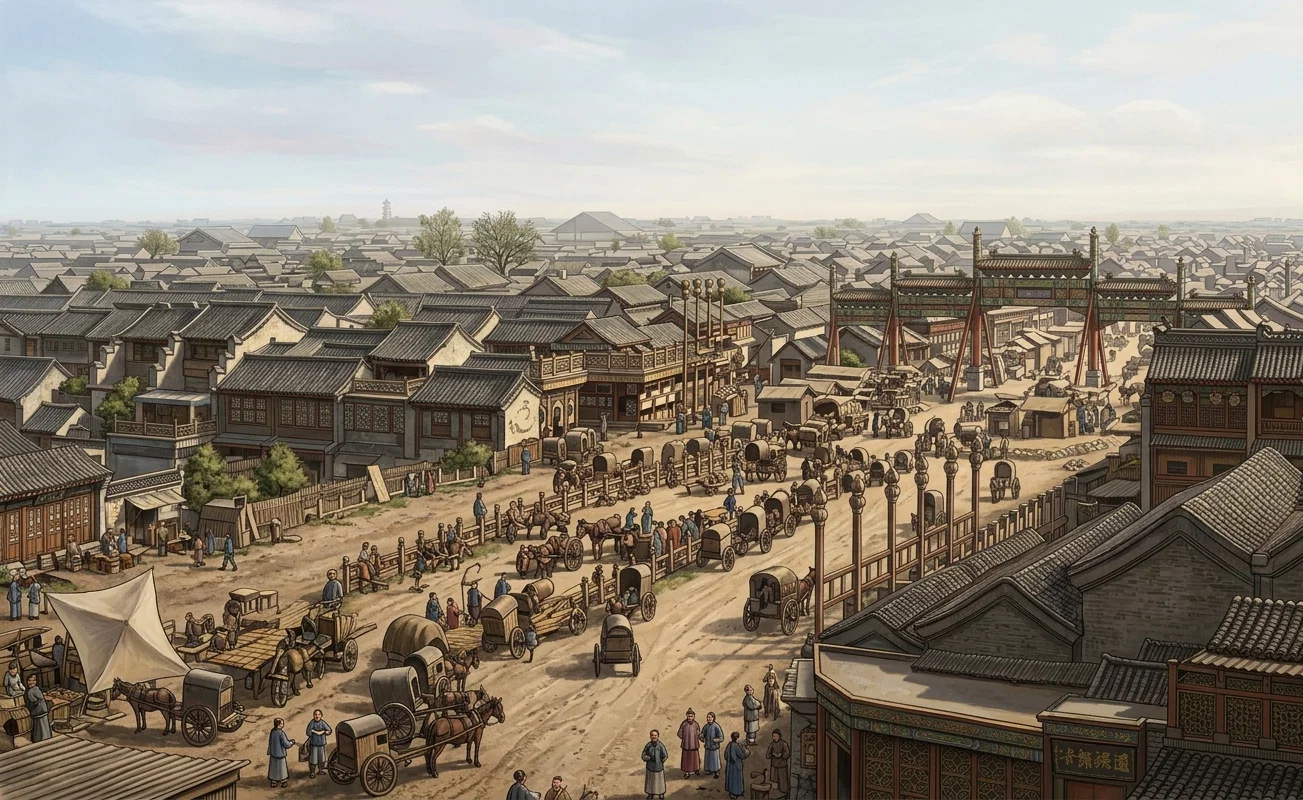
View in Peking, capital of China. This city is situated in the province of Chihli, about 100 miles from the Gulf of Pechili, near the Pei Ho River. Its population is estimated at 1,300,000. Among the great temples found here is the temple of Confucius, known as the Kwo-tsze-keen. This temple is very plain, one hall containing all that is accounted sacred. The objects of worship therein for the countless followers of the Chinese sage are the tablets of “the soul of the most holy ancestral teacher, Confucius,” and of his ten principal disciples.
“The first solution of these problems is that attempted by western civilization. Successive wars with western powers have forced upon the unwilling empire a navy, a foreign-drilled army, and railroads and telegraphs so fatal to the hitherto all-powerful system of Feng Shui, or geomancy. As an indirect consequence, the customs service was organized under foreign supervision, and has been an object lesson of official honesty. Industrial progress has been especially marked since the conclusion of the Japanese war, and is already beginning to affect for good China’s economical situation, through the starting of mills, and the exploitation of mines. More important still is the encouragement of western science resultant upon the opening of national doors.
“A second attempt to solve China’s problems has been that of storming Confucianism’s high places. The New Testament, costing $1,200, that was presented to the emperor’s dowager on her sixtieth birthday; the emperor’s purchase of copies of the same; his interest in the study of English; Li Hung Chang’s contact with missionaries and board secretaries; the success of the publications of the Christian Literature Society in reaching the chief official opponents of the foreigners; the Reform Club in Peking, under the influence of two former missionaries, —these have all been efforts of great significance.
“The essential solution of China’s greatest problem—that of the regeneration of her people—must be a more radical one. It lies first of all in a reproduction of the life of Jesus in the persons of foreign missionaries, who are sent to touch life at all points as He did in Palestine. His Spirit must be the leaven in the lives of native Christians and Christian helpers who come into closest contact with Confucianism. The Word of God, so largely used hitherto in China, will be a silent missionary in tens of thousands of homes, and His Spirit must be believed in and prayed for and possessed by every Christian in the empire before the final victory is won.”
SPURGEON’S ONLY DEBT.
FROM volume one of the “Autobiography of Spurgeon,” just published in London, the following is extracted. It should not only be read carefully, but the lesson should be heeded:—
“When I was a very small boy in pinafores and went to a woman’s school, it so happened that I wanted a stick of slate-pencil and had no money to buy it with. I was afraid of being scolded for losing my pencil so often, for I was a real careless little fellow, and so did not care to ask at home. What then was I to do?”
“There was a little shop in the place, where nuts and tops and cakes and balls were sold by old Mrs. Pearson, and sometimes I had seen boys and girls get trusted by the old lady. I argued with myself that Christmas was coming, and that somebody or other would be sure to give me a penny then and perhaps even a whole silver sixpence. I would, therefore, go into debt for a stick of slate-pencil and be sure to pay at Christmas. I did not feel easy about it, but still I screwed my courage up and went into the shop. One farthing was the amount, and as I had never owed anything before, and my credit was good, the pencil was handed over by the kind dame, and I was in debt. It did not please me much, and I felt as if I had done wrong, but I little knew how soon I should smart for it.”
“How my father came to hear of this little stroke of business I never knew; but some little bird or other whistled it to him, and he was very soon down upon me in right earnest. God bless him for it; he was a sensible man, and none of your children-spoilers; he did not intend to bring up his children to speculate, and play at what big rogues call ‘financiering,’ and therefore he knocked my getting into debt on the head at once, and no mistake. He gave me a very powerful lecture upon getting into debt, and how like it was to stealing, and upon the way in which people were ruined by it, and how a boy who would owe a farthing might one day owe a hundred pounds, and get into prison, and bring his family into disgrace. It was a lecture, indeed; I think I can hear it now, and can feel my ears tingle at the recollection of it. Then I was marched off to the shop, like a deserter marched into barracks, crying bitterly all down the street, and feeling dreadfully ashamed, because I thought everybody knew I was in debt. The farthing was paid, amid many solemn warnings, and the poor debtor was set free, like a bird let out of a cage. How sweet it felt to be out of debt! How did my little heart vow and declare that nothing should ever tempt me into debt again!”
“It was a fine lesson, and I have never forgotten it. If all the boys were inoculated with the same doctrine when they were young, it would be as good as a fortune to them, and save them wagon-loads of trouble in after life. God bless my father, say I, and send a breed of such fathers into old England to save her from being eaten up with villainy, for what with companies, and schemes, and paper money, the nation is getting to be as rotten as touchwood! Ever since that early sickening, I have hated debt as Luther hated the pope.”
GERMS!
By Helen A. Steinhauer
Two winsome little folks, a laddie and a lass, were playing in the green field south of my house. Suddenly the wee mon, who is a great friend of mine, rushed up to me—blue eyes distended, and horror depicted on his round, chubby face—as he held towards me a paper sack which he had picked up, and excitedly exclaimed:—
“O! look at the germs!”
The old bag had evidently contained sugar, once upon a time, and an army of small ants, out foraging, had taken possession of it with a view to carrying off the grains that still adhered to its sides.
At this moment our small Scotsman’s little French playmate caught up with him, cheeks aglow, and eyes shining with the importance of the find. Turning her pretty, bright face up to his, she inquired eagerly:—
“W’at is oo doin’ to do wiz ze germs, Davie; burn ’em?”
“No,” promptly replied the petticoated doctor of the next decade, solemnly shaking his blond curls, “I shall bury them!”
Es geht ohne sagen (it goes without saying) that the parents of these well-informed infants were employees of a famous Sanitarium which makes a specialty of germology, and is noted for its discoveries in that line.
Roentgen rays, Crooke’s tubes, calcium tungstate screens, etc., are all well enough in their way, but what may we not hope from the unassisted vision of the rising generation!
HELEN A. STEINHAUER.
OLD ACQUAINTANCES.
AMONG the visitors in New York during the centennial celebration from the south, was a gentleman on the staff of the governor of Virginia. He had written to a friend to engage a horse for him to ride during his stay in New York. A white horse, proud-stepping and slender-limbed, was selected, and on the morning appointed was led, in company with a coal-black steed, to the spot where the Virginia gentleman and a friend were ready to mount, when, lo! the black horse pawed the ground, shook his head, showed great uneasiness, and altogether behaved so remarkably that he attracted great attention.
“As sure as I live,” said the rider of the white steed to his companion, “you are mounted on Black Diamond, my own old horse!”
“Nonsense!” said the other equestrian. “You wouldn’t know Black Diamond now, and he wouldn’t know you.”
By this time a little throng of spectators had gathered, interested in the scene. Black Diamond’s saddle was taken off, and under it was discovered an old scar, and a little tuft of white hair, which proved his identity beyond a doubt. When his old master mounted him, the horse fairly quivered with delight, and gave a cry of gladness. All through the centennial week there were two happy beings together, a man and a horse, and a horse sometimes shows intelligence so nearly human that one can not but be glad when a great pleasure falls into the life of this faithful friend of man.—Our Dumb Animals.
LEARN TO BE SILENT.
By T. C. Upham
It is a great art in the Christian life to learn to be silent. Under oppositions, rebukes, injuries, still be silent. It is better to say nothing than to speak in an excited or angry manner, even if the occasion should seem to justify a degree of anger. By remaining silent, the mind is enabled to collect itself, and to call upon God in secret aspirations of prayer. And thus you will speak to the honor of your holy profession, as well as to the good of those who have injured you, when you speak from God.—T. C. Upham.
Pride and Humility
I NEVER yet found pride in a noble nature, nor humility in an unworthy mind. Nothing procureth love like humility; nothing hate, like pride.—Owen Feltham.
RALLY ’ROUND THE ENSIGN.
By John McCarthy
“O, rally ’round the Ensign,”
Ye Christians, great and small;
The conflict fierce is waging;
Let not the banner fall!
The whole world now is watching
Your action in the fight;
Then will you to the battle?
Go forth in Jesus’ might.
“O, rally ’round the Ensign!”
The foe is pressing sore;
For truth our faithful brethren
Their blood do freely pour.
Shall ye as cowards linger,
Despising God’s command?
Or will ye ’neath the Ensign
For Jesus take your stand?”
“O, rally ’round the Ensign!”
The fight is hottest there;
The enemy would lower
Our colors, but your care
Must be to lift them higher.
Stand by, be firm and true,
As zealous, earnest watchmen,
Who well their duty do.
“O, rally ’round the Ensign!”
The hosts of sin assail;
Alone by trusting Jesus
Can ye o’er them prevail.
Their ranks are numbered legion,
And still they swell each hour;
But yet you can, confiding,
Them vanquish—by God’s power.