Your ShelfYour Projects

Signs of the Times, Vol. 39, No. 8.

Question Corner

Signs of the Times

Feb 20, 1912

Pacific Press Publishing Association · Mountain View, California · Feb 20, 1912

Question Corner

"IF YE WILL INQUIRE, INQUIRE YE."

This Inquirers' Department is conducted for the purpose of helping those who are studying the Bible. The answers are oftentimes only suggestive. They are never to be considered infallible, only as they agree with the infallible Word. The writer who may answer them does not consider that his opinion is infallible. He will simply give the best that he has, and plead with the inquirer to search the Word. Such questions only will be answered as, to the editors, seem to minister to the good of the readers and to the mission of the paper. We can not answer repeatedly in the same volume questions upon the same scripture. The name and address must accompany question, not for publication, but as an evidence of good faith, and that answer may be made by letter if deemed advisable. No letters are answered which do not contain the name of the writer. It is well always to enclose stamp for reply.

3669 — One's Talents

If a person has ability and desire to draw, is that his talent? and should he place himself under an instructor, and improve and develop his skill, and use it to the glory of God? A. K.
It may be, and it may not. Our desire to do things is not always the thing that God can use best. One's ability should not be confounded with talent in the sense of Scripture. In common parlance, we often use "talent" in the sense of ability, but the talents in the parable represent spiritual gifts, as will be seen by comparing that parable with the instruction which God has given in 1 Corinthians 12 and Ephesians 4. The talents and the gifts were given at the same time, for the same purpose, for the same length of time, by the same One, our Lord Jesus Christ, when He ascended on high. The talent is not of our choosing. God bestows His gifts as He will, and not as we will. 1 Cor. 12:11. Sometimes the very thing that He chooses, is the thing that is repugnant to the natural heart, and yet He knows our ability a great deal better than do we, and knows much better than do we what gifts we can use. A desire which we might have might not be the best thing for us. It simply, if developed, might bring glory and praise to us, and yet no good to Him. And we may entirely overestimate our ability in that direction. There are thousands who love drawing and painting, and have an intense wish that they could do that. There are many worldly reasons why this wish should be fostered. There are always friends enough who praise the most ordinary kind of work, and flatter him who does it, in both poetry and art. The only way for the Christian to do is to lay all before God, count all but loss, and receive from Him that which He can use best to His glory.
You may ask how that may be determined. One of the very best ways to determine it is to do whatever comes to our hand to do, whether we like it or not — do it for the Master. "Whatsoever thy hand findeth to do, do it with thy might." In that very thing we may develop in an astonishing way to ourselves just the very work to which we are called. And then we will not take glory to ourselves, but give all the glory to God.

3667 — What Is the Use?

Why, when we know that the world is going on from bad to worse, and will sometime, according to the Bible, be destroyed, should we seek to overcome the evils and graft of our Government, public officials, etc.? In other words, where is the stimulus to build a good house when you know it will be torn down?
C. S. H.
Now if this were all there was to it, there certainly would be little stimulus, little incentive; but more is involved than material things, of infinitely more value, and this is character—nay, more, characters. Here is a ship that is sinking. It may have a thousand souls on board. Some of them may be ready for any crisis which may come, and if they go down to death will come up again in the first resurrection, justified in Christ. Others do not know Him, and if they go down to death they are sure to meet eternal death. God asks every soul who can save life at such a time to put forth his effort in saving life, to do all in his power to snatch from peril those for whom He has died. If men are pursuing a wrong course, for the sake of the men, and the men whom they will influence, they ought to be warned. If a government is taking a wrong course, it is doing so because men are leading in that direction. A warning ought to be given regarding these. This is the purpose for which the "Signs of the Times" is giving warning concerning all these evils to come, and will do all in its power to stay these evils, in order that souls may be saved from them. Jesus said of Satan, under the figure of the false shepherd, or the thief, that he comes to steal and to kill and to destroy, but He, the Good Shepherd, came "that they might have life, and that they might have it more abundantly." John 10:10. And as He labored while in this world, and labored for a people that He knew was soon going to destruction, so His children ought to labor now.

3668 — Weak and Beggarly Elements

What are the weak and beggarly elements referred to in Gal. 4: 8-10? H.
The very scripture itself clearly shows us to what the apostle refers. Man by sin is under bondage, under the bondage of sin. Under that bondage he does all that he can to free himself; he uses everything in his power to do this; but he finds them all weak, and all beggarly, and instead of giving him freedom they give him bondage. Every system of idolatry is based on the thought of self-salvation. Out of this God saved the heathen Galatians, or Gauls. Certain Jews came there and told them to be circumcised if they would be saved. Circumcision of itself was nothing either way, but when it was made a matter of salvation it became an enemy to Christ; and the apostle would teach them that to go back to any of those things as saving ordinances would throw them right back where they were in the beginning, of endeavoring to be saved by their own works. And so therefore, "Now that ye have come to know God, or rather to be known by God, how turn ye back again to the weak and beggarly rudiments, whereunto ye desire to be in bondage over again?" And that very thought, that returning to that same idolatry (for if circumcision would help, why, their old idolatrous feasts, and fasts, and days would also help), led them back again to the days, and the months, and the seasons, and the years. This does not refer to God's days, or God's appointed seasons, which have their purpose and their object. The Sabbath is a worship day; the Lord's Supper is to call to remembrance the Lord Jesus Christ; so with all of His simple ordinances. The text makes no reference to these. It is to those things that men have themselves devised, or used as a means of salvation, leaving out the Lord Jesus Christ. "For in Christ Jesus neither circumcision availeth anything, nor uncircumcision; but faith working through love" (Gal. 5:6), and love keeps all of God's commandments (1 John 5:3).

3670 — Under the Law

Paul, in his masterly argument in the 3d, 4th, and 5th chapters of Galatians, used the expression "under the law." What do you understand this to be?
"Under the law" means, we are sure that our correspondent will find, wherever used, except once, under the condemnation of the law. That exception is in Rom. 3:19, where it means subject to the law. The term is not the same in the original. "Under the law" comes from "hupo nomon;" literally, "under law." The expression in Rom. 3:19 comes from "en to nomo;" literally, "in the law"—that is, within its jurisdiction. But the text points out this fact,—that all are condemned by it.
Now those under the law are not within the blessings of God's grace. They have not accepted of the grace which pardons sin, but when the grace which pardons sin is accepted, it takes a man out from under the law; and therefore Paul declares, "Sin shall not have dominion over you: for ye are not under law, but under grace." God's grace has forgiven the sin, and the law does not condemn. And he goes farther than that: "What then? shall we sin, because we are not under law, but under grace? God forbid." See Rom. 6:14, 15. Not to sin is to keep the law; and that is the object of God's grace under the new covenant. It is to write His law in the heart, so that we shall rejoice in it. (See Heb. 8:8-10.) God's law, therefore, is no longer over us a condemner; it is within our heart as a cherished friend. We are not over it, nor is it over us; we are with it—in harmony with it. (See "Bible Students' Library," No. 163, "'Under the Law,' or 'Under Grace'?" in which this question is discussed much more fully.)

3671 — Why the North?

We have no desire to speculate as to why God places His throne in what is said to be the north. That it is there, and that He is the great King of the North, seems clearly evident, even from the ambition of Lucifer himself, who declared that he would place his throne in "the sides of the north." The usurper, of course, would desire to imitate God. Consequently, the pseudo king of the north has stirred up all sorts of trouble in the earth; and in nearly all cases in the prophets where trouble is to come upon the people of God it is spoken of as coming out of the north, as in the texts under consideration. Of course the great, ambitious powers of earth were northern powers,—Babylon, Medo-Persia, Grecia, and Rome.

3672 — The Law of Gravitation

Does God have control over the law of gravitation? and is it true, as some say, that the universe would get out of order if the earth were burned up, or annihilated? A. K.
Yes, God has control over the law of gravitation, and He has laws that are higher than the laws of gravitation. This was demonstrated in three different instances in the Bible—in the ascension of Enoch, and Elijah, and our Lord Jesus Christ. The laws which elevated them above the earth and carried them to heaven were certainly laws which were above the laws of gravitation, which would have held them here. We need not be afraid of God's universe getting out of order, if any world is burned up. Of course there is nothing in the Bible to indicate that the earth will be destroyed; in fact, we are told "the earth abideth forever." It will be changed, renovated, cleansed, by the fires of the last days, and so far as we know there may be changes in the planets and suns. Some even may go out of existence. New may be created, but we can leave it with God to care for His universe. He "bringeth out their host by number: He calleth them all by names by the greatness of His might, for that He is strong in power; not one faileth." Read Isaiah 40.
Schedule for Week Ending March 2, 1912
Note.—There comes to us an inquiry as regards the time when the Jews went up to Jerusalem to be taxed, or enrolled, but there is no signature whatever to the inquiry. This, with others, we pay no attention to, and would not cite this one, were it not for the purpose of helping our querists. We do not ask the name for publication. We must insist upon it, however, as an evidence of good faith in the asking of the question. We publish no names,—nothing but the initials, unless it is so requested by our correspondent; and any pseudonym which they may wish to use instead of their name will be used in the published question and answer. But in the correspondence we must have the name.

Lessons from Leviticus and Numbers

We omit the rest of the book of Leviticus, having to do largely with rites and ceremonies, but containing many important lessons. Read it if there is time. We bring in Leviticus 23, as it has to do explicitly with the yearly feasts which Israel observed, or failed to observe, but which God gave for a purpose. We find in them the yearly, or ceremonial sabbaths set forth in contradistinction to the Sabbath of the Lord of the seventh day. Verse 38.
We omit the first five chapters of Numbers, which pertain to the numbering of Israel, the order of their encampment, the princes of the tribes, the division of duties among the Levites and the priests, the redemption of the first-born, and other ceremonies connected with the institution of worship. We retain the 6th chapter because of the Nazarite vows, which we will read more about hereafter, and of the blessing which the Lord placed upon the children of Israel.
We omit again the oblation of the princes, the purification of the Levites, etc., and make a new beginning at the 10th chapter, giving directions regarding the blowing of the trumpets and the marching of the hosts of Israel, and the extremely sad but important lessons of the murmuring of Israel for flesh, the speaking against Moses, the searching of the land, and the reports of the spies. Omitting the 15th chapter, we read in the 16th the lesson of Korah's rebellion. God's decided choice of the house of Aaron is set forth in the 17th. We again omit the ceremonial instructions in chapters 18 and 19, and read the interesting narrative of chapters 20 and 21, of Miriam's death and Israel's journeying around Edom, and the enemies they met in the way, closing with the wonderful 19th, 20th, and 21st Psalms. The first two ought to be committed to memory.

Schedule for Week Ending March 2

Schedule for Week Ending March 2
Sunday February 25 Leviticus 23
Monday " 26 Numbers 6, 10
Tuesday " 27 " 11, 12
Wednesday " 28 " 13, 14
Thursday " 29 " 16, 17
Friday March 1 " 20, 21
Sabbath " 2 Psalms 19, 20, 21

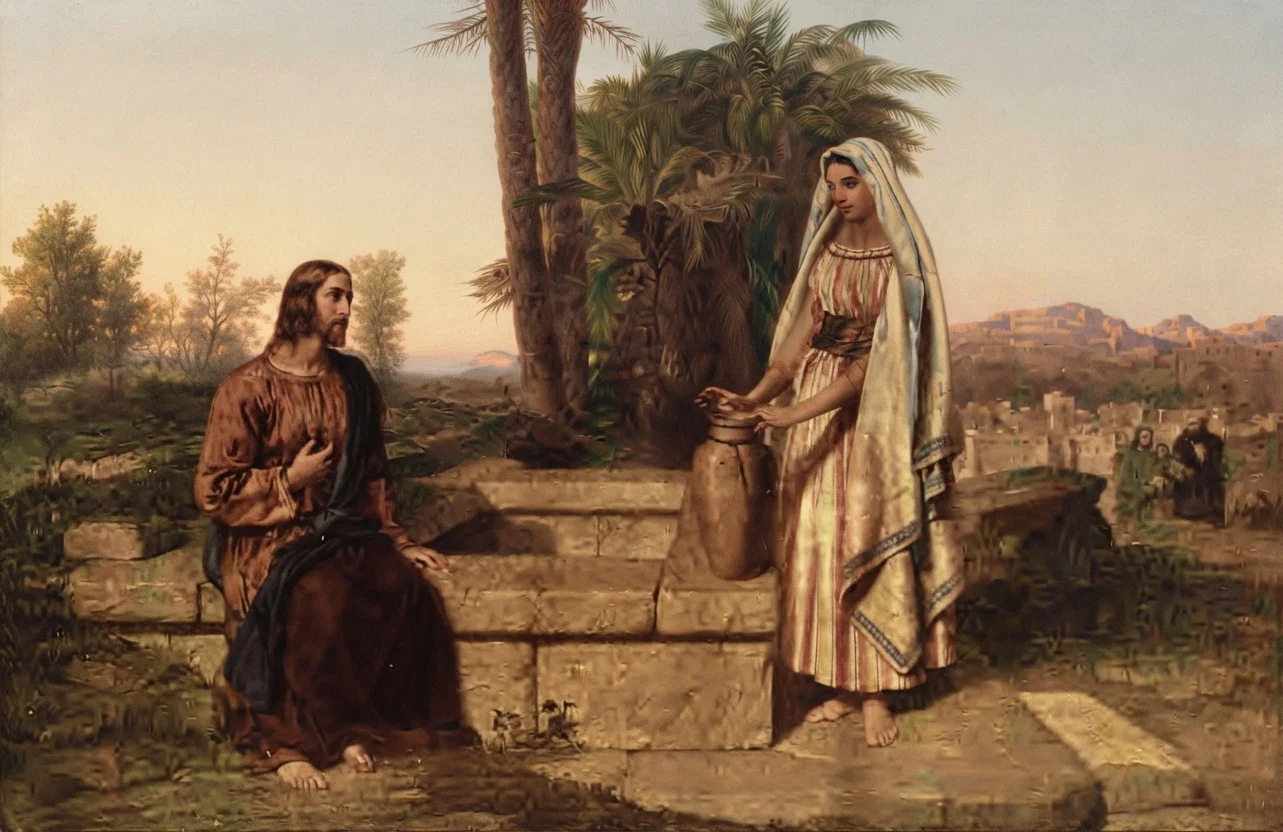
Jesus at the Well of Sychar

By Mrs. E. G. White

The Water of Life

As the world's Redeemer, the Son of God took upon Him our human nature. He humiliated Himself, veiling His divinity with humanity, that He might in His life upon earth share in the experiences of the poor, the oppressed, and the suffering of the human race. He was subject to the frailties of humanity, and as He journeyed from Judea to Galilee, He was weary with labor and travel. Hungry and thirsty, He tarried to rest at Jacob's well, near the city of Sychar, while His disciples went to buy food in the city. He who had subjected Himself to humanity was the Majesty of Heaven, the Creator of every good and perfect gift. In giving Himself to redeem our world, Christ gave Himself a living sacrifice. He emptied Himself of His high prerogatives, left His mansions of glory, His throne and high command, and became poor, that we through His poverty might be made rich.
As Jesus sat by the well side, the cool, refreshing water, so near and yet so inaccessible to Him, only increased His thirst. He had neither rope nor bucket with which to draw, and He waited until some one should come to the well. He might have performed a miracle, and thus have obtained a draft from the well, had He wished; but this was not God's plan. Nothing must be allowed to separate Him from the lot of humanity, which He had voluntarily assumed.

Christ Near, but Unknown

"There cometh a woman of Samaria to draw water: Jesus saith unto her, Give Me to drink." The woman answered, "How is it that Thou, being a Jew, askest drink of me, which am a woman of Samaria? for the Jews have no dealings with the Samaritans." Christ was near to the woman of Samaria, and she knew Him not. She was thirsting for the truth, yet knew not that He, the Truth, was beside her, and was able to enlighten her. And to-day there are thirsting souls sitting close by the living fountain. But they are looking far away from the well that contains the refreshing water, and tho told that the water is close by, they will not believe.
Whosoever drinketh of this water shall thirst again: but whosoever drinketh of the water that I shall give him shall never thirst.
Jesus answered the woman, saying, "If thou knewest the gift of God, and who it is that saith to thee, Give Me to drink; thou wouldest have asked of Him, and He would have given thee living water. The woman saith unto Him, Sir, Thou hast nothing to draw with, and the well is deep: from whence then hast Thou that living water? Art Thou greater than our father Jacob, which gave us the well, and drank thereof himself, and his children, and his cattle?" Jesus could have answered, The one who is speaking to you is the only-begotten Son of God; I am greater than your father Jacob, for before Abraham was, I am. But He made answer, "Whosoever drinketh of this water shall thirst again: but whosoever drinketh of the water that I shall give him shall never thirst; but the water that I shall give him shall be in him a well of water springing up into everlasting life."

Desires to Catch Every Word

The woman was so astonished at His words that she rested her pitcher on the well, and forgetting the thirst of the Stranger and His request to give Him to drink, forgetting her errand to the well, she was lost in her earnest desire to hear every word. "Sir," she said, "give me this water, that I thirst not, neither come hither to draw."
Jesus now abruptly changed the subject of conversation, and bade the woman call her husband. She frankly replied, "I have no husband." Jesus said unto her, "Thou hast well said, I have no husband: for thou hast had five husbands; and he whom thou now hast is not thy husband: in that saidst thou truly." As the past of her life was spread out before her, the listener trembled. Conviction of sin was awakened. She said, "Sir, I perceive that Thou art a prophet." And then, in order to change the conversation to some other subject, she endeavored to lead Christ into a controversy upon their religious differences. "Our fathers worshiped in this mountain," she said; "and ye say, that in Jerusalem is the place where men ought to worship." Jesus saith unto her, "Woman, believe Me, the hour cometh, when ye shall neither in this mountain, nor yet at Jerusalem, worship the Father. Ye worship ye know not what: we know what we worship: for salvation is of the Jews. But the hour cometh, and now is, when the true worshipers shall worship the Father in spirit and in truth: for the Father seeketh such to worship Him. God is a Spirit: and they that worship Him must worship Him in spirit and in truth." The woman saith unto Him, "I know that Messias cometh, which is called Christ: when He is come, He will tell us all things." But what was her astonishment when Jesus said, "I that speak unto thee am He."
The conviction of the Spirit of God had come to the heart of the Samaritan woman. She believed that the words of Christ were the truth. No teaching that she had hitherto heard had aroused her moral nature, and awakened her to a sense of her higher need.

Revealed Her Soul Thirst

Christ reads beneath the surface, and He revealed to the woman of Samaria her soul thirst, which the water from the well of Sychar could never satisfy. He Himself lost all sense of hunger, and thirst, and weariness. His thirst was satisfied in seeing her drink of the water of life. He was rejoicing in spirit that His words had aroused her slumbering conscience, and quickened her spiritual perceptions.
Christ understands the needs of the world, and through Him alone can the Father supply them. He is thirsting to give the needy souls the water of life freely. Christ is thirsting for the recognition of those for whom He left the courts of heaven, His honor, His glory, His royal throne, His high command. He is thirsting for the love, the coöperation that must be given Him as their personal Saviour. He would have them come to Him, taking hold of His grace by faith, partaking of Him, the Living Water.
The natural thirst of the woman of Samaria had led her to a thirst of soul for the water of life. Altho she had made no request of Him to satisfy her spiritual wants, Christ offered her an abundant supply for her soul's great need. And through the words spoken to her, the water of life was to flow forth to many thirsting souls.
Forgetting the errand that had brought her to the well, the woman left her waterpot, and went into the city, saying to all whom she met, "Come, see a man, which told me all things that ever I did: is not this the Christ?"

Better than Food, tho Hungry

As yet Christ had not taken the refreshing draft that He desired, nor tasted the food that His disciples had brought. They saw that their Master was intently absorbed in meditation, His face beaming with divine light, and they scarcely dared to interrupt His communion with Heaven. But they knew that He had been a long time without food; and placing some before Him, they prayed Him to refresh Himself. Turning lovingly to them, He said, "I have meat to eat that ye know not of."
The disciples, thinking that He was speaking of temporal food, inquired among themselves, "Hath any man brought Him aught to eat?" But Jesus explained: "My meat is to do the will of Him that sent Me, and to finish His work. Say not ye, There are yet four months, and then cometh harvest? behold, I say unto you, Lift up your eyes, and look on the fields; for they are white already to harvest. And he that reapeth receiveth wages, and gathereth fruit unto life eternal: that both he that soweth and he that reapeth may rejoice together. And herein is that saying true, One soweth, and another reapeth. I sent you to reap that whereon ye bestowed no labor: other men labored, and ye are entered into their labors."

Pentecost Not the Work of a Day

Christ looked forward to the Day of Pentecost, when the Holy Ghost should descend upon His disciples. He would teach them that they were not to look upon this as the result of their own labor. They were not to lose sight of the fact that patriarchs, prophets, and holy men had been sowing the seeds of truth. God's ancient chosen people had been enriched with precious truth, which was to them as the river of God. Christ had been their invisible leader through all their travels in the wilderness. Gracious illustrations of His love were given them in the covenant signed by God in the rainbow of promise, which was ever to be an assurance that seed-time and harvest-time should remain, and that the world should never again be destroyed by a flood. Christ was just as truly the water of life to Abel, Seth, Enoch, Noah, and all who received His instruction then, as He is at the present time to those who ask of Him the refreshing draft. God has given His Word to His chosen ones, and made known His way. Through His Son He has been supplying them with the dews and showers of His grace. But His blessings are often overlooked, and men take the glory to themselves.
The rain is not seen until it begins to fall, and it often comes wholly unexpectedly. So the Lord's precious gift of grace is often nearer than we think. If we will only have faith, and wait patiently for a little while, His help will come, and will surprise us as He surprised the woman of Samaria. He shall come down like showers upon the fruitful earth.

Message to the Laodiceans

When the Lord gave His message to the Laodiceans, who thought themselves rich and increased in goods, and in need of nothing, He did not conceal from them their true condition. He said: "He that hath an ear, let him hear what the Spirit saith unto the churches. And unto the angel of the church of the Laodiceans write; These things saith the Amen, the faithful and true witness, the beginning of the creation of God; I know thy works, that thou art neither cold nor hot: I would thou wert cold or hot. So then because thou art lukewarm, and neither cold nor hot, I will spew thee out of My mouth. Because thou sayest, I am rich, and increased with goods, and have need of nothing; and knowest not that thou art wretched, and miserable, and poor, and blind, and naked." This was the message of truth that Christ opened before them. They needed everything. But He did not present to them their great necessity without also providing a remedy. He opens before them a fountain of supply for every need. "I counsel thee to buy of Me," He says, "gold tried in the fire, that thou mayest be rich; and white raiment, that thou mayest be clothed, and that the shame of thy nakedness do not appear; and anoint thine eyes with eye-salve, that thou mayest see." It is necessary for us to know our soul's need in order to receive the heavenly treasure provided for us in Christ.
In Eden the Lord gave the promise that the seed of the woman should bruise the serpent's head. And the work which Christ carried forward at Jacob's well, in proffering the water of life to the woman of Samaria, is a fulfilment of that promise. And He will continue this work until every soul shall have been tested and tried.

Withholding Recognition

The woman, in apparently withholding from Christ the water He asked of her, represents many who are withholding from Him the recognition, the sympathy and love, that He is hungering and thirsting for in response to His great love for us. Christ has not withheld His grace and love from any member of the human family. For each He has an inexhaustible supply. And yet how little acknowledgment He receives, how little thanksgiving, how little fruit, in good works! He is hungering for the sympathy and love of those whom He has purchased with His own blood. He is watching and waiting for that love which we can not withhold from Him with any safety.
The world's Redeemer knows the necessities of every soul. When we are oppressed and languid, He knows it, and He it is that supplies the spiritual refreshment. Ask ye of Him; watch unto prayer, and it will come. Jesus is the bread of life, to be eaten every day; He is the water of life to the parched and fainting soul, and all may partake of His grace.
Earth's cisterns will often be emptied, its pools become dry; but in Christ there is a living spring from which we may continually draw. However much we draw and give to others, an abundance will remain. There is no danger of exhausting the supply; for Christ is the inexhaustible well-spring of truth. He has been the fountain of living water ever since the fall of Adam. He says, "If any man thirst, let him come unto Me, and drink." And "whosoever drinketh of the water that I shall give him shall never thirst; but the water that I shall give him shall be in him a well of water springing up into everlasting life."

Absalom’s Oak

By Delwin Rees Buckner
O, what a youth, of finely featured face, To dangle from an oak-tree's knotted bough! From that broad, choice-ly-chiseled, tress- topped brow, Down to those sandaled soles, which stepped with grace O'er costly carpets of the court, no trace Of spot or blemish might be found, but now — Why died he? How?—False furrows which men plow, Lead often to a fatal halting-place. Suffice to say his beauty sealed his doom — His hair became the halter, as it were, By which he hung betwixt the earth and sky, His target breast affording ample room For angry arrows whizzing with a whir To gorge like vampires whilst their victim die.

What Shall We Do with the Fourth Commandment?

The Unchangeable Character of God's Law

The unchangeable character of the Ten Commandments, of which the Sabbath command is a part, is so plain as to be quite self-evident. The duty of man to give obedience and love to his Creator, as indicated by the first four precepts of the Decalogue, must always have been the same, and must always remain the same. The time has never been when the claims of the Creator upon our love and service ceased or could cease in the smallest degree, neither can such a time ever come. In like manner, man's duty toward his fellows, as indicated by the last six commandments, has ever been and must ever remain the same — unaltered.

Always Present Truth

It is this law of which Christ says that not one jot or tittle shall pass away; this law of which the Son of the Eternal Himself speaks when He says, "I have kept My Father's commandments, and abide in His love."
This must be so in the very nature of the case. It has never been right to blaspheme, to worship idols, to break the Sabbath, to covet, to steal, or to murder, and never will be. This truth is eternal in its nature, and must always be "present truth," while some truth is such for a limited time only.
For about four thousand years after creation it was true that the Saviour of mankind must appear in human flesh, become a helpless babe, grow to youth and manhood, and finally die for the redemption of the race; and of course men were commanded to follow the provision made for them during this limited time, that provision being a continual succession of sacrifices and offerings and ceremonies, to keep ever before their minds the fact that the promised Redeemer would surely come and shed His blood for the remission of sin. Every time the blood of an innocent victim was spilled, man virtually declared: "I have sinned; but I hereby show my faith in a coming Redeemer who will shed His blood for me. So shall I be saved."

At the Time Foretold

Forty long, dreary centuries rolled away. At the very moment when the clock of time struck the hour foretold by the prophets, the Redeemer was born, was baptized, was crucified.
Then comes a tremendous change. Truth that had held undisputed sway for so many centuries — that the Messiah must appear, be born, and die — was truth no longer; because He had come, He had shed His blood — the great contract had been fulfilled. How vain to offer the blood of animals after this! Type had met antitype; shadow had met substance; and every law and every ceremony and every sacrifice which pointed forward to a coming Redeemer, must perforce cease at the cross of Calvary. Here must the old law of ceremonies and ordinances be nailed to the cross, their mission ended. Those impressive ceremonies upon which so much had depended for long ages, were henceforth and forever utterly annulled. This logic is self-evident.

Not to Be Confounded with Ceremonies

"Well," you say, "if self-evident, why waste time in further explanation?" — Because of a strange habit into which some of us have fallen, of mixing and confusing the moral law with the ceremonial.
"Why," you again protest, "nobody but the poor misguided Jew believes in keeping the ceremonial law any longer — except — well, I believe there is a class of people who still persist in keeping the seventh day — the old Jewish Sabbath!"
Stay! Let me ask, Is there anything in the fourth commandment of the Decalogue which calls attention to the cross of Christ, which points to it, or which in any way refers to His great sacrifice on Calvary? — No, my friend; the fourth commandment has an entirely different meaning. It points back to creation — not forward to the cross. How, then, could it or any part of it have been abolished at the cross? How could the death of Christ have annulled the fact that God created the heavens and the earth in six days and rested the seventh? Was this the aim and object of Calvary? Would it have been worth while — I ask in all candor — would it have been worth while for Christ to pay so tremendous a price in order to accomplish such an end, even if it had been possible? Could the cross of Christ have abolished the facts of creation?
"But," some one still protests, "I am willing to admit that the moral law is still in force — in fact, it must be — except the old Jewish Sabbath!"
But remember, that commandment was given before there was a "Jew" on the face of the earth.
"Well, that may be; but I must ask why you always harp on the fourth commandment. Why don't you talk about the binding force of the other nine?"
We do; and they are all binding, and of equal force. But if you will follow me, I will try to make this point plain in my next article.
But please remember that the first great reason for observing the Sabbath of the commandment, is the undeniable fact that God did create the heavens and the earth in six days and rest the seventh; and that this truth can not be altered nor this fact denied, either in time or in eternity; and that to keep in memory this eternal truth, was the very reason for the giving of the fourth commandment. When this truth can be denied, or this fact annulled, then and not till then will it be time to raise the inquiry, "Is the Sabbath commandment still binding?"

Lilies

By Mrs. Pauline Alderman
We are told of the lilies of heaven, In the beautiful garden of God. A glimpse of their wonders is given, Where the feet of no mortals have trod.
Dear lilies, with smiles of the Master Asleep in your delicate forms! In the great and the blissful hereafter, We shall find them where beauty adorns.
Will they be fairer or sweeter? I gaze on their blossoms of snow, And drink their perfume in a rapture That only their Maker can know;
And I turn from the exquisite beauty, To the Maker of tree and of flower, And think of the home where I'll view them Sometime at the shrine of His power.
Sweet lilies! They tell us of heaven, Of Jesus, perfection, and love. They speak of a hope to us given, Of sharing that glory above.

Zaccheus, Come Down

ZACCHEUS lived in Jericho. He was a publican, and was rich. He had heard much about Jesus as a great teacher, preacher, and physician. Some of Jesus' teaching reported to him had brought conviction to his heart, and he had already begun, in a formal way, a work of reform.
He longed to see and hear Jesus. There comes an opportunity. Jesus is passing by Jericho. Zaccheus, being a small man, could not see over the heads of the multitude that thronged Jesus, so he ran ahead and climbed a tree by the roadside. Snugly nestled among the foliage, with a fine view of the road beneath, he awaits the multitude and the coming One.
Jesus arrives on the very spot, and stops. How fortunate for Zaccheus! Jesus looks up into the tree, and fixes His gaze upon Zaccheus. Zaccheus trembles on his perch. He thinks: "How did He know a man was in the tree? Did He from afar see me climb this tree? Will He speak to me? Hear, 'Zaccheus, come down.' He knows my name. Wonderful man! I must not disobey." Hastily he descends right into the presence of Jesus. Jesus says to him, "I must abide at your house to-day"—gave Himself an invitation to go home with Zaccheus, you see.
Zaccheus joyfully and quickly led the way to his home. Many murmured, saying Jesus had gone to be guest with a man that was a sinner. When Jesus had entered the house, Zaccheus said to Him, "Behold, Lord, the half of my goods I give to the poor; and if I have taken anything from any man by false accusation, I restore him fourfold. And Jesus said unto him, This day is salvation come to this house, forsomuch as he also is a son of Abraham. For the Son of Man is come to seek and to save that which was lost." Luke 19: 8-10.
O, happy day for Zaccheus! How glad he was that he had sought to see Jesus! How glad that Jesus noticed him, knew him, and called him, and brought salvation to his house and heart! Reader, have you ever heard Jesus calling to you to open the door of your heart and let Him come in? He stands waiting without, pleading that you open the door and let Him in. He brings salvation, so sweet, so divine. O let Him in while He pleads, or He may leave you, and never again come that way. Now is the accepted time. H. A. ST. JOHN.
Continue reading: Studies in Daniel