Your ShelfYour Projects

Review and Herald, Vol. 66, No. 5.

THE RICH MAN AND LAZARUS
Earlier text: ILLINOIS

OPPOSITE RESULTS OF ACCEPTING OR REJECTING DIVINE TRUTH.

The light of divine truth, like that of the solar orb, is necessarily influential and effective. The gospel of Christ, from its very nature, will not allow man to hear and understand its sacred and gracious messages, without affecting him in his deepest interests. This light comes to him from heaven, and comes clothed with heaven’s power, to change and fashion him into a vessel of mercy, fitted for glory; or into a vessel of wrath, fitted for destruction. It leaves no soul of man upon whom it shines, unaffected.
The nature of the effects produced by the light of the Sun of Righteousness, like that of the sun’s light, is determined by the character of those upon whom it descends. The influence of the sunlight varies with the nature of the substances upon which it falls; its warm rays fall upon the wax, and it is melted; upon the clay, and it is hardened; upon one fabric, and it is bleached; upon another, and it is blackened; upon the plant that has its roots imbedded in the soil, and it flourishes; upon that whose roots are exposed, and it dies; upon the clear lake, and it exhales refreshing moisture; upon the stagnant marsh, and it sends forth fatal malaria; upon the living creature, and it is animated and delighted; upon the dead carcass, and it is corrupted and decomposed. So diverse, so opposite are the effects wrought by one and the same sun, according to the differing natures of the objects upon which its light falls. The same holds true of the light of the Sun of Righteousness. The character of those upon whom his divine light shines, likewise, determines the nature of the effects produced upon them. It depends mainly upon the disposition of the man himself—for he is a voluntary agent—whether the heavenly light that shines upon him shall prove to him “a savor of life unto life, or of death unto death.” If he receive it in an humble, docile, and obedient spirit, it will be life; but if in a proud, unbelieving, and rebellious spirit, it will be death.
The light of the Sun of Righteousness works a change in our moral and religious obligations. It is required, and it is accepted of God, according to that a man hath, whether it be of ability or of light. When a man, therefore, who has had nothing more than the light of nature for his guidance, is brought into the superior light of revelation, his obligations to God and man become greater and higher in a corresponding degree. The measure of his light becomes the measure of his duty. As soon as the gospel is proclaimed to him, it becomes to him the rule of life. A knowledge of his duty binds him to the performance of it. This is the law of heaven; to it, there is no exception, and from it, there is no escape. “To him that knoweth to do good, and doeth it not, to him it is sin.” It follows, therefore, that from the hour the light of the Sun of Righteousness shines upon us, and makes duty plain before our eyes, there remains for us no rule but to walk according to that light. No sooner is the command sounded in our ears, “Thou shalt love the Lord thy God with all thy heart, and thy neighbor as thyself;” than it becomes our bounden duty to obey it. From the moment Christ is proposed to our acceptance as our Saviour from sin, we come under the most sacred obligation to commit our souls into his hands. Not to receive him is to reject him; and to reject him is death. So great is the change wrought in our standing and duty by the coming of the light of the Sun of Righteousness.
The more direct and clear his divine beams fall upon us, the more decisive their effects upon our moral and religious character. “If I had not come and spoken unto them, they had not had sin; but now they have no cloak for their sin.” These words spake Jesus to the Jews. Their former advantages had been very considerable, yet were small, compared with those which they enjoyed under his luminous ministry. Their previous light was but as the gray dawn to the noon-day sun, when compared to the bright and glorious light which now shone around them from his teachings and miracles and example. As a consequence, their sin in their former condition was as nothing to their sins under their present privileges. Hence, Christ speaks as if their previous offenses were not to be noticed in comparison with the guilt of their unbelief and disobedience, amid the blaze of light which he had shed upon them. He fixes attention upon their present guilt as if it had been their only guilt: “If I had not come and spoken unto them, they had not had sin; but now they have no cloak for their sin.” And all this is equally true of all that enjoy the light of his gospel in the present day.
The light of the Sun of Righteousness affects every heart, and works a change in its disposition and character. It never fails to soften or to harden it. It is impossible to hear and understand the truths of the gospel without being essentially and eternally affected by them. Like the sun in the heavens, the gospel is designed and fitted to promote the good of all—to win them from sin, to lead them to holiness, and to save them with a glorious and everlasting salvation. And it actually produces these effects on the minds of all who cordially receive it, and yield their hearts to its transforming influence—they are renewed, they are sanctified, they are justified in the name of the Lord Jesus, and by the Spirit of our God. But upon the minds of the carnal and sensual, of the worldly and heedless, it produces entirely opposite effects. Instead of melting, it indurates; instead of quickening and refining the moral sensibilities, it blunts and deadens them; instead of elevating to more devout aspirations, it sinks to greater apathy and stupidity—and all this, not through any tendency to foster evil in the gospel itself, but through the evil that is, in man, resisting and perverting its legitimate influence. And by continuance in this course, a habit of opposition and indifference is soon established; and the habit inevitably issues in blindness of mind and hardness of heart; so that presently he becomes unimpressible alike to the invitations of mercy and to the threatenings of justice. Eternal things cease to move him, cease to interest him. He can listen to the thunders of Sinai and to the groans of Calvary with equal indifference. Henceforth the gospel of the Son of God, and all the gracious means of salvation are to him but “the savor of death unto death.”
From the foregoing facts, it obviously follows, that the light of the Sun of Righteousness decisively affects the eternal destiny of all that enjoy it. This light is clothed with mighty power; it bleaches or blackens, it saves or destroys. Those who walk according to the light will be conducted to glory, honor, and immortality; but they who love darkness rather than light, shall stumble, and fall, and perish.—The Celestial Symbol Interpreted.

News of the Week.

FOR WEEK ENDING JAN. 26.

DOMESTIC.

—Small-pox is prevalent in the small town of Ozalia, Mich.
—The Dakota Legislature has passed unanimously a memorial asking Congress to open the Sioux Reservation.
—The cotton crop of this year, it is said, will be the largest ever known, approximating seven and one-half million bales.
—The contract for fireworks to be used at Washington on the night of inauguration day has been awarded. The cost will be $11,000.
—The Hon. Jacob Tome, a Washington millionaire, has given half a million dollars to found a free, non-sectarian seminary for the industrial training of children.
—Eight cases of varioloid have been discovered at Oberlin, Kan., and a strict quarantine has been established. The disease is supposed to have originated at Denver, Col.
—An “omnibus” bill for the admission into the Union of five new States,—North and South Dakota, Montana, Washington, and New Mexico, has passed the House by a vote of 144 to 98.
—Mr. Springer has introduced in the House of Representatives a resolution for a Constitutional amendment giving Congress power to make a uniform law governing marriage and divorce.
—A joint resolution proposing an amendment to the Pennsylvania Constitution prohibiting the manufacture or sale of intoxicating liquors, was passed by the legislature Monday, by a vote of 132 to 55.
—The Grand Opera House at St. Paul, Minn., was entirely destroyed by fire Monday. The mercury registered 14 degrees below zero, which made it exceedingly hard on the firemen. The loss is about $200,000.
—Twelve different albums are now offered, says the N. Y. Times, as prizes for smoking certain brands of cigarettes. Many a boy under twelve years is striving for the entire collection, which necessitates the consumption of nearly 1,200 cigarettes.
—The Monongahela River coal-operators notified their 5,000 miners that the mines, which have been closed for two weeks, would resume operations Saturday, providing the men would accept one-fourth of a cent reduction, but it is not known what the employees will do.

FOREIGN.

—The royal College of Surgeons recently passed a resolution censuring Dr. Mackenzie for publishing his book reviewing Emperor Frederick’s illness.
—The latest information pertaining to the whereabouts of Stanley comes in a dispatch from Suakim, dated Jan. 22, which states that a Government messenger who recently arrived there declared positively that Emin and Stanley’s baggage and standards were at Ournureman, and that he had heard that both Emin and Stanley were prisoners up the Nile.
—Reports from the Samoan Islands do not indicate any prospect of a speedy termination of the existing difficulties in which their inhabitants are involved with foreign powers. A dispatch from Sydney, N. S. W., states that a German gun-boat has taken Malietoa, ex-king of Samoa, to the Marshall Islands. Meanwhile the United States Government is beginning to take definite action in the matter. A dispatch from Washington states that Senator Sherman, on the morning of the 23d, reported the following amendments to the Diplomatic and Consular Appropriation bill designed to protect the interests of the United States in Samoa: “For the execution of the obligations and the protection of the interests of the United States existing under the treaty between the United States and the government of the Samoans, $500,000, or as much thereof as may be necessary, to be expended under the direction of the President, this appropriation to be immediately available for the survey, improvement, and occupation of the bay of Pago-Pago, in the island of Tutuila, Samoa; and for the construction of the necessary wharves and buildings for such occupation and for a coaling station therein, $100,000, this appropriation also to be immediately available.” This amendment leaves the President free to send a fleet of war-ships or any other force he may deem necessary, to protect the Samoan Government, and to relieve the people from the danger of war.

RELIGIOUS.

—A Catholic Colonization Society has been formed at Pittsburg, with a capital stock of $100,000. The object of the organization is the founding of Catholic colonies throughout the South.
—The first edifice for Christian worship in the city of Sungli, India, a city of 600,000 inhabitants, is soon to be completed, through the beneficence of a lady donor in New York.
—During the past year the net gain of new churches in the United States was 6,434; of ministers, 4,505; and of new members, 774,861. On an average, therefore, seventeen churches, twelve ministers, and 2,120 members were gained each day.
—A religious house-to-house canvass is being carried on in the city of New Haven, Conn., by theological students, with a view to ascertaining what families not now under church influence, may be reached by them. A similar canvass is in progress in Los Angeles, Cal.
—In a Methodist ministers’ meeting at Cincinnati, Monday, the Rev. F. L. Nadler made the statement that he did not believe children and heathen would be called to strict account for their deeds. The remark called forth a sharp rebuke from some of those present.
—Representative clergymen of New York City have issued a call to the citizens of that city and of the nation, asking that those “of every name and race and creed,” “follow the example of their fathers, and meet in their respective places of worship at nine o’clock on the morning of April 30, and hold such religious services of thanksgiving and praise as may seem suitable, in view of what God has done for us and our land during the century which has elapsed since George Washington took the chair of State.”

Obituary Notices.

“Blessed are the dead which die in the Lord from henceforth.”—Rev. 14:13.
STANTON.—Died of scarlet fever, Jan. 14, 1889, Eva L. Stanton, aged 6 years, 10 months, and 23 days; also little Ralph, aged 11 months, of the same disease, Jan. 17. A. W. STANTON.
FIELD.—Died at Oxford Mills, Ia., Nov. 19, 1888, Jimmie H., youngest son of Geo. and Lydia Field, aged 5 years, 9 months, and 19 days. These parents greatly miss their darling, but they sorrow not as those without hope. Words of comfort were spoken by the writer. J. T. MITCHELL.
DYER.—Died at Almena, Van Buren Co., Mich., Jan. 1, 1889, the infant daughter of Mr. and Mrs. W. D. Dyer, aged 1 year, 4 months, and 22 days. The funeral services were held in the M. E. church of that place, and words of comfort were offered to the bereaved parents and sorrowing friends, on this occasion, from Rev. 21:4, by the writer. G. T. WILSON.
MILLMAN.—Died of membranous croup, at Winston, Mo., Jan. 1, 1889, Oscar L., son of I. C. and Addie Millman, aged 1 year and 21 days. Sad hearts mourn the loss of this lovely babe. May they so lay hold of the grace of Christ that their little treasure will be restored to them when the righteous dead shall rise. Sermon by Eld. Woodruff (Methodist) from Luke 18:16, 17. W. T. MILLMAN.
GIBSON.—Died Jan. 5, 1889, at his home near Springdale, Ark., Bro. Porter Gibson, aged 83 years, 9 months, and 8 days. Bro. Gibson embraced the views held by Seventh-day Adventists about 1872, and joined the Sunny Side Church, Dakota Territory. He was a great Bible reader, having read it through some forty-five times. Some of his last words were praise to God for his goodness. He leaves an aged companion, who looks forward with bright hope to the morning of the resurrection. The services were conducted by the writer. W. J. KERR.
TOWNSEND.—Died near Akron, Ind., Dec. 29, 1888, after an illness of several weeks, Samuel Townsend, aged 71 years, 8 months, and 21 days. He leaves a wife, three sons, and three daughters, with many friends, to mourn his loss. Bro. Townsend was a member of the Akron church. He enjoyed the light of present truth, and was looking for that blessed hope, and the glorious appearing of the great God and our Saviour Jesus Christ. Words of comfort were spoken by the writer, from Ps. 116:15. W. NILL.
HARRIS.—Died at Levering, Emmet Co., Mich., Dec. 27, 1888, sister Asenath Harris, aged sixty-three years. Sister Harris embraced religion at about the age of fifteen, and joined the Methodist Church. About twelve years ago she embraced the present truth, and was, at the time of her death, a member of the Ely church, of Emmet County, Mich. She leaves a husband and five children. She led an exemplary Christian life, and was a faithful witness for the truth. Words of comfort from Rev. 14:13 were spoken by Eld. Walker, of the United Brethren Church. ANN E. FRANK.
YATES.—Died at Chanute, Kansas, Jan. 15, 1889, sister Yates, aged 62 years, 6 months, and 22 days. She was one of the few who embraced the truth two years ago last fall when the tent was at Chanute. She had been a widow many years, and was living with her son, who also embraced the truth. He and his mother have faithfully lived the truth, and tried to hold the little company there together. Sister Yates leaves several married children and a large circle of friends to mourn their loss. Remarks on the occasion, from Rev. 13:14. S. SHARP.
WITHERSELL.—Died in Iroquois, Dak., Dec. 28, 1888, after an illness of two days, my dear mother, Mrs. Prudence Withersell, in the ninety-sixth year of her age. Mother was born in New Hampshire, Jan. 11, 1793. In 1796, she, with her parents removed to Cavendish, Vt., where she lived till 1820, when she married and removed to Reading, Vt. In 1869, she, with my father, came to Rochester, Minn., to reside with us. In June, 1873, she united with the Seventh-day Adventist Church, and has since lived a consistent Christian life. Naturally diffident and retiring, she made little show in the world, but, nevertheless, led a life of usefulness. Funeral service conducted by Eld. L. H. Ellis. S. E. GIBSON.
MOODY.—Fell asleep in Jesus at East Cornville, Me., Dec. 28, 1888, Nellie H., youngest daughter of brother and sister Jeremiah Moody, aged twenty-one years. Sister Nellie retired Thursday night as usual, in the best of health, having apparently no illness of the slightest nature; but when her boarding-mistress attempted to awaken her the next morning, she found her cold in death. Physicians were summoned, and upon examination, it was decided that death was caused by heart-failure. Sister Nellie gave her heart to the Saviour some five years ago. She was by faith a Seventh-day Adventist, as are all the family. She was a quiet, obedient daughter, a loving sister, a true friend, and a consistent Christian. There was a large concourse of scholars, classmates, neighbors, friends, and relatives gathered at the home of Bro. Moody on the morning of the closing day of 1888, to pay their last respects to one so dear to all. Discourse by the writer, from the words found in Matt. 24:44. O. M. CHASE.
RICHMOND.—Died in Cedar Springs, Mich., Dec. 17, 1888, of pneumonia, our mother, Mrs. Lois Richmond, wife of David Richmond (deceased). Mother was converted to Christ at an early age, and united with the Christian Church. She first heard the third angel’s message preached at Greenbush, Mich., and soon embraced the doctrines held by S. D. Adventists. She has been an exemplary member of the S. D. A. church at Cedar Springs since its organization. For many years the meetings were held at her house. Many pioneers in the truth can testify to her Christian hospitality. The great desire of her life was faithfully to do the will of her Master. Her last illness was characterized by Christian fortitude and patience. Her trust was in God. She was willing to be laid away, and believed she would awake in the first resurrection. She leaves five children, nineteen grandchildren, and numerous other relatives and friends, who will miss her wise counsel and loving ministrations. MRS. L. S. KELLOGG. MRS. H. M. CURTISS.
BASSETT.—Died in Barre, Vt., Dec. 16, 1888, our dear sister, Betsey Bassett, aged nearly eighty-six years. Sister Bassett gave her heart to the Lord when quite young, and united with the M. E. Church. Being of strong mind and decided character, she labored earnestly for the advancement of every good cause which came within her reach, and gladly contributed her means to its support. She remained a worthy member of that church until fourteen years had passed over her head, when she listened to lectures on the distinctive faith of S. D. Adventists. These truths she gladly accepted, and rejoiced in them as a precious treasure. Though she did not often have the privilege of meeting with those of like faith, she was always ready to give a warm, decided testimony whenever favored with the opportunity. By her kind, unselfish interest in others, she endeared herself to all. Truly “the hoary head is a crown of glory, if it be found in the way of righteousness.” She had been remarkably strong, and during her last illness, which was distressing, she still clung to life with tenacity. Yet in the midst of great suffering she was enabled to be patient, and trust in God. MRS. H. W. PIERCE.

Travelers' Guide.

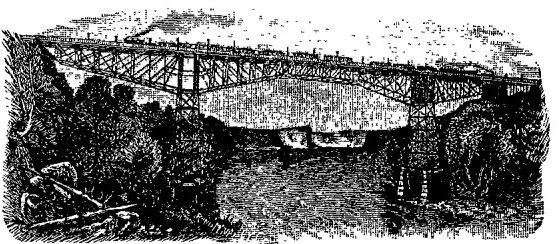
MICHIGAN CENTRAL NEW CANTILEVER BRIDGE, NIAGARA FALLS.

MICHIGAN CENTRAL RAILROAD.

“THE NIAGARA FALLS ROUTE.”

TRAINS EAST.

STATIONS. Mail. Day Exp’s N. Y. Exp’s Atl’e Exp’s Night Exp’s Kal. Acc’n Local Pass.
Chicago1 A.M. 7.00 A.M. 9.00 P.M. 3.10 P.M. 10.10 P.M. 9.10 P.M. 4.40
Michigan City2 7.23 11.00 4.54 12.29 11.27 6.57
Niles3 8.37 12.10 5.49 1.50 12.55 8.20
Kalamazoo4 10.20 1.40 6.58 3.35 2.27 0.00 a7.10 5.30
Battle Creek5 11.15 2.18 7.33 4.20 3.15 7.55 6.25
Jackson5 12.20 4.15 8.49 6.15 4.45 9.35 8.20
Ann Arbor6 2.43 5.37 9.41 7.50 6.00 10.40
Detroit7 4.10 6.45 10.45 9.20 7.30 11.50
P.M. P.M. P.M. P.M. P.M. A.M. P.M.

TRAINS WEST.

STATIONS. Mail. Day Exp’s Oh’go Exp’s Pac’fic Exp’s Eve’g Exp’s Kal. Acc’n Local Pass.
Detroit7 A.M. 7.30 A.M. 9.10 P.M. 1.20 P.M. 10.10 P.M. 8.00 P.M. 4.00 A.M.
Ann Arbor8 8.50 10.40 2.24 11.35 9.15 5.40
Jackson5 10.13 11.45 3.27 12.54 10.55 7.10 6.25
Battle Creek5 12.09 1.16 4.38 2.15 12.27 8.52 7.55
Kalamazoo4 12.50 1.55 5.15 3.07 1.20 p9.55 a4.45 8.40
Niles3 2.27 3.20 6.27 4.32 3.07 6.40
Michigan City2 3.48 4.59 7.32 5.43 4.32 8.03
Chicago1 6.10 6.40 9.30 7.45 7.00 10.20
P.M. P.M. P.M. A.M. A.M. A.M. A.M.
O. W. RUGGLES, General Pass. & Ticket Agent, Chicago. O. E. JONES, Ticket Agent, Battle Creek.

THE YOUTH'S INSTRUCTOR.

AN ILLUSTRATED WEEKLY PAPER FOR CHILDREN AND YOUTH,
Devoted to moral and mental culture, and especially designed as a companion to Bible study. It is the best paper in the world for youthful readers, being free from modern fables and sentimentalism. Beginning with the first of April, 1889,

TWO NEW SERIES OF CHILDREN'S LESSONS

Will be issued regularly in the paper, furnished by the International S. S. Association.
The publishers design that the Instructor shall contain the choicest illustrations and reading matter that can be secured, suitable for young minds; and while the size of the paper is unchanged, the price for single copies has been reduced from 75 cents to—

ONLY SIXTY CENTS PER YEAR.

TEN or more copies to one address, 50 CENTS EACH.
Address, YOUTH'S INSTRUCTOR, Battle Creek, Mich.

Modern Spiritualism.

_ITS NATURE, TENDENCY, DEVELOPMENT, AND DESTINY._
IN this work, this modern and remarkable system of belief is logically treated in the light of Scripture, showing what may be expected of its influence upon the theological world.

The Remarkable Growth of Spiritualism

At the present time renders this pamphlet of great interest and value. 184 pp., 12mo., paper covers. Price, 20 cts.
Address, REVIEW & HERALD, Battle Creek, Mich.

LESSONS ON OLD TESTAMENT HISTORY, WITH EXPLANATORY NOTES.

A 64-page pamphlet, containing lessons for the Senior Division of the Sabbath-school, from January 1 to July 1, 1889. Price, 10 cents.
Back lessons for 1888, (two pamphlets), 25 cents.
Address, REVIEW AND HERALD, Battle Creek, Mich.

VIEWS OF NATIONAL REFORM.

PACKAGE NO. 1, THIN PAPER EDITION, 112 PAGES, SIZE 6½ x 3¾, 10 CENTS.
This package contains thirteen tracts treating upon the various phases of the National Reform movement, as follows:—
NO. PAGES.
1. Evils of Religious Legislation, 4
2. Religious Liberty, 8
3. National Reform and the Rights of Conscience, 8
4. The American Papacy, 8
5. Bold and Base Avowal, 8
6. National Reform in Church and State, 8
7. Purity of National Religion, 4
8. The Salem Witchcraft, 8
9. What Think Ye of Christ? 4
10. National Reformed Constitution and the American Hierarchy, 16
11. The Republic of Israel, 4
12. National Reformed Presbyterianism, 24
13. The National Reform Movement an Absurdity, 8
The same matter printed on a better quality of paper, 184 pages, 5½ x 3⅞ inches, 20 cents.
Address, REVIEW AND HERALD, Battle Creek, Mich.; 26 and 28 College Place, Chicago, Ill.; or Toronto, Ontario.

BUSINESS NOTICES.

[Under this head, short business notices will be inserted at one dollar for each notice of four lines or less. Over four lines, twenty-five cents a line. Persons unknown to the managers of the REVIEW must give good references as to their standing and responsibility. Ten words constitute a line.]
WANTED.—A man to work on a farm by the month, or for a share of the crops. Must be a Sabbath-keeper. For further particulars, inquire of Moses Wilson, Dorchester, Saline Co., Neb.

CHICAGO AND GRAND TRUNK R. R.

Time Table, in effect Dec. 2, 1888.
GOING WEST STATIONS GOING EAST
Chgo Pass. Mail. Day Exp. Pac'tic Exp. B.Crk Pass. Mail. Lmtd Exp. Atl'to Exp. Sun. Pass. Pt'Hn Pass.
5.55 7.15 7.55 4.00 Dep. Port Huron Arr. 10.20 1.15 9.35 10.50
7.28 8.31 9.31 5.40 Lapeer 8.40 11.58 6.17 9.17
8.03 9.10 10.10 6.20 Flint 6.55 11.27 5.40 8.38
8.48 9.35 10.58 7.15 Durand 7.15 11.58 5.05 8.00
10.00 10.30 12.00 8.26 Lansing 5.20 10.07 4.00 6.35
10.37 11.00 12.50 9.05 Charlotte 4.42 9.37 3.25 6.02
11.30 11.45 1.45 1.15 10.05 BATTLE CREEK1 3.45 8.55 3.25 6.16
6.30 12.05 1.20 Vicksburg 3.40 8.00 2.30
7.15 12.50 2.21 Schoolcraft 2.52 8.11 1.44
7.25 1.00 2.32 Cassopolis 2.40 1.35
8.19 1.50 3.19 South Bend 1.50 7.26 12.45
8.55 2.30 4.07 Haskell's 1.05 6.50 12.00
10.05 3.41 5.30 Valparaiso 11.54
10.20 7.20 4.00 5.60 6.55 Hammond 11.40 5.30 10.30 9.40 7.00
12.40 10.00 6.25 9.10 9.45 Chicago 9.05 3.25 8.15 1.15 4.25
pm am pm am Arr. Dep. am pm pm pm
Trains run by Central Standard Time.
Valparaiso Accommodation, Battle Creek Passenger, Chicago Passenger, Pt. Huron Passenger, and Mail trains, daily except Sunday.
Pacific, Limited, Day, and Atlantic Expresses, daily.
Sunday Passenger, Sunday only.
GEO. B. REEVE, Traffic Manager.
W. J. SPICER, General Manager.

Another Factor in Behalf of Sunday.

The Pearl of Days, which was started as an organ of the Sunday Reform cause, has been discontinued. This may seem strange to some, when the movement itself is just now lifting itself into such prominence before the nation; but the fact does not prove that the promoters of that work mean to slacken their efforts in the least. On the other hand, it is sure to give the movement a wider range of popularity. The Pearl of Days was only a monthly, and necessarily confined to a limited circulation, because of the character of the paper, and did not therefore reach as many as the matter it contained was designed to do. Besides, the ideas it contained did not meet with that favor in the minds of many, that they would if published in a secular paper.
Rev. J. H. Knowles, who edited the magazine, has been elected general secretary of the American Sabbath Union. Col. F. Shepard, the manager of the New York Mail and Express, is president of the Union. Now Col. Shepard gives the Union a department in one issue of his paper every week (Friday’s issue), where the principles of the party may be freely advocated, and Mr. Knowles becomes the editor of the department.
It will thus be seen that the suspension of the Pearl of Days but gives the matter with which it was formerly freighted, more prominence than ever. It now goes into a secular paper, which is read with less general prejudice than a religious magazine, and has a much wider circulation. This is one step forward for that party, and shows that they will take advantage of every means before them to carry their ends. Shall we not learn a lesson from this? and make corresponding efforts in behalf of the truth? J. O. C.

AN APT ILLUSTRATION.

The incongruous and composite character of a Christian humbug is most strikingly set forth in the following illustration by T. De Witt Talmage:—
One of the professors in Harvard University was a great bug-ologist. He had all sorts of bugs the world ever saw, in frames; and he studied bug-ology until he knew all about it, and had thousands of specimens of different sorts of bugs. And the mischievous students took the legs of one bug, and the body of another, and the wings of another, and put them all together, just as nature puts them together, and carried the bug in to the old professor, with his thick glasses on, and laid it on the table, and said:—
“Professor, what sort of bug is that?”
The old professor looked at it, and turned it around, and looked at it, and looked at it, and looked at it again, and said he, “Gentlemen, this is a humbug.” And this is just what we mean by a religious humbug. He has got the head of a Christian, and the feet of a dancer, and the tongue of a tattler, and the appetite of a drunkard, and the laziness of a shirk; and you just put him all together, and he is the finest specimen of humbug you ever saw.

WATCH THE BLAIR PETITIONS.

OUR brethren everywhere will do well to keep an eye on the circulation of the petitions for the Blair Sunday-rest bill, and the religious-instruction bill, and mark the kinds of signatures that are obtained, and the means resorted to, to secure them. We have reason to believe that there are many cases similar to the one reported in the REVIEW of Jan. 8, p. 24, in which the signatures of young lads and misses in classes in the Sunday-schools are taken, without regard to age, to swell the number. And wherever such is the case, the facts should be ascertained and certified to, and reported to us, that the matter may be made known to Congress when the bills come up for action.

THE “SENTINEL.”

We have received the first number of the Sentinel, as it enters upon its mission as a weekly publication. The fact that circumstances which are leading on to the fulfillment of the last part of Revelation 13, have now reached such magnitude as to require the weekly presence of a publication devoted to that particular branch of “present truth,” which is now the case, should inspire every one with new zeal and activity in the cause.
While the Sentinel, rising from a monthly to a weekly, increases its matter and efficiency fourfold, it only doubles its price, raising it from fifty cents to one dollar per year. Whatever may be thought of the former price of the monthly, which some considered high, certainly the price of the weekly at one dollar per year is exceedingly low; and it must have, at this price, an extensive circulation in order to be self-sustaining. And such a circulation it ought to have, on its own merits, and for the sake of the good work in which it is engaged.

THE BLAIR RELIGIOUS AMENDMENT.

A correspondent has written to us from Wisconsin desiring us to reprint the amendment to the Constitution proposed by Senator Blair, to which frequent reference has been made in the REVIEW since the time of its introduction last May. He intimates that a large number of our people are ignorant of the nature, or at least the wording, of this proposed amendment, and as it is not improbable that such may be the case, we give the proposed amendment in this column, because we believe it is important that every one should know just what this measure is designed to accomplish, and what it will accomplish, if allowed to pass. It would not, we think, be a waste of time to commit to memory its exact wording. The amendment reads as follows:—

ARTICLE.

SECTION 1. No State shall ever make or maintain any law respecting an establishment of religion, or prohibiting the free exercise thereof.
SEC. 2. Each State in this Union shall establish and maintain a system of free public schools adequate for the education of all the children living therein, between the ages of six and sixteen years, inclusive, in the common branches of knowledge, and in virtue, morality, and the principles of the Christian religion. But no money raised by taxation imposed by law, or any money or other property or credit belonging to any municipal organization, or to any State, or to the United States, shall ever be appropriated, applied, or given to the use or purposes of any school, institution, corporation, or person, whereby instruction or training shall be given in the doctrines, tenets, belief, ceremonials, or observances peculiar to any sect, denomination, organization, or society, being, or claiming to be, religious in its character; nor shall such peculiar doctrines, tenets, belief, ceremonials, or observances, be taught or inculcated in the free public schools.
SEC. 3. To the end that each State, the United States, and all the people thereof, may have and preserve governments, republican in form and in substance, the United States shall guarantee to every State and to the United States, the support and maintenance of such a system of free public schools as is herein provided.
SEC. 4. That Congress shall enforce this article by legislation when necessary.
The only purpose of this amendment was to pave the way for legislation by Congress upon religious matters, a practical demonstration of which was even then in existence in the shape of the Blair Sunday-rest bill, which had been introduced a few days previous. Those of our readers who have not already done so, should provide themselves with a copy of the October American Sentinel, in which both these bills are printed in full, and discussed. It is of the greatest importance that every one should be familiar with the wording of these measures, and should know the evils which are hidden within them.
L. A. S.

LITERARY NOTICES.

Boston “Musical Herald.”

We would call the attention of our musical friends to the Boston Musical Herald, as a publication which can be commended to their favorable notice. It is replete with valuable and well digested intelligence for all students of music. It is under especially able editorial management, while its Questions and Answers, Reviews of New Music, Musical Reading Course, and other departments, make the Musical Herald a valuable journal to all lovers of the useful and entertaining art. Subscription, $1.00 per year. Address Boston Musical Herald, Franklin Square, Boston, Mass.

Bible vs. Hymn Books.

OUR readers will remember a series of articles which went through this paper some time ago, entitled, “A Dispute between the Bible and the Hymn Books on the Doctrine of the Immortality of the Soul,” by Isaac Morrison. The same matter is now issued in tract form (20 pp.) by the North Pacific Tract Society, Box 18, East Portland, Oregon, at $3.00 per hundred copies. It is instructive, as showing how far the hymnology of Protestant Christendom has been led astray by the most ancient error of the world, and made to contradict the plain prose of the Bible. Address as above.

“Life’s Golden Lamp.”

We have received from the publishers (New York Observer, 37 and 38 Park Row, New York) a unique volume of daily readings for the year, entitled, “Life’s Golden Lamp, for Daily Devotional Use; a Treasury of Texts from the very Words of Christ, with Comments thereon by as many Ministers of the Gospel as there are days in the year; Autograph of each Contributor; suggestive Scripture Headings, and appropriate lines from Familiar Hymns. Edited by Rev. R. M. Offord.”
The nature of this work is very clearly indicated by its title. Thus, a page is devoted to each day of the year, opening with a subject stated in Bible language, followed by a quotation from some of the sayings of Christ, on the subject named; then follows a comment on Christ’s words, by some accredited minister, to which is attached his autograph; and the page is filled out by the quotation of a stanza from some familiar hymn bearing on the same subject. The three hundred and sixty-five different ministerial contributors represent all the leading denominations, and the index of authors shows to which denomination each one belongs. The whole forms a work of 391 pages, and contains something for profitable meditation every day. Bound in green cloth, red edges, with gold back and side stamp. An attractive and useful volume.

You have reached the end of this edition.

Review and Herald · Jan 29, 1889