Your ShelfYour Projects

Review and Herald, Vol. 93, No. 37.

A Practical Illustration of the Value of Tithing
Earlier text: A Practical Illustration of the Value of Tithing

Christian Living

Christian Experience — No. 3

Christian Living

W. E. HANCOCK
A DEEP Christian experience involves a right relation between personal piety and Christian activity. If this relation is constantly sustained in the individual, his living becomes a forceful element for good in the world of service. To develop one at the expense of the other means a crippled life. This simple and evident fact, so clearly taught and implied with great force throughout the whole history of God’s dealings with his people, has been often forgotten.
In the early days of the church, after the time of the apostles, many of the most pious and faithful felt themselves being swallowed up by the increasing worldliness of the church and the terrible wickedness of the world. There sprang up within the church itself a reformatory movement which took the form at first of celibacy, and later of monasticism. This movement attained great proportions, did much good, and aimed at a true reform of the Christian church; but its power for good was vitiated, and its high aims were perverted by a wrong emphasis on the truth of personal piety. Men and women were taught to flee from the world of human beings to dwell in mountains, in caves, in wilderness places, or in monasteries. The ideal life was reached in a personal piety that man could attain only by fleeing from the world of evil to live alone.
By this movement a great truth was emphasized to the point of exaggeration. The Lord requires personal piety, and it must become the primary experience of every truly Christian life; but any one who attempts to be a Christian by stopping up all the channels of communication between himself and a sinful world, makes of his life a spiritual Dead Sea. The place for one to be a Christian is in the world of evil. We must let the light shine, and not hide it under a bushel. A Christian ought to be a channel of influence between God and lost mankind.
This important truth was forgotten back there by many of the best men of the time. It was not fully realized that Christian being necessarily implied Christian doing for and among men and women. The result was the stifling of the regenerating forces of the church, and this in its turn may be considered alone the principal cause of the period of the Dark Ages which followed.
This earnest effort to do a great service for the church failed and became perverted, because, in its attempts to do good, it stopped up, worldward, the channels of communication between God and the world. The Christian believers who compose the church of God form the great connecting link between God’s saving power and lost humanity. That power is Christ residing in and operating through the believer. The believer is both the receptacle and the channel of communication. The receptacle must be always kept open heavenward for the continuous inflowing of soul-saving power; but it is equally important that the outflowing channel, worldward, be unobstructed, if his life is to be a saving force among his fellow men. An obstruction from either side is fatal to a full Christian experience.
In other times the church made the mistake of allowing an obstruction in the channel worldward; in these times of great missionary endeavor and of church activities, we are in great danger of allowing an interruption in the communication Godward. This mistake, if allowed, will be just as fatal to all our efforts toward evangelizing the world in our day as the opposite mistake was to the accomplishment of the church’s high aims in other times. This grave danger which threatens the missionary forces of the church of this time, was forcibly expressed in a statement by Dr. John R. Mott, in the Christian Advocate:—
“An alarming weakness among Christians is that we are producing Christian activities faster than we are producing Christian experience and Christian faith; that the discipline of our souls and the deepening of our acquaintance with God are not proving sufficiently thorough to enable us to meet the unprecedented expansion of opportunity and responsibility of our generation.”
To be always receiving without giving out stagnates Christian life and paralyzes missionary activities; but constant activity without a continuous inflowing of power from above is sure to result in drying up the church’s spiritual forces. Without meeting these essential conditions in our personal experience as Christians, all our Christian activities and our great missionary enterprises will fail to meet the needs and duties of our times.
World-wide opportunities, and urgent needs, and compelling duties press themselves upon the church of God in this generation with such an unparalleled persistence that they stagger us and all but overwhelm us. No one senses this situation more than the missionary who stands on the border of an unwarned heathen world, and no one more than he realizes how completely helpless he is to seize his opportunities and meet the demands resting upon him without a thorough Christian experience and a deep, abiding faith in God. This is an experience which, however, must be attained by every Christian believer; it is not one which will suffice for ministers and missionaries any more than their efforts alone suffice for the work that is to be done.
There is no people of whom this is truer than of Seventh-day Adventists. Surely none more than we need a deepening of experience with God in order to finish the work set before us. No other missionary body, single-handed, as far as human help goes, undertakes so great a missionary enterprise, or teaches a system of Bible truths so extensive. Our missionary aim is, “The message to all the world in this generation,” and the message itself necessitates a complete revolution of the customary habits of living. It ought to be accompanied by a deep and thorough inward experience on the part of every one who accepts it.
To fulfil our aim and mission, to make our activities and enterprises effective, this is the experience that we need as a people, individually and collectively.

Alone with God

MRS. FLORA POST
As we near the closing scenes of earth’s history, each must obtain an experience that will enable him to stand alone. This will be gained by becoming acquainted with God. We get acquainted with our friends by conversing with them; and when a warm friendship has been formed, how natural it is to long to spend time in sweet intercourse with them! Such was the example left us by the Master. I read of him:—
“Christ’s disciples were much impressed by his prayers, and by his habit of communion with God. One day after a short absence from their Lord, they found him absorbed in supplication. Seeming unconscious of their presence, he continued praying aloud. The hearts of the disciples were deeply moved. As he ceased praying, they exclaimed, ‘Lord, teach us to pray.’”—“Christ’s Object Lessons, p. 140.
Do we become thus absorbed in our communion with God? All that Christ received from the Father we, too, may have. It is our privilege to ask, and to receive all that God has promised. We are invited to prove him, and to learn for ourselves that his promises are unfailing. In his Sermon on the Mount, Jesus told his disciples that when they prayed, they should enter their closet and shut the door, and then pray to their Father, who sees in secret, and he would reward them openly. Daily and hourly interviews with his heavenly Father prepared Enoch for translation. He walked with God, and no unexpected trial overcame him.
I am so glad that God is no respecter of persons, and that the relations between him and each soul are as distinct and full as if there were not another soul for whom he gave his beloved Son.
When Hannah’s heart was burdened, she fasted and prayed. She prayed in her heart, only her lips moved; but God, who sees in secret, rewarded her openly.
George Mueller says that for years he never failed to have a daily audience with God. He knew the Lord as his friend, and expected him to answer, even to removing a fog in five minutes, that he might keep an appointment for a religious service.
Jacob was enabled to do, through prayer, that which he could have accomplished in no other way. He met Esau peaceably, and even the rude soldiers were impressed by the meeting. Jacob was crippled for life in his struggle; but the desired blessing was realized, and he learned how vain is the help of man, and how groundless is all trust in human power.
Are we prevailing with God, or do we cease praying too soon? Why are we so often found carrying our own load, and struggling for that which we might possess for the asking? Satan indeed trembles when he sees the weakest saint upon his knees. It should be the most natural thing in the world for us to turn to our kind Benefactor for the things we need, which, being received, are deserving of a “Thank thee, Lord”—a courtesy sometimes forgotten.
Daniel had three stated seasons of prayer, evening, morning, and noon. Appropriate seasons indeed! But is there any time or place in which it is inappropriate to offer up a petition to God? A closet of communion may be found wherever we are.
Is there danger of our asking too much of our Lord, or of expressing our ideas too feebly to be understood by him?—No! God is well pleased when we make the very highest demands upon him that we may glorify his name; and the prayer of even the humblest suppliant Jesus presents as his own desire in that soul’s behalf. If our heart is in our prayer, it will be presented to the Father without one awkward, stammering word, beautiful and fragrant with the incense of Jesus’ own perfection. What an encouragement to pray!
“Be careful for nothing; but in everything by prayer and supplication with thanksgiving let your requests be made known unto God. And the peace of God, which passeth all understanding, shall keep your hearts and minds through Christ Jesus.” Phil. 4:6, 7. Then why the heartaches and bitter experiences?
All my griefs by him are ordered, Needful is each one for me. Every tear by him is counted, One too much there cannot be; And if when they fall so thickly, I can own his way is right, Then each bitter tear of anguish Precious is in Jesus’ sight.
Far too well my Saviour loves me To allow my life to be One long, calm, unbroken summer, One unruffled, stormless sea; He would have me fondly nestling Closer to his loving breast; He would have that world seem brighter Where alone is perfect rest.
Though his wise and loving purpose, Once I could not clearly see, I believe, with faith unshaken, All will work for good to me; Therefore when my way is gloomy, And my eyes with tears are dim, I will go to God, my Father, And will tell my griefs to him.

Porto Rico

WILLIAM STEELE
The cause of present truth is making rapid advancement in this little island of eternal spring. The building of our first church in the capital has given a wonderful impetus to our work. During the first eleven months the membership has nearly doubled. Recently Brother D. D. Fitch received nine members into the church by baptism. Truly the Lord has set his hand to finish the work. The people are awakening to the fact that we are not transient, as was said by some in days past because we owned no church buildings. People are beginning to take notice that we are permanently established. We now have two church buildings, and a third in contemplation. For all these evidences of advancement we praise God.
On October 28 we began a gospel effort in Cayey, an interior city, Brother R. Lopez and Sister Jessie C. Butler assisting as Bible workers. The Lord abundantly blessed in the presentation of the truth, and a short time ago we were able to perfect an organization which now has twenty members, and eight others are preparing for baptism. There are still many interested ones who give promise of being received later.
The Cayey church, although young, has given us four excellent young people who are actively engaged in the colporteur work. Brother and Sister Taro, who are working in Mayaguez, give promise of becoming valuable workers. Brother Angel Ojeda is working with the missionary paper, and Brother Artemio Vasquez also is working with great energy to advance the message.
In Moca, where we built our first chapel, the message is making progress. Brother Moon is in charge. During my recent visit seven presented themselves for membership. Two of these had learned of the message through the efforts of a young brother who did not bury his talent, but has followed the command of the Master to use it in blessing others. His face shone with joy when he saw the fruit of his labors. He has also induced his parents to leave off the use of tobacco, something that seemed to the writer as impossible, all his efforts having failed. The faithful labor and fervent prayers of the son, however, brought the change. A sister of this boy, although not able to read, is one of our most faithful members.
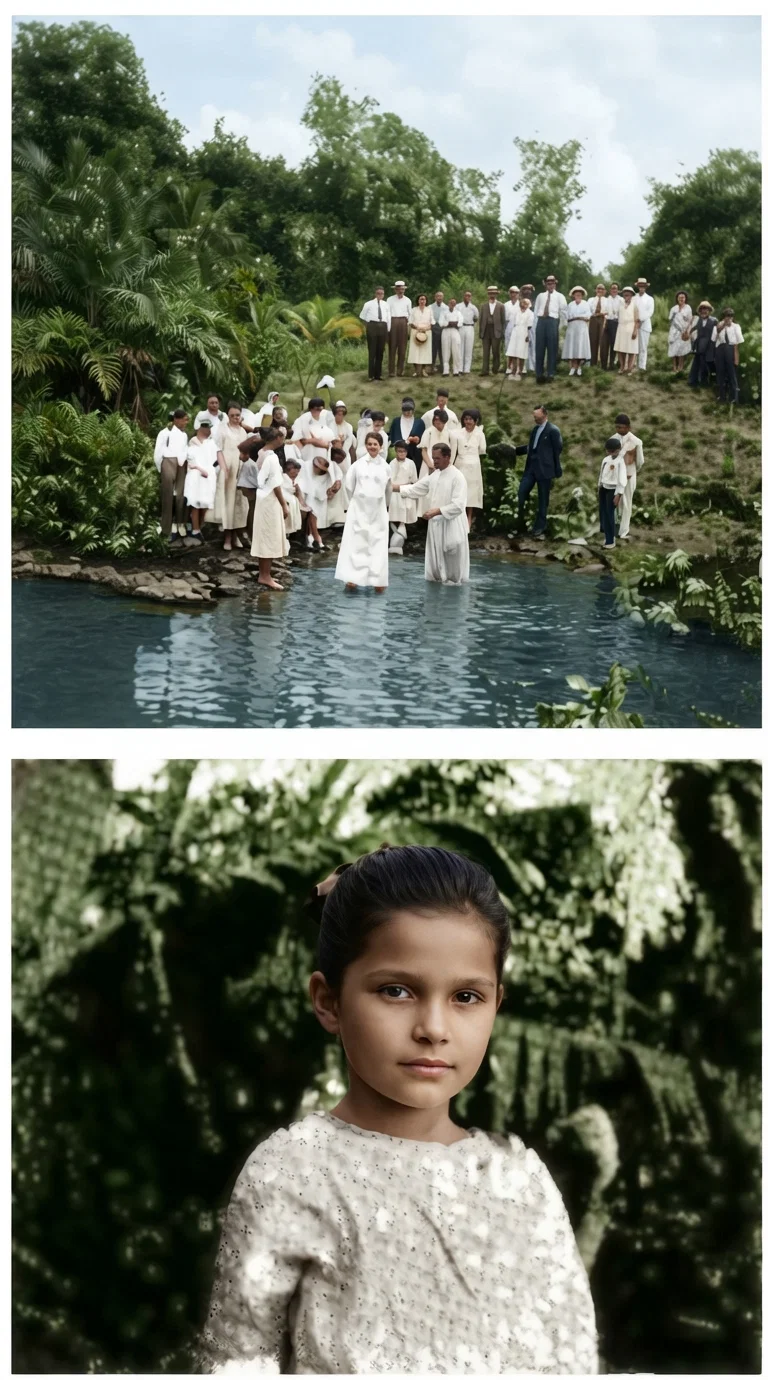
I must tell you about Josefa, a little seven-year-old girl whose grandparents are members of our church. Her father professes the Catholic faith, while the mother is a believer in Spiritism. Josefa, in company with her grandparents, has attended Sabbath school, and has gained quite a knowledge of the truth. She is anxiously awaiting the time when she can be baptized.
On one occasion, the father, having made a promise to his saint that his little daughter should carry some images to the church that the priest might bless them, commanded her to go. She said she would take them if he commanded it, but she would not kneel or take any part in the ceremony, and would not be responsible if they should fall and be broken. Her father threatened her with a beating, but she remained firm, telling him that he might beat her to death if he desired, but added, “I cannot worship false gods or images.”
Upper — Baptismal Scene in Cayey, Porto Rico
Lower — Josefa
Upper — Baptismal Scene in Cayey, Porto Rico Lower — Josefa
I recently visited Sister C. N. Mounton, who lives in the country of Lajas. She has a home Sabbath school of about twenty members, several of whom are preparing for baptism.
Companies could be raised up in all the seventy towns in the island had we the laborers. Through literature the leaven of truth is working. We can see this wherever we go. We must educate the bright young people who are coming to us, and send them out laden with the message. But to do this we must have the cooperation of our brethren in the homeland. Come to our aid, brethren, both with your prayers and with the substance God has so graciously lent you, so that we may be able to carry on a school for training these young people.
‘The time is short, the King’s business requires haste; let every one faithfully work in his place, and then there will be a sound of “a going in the tops of the mulberry trees.”’

South Africa

GEORGE R. E. MC NAY
SINCE OUR arrival in South Africa, we have held two series of tent meetings. God blessed our feeble efforts, and thirteen persons have been baptized, and six or seven others are nearly ready for the next baptismal service. The second tent effort was held at the beginning of the rainy season; and how it did rain! During that effort we had but five or six clear evenings, so not much fruit was gathered, but the meetings helped some who had not taken their stand for the truth in the first effort. We are planning on pitching the tent again in a few days, and starting meetings April 30.
Between tent series I have been holding cottage meetings and Sunday night hall efforts, and some good has been done. One night each week was devoted to a service in the Berea Health Institute, which is operated by Brother and Sister Blaine.
My throat has been giving me much trouble since coming here, and I have had a cold or bronchitis or influenza almost continually. I am told that this is caused by the change of climate. However, my tonsils were greatly enlarged, so I had them removed, March 27, by Dr. Hankins, at the Health Institute. The institute being crowded, I made my preparation for the operation in the room of a patient, Mr. Odendaal, a Dutchman, or Boer, who had arrived the day before, helpless with rheumatism. When the doctor gave me the hypodermic, I fainted in the room, but was soon taken to the operating-room. When I was able, I returned to Mr. Odendaal's room for the things I had left there. He asked what my work was, and when I told him, he said that he was an unbeliever.
On the fifth of April, accompanied by Sister Blaine, I visited him again. Mr. Odendaal asked about my faith in Christ, and said that for twenty years he had had no faith in Christ, though he believed in some Being who controlled in the affairs of man. During all these years he had prayed to the Being he could imagine, but could not learn of, and his prayer had always been for light and understanding of God's character and for a knowledge of what the future had in store. Only the previous night he had prayed in agony until after midnight, that that Power or Being would give him light and relieve him from the terrible burden which had been crushing him the past twenty years.
He said that he was a member of the Dutch Reformed Church, but could not understand, or believe in, the God they preached. He could not believe that a loving, omniscient God could permit beings to come into this world only to burn them in a lake of fire throughout eternity. He supposed, because his ministers told him so, that the Bible presented just such a God and such a place of torment, and felt that he could not consistently believe in Christ, who was said to be a Saviour from that place of torment. Consequently he had had no God to trust in, and had become reckless and even blasphemous in his language.
In a few words I asked him if he could harmonize his conception of God with One who permitted sin that the character of Satan might be revealed to the universe, and characters be developed in angels and human beings; and who would finally destroy Satan and sinners, leaving only those who had perfected characters to live with God and Jesus throughout eternity. He was lying in bed in pain, but as I spoke these few words to show God's true purpose, the expression of his countenance changed, and he buried his face in his hands and broke down in weeping. He reached up his hand toward the ceiling and said, "Now I begin to see the light that I have been praying for for twenty years." Then I went into the matter more in detail, and he was a changed man. That day he gave his heart to his new-found Friend and Saviour, and his whole life and ambition have changed. From a boisterous, swearing, godless man he has become a humble, spiritual, God-fearing, and loving child who wants to talk always of his new joy and hope.
He is a man of wealth, owning many large and valuable farms, but he told me that because of his unbelief he had taken no pleasure in his possessions. He said that he had hated "parsons" because he had decided they were liars in preaching the popular "hell," and he had hated me because I was a "parson." When I fainted in his room, he thought, "The sooner he goes to heaven, the better."
When I came to visit him on April 5, he hated me, and would have ordered me out of the room but for his respect for Sister Blaine, who had ushered me in. Now his hate has turned to love. I have had various experiences with people as the truth came to them, but never one quite so striking. Without my suggesting it, he has quit smoking.
Mr. Odendaal has been reading intensely, and I have been studying with him almost daily, and he has eagerly accepted the truth and is anxious for baptism. He kept his first Sabbath the third day after he received the first light. He is gifted in writing poetry, in debate, etc., and says that not another line will he write but for the furtherance of this cause which has brought him freedom. His means also, he says, will hereafter be spent in the furtherance of this message. He is certain of opposition and persecution when he returns home.
The other day this man wrote a poem concerning his experiences and his expectations for the future. The poem follows:—
“Praise God!
“Praise God! Praise God! ’Tis all so plain, My heart with praise is filled, My soul with gratitude abounds!— Nor can that joy be stilled.
“A disbeliever have I been; I tried but could not see (Although I knew a God there is) Why Christ had died for me.
“For God was love, almighty too, Omniscient; so could he Create man for eternal hell Premeditatedly?
“For twenty years, all seemingly, I prayed, implored in vain; ‘Reveal, O God, the truth to me!’ But prayers brought me no gain.
“A chastised soul for twenty years, A struggling soul for peace! In vain! in vain! No peace was there. I wished that life would cease.
“I prayed,—my prayers apparently Went to the winds in vain,— ‘Reveal, O God, the truth to me!’ My prayers brought me no gain.
“Afflicted mentally was I, My body worn by pain; I writhed and cursed in agony At times, then prayed again.
“And at an institute of health, Three hundred miles away From home, I found myself at last; I’ll ne’er forget that stay.
“Berea institute of health— There God revealed to me The truth,—sweet life eternal, free For all, for even me!
“I do believe, I now believe, That Jesus died for me, That on the cross his blessed blood Was shed to set all free.
“Praise God! Praise God! His purpose now I see; with praise I’m filled; My soul with gratitude abounds; Nor can that joy be stilled.”
Such experiences as the preceding cannot help but inspire the worker who witnesses them with a stronger determination to hasten to tell others who may be in darkness, of the true character and love of God and Christ. Our courage in God is good, and though the people among whom we labor seem indifferent and self-satisfied, we are expecting great things from God, and will attempt much for him.
Mrs. McNay joins in greetings to those in the homeland.

Does It Pay?

O. A. HALL
On entering upon any career in life, one first reckons carefully to determine if the choice he is about to make will bring the desired results. Although Christian organizations were slow to take up foreign mission work, because of lack of confidence in its success, it long ago proved to be one of the most fruitful undertakings.
At the biennial meeting of the East China Mission, held this year at Nanking, a marked growth in the work was seen. The number of delegates seated was three times the number present at the meeting two years before. Reports from all parts of the field were most encouraging, showing that the church membership has more than doubled during the two years, and that our corps of workers has grown from nineteen to fifty-five. Eighty-six persons have been baptized during the last seven months of the year just closing. A good class of inquirers are studying, and we are led to feel that this work pays,—in this life thirty, sixty, and even a hundred fold, and in that to come, eternal life.
Although the work in Shantung Province is new, the early harvest of souls has been good. The northern, or Mandarin-speaking, part of Kiang-su Province, is being entered by evangelists and colporteurs from Anhwei Province, in response to the calls that are coming from many parts of that field, and we expect, by the blessing of the Lord, through the ministry of these devoted workers to gather a large harvest of souls from there this year.

Mission Notes

BISHOP BASHFORD recently declared that in the eleven years of his stay in China he had never given an invitation to come to Christ that had not met with definite response.
WHEN the shipowner in whose vessel Missionary Robert Morrison sailed said sneeringly, “And so, Morrison, you really expect that you will make an impression on the idolatry of the great Chinese Empire,” Morrison replied, “No, sir; I expect God will.” When he went to Canton in 1807, he worked seven years before he won his first convert to Christianity. But if Morrison had lived in the year 1913, one hundred years from when he received that first convert, he would have had the joy of attending, in that same city of Canton, a religious service in which there were 3,500 persons gathered to hear a Christian speaker from America.
FIRST reports being received at the Australasian Union Conference office as to the offerings during their recent week of prayer (they hold their week of prayer at another time than here in the States), indicate that a large increase in offerings will be realized this year. One conference reports that $569 more than the amount it had set as its goal had been received, although several companies had not been heard from. Australia is now one of the strong bases of supply for mission funds, and it is a source of encouragement to note that the brethren and sisters in that field are so liberally supporting the mission advance this year by their annual offerings.
VOLTAIRE, the French infidel, once said, “In a hundred years from now the Bible will be an unknown book.” And how has this prediction been fulfilled? After a hundred years his house in Geneva was a branch office of the British Bible Society. In Voltaire’s time not one Bible society existed in the world; today we have seventy-three. In 1908 the American Bible Society alone distributed 2,826,841 Bibles, and all Bible societies together published 11,378,954 copies. If we add the products of all the Bible societies, we have the enormous sum of 500,000,000 Bibles published in the nineteenth century. In Voltaire’s time the Bible was published in 38 languages; now it is in 436 languages.

Conducted by Mrs. I. H. Evans, Takoma Park, Washington D. C

Assisted by Miss Lora E. Clement
Through the columns of this department, hints will be given on all matters pertaining to the home life. Short articles and letters are solicited from home makers, telling of their everyday experiences,—their joys and sorrows, their failures and successes.

Making the Hot Days Bearable

THE problem of making the hot days endurable is one that must be solved by many who live in crowded places during July and August. The fortunate few who can take refuge by sea or lake, or enjoy the cool nights of some mountain retreat, escape the strain put upon the nerves and general physical reserve, to say nothing of temper and disposition, that must be endured by those who pass the heated days with no such respite.
It requires careful planning on the part of most of the stay-at-homes to lessen the routine duties, provide the necessary meals, and keep up a fair degree of the cleanliness that is so essential to health.
But much can be done. An hour or two gained in the cool of the very early morning may make it possible to take a siesta during the breathless hours of the afternoon. It is a good plan to go often to the woods and parks and public gardens near home. As early as you can after breakfast, take the children and go off for a day together in the green places. A box of sandwiches, a basket of fruit, and a supply of pure water,—these essentials will make the outing a real picnic to the little folks; and if there is a wading place and a sand pile, their happiness will be complete. To the mother these restful hours, in the cool shade, with reading or sewing, will also be a boon. And at the end of the week or month, she will find nearly as much accomplished as if she had spent all the days in the house.

The Hot-Weather Menu

The diet in hot weather is of supreme importance. “No one,” says Dr. Harvey W. Wiley, “would deliberately cuddle up to a hot stove on a warm summer day; and yet we very often do worse when we sit down at the table, for we build a fire inside of ourselves from which there is no escape. Less heat-giving food is needed than in the winter, when we must fortify ourselves against the cold, and when we usually exercise more vigorously, and so need more ‘steam.’ The kind of food eaten in summer should be quite different, and nature points the way with her usual wise adaptation to human needs. Sweets, oils, meats, and rich, greasy foods of all kinds are to be slighted, and the emphasis put on the fresh, succulent vegetables and juicy acid fruits. Any excess of protein should be carefully avoided in hot weather. It is a food that insists on being burned, whether one is active or at rest. Let us ‘slow down’ our speed, put less fuel in the furnace, and partake of the ‘tonics’ that nature furnishes in the laxative and acid principles of fresh fruits and vegetables, the lemon, the grape, the pineapple, the peach, and the berries, not forgetting the dandelion greens, spinach, and lettuce.”
Temperance is the golden rule of the summer days,—temperance in eating and temperance in partaking of cool drinks and ices. Overeating and irregularities in diet are the cause of much summer illness.
All kinds of bacteria flourish in hot weather, and food spoils quickly. Guard your food supply. Milk is especially liable to contamination, and unless one is sure it is pure and clean, the safest plan is to Pasteurize it.

Don’t Succumb to the Heat

When we have done all we can to mitigate the effect of the hot weather, we should forget it! Refuse to talk about it! “At least half of the human suffering is invited, coddled, domesticated, pampered, petted, solicited. The one who complains most of the heat is usually the one who has the least cause. You don’t often hear the hodcarrier or the binder of wheat complain about the heat. The man who is doing work is too busy to remember the weather. It is the idle who complain; fortunately, perhaps, it is the idle who suffer most.”
Needless hurry and worry can be eliminated to a truly remarkable degree by a determined exercise of the will. A new automobile advertises one of its selling points thus: “You ride in the car, not on it.” That is all right for automobiles, but for troubles it is better to ride above them, not in them; the resultant saving in vitality is a decided asset toward passing the endurance test that the hot days will inevitably bring. “Make the hot days easier where you can; and when you are not able to do that, make them nobler.”
And bear in mind that in any case the cool, delightful fall days are just around the corner!
MRS. I. H. E.

Fruit Juice for Babies

MRS. E. SISLEY-RICHARDS, M. D.
The opinion is commonly held that children should not be allowed to partake of fruits until they have well passed the period of infancy. This may be true of fruits in general, but the giving of the strained juices of certain fruits is not only conducive, but is actually essential, to the baby's health. This principle is recognized in the large hospitals for sick children, where a teaspoonful of orange juice three times a day is prescribed for hundreds of babies, especially such as are suffering from rickets and other disorders of nutrition.
Artificially fed infants are very liable to suffer from scurvy, a disorder caused by partaking exclusively of cooked foods. There seems to be a certain living principle in fresh fruits and vegetables which is absolutely essential to health. Since regulations have been passed requiring all seagoing vessels to provide some fresh foods for the sailors, scurvy has been practically exterminated among them. We also find that the only way of preventing or relieving infantile scurvy is the administration of some uncooked food substance. Since it is dangerous to give unsterilized milk, we must turn to fruit juices to satisfy this need. There are a number of mild fruits, the juices of which may be given to even young infants. The sweet oranges and mandarins head the list; then follow sweet grapes, strawberries, raspberries, pineapples, peaches, and possibly some other fruits.
Several regulations govern the use of fruit juice for babies:—
1. It must be obtained from fruit in perfect condition, and it must always be strained. It should be so sweet in itself as to demand no sugar in addition.
2. It must never be given in connection with the milk feeding. It should be given not less than two hours after a milk feeding, and not nearer to the next milk feeding than one half or three quarters of an hour.
3. It should be given at least once daily, and more frequently if the child desires it.
There is absolutely no danger in giving fruit juice to babies if these suggestions are followed. In almost every case the fruit juice is taken with the greatest enjoyment, this fact in itself being one of the greatest recommendations for its administration.
Since mother's milk is free from the objections offered to all artificial foods, it is not necessary to give fruit juices to breast-fed infants; however, it is often an advantage to do so.
Fruit juice is one of the best preventives of infantile diarrhea, in that it is a natural disinfectant, and the bacteria which produce diarrhea cannot flourish in it.

My Treasures

HUSHED are the woods against the sky, In amber light the wheat fields lie, And from the barn a breath of hay Floats, as from summers far away.
Beside the border path, the phlox Blooms by the unwaked four-o'clocks; The air is still, save for a note Of warning from the tree toad's throat; And, with my folded work close by, I drink the calm of earth and sky.
Elizabeth, my one wee maid, Sleeps in her hammock in the shade, Dear little tired five-year-old, Whose pillow nests her curls of gold.
Through the net canopy I see The curving of one half-bared knee; Her rosy lips their smiling keep, A little trick of hers in sleep; And one deep dimple, in her cheek, Plays with her dreaming, hide and seek.
What wish have I, O heart of mine? This mother rapture, half divine, The dear, protecting love of home, The shelter of this simple dome Of Gothic roof whose eaves droop low, The old clock ticking staid and slow, The small-paned windows of the rooms, Now bright with red geranium blooms.
What though the world be rich and wide? With home's best treasures at my side, I have no wish, I breathe no prayer, For wealth to hoard, for silks to wear — Only to fare my way through life Content — a mother and a wife.
— Cora A. Matson Dolson.

On Several Topics

MRS. D. A. FITCH

Spread for Bread

EITHER from necessity or from force of habit we have come to feel that each slice of bread must be provided with some sort of spread. Dairy butter is generally used, but for various reasons many experiments have been made for the provision of substitutes. We use the following very palatable mixture: To two tablespoonfuls of good cooking oil add one teaspoonful of lemon juice, two tablespoonfuls of water, four of good milk or cream, and salt to taste, thickening to a creamy consistency with gluten. In this country (Porto Rico), where gluten is hard to get, we find that lightly browned flour may be substituted with satisfactory results.

Stewing — and “Stewing”

Cooks generally agree that boiled fruit is inferior to that which is stewed, and there are many foods which are much more palatable when cooked by the stewing process. But there is one kind of stewing which adds nothing to the taste or digestibility of table viands, and that is “stewing” about table linen. Recently I heard a friend remark, “There is no comfort in dining with Mrs. —, because she is so afraid some one will get a spot on the tablecloth.” Tidy young housekeepers are likely to fall into this fault of fretting over such spots; but as experience comes to them, they realize that no one will purposely soil their table linen, and that all their fuming will not tend to lessen the number of accidents. No family enjoys eating in fear and trembling.

Initials

Those of us who have been long in the way find pleasure in the recognition of the names and initials of various writers for our publications. Some that appeared frequently years ago we do not see any more. It is sad to realize that some of these are sleeping in the grave; but sadder still is the thought that others have lost interest in the message of truth. We trust that this latter class will renew their vows before it is too late. But occasionally the old initials appear, though they belong to another person. It is a coincidence of deep meaning and responsibility to bear the name of some faithful warrior who labored diligently to advance the third angel’s message in years gone by. The place one thus endowed is called to fill is an important one. If your predecessor has been faithful, you must not lower the standard; if he has fallen out by the way, the banner of truth must be again uplifted. It is a solemn thought that if I am not faithful, another will take my place in the everlasting kingdom of our Lord, and some one else will wear the crown I might have won, had I been true.

The United States Public Health Service Asks —

Do you clean your teeth, and then expectorate in the washbowl?
Do you omit lunch to reduce weight, and then overeat at dinner?
Do you go to the country for health, and then sleep with your windows shut tight?
Do you wonder why you have earache, and then blow your nose with your mouth shut?
Continue reading: Front Porch Visits