The Youth’s Instructor, Vol. LIII, No. 18

How Shall We Find the Way?

The Youth’s Instructor

May 2, 1905

Review and Herald Publishing Assn. · Washington, D. C. · May 2, 1905

“How Shall We Find the Way?”

A FEW years ago my husband and I were crossing Central China, with Mr. Hudson Taylor, to a distant conference of missionaries. We were traveling at the greatest speed attainable, across a very populous part of the country. The journey took us two months — our wedding tour, as it happened — and three weeks out of the time we spent on wheelbarrows.
One morning we came to a bright little Chinese town by the roadside, where the barrow-men wanted to stay for their midday rest and meal. They wheeled the barrow into the yard of the little inn, and I passed into the inner courtyard, where I knew the women of the household would be assembled. Here we found the landlord’s wife and mother and other people, and they asked us many questions. When they learned the object of our journey, they said, “Oh, are you religious teachers? That is exceedingly interesting, because here in this town we are all religious women, and we would like to hear what you have to say.” Will you notice that fact in passing? There, far away in the heart of China, in that one little town, they all call themselves religious women. They continued “We have a great religious society here, to which we all belong. The leader of our society is a very intelligent woman, who can read, and she would like to hear what you have to say. We give our money to the worship of the gods; we do all we can to obtain merit in the life to come. Sit down and rest awhile, and we will gather together the women of this town that they may come and hear what you have to tell us about right living.”
In a little while the courtyard was filled with eighty or a hundred people, who crowded about us, so friendly and anxious to hear our message. No Christian had ever been there before, so far as we could tell, and not one of those people had heard the precious name of Jesus. Oh, what a joy to tell them! But they were interested, that is the point; they were longing to hear. And I want you to remember that there are towns and cities all over China more or less like this.
They kept saying to me, “We have sent for the leader of our society, and she will soon be here. She can read; and we want her to know all that you can tell us.” But it seemed a long, long time before she could be found. At length the crowd parted, and I looked up. How I wish I could make you see that woman as I saw her then! She was quite young — tall, graceful, and slender; a girl of about twenty-four, with an intelligent, sweet face — a sad face, but wistful and eager. She came forward as quickly as she could on her little, bound feet, holding out both hands, and, taking mine in hers as I rose to meet her, she said, “Are you the religious teacher who has come from the other side of the world?”
“Yes,” I replied, “I am.”
“Oh, do sit down, and tell me! I want to hear.” And forthwith she sat down on the mat beside me, and with no further questions, still holding my hand in hers, she waited. How would you have felt? I had only a few minutes in which to tell a soul of Jesus. With a cry to the Holy Spirit for his enlightenment, and a heart full of longing love, I began:—
“Little sister, you can read?”
“Oh, yes,” she said, “I can read.”
“Well, here in these books is a message from the God of heaven, who loves us.” I can not tell you all that passed between us, deeply interesting though it was, but she understood every word, and responded eagerly. I put before her an outline of the gospel — God, sin, the punishment of sin in the future, the incarnation, the atonement, the resurrection of Jesus Christ, substitution, faith, and so on. And she kept saying, “Oh, but how wonderful! Is it really true? We never heard these things before.”
But the moments went by so quickly, and the barrow-men were impatient to start. At length I saw that I must go, and putting the Gospels and tracts into her hand, I said, “Little sister, it is all here. When we are gone, you will—”
“What?” she said; “what did you say? When you are gone? Why, elder sister, you are not going away! Those barrow-men are not calling for you, surely?” I told her all about our journey, explaining that we could not possibly stay. “Oh, but there must be a mistake!” she exclaimed. “We never heard these things before, never. You can not go away to-day. Stay with us here one moon or longer and teach us these things. They are exceedingly important! We can not let you go to-day.”
It was very difficult to make her understand. Why, if we had stayed there, we might have stayed every day of that journey; for in those two months we came to only two places where missionaries were preaching Christ. At length she said, “Oh, elder sister, if you leave us, I am so afraid that we shall not be able to find the way! How shall we find the way?” I told her that the Lord Jesus would never leave her; that he would be there all the time; and that she must pray to him day by day, and put her hand in his, and trust him to lead her safely home.
“Oh, but,” she said. “I am afraid that we shall not be able to find the way!”
At length I had to go, and she came out to me in the courtyard, holding my hand all the time, and in the middle of the courtyard she stopped me. She was looking bright and eager again, and said, “Elder sister, tell me one thing — you will not be very long gone, will you? You will soon come back again to our town, and tell us more about these things? Will it be this next moon, or the moon after?”
I did not know what to say. I thought of that long journey of two months and more — of all those hundreds of towns and cities in a district we were hoping to evangelize. I knew there was but little hope of our ever being in that neighborhood again. But she would have an answer. With tears I said, “Dear little sister, I will come back if I possibly can. And I will come back as soon as I can. But I can not say just when it will be.”
“Oh,” she said, the tears springing to her eyes, “O elder sister, are we only to hear this once?” It was her last word. She went out with me to the street, and dropped my hand in silence, as I got on the barrow. I looked back as long as I could, and still saw her standing, the books in her hand. But I have never seen her since. That is ten years ago, and so far as I know, no other missionary has visited that town or district. Certainly there is no one there to-day telling of Jesus. O friends, is it right? Is that what the Lord intended? Can it be pleasing to him that we should live as if no such needs existed? Do we really love him? Do we care?
A dear girl who went out to China as a missionary was asked what had led to her taking this step. She replied: “I seemed to see the Lord Jesus Christ standing alone among the heathen dumb! No one to speak for him; no one through whose life he can pour the love of his heart; waiting for you and me to come to his side and be lips for him, and love for him, and win those waiting souls to him.” Do you see Jesus Christ standing among the heathen dumb?—Mrs. Howard Taylor, China Inland Mission.

Burning the Bridges Behind

That is a beautiful story which tells how Elijah came one day striding across the great farm which belonged to the father of Elisha, having his heart bent on calling that young man to God's work. The Spirit of God had spoken to him, and had put it in his heart to go and win Elisha to set himself apart to the work of the Lord, and fit himself to become, after a while, his own successor.
The way in which Elijah performed his errand is just like him. Elijah was one of those original characters who always do a thing in their own way. He had been alone a great deal, and he was not a man given to talking overmuch, but he never failed to make people understand what he meant. So that day, when he came walking across the field where the twelve plows were slowly cutting their way, pulled by the lazy and sluggish oxen, Elijah waited until the last team came along, where his young friend Elisha held the plow. Without saying a word, he took the great sheepskin mantle, the sign of his prophetic office, from his own shoulders, and threw it around the shoulders of the boy, and walked away. Elisha was at first astonished and full of wonder, and then the meaning flashed upon him. The prophet meant that he was called of God to fit himself to be his prophet. He must leave the farm, and set himself apart to such studies and to such service as would make him fit for the work to which God had thus so strangely called him.
Elisha's decision of character comes out well in his conduct at this time. He does not wait, but at once decides. Leaving the oxen standing in the furrow, he runs after Elijah, and says, “Let me, I pray thee, kiss my father and my mother, and then I will follow thee.” And when he gets permission, he goes back and makes his arrangements to at once obey God's call.
Now, the thing that impresses me most is the way Elisha commits himself without reservation to this new decision. Naturally he was driving the best oxen himself, but he unhitched them from the plow, drove them home, and killed them to furnish food for his farewell banquet to his friends. If there had been any doubts in his mind about sticking to his purpose, and carrying it through at any cost, he would never have killed his favorite yoke of oxen, and made this big feast, calling so much attention to his changed career. But this young farmer had no doubt about the future. He had been called of God, and he had yielded to it, not for a day, or a year, but for life.
Now that was the very wisest thing Elisha could have done. I have no doubt that afterward he was sometimes tempted to go back to the old life; but the fact that he had openly announced to all his friends that he had accepted the call of God for special service was a great safeguard for him, and a great help in resisting temptation to give up. He had burned his way of retreat. This proverb, “burning the bridges behind,” comes, as we all know, from the fact that more than once a great general, in order to make retreat impossible to his army, has burned up the bridges behind him, or burned the boats by which he came to land, so that victory or death is the only alternative. If there is any fight in a man, it will come out under those circumstances. There is always great power in such a public confession of one's purpose.
Luke tells us, in his story of the Acts of the Apostles, that in Ephesus a number of swindlers who had been getting rich by cheating the people, and playing on their superstitions and follies, became convicted of sin under the preaching of Paul, and determining to lead honest Christian lives in the future, they brought their manuscripts, which were worth a small fortune, and made a bonfire in the streets, and burned them before the people. And we are not astonished when Luke says that it had a tremendous influence, and that “mightily grew the word of God and prevailed.” Now, any one can see that those men acted wisely. If they had kept those manuscripts, the first time they were out of work, and were having rather a hard time to get along, the devil would have tempted them to go back to their old swindling habits; but when they burned them up, they put an end to that kind of temptation.
Both of these stories are full of instruction and inspiration to any person who has made up his mind to lead the Christian life. The wise way is the frankest. To let the whole world know it, and take an aggressive, positive course is the way of least resistance. If we go timidly along as though we were only half sure of our purpose, it is a kind of invitation to attack from every mischievous associate, and every open or covert enemy of Christ. But if we frankly show our colors as an avowed and determined friend of Jesus, we put everybody who is not a Christian on the defensive, and the advantage of position at once becomes our own. This advantage is very great; for the conscience of every man or woman we meet who is a Christian is on our side.
Great growth in character, and large development in the Christian graces, can come only to a heart unreservedly given up to Christ. Give your heart to be the garden of the Lord, and then, whether the north wind of trial or the south wind of sympathy shall blow over your garden, the Holy Spirit shall cultivate divine graces in your soul, and Christ shall pluck fragrant flowers in abundance there, for his joy and delight.—Louis Albert Banks, in Christian Advocate.

Some Lessons from the Battle of Mukden

As I have been reading of that vast Japanese victory at which the world is wondering, it has seemed to me wealthy with lessons for the personal life.
For, after all, for every one of us life is a battle—against foes outward and inward; against difficulties, disappointments, a thousand opponents. Every life, if it amounts to anything, must be a battle won. I am sure that great Japanese victory may have, for any one who would make the most of his own life, most valuable impulse and suggestion.
First lesson for the personal life from that victory, is the need of general intelligence for the successful waging of life's battle.
Times have changed. In the old time the victory hung upon preponderating brawn rather than brain. When David vanquished Goliath, Hebrew and Philistine gazed upon the contest of the champions from their respective camps. Yet even then the conflict turned upon the intelligent and dexterous use of the sling. But, speaking generally, hope of victory would, in the old time, usually depend upon Goliath's brawn. Not he who could think the quickest, but he who could strike the hardest, would be most likely to be the winner.
But times have changed. The implements of warfare which science has put into the hands of combatants demand intelligence for their wielding.
I have seen it authoritatively stated that either ninety-four or ninety-six per cent of the rank and file of the Russian army can not read or write. Only one-quarter of the Russian youth of school age are receiving any education at all. There are mitigations of this last statement I have no space for mentioning, but the truth holds that there is an immense amount of the most stolid ignorance in the Russian peasant class, whence the rank and file of the Russian army are chiefly drawn. Such ignorance may be even heroically enduring, but it can never for long hold its own against a confronting general intelligence.

Compulsory Intelligence

But long ago the Japanese emperor made proclamation that there was to be no Japanese village in which there was a family illiterate, nor any one in any family who could not read and write. Intelligence in Japan is compulsory.
Take an instance of the way in which a general intelligence can focus itself to special ends. War-ships for both Russia and Japan were at the same time building in Cramp's shipyard near Philadelphia. The Russians spent most of their time in drinking, and rarely came near their ship. The Japanese watched every piece which went into the structure of their ship, and knew the reason and use of it. “It is only such intimate knowledge,” says the one who tells about it, “that can use so intricate a machinery as a modern war-ship to its full capacity.” And what is true of modern war-ships on the sea is as true of modern guns upon the land.
It was the so superior general intelligence of the Japanese that equipped them for their victory.
Is not this a lesson worth the heeding by any one who would successfully wage his life's battle?
Second lesson for the personal life in that great Japanese victory, is the necessity of the most thorough preparation for life's battle.
I suppose there never was another nation entering a great conflict that was so thoroughly prepared as were the Japanese—in accurate knowledge of the country in which the armies would clash, in the most particular care about the carrying and feeding of troops, in the scouting parties of physicians pointing out the pools and springs whence the soldiers might safely drink, in the careful instruction of the troops about the first treatment of wounds, in elaborate hospital arrangements, in the sort of drill and sort of uniform for various climates—in ten thousand other items.
Is not here a lesson worth heeding by anybody who would successfully wage the battle of a life? There must be preparation for it, if life's battle is to be well won.
And youth is the time for preparation. He who lets his youth speed without making the preparation must be always handicapped.
Third lesson for the personal life in that great victory, is the power of a right initiative.
Have you noticed the moment the great Japanese general Oyama seized for the bringing on of the conflict which has been won so mightily?
It was just that opportune moment at the ending of the long Manchurian winter before the spring sun had softened the frost-hardened roads. So there was chance for the swift encircling flank marches which have made the victory. Such another moment the whole round year would not present. That propitious moment, and with the power of a wise initiative, Oyama seized.
Is there not here, too, a lesson worth everybody's heeding? Thomas Carlyle used to say, “Grasp opportunity by the forelock; she has no back hair.”
And let us learn this other personal life lesson from this great victory: the force of a mighty motive. It is patriotism with the Japanese.
But for each of us, pushing the battle of his individual life, there may be a motive nobler, stronger. We have opened our hearts and lives to the highest motives possible, when, with the great apostle, we can sincerely say, “For to me to live is Christ.”—Wayland Hoyt, D. D.

L. D. SANTEE

Faith

With faith’s fine ear I listen and hear The things that will soon be true, The rapturous song of the white-robed throng, Far up in the shining blue. I hear the throng in the land of song, More sweet than the song of birds, And the voices dear, they sound so near I can almost hear the words.
The harps by angelic fingers swept Have never a note of pain, And never a chord of sadness crept Into their glad refrain. Oh, the songs of love that are sung above, The heart-sense, listening hears, Till we long the more for the farther shore. For the land undimmed by fears!
And faith’s bright eyes look up to the skies, And away in the life to be We see the hands of the loved that stand By the shining crystal sea. We see each face with its tender grace, And eyes with love that glow, And brows so white, where the curls lay bright, Like sunbeams o’er the snow.
And angel feet, so pure and sweet, We see on the shining strand, Till desire grows strong, and our spirits long For the better, the dear home land. The Saviour waits at the pearly gate For the children bowed with care, To welcome home when our work is done, To the mansions bright and fair.

L. D. SANTEE

Strength of Elephants Compared with Horses

An elephant, it is said, can pull its entire weight, while a horse can pull but one sixth of its weight. Two elephants, in carefully arranged tests, raised sixty-five hundred pounds. One raised a safe weighing more than a ton. Recently there was a tug of war between elephants and a locomotive, in which the huge beasts nearly succeeded in wrecking the engines.

The Growth of Early Spring Flowers

WHEN the first growing days of spring come, and after the rains the April sun bursts out as warm as June, we stand amazed at the sudden transformation that takes place in the landscape. The leaves seem not to grow, but actually to jump out. In a few days the trees which had been covered by a faint, misty haze of green, spring into full leaf, and only the oaks and beeches remind us that winter is not far behind us. The flowers appear as suddenly, and hepaticas, bloodroot, and violets soon gladden our eyes.
How is this sudden growth possible? If the trees and herbs were obliged to wait until they had slowly made the food required for this transformation, a few warm days and soaking showers would have little effect in bringing it about. All through the previous summer the surplus food-substances formed in the leaves, the starch-factories of the plant, have been carried to safe places in stem and root, and laid up for future use. Through the winter this store of food has lain safely, waiting for its appointed time, and as soon as the rain and sun have started the buds, the starch absorbs moisture, and is turned into a sort of sugary sap, which takes up more room than the dry starch, and forces its way into every twig of the tree. The growing buds absorb this sweet sap and unfold with marvelous rapidity.
DANDELION
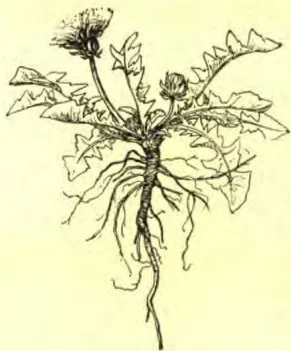
DANDELION
If we examine any very early herb, we shall find somewhere at the base a storehouse of food. Let us look, for instance, at one of our commonest weeds, the dandelion. If we pull up a plant, we shall see a long, tapering, fleshy root which is full of food, put there during the previous summer. In the spring the new leaves do not have to make food before other leaves and flowers can develop, but they can draw on the prepared store. The dandelion uses its root for its storehouse, so do the carrot and the beet, the radish and the turnip, which are used by us for food. Other plants store their food in their stems. Many of our spring plants have large, creeping, underground stems, which throw up new shoots every year. The Solomon's-seal takes its name from the seal-like scar at each place where a shoot has grown and withered in former years, and the bloodroot is named from the red juice which fills its underground stem, and stains our fingers, making us look guilty of some crime. But it is not a crime to pick all the bloodroot that we want. Safe beneath the ground are the tiny forming buds that will throw up the blossoms and leaves next year, and we can not hurt them. But the wild flowers which have no creeping underground stems provided with buds, depend on their seeds for future descendants, and we must not pick them all.
ADDER'S-TONGUE AND BLOODROOT
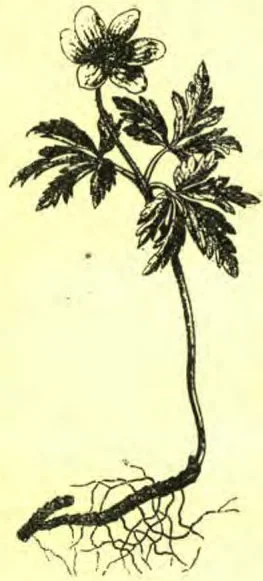
The violet and anemone also have a storehouse in their underground stems, and the stem of the violet is covered with fleshy teeth. The teeth are the remains of former leaves, while the upper part above the ground has withered away. In the anemone the underground sheaths are modified leaves, and from their axils spring branches to continue the growth for the following year.
In all our bulbous plants, snowdrops, crocuses, tulips, adder's-tongues, and trilliums, the food is stored in the base of the stem or in the bases of the leaves. The green leaves of a tulip die down to the ground after flowering-time is over, but it has first deposited its provision for the following spring in the underground part of the leaves, which become fleshy and gorged with nourishment.
ANEMONE
ANEMONE
We call these storehouses bulbs, and the name is given in common speech to the underground part of the crocus also, where the food, instead of being stored in the bases of leaves, is collected in the base of the stem.
Any organ of the plant may thus be utilised as a storehouse of food, and we can name many examples of plants which so use their roots, their stems, and their leaves. In our trees the food is stored principally in the branches, where it is close at hand to supply plenty of sap to every little bud as soon as it begins to swell in the spring-time.—Jane H. Newell, in “Flower and Fruit.”

A Dog’s Gratitude

THE appointment of Dr. David Jayne Hill, Assistant Secretary of State, as minister to Switzerland, calls to mind an incident of his university days which has never been made public before, and sheds an interesting light upon a trait in his character which but few of his friends appreciate. This is his love for animals, especially dogs. While Dr. Hill was president of the University of Rochester, he owned a beautiful Irish setter, of which he was exceedingly proud, and the two were seldom seen apart. Occasionally the dog would bring a friend to the house, and was never disappointed in the manner of its entertainment. One dark and stormy night late in November Dr. Hill was reading in the hall of his home when he was arrested by a sound of scratching against the storm-house door. Thinking that perhaps his Irish setter had been shut out in the rain and cold, he arose and threw open the portal. A drenched and sorry figure stood in the glare of the light. It was an aged dog, of the breed of the doctor’s favorite, but worn and weak with hunger and exposure. It stood half crouching, and wagging its drooping tail with hesitating and doubtful motion. Touched by the helplessness of the animal, Dr. Hill called it in, made it lie down in front of the fire, and then with his own hands gave it something to eat. The food was devoured ravenously, and after every scrap had been consumed, the thankful old setter rubbed its scarred muzzle against its host’s hand. Dr. Hill decided to keep it for a while, at least, and gave orders that it should be treated with kindness and consideration. But its stay was not destined to be long continued, for one day it fell sick, and lay in the kitchen by the fire, growing weaker hour by hour.
One evening Dr. Hill sat at the desk in his study, deeply immersed in work, when he was aroused by a faint scratching at the door, like that which had taken him to the storm-house three nights before. He arose and opened the door. Tottering and swaying, the wasted tramp dragged its feet inside with a heroic but difficult wag. Dr. Hill went back to his desk, and was soon buried in the depths of work. Thus he sat in the rim of light from his reading-lamp for an hour. Of a sudden he felt a pressure on his foot. Looking down, he saw the old dog lying at “charge,” with his weary head resting on his friend’s foot.
Something in the attitude struck the student, and he leaned forward and touched the quiet muzzle. Then he lifted it. It dropped back limp and inert. The old dog was dead.
“The tears sprang to my eyes,” said Dr. Hill when he told the story afterward. “My heart was never more deeply touched. I thought I understood dog nature before, but after that I saw that I had but reached the threshold. Driven through the world with kicks and cuffs, worn and weary, the dying dog knew his end was approaching, and with the warmth of gratitude to me, who had taken compassion upon him, the faithful creature dragged himself to my side and breathed his life out in one last expression of his thanks.”
—Selected.

Spring-time Sights and Sounds

On such a cherry, sunny day, When nature calls us all away To haunts of shade and sunny nook Beside some gurgling, prattling brook, Think you that I'll resist the call And stay indoors?—No, not at all!
So here I am, and oh, how good To see and smell the spring-time wood! The rain has left it fresh and sweet, And all about my rustic seat The violet's sweet faces peep, And dandelions vigil keep.
And I have brought a book along,— 'Twill vex my eyes, but they are strong. But who could read and get the sense When all these birds their noise commence?
Just there, not thirty steps from me, High up the trunk of that dead tree Two noisy redheads have their nest, And every time when from their quest For bugs and worms they chatter back, They stop to give the bark a crack. With rat-a-tat and then a thump, With ease side-stepping on the stump, They circle round the old white bole, And stick their heads into their hole.
See that one hanging from a twig— An acrobat with crimson wig! Depend on him to find the bugs; He knows the haunts of juicy slugs; And such a lot of them he'll need For four small mouths he has to feed.
And near me, saucy, rude, and bold, Two English sparrows fuss and scold; A half a dozen, bolder still, Are splashing in a little rill.
Now watch that robin! Only see! I do believe he's teasing me. He hops this way close as he dares, Then stands with long-stretched neck and stares! The saucy fellow, watch his eye! The smallest bugs and worms he'll spy, And long before they've time to think, He swallows them, without a wink!
And that gay singer, where is he? He's perched away where I can't see; But such a song, such jolly notes, Come not from any common throats. Ah, there he is! I know him now, His whistled song ends with, Meow!
Ah, there! my lad! How do you do? I'm wondering who invited you. You're welcome, though, just come along— Don't interrupt the catbird's song. Well, run along, if you think best. And curl up in your lofty nest. Don't think you're hidden, for I see Your bushy tail around the tree.
And that small goldfinch,— now don't stir Or you will surely frighten her. She's come for lunch at Elm Tree Inn; I wonder how she likes the din.
And there upon another tree A tiny wren has come to see What kind of place will be the best For her to build her summer nest. But noisiest of all the folks In hair, or fur, or feather cloaks That occupy these woods and ways I think the prize goes to the jays. Just now are gathered in a tree, The tallest one that I can see, At least a dozen, beauties, too! But what are they about to do? Why, it's a dance! Just watch them now! Just see them strut, and nod, and bow! And hear them jabber, scold, and call! A monk would laugh to see it all! There! Hear that redbird's whistled call! The clearest, sweetest note of all! Now would not any boy be proud If he could whistle half so loud? Just listen!
MAX HILL.

THE MAY FIELD STUDY

(May 13)

OPENING EXERCISES:—

Singing.
Prayer. (Let several take part.)
Scripture lesson.

REMARKS BY THE LEADER.

“The Work Fitted the Time.” See Editorial, Review, March 16.

FIELD STUDY:—

“A Journey to the West Coast of South America,” Review, March 23.
“The Boys’ School, Canton, China,” Review, March 23.
“Buluwayo Mission,” Review, March 30.
“Our Nyassaland School,” Review, April 6.
“Our New Mission Station,” Review, April 6.
Brief Messages from Thos. H. Davis, Geo. F. Enoch, F. W. Spies, W. S. Hyatt, W. Robinson, H. C. Goodrich, L. R. Conradi, H. H. Votaw, C. E. Rentfro, F. B. Armitage, A. G. Watson.

CLOSING EXERCISES:—

Prayer for the fields.
Song.

Note

Use the map. If you do not have one, draw an outline map on the blackboard or a large sheet of paper. Note the fields from which our messages come to-day: West Indies, Central America, Chile, Ecuador, Brazil, Spain, Portugal, Turkey, Asia Minor, Africa, India, China, and the East Indies. Put a cross or star on the map to designate each field represented. This will produce a vivid picture of the work in hand, as well as show something of the work yet to be done.
Continue reading: Baptism: A Divine Rite Taught in Scripture