The Youth’s Instructor, Vol. LIII, No. 18

How Shall We Find the Way?
Earlier text: How Shall We Find the Way?

Baptism: A Divine Rite Taught in Scripture

Baptism

THAT baptism is clearly taught in the Scriptures, no student of the Bible can question. This divine rite was established by the Lord himself. It is a part of the great gospel commission which the Saviour gave before he ascended to heaven. He commanded, “Go ye therefore, and teach all nations, baptizing them in the name of the Father, and of the Son, and of the Holy Ghost: teaching them to observe all things whatsoever I have commanded you: and, lo, I am with you alway, even unto the end of the world. Amen.” Matt. 28:19, 20. And in this same commission he gives the assurance that “he that believeth and is baptized shall be saved.” Mark 16:16. Some say, Is baptism a saving ordinance? Well, it certainly is as much so as any other thing the Lord has commanded.
The Saviour, when on earth, was our example. We are exhorted to walk in his steps (1 Peter 2:21; 1 John 2:6), and we find him at the beginning of his public ministry, coming to John the Baptist to be baptized, to “fulfil all righteousness.” Matt. 3:15. On the day of Pentecost, when the Spirit of God wrought in great power among the people, causing them to exclaim, “What shall we do?” Peter said, “Repent, and be baptized every one of you in the name of Jesus Christ, for the remission of sins, and ye shall receive the gift of the Holy Ghost.” Acts 2:38.
Repentance and faith in our Lord as a Saviour, precede baptism, and only those who are old enough to understandingly repent of their sins, and believe, and have by faith accepted Jesus as their Redeemer, are proper subjects for baptism. Sprinkling and infant baptism are both pagan rites. It is through baptism, and not by observing Sunday, that we commemorate the death, burial, and resurrection of Christ. “Therefore we are buried with him by baptism into death; that like as Christ was raised up from the dead by the glory of the Father, even so we also should walk in newness of life. For if we have been planted together in the likeness of his death, we shall be also in the likeness of his resurrection.” Rom. 6:4, 5.
Much theological discussion has been engaged in concerning the “mode” of baptism. This is wholly unnecessary. It is scarcely proper to speak of the “mode” of baptism, for baptism is baptism, and there is only one way (Eph. 4:5), and any so-called “mode” is simply a perversion. The Bible is very plain in reference to the matter, and no technical examination of texts in Greek or Hebrew is necessary to determine which of the so-called “modes” is the proper one.
Smith in his Bible Dictionary truly says, “Baptism properly and literally means immersion.” The Greek word should have been so translated, and Rotherham in his excellent translation of the New Testament has so rendered it throughout. But there is no room even for cavil from the Authorized Version. We are “buried with him by baptism,” “planted together in the likeness of his death.” These figures indicate unmistakably the “mode.” John the Baptist baptized “in the river” (Mark 1:5), and on a certain occasion “was baptizing in Enon near to Salim, because there was much water there.” John 3:23. It does not require “much water” either to sprinkle or to pour, but it does to immerse. “And being immersed, Jesus straightway went up from the water; and, behold! opened to him were the heavens, and he saw the Spirit of God descending like a dove and coming upon him.” Matt. 3:16, Rotherham’s Translation.
The story is related of a little girl who, wishing to be baptized, was asked by her pastor, who believed in sprinkling, how she wished to be baptized. She replied, “Just like Jesus was.” He turned to some of his assistants and said, “We shall have to take this girl to the river.” How true; for Jesus, when he was baptized in Jordan, “went up straightway out of the water.”
The same truth is stated in the narrative concerning Philip and the eunuch. When Philip joined himself to the chariot, he found the eunuch reading the fifty-third chapter of Isaiah. Philip “began at the same scripture, and preached unto him Jesus.” As they were riding along, the eunuch said, “See, here is water; what doth hinder me to be baptized?” In preaching Christ to him he had preached baptism, and the Spirit of God convicted the eunuch of his duty to obey in this holy ordinance. “And Philip said, If thou believest with all thine heart, thou mayest. And he answered and said, I believe that Jesus Christ is the Son of God.” Acts 8:35-37. “And he ordered the chariot to stand still, and they went down both into the water, both Philip and the chamberlain, and he immersed him.” Verse 38, Rotherham’s Translation. As soon as he fully believed, he was baptized. So was also the Philippian jailer. When he saw the prison doors open, but all the prisoners safe, he exclaimed, “Sirs, what must I do to be saved? And they said, Believe on the Lord Jesus Christ, and thou shalt be saved, and thy house. And they spake unto him the word of the Lord, and to all that were in his house. And he took them the same hour of the night, and washed their stripes; and was baptized, he and all his, straightway.” Acts 16:30-33. He was not baptized in the house as those who argue in favor of sprinkling declare; for they came into the house after the baptism. Verse 34.
The believer is married to Christ (Rom. 7:4), and baptism is the ceremony which unites him to his Lord, and places him in the royal family. We are baptized “into the name [or family] of the Father and of the Son and of the Holy Ghost.” Matt. 28:19, R. V. In the marriage relation the prospective bridegroom selects from another family a lady of another name; she consents to give up her own family and name, and they are married, and the bride becomes a member of another family, and takes the name of the bridegroom. When the ceremony is pronounced which legally makes them one, her name is changed, and she is a member of a new family. So with us. We are all members of another family, children of wrath, aliens. But by faith we become children of God and united to Christ. He adopts us into his family, on condition of our obedience, and death to every known sin. Baptism is the outward symbol of this inward work, by which we say to all the world that from henceforth we are members of the family of God. What a high and exalted privilege! Children of the royal family indeed! And having become members of this royal household, how circumspectly we should walk, lest we through sin bring reproach and disgrace upon the family. How necessary it is that we become indeed dead to sin before we are buried in the sacred rite of baptism. “For as many of you as have been baptized unto Christ have put on Christ.” Gal. 3:27. “If ye then be risen with Christ, seek those things which are above, where Christ sitteth on the right hand of God.” Col. 3:1. G. B. THOMPSON.

English Dominates the World's Newspaper Printing

SIXTY-EIGHT newspapers out of every one hundred in the world are printed in English.

The Waking of the Johnny Jump-up Family
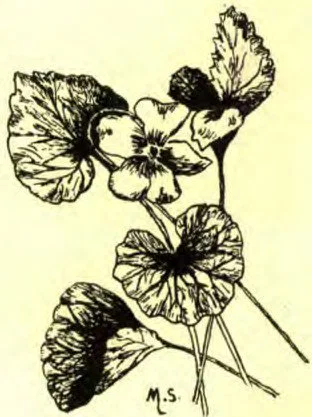
FATHER JUMP-UP had slept till he was tired, and felt that it was time to get up. But it was still early for his neighbors to bestir themselves, and everything was cold and cheerless, so, although restless and impatient, Father Jump-up very wisely remained quiet in his snug quarters until a time when his surroundings warmed up a little, and the air became mild enough to allow his venturing out into it without shivering until his ribs ached. Such a time finally came. Uncle Sunbeam, the Jump-ups’ furnaceman, began work, and what a wonderful change soon took place under his skilful management! Very soon a gentle warmth began to creep about into nook and cranny and crevice, till at last the entire premises were delightfully cozy and comfortable; then with an air plainly expressing his approval of Uncle Sunbeam, Father Jump-up gave Mother Jump-up a nudge as a hint for her to follow, and crept carefully from beneath the coverlet, and peeped out to see what sort of weather it was.
He could not have asked for better. The sky was bright, the grass green, and the air as pleasant as air could be, while the thorn-apple tree above his head was like a white umbrella made of flowers. Father Jump-up was not sorry that he awakened so early, the better to enjoy it all.
Then Mother Jump-up gave their oldest son a nudge, saying, “Wake daughter!” and slipping into a new green gown, came out beside Father Jump-up; and they nodded and smiled at each other while exclaiming repeatedly, “This is delightful!”
Then Son Jump-up gave Daughter Jump-up a nudge, saying, “Wake brother, it’s time to get up!” and he sprang out of bed, and hastened to join Father and Mother Jump-up in the fresh air and sunshine. Almost the first thing a little breeze tapped him playfully in the face, but he only bobbed good-naturedly about, looked up at the thorn-apple tree, and declared with the others, “This is delightful!”
Daughter Jump-up at once grew wide-awake. She did not even wait to rub her eyes, but giving Brother Jump-up a shake, she cried, “Get up, brother, and wake sister!” tumbled out of bed, and hurried away to romp with her brother, and young Neighbor Fern, who was crowding into the group to join their games.
Brother Jump-up felt there must be great fun somewhere, of which he was getting no share, and in a sudden hurry to get out and see, he gave Sister Jump-up a tremendous poke, and shouted, “Get up! Get up! Here I go!” and sure enough, out he went, and was soon on the green grass with the others; while Sister Jump-up followed just as quickly as possible, after getting into a nice spring frock and opening the big front door.
They all had breakfast under the thorn-apple tree, and Neighbor Fern was very sociable, remaining to breakfast with them, and behaving almost like a Jump-up himself.
But there was another member of the Jump-up family,—the baby, which has not been mentioned. He was allowed to sleep longer than the others, being the youngest, and such a little fellow; but presently, Mother Jump-up said, “My dear, is it not now time to wake Johnny? He should be taking his morning sun-bath.”
Father Jump-up nodded, and called, “Johnny, Johnny, get up!” And Mother Jump-up called also, “Johnny, get up, Johnny!” And Son Jump-up echoed, “Get up, Johnny!” And Daughter Jump-up cried, “Johnny! Johnny!” And Brother Jump-up shouted, “Johnny! Come on, Johnny!” And lastly, Sister Jump-up piped shrilly, “John-e-e! John-e-ee! Get u-u-u-up!”
Baby Jump-up heard all the calls, and awoke. But he did not cry nor pout like some babies I have seen when their naps are disturbed. Instead, he smiled as brightly as could be, stretched himself, pulled on a cunning little blue hood with a green pointed collar about the neck, and crawled out of his cradle as quickly as he could, to toddle into the open air where the others were all expecting him and waiting to give him a royal welcome.
Johnny did not get cold, for his blue hood fitted snugly. Mother Jump-up was much too careful a mother to allow her baby to go out to play on a fresh spring day without something on his head; and Johnny never displeased her by slyly leaving off his hood when she was not looking. The other children wore nothing but plain green suits, but none of them grumbled that Johnny’s clothes were so much finer; instead, it seemed to please them that he was dressed so gaily, and the little face that looked out of the blue hood was so sweet and gentle that it could easily be seen that fine clothes were little to Johnny, and that he would be the same lovely darling in a blue hood, a yellow hood, or no hood at all. His brothers and sisters were always happy when playing with Johnny Jump-up, never complaining of getting tired, nor of the baby’s being such a bother, and each was kind, loving, and patient with the other the whole delightful time they spent together beneath the thorn-apple tree.
And a bird as blue as Johnny’s hood, flying into the white umbrella, turned his head side-wise to look at the Jump-up baby, as much as to say, “Well, if there isn’t Johnny Jump-up, awake and out already!” And the sky of a paler blue than the hood, smiled down to say, “Little Johnny Jump-up, you are not a lazy baby!” While a small stream, blue like the sky, flowing about the roots of the thorn-apple tree, gave Johnny Jump-up a drink whenever he was thirsty, and all day long gurgled baby talk, which the blue bird, the blue sky, the blue stream itself, and even the blue-hooded baby fully understood.
MINNIE ROSILLA STEVENS.

A Spring Chorus

Oh, such a commotion under the ground When March called, “Ho, there! ho!” Such spreading of rootlets far and wide, Such whispering to and fro! And, “Are you ready?” the Snowdrop asked; “’Tis time to start, you know.” “Almost, my dear,” the Willow replied, “I’ll follow as soon as you go.” Then, “Ha! ha! ha!” a chorus came Of laughter soft and low, From the millions of flowers under the ground— Yes, millions, beginning to grow.
“I’ll promise my blossoms,” the Crocus said, “When I hear the bluebirds sing.” “And straight thereafter,” Narcissus cried, “My silver and gold I’ll bring.” “And ere they are dulled,” another spoke, “My Hyacinth bells shall ring.” And the Violet only murmured, “I’m here,” And sweet grew the air of spring. Then, “Ha! ha! ha!” a chorus came, Of laughter soft and low, From the millions of flowers under the ground— Yes, millions, beginning to grow.
Oh, the pretty, brave things! through the coldest days, Imprisoned in walls of brown, They never lost heart, though the blast shrieked loud, And the sleet and the hail came down; But patiently each wrought her beautiful dress Or fashioned her beautiful crown, And now they are coming to brighten the world, Still shadowed by winter’s frown; And well may they cheerily laugh, “Ha! ha!” In a chorus soft and low, The millions of flowers hid under the ground— Yes, millions, beginning to grow.
— Harper’s Young People.

More Waste-paper Baskets

Model No. 6
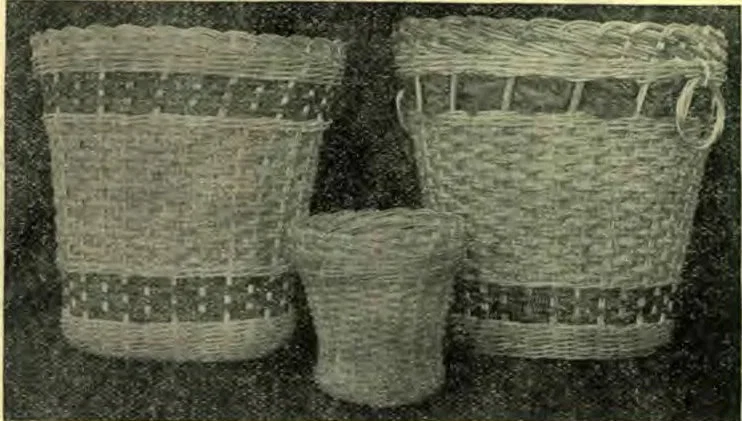
MATERIAL, reeds Nos. 3, 4, and 5, and braided straw. The base for each of the large baskets is seven inches in diameter. Make as previously directed.
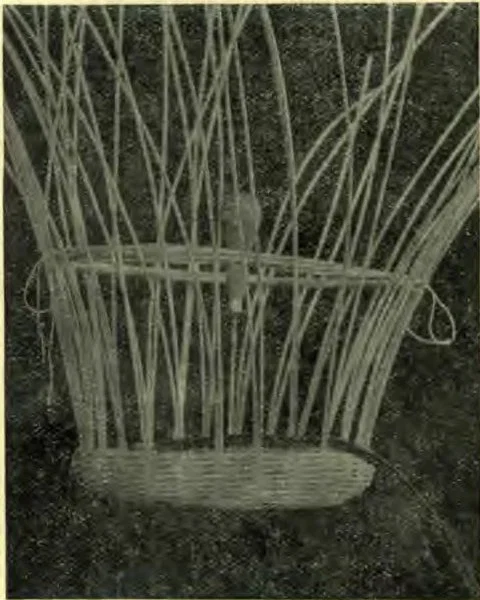
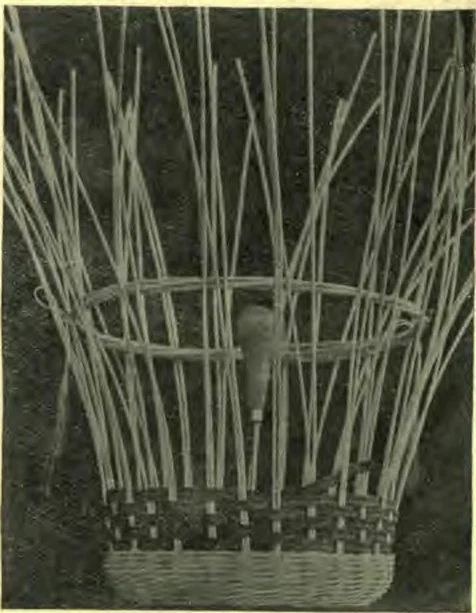
Twenty-seven double stakes of No. 4 reed, each twenty-two inches long. Insert as directed in last lesson. Be sure to have the right number. Stakes may be pinched and turned up sharply, or turned gradually to form a roll, as in the one here shown. Rope twist and seven rows of triple twist of No. 3 reed. Evenly space the stakes while weaving the upsetting. When finished, cut each weaver, leaving the end on inside back of one stake. Five rows of braided straw follow the upsetting. This material can be obtained in a great variety of colors and widths. For the basket here described dark green and natural, one-half inch wide, were used. Dipping in warm water (not soaking) prepares it for use. It is somewhat difficult to shape a basket when using straw weavers, so an aid is provided by the use of a hoop or ring of coiled reeds tied inside the stakes to keep them properly slanted. Fig. 1.
FIG. 1
FIG. 1
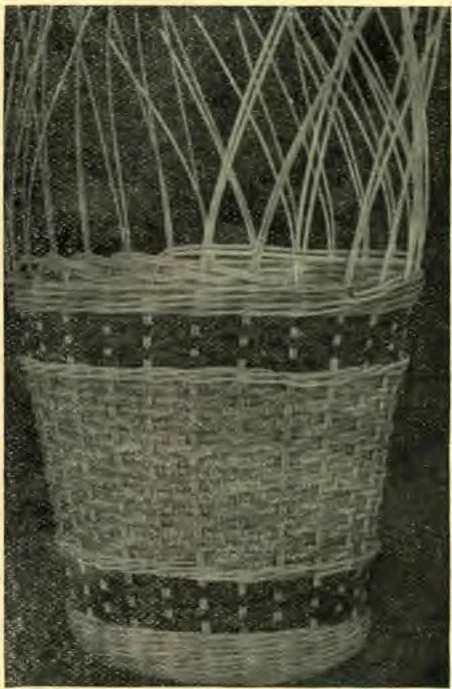
Still better than this is a large flower-pot, or anything of suitable size and shape, which may be slipped inside, and the basket woven tightly around it. An awl may be forced through the center of base and into a table or board to hold basket stationary, and yet allow it to revolve while being woven. To begin the weaving pass one end of the green straw under two pairs of stakes, over the first pair at left with the end just reaching to second pair. Fig. 1. Holding this in position with the left hand, work toward the right, passing the straw in front of one pair of stakes and back of the next—single weaving. Continue around the basket; when the first row is completed, cover the end that was left on the outside by passing the weaver in front of it, and pressing both down close to upsetting; pass under the next stake, still keeping the weaver close to upsetting. The next stroke begins the second row. Fig. 2. Complete five rows, and finish by passing the weaver under the same two pairs of stakes it was placed under at the start. Fig. 2. Carry weaver along back of last row of weaving a distance of three or four stakes; press it down securely to make a strong and straight finish. Above this put two rows of triple twist with number 3 reed. Then five inches (about fifteen rows) of natural straw braid. Begin and finish same as directed for the green. Two rows of triple twist, five of green straw, and four of waling twist complete the weaving.
FIG. 2
FIG. 2
To prepare for the border invert the basket for a few moments in a dish pan or pail of hot water. Stakes must be under water clear to the basket. When well softened, take any pair, bring down in front of first pair at right, back of the next, in front of the next, and back of next, leaving the ends on inside of basket. Treat each stake in the same way, working toward the right. Fig. 3. Leave the first two loose, as the last two must be woven in below them in finishing. Make the border as close and even as possible. Cut ends so that each will rest against a stake. Do not cut too short.
FIG. 4
FIG. 4
The height and top diameter of the basket is eleven and one-half inches.
The second basket is the same as the first with the exception of a row of pairing above the last row of triple twist at top, and another just below the waling twist. The upper row of pairing is begun by doubling a long weaver, and placing it around one pair of stakes. There is no weaving between the two rows of pairing. The space thus left is called straight fitching. A ribbon, matching in color the straw at the bottom, was run through the open work.
About two feet of No. 5 reed will be required for each handle.
Cross the ends so as to leave in the center a loop two and one-half inches in diameter. Put each end through the loop three times. Cut the ends slanting. If properly made, this will be a perfect three-strand circle. To attach to the basket take an eighteen-inch piece of No. 3 reed, slip it back of one stake just below waling, bringing ends together in front. Twist them together to form a cord about one and one-half inches long. Slip a handle over this, and pass the ends through, one on either side of stake just above waling. Draw as tight as possible, and cross just back of the stake. Weave one to the right and one to left over and under stakes until secure.
FIG. 3
FIG. 3
The small basket may be used for a jardiniere. It has a three and one-half inch base. Height and top diameter six inches. Nineteen double stakes of No. 3 reed each thirteen inches long. Rope twist and six rows of triple twist of No. 2 reed. Three and one-half inches double weaving with No. 2 reeds. Four or five rows of waling. Border same as the large baskets.
Straw as well as reeds should be finished with one or two coats of shellac.
MRS. E. M. F. LONG.
Continue reading: The President’s Secretary