Political Conditions — War Preparations — Commerce — Alien Immigration — Various Reforms — Men's Hearts Failing — Loss in Church-Membership — Fallen Children
From Our Own Correspondent
Conditions Political
THE remarkable figures of the recent general election indicate how close has been the constitutional struggle. Not only is there a tie between the Liberals and the Conservatives, but the new government resumes power with almost exactly the majority that it possessed at the dissolution of Parliament. Then it had a margin of 124 votes, now it has 126. In the new house there are 272 Conservatives, 272 Liberals, 42 Labor members, and 84 Irish Nationalists. So long as the Liberal party can maintain its alliance with the Labor members and the Irish party, it remains in the ascendant; but whenever these turn against it, it will be in the minority.
The first business before the new party will be to dispose of the veto hitherto wielded by the lords. The government proposals provide that any bill which has passed the House of Commons shall become operative, notwithstanding the opposition of the lords, after being twice presented to the Upper House. This means that, no matter how much the House of Lords may disapprove of a certain bill, it can not delay the passage of the measure for a longer period than two years. The question of interest now is, Will the House of Lords and the Conservative party give way on this matter, and consent to the curtailment of the veto, or will they fight for the old privilege to the bitter end?
If they choose the latter alternative, matters will soon come to a deadlock. The Conservative party in the House of Lords will stand out against the will of the Liberal majority in the House of Commons, and there will be only one way out of the difficulty; namely, the King must agree to the creation of a sufficient number of Liberal peers to carry the day against the Conservative lords. The country has been given to understand by Mr. Asquith that the King has pledged himself in advance to agree to such a course if it becomes necessary.
The counsels of the Conservative party are divided over this issue. Some advise that the Veto Bill be adopted by general consent; others urge the policy of "no surrender." The latter say that the Liberal government will only make itself ridiculous by an attempt to create five hundred new peers, and that they will surely shrink from such an extreme course when the moment arrives for putting their threat into execution.
In the Liberal ranks, however, there is considerable jubilation over the possibility that the new peers may have to be created. It is pointed out that if five hundred titles of nobility are conferred upon stalwart Liberals, there will be no difficulty in finding that number of eminently suitable public men, and that it will not be the new peers who will become the butt of ridicule, but rather the old ones — those who owe their rank, not to merit, but to birth. Moreover, if once there is formed in the House of Lords a strong Liberal majority, the golden age will come for Liberalism. For once it will hold the reins in both houses, and may pass whatever measures it pleases. In that case there will be no difficulty about giving Ireland Home Rule, or disestablishing the church in Wales, or carrying through many other important reforms which have hitherto been held up by the certain knowledge that they would not pass the House of Lords.
Reform Waiting
We shall soon know, however, what course events are to take. When the Veto Bill is out of the way, there are many promised reforms to be proceeded with. The government is planning to introduce a bill providing for insurance against unemployment, and another creating a system of insurance against invalidity, to apply to all who earn less than £160 ($800) per annum. On the first of January, 1911, the benefits of the Old Age Pension were extended to persons seventy years old who have been in receipt of poor relief, so that now every person in the country who has reached the age of seventy years, and whose income is below a certain limit, is entitled to the sum of five shillings ($1.25) a week.
Another promised reform is the abolition of plural voting. Three hundred thousand persons in this country have two or more votes in different places on account of property held by them. It is calculated that at least thirty seats in the new Parliament were won for the Conservative party by the aid of these plural votes. The Conservatives will naturally desire to preserve so valuable a reserve of voting power, but the Liberals confidently hope that plural voting will never again figure in a general election.
Men's Hearts Failing
It will be seen, therefore, that the forces of democracy in this kingdom are intent on new victories. The national wealth and the land, which is the national inheritance, are claimed more and more in the name of the people. Those who are leading out in these movements believe and feel that a better day is dawning for the masses. Yet even among the observers of the world there is a conviction that, while we seem to be making progress in one respect, we are losing ground in another. The close of another decade has led to much reflection on the developments it has witnessed; and the latest issue of the "Cambridge Modern History," prepared by a number of well-known scholars, has dealt with the course of events during the last half century. Reviewing this book, a writer in the Birmingham "Post" thus sums up its lessons:
It seems to us that what this record teaches is that our own age is essentially like all other ages, one of transition and inextricable confusion, of magnificent endeavor, of splendid faith in the ultimate victory of man, of harvesting uncertainty, of dismal failure. Apparently there is all-round progress in the arts of life, at least in Europe and America and other parts of the earth where men of European stock have taken root; there is more stability in governments, monarchical and republican; greater security for the individual citizen that the bread he earns may not be taken from him by force or fraud; but, concurrently with these things, there is the paradoxical circumstance that it is only by the maintenance of millions of armed men — of armies and navies of a magnitude and destructive power such as the world has never before known — that the governments stand and the private man goes his way in peace.
Viewing the history of the world during the past fifty years through these pages, remembering the cataclysmic wars Europe has suffered, and the many more from which we have all but narrowly escaped, the dominant thought is that our civilization is jerry-built. If what has been still be again,11well may men's hearts fail them for fear of the things that shall come upon the earth. The West is armed from head to foot; the races of the East are arming; in every portion of the globe the story is of military service and armaments for land and sea; humanity, as by a common instinct, is going full force onwards to universal war or insolvency.
Preparing War
It is certainly true of this country that its wealth is poured out lavishly in the erection of great battle-ships. Every little while we hear of the launch of Super-Dreadnoughts of ever increasing tonnage and gun power. At the present time fifty-nine war-ships are being built in the United Kingdom for the British government, with an aggregate displacement of 980,665 tons. During the last twenty years there have been launched for the British navy 103 sea-going armed ships, with a tonnage of 1,876,650. The next two strongest navies, the United States and the German, have launched between them ninety-one sea-going armed ships, with a total tonnage of 1,300,940.
An interesting report has just been published, drawn up by Sir Arthur Wilson, First Sea Lord of the Admiralty, on the possibility of an invasion of England by a hostile force. Admiral Wilson points out that the introduction of wireless telegraphy has greatly increased the risks and difficulties of such an undertaking. "To realize the difficulty that an enemy would have in bringing a fleet of transports to our coast and disembarking an army, it is necessary to remember that all the ships operating in home waters, whether they are in the North Sea, the channel, or elsewhere, are in wireless communication with the Admiralty, and with the commander-in-chief, so that if a fleet of transports is sighted anywhere by a single cruiser, or even by a merchant ship, if she is fitted with wireless, every ship which happened to be in a position to intercept the transports would at once get the order to concentrate as necessary for the purpose, whether she was at sea or in the harbor."
Commercial Matters—Alien Immigration
The last year has witnessed a huge increase in the amount of our exports and imports. These have reached the sum of £1,912,806,088, or a growth over the previous year's returns of £118,579,956. This tremendous increase, however, is mainly accounted for by higher prices of merchandise, not by larger quantities of goods handled.
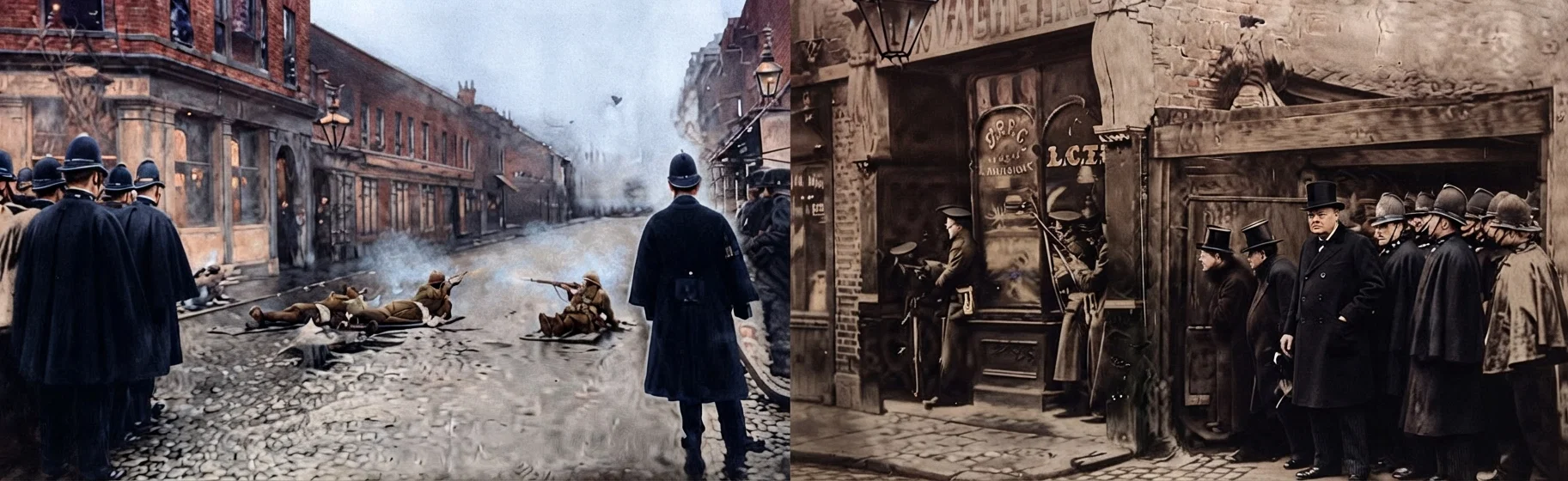
One question which has come very prominently to the front during the past few weeks has been the necessity for putting some more rigorous restrictions upon alien immigration into the United Kingdom. This question has been brought forcibly before the public mind by the extraordinary spectacle of a body of soldiers summoned to the assistance of the police for the capture of desperate foreign criminals armed with powerful weapons. The whole country listened with amazement a few weeks ago to the story of how a company of soldiers poured volley after volley for hours into a private residence, until the house caught fire, and the desperadoes within it perished in the flames. There is sure to arise in the new Parliament an insistent demand that this country shall close its doors against the entrance of dangerous foreign criminals. Unfortunately, such discrimination is bound to work hardship on those who are genuine refugees from religious and civil oppression in other lands. The more objectionable immigrants know how to provide themselves with sufficient means to travel first-class when necessary, and in this way they are able to enter the country with ease.
Loss in Church-Membership
For some years past the statistics of the free churches in this country have shown a continuous decrease. This has been explained by them as due to inflation of their returns at the time of the Welsh revival. It was hoped last year that the losses due to the ebb of the revival would not be felt any further, and that thenceforth there would be a recovery. The present year brings, however, a repetition of the discouraging story. The principal non-conformist bodies all report a diminution in membership.
Fallen Children
A few days ago there appeared in a London paper an appeal from Canon Newbolt, of St. Paul's Cathedral, for funds to provide a home for fallen children between the ages of eight and sixteen. "This," writes the canon, "is a matter on which we would fain keep silent; but in view of the facts which are constantly being brought before the Church Penitentiary Association, it is impossible any longer to do so. More than fifteen hundred cases of children who have become implicated in sin of the grossest kind have been reported to the secretary of that association, and there must be many hundreds more which are never brought to light."
Mrs. Bramwell Booth, of the Salvation Army, bears out the canon's statements. Interviewed the same day that his appeal appeared, she said to a reporter:
"The most startling and most terrible of all the startling and terrible facts connected with this matter is that too often the children are ruined in their own homes, and by those on whose care and protection they have the nearest claim. In the twelve months ending September last we dealt with over three hundred cases of girls under sixteen years of age; some were only ten and eleven years old."
"Much of this evil," says Mrs. Booth, "is due to drunkenness. The man who when sober can be tender and considerate, is cruel when intoxicated, cruel and pitiless. Drink destroys the sense of responsibility in parents. Another fruitful cause is overcrowding. Insufficiency of house room causes terrible degradation."
Mrs. Booth believes that this evil is far more widespread than people in responsible positions have any idea of, not only in England, but in other countries as well. Her own knowledge satisfies her of this.
So painful a disclosure suggests the fearful depths of degradation to which our fallen humanity has sunk, even in lands that lead the world in the paths of civilization and progress. Surely it was none other than an Inspired Word that foretold the conditions of society in these last days, and likened them to the foul corruptions of Sodom and Gomorrah.
The Battle of Stepney in the East End of London. The firing line of the Scots Guards at the left. In the right hand scene the silk-hatted man at the right is the Home Secretary, Winston Spencer Churchill. It was not a noted battle, but it may have notable results in checking criminal anarchists in London.
THE OUTLOOK
By Editor
"Watchman, what of the night?"
China’s Famine Victims
An eye-witness of the sufferings of famine victims in China tells pathetically of children's being sold to buy food. "A Chinese boy of five years will bring the equivalent of $1.50 in American money, or sufficient to feed a man till another crop comes." Little girls sell for twenty-five cents apiece. An official estimate, which is generally believed to be much too low, places the number of deaths from the bubonic plague epidemic at 66,000. One village has been completely depopulated, and the bodies of victims lay half buried in the snow.
"One of the earliest effects of the proposed new postal tax on periodical literature would be a lowering of the wages of the men and women who write for a living," reads an editorial in the San Francisco Examiner. "Magazine managers, in their enforced efforts to decrease the cost of their product, would find their line of least resistance in their account with the writers. The cost of paper and other materials is inelastic. Printers would suffer in the long run, but they can put up a stout resistance through their unions. There is," the writer concludes, "no trust or trades-union in the supply of literature; and the writers would go to the wall."
A bill has passed the Senate to establish a children's bureau under the department of commerce and labor. The chief of the bureau is directed to "investigate and report on all matters pertaining to the welfare of the children and child life, and especially investigate the questions of infantile mortality, birth-rate, physical degeneracy, orphanage, juvenile courts, desertion, dangerous occupations, accidents and diseases of children," etc. More and more are we trending toward centralized and parent government. It is not a healthy sign.
Decisions handed down by the Interstate Commerce Commission prohibit the advance of first-class railroad rates, and a reduction is ordered in second-class rates. It was shown that the railroads are prosperous, and that there is no justification for a rate increase. "The railroads must either obey the law as laid down by the Interstate Commerce Commission, or they must pass into the hands of the United States Government," is the unalterable alternative made by the commission.
The Presbyterian Ministers' Association of New York and vicinity protest "as citizens and patriots against the proposed presentation of a silver service to be placed on the United States battle-ship Utah as the gift of the State of Utah. This service," says the resolution of protest, "bearing the portrait of Brigham Young and a picture of the Mormon Temple at Salt Lake City, will discredit the State making the gift, and be a disgrace to the nation, if it is accepted."
The discovery that skin taken from the human body may be kept in a healthy condition for an indefinite length of time, is of inestimable value to science in the grafting of skin. Thus kept it may be used to replace skin that has been burned or otherwise destroyed, and answer the purpose as well as skin cut fresh from the flesh.
Schwabacher Brothers and the John Vitucci Company, two of the largest wholesale grocery firms of Seattle, Washington, have been accused of violating the national pure food law by sending out cottonseed oil labeled as olive oil. But refined cottonseed oil is said to be just as good and cleaner.
Eight Indians and one member of the State police force were killed in a battle near Tuscarora, Nevada, when the Indians, charged with the murder of four stockmen, were traced and found. In this revival of pioneer scenes, the red men made their last stand with bows and arrows.
Progress of the Culebra cut on the Panama Canal is greatly retarded as the result of a landslide which carried half a million cubic yards of earth into that cut. On account of numerous landslides, plans for the Culebra section may have to be changed.
A cigaret thrown near a can of gasoline caused an explosion and fire at Watsonville, California, that injured two men and destroyed a factory, the loss amounting to $10,000. This is one of the smallest of cigaret losses.
An explosion which set fire to a vessel containing 16,000 cases of oil, resulted in the death of thirty-nine men out of a crew of forty-two. The boat sailed from Paiphong for Touraine in January.
Resolutions have been passed by California Socialists condemning a bill in the State legislature, the alleged object of which is the introduction of compulsory military training in the public schools.
A proposed State law of Nevada governing capital punishment gives convicted murderers the choice of being hanged, shot, or taking poison.
The cost of taking the recent United States census is $14,500,000. The field work in 1910 was 13½ per cent higher than in 1900.
A fire believed to be of incendiary origin has left the city of Aux Cayes, Hayti, in ruins, and 25,000 people homeless.
Degrees of Grief
DR. TALMAGE, the celebrated Brooklyn clergyman, was riding once in a railroad coach, soon after the decease of a favorite son. His grief was constant and acute, and he could not feel that any one had ever suffered as he was suffering.
In a seat near him sat a gentleman who, he thought, possessed one of the most cheerful faces he had ever seen. "How happy that man is compared with me!" he thought. "I will get into conversation with him. Perhaps he may console me, or cheer me up a13little."
The dialog ran upon general subjects for a little while, and then turned upon Dr. Talmage's great loss. "I can not help envying you," said the preacher. "You seem, from your appearance, as if you had not a trouble in the world."
The other gentleman looked grave, and a spasm of grief went over his countenance. "I never saw a sadder face, for the moment," said Talmage, in relating this incident to the writer.
"My dear sir," he inquired, "will you tell me where you are going?"
"Why," replied Talmage, "home, to Brooklyn, New York. I get there this evening, if all goes well."
"I suppose to a wife — perhaps a mother — a live son — a daughter or two."
"O, yes! I have all those awaiting me."
"Now I will tell you where I am going. All my family are dead but one, and that is my wife; and I am making my regular weekly visit to her, at an asylum. She is hopelessly insane. But God has left me my life, my honor, and my faculties; and I am trying to keep patient and cheerful, with the hope of meeting them all again in a better world, by and by."
Talmage rose, and took the stranger by both hands. "I surrender!" he exclaimed. "My sorrow is as nothing, compared with yours. I have learned a lesson, and hope God will help me to profit by it."—Everywhere.
Influence
By Hart Hall
A BEAUTIFUL ship swings from her moorings, her colors streaming from the masthead; passengers line the railing, waving adieu to friends; bells clang and clang in the engine room; the water begins to boil and churn at the stern, leaving in her wake a long, broad, silvery path. She is gone to sea, with a great cargo and many passengers.
Days pass, and far from sight of land the good ship plows through the deep. The pilot holds her — so he thinks — to one of ocean's trackless paths; but suddenly through the darkness there loom high the rocky ledges of an unknown shore.
Too late the bells clang reverse.
Too late spins the pilot wheel.
The ship is lost! What was the cause?
The carpenter, in making repairs, had driven a nail too close to the compass. The nail's influence would have been unnoticed by other nails or material; but the delicate compass needle was drawn away, and the ship surged ahead on a wrong course — because of the influence of a nail!
Is there anything that does not exert an influence? Note how the sun draws to itself the faces of the flowers, the waters of the ocean. Metals attract other metals. The law of attraction is universal.
Cast a stone into the lake and watch the ripples that widen and widen till they reach the shore. So the influence of our lives widens and still widens, tho we are cast without our choosing into the great sea of life.
Imperceptibly, perhaps, to us, we cast upon our pathway light or shade. Like the planets that deviate somewhat from their courses through the influence of other planets, so our lives influence other lives that we meet as —
Ships that pass in the night, And speak to each other in passing.
The Bible says, "None of us liveth to himself, and no man dieth to himself." What we say or do or are reacts upon others to greater or less extent, influencing them for good or ill. Legions of tragedies are occurring daily that will all be traced by an unerring finger, in the day of final reckoning, to somebody's influence.
Shall we see that ours is for good?
HART HALL.
Los Angeles, California.
A "Slave"
WHAT a shame for a big, strong man to be such a slave to an invalid wife!'
The words were spoken in a disgusted tone by a girl in the saloon of an ocean steamer. The couple on whom she made her caustic criticism were slowly descending the stairs. The woman was pale and haggard. Her hands were twisted by pain, and her voice had the pathos of suffering. She was helped from stateroom to steamer chair and back every day, and all day long her handsome husband attended upon her. He adjusted her wraps, saw that her food was prepared for her helpless hands, read to her hour after hour, or sat quietly with his hand resting near hers, and his eyes watching her, even when they seemed fixed on the horizon.
Sympathetic spectators had pitied the man even while they admired his devotion, and the girl had but put into words the popular irritation when she called him "a slave to an invalid wife."
She spoke in a louder tone than she meant, and the two persons interested in her speech heard her clearly. An hour later the man slipped into a deck chair beside his critic, and said:
"I think your remark, which I accidentally overheard, justifies me in telling you a little about my 'slavery,' as you call it. It began thirty years ago, when my young bride nursed me through yellow fever — alone — because every one else had fled in panic.
"She did not have a sound hour's sleep for three weeks. Most of the time I was violently delirious, and how she managed to control me was a wonder. We were quarantined three miles from a town, and she cooked for me, and tended me, and brought me safely out of the loathsome disease before she fell ill with it herself.
"After she recovered she pulled me through a worse trial. I was in business with a man who proved a scoundrel, and for three years everybody except my wife believed that his villainy was mine. When I lost money and position she did herself the work of three women. When children came, she contrived that they should be noticeable for their gentle manners and thoughtfulness, altho they wore poor clothes.
"When sickness and death visited our home, it was her courage and wisdom which kept the sordid details of the trouble away from the rest of us, and left us only the ideal sorrow which lifts life toward heaven.
"For twenty-five years all this was her task. I tried to save her from strain when I could, but so great a spirit could not spare herself. Five years ago her health gave way. She will never be well again. She has given her life for mine.
"My 'slavery,' thank God, is the slavery of whole-hearted devotion to one of the noblest women ever given to earth. I love her and delight in her more than the day I married her. Her courage and humor and charm are unconquerable by pain.
"My dear young woman, you may well pray every night that you may some day be so lovely a tyrant, and that you may command so happy a 'slave'!"
So the gay young girl learned with some wholesome humiliation the frequent human lesson of the folly of passing hasty judgments.— Youth's Companion.
THE HOME
Who Is the Strong?
By Ella Wheeler Wilcox
WHO is the strong? Not he who puts to test
His sinews with the strong and proves the best;
But he who dwells where weaklings congregate,
And never lets his splendid strength abate.
Who is the good? Not he who walks each day
With moral men along the high, clean way;
But he who jostles gilded sin and shame,
Yet will not sell his honor or his name.
Who is the wise? Not he who from the start
With Wisdom's followers has taken part;
But he who looks in Folly's tempting eyes,
And turns away, perceiving her disguise.
Who is serene? Not he who flees his kind,
Some mountain fastness or some cave to find;
But he who in the city's noisiest scene
Keeps calm within — he only is serene.
— Ella Wheeler Wilcox.
"You Could Have Said 'O!'"
A LITTLE boy showed his hurt finger to his father.
"Well, I can not help it," said the busy man.
"Yes, you could; you could have said 'O!'" replied the grieved boy.
"Sympathy is in itself a help," says one writer, "and sympathy prompts to an expression of itself in help. If in our hearts we feel with another, we want to share his sorrows, and enter into his joys. And if it be known by another,—as it will be,—that we have real sympathy with him, he will be helped and cheered thereby, and he will know he can call upon us for any needed expression of our sympathy in practical help. Sympathy is the outcome of a loving heart. It is the expression of love for Christ, and of love for those who are dear to Him. There are calls for sympathy in every sphere in which we are placed in the providence of God." Let us bear "one another's burdens, and so fulfil the law of Christ." Let us "rejoice with them that do rejoice, and weep with them that weep."— The Little Christian.
The Crown of Character
By Henry Van Dyke
THERE is a loftier ambition than merely to stand high in the world. It is to stoop down and lift mankind a little higher. There is a nobler character than that which is merely incorruptible. It is the character which acts as an antidote and preventive of corruption. Fearlessly to speak the words which bear witness to righteousness and truth and purity; patiently to do the deeds which strengthen virtue and kindle hope in your fellow men; generously to lend a hand to those who are trying to climb upward; faithfully to give your support and your personal help to the efforts which are making to elevate and purify the social life of the world — that is what it means to have salt in your character.—Henry Van Dyke.
A Logical Result
By The Presbyterian
A CERTAIN mother in one of our small cities was very fond of playing "progressive euchre." One evening she received a fine silver cup for being the most successful player in a group of society friends. She was much delighted with her success, and, on showing it to her family the next morning, her son, in his early "teens," said, "Huh! I can beat that, for I made ten dollars at the pool-table last night!" Immediately the eyes of the mother were opened in more senses than one, for, in the first place, she had no idea that her son had thus been spending his time, and, in the next place, partners in sin, how could she condemn him? It taught her a lesson once for all.—The Presbyterian.
Questions and Answers
By Editor
A NEW BOOK
It isn't very often that we give something for nothing, but in order to increase greatly the circulation and usefulness of the weekly SIGNS OF THE TIMES we are actually offering to give a copy of this new book absolutely free. The book contains 256 pages and is handsomely bound in cloth. It answers hundreds of those questions which have perplexed Sabbath-school teachers, and other exponents and students of the Word.
Here is one of the Contents pages
viii
### CONTENTS
Meat-Eating and Romans 14; 202-Tobacco; 203-Remedy for Tobacco.
SECTION XVI.—SATAN - - - - 201-206
204-Lucifer and Babylon; 205-Creation and Satan; 206-Can Satan Cure Sickness? 207-The Unclean Spirit; 208-Is the Devil a Separate Entity or a Principle?
SECTION XVII.—TITHING - - - - 207-212
209-The Tithing System; 210-The Tithe and Debt; 211-A Question of Tithe; 212-Tithing Profits; 213-Tithes and Increase; 214-Tithing Teacher's Income; 215-Bazaars, Fairs, for Raising Money.
SECTION XVIII.—SEVENTH-DAY ADVENTISTS - - - - 213-215
216-What of Seventh-Day Adventists? 217-"Hard Nuts for Seventh-Dayists;" 218-What Is Required? 1 Cor. 10:31.
SECTION XIX.—MISCELLANEOUS - - - 216-248
219-Two Adams or One? 220-The Dominion to Whom? 221-The Garden of Eden; 222-"Thou Shalt Rule;" 223-Children of Ham; 224-Cain's Wife; 225-Origin of Races; 226-What Beast? 227-Pharaoh's Free Will; 228-Time of Egyptian Plagues; 229-Borrowing of the Egyptians; 230-Seeing God Face to Face; 231-Cruelty to Children, Num. 31: 13-18; 2 Kings 10; 232-Instruments of God; 233-The Matter of Usury; 234-Jephthah's Daughter; 235-Does God Cause Earthquakes? 236-"Serve with Thy Sins;" 237-Increase of Light; 238-Child and Sinner of a Hundred Years, Isa. 65:20; 239-Taking an Oath; 240-A False Prophecy, Micah 4:5; 241-"On" or "to," in the Lord's Prayer; 242-False Religion; 243-Old Garments and Wine-Skins; 244-Smoking Flax; 245-"It Is a Gift;" 246-Take Up Serpents; 247-"Hate" and "Love;" 248-The Sin "Winked At;" 249-Mammon of Unrighteousness; 250-Who Judges? John 5:22; 251-Women in the Church; 252-Who Are the Branches? 253-"Every Eye Shall See Him;" 254-The Whole Family in Heaven and Earth; 255-"I" or "He," Rev. 13:1; 256-Priests in the New Earth; 257-The Bottomless Pit; 258-What Is the Meaning of Old Style and New Style? 259-Old and New Dispensations; 260-The Meaning of "Jew;" 261-Can a Child of God Be Lost? 262-Discoveries of Geology; 263-Will Solomon Be Saved? 264-The Holy Shekinah; 265-"God" in the Plural; 266-Was Peter a Catholic? 267-The Lord's Prayer; 268-Life-Insurance; 269-Why Men Shave; 270-The Morning of the Resurrection.
HOW OBTAINED
"Questions and Answers" will be sent free (postage prepaid) to new and old subscribers who subscribe to the weekly SIGNS OF THE TIMES for two years at the regular subscription price of $1.75 a year; or we will accept two subscriptions at $1.75 each, provided one or both are new subscribers.
The only other way in which the book may be obtained is with single yearly subscriptions to this same journal at $2.00.
If your subscription does not expire for some months, we will accept your renewal now, add the time to the unexpired subscription, and send you the book at once.
Some idea of our liberality may be seen when we explain that the book if sold alone would cost $1.25. We will not sell it at any price, however, as it was published exclusively as a premium to the SIGNS OF THE TIMES. Don't ask us to give a copy at club rates or on short-time subscriptions. We could not afford to do so.
Send orders through your tract society, taking care to make it clear that you wish the SIGNS premium "Questions and Answers."
Not against the Truth, but for the Truth
THE apostle Paul tells us in 2 Cor. 13:8 that "we can do nothing against the truth, but for the truth." God makes even the wrath of man to praise Him. At another time the apostle wrote his brethren at Philippi, who were cast down because of Paul's trials and imprisonments. "But I would ye should understand, brethren, that the things which happened unto me have fallen out rather unto the furtherance of the Gospel." See Phil. 1: 12-18. Whether men accepted or resisted the Gospel of God, all efforts were turned to the spreading of the truth. In that he rejoiced.
The following incidents from Chili, given by the president of that conference, illustrate the above scriptures:
At the time of the Chili presidential election, the elder of one of our churches and his father were named by the government to take charge of the ballots. But the election took place on the Sabbath day, and therefore the brethren refused to serve. They were indicted, and gave their testimony for the truth in court. No sentence of punishment was pronounced against the brethren for not appearing to serve the government on the presidential election day, and some prominent men had opportunity to hear the truth. A general good impression was made. As the result the work is moving forward. Sixteen souls were added to the church there by baptism this year, for which we praise the Lord.
In the country near Temuco a certain monk, who made regular visits there, said that he would like to have a debate with one of our ministers, and if he were beaten, he would turn Protestant. Several families were interested, and among these the family in whose house the priest generally held his services. We invited one of our ministers to go there and meet the priest. When the priest learned that our people were there, he arranged his meeting in another house. The brethren went there also, and after a few moments, a woman, with quite a few joining her, began a great noise about the presence of the brethren. The priest finally invited the brethren to explain the reason of their presence. They stated that they had come to be instructed about several fundamental points of their faith. The priest then asked them why they were making such a noise and disturbance in his meeting. They told him that his own members were making the noise, and that he should ask them to be quiet. He did so, and said that at the close of his meeting he would instruct them privately, and not before all the people.
The brethren finally went out of the meeting and met a number of Catholics outside. These were expressing their discontent because of the presence of our brethren. The brethren felt that they might be violently attacked if they should remain longer, so concluded to leave one by one, and not provoke much attention. Two, however, remained. Questions and answers were exchanged until each of our brethren was served with a severe blow with the hand, on the cheek. Neither of them retaliated, and so did not suffer further violence.
As a result, many of the Catholics came to our meeting and listened to the truth with interest, several families accepted it, with many others interested. We expect to see the work grow there much faster than before. The patience of our brethren who received the blows, did much to increase the interest in the truth at this place.