The Youth’s Instructor, Vol. LIII, No. 7

Seeking the Light

The Youth’s Instructor

February 14, 1905

Review and Herald Publishing Assn. · Washington, D. C. · February 14, 1905

Seeking the Light
LIFE acts only in the light. “Light is not simply a stimulus under which the life acts; the plant feeds upon the light, and completely appropriates it. The luminous waves which beat upon the green surface of the leaf are there arrested;” and their moving power is so completely absorbed that the reflected rays will not even affect the exquisitely sensitive plate of the photographer.” The plant lives and feeds upon the light; it takes the light into its inner self, and converts the energy of the light into the energy of life and growth. In the same manner, spiritual light is not a mere influence under which spiritual life acts; it is a condition of life; it is appropriated into spiritual lives; it is to be lived and fed upon. It is thus converted into the energy of spiritual life and growth.
But remember that life acts only in the sunlight. Have you ever noticed the potato plant? If it grows in a darkened cellar, it is a weakly, white, frail thing, with no strength or vigor; it has had but little light, so it has but little life. But when it grows out in the garden plot, it has a far different appearance. It is then one of the most vigorous and thrifty of our plants; it has plenty of life, for it has had abundance of light. Fulness of life comes only with fulness of light.
Are you dwelling in the sunshine? Are you basking in the sunlight? “Unto you that fear my name shall the Sun of Righteousness arise.” Our “God is a sun.” Let us not try to live in the cellar, but rather in the light, where we can grow and thrive. The church is filled with weak plants that have grown in the shade, the basement, and the cellar.
Is this because there is not enough light?—Of course not; there is fulness of light out in the open field. Abundance of light is beating down there upon the waving heads of wheat. There, too, the grain is ripe for the harvest. In the field you will find light; in the field you will find labor: light and labor, these are life. Yes, light is the condition of life; for light acts only in the light. Let your soul, then, bathe in the light of God; let your soul drink it in. God sheds every ray for the life of your soul. If you shut the light away, you shut out that much of life and God. There is enough of darkness at night; let us not make any darkness of our own. Remember you can have fulness of life only by dwelling in abundance of light. Do not attempt to be a basement Christian; do not try to be a cellar Christian; do not try to grow in somebody’s shade. Grow in God’s sunlight. So shall you be a living Christian. “Ye are all children of the light, and the children of the day; we are not of the night, nor of darkness.” Can it be truly said of us that we are not children of the night, nor of darkness? Do we ever seek darkness? Do we love, even for a moment, to dwell in the blackness? It is the baneful plants that grow in the darkness. It is the fermentations of death and decay that thrive and increase in the absence of the light.
Some of the most deadly germs are speedily killed when exposed to direct sunlight. Koch says that the “tubercle bacillus is killed by the action of direct sunlight, in a time varying from a few minutes to several hours, depending upon the thickness of the layer exposed.”
The only hope of the consumptive is abundance of pure air and sunlight. The admonition to the consumptive is the admonition to the Christian,—Keep out of the shade and the darkness; live in the sunshine. “Live not in the shadow” even of the cross of Christ; “but on the sunny side of the cross, where the Sun of Righteousness may shine into your heart.”
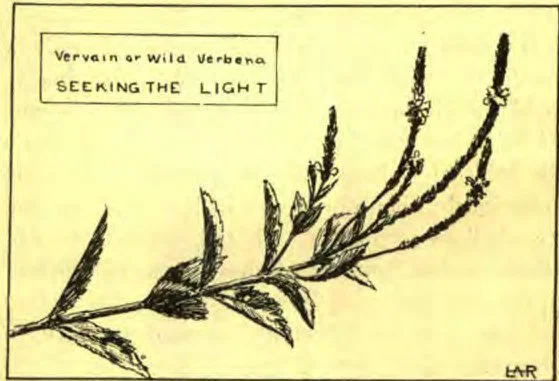
O, how the plants condemn our ways of living! We set our potted plant in the window, and, in a few hours, we find its leaves and blossoms all turned toward the light. It seeks the light; for light is necessary for its very existence. Some of our common weeds are very sensitive to the light. Late one afternoon I brought home a downy vervain, and, to keep its roots moist, threw it carelessly into the sink. Although the plant lay prostrate, it could lift its blossoms to the light; in a very short time the flower-stalk was bent at a right angle with the plant, thus lifting the flower upward as far as possible to receive every living ray of light.
Often I have found this same plant, lying prostrate on the ground, where it had been trampled by unheeding feet, and always the flower-stalk is bent upward to lift the blossom toward the light. The picture is of one of these plants which, growing on the edge of a bank, had been thrown over from its original erect position. True to its nature, its blossoms are lifted to the sky. There is a lowly little weed, called the mallow, which ordinarily closely hugs the earth. It lies so close to the ground that a lawn mower will scarcely cut it. And yet, when it happens to grow where the grass and weeds are uncut, it will run long stems up out of the rank weeds, thus carrying its foliage into the sunlight. The yellow sorrel, the clovers, and many other plants will do the same.
How fully sin has perverted our natures that we act so differently with reference to the light of heaven! The plant will violate every law of its being, before it will refuse to seek the light. It must have light, and every influence of its life works to this end. L. A. REED.
Vervain or wild Verbena
SEEKING THE LIGHT
Vervain or wild Verbena SEEKING THE LIGHT

The Spirit of Progress

“Open thy bosom, set thy wishes wide, And let in manhood; let in happiness; Admit the boundless theater of thought From nothing up to God — which makes a man.”
True manhood and true womanhood, true happiness and success at last, surely come as a result of thought, but it is the cheerful thought of a progressive mind that accomplishes most in the world; never the drifter or idle dreamer.
If there is a divine spark in our beings, it must be the longing for progress, for something better; and the progressive man is so busy with the duties of the hour, and the opportunities of the future that he has no time to waste looking at the dead past, except to gain wisdom for his future life.
If we are to advance we must keep our faces forward, always looking toward our ideal, which should be a noble character, and a position to labor where we are the most needed. The world’s need is our opportunity, so where exists the greatest need, there are found the greatest opportunities. Never were there better openings for entering the sunshine business than now, when everybody is bending every energy to the task of making money. Happy smiles and cheery words are welcome anywhere, and should be the passport of every Christian.
We young people who love truth better than gold can not afford to let our nobler impulses be choked by greed; and we should scorn even the thought of measuring a man’s success by his income. There is a better measure of success,—“Unto a perfect man, unto the measure of the stature of the fulness of Christ,” who went about doing good. Whatever work we hope to do, whether it be that of a farmer, teacher, minister, or physician, our chief object should be to do good.
Our usefulness in the world will be aided greatly by a cultivated mind and courteous manners, and these are for all. A former mayor of New York City always carried in his pocket a copy of maxims, and among them was one which, if followed, must result in culture, “If your hands can not be usefully employed, attend to the cultivation of your mind.” That is surely the essence of the spirit of progress.
We hear it said often that a man is only a bundle of habits, and that in youth is the time to mold the character. This must be true; so now while habits are easily formed, let us all form the habit of making daily progress, and of living victoriously, then our lives will be a blessing, and we shall be crowned with the highest success, which is the “stature of the fulness of Christ.”
The goal lies ever onward, and the spirit that reaches it is the cheerful, courageous spirit of progress.
“If to-day you’ve made some progress, Do not tire. Sit not down! Upon the morrow Step up higher! “If to-day you’ve felt a soul growth, Then aspire. Loftier ideals still await thee, Step up higher. “If you’ve seen the mountain summits Tipped with fire, Beyond are scenes aflame with glory, Step up higher. “If you’ve heard the Master’s whisper, Then draw nigher; There is offered life to him who Steps up higher.”
J. W. PEABODY.

The Christian's Library

The Bible

It would seem idle for me to recommend the Bible for study. We say we all recognize its importance, but certainly we do not appreciate it, and we never can appreciate it until we study it so that we love it. Then we shall begin to see some of the benefits. I am convinced, however, that one reason we do not study it more is because story reading has spoiled our power of appreciation. We want to read something that tells us the whole thing itself, and thereby we miss the exercise of a most precious faculty, the faculty of imagination. What wonders can not our fancies conjure (fancies, too, which will be realized in exact or better form), as we read the meager but grand revelations of our future new earth home? Do you ever walk with Johnathan and David? Did you ever go down into the slimy hole in the courtyard with Jeremiah? Have you rocked on the sunny waters of Galilee while you heard, “Behold, a sower went forth to sow”? Or have you merely read the words, perhaps to enable you to answer certain questions, and put away only a verbal memory? Try a new way of reading; take time, and live what you read. The Bible will be a new book, and you will be a new person.

Hymns

Some of the best literature in the English language is found in our hymns. They hold a treasure which often we miss because we know only the tunes to which they are sung; we suppose the hymn belongs to the tune. We need to learn hymns as literary productions, so that we shall not have to hold our song-book when we praise God with music, and so that the blessed influence of these musical prayers may often be with us when we are alone. More than one poet has been made through the influence of hymns. I fear, sometimes, that the knowledge of the best hymns which constitute true literature, will be lost among us as Adventist young people; I find so many who are wholly ignorant of the standard hymns which have voiced the thoughts of Christians for decades and centuries. We would do well to come back to the best collection of hymns we have, the “Seventh-day Adventist Hymn and Tune Book,” and use it more in praise than we do. Our taste would be much better trained, and by such a training we would be saved the humiliation which sometime, as workers, we shall have, if, when in the presence of other Christian people, we know only the tinkling rhymes and rag-time tunes of modern versifying commercialists. Certainly there are hymns of recent composition which deserve to rank high among hymns of all times, but they are, in the common collections, mixed with a vast majority of mediocre and despicable rhymes, such as the great hymns of past years have disengaged from themselves and left far behind to die. A careful study of hymnology and of hymn writers will be helpful in forming a good taste.

Denominational Literature

We should be well acquainted with the works of most of our own writers; and this we may well do, not merely to make ourselves familiar with present-day truths which will stir us to action, but as well for the culture in language which they give. Some of these will rank high in literature, as compared with the productions of the masters, and in the style of all our most important works there is a dignity and a poise such as only the utterance of truth can give, and these works can well be set as models for the prospective writer or speaker. While it may not be in good taste in such an article as this, to discuss critically the works of living authors, it is not out of place to mention as models of rhetoric in varying degree, such works as “The Desire of Ages,” “Education,” “Christ's Object Lessons,” “Thoughts on Daniel and the Revelation,” “Great Controversy,” and “Thoughts from the Mount of Blessing.” The number of our works which might be added make a very respectable list of books which should not be left to the last in the scheme of reading.

History

It is commonly felt that the reading of history to any extent is proper and good. That is to be challenged. Earth's history is but an account of the struggle of evil against good. Any history which deals wholly with the internal paroxysms of evil, the wars, the conspiracies, the treacheries of wicked men, with no apparent relation to the progress of God's cause, is the conveyor of more evil than good. It is better for us to stay entrenched within the camp of God, and study history only as it relates to the assaults of evil upon those ramparts. That does not bar us from any field of history, but it does protect us from some phases of history study, and from some books upon history.
Biographies of such men as Columba, Wycliffe, Luther, Penn, Howard, Livingstone, Miller, Mann, and Lincoln, and histories of such peoples as the Waldenses, the Lollards, the Dutch Protestants, the Puritans, and the Moravians, should take the place of indiscriminate perusal of the deeds of ambitious kings and priests and bloody captains. Not that general history shall not be known, but that it shall be studied from the right point of view. There is room for the production of works of such a nature which shall be at once virtuous and entertaining.
A similar view should be taken of works of travel. Special attention should be given to such works as have connection with the cause of God. The great travelers are not Marco Polo, Captain Cook, Fremont, and Peary; they are Livingstone, Howard, Williams, Robinson, Barrow, Wolfe. Studies of foreign countries should be through the reports of those who have been urged on by the claims of God upon them.

Science

So wide a field is presented in this that a few words could lay no proper bounds. Science of the hand, the eye, the machine, the instrument,—every phase is represented by a multitude of books. Let it suffice to say that those which will supply the needs of a well-defined purpose should be carefully selected and studied. From among the many popular, well-written books upon various handicrafts, I would select the one that especially interests me for the time, the instructions of which I can put into practise. Some books of an entertaining nature upon natural history may help me to learn for myself in the fields and woods, but this subject is being drowned by a flood of books of an unworthy character. Better to take a few suggestions, and let nature be the text-book, and God the teacher. Most other branches of science, perhaps, belong to the school, where a wise teacher should be a good counselor.
Let us remember, finally, that our time is not to be given wholly, nor half, to reading. To put into practise a little which we have learned, thereby adding to the talent bestowed five other talents, is to use wisely and justly the power of acquirement. The purpose of our learning is not to absorb as a sponge, but to take, convert, and give, as a tree. We have a little space in which to learn our A B C's before we enter the higher school a few days hence. He who is wise will not dispute the lesson set; he who is diligent will not idle away his time upon frivolities, he who is persevering will win entrance, and take many with him.
A. W. SPAULDING.
(Concluded)

My Library

THE lords of the lyre and the laurel Look silently down from my shelves, And the proud theologians that quarrel Have written their books like themselves; They speak of their foes with aspersions, For prejudice hinders their view,— I'm weary of their groundless assertions, I long for a volume that's true.
My pen has been trailing here idle, While my eyes wandered over each book, Now I take up my well-beloved Bible, And in its dear pages I look; I find there a rest for the weary, A solace for trouble and care, A home full of love for the dreary, Where the mansions await over there.
I read of a life that is endless, Where time lays his hand not on youth, And though we were lonely and friendless, We may walk in the sunshine of truth. I read of a happy awakening, In the day when the white robes are given, And the righteous, their earth-life forsaking, Shall enter the glories of heaven.
I read of a city of beauty, All radiant with jasper and gold. And for those who are faithful to duty, Their recompense can not be told. My pen has been lying here idle, And the shadows of night darker fall, But I say, as I lay down the Bible, Thank God, O thank God, for it all.
L. D. SANTEE.

Time Is the Stuff of Life

Dost thou love life? Then waste not time; for time is the stuff that life is made of.—Benjamin Franklin.

Russia: Its Youth and Its Life.

Russia is the land of paradoxes and contrasts. It is at once the most autocratic and the most democratic of European nations. It presents the most extreme example of imperial power of national affairs and the most extreme type of popular sovereignty in local affairs. It exhibits at the same time the most stately magnificence and the most abject poverty. It has the most splendid court and the most servile people. It shows the richest culture and the deepest debasement. It offers much that is singularly attractive and much that is singularly repulsive.
St. Petersburg is one of the imposing capitals of the world. It was built by Peter the Great in the midst of a swamp; now it ranks among the marvels of modern development. That wonderful Titanic genius wanted a window to look out on Europe. He saw the naval power of the Western nations, and he wanted to be on the water.
He chose the miasmatic delta of the Neva, and although his capital is younger than Boston and Philadelphia, it is one of the greatest cities of the world. With its wide streets, its stately palaces, its grand churches, its cosmopolitan people, and its dashing life, it has a distinct character of its own.
The Neva is the noblest river which any capital can boast, and there is no such open, attractive place of residence in any great city as on the magnificent quay which stretches for three miles along its course.
The scene on the streets in the characteristic winter life is one of great animation. The Nevskiy Prospekt, which is the Broadway of St. Petersburg, is thronged with a motley crowd of pedestrians and sledges.
There is the prince with his rich sables and the muzhik with his unsavory sheepskin. There is the Turk, the Armenian, and the Persian. There is the Great Russian with his fair, full beard, and the Little Russian of a much darker type. The thousands of diminutive droshkies with their little, hardy, scraggy Russian horses, and the unkempt istvostchiks in their heavy fur caps and long blue caftans; the numerous private equipages with their fat, padded drivers in curious, velvet pincushion caps, and their shapely black Orloffs as swift as the wind—all unite to make the spectacle singularly picturesque and spirited.

Outside the Cities

The moment one passes from the city to the country, the whole impression completely changes. Everything becomes dreary and dismal. In England one sees a pretty country life, as in our own land—hawthorn hedges, radiant flowers, attractive homes. In France and Germany there are smiling rural scenes. But in Russia, outside of the cities, everything is crude and dull.
Among the peasantry life is of the most simple and primitive character. Their homes are log houses of a single room. The great brick oven in the center gives them heat, and the loft above it is their bed.
They live from hand to mouth. Their only capital is represented by their cheap buildings and their few farm animals. Their land is owned by the commune, and they are only tenants, liable to be dispossessed at any time, and certain to be changed at intervals of a few years. They have few schools, and none of much account.
The orthodox church in the form of the Greek cross, with its green pineapple dome, is the one picturesque object amid all the dreary surroundings. The priest is the one person of authority, and he is oftentimes as much derided as respected; for, with all their reverence for religion, the Russians level many jests at its representatives.
In these rural communities the story of one year is very much the story of every year. The people know little of what is going on in the world. They know little even of the affairs of their own government. Their interest and their intelligence are limited to their own immediate concerns.
In these concerns the local communities are supreme, and they meet together in democratic fashion on the public green and regulate them. There are frequent fête days and harvest-feasts, when the peasants get together for their cheerless amusement.
Their two resources are music, and vodka, a poor kind of whisky—the former a national blessing and the latter a national bane. The national musical instrument is the accordion, and among the peasantry everybody plays it.

Contrasts

During the long winter evenings the women and girls spin, while the boys employ themselves at wickerwork or in making rude shoes of bark or something of that sort. Their clothes are of the simplest kind. In winter the greasy sheep-skin over their homespun suit gives them warmth, and in summer the red blouse is the characteristic peasant garment.
When we turn again to the upper classes, everything is different. We find education, culture, gay life, prodigal expenditure, brilliant display, and large achievement.
The contrasts of Russia are strikingly illustrated in the system of education. There are splendid universities for the gentry, and practically no common schools for the people. The population of the United States is eighty millions, with more than eighteen million children enrolled in the public and private schools. The population of the Russian empire is one hundred and forty millions, with less than five millions on the school rolls.
The youth of the upper classes are prepared for the universities by private instruction. Their first necessity is to learn the modern languages. The Russian language is bounded by the Russian frontier, and if the Russians desire to travel or to know other literatures, they must learn other tongues.
Their own, with its thirty-six letters, more hieroglyphic than the Greek alphabet, is so difficult that the other principal languages seem easy in comparison.
Their general education in literature and science is not equal to that of our American boys and girls. From the nature of their institutions they have no such interest in public affairs. But in that social accomplishment which comes with travel and good breeding and excellent manners they are very superior. With this polished exterior they unite many vices. They are spendthrifts.

“Where Do You Serve?”

They all seek position in the army or in the civil service. The broad and varied field of work which invites the ambition of the American youth is not, with their false ideas, open to them. When a young man is presented, the first question is: “Where do you serve?”
If he answers, “Nowhere,” it is accepted as evidence that there is something wrong with him.
The two crack regiments of St. Petersburg, the Chevalier Guards and the Guards a Cheval, with their glittering helmets and their showy uniforms,—one of them the special regiment of the emperor and the other that of the empress,—are the objects of a great struggle on the part of all young men of position, and they are the centers of free life and lavish expenditure.
The Russian court is the most brilliant in the world. Strangely enough, it has a higher refinement of art in its ceremonials and a more exquisite courtesy than is possessed by the English court.
There is a nobility in Russia, but no aristocracy in the sense of the English aristocracy. The only strictly Russian title is that of prince, and that comes from the Tartar chieftains.
Peter the Great, who brought in so many notions from western Europe, created a few counts and barons, but they are a graft, and not indigenous. The possession of a title does not necessarily imply wealth or even position. Indeed, not a few of the titled families are utterly impoverished, and there are said to be princes among the droshky-drivers of St. Petersburg.

The Tribune of the People

It is an interesting circumstance that in this most autocratic of governments birth and blood are by no means the passports to place and influence. Several of the chief ministers of the empire are men who sprang from the ranks of the people. The late minister of finance, Witte, now president of the council, was not many years ago a subordinate railroad official, and rose by sheer force of ability. The emperor summons whoever he thinks will best serve him and the empire.
The Russians have great faith in their destiny. They nourish and cultivate the national spirit. Theirs is the patriarchal system. They believe in two things—the church and the czar. Under their theory the czar is the tribune of the people. The first of the Romanofs was elected, and he and his successors are regarded as the representatives of the masses.
Among the university students there is much ferment and agitation. They read revolutionary and socialistic literature, and imbibe its teachings to a considerable extent. But this spirit does not yet prevail among the mass of the people.
The resident of St. Petersburg, even as late as a few months ago, saw scarcely any signs of unrest. He saw the same agencies of vigilance and repression as at Berlin and Vienna, but nothing more. He saw the emperor driving about with full freedom. He saw a people apparently contented, tranquil, and happy. And he could not help wondering how long these conditions would continue, and what was to be the destiny of this mighty empire. To-day he would find this last question still more difficult to answer.—Honorable Charles Emory Smith, in Youth’s Companion.

Selections from Pope’s Essay on Criticism

BE thou the first true merit to defend. His praise is lost who stays till all commend.
IN all you speak, let truth and candor shine.
MEN must be taught as if you taught them not.
A VILE conceit in pompous words expressed, Is like a clown in regal purple dressed.
TRUST not yourself; but your defects to know, Make use of every friend—and every foe.
IT is with our judgments as with our watches, none Go just alike, but each believes his own.

A Noble Art School

REMEMBER it is not so much in buying pictures, as in being pictures, that you can encourage a noble school. The best patronage of art is not that which seeks for the pleasure of sentiment in a vague ideality, nor for beauty of form in marble image; but that which educates your children into living heroes, and binds down the flights and the fondnesses of the heart into practical duty and faithful devotion.—John Ruskin.

Be Strong: A Call to Work and Struggle

“Be strong! We are not here to play, to dream, to drift. We have work to do, and loads to lift, Shun not the struggle,— face it; ’tis God’s gift.”

THE WEEKLY STUDY

Paul and Apollos

OPENING EXERCISES.
SCRIPTURE FOR STUDY: Acts 18:24-28; 1 Cor. 1:10-17.
REFERENCE STUDY: “Sketches from the Life of Paul,” pages 119-128.
SCRIPTURE FOR PERSONAL STUDY: 1 Cor. 1:18-31.
TOPICS FOR STUDY:—
Apollos.
Birthplace.
Mighty in Scripture.
Eloquent.
Learned.
Fervent in spirit.
His instructors.
Baptism.
Encouraged.
Disciples of Paul.
Disciples of Apollos.

Notes

Apollos was born at Alexandria, a city of Africa, founded by Alexander the Great, 332 B. C., and of great educational importance. It was here that the Septuagint version of the Old Testament was made.
Notice that although Apollos was a man of great learning and eloquence, and mighty in the Scriptures, he was not above receiving light from humble tent-makers. His example in this respect is worthy of imitation. In lowliness of heart we should be ever willing to receive truth, no matter how humble and obscure the instrument may be that brings it to us.
“Apollos, having become better acquainted [through the instruction of Aquila and Priscilla] with the doctrine of Christ, now felt anxious to visit Corinth, and the Ephesian brethren wrote to the Corinthians to receive him as a teacher in full harmony with the church of Christ. He accordingly went to Corinth, and labored with the very Jews who had rejected the truth as preached to them by Paul. . . . Thus Paul planted the seed of truth, and Apollos watered it.”
“His success in preaching the gospel led some of the church to exalt his labors above those of Paul, while he himself was working in harmony with Paul for the advancement of the cause. This rival spirit threatened to greatly hinder the progress of truth. Paul had purposely presented the gospel to the Corinthians in its simplicity. Disappointed with the results of his labors at Athens, where he had brought his learning and eloquence to bear upon his hearers, he determined to pursue an entirely different course at Corinth. He presented there the plain, simple truth, unadorned with worldly wisdom, and studiously dwelt upon Christ, and his mission to the world. The eloquent discourses of Apollos, and his manifest learning, were contrasted by his hearers with the purposely simple and unadorned preaching of Paul.”
“Many declared themselves to be under the leadership of Apollos, while others preferred the labors of Paul. Satan came in to take advantage of these imaginary differences in the Corinthian church, tempting them to hold these Christian ministers in contrast. Some claimed Apollos as their leader, some Paul, and some Peter. Thus Paul, in his efforts to establish Christianity, met with conflicts and trials in the church as well as outside of it.”
“There can be no stronger evidence in churches that the truths of the Bible have not sanctified the receivers, than their attachment to some favorite minister, and their unwillingness to accept the labors of some other teacher, and to be profited by them.”
“Paul and Apollos were in perfect harmony. The latter was disappointed and grieved because of the dissension in the church; he took no advantage of the preference shown himself, nor did he encourage it, but hastily left the field of strife.”
G. B. T.

A Boy's Gift to Missions

THE writer had spoken to the company of believers at Prospect, South Australia, on the work of the third angel's message in the Cook Islands. After the meeting, we were visiting at the home of one of the church-members, and while there, the eldest son, a lad about ten years of age, who had been deeply interested in what was said at the meeting, went to his money-box, in order to give all its contents to help some black boy to go to the mission school. The box, which was a good one, was locked, and the key could not be found. We suggested that when the key was found, he could forward the money. But, no, he wanted the money to go at once, and said, “Take the box, and break it open when you get there.”
Then his younger brother brought all the money he had. It was only a shilling; for he had broken some of the household crockery a few days previous, and it had taken most of his money to replace it. But his last shilling was for the “black boys.”
The joy and willingness with which these brothers gave their money was indeed refreshing and inspiring, but that is not all. The story was told to the secretary of a tract and missionary society, and she incorporated it in a circular letter to the church librarians. A little fellow in the Auburn Sabbath-school, New South Wales, heard the story read, and, on reaching his home after the meeting, went to his money-box and gave all its contents to his mother for the missionary work, saying, as he did so, “I want to be like that boy you read about this afternoon.” And so the good work goes on. Boys and girls, what are you doing with the money in your money-boxes?—A. H. Piper.

Report from California

This report of the Young People's Societies of Southern California is for the quarter ending Dec. 31, 1904. There are seven Societies in this conference. They have a membership of two hundred eight. They study in their meetings the lesson outlines in the INSTRUCTOR, different foreign mission fields, the life of Paul and the Reformers. The report of the missionary work done is as follows:—
Missionary letters written ............... 31
Missionary letters received ............... 27
Missionary visits ........................ 46
Bible readings or cottage meetings ..... 10
Subscriptions taken for periodicals ...... 2
Papers sold .............................. 555
Papers mailed or given away ............ 1,497
Books sold ................................ 43
Books loaned .............................. 24
Pages of tracts given away ............... 575
Hours of Christian Help work .............. 14
Persons supplied with food ................ 6
Articles of clothing given away ........... 71
Offerings for home mission work ........ $17.00
Offerings for foreign mission work ....... 2.84
There are other lines of work being carried on by the members, such as planting missionary gardens, supplying public free reading-racks, and assisting in the education of native missionaries. One Society reports several conversions, another several baptisms. We are not as systematically organized as we desire to be, but are laboring to that end, and rich blessings are attending our efforts. The Los Angeles Society gave a Christmas dinner to worthy poor at the Vegetarian Cafe. One hundred self-denial boxes were distributed among the different Societies, which we expect to hear from this quarter.
E. C. Silsbee.

Pennies Are Fortune Seed; Save Them for Service

PENNIES are “fortune seed;” save them for service.

Attraction Between Humanity and Heaven

“THERE is a mysterious attraction between us and heaven. God wants us, and we want God.”
Continue reading: Winning a Roommate