THE personal work that I have been able to do successfully has been of the most natural type. From work that was out of the ordinary there has been little apparent result.
I had known Harry since he entered college, but we were thrown together more than usual for a few days near the end of his sophomore year. The last night but one before vacation we spent together at my room. We chatted a while before we slept, and I knew that God had entrusted me with a rare opportunity.
“Harry,” I said, “there is something I want to know very much. I am sure you will pardon a very personal question. Why aren’t you a Christian?”
Slowly but earnestly he answered, “I wish I were.” And he told me of the time when he had been an active Christian, and how he had drifted away, and in college especially had set a rapid pace until he had made a reputation that was not to his credit. His studies had led him into doubt, and his sin had cut him off from helpful friendships. Now he was confining himself to his books, and he hoped to finish his course without any further disgrace.
“That is a pretty gloomy prospect,” I remarked, “for a man with his best two years before him.”
“I know it,” he acknowledged; “I’m ashamed of the past, and the future doesn’t look much better. As I have watched some of these fellows here, I have wished for their chance and ambition. Somehow, my doubts don’t seem so important as they did. But I failed once.”
“You have yet time to show what Christ can do for a fellow,” I said. “Leave the past to him. You know your weakness, and he will help you if you will let him, and he will take care of your doubts, too.”
After some thoughtful minutes, he said: “I am a passionate fellow. I have thought a good deal about this, and if I go into it, I’ll do it with all my might.”
“Go into it,” I urged. “You know the conditions.”
He hesitated, but finally gave me his hand, saying, “I’ll do it.” And there in the quiet and darkness we prayed together, and he pledged allegiance anew to the Master.—Selected.
Second-hand Clothes
By Mrs. Elizabeth Rosser
ONCE there lived a little girl,—
Her name, I think, I will not call,—
Whose silly head was in a whirl,
Because upon her closet wall
There hung three dresses in a row,
Of silk and wool, a pretty show.
One night she dreamed a dream like this:—
Her little red shoes spoke aloud
(For they had tongues), “Dear little miss,
Why is it that you are so proud?
You stole the silkworm’s cradle-bed
To make a dress,” they sadly said.
“Out in the field, beside the way,
There fed a flock as white as milk.
Or gamboled o’er the grass in play,
Their coats as fine and soft as silk.
To make your gay, red woolen frock,
You sheared the choicest of the flock.
“That you should have red shoes, dear miss,
Some pretty, gentle creature died.
Now will you please to tell us this,
Why should you be so full of pride?
We really can not understand,
Since all you wear is second hand.”
MRS. ELIZABETH ROSSER.
The Chickens’ Napkin
“YOUR napkin, dear,” reminded mama, gently.
Bernice, across the table, lifted her little bread-and-buttery face, and the tiniest of scowls traveled up and down between her eyes. Napkins were such a bother.
“I wish there weren’t any!” she murmured, getting down from her high chair to pick hers up. “They always drop, an’ they get all mixed up when you fold ’em up.”
“When you don’t fold them up,” corrected Earl, laughing.
“You couldn’t have any pretty napkin-ring, dearie, if there weren’t any napkins,” remarked Esther, wisely.
Bernice turned her dainty, beloved little ring over and over thoughtfully in her small hands.
“Then I wish I was a chicken,” she announced slowly.
“Oh, chickens use napkins regularly at every meal,” said papa.
“Chickens!”
The word came in an astonished chorus from all the children.
“Why, of course. Did you think they hadn’t any manners at all? I can tell you Mother Biddy is bringing them up better than that. After dinner you shall see. She teaches them to use their napkins very carefully.”
“Only just one to them all?”
“Ye-es,” papa said a little reluctantly, “only just one; but then it’s plenty large enough.”
The twinkles in papa’s eyes were playing hide-and-seek.
“It’s so large they share it with their relations, their aunts and cousins and uncles.”
“Why, the idea!”
“Oh, my, I don’t call that having good manners!” cried Bernice, scornfully.
The children started out with papa to the chicken yard, but mama had to call Bernice back again to fold her napkin. That happened very often.
The chickens’ meal was nearly over, but they watched them take the last few dainty pecks.
“That’s the dessert. They eat it slow because they’ve eaten all their hungry up,” exclaimed Esther.
“Where’s their napkins? I don’t see any,” Bernice exclaimed in disappointment.
“Wait,” said papa.
“Now watch!” he said a minute later, as the downy little fellows finished their last crumbs. They walked away a few steps, and then every single one of them wiped his bill—this-a-way, that-a-way, very carefully—on the grass.
“Oh!”
“O-oh!”
“Oh, my!”
“Well,” Bernice added triumphantly, “they didn’t fold it up, papa.”—Selected.
Some Boys I Have Met
I saw a small boy stealing a ride on the back of a street-car, says a writer in an exchange.
IT'S PAST MENDING
“Not much harm in that?” Well, it is cheating.
One boy I have seen I would not recommend for any position whatever. He is bright and energetic, he has winning manners, but he is dishonest.
What does he do? He cheats in little, mean ways — and thinks it’s smart. He writes a note on the corner of a newspaper, and mails it at newspaper rates; he holds his railway ticket in such a way that when the conductor punches it, the boy gets three rides where he should have but two, and then boasts of “getting the better” of the railway; he borrowed a pencil when he entered an office on trial, and the pencil went away in his pocket. He has no keen sense of honor; he has lost his self-respect, and, worse still, he does not know it.
“John,” said a lady in the office where John was employed, “don’t you live near the corner of Fifth Street and West Avenue?” “Yes,” he said. “Then will you take this parcel around there on your way home?”
John did not dare to say “No,” but he grumbled out after the lady had turned away: “There’s no money in working overtime.” He never knew that one listener might have recommended him for a better position, nor that his surly remarks lost him the chance.
“What he wants,” two men were saying of a third, “is a truck that will come right up to the job and load itself.” Tom was that kind of a boy. He would do his work—yes, but in a grudging sort of way, and never in the way he was told to do it if he could possibly devise another. Unless constantly called to order, he would tip back his chair in his leisure moments, put his feet on the top of the table, and drum with his fingers. Tom lost his place after a very short trial, and so will every boy who takes no pains to do as he is told or to be courteous.
“Across the lake? Take you over for one cent. Just as cheap as the bridge.”
“No, thank you. I want to go down to the pavilion.”
“Take you down there for five cents.”
“All right! That’s cheaper than walking,” and I stepped into the boat, leaned back at my ease on the cushioned seat, and watched the young oarsman. He couldn’t have been more than twelve years old. He had a frank, clear face, and he managed the oars as if used to them.
The camera in my hand gave the clue for opening conversation, and I soon learned that he owned one, and could use it, too. But he had discovered that “it costs a great deal to keep up a camera,” and, being fond of music, he had agreed to a proposal by his mother to change it for a mandolin.
“Can you swim?” I asked.
“Oh, yes! Mother wouldn’t let me out with the boat if I couldn’t.”
Our ride was all too short for the talk with the active young American who had an eye for business, who believed in his mother, and whose mother trusted him.
Coming from an office to which business occasionally calls me, I met a newsboy with the evening papers under his arm. Selecting one from the big bundle, and folding it with care as he spoke, he said, “Mail and Express?” in the confident tone of one who knew what the answer would be.
Smiling and taking out my purse, I asked, “How did you know I wanted a Mail and Express?”
“Oh, you’ve bought it from me two or three times,” he replied, quickly.
“Well, you remember me better than I do you,” I said.
“It’s worth while to remember your customers,” was his answer.
One of these days that boy will be a treasure to an employer, and his customers will come again and again, and buy of him something more valuable than the daily papers.—Selected.
Fadeless Australian Starflower Cultivated from Hardy Plant
A FADELESS flower is now found in the “Australian starflower,” which has been evolved from a hardy plant of Central Australia. The plant produces large clusters of flowers, varying in color from a rosy crimson to almost pure white. A cluster on exhibition in San Francisco has remained unchanged for over a year.
Whitelaw Reid to Succeed Choate as Ambassador
MR. WHITELAW REID is to succeed Mr. Joseph Choate as United States ambassador to Great Britain.
A Stained-Glass Window
At the St. Louis Exposition there was an exquisite display of stained-glass work. The colors were so rich and so harmoniously blended that observers were fascinated, and would linger long before these works of art; for the artist’s skill is revealed as clearly in these elegantly designed windows as in the rarest painting. A description of the mechanical construction of a stained-glass window may be of interest.
You have noticed that such windows are made of many pieces of glass. Some think that these pieces are stained by painting ordinary pieces the colors desired, but this is not true. Every piece of glass put into a stained-glass window is colored in the making. During the process of getting them ready to put into the window the pieces are shaded by means of a chocolate-brown pigment that is made of the same earths as the glass itself, with copper or iron added to render it semitransparent or opaque. The first thing necessary when a stained-glass window is wanted is a design. After the design is prepared, a sketch of it is made in water-colors, and from this sketch the artist takes his “color-scheme.”
Next a drawing the exact size of the window wanted is made, and on this drawing the lead-glazing lines are shown; for the pieces of stained glass are put together firmly with lead, and the lead-glazing lines are necessary for the guidance of the workmen who cut the glass and put on the lead.
Much care is required in selecting the pieces of glass. Indeed, to get exactly what is necessary for a real art window, the artist stands by the cutter and chooses each little piece that has just the tint the color scheme calls for. When all the pieces have been thus chosen, they are cut into the size and shape indicated in the drawing already prepared. On these pieces of glass a workman then marks the main lines of the artist’s drawing. Then by means of hot wax all of these carefully selected pieces of glass are fastened to a sheet of plate glass, and while thus fastening them the original design is strictly followed.
Then the entire design is given a tolerably thick coat of the chocolate-brown pigment that we have already mentioned. While this pigment is still wet, it is “stippled” to let the light through. As soon as the pigment is thoroughly dry, the lights and half-tones are picked out and brushed away, and here and there more pigment is applied to strengthen a shade.
Next comes the “diapering” process. The patterns of the design are called “diapers,” and these diapers are either laid on in heavy, thick paints or etched out in very distinct lines.
The staining process comes next, and this process consists in painting with nitrate of silver the backs of such pieces of the glass as may need painting. These stained or painted pieces, when sufficiently heated and expertly manipulated, can be made to give all the shades from faintest yellow to a brilliant orange.
The staining completed, the pieces of glass are removed from the sheet of plate glass, and with much care put on flat iron trays. The iron trays are placed in a kiln, where the pieces of glass are heated to as high a point as can be reached without fusing. This heating process incorporates the pigment into the glass. When the pieces of glass are taken out of the kiln, they are taken charge of by a glazier, who, with the original design and the drawing of the full-size window as guides, assorts them, puts them into their proper places, and joins them securely together by means of grooved leads and solder. A very heavy piece of lead is bound around the outside of the entire window, so that the pieces of which it is composed may be well held together.
Now the window must be made weather-proof. This is accomplished by smearing it on both sides with a cement composed of whiting, oil, paints, and some other ingredients. This cement is thoroughly rubbed under the lines of lead, and then once more the window goes to the glazier. He cleans away the surplus cement from the window, and strengthens any weak places he may find by soldering copper wire on at different places. When the glazier this time gets through with the window, it is ready to be placed in the building it is to adorn.—Children’s Visitor.
How to Make a Simple Lantern
By Claude Conard
THE long dark evenings and the late break of day in the winter make some kind of artificial light indispensable. The simple lantern described below is used almost altogether by the people of Ymir, a small mining town in southern British Columbia.
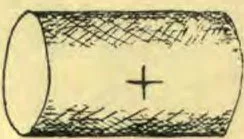
Take a three- or five-pound ko-nut or lard pail. A two-and-one-half-pound tomato or fruit can is not too small. Cut a hole about the middle of one side sufficiently large to admit an ordinary candle. The following is a good way to do this: with a cold-chisel cut two slits, each about an inch and a half long, intersecting at right angles. See Fig. 1. Each one of the angular points thus formed should be pushed inward until an opening is made large enough for the candle. The points will also help to hold the candle in place, and keep it from slipping back when once it has been put in.
Fig. 1.
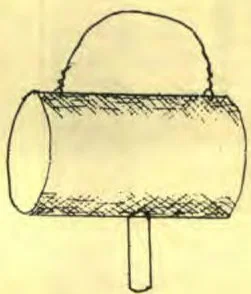
Punch two holes at each end of the opposite side of the can, and into these loop a wire for a handle. Fig. 2. Also put three or four small holes in the bottom of the can on the side nearest the handle, for ventilation. The lantern is now ready for the insertion of the light.
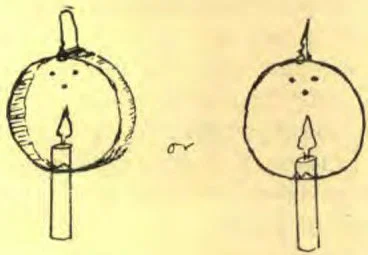
Put a common tallow candle, or a piece of one, into the hole first described. As the candle burns away inside the can, it may be pushed farther in. Figs. 2 and 3.
Fig. 2.
Side View - Complete
Fig. 3.
Front View - Complete
Of course this little “bug,” as the Ymir people call it, will not stand in a hard wind, but it is amazing how much it will go through without being blown out. On a still night, it will serve every purpose of a kerosene lantern, costs nothing to make, and is much simpler and less expensive in its operation. CLAUDE CONARD.
A Clock Without Works
IN the courtyard of the palace of Versailles is a clock with one hand, called L’Horloge de la Mort du Roi. It contains no works, but consists merely of a face in the form of a sun, surrounded by rays. On the death of a king the hand is set to the moment of his decease, and remains unaltered till his successor has joined him in the grave. This custom originated under Louis XIII, and continued till the Revolution. It was revived on the death of Louis XVIII, and the hand still continues fixed on the precise moment of that monarch’s death.
Professor Moissan Discovers Diamonds in Meteoric Stone
PROFESSOR MOISSAN, the celebrated French physicist, has discovered a number of small diamonds in meteoric stone.
Banana Imports to the United States
Fifteen million bunches of bananas were brought to the United States last year by one fruit company. They came chiefly from Cuba, Costa Rica, Jamaica, and Honduras.
Standard Oil Plans Long Pipeline from Indian Territory
THE Standard Oil Company is planning to pump oil from its wells in the Indian Territory to the refineries in Long Island City. This will require an underground pipe line of two thousand miles.
Government Printing Office Largest in the World
THE government printing-house in Washington, D. C., is said to be the largest printing-house in the world. The annual expenditure for public printing has more than doubled in the last seventeen years. The printing bill for the year 1903 was $5,345,720.11.
President Roosevelt Urges Protection for the American Bison
THE American bison may now take courage, for President Roosevelt is pleading his cause. In the president’s annual message, he urges upon Congress the importance of authorizing the president to set aside land as game refuges for the preservation of the bison.
Record-Breaking Shoe Manufacture in Lynn, Massachusetts
A PAIR of woman's shoes made in Lynn, Massachusetts, to establish a record for rapid shoe-making, required fifty-seven different operations, and the use of forty-two machines and one hundred different pieces. All these parts were assembled and made into a graceful pair of shoes, ready to wear, in thirteen minutes.
Photographs of Wild Animals Taken by Themselves
THE African explorer, Shillings, has brought to Berlin an extraordinarily interesting series of photographs of wild animals taken by themselves. His method was to attach to a piece of meat a string, which, on being touched, brought on a flash-light exposure. Leopards, hyenas, lions, apes, zebras, and other animals were thus taken in the most diverse attitudes.
Japanese University Challenges Stanford to Baseball
The aggressiveness of the “little Jap,” as he is popularly called, is shown by the challenge recently received by the Leland Stanford University of California from the Wasada University of Japan for an international baseball match to be played in San Francisco. The game is distinctively American; but the Japanese have adopted it, and are said to be excellent players. This is the first definite challenge of the kind ever sent to this country. It may be that the agile Jap will be able to surprise the Americans as well as the Russians.
VIII—The Story of Jonah
(February 25)*
LESSON SCRIPTURE: The book of Jonah.
MEMORY VERSE: “For thou, Lord, art good, and ready to forgive; and plenteous in mercy unto all them that call upon thee.” Ps. 86: 5.
About three hundred fifty years before the time of Esther, there lived a prophet whose name was Jonah. At one time the word of the Lord came to this man, saying, “Arise, go to Nineveh, that great city, and cry against it; for their wickedness is come up before me.”
Instead of obeying, Jonah tried to run away from the presence of the Lord. He went down to Joppa, and took passage on a ship that was sailing to Tarshish. But though one may shirk a duty, or run away from it, no one can escape from the presence of God. No sooner had the ship put out to sea, than “the Lord sent out a great wind into the sea, and there was a mighty tempest in the sea, so that the ship was like to be broken.”
Then the sailors cast lots, to see for whose sake this evil had come upon them, and the Lord caused the lot to fall upon Jonah. They asked him what he had done, and he replied that he was a Hebrew, and worshiped the God who made heaven and earth, and that he was fleeing from his presence.
“Then said they unto him, What shall we do unto thee? . . . And he said unto them, Take me up, and cast me forth into the sea; so shall the sea be calm unto you: for I know that for my sake this great tempest is upon you. Nevertheless the men rowed hard to bring it to the land; but they could not.” So after praying earnestly to Jehovah, they took Jonah up, and cast him into the sea. “And the sea ceased from her raging.” Then the men offered sacrifices to the Lord, and made vows.
Jonah did not drown. The Lord had prepared a great fish, which swallowed Jonah, and here he was preserved alive for three days and nights. During this time Jonah thought about what he had done, and prayed earnestly to the Lord to deliver him. “And the Lord spake unto the fish, and it vomited out Jonah upon the dry land.”
“And the word of the Lord came unto Jonah the second time, saying, Arise, go unto Nineveh, that great city, and preach unto it the preaching that I bid thee. So Jonah arose and went unto Nineveh. . . . Now Nineveh was an exceeding great city of three days’ journey. And Jonah began to enter into the city a day’s journey, and he cried, and said, Yet forty days, and Nineveh shall be overthrown.”
“So the people of Nineveh believed God, and proclaimed a fast, and put on sackcloth, from the greatest of them even to the least of them.” Even the king put on sackcloth, and sat in ashes. “And he caused it to be proclaimed and published through Nineveh by the decree of the king and his nobles, saying, Let neither man nor beast, herd nor flock, taste anything: let them not feed, nor drink water: but let man and beast be covered with sackcloth and cry mightily unto God: yea, let them turn every one from his evil way, and from the violence that is in their hands.”
“And God saw their works, that they turned from their evil way; and God repented of the evil, that he had said that he would do unto them; and he did it not.”
Instead of rejoicing over the love and mercy that had spared this great city, Jonah was very angry. And instead of staying to teach the people, he went away and sat down where he could see the city, and wished that he might die.
The Lord was very patient with Jonah. He caused a gourd to grow up and cover the little booth of branches that Jonah had made, so that it might be a shadow over his head. Jonah was “exceeding glad of the gourd;” but he had no thought of thanking God for the love that had caused it to grow over him, to shield him from the sun.
The next day the Lord sent a worm that ate the gourd, so it withered. There was a strong east wind, too, and the sun beat upon the head of Jonah, so he fainted. Still, he had no thought of the Lord’s mercy; still he wished in himself to die and said, “It is better for me to die than to live.”
“And God said to Jonah, Doest thou well to be angry for the gourd? And he said, I do well to be angry, even unto death. Then said the Lord, Thou hast had pity on the gourd, for the which thou hast not labored, neither madest it grow; which came up in a night, and perished in a night: and should not I spare Nineveh, that great city, wherein are more than sixscore thousand persons that can not discern between their right hand and their left hand; and also much cattle?”
Questions
1. What word came to Jonah the prophet? What did he do? Why? What happened when the ship put out to sea? Tell how the sailors came to place the blame on Jonah. What did they ask him? How did he answer?
2. What did Jonah tell the sailors to do with him? What did they do before they would cast him into the sea? What does this show?
3. What became of Jonah? What did he do while he was in this great fish? After a time what happened to Jonah?
4. What command was now given to the prophet? What warning did he give to the great city of Nineveh?
5. Tell how this warning was received. What was done by the king? What command did he give? What did the Lord do when he saw that the people of this great city truly repented of their evil ways?
6. How did Jonah feel when the Lord spared the city? What does this show? Where did he go? What did he make for himself? What did he say?
7. What did the Lord cause to grow to shield Jonah from the fierce heat of the sun? What happened to the gourd the next day? What did Jonah say?
8. What question did the Lord then ask Jonah? How did he try to teach the selfish prophet the lesson of love and pity for others? From this story what may we learn about the God whom we serve? Memory Verse.
The Progress of Civilization
SOME one has written a dialogue between the years as follows:—
1594— What have those men in their mouths?
1894— Tobacco. We have special rooms for its use in public places.
1594— A kind of medicine? Many using it look pale and nervous.
1894— O, no. Instead, it's a delightful poison. It kills many, injures more; but some it doesn't seem to hurt.
1594— Probably it takes the place of the liquors we used?
1894— No; it gives an appetite for them.
1594— Do children use it?
1894— Fathers are seldom willing to let children under three years of age use it for themselves, although they often breathe the poisonous smoke from the day of their birth.
1594— Is the smell ever offensive?
1894— Any one with good manners (?) says, “I do not mind the smell,” even if it sickens him.
1594— Is it not rather dirty?
1894— By using spittoons and being very careful, the user can keep himself pretty clean, except his breath and clothes and hair.
1594— Is it cheap?
1894— O dear, no!
1594— Do only rich people use it?
1894— O, no. It is one of the luxuries of the rich and the necessities of the poor. Tobacco first, bread next.