Your ShelfYour Projects

Review and Herald, Vol. 93, No. 1.

The Law of God
Earlier text: Mission Needs for 1916

Tsung Ming Island, China

K. H. WOOD
I HAVE just returned from a trip to Tsung Ming, a large island in the mouth of the Yang-tze-kiang. I had planned to start for the island on Wednesday, having previously consulted the time-table to ascertain upon which days the boats went to Tsung Ming. However, upon arriving at the wharf to take the boat, I was informed that as this is a “small month,” the boat schedule is not in effect as usual, and consequently the boat would not leave until the next day.
About the middle of the following forenoon we left Shanghai, and arrived at Tsung Ming at five o’clock in the afternoon. I found conditions there much different than I had expected. Although there are several steamboat lines connecting with the mainland, and one would expect to find things reasonably modern, the state of civilization is about what it was ten or fifteen years ago, before China was open to foreign influences as it has been for the past few years.
As soon as I landed, men, women, and children began to flock about me, and followed me to the inn. And they did not stop at the door of the inn, nor even at the door to my room, but crowded in so closely that I could scarcely get my bed prepared for the night, though I was tired and wished to retire early. However, after their curiosity had been satisfied to some extent, I was able to persuade them to allow me to retire.
I was just getting nicely settled when I was visited by the police and some soldiers, who wanted to know what my business was and when I expected to leave. They also asked to see my passport, which I had not thought necessary to take along, Tsung Ming being such a short distance from Shanghai. I assured them that I would make no trouble, and upon my statement that I expected to leave the island the next day, they consented to take their departure.
We had had a colporteur at Tsung Ming for some time, so the few matters I had to attend to were easily disposed of. Among these was the securing of a building for a permanent chapel and evangelist’s quarters.
Ours is the only Protestant mission on the island at the present time, so we consider this a most desirable opening. Having established our work at Tsung Ming, we shall be able to scatter our literature in the cities on the north side of the river, and thus gradually prepare the way for an evangelist to open a chapel and publicly teach the gospel there.
The Lord has greatly blessed our literature workers during the past few months. Our sale of the Chinese Signs alone has increased more than sixfold. One of our colporteurs often sells as many as fifteen hundred copies of the monthly issue of this paper, on the streets of Shanghai and other large cities.
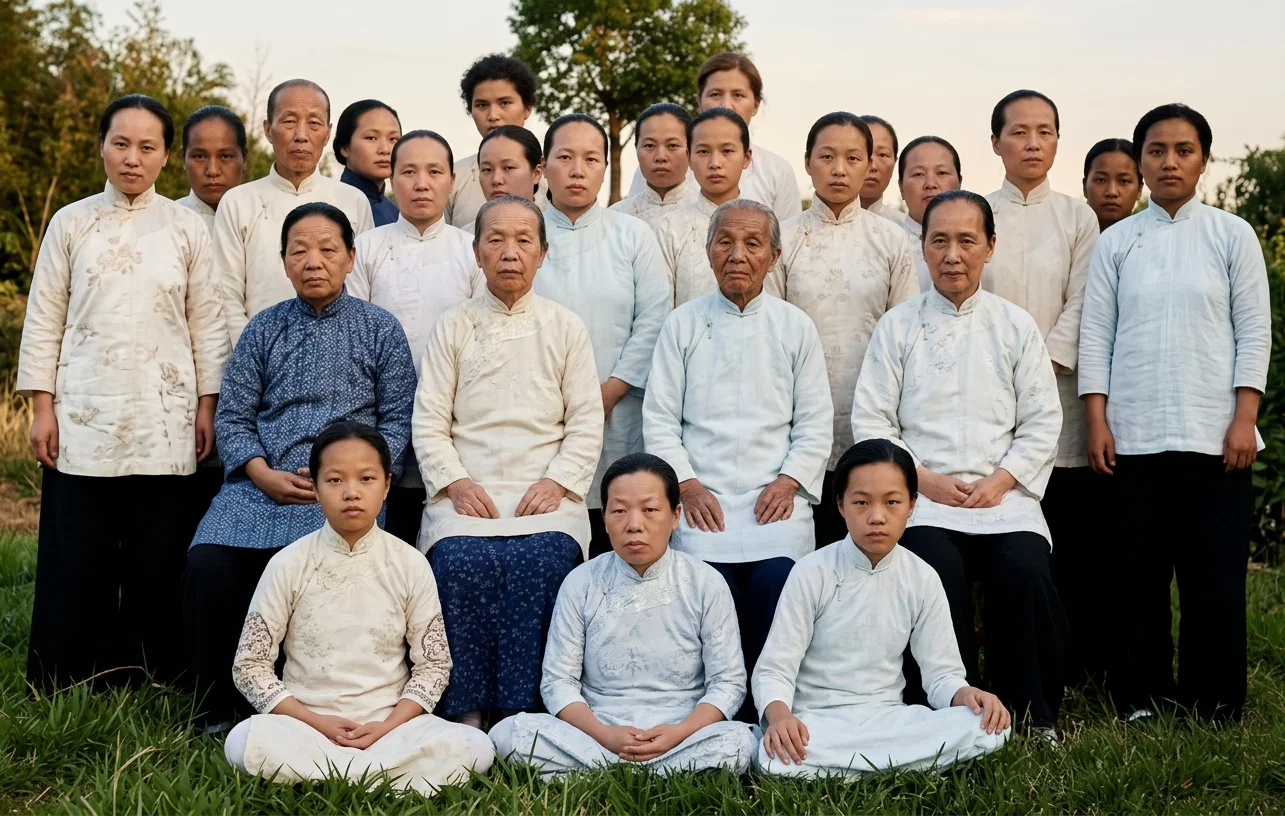
GROUP OF WOMEN ATTENDING A BIBLE INSTITUTE CONDUCTED BY SISTER B. MILLER
We have recently moved two of our station chapels into better buildings, located nearer our believers; but we are still in very undesirable quarters at Kading. One of our people there has recently given a large plot of ground in the heart of the city, on which to erect a chapel, school, and rooms for the evangelist and teachers. The transfer of the title has already been made, and registered in the American consulate. All that prevents our having a clean, light building for our meetings is the lack of funds with which to build it. We are hoping that money for this purpose will be forthcoming soon after the first of the year. Our landlord evidently thinks we are permanently located where we are, as he has recently doubled our rent. We are unable to better ourselves in any rented quarters, so we must remain until we can move into our own premises.
The future promises steady growth for our work in this mission. We now have more openings than our laborers can fill. In one large inland city there are more than ten new believers who are calling for a worker to come and teach them more fully the truths of our message. I have just received a letter saying they were making arrangements to provide a small meeting place where they can gather for their Sabbath services.
Thus far this year, we have baptized twenty-seven new members, and we have a class of twenty-five who are preparing for baptism. Half this number will, doubtless, receive this rite before the close of the year.

Hilo, Hawaii

MRS. MABEL MC KEAGUE
In my last report I told you of a Hawaiian woman and her seven children who had accepted the truth. They were few then in the country, but have since moved to Hilo, near us. The husband was also convinced of the truth, but in his struggle to withstand his convictions, he made it very hard for his wife. Still we prayed and pleaded, and just recently he yielded.
He told his employers he was going to keep the Lord’s Sabbath. Although he was ridiculed, and had many testing experiences when it seemed that he would be without work, now he has more than he can do.
He called in two men, a Hawaiian and a Porto Rican, to study in his home with my husband. These also have determined to keep the Sabbath, and have witnessed the power of God in opening the way before them. The Hawaiian held a position where he had been trusted for several years, but when he told his employer of his desire to keep the Sabbath holy, the man became very angry and said, “Every day will be sabbath for you, then.” He accepted his dismissal meekly, trusting in God. At the end of six days, his employer sent for him to come and take up his work again, with the Sabbath off. So now our brother is rejoicing in the Lord, has given up his bad habits, and is determined to live up to all the light.
The Porto Rican had been in the Salvation Army corps, but was not satisfied. He has taken only a few studies, and we need to pray that he may accept the whole message and become a valuable worker. He can speak English equally well as Spanish. The first-named brother has given him a home, and also work.
A young Hawaiian woman who has the responsibility of caring for an aged mother, has become more and more interested, first paying tithe, then securing all our books and papers she could afford, taking part in missionary work, and attending all our meetings and readings. We were very glad yesterday when she told us of her intention to ask her employer for relief from all Sabbath work. Her mother and niece are also keeping the Sabbath, and others of the family are interested.
Another young woman, one of my patients, has taken her stand and is happy in the new-found light. She obtained relief through the treatments, relief which she had long been seeking from different doctors, and this opened the way for Bible studies. She also is working for her relatives.
Our medical work is very encouraging and interesting. We have many calls from the doctors for private nursing, which we cannot fill. As there is only one hospital here, operated by the Catholics, there will be an increasing demand on us for help. One doctor urged us to start a small sanitarium. While this may not be possible, what an opportunity there is for one of our physicians to come here and help us to educate the people while giving them physical relief.
My Sabbath school class of eight children is doing good work, and we can see some improvement in the daily life of each child. But they are calling for a church school, and they have friends who would like to attend also. The Hilo company, by tithes, offerings, treatment returns, sale of books and papers, and the large Harvest Ingathering fund which the Lord helped us to raise, are doing their share. We need help, and need it badly. We have been promised medical help so that we could give our time more fully to missionary work, but we feel that we must also have a church school by the next school year.
Then there is the country work. Hilo is only one town, and this is a large island. Its towns are widely separated, and often inaccessible by railroad, which is a slow and expensive means of travel here. Last Sunday my husband spoke in the Olaa church, and today he is holding a study with a company of Hawaiians there. Several others at different places are studying, and the calls keep coming. We hope to raise up small companies all around this island. But the roads are very bad, owing to the heavy rains; and the carrying of books and equipment on his person is fast telling on my husband's health. Too long have the people sat in darkness, and we must redeem the time with all haste before the terrible calamities which the Lord has thus far mercifully withheld from these fair islands, shall wipe out her people in a moment.
We have marveled at the goodness of God in using us, weak as we are, to proclaim his message and to win souls, and we long for more of his Spirit and power in our lives. We are determined to seek and obtain many blessings in the week of prayer just upon us. Pray for us, as we pray for all of you.

Mission Notes

A BIBLE colporteur working among the Moslems relates this experience: “In Bagdad a number of Moslems whom we had met in Kerbela a year ago—when we were threatened with death by the fanatical followers of the Arabian prophet—approached me, and said, ‘Do you not fear the Moslems, that they will kill you?’ I quoted Christ’s injunction, ‘Fear not them which kill the body,’ and added, ‘You hate us, and Christ has commanded us to love our enemies.’ One then said, ‘Your purpose is to change the religion of the Moslems.’ I replied, ‘We wish you to know the truth, and that you may be led to trust Christ as your Saviour.’ After further conversation, they bought two New Testaments.”
ONE of the brethren writing from Costa Rica, sends this good word: “We are enjoying much of the blessing of the Lord in this part of the vineyard. An intelligent gentleman who for years opposed our work here is now rejoicing in the third angel’s message. He has been won to the truth by reading papers circulated by our home missionary society. This man is a great help to us in our work here.”
THE first of September, Brother F. A. Stahl wrote concerning the large mission at Puno, Peru: “I was planning on Mrs. Stahl’s going to Bolivia, while I should make strong efforts to open a mission among the Indians on the other side of Lake Titicaca. But I find I must not undertake so much: I believe more will be accomplished in the end. There has been much to do, and many calls that I have been unable to answer. But the mission here has gained by the course I have taken, for I have devoted more time to getting our people in this place firmly established in the truth, and a great interest has been aroused right about us by home missionary work. God has graciously spared our lives, and now we do not want to do anything foolish that would spoil our work. It would suit the priests only too well if we should have to leave this mission. They are ever on the watch to harm the work, but God has shown them plainly that it is his work. Our love for this work and this people is growing stronger and stronger, and if the Lord can use us here, we ask nothing better than to remain until the end. We know the people better now, and can speak to them a little in their own language. The Lord is blessing in many ways. We have had good success in treating the sick from the villages where there is opposition to our work. Just the other day I was called to attend a Spanish gentleman, and was able to help him very much. The house was full of people when I arrived, and among them I recognized some who had been very bitter against us, even going so far as to stand in the middle of the street and threaten us as we passed through the town. I prayed the Lord to help me to say and do just the right thing, and I believe he did. All this is having an effect upon the Indians. As they see these gentlemen—as they are called by the Indians—come to us for help, they are more encouraged than ever, for they see that what these same people said against us some years ago is not true. And through it all we say very little, but keep on working for God.”

The Work in Bermuda

EUGENE LELAND
THE message was first brought to these islands about twenty years ago by some Sabbath keepers who came from Canada. Soon afterwards a minister was sent here by the General Conference, and as the result of his labors during a period of a little more than six years, a church was organized which numbers seventy-eight members at the present time. A substantial church building has been erected in a pleasant and central part of the city of Hamilton, and is entirely clear of debt. The church is equipped with electric lights, and has a baptistery.
The amount of tithe paid last year was £154 1s. 11d., and the Sabbath school offerings amounted to £46 5d. Seven new members were added to the church upon profession of faith, two by letter, and three who had formerly been members were reclaimed, making an addition of twelve members, in all, during the year.
Tent meetings have been held in several places, and other work in the way of selling literature and visiting has been done, until our work is well known by the resident inhabitants. Sunday evening meetings at the church have been well attended during the past year, and the interest is increasing. We hope to see some good results.
The work here is more than self-supporting, and the brethren are very liberal in their contributions to the needs of the fields beyond.

Moral Clarity and Integrity

“If you blur your moral perceptions, if you sacrifice your honor by ways that are not clean and straight, then the whole landscape of your spiritual outlook will lose its delicate coloring and lose its clear edge, and you will not be able to distinguish between the good and the evil, between the true and the false.”

Building Foundations Under Castles

If you have built castles in the air, your work need not be lost; that is where they should be, but put foundations under them.—Thoreau.

The Ideal Woman

THE man who made the collection of proverbs contained in our Bible included in his volume a sketch of the ideal woman. She is a wife and mother. The Hebrew mind never questioned the fact that married life is the normal life for men and women on this earth, and that a home is incomplete without children. A woman’s highest career—so the Hebrew was convinced—lies in the home. She comes to the fullest realization of herself in motherhood. Her supreme work is caring for her family. Her chief jewels are her sons and daughters. The richest contributions she makes to the world are the children she molds and trains.
This is not only the Hebrew view, it is the human, universal, everlasting view. Whenever this conception is repudiated, the life of society is bound in shallows and in miseries.
The outstanding feature of the woman who looks out on us from the book of Proverbs is her efficiency as a home maker. It is she by whom the family is nourished. She spreads the table in the presence of her husband and children.
“She . . . giveth food to her household.”
She not only feeds her family, she clothes it. She protects it from the weather. She keeps in mind not only its comfort but also its appearance. She makes it brightly beautiful. Her children are a feast to the eyes.
“All her household are clothed with scarlet.”
In clothing her children, she does not neglect her own appearance. Having dressed her daughters in scarlet, she does not array herself in drab. She also is beautiful to look at.
“Her clothing is fine linen and purple.”
But dress alone does not make a woman. Her adorning must not be “the outward adorning of braiding the hair, and of wearing jewels of gold, or of putting on apparel.” She must be adorned with the graces of a lovely heart, and her crowning beauty lies in her disposition.
“Strength and dignity are her clothing.”
Weakness is not an essential element of womanhood. To be feminine does not mean to be feeble. A woman’s strength must possess charm. It must have in it the suggestion of royalty, the distinctive grace of queenliness. Her soul is calm. She is not agitated by constant fears, nor consumed by petty worries. She faces life with a courageous heart.
“She laugheth at the time to come.”
She is neither frivolous nor sarcastic. Her conversation is seasoned with salt. It gives life fresh tonic. She does not talk an infinite deal of nothing, nor does she habitually occupy her mind with trifles. She is as gracious as she is sensible. She does not use words which stab and cut. She is gentle in her speech, and genial and generous in her judgment.
*“She openeth her mouth with wisdom; And the law of kindness is on her tongue.”*
Industriousness is one of her shining virtues. She is never idle. She looks after her home with a fidelity which never fails. Early and late she gives herself to her calling.
“She riseth even while it is yet night.”
“Her lamp goeth not out by night.”
She has a great work to do, and she does not shirk it. She constantly studies the comfort and happiness of the little kingdom of which she is the anointed queen.
*“She looketh well to the ways of her household, And eateth not the bread of idleness.”*
But her horizon is not formed by the four walls of her home. She owes a debt to the outside world, and pays it. She is not unmindful of the great poverty which lies beyond her door. Her heart goes out in sympathy to those who need her, and her hands give help to those who cannot help themselves.
*“She stretcheth out her hand to the poor; Yea, she reacheth forth her hands to the needy.”*
The result of it all is that she wins and holds the hearts of her husband and children. She sways them by what she does, and still more by what she is. She is a true woman, and does a true woman’s work, and great is her reward.
*“Her children rise up, and call her blessed; Her husband also, and he praiseth her.”*
Nor is her praise confined to those who are nearest to her. Poets and orators, philosophers and sages, unite in eulogizing her. The heart of mankind exclaims:—
*“Give her of the fruit of her hands; And let her works praise her in the gates.”*
What page of the Bible might a woman more profitably keep before her than this page of the ancient book of Proverbs! Centuries have passed since the portrait was painted, but the colors have not faded, and the world, gazing on it, still exclaims, “This is ideal!”—Charles E. Jefferson, D. D.

Conducted by Mrs. I. H. Evans, Takoma Park, Washington D. C

Assisted by Miss Lora E. Clement
Through the columns of this department, hints will be given on all matters pertaining to the home life. Short articles and letters are solicited from home makers, telling of their everyday experiences,—their joys and sorrows, their failures and successes.

The Mother’s Privileges

WORTHIE HARRIS HOLDEN
A JEWISH proverb declares, “God could not be everywhere; therefore he made mothers.” We know that God is omnipotent by his Spirit, but it is true that to the very young child the mother is the one through whom he interprets divinity. Have you not held even a stranger child committed temporarily to your care, and seen him scan your face to learn the real intent of your heart? Does not the wee one know whether your command must be obeyed, or if it is only a threat? If you have to punish, can you hide from him whether it is done in love or in anger?
The one whose constant care attends the little child is the one who wins his love. Leave continually the tender daily administrations to some maid, and she will soon supersede yourself in his affections. When you meet a rich man’s son thus chaperoned, to whom the mother is almost a stranger, do you envy or pity her? Is she not bartering for fickle social esteem the inestimable privilege of working with God for her child? Some realize this. I know a mother who lives in affluence, and is attended by servants, but who cherishes the labor of caring herself for her little son.
God speaks to mothers individually, “Take this child, and train it for me, and I will give thee thy wages.” It might be well to place this motto in the kitchen, where little fingers long “to help.” It would still your impatient word or gesture. How else can you train the little one for Jesus, if you cannot teach him lessons of helpfulness, and inspire a desire for usefulness? By and by, when silver hairs begin to adorn your temples, a present earthly reward will be reaped when skilled hands insist upon letting mother rest from these routine duties.
Place the motto in the dining room and the living room, but still better, inscribe it on your heart. Take time to talk with Jesus, that the light of his countenance may rest upon your soul and manifest itself in deeds and words of love.
The business man frequently balances his accounts to find his loss or gain. No less often should the mother pause to discover her liabilities and resources. In this strenuous life of ours, seeming duties will constantly creep in upon us until we are “swamped” by them. Calls clamor from without; it may be from the church or from social affairs. There is a tendency to spend more and more time in adorning the children’s clothes, or in preparing a greater variety of dishes to entertain one’s company. Things that are not wrong in themselves we are slow to detect as household enemies, yet they become such as soon as they steal the time that should be devoted to the development of the children’s characters.
Perhaps your neighbor can do both,—attend to home duties properly and still be a social aid. Each one must determine, What are my resources? Your strength may be limited, your health not the best. Your nerves will not permit of overtaxation. To deny your other aspirations may be a real sacrifice, yet by it you may make your covenant with God.
Talk with your children. So many have scarcely any conversation with their parents. They hear only commands and negations. The little child will open up his soul to you through his unique questions and his imaginative flights, and your own heart will grow younger. Unconsciously the little one will learn to love the things you love and hate the things you hate. He will respect your wishes. He will guard your half hour of rest as chivalrously as a little soldier. When he plays with his young companions, the final word in any argument will be, “Mother said so!”
Have you never wished, when weary, that you could be a child again, and that after the short prayer with mother, she could once more tuck you into your bed, tell you a wonderful story, and then press a fond good-night kiss on your forehead? Has any gray-haired mother ever been known to say that she regretted spending so much time at the children’s hour? Ah, what is more precious to the mother? The busy little feet that have pattered around the house so unceasingly all day are ready for rest, and the child is eager for his story before he yields to slumber.
One mother I know was at her wit’s end. She could not tell even a Bible story in an interesting way, though she longed to do so. Finally she read the parables to her three-year-old. Certain ones came to be favorites, and the child would ask for them again and again. By and by she came to repeat such ones as the ten virgins and the rich man who pulled down his barns and built greater. The idea of not giving a stone for bread or a serpent for a fish seemed thoroughly grasped, judging by the manner in which the wee lassie recited the Bible verses.
The world says this is the age for fairy tales—when the very young are imaginative. May we not be glad for the simple illustrative passages in the Word of God to read to our little ones? Let them early learn its treasures, and it will aid materially in helping them to breathe in naturally the atmosphere of grace.
I remember, when a girl, hearing a well-known evangelist remark that it was a shame we had to sing,—
“Prone to wander, Lord, I feel it; Prone to leave the God I love.”
Yet how often this familiar hymn has described the heart’s experience! In our dealings with the little ones we need to reflect our Saviour’s tenderness; for the tiny feet will go astray so often from the right paths. The mother must have vigilance like that of our gracious Shepherd, to keep the little lambs in the fold. When necessary, she must rebuke and chasten in the spirit of the Master. She must train these opening buds to grow in wisdom and in the knowledge of God. Thus only may she know the divine rights and privileges of motherhood.

The Cold World

If the world seems cold to you, Kindle fires to warm it! Let their comfort hide from view Winters that deform it. Hearts as frozen as your own To that radiance gather; You will soon forget to moan, “Ah! the cheerless weather!” —Lucy Larcom.

Rocking at Bedtime

THE only excuse that has ever existed for rocking, is that the mother liked to do it, or thought she must follow the precedent of other rocking mothers, although the time nearly always comes, sooner or later, when what was a joy becomes an irksome task. The inconvenience of rocking becomes manifest some day, especially after the child grows older and falls asleep more slowly. It is then that the mother begins to realize that in giving way to her inclination to rock the baby, she has trained him along lines which are not well for him and are decidedly hard for herself.
Good habits are quite as easy to establish as bad ones: and the mother who begins right in the training of her child will have more energy with which to care for him, and more opportunity to enjoy this fleeting time of his babyhood.
When the little one cries or is fretful during the first days of his life, she should not allow any one to quiet him by walking about or rocking him. Holding him upright against the shoulder or gently patting the little back may be sufficient to soothe, if colic is the disturbing ailment. In fact, a certain amount of lusty crying is good for the child. This cry can readily be distinguished from the whimpering cry of discomfort or the sharp cry of pain. In any event rocking cannot benefit him in the least.
There is absolutely no reason for rocking, and there are some very good ones against it. The body of the young infant is exceedingly tender and soft, because as yet there is present in the body cells a great deal of fluid. This continual change of position as afforded in rocking, tends continually to disturb the body equilibrium, thus calling for a large amount of nervous expenditure to restore a normal and stable condition of quiet. Brain and body rest much better if, when it comes time to sleep, the child is laid down quietly.
In the very first month of a baby's life he begins to adapt himself to the suggestions of his daily life and care. Perhaps one of the first impressions he receives is hunger. He is uncomfortable, and he cries. The cry brings food. The second impression is comfort and pleasure. After this experience has been repeated a number of times, little brain grooves begin to form, connecting the ideas of hunger, crying, and food. These brain grooves are the beginning of memory. He soon learns to expect that which is given regularly, because of the repeated impressions made.
During the first month he begins to adapt himself to these repeated impressions of his daily life. This adaptation is called habit. He learns when to expect food, and how he is expected to go to sleep.
Baldwin, whose psychological researches are highly valued, assures us that there is no element of will as yet, “for the fibers of the brain necessary to voluntary action, in the cortex of the hemisphere, are not yet formed.” This learned man says, further:—
“The realization of the extraordinary adaptiveness of the very young child should save parents many an anxious day and sleepless night. There is practically nothing easier than to impress upon the child whatever habits of daily and nightly routine one wishes him to acquire, if he be taken in hand early enough. The only requirements are knowledge of what is good for him, and then inviolable regularity in everything that concerns him. Under this training he will become as ‘obstinate’ in being ‘good’ as the opposite so-called ‘indulgent’ or ‘capricious’ treatment always makes him in being ‘bad.’ There is no reason whatever why he should be walked with or held, why he should be taken up when he cries, why he should be trotted when he awakes, or why he should have a light by night. Things like this are simply bad habits, for which the parents have themselves to thank. The child adapts himself to his training, and it is his treatment that his habits reflect.”
When the child is wide-awake, and especially as he grows older, every normal mother will desire to express her affection by a certain amount of mothering and loving; but when it comes time to put baby to bed,—and there must be regular times with which nothing is allowed to interfere,—he should be trained to be put quietly into a well-ventilated room in a comfortable crib or bed.
From the beginning the regular noises of the household should continue without reference to the child. He will readily become accustomed to these and can adapt himself to them. It is not fair nor yet necessary that the household should go about on tiptoes and with bated breath because the baby is asleep. Unusual and sharp noises will disturb, however, because they are something which startle, and to which adaptation has not been made.
Do not rock the baby to sleep, it cannot do any good and is very likely to make a nervous, excitable, exacting child, not properly established in the early and important habits of healthful regularity and unselfish obedience.—The Mother's Magazine.

Friendship’s Golden Thread

THERE is in friendship something of all relations, and something above them all. It is the golden thread that ties the hearts of all the world.—John Evelyn.

Our Work at the Panama-Pacific Exposition

At the invitation of the Pacific Union Conference Committee, we came to San Francisco about the middle of April, to take charge of the work at the Pacific Press booth. We found this booth favorably located in the Liberal Arts section of the Machinery Palace. The space occupied was about eighteen by thirty-six feet, and was a free concession by the exposition management. It had a frontage on two sides; and on these sides it was inclosed by spacious counters, on which were displayed, in morocco library binders, our leading periodicals. A small case on one of the counters contained several of our large books in full morocco, and at each side of the case was a sign reading, “Come In; Rest and Read.”
PACIFIC PRESS BOOTH AT THE PANAMA-PACIFIC EXPOSITION
The principal furnishings were a fireplace, electrically illuminated, and six sectional bookcases on either side of the same, which were filled with our various large books in the different styles of binding. A good-sized reading table, with two easy rockers and six other chairs, tended to give an inviting appearance. Near the front corner was located the large revolving globe, which was the chief attraction in the exhibit. This was five feet in diameter, and was studded with more than two hundred electric lights in red, blue, green, and white.
A key to the lights was placed on each of three sides of the globe stand. The red lights showed the location of our publishing houses and branches; the green lights, the location of our schools; the blue lights, that of our sanitariums and medical missions; while the white lights indicated the location of our evangelical stations.
On the globe stand was always kept a variety of our good tracts, from which the public were invited to select. Over 11,000 periodicals and 12,000 tracts were distributed.
In a neat rack back of the globe were shown photographs of our leading institutions both in this country and in foreign fields, while at the rear of the booth were shown samples of our literature in forty foreign languages. This feature drew the attention of the foreigners, many of whom left their addresses, in order to have publications in their own language mailed to them.
The attention of visitors was called to a booklet to be mailed from the Pacific Press to those requesting it. More than 3,500 requests were received. In one day, such requests were made by persons from seventeen different States and countries, including Java and New Zealand. The addresses of all these were sent to our various State tract societies, to be distributed among our churches for missionary correspondence.
One incident will illustrate the far-reaching influence of the work at the exposition. A young Japanese, just returned from Japan, presented a letter written in Japanese characters, with the exception of the words, “Seventh-day Adventist, Pacific Press Publishing Association, Mountain View,” and “Machinery Palace,” which were in English. He told us of the illness of his brother, which necessitated his going to our sanitarium in Kobe, where he was “made cured.” He further said that his brother was much interested in the religion of the Seventh-day Adventists, and that he, too, was interested and wanted something to read.
We also met a company of Chinese students sent by their government to various universities in the East. All were bright young men, and manifested appreciation on receipt of the reading matter we gave them. They all left their addresses.
We had many opportunities to present our message to a superior class of people. Men prominent in the work of other denominations visited us, and expressed highest admiration of our exhibit. We have enjoyed most friendly relations with nearly all religious denominations having exhibits at the exposition.
Often, while explaining the lights on the globe, we were asked, “Does this represent the work of all the Protestant denominations?” And when informed to the contrary, many said, “I had no idea the work of the Seventh-day Adventists was so extensive.” This was also the remark of one of the international jury when making his official visit. We also enjoyed the privilege of meeting more than sixteen hundred persons of our faith, all of whom registered at the booth.
E. W. SNYDER, MRS. E. K. SNYDER.

Utah

We are glad to report some degree of success in two series of evangelistic meetings held the past summer by the writer and a company of workers, in Ogden and Salt Lake City, Utah. The Ogden meetings began June 13 and closed August 15, and the Salt Lake City series began September 5 and closed November 7,—eighteen weeks altogether. The attendance at these services averaged from seventy-five to five hundred.
Though in some respects this field has been the hardest in which the writer ever labored, yet some seed has been sown, and a number have decided to obey the truth. Thus far over one hundred have signed the church covenant. Fifty-five have united with the church—seventeen with the Ogden church and thirty-eight with the Salt Lake City church. Besides these, twenty or more are seriously considering baptism.
Further instruction and encouragement will doubtless add to the number of church members.
Five newspapers, two in Ogden and three in Salt Lake City, have shown us favor by publishing synopses of the sermons. One hundred and ninety-five articles have been printed besides free church notices. These varied from two or three paragraphs to three columns, averaging ten inches or one-half column each. The circulation of these papers, amounting to about 100,000, has reached Salt Lake City, Ogden, Provo, and a number of small towns. Thus, many who could not attend the services have had the opportunity of reading the truth. A number of those who have decided to obey the truth were first interested by reading the papers. They not only saw the articles, but the announcement of the services, and came to learn more.
One lady who signed the covenant lived in the country two miles from the car line. She became interested in the articles, and decided to come to the services. She walked the two miles to the car and back several evenings in order to attend the meetings. Afterwards she decided to move her family into the city for the special purpose of hearing the lectures. We hope to see her and a number of her family join the church.
Tourists, seeing the announcements of the services in the papers, have come to the meetings. It pays to get acquainted with the editors, and put forth a determined effort to use the newspapers.
Associated with the writer in these services were the following-named persons: Elder W. M. Adams, president of the conference; Elders H. G. Gjording and W. A. Johnson. Mrs. H. W. Holloway and Miss Ester Smith have rendered valuable service in the Bible work.
For the blessings received and the results obtained, we are thankful to God, and to him be all the glory. Pray for the work and workers in the Utah Conference.
A. S. BOOTH.
Continue reading: Missionary Papers