THE writer of this is a believer in Christ Jesus as his Saviour and Lord, and he appeals to those of like faith, by whatsoever name they are called. Whatever may be their predilection, inheritance, early teachings, or convictions concerning a Sabbath, he asks them:
Why a Sunday Law?
If Sunday is a holy day, does it not receive its sanctity from God, and is not God able to care for it? If it is of God, will not the presence of God in it vindicate its holiness, as it did that of the ark among the Philistines anciently?
It was a wise saying of Gamaliel's, "If it be of God, ye can not overthrow it." If, on the other hand, the Sunday sabbath be not of God, no law, men, or nations can preserve it. It is the word of our Lord, "Every plant which My heavenly Father planted not, shall be rooted up." Matt. 15:13.
Not of Majorities
You, my Christian brethren, know that large numbers, or majorities, do not make things right. All the children of Israel, at the head of whom was God's high priest, could not make the worship of the golden calf right. Moses, the man of God, and a few others, stood alone. The three Hebrew children were right when they would not bow to Nebuchadnezzar's apotheosis of patriotism on the Plain of Dura, and all Babylon was wrong, patriotic as they were. Daniel in the lions' den was right, and Persia was wrong. All the Jewish nation — doctors, scribes, priests, and the mass of the people — were wrong, while the Victim of Calvary alone was right. It has ever been true in this world that religious truth has been in the minority, but always the right has triumphed, or does triumph, or will triumph. "The endless years of God are hers," tho she die in the dungeon, or is crucified on the cross, yet ever —
"Standeth God within the shadow, keeping watch above His own."
The grave portals may seemingly forever close above the right, the truth; but the grave has been tunneled by the Prince of Life, and there is eternal victory on the other side. Majorities signify nothing; masses signify nothing, so far as religious truth is concerned. This is the lesson of the ages: It is "not by might [an army], nor by power, but by My Spirit, saith Jehovah of hosts," that His work is wrought. Why not use God's way for the Sunday question?
Granted that there is much wickedness and foolish, reckless pleasure on that day; granted that law might be able to stop much of it in outward manifestation. Yet you do not change the heart thereby; you do not convince the wrong-doer; you do not make men. But you do make hypocrites and cowards, and foster crime. Why not take God's way, His Word, His Spirit, and prayer?
"More things are wrought by prayer than this world dreams of."
Why turn to the State, to Egypt, to Babylon, to Assyria, to Cæsar, to civil power, when the mighty Master of Christianity, with whom is all authority in heaven and earth, has vouchsafed His power and presence, apart from all earthly power? "The weapons of our warfare are not carnal," nevertheless are they "mighty through God to the pulling down of strongholds."
What the End Will Be
But again: Your Sunday law may suppress useful labor, but it can not stop sin. Every evil thing in religion contrary to Christ and truth, a thousand times worse than common labor, may be taught that day. Will the aim of the Sunday law men be the suppression of all false religion? Who, then, will decide what is true? In some States Catholics are in the majority. Shall the Roman Catholic religion be established by law in such States? In some States Protestants would be in a majority; but in both cases there would be a revival of the century-long strife between Roman Catholicism and Protestantism, which strife would be minimized if the tenets, dogmas, or creed of neither were entrenched in civil law. Why work for a recrudescence of the Dark Ages by a Sunday law?
The church — any church — has never attempted to rule civilly without bringing a curse upon both herself and humanity. Why repeat the sad, suffering lessons of history? Why leave God's way?
Makes Loyalty to God a Crime
Again — the question is of infinite import: Why make loyalty and devotion a crime? The conscientious Jew, the Sabbath-keeping Christian, observe, in loyalty to God, the seventh day. They have in truest worship rendered to God that which bears His image and superscription. Their duty to their families and to their God, as they see it, — as millions of others see it on a different day, — demands that they shall work at their usual business on six days of the week, and consequently on Sunday. They injure no one, interfere with no one in so doing, yet a Sunday law makes them criminals, and makes them criminals for just what Jesus Christ did, whom we all profess to serve. Why, Christian friends, will you make criminals of those who are conscientiously following Christ?
Will You Stand for This Injustice?
Again: Do you feel that it is right and Christian to demand of your fellow Christians who may differ with you as regards the day, sixteen and two thirds per cent of their time, solely in deference to your opinion? Think of it. They have observed the Sabbath, as they believe, of the Bible, taught by the fourth commandment and enforced and observed by Jesus Christ. You have observed the first day of the week, believing it to be a holy day. In that respect you stand equal. They feel that they can not lose the time to spend Sunday in idleness, and you do not believe that it is your duty to observe the seventh day, or spend it in idleness. Both classes stand on the same basis exactly before God and before all American governments in the light of elemental and fundamental law. But now the Sunday law comes in, and you, through that Sunday law, demand that your seventh-day neighbor shall give up one whole day in the week of precious time — one sixth of all his income, sixteen and two thirds per cent of his earnings — simply and solely in deference to you. Do you believe that is right, or just, or Christian? It seems to us that if you will once let that question come home to your heart, that of itself would decide forever with you that you would never ask for a Sunday law, nay, more, that you would throw your whole power against a thing that would work such injustice.
Once more: These observers of the seventh day believe that in loyalty to God they ought to observe that day. They believe that when Jehovah said, "The seventh day is the Sabbath of the Lord thy God," He meant it. They believe that when He called it "My holy day," and commanded that man should turn his foot from that day, He meant it. They believe that our Lord honored that day when He said, "The Son of Man is Lord also of the Sabbath." They believe that that day, according to His own Word, is a memorial of His creative power, and a sign of His redeeming power, because His redeeming power is creative power. They feel that it would be disloyalty to God to do otherwise than to observe it by the grace given through the Lord Jesus Christ. They look upon Sunday as originally a pagan institution, that it has been brought into the Christian church through apostasy, that it bears the stamp of apostasy in demanding through civil law its observance, and they feel also that it would be disloyalty to God to place such an institution alongside that which all the Sacred Writings uphold. They do not judge or condemn their fellow Christians who may keep Sunday. They leave that with conscience and God. They would not have one single soul on earth observe the Sabbath of the Lord unless he can do it believing it to be right, believing it to be true, believing it to be a blessing. They know that religion, if it is of worth, must be voluntary, that service to God must be, if acceptable, by love; and therefore they can not believe in coercion or compulsion. They hold that this very principle is elemental in true service to God and in Christianity. And therefore I plead with you, my Christian brethren, as Christians, that whatever may be your regard for Sunday, or your disregard for the seventh day, you will let the spirit and principles of Christianity rule regarding the upholding or the promoting of religious belief.
It is our prayer, and it shall be our prayer, that whatever may come, or whatever questions may come before you, whatever position you may have taken in the past, the great God who rules over all men may help you to see error, may lead you with clear vision to see truth, and may give you will and conviction to decide for the right.
Yours in Christ Jesus our Lord, THE EDITOR.
What a Sunday Law Means
Un-American, Unjust, Unchristian
THE enactment of a Sunday law by any civil government involves the decision of a religious controversy, the government thereby assuming dictatorship in religious matters. One class of religionists hold that the seventh day of the week, from sunset Friday evening till sunset Saturday evening, is the Sabbath of the Lord as enjoined by the law of God and observed by Jesus Christ. Another class hold that Sunday, the first day of the week, from Saturday night at twelve o'clock to Sunday night at twelve o'clock, is a holy day divinely enjoined. Now for a government to establish the Sabbath by10law in any sense for one class is in that respect to define God's law. Logic will demand that sooner or later it must define God's will in every respect where it is possible for government to act, and where sufficient difference arises to demand such definition and interpretation. This means that the government will be torn, divided, distracted by religious factions, or dominated by a tyrannous hierarchy. Of course we are told that a Sunday law is not a religious measure, but it is. As one Sunday bill expresses it, it is to "prevent open acts of Sabbath desecration." Nearly all the Sunday laws in the United States expressly name "the Lord's day"—a religious term. All exemptions that are granted are on religious grounds. The Lord's Day Alliance of Canada, allied with the Lord's Day Alliance which is by its secretary, Mr. G. L. Tufts, pushing the Sunday law in California, stands for a law enacted in Canada in 1906, which specifically uses the religious term "the Lord's day," and forbids persons to "be present at any performance or public meeting ELSEWHERE THAN IN A CHURCH, at which any fee is charged directly or indirectly."
Be not deceived. The law desired is religious. It is not we who declare it. In its genesis and promotion, its friends so declare it.
2. A Sunday law destroys the boasted EQUALITY of Americans. It will elevate the class which favors Sunday laws as friends of the Government, and place those who oppose it from principle in the attitude of enemies, inimical to the nation's best interests; and yet opposers of Sunday laws may be as good citizens, as pure patriots, as good neighbors, as conscientious Christians in every respect, as those who favor it. All the difference in standing before the law is created by the legislation and religious institution, with which government has no right to meddle.
Unjust
3. A Sunday law, when fully operative, works injustice. The first-day keeper has the right to observe Sunday, so far as man is concerned. The seventh-day keeper has equal right. Neither have numbers any weight, for religion is not a matter of numbers. The seventh-day man may keep his day, but he may not coerce his first-day neighbor. Has the Sunday keeper any right to coerce the seventh-day man? Yet he does if he secures a Sunday law. He need not say that the Saturday keeper may observe the seventh day if he wish; that the law will not prevent him. This is not the point. The Saturday keeper has the same rights before God, according to the Declaration of Independence and the Constitution of the United States and the Bill of Rights of California, to keep his day, as the Sunday keeper has to keep his day. Both stand equal in this respect. But the Sunday law now steps in and demands that the seventh-day keeper shall, after he has conscientiously observed one day, observe another, contrary not only to his conscience, but against his temporal interests. THE SUNDAY LAW THEREFORE DEMANDS ONE SIXTH OF THE SEVENTH-DAY OBSERVER'S TIME, OR SIXTEEN AND TWO THIRDS PER CENT OF HIS INCOME, WHICH IT DOES NOT DEMAND OF THE FIRST-DAY OBSERVER. And it demands this not because of any relation which he sustains to the State or his fellows, but solely because of his religion, or rather BECAUSE OF THE RELIGIOUS OPINION of the Sunday observer.
Exemptions
4. Exemption may be granted, as now in some cases, to those who keep the seventh day; but it will never be asked, for those who are opposed to religious legislation do not admit the right to legislate in any way upon religious matters. To ask and accept an exemption would be to acquiesce in the legislation, and therefore to endorse it; but this they can not do. The same principle which has led them to identify themselves with an unpopular truth, contrary to natural inclinations and business interests, will lead them to protest against the law, to declare what they believe to be the Word of God; and this consistent, persistent, and aggressive agitation, which with no religious legislation would result in no harm, will force the Government, when embarked on the perilous course, to take measures to silence them, even to confiscation of property and death itself.
Statutory enactment in behalf of religious institutions or doctrines, unless the law becomes a dead letter, inevitably results in making hypocrites of the vacillating and insincere and in the persecution of the brave and conscientious opposer. The Sunday law, of whatever form, is therefore certainly un-American, unjust, unchristian.
Seventh-Day Observers and the Government
IN the scheme of the National Reformers, back of all the proposed religious legislation in this country, we have shown that all who oppose their ideal government are counted atheists, and in this class fall seventh-day Christians. It is intimated that those who oppose Sunday laws are not loyal Americans, that they should leave this country and go to some other land or submit. But those who thus talk are either themselves ignorant, or believe that the people are ignorant, of the devotion and loyalty that have been manifested by seventh-day observers and opposers of Sunday law, to this Government, from the very beginning. Here are some facts which clearly show the prominent part which they acted in the foundation of this Government:
One of the leading men in the First Continental Congress, to which he was duly elected, which convened September 5, 1774, was Governor Samuel Ward, of Newport, Rhode Island. In 1775 he became a prominent figure, acted as chairman upon some of the most important committees, and when Congress did business as a committee of the whole, Mr. Ward occupied the position as chairman almost continually during the sessions of 1775 and 1776. In fact, he so acted at the time that George Washington was made commander-in-chief of the Continental army. He had much to do with the organizing of the Continental army, and directing the movements of the colonies. He would have been one of the signers of the Declaration of Independence, if he had not been taken during the sessions of that Congress with virulent smallpox, of which he died when Congress was in session, in March, 1776. (See "Seventh-day Baptists in Europe and America," by Randolph, pages 637, 638, also pages 937, 1163-6.)
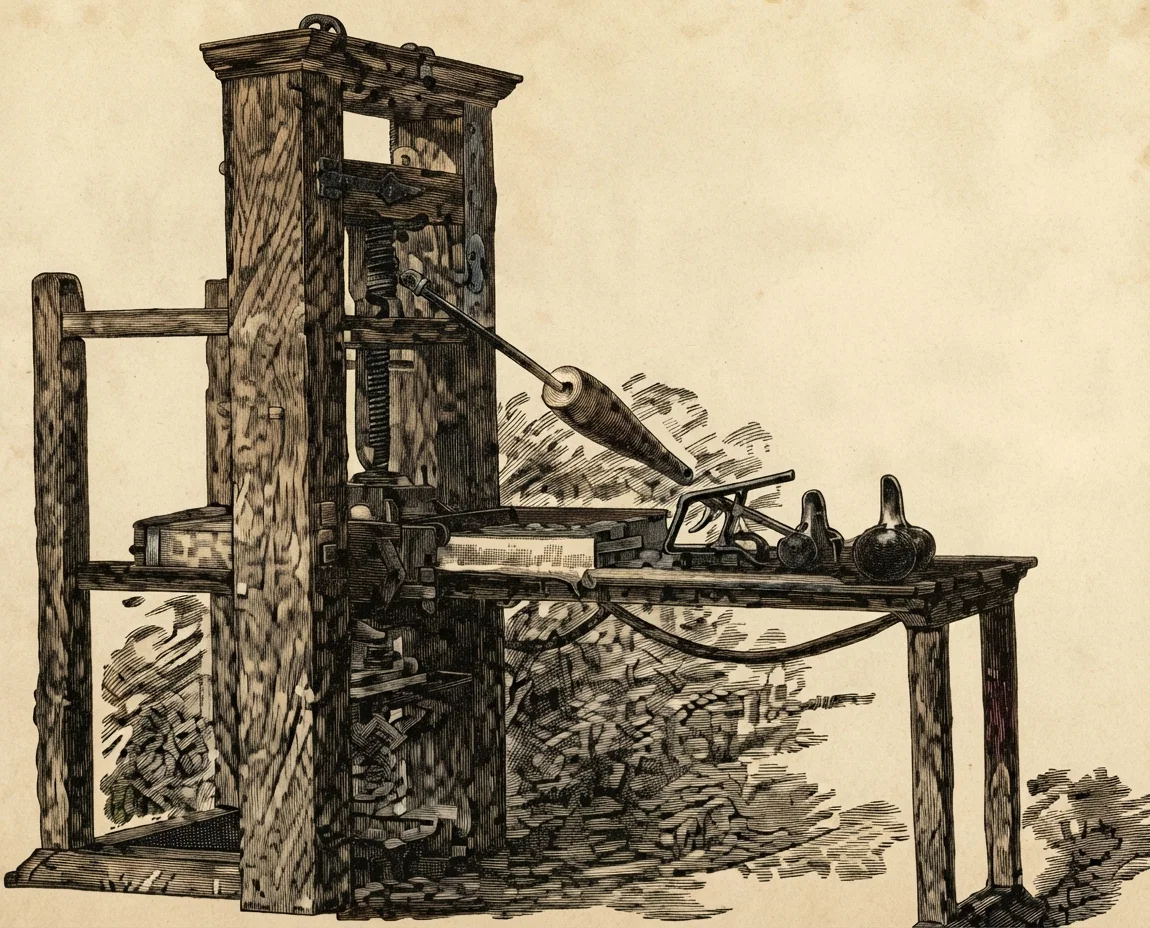
The old Ephrata Seventh-day Baptist press on which the Declaration of Independence was first printed.
His published correspondence with Washington and others contains important documents touching the work of the Continental Congress. Mr. Ward's son Samuel was captain of the Twelfth Rhode Island Regiment, and of him George Washington speaks very highly as a competent officer. Governor Ward was a Seventh-day Baptist.
The German Seventh-day Baptists of Pennsylvania—the little town of Ephrata, near Philadelphia, being the center of their work—rendered also faithful service during the times of the Revolutionary War. Altho themselves not believing in war or bloodshed, their whole sympathy was thrown with the ardent struggle of the patriots, and their homes and church and hospital became hospitals for the care of the wounded soldiers. Some of them died in nursing the soldiers sick of typhus fever. Not less than five hundred sick and wounded soldiers became the guests of the Seventh-day Baptists during this dreary winter, and were buried in the Seventh-day Baptist cemetery. Their hospital was burned to destroy the infection. The Rev. Dr. Peter Miller, of Ephrata, was chosen by the Continental Congress to conduct diplomatic correspondence—a most laborious and responsible position. He accepted it with the clear understanding that he should perform the service for his country without money and without price, and Congress gratefully accepted the patriotic service. He translated the Declaration of Independence into as many as seven different languages for the imperial courts of continental Europe. He pleaded with Washington, and secured the pardon of a traitor condemned to die, when the condemned man was Miller's "worst enemy." Washington was moved to tears by this, and thanked Miller for his Christian act.
The old Ephrata presses were the first to use English and German type; and on one of these, which is now in the museum of the Historical Society in Philadelphia, it is said that the Declaration of Independence was first printed. And from that day to this we know that no unpatriotic act of any kind can be brought against the Seventh-day Baptists, or other Sabbath-keeping Christians. Surely they have a right to the liberty granted by the Constitution of the United States.
And yet they feared, knowing the religious prejudice of men, as did the Baptists, the Quakers, and others, that the religious liberty which they hoped for might not be granted them, and in the little Ephrata community there is still cherished a letter written by Washington in behalf of religious freedom, August 4, 1789. The "father of his country" says:
"If I had had the least idea of any difficulty resulting from the Constitution adopted by the convention of which I had the honor to be president when it was formed, so as to endanger the rights of any religious denomination, then I never should have attached my name to that instrument. If I had any idea that the general Government was so administered that liberty of conscience was endangered, I pray you be assured that no man would be more willing than myself to revise and alter that part of it, so as to avoid religious persecution. You can, without any doubt, remember that I have often expressed as my opinion, that every man who conducts himself as a good citizen is accountable alone to God for his religious faith, and should be protected in worshiping God according to the dictates of his conscience." (Quoted from Hinds's "American Communities," page 21. See also "American State Papers," page 171.)
Fifty-two days later came the proposal of the first amendment to the Constitution of the United States, forbidding Congress to make any law respecting an establishment of religion or prohibiting its free exercise; guarding the right of freedom in speech and of the press, and the people peaceably to assemble and petition the Government for redress of grievances. This must have been with direct reference to Seventh-day Baptists, Baptists, Quakers, and Presbyterians.
And yet when Dr. Wayland Hoyt, a Sunday-keeping Baptist, wished the Federal Council of the Churches of Christ, meeting in Philadelphia, December 2-8, 1908, to exempt Seventh-day Baptists,—a member of that federation, having delegates present,—Dr. Hoyt's earnest plea was set aside, and his amendment to exempt Seventh-day Baptists rejected. Valley Forge was a long time ago, and National Reformers have been diligent seed sowers since that day. Philadelphia of 1776 and 1908 were farther apart than 132 years. That act of the Federal Council belonged to the Dark Ages.11Would that every lover of liberty could see, with Garrison, that religious liberty is equally important with civil liberty, and even more. The seventh-day people have seen this.
A Mighty Advocate of Liberty
WILLIAM LLOYD GARRISON believed not only in civil liberty, but in religious liberty as well. "He was as much opposed to Sunday laws as he was to slavery. Both to him," in the language of the editor of "American State Papers," "were equally violative of human rights and human freedom." In one of his editorials in the "Liberator" he declared that "all attempts to coerce an observance of the sabbath by legislation have been, must be, and ought to be nugatory." While believing in the fourth commandment and observing Sunday, he was "decidedly of the opinion that every attempt which was made to enforce its observance as a peculiarly holy day by pains and penalties, whether civil or ecclesiastical, is positive tyranny, which ought to be resisted by all the Lord's freemen, all who are rejoicing in the glorious liberty of the sons of God."
He issued an appeal to the friends of civil and religious liberty against Sunday law, in 1848. Theodore Parker, Parker Pillsbury, James and Lucretia Mott, C. C. Burleigh, and many others, signed that appeal. He declared in this address: "There is therefore no LIBERTY OF CONSCIENCE allowed to the people of this country under the LAWS THEREOF IN REGARD TO THE OBSERVANCE OF A SABBATH DAY." And therefore to oppose this a convention was called in Boston on Thursday and Friday, the 23d and 24th of March, 1848. They especially say in this call for a convention:
"We have no objection either to the first or the seventh day of the week as a day of rest from bodily toil both for man and beast," "nor do we deny the right of any number of persons to observe a particular day of the week as holy time, by such religious rites and ceremonies as they may deem acceptable to God. To their own Master they stand or fall." "The sole and distinct issue that we make is this: We maintain . . . that the attempt to compel the observance of any day as the Sabbath, especially by penal enactments, is unauthorized by Scripture or reason, and a shameful act of imposture and tyranny. We claim for ourselves, and for all mankind, the right to worship God according to the dictates of our own consciences. This right, inherent and inalienable, is cloven down in the United States; and we call upon all who desire to preserve civil and religious liberty to rally for its rescue. . . . We are aware that we shall inevitably be accused by the chief priests, scribes, and Pharisees of the present time, as was Jesus by the same class in His age, as 'not of God,' because we 'do not keep the Sabbath day;' but we are persuaded that to expose the popular delusion which prevails on this subject is to advance the cause of a pure Christianity, to promote true and acceptable worship, and to inculcate strict moral and religious accountability in all the concerns of life, on all days of the week alike."
Among the resolutions adopted at the convention held as called, is the following:
"Resolved, That if the legislature may rightfully determine the day on which people shall abstain from labor for religious purposes, it may also determine the place in which they shall assemble, the rites and ordinances which they shall observe, the doctrines which they shall hear, the teachers which they shall have over them, and the peculiar faith which they shall embrace; and thus entirely subvert civil and religious freedom, and enable bigotry and superstition, as of old, to—"
" 'Go to their bloody rites again,—bring back
The hall of horrors and the assessor's pen,—
Recording answers, shrieked upon the rack,—
Smile o'er the gaspings of spine-broken men,
And perpetuate damnation in their den!' "
To the first-day Sabbatarian, who claims the right to worship upon that day, Garrison says:
"I do not assail that right. I claim the right also to have my own views of the day; the right to sanctify the first, second, or third, or all days, as I think proper. Now I turn to the first-day Sabbatarian, and ask him how he dares to dictate to me to keep the day which he regards as holy, and to say, 'If you do not obey me, I will put my hands into your pocket, and take out as much as I please in the shape of a fine; or if I find nothing there, I will put you in prison; or if you resist enough to require it, I will shoot you dead.' How dare he do this? If he is not a ruffian, is he a Christian? . . . Who made him a ruler over other men's consciences? In a government which is based on equality, we must have equal rights. No men, however sincere, are to wield forceful authority over others who dissent from them, in regard to faith and observance. . . . If the Sabbath day be of God, it does not need legislation to uphold it. There is no power which can prevail against it."
"Christianity as taught by its Founder, does not need any governmental safeguards; its reliance for safety and prosperity is not on the rack or the stake, the dungeon or the gibbet, unjust proscription or brutal supremacy. No—it is the only thing under heaven that is not afraid; it is the only thing that repudiates all such instruments as unholy and sinful. . . . Let us be careful how we trample on human liberty or human conscience. Said the apostle, 'Every man shall give account of himself'—not to the legislature of Massachusetts, not to the Congress of the United States, but 'to God.'"
The Spirit of the Sunday Law Movement
SOME men, wise in the wisdom of God and of principle, have seen danger in it from the beginning. William Lloyd Garrison saw it; Roger Williams saw it; Baptists saw it. Seventh-day Baptists and Seventh-day Adventists have both faithfully warned against it. This the National Reformers themselves have recognized. The "Christian Statesman" of March, 1874, said:
"From the beginning of the National Reform movement, they have regarded it as the first step toward the persecution which they, as observers of the seventh day, will endure when our sabbath laws are revived and enforced. One can but smile at their apprehension of the success of a movement which would not harm a hair of their heads; but their fears were sincere enough, for all that."
But to show that their fears were not only sincere, but well grounded, we may state right here that in eleven years, 1885 to 1896, under the revival of Sunday laws, over one hundred conscientious, God-fearing seventh-day Christians, besides thirty in foreign countries, were prosecuted for doing quiet work on Sunday. The fines and costs resulting from those prosecutions amounted to $2,269.69. The imprisonment totaled 1,438 days, of which 455 were served in the chain-gang. These prosecutions took place in at least fifteen States.12But the National Reformers themselves have later told us what would be the effect of their movement. The Rev. W. T. McConnell, in the "Christian Nation" of December 14, 1887, in an open letter to the editors of the "American Sentinel," said:
"You look for trouble in this land in the future, if these principles are applied. I think it will come to you if you maintain your present position. The foolhardy fellow who persists in standing on the railroad track, may well anticipate trouble when he hears the rumbling of the coming train."
Dr. David McAllister, a well-known National Reformer, said in the convention of that body at Lakeside, Ohio, August, 1887:
"Those who oppose this work now will discover when the religious amendment is made to the Constitution, that if they do not see fit to fall in with the majority, they must abide the consequences, or seek some more congenial clime."
The Rev. E. B. Graham, in the "Christian Statesman" for May 21, 1885, said:
"We might add, in all justice, If the opponents of the Bible do not like our Government and its Christian features, let them go to some wild, desolate land, and in the name of the devil, and for the sake of the devil, subdue it, and set up a government of their own on infidel and atheistic ideas; and then if they can stand it, stay there till they die."
Let the reader remember that all that opposes the National Reform idea is "atheistic" and opposition to the Bible. And yet on the other hand, the truest Christian faith and devotion to the Bible demands opposition to that movement.
The Rev. M. A. Gault, another prominent National Reformer, in a letter dated June 3, 1889, said:
"We propose to incorporate in our national Constitution the moral and religious command, 'In it [the Sabbath] thou shalt do no work,' except the works of necessity, and by external force of sheriffs we propose to arrest and punish all violators of this law."
The "Christian Nation" said:
"Let those who will, remember the sabbath to keep it holy, from motives of love and obedience; the remnant must be made to do so through fear of law. We have no option."
Said Dr. S. F. Scovel, president of the National Reform Association, at Winona Lake, Indiana, in August, 1910:
"Uniformity is essential both to peace and progress. The opinion of the majority must be decisive. Even in the matter of men's consciences a degree of uniformity is a necessity."
The Rev. W. J. Coleman, in the "Christian Statesman" of November 1, 1883, said:
"To be perfectly plain, I believe that the existence of a Christian constitution would disfranchise every logically consistent infidel."
And so we might go on with quotation after quotation of what is proposed to be done under the régime of a Sunday law. Let California place such a law upon its books, and there would be found bigots enough to see that it was applied, and applied especially to those who have opposed this movement for liberty's and conscience' sake. Without such weapon such bigotry and intolerance would be harmless.
To the Women Voters of California
YOU have come into your own in the "Golden State." It is yours to help in a more direct way to shape the future destiny of this great commonwealth. There will come before you this autumn a proposed Sunday law. You will be asked through the Initiative to legislate such a law into the statutes of California. Fervent appeal will be made to your intense religious nature, to your devotion to ideals and to Christianity.
You will be asked to follow the fashion of other States, and enact a Sunday law borrowed from medieval or Puritanic times.
We appeal to your good sense, your intuition, and your knowledge of real conditions. You know that men can not be made religious by law. You know that pleasure seekers can not be made Sabbath keepers by law. You know that every man and woman ought to have the right to spend his or her day of rest as he or she may choose. Your knowledge of conditions here and in the East tells you that people can keep Sunday here, and do keep Sunday here in California, without a Sunday law, as well as they keep it in Eastern States under the most stringent Sunday laws.
You may not know that there is now on the statute-books of California a law guarding man's right to rest one day after six consecutive days of labor, without naming the day. This guards the working man.
Your knowledge of the genius and spirit of Christianity teaches you that persuasion and prayer and the Word of God must make souls Christian if at all, and that they can not be made Christian by coercion or compulsion.
Will you preserve these issues of our journal on religious liberty, study them, and know for your own selves where right and truth and justice lie? Your mothers, your sisters, your fathers, your brothers, have suffered and died for liberty. In memory of them and for the sake of Christ and the future, help to perpetuate liberty in California, that religion may be as free as the streams from the mountain and the breezes from the sea.
Vote "NO" against any and every Sabbath law, or class legislation, or religious legislation. You feel you have suffered from class legislation in the past. Let the future legislation be general and liberty-serving in all respects.