ALL consistent lovers of religious liberty, among whom are thousands of Christian believers, are uncompromising in their devotion to the maintenance and promotion of individual freedom of conscience. They believe with all the heart that “freedom of conscience is the highest of all freedom;” that “it is the life principle of every people that deserve to be called civilized.” Of all aspects of liberty, they maintain, on the ground of both Scripture and reason, that there is none greater, more precious, and more essentially fundamental than the right to worship God as conscience dictates. It is axiomatic, with them, that this priceless right of conscience is an original and inalienable gift of Heaven, and must, therefore, at all hazards, be preserved intact.
God is love, God is a Spirit, and hence they that serve Him must serve Him in love, in spirit, in truth. That God created man free is the irresistible logic of the fact that He invested him with the power of choice. Hence it is not by peremptory mandate that God seeks to lead man to repentance and worship, but by His goodness. It is not by might or by outward coercion that He seeks to bring man to Himself. No, it is by appeals prompted by infinite love that God is ever seeking to woo the sinner out of sin and self into Christ and righteousness.
Not Coercion, but Appeal
To every individual soul God makes this touching appeal: “Come now, and let us REASON TOGETHER: . . . tho your sins be as scarlet, they shall be as white as snow.” Our divine Father reasons with, appeals to, and lovingly draws man, but never coerces him. Note again how He appeals to the reason, the manhood, the liberty, of the individual: “CHOOSE you this day whom ye will serve.” The context here shows unmistakably that He speaks of service to Himself; that is, religious service. Yes, the Lord loves a CHEERFUL giver, not only of money, but of time, of affection, of worship. God’s law is a “law of liberty;” hence His words are not, “You shall come,” “You must come;” but “Whosoever WILL, let him take the water of life freely.” Lastly, let us call to remembrance the following blessedly touching assurance — an assurance to every soul individually: “Yea, I have loved thee with an everlasting love: therefore with LOVING-KINDNESS have I DRAWN thee.”
We see, then, that all genuine worship of God, all true service rendered to Him, must be free, glad, voluntary on the part of him who renders such worship and service. The element of choice, of glad spontaneity, is therefore fundamental in the religious life. Worship and service in which this element is lacking are necessarily formal, mechanical, and hollow, and therefore abhorrent to God.
Liberty for All
We now see why it is that all lovers of genuine Christian worship, of true Christian living, OUGHT to be unswervingly opposed to every form of outward compulsion in matters distinctively religious. They should be jealous for the conservation of the faith once for all delivered to the saints — jealous for the maintenance of the original and inherent purity of the religion of Christ. Do they not owe it to God and to their fellow men to do their utmost to make certain that whatever religious service is rendered shall be true and genuine, and in consequence, pleasing to God and effectual in promoting the temporal well-being and eternal salvation of the worshiper? Are they not morally bound to do what they can to shield men from all false and futile expressions of the religious life? Whatever in religion is not genuine can not possibly be helpful or efficacious to the worshipers. And since, according to the overwhelming testimony of Inspired Writ, and of reason as well, no religious forms can be genuine unless they are the free, glad expression of the heart, it is imperative that those who call themselves Christians should, by every means at their command, labor to keep the exercise of religion free from the intrusion of civil magistrates. In the very nature of the case, therefore, they are morally bound to maintain an uncompromising antagonism to every movement looking to the enactment of laws which have for their object the enforcement of any religious rite or duty. It is, in fact, a religious duty — aye, and a civil duty as well — to oppose to the last ditch all movements to secure legislation on any question of religion.
Christianity Demands It
Hence those of us who oppose the enactment of Sunday or sabbath laws, or laws upon any other religious question, are by no means prompted by motives of self-interest. We are not trying to shield ourselves from any prospective annoyance or persecution. Opposition springing from such motives would be essentially selfish, and therefore immoral and unchristian. It is solely our devotion to principle, our love to Christ, which constrains us to oppose movements looking to the incorporation of religious dogmas into the law codes of State or nation. For it was the Founder of the Christian church Himself who declared that the things pertaining to Cæsar and the things pertaining to God should forever be kept separate. We respect His pronouncement and honor His dictum. Accordingly, we seek not our own comfort and convenience, but the honor of our Lord and the well-being of the individual and even of the State, in endeavoring to preserve intact the priceless boon of freedom of the individual conscience — of the God-given liberty to worship or not to worship, to practise the precepts of religion or not to practise them.
Why Not the Master’s Way?
As Christians, dear reader, should we not seek to let Jesus have His way? Don’t you think He knows best? Let us remember that it was Jesus Himself who said, “If any man hear My words, and believe not, I judge him not.” If the Master refuses to employ the coercive power of law to compel the indifferent and unbelieving to accept and practise His teachings, shall we, by employing such power, presume to be wiser than He?
Of course Jesus lets it be known that those who reject His words will be judged by those words, not now, but “in the last day.” Jesus sought, and still seeks, to attract men to His service, by the power of love. His method is the best and only true method. The devotees of freedom of choice in the sphere of religion are solicitous that His method shall prevail. This is the reason, and the only reason, why they antagonize all efforts to secure legislation on religious questions.
The Crisis
By Editor
[The following stanzas from Whittier’s “The Crisis” were written when this nation was passing through a crisis which cost millions of dollars and thousands of lives. We are nearing a crisis now. In fact the crisis is here in principle; and the principles of church-and-state union, now rapidly making their way, will, when crystallized into law, spell ruin to the Government. The only hope is to see the deed in the principle, the fruitage in the apparently harmless seed-sowing. Will Americans see it, or will they turn their faces to the darkness of the past?]
Forever ours! for good or ill, on us the burden lies;
God’s balance, watched by angels, is hung across the skies.
Shall Justice, Truth, and Freedom turn the poised and trembling scale,
Or shall the Evil triumph, and robber Wrong prevail?
Shall the broad land o’er which our flag in starry splendor waves
Forego through us its freedom, and bear the tread of slaves?
Great Heaven! Is this our mission? End in this the prayers and tears,
The toil, the strife, the watchings of our younger, better years?
Still as the Old World rolls in light, shall ours in shadow turn,
A beamless chaos, cursed of God, through outer darkness borne?
Where the far nations looked for light, a blackness in the air?
Where for words of hope they listened, the long wail of despair?
The Crisis presses on us; face to face with us it stands,
With solemn lips of question, like the Sphinx in Egypt’s sands!
This day we fashion Destiny, our web of Fate we spin;
This day for all hereafter choose we holiness or sin;
Even now from starry Gerizim, or Ebal’s cloudy crown,
We call the dews of blessing or the bolts of cursing down!
By all for which the martyrs bore their agony and shame;
By all the warning words of truth with which the prophets came;
By the Future which awaits us; by all the hopes which cast
Their faint and trembling beams across the blackness of the Past;
And by the blessed thought of Him who for earth’s freedom died,
O my people! O my brothers! let us choose the righteous side.
California and Religious Liberty
By John Orr Corliss
[Mr. Corliss has been engaged in religious liberty work for many years in three continents, Europe, Australia, and America. He has appeared repeatedly before committees in Congress and in State legislatures. For several years past he has led the religious liberty forces in California. He has in every way studied the question from every side.]
A Candid Appeal to Californians
WITHOUT any doubt whatever, Sunday rest law advocates will succeed in securing the necessary eight per cent of the voters' signatures necessary to insure the Sunday rest question a place on the ballots to be used at the next State election. The measures now being taken to this end must succeed, because there will be enough of the clergy of the State, who are at the head of the movement in California, to enroll easily the names of their church-members, after some impassioned appeal to their church loyalty.
STATE CAPITOL IN SACRAMENTO, CALIFORNIA
This done, the final disposition of the proposition will rest with the voters of the State, who have, under the "Initiative and Referendum," the privilege of voting "Yes" or "No" upon the question. In meeting this issue at the polls, it will be well for every voter to have canvassed beforehand the whole topic, in order to cast his vote intelligently. It will be much better voluntarily to look squarely at possible results at the beginning, with a remedy at hand, than to gaze back with regret over a situation from which no relief is afforded.
One thing is certain,—that under present circumstances, when every individual is permitted to elect for himself whether he will rest, perform labor, or seek some form of recreation, peace and good will have been the rule throughout the State. But if a legal Sunday rest obtains, no certainty of this harmonious relation of society is assured, for the reason that it is a purely religious movement, born of a determination to have the church rule in matters of public religious ceremony. If the church wins in the contest through the aid of the "Initiative and Referendum," its members, especially those of narrow conception and illiberal sentiment, will feel in duty bound to act as spies on the conduct of their neighbors, to see that the law is reverenced.
A Generation of Hypocrisy and Deceit
This could but cause a repetition of medieval conditions, when, under a similar governmental arrangement, neighbors betrayed neighbors, friends violated sacred confidences, and near relatives delivered up each other to the civil courts, through frenzied fear of being counted comrades of those who overstepped the limits of the law. So far, indeed, was this régime carried that the milk of human kindness seemed frozen out of every breast, and the empty place filled with the icy coldness of distrust and deceit. The general rule of life was, in consequence, one of studied falsehood and hypocritical observances, until, with a mind degraded by habitual deception, the wrecked soul sank, hopeless and terror-stricken, into the grave.
A part of that early persecution, history affirms, was over the enforcement of Sunday as a day of rest, on the ground that the non-observance of that day was a sure sign of heresy. But this stigma of rebuke by the church would have counted for nothing, had not the church won the coöperation of the State to make her anathema effective. It was this, and this alone, that destroyed neighborhood unity, and made life a burden to all dissenters. Without State support the church could not have enforced her decrees on unwilling subjects; for of herself she was powerless to do more than that which she was divinely commissioned to do,—preach the Gospel.
An Unholy Ambition
But the church could not be, or at least was not, satisfied with the commission received, accompanied tho it was with the promise of divine power to win men through moral suasion. State power she was determined to have, by which to coerce halting souls; and she carried her point. State support secured, her path was unobstructed and smooth. From that time on, her skirts would be untainted with the blood of heretics, since they would be punished by State authority. Church-members, however, in the rôle of citizens, were not barred from making complaints in civil courts, against the transgressors of a rigid church rule sustained by State law, and thus it happened that the church received power to harass and persecute dissenters by means of civil law.
It may be said that that system was one of church-and-state union. True enough; but should the church now enlist the support of the State to enforce a religious ordinance upon the people, that would be exactly what was done to unite Church and State in medieval days, which resulted in so much sectarian strife and mortal hatred. There is nothing to prevent the same state of affairs now, if a like opportunity ripens by the use of the "Initiative and Referendum."
Like Causes, Like Results
The objection may be raised that people are more enlightened now than before, and this would act as preventive against such work as history records of past ages. But human nature is much the same now as it ever has been, and bigotry operates in the same way. Even now Sunday law agitators are scenting their prey, and are becoming bold in their declarations of attitude toward those who oppose their demands. At a National Reform convention held at Winona Lake, Indiana, August 8-19, 1910, the Rev. J. S. Martin, general superintendent of that association, is reported to have said when referring to seventh-day observers:
"This is not a Jewish country. If the people who come to this country do not like its Christian features, the doors that swung in, and permitted them to enter, will swing the other way, and they will have to hunt a country where they will find what they want. . . . The State will not allow those who want to keep the seventh day to do work on the first day of the week. It will not allow them to do this in the name of conscience, because the conscience of the American people is Christian."
"It is up to us to say what the religion of this country shall be. If the State accepts the religion of Jesus Christ as its religion, and seeks to be governed by the will of God, you can safely trust that State. . . . I am not afraid of persecution or infringement upon the rights of individual citizens under a Christian administration."
What Will the Ripened Fruit Be?
But all men know that it was just this kind of government in past ages that brought millions to martyrs' graves. Given the same conditions and opportunity of that time, its history will be repeated. Yet the sentiment uttered by Mr. Martin is the growing sentiment of this movement everywhere.7While in an attempt to have the people vote in favor of a Sunday rest law, with the promise that the measure will be a mild one, and not too exacting upon any one, yet in a speech by the California State superintendent of the Sunday rest proposition delivered in San Jose, the evening of February 14, 1912, he said that “those who were not loyal enough to the American Government to observe its American sabbath [meaning Sunday] should find a spot in some other part of the world where they can go and spend their time as they wish.”
Such statements surely ought to open the eyes of voters as to the ultimate design of these would-be Sunday reformers. If they mean anything, they show that the aim of these churchmen is to enslave, by civil enactment, the general conscience if possible, by chaining it to their Sunday-keeping creed. The immortal statement of Lincoln is to the point in considering this issue: “But we can not be free men if this is, by our national choice, to be a land of slavery. Those who deny freedom to others, deserve it not for themselves; and under the rule of a just God, can not long retain it.”
Court Decisions
One is told, by way of assurance, that the measure is correct, that it is sustained by supreme court decisions in many States. But in every case, without exception, where this has been done, it has been upon the basis that Christianity is the common law of the land, and this clearly shows that religion is the basis upon which all Sunday laws rest. If, however, Sunday rest laws have a rightful place in the statutes, on the ground of their constitutionality, why is it designed to contravene the Constitution by exempting some from a constitutional requirement, on the ground of their counteracting religion?
To know that seventh-day observers are counted such, one has only to hear the Sunday rest law advocates reiterate, in each public talk, that these are the worst opponents of Sunday laws in the country, and that they are doing more than all others combined, to destroy respect for Sunday observance. Yet these are the very people to be especially exempted from the operation of the proposed law, which is to be enacted for the express purpose of enforcing Sunday rest.
Why is this? Is it out of respect for them, or because of a desire to help them further to destroy respect for Sunday?—Hardly either of these. No, indeed; it is hoped by this course to check their opposition, and cover up from honest souls the real intent of the movement, until the State is committed to the desired legislation.
But have not seventh-day observers a perfect right to teach people that “the seventh day is the Sabbath of the Lord,” just as the Bible states it, and that it is the only Sabbath known to the Bible? Prominent Sunday law advocates are obliged to admit that there is no explicit command in the New Testament for Sunday observance. Why should Seventh-day Adventists be arraigned before the public for saying the same thing? Suppose even that they affirm Sunday is the Sabbath. Have not Adventists as good right to disagree with them as they have to disagree with Adventists?
Speaking to this point, an editorial in the Western Christian Union, as far back as March 22, 1889, said:
“Instead of thankfully making use of concessions granted them, and then going off quietly and attending to their own business AS THEY OUGHT, they [the Adventists] start out making unholy alliances, that they may defeat the purposes of their benefactors[?]. None of the bills are aimed at them; but if they fail to appreciate the fact, they may call down upon themselves such a measure of public disfavor as that legislation embarrassing to them may result.”
All this because the Adventists fail to see religious duty as do these Sunday law advocates. But if the church shall secure the legislation it craves, who will see to the enforcement of the law, if not the church itself? In order to do this, police courts must do her bidding. This will put the State in a subordinate position to the church, existing simply to formulate and to execute the will of the church.
Rest assured, voters of California, that to lend assistance to the enactment of a Sunday rest law will be to unsettle present satisfactory conditions, and not only bring dissatisfaction and unrest, but it will be an opening through which will enter more drastic religious demands. It is far better to wait for a sure light to guide in the way, than to take a leap in the dark, as will all who lend aid to the foisting of a legal Sunday rest upon all the people. Let those whose convictions lead them to the strictest observance of Sunday be faithful to their consciences, but let none attempt to be conscience for others in the matter of a weekly rest.
J. O. CORLISS.
Christ’s True Manliness
By Thomas Hughes
CHRIST's whole life on earth was the assertion and example of true manliness—the setting forth in living act and word what man is meant to be, and how he should carry himself in this world of God—one long campaign in which the “temptation” stands out as the first great battle and victory.
The Seven Days of the Week
By William S. Holman
By William S. Holman
THROUGH the turmoil and conflict of opinion existing to-day, can we not see that God, in His infinite wisdom, designed a double significance in the order of the days of the week, to reprove the errors and traditions of men?
The initial principle of the Sabbath was to be the recognition of Jehovah as the maker and sustainer of all things. It was to be a reminder of what we owe to Him, giving, at the same time, opportunities to worship the great God, our Creator.
There is also a prophetic significance, supplementary to the regulation of work, rest, and worship. The six days of work are parallel to the age of the world as inhabited by man in his fallen state, ending in the consummation of that great sabbath—the millennium.
Ever since Satan assumed the dictatorship in the Garden of Eden, the world has had no rest from its labor of sin. And present conditions prove we are still in the six working-days of its history.
The “rest that remaineth”—the millennium—will be the first sabbath of absolute rest—one of the many that are to adorn eternity.
The world as it is now, more than ever, bears the burden of constant work and toil. Business men, with a superficial respect for the ethics of religion, vacate the scene of active pursuits for a day, only to carry a load of mental anxieties concerning their next week's ventures, till they are again plunged into the water that absorbs them, body and soul. Whatever the day, they labor and have no rest.
There is a vast difference between labor and occupation. Labor tires, while occupation edifies. Labor is the result of sin; occupation is the essential of intelligence.
The Scriptures teach us that even God Himself is occupied attending to the wants of His creatures, from His mystic center of existence.
The duties of Eden were but an occupation—an occupation that many a gentle soul has found pleasure in since that early day—pruning and tending the growth of flowers and fruit—a task that brings the mind into touch with the loving hand scattering these gems upon the crust of our now sin-cursed world.
When man was decreed to till the ground, thus to incite what before was spontaneous—when he was told that as a result of his disobedience, he was to earn his bread by the sweat of his brow—occupation was changed into the strain of labor. We are chained by circumstances to work while the six thousand years of the world age lasts. When that ends we shall be emancipated from the burden of undue exertion, to take up an occupation that will thrill the whole ransomed throng.
By keeping the first day of the week as the sabbath—in honor of the Lord Jesus, as some say—we are to a certain extent perpetuating the first thousand years of the world's history—a period marred by the first sin and the perpetration of the first murder. Surely such an association can not honor the Lord, our Redeemer.
Gratitude and Ingratitude
“GRATITUDE is one of the least of virtues, but ingratitude the worst of vices.”
Church Federation
By Mabel H. Turner
By Mabel H. Turner
When the Master sent His servants true
With the Gospel to all lands,
They went where'er was work to do,
With joyful hearts and willing hands
To do their Saviour's kind commands,
And bring to men salvation;
For unto every nation
Had gone the invitation,
And each and every Christian
Felt the lost world's demands.
There was no time, in that early day,
To divide the land for gain.
“But we'll do it now,” the churches say,
“And every church shall be under pain
To keep to its own share of the plain,
And the all-wise federation
Shall assign to each church a station,
And evangelize a nation,
Or mete out to the world salvation,
By our rule, approved and sane.
“On points of doctrine, we'll agree
To drop our petty strife.
If one should plead for liberty,
Then use the surgeon's knife
Of civil law, to take his life.
Then the power and gold of the nations
Shall be all the federation's,
For making invocations
And offering oblations
For a world where sin is rite.
“Not the commandments of the Lord
Shall be our doctrine true;
For they would cut like a two-edged sword,
And split our modern creed in two.
For us, the commands of men will do.
No ‘second coming,’
No ‘final summing,’
A Lord too loving
To be reproving;
And the modern man shall a god be too.”
A Representation of God's Love for the Sinner
By Mrs. E. G. White
By Mrs. E. G. White
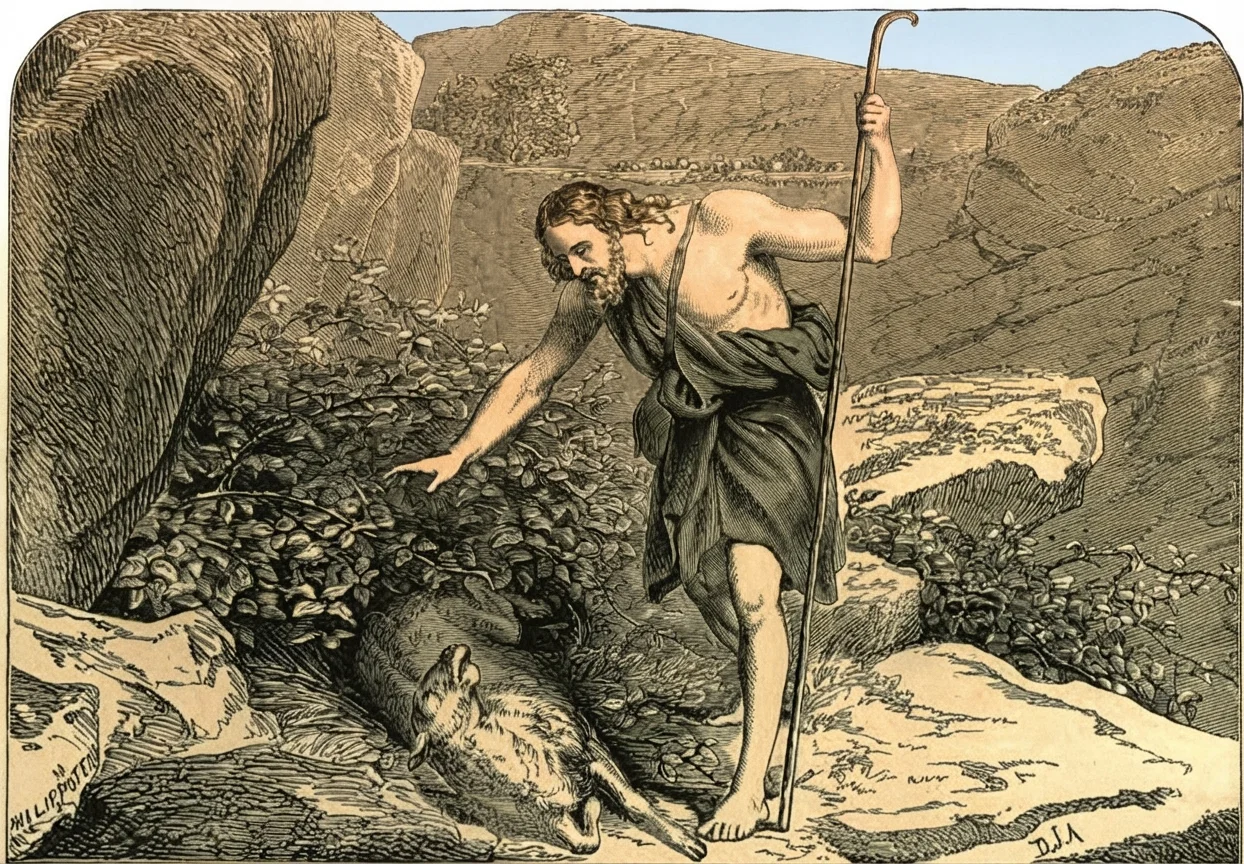
IN the parable of the shepherd seeking for the lost sheep is a representation of the tender patience, perseverance, and great love of God. As we contemplate the unselfish love of God, our hearts well up with gratitude, praise, and thanksgiving. We praise Him for the priceless gift of His only-begotten Son. There is no animal so helpless and bewildered as is the sheep that has strayed away from the fold. If the wanderer is not sought for by the compassionate shepherd, it will never find its way back to the fold. The shepherd must take it in his arms himself, and bear it to the fold. This care on the part of the shepherd, and helplessness on the part of the sheep, represent God's care for the sinner, and the condition of the soul that has wandered away from God. He is as helpless as the poor lost sheep, and unless divine love comes to his rescue, he will never find his way to the Father's house.
There is no possible way in which, of himself, man may recover his purity. The natural powers are perverted. Jesus, the Good Shepherd, says, "I know My sheep, and am known of Mine." The Pharisees were ready to accuse and condemn Jesus, because He did not, like themselves, repulse and condemn the publicans and sinners. The Pharisees put their trust in the law, and yet Jesus declared they did not keep the law. They thought that the law would justify them, and they would not consider the compassion and mercy that Jesus presented in His lessons as necessary to be brought into their practical life. Jesus came to the world to erect the cross, and beneath it all publicans and sinners may find refuge, and the Pharisees also may find peace, but only on the same terms by which those thought to be the greatest sinners may come to Christ.
"For God sent not His Son into the world to condemn the world; but that the world through Him might be saved." Christ never invited the wicked to come to Him to be saved in their sins, but to be saved from their sins. O, what hope does this give the sinner! for there is a way whereby he may return to his Father's house. The bright beams of the Sun of Righteousness shine upon his pathway, making it the royal path of holiness. The scribes and Pharisees can be saved only by entering in at the door of the sheepfold,—through faith in Jesus Christ.
The mercy and compassion of Christ stand out in clear contrast beside the indifference of the Sadducees and the contempt of the Pharisees toward those they looked upon as inferior to themselves. Christ did not ordain the plan of salvation for any one people or nation. He said: "I lay down My life for the sheep. And other sheep I have, which are not of this fold: them also I must bring, and they shall hear My voice; and there shall be one fold, and one Shepherd." Christ is not only the propitiation for our sins, but also for the sins of the whole world. The value of the offering of Jesus Christ can not be estimated; yet, by beholding the sufferings of the Son of God on Calvary, we may obtain some idea of the value at which God estimates the world. The value of the offering was deemed sufficient to save every soul from Adam's time down to the close of earth's history. "With the heart man believeth unto righteousness; and with the mouth confession is made unto salvation." Salvation is proffered to all men. The Jews, the Greeks, the Gentiles, the bond, the free, all tribes and nations, may come to Christ.
But while Heaven rejoices over the restoration of one lost sheep, the scribes and Pharisees looked upon Jesus with contempt, and the result of His expressed compassion and love led them to determine to kill Him. When the Lord works through human instrumentalities, and they are moved with power from above, Satan leads his agents to cry, "Fanaticism," and to warn the servants of God not to go to extremes. Let all be careful how they raise this cry; for, while there is spurious coin, the value of the genuine is unreduced. Because there are many spurious revivals and spurious conversions, it does not follow that all revivals are to be held in suspicion. Shall we have no reason to rejoice on earth, when angels rejoice in heaven? Will not those who claim to be children of God, stand in harmony with the angels of heaven in their rejoicing? Let them not voice the words and reveal the contempt expressed by the Pharisees as they said, "This Man receiveth sinners, and eateth with them." We have abundant reason given by our Lord to make us afraid of sneering at His work in the conversion of souls. The manifestation of God's renewing grace on sinful man, pronounced in heaven as genuine, causing angels to rejoice, has by many through unbelief been termed fanaticism, and the messenger through whom God has worked has been spoken of as one having zeal not according to knowledge.
Let every desponding, distrustful soul take courage, even tho he may have done wickedly. Read the parable of the lost sheep, the lost piece of silver, and the prodigal son, and take courage. You are not to think that perhaps God will pardon your transgressions, and permit you to approach into His presence; but you are to remember that it is God who has made the first advance, that He has come forth to seek you while you were still in rebellion against Him. With the tender heart of the shepherd, He has left the ninety and nine, and gone out into the wilderness to seek His wandering one. His lost sheep is precious to His heart of love, and He will bring back every wanderer to His Father's house who will let Him do so. In the return of the lost sheep to the fold, not only does the Shepherd rejoice, but the angels also rejoice over the restoration of the wanderer, more than over the ninety and nine who think themselves just persons.