Your ShelfYour Projects

Signs of the Times, Vol. 38, No. 34.

Infinite Protection
Earlier text: Second Phase of Christ's Kingdom

Our Bible Reading

The Promise of the Spirit

1. When Jesus was here in person, what did He say in regard to His going away? Nevertheless I tell you the truth; It is expedient for you that I go away. John 16: 7.
2. Why did He say it was "expedient" that He go away, rather than to stay with the disciples in person? For if I go not away, the Comforter will not come unto you; but if I depart, I will send Him unto you. Ib.
3. What was to be the work of the Spirit when He should come? And when He is come, He will reprove [margin, "convince"] the world of sin, and of righteousness, and of judgment: of sin, because they believe not on Me; of righteousness, because I go to My Father, and ye see Me no more; of judgment, because the prince of this world is judged. Verses 8-11.
4. What will the Spirit do for the believer? Howbeit when He, the Spirit of truth, is come, He will guide you into all truth. Verse 13.
5. Would the Spirit exalt self? He shall not speak of Himself; but whatsoever He shall hear, that shall He speak: and He will show you things to come. Ib.
6. Whom will the Spirit glorify, and whom will He represent? He shall glorify Me: for He shall receive of Mine, and shall show it unto you. All things that the Father hath are Mine: therefore said I, that He shall take of Mine, and shall show it unto you. Verses 14, 15.
7. What is one of the significant names of the Spirit? and how long will He abide with us? And I will pray the Father, and He shall give you another Comforter, that He may abide with you forever; even the Spirit of truth; whom the world can not receive, because it seeth Him not, neither knoweth Him: but ye know Him; for He dwelleth with you, and shall be in you. John 14: 16, 17.
8. Whose presence in reality does the Comforter bring to the individual? I will not leave you comfortless [margin, "orphans"]: I will come to you. Verse 18.
9. What other scripture shows that the personal presence of Christ through the work of the Spirit is continually with the believer? Go ye therefore, and teach all nations, baptizing them in the name of the Father, and of the Son, and of the Holy Ghost: teaching them to observe all things whatsoever I have commanded you: and, lo, I am with you alway, even unto the end of the world. Matt. 28: 19, 20.
NOTE.—By observing what the foregoing scriptures say, it will be clearly seen that Christ has arranged to bring His personal presence to the believer through the work of His Spirit, the Comforter, which He sent into the world in a special manner when He went away. Thus it is "expedient" that He go away and send the Comforter to us. For had He remained, only one individual at a time could have had the Master all to himself for intimate, private, personal interview; but by the work of the Spirit, He has arranged things so that each individual all the time can be in personal, intimate, soul-satisfying communion with the Lord of glory. Don't spend your time in trying to figure out how the Lord is able to do this. The almighty Father has created indescribably great worlds, and keeps them moving accurately about us in the infinite expanse of the heavens. We see unfathomable secrets and mysteries all about us in the work of His hands in every realm of nature. We may never know "how" these things are done, or why they are so; but we do know and enjoy the definite fact that they do actually exist. Even so we may never be able to tell how the Master can give His personal presence, and His personal attention, through the agency of His Spirit, to each one of us in detail; but we may know and enjoy the great fact. Who would not walk from one side of the continent to the other to meet the personal Christ and have an interview with Him? But do you realize that through His Spirit He has arranged for you to enjoy this pleasant intimacy all the time, and right where you are!

The Bible in Newspaper Offices

An Ohio man writes to the Congregationalist that the two following stories are believed to be true in his State:
When Salmon P. Chase was governor of Ohio he issued a Thanksgiving proclamation wholly in Scripture quotations. A Democratic paper declared that it was plagiarized, but frankly stated that it could not name the source. Whereupon a leading Republican paper hotly replied that the governor was entirely capable of writing the proclamation, and that it was original!
A few years ago the Toledo Blade, one of the brightest and best informed of the Ohio dailies, began an editorial with the statement, 'Some wise guy has said, 'It is more blessed to give than to receive.' ' The leading Sunday-school man of America, a citizen of Toledo, called the attention of the paper to the ignorance of familiar scripture, and the unintended irreverence suggested by the sentence, and asked for a correction. This was neglected, until an article was taken to the Blade office written for another Toledo daily, calling attention to the 'break,' when a rather grudging explanation appeared.—The Christian Advocate.

God's Hand in Mexican Affairs

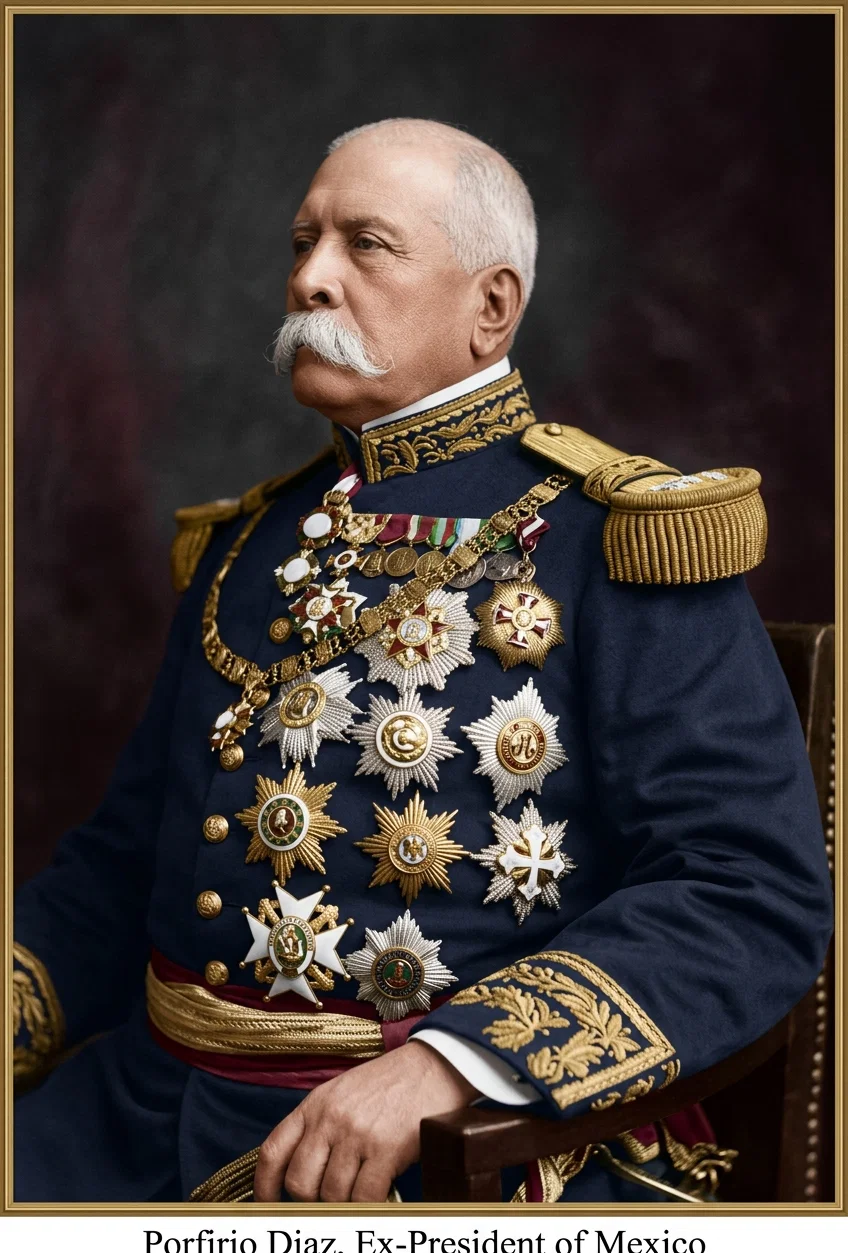
In scores of clubs, societies, churches, papers, and magazines, there has been recently considerable discussion concerning Diaz, ex-president of Mexico, and the future rôle of that government. Comparatively little of the discussion is based upon a personal knowledge of life as it is in Mexico.
It having been my good fortune to attend the Guadalajara high school for several months, and the national school of commerce in Mexico City for almost a year, and having lived for six months as one of the family in a Mexican home of the middle class, I am in a position to judge with some degree of accuracy as to Mexican character, what has been for years the sentiment of the educated class in regard to the Diaz régime, and what are some of the probable fruits of present conditions.
In forming our judgment of our own race, we call to mind the best. We should not judge Mexico by the peon who, after centuries of ignorance and oppression by both Church and State, manifests a deceitful character. Very many of the middle and higher classes are honest, brave, and true. They long, pray, and work for the betterment of their race. Almost to a man the Mexican is polite and excessively generous. Their patriotism is remarkable.
In regard to the Diaz régime, I quote from John Kenneth Turner, whose article in the February number of the "Pacific Monthly" is indisputable. He questions why the multimillionaire, Francisco I. Madero, a man deserving honor and respect, should suddenly turn outlaw, "taking a step that he knew would result in the confiscation of his property, estrangement from lifelong friends, persecution of the members of his family; and for himself, if he failed, banishment or imprisonment, perhaps execution!"
Porfirio Diaz, Ex-President of Mexico
As students of prophecy we may promptly answer, It is because God's will demands universal progress, advancement in education, and individual freedom. God will use the man best suited to fulfil His purpose. The third angel's message means the highest development of body, mind, and soul to the individual Mexican as well as to any one of our own favored land.
This individual development of the masses has been restrained. But God has decreed a "new order of things," that seems to rest largely in the hands of Madero. In more than one instance this man has manifested a character of nobility, honor, and self-sacrifice. One illustration of his honor is shown by his risking his own life to save that of Navarro, a captured general of the federal forces.
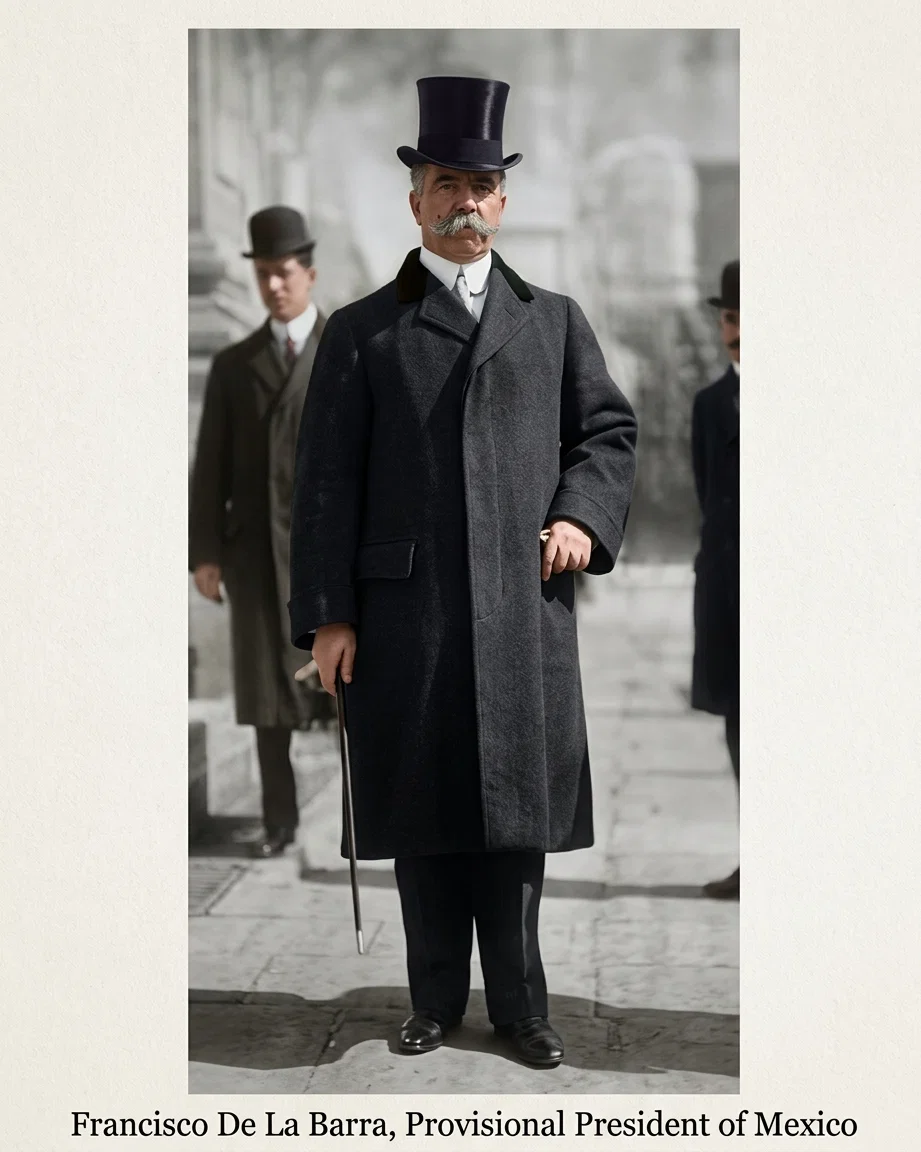
Francisco De La Barra, Provisional President of Mexico
The advancement of Mexico in evangelical, in educational, and especially in industrial lines during the rule of Diaz, is insignificant compared with the contemporary progress of other nations. And yet he is praised as the "maker of his country," as tho individually responsible for whatever benefits his countrymen now enjoy. America's greatest benefactor, Abraham Lincoln, said, "No man is necessary to the State," realizing that there is a superior Power directing in the affairs of men.
If we believe that, for ourselves, rulers obtain their just right to rule by the consent of the governed, should we deny our neighbors the same privilege? We ought rather to congratulate the Mexican republic in its daring struggle to throw off the shackles of graft and selfishness, and make itself wholly free.
Mr. Turner gives us a true glimpse of Mexican life as it was under Diaz:
1. "In Mexico there are chattel slaves, at least three quarters of a million of them — five per cent of the population."
2. "In Mexico there are at least five or six millions of peons — one third of the population. These peons are only slightly removed from chattel slavery. They are bound to their employers by debt, and under such terms that there is no hope of ever paying their debt. . . . The peons have absolutely no opportunities to learn to read or to advance in any way. . . . The system of peonage has expanded during the régime of Diaz, and the conditions of the peons have become very much worse."
3. "The extremes of wealth are far greater than they are in the United States. . . . The typical farm is the million acre farm; the farmer, the man who owns the slaves and the peons — the king of money kings."
4. "In Mexico City, the metropolis of the country, not more than one fifth of the houses within the city limits are regularly supplied with water with which to flush the sewers, while there are many densely populated blocks which have no public water whatever."
5. "According to the Mexican census of 1900, but sixteen per cent of the population were able to read and write."
6. "If justice is meted out in any case, it is justice that is given in charity — not justice that is guaranteed by the State."
7. "In Mexico free speech and free press are unknown. To breathe a word against the government spells ruin."
This view of Mexican life is given by Mr. Turner. I know that it has been the view of the educated class, for I have heard just such things discussed in Mexico by both teacher and pupil. I have seen the political rival of Diaz suppressed, and the unfavoring press quickly silenced.
I insert a few quotations as to the character of Diaz:
1. "The one remarkable thing that Porfirio Diaz has done has been to keep his grip on the reins of power for thirty-four years."
2. "He wanted to rule for life, and he moved along the line of least resistance."
3. "Why have Americans hailed Diaz as the greatest statesman of the age? . . . It is because he has made it pleasant for Americans who happen to be in a position to influence public opinion." It is argued that the Mexican character is unsuited to the civil procedure of courts, incapable of successful popular sovereignty. Many fear that popular sovereignty will lead to Catholic domination, to less favorable conditions for the advancement of Christianity, etc.
Let me ask, How can Mexican character become suited to proper government except by the actual exercise of their powers in that function? History has proved over and over again that, whatever the condition of the people may be, popular sovereignty means a greater measure of liberty, advancement in social and educational lines, and happiness.
"But the Catholic domination!" cries one in horror. We must leave that with God. While the majority have no right in any country to enact religious laws, neither have the minority a right to hinder such enactments by force of arms. This latter condition prevailed under Diaz.
Nothing can hinder the rapid advancement of God's work in Mexico except selfishness. In the religious as well as in the political sphere, God's plans have often been retarded by the covetousness of His servants.
To me, the Mexican revolution means the clearing away of much rubbish that has impeded modern progress, the open door to a work no less than that already accomplished in the American republic. What shall we do to follow up God's leading? Shall we not in humble gratefulness to God deny our own pleasure, or profit, or personal interest, and throw ourselves into the furrow of Mexico's great need? Dear reader, the call comes to you and to me.
W. A. YARNELL.

Of the Dreadnought Type

THE first vessel of the Dreadnought, or all-big-gun type of battle-ship was commenced by England in 1905, as the result of observations by her naval officers in the Russo-Japanese war. This vessel, begun in 1905, was put into commission in 1906, making the quickest record by far up to that time for the building of a great fighting ship.
In this year, 1911, only six years having elapsed, there are exactly one hundred of these monster ships either completed or in process of construction. Great Britain, Germany, the United States, and Brazil are the only nations that have any of the Dreadnought war-ships in commission. The other nations that have them in process of construction are Japan, Italy, Austria, Russia, France, Spain, Argentine, Chile, and Turkey.
After the success of the Dreadnought battle-ship was assured, the building of Dreadnought cruisers was the next step. The up-to-date cruiser of this type has a speed of about twenty-five knots an hour, and carries about the same battery of big guns that the regular battle-ship does, the main difference being in lighter armor and construction otherwise for this great speed. Britain, Germany, and Japan are the only nations at the present time that are building these large cruisers.
Men with powerful influence, like President Taft, Doctor Jordan, Mr. Carnegie, and numerous others, are working to secure and hold peace for the whole world. But while the good work they are doing is going on, there has never been such an awful war fever as has seized the entire world. It takes only four or five years to render all implements of warfare obsolete, and in many instances, worthless. To the individual who is familiar with Bible prophecy, this sentiment in favor of peace, which is met and contradicted by these mighty preparations for war, is plainly understood. If there was no other prophetic prediction in all the Word of God, this one should be enough to convince us of the truth and accuracy of divine prophecy.
Recently in some special articles this matter was set forth quite fully in these columns, and from time to time we call attention to the evidence. Have you been studying it? The subject is a striking one, and is worthy of the attention of all.

Decorative Divider

---**---

Unidentified Fragment

—**—

Funeral Directors’ Combination

The California Funeral Directors' Association has just concluded in San Francisco its seventh convention. Each county in the State is supposed to have a local association amenable to this State body, and it in turn is auxiliary to the national association. Many interesting things were discussed, such as "Auto Hearses for Funeral Equipment," "Recent Court Decisions as to Undertaking Zones," "Women in the Profession," etc., etc. From the discussions, and a little talk with some of the delegates, one has no trouble in ascertaining that the undertakers' union is one of the very strongest and the most exacting. The local undertaker is told just where he shall buy his goods, and what he shall pay; and generally speaking, it is understood just what prices he shall charge. This is a combination, properly speaking, of capitalists; yet it is one in which the capital of the manufacturer controls the labor of the local undertaker, if indeed he would be classed as a laborer at all. He has come to be ranked more in the professional line. But no matter where you classify him, he is a part of the combine. There is scarcely anything you can touch in these days, but you have to pay toll to some kind of combination. It would seem that shame, even the sympathy should be wholly lacking, would lead men to refrain from combining to gather a tribute from the sorrowing and suffering friends of the dead. But greed, seeming to have its avaricious appetite whetted by the thought that "this is my last chance," sternly arises to make some of its most exacting and exorbitant demands before allowing your friends to pass your mortal remains through the doorway of the tomb.

Blood Madness

Blood Madness.—In Popular Mechanics magazine for September, Barney Oldfield, one of the greatest automobile drivers in the world, has a strong article against the mad auto races, which almost invariably bring their toll of death. He declares that it is not the "speed madness" that draws the crowds, but the "blood madness;" that in the mere matter of speed they do not care; it is the element of human danger that affects the people; that if there were no probabilities of accident, the people would scarcely take interest in it. He tells us that since 1904 more than two hundred drivers and mechanics have been killed in racing accidents; that Americans criticize the Mexican bull-fight, in which there have not been five deaths among the fighters in as many years, while there were twenty-nine fatal race accidents in the United States last year. He says, "The American grows sentimental about killing cattle; the Mexican prefers cattle to human beings." In any other kind of public work or exhibitions, Mr. Oldfield believes there would be arrests, fines, imprisonments, criminality charges; but the blood madness of the people, and the stereotyped falsehood that it is all in the interest of progress, prevent it. He declares that the "public watch without interest or perception the most skilful and delicate driving; but let a wheel skid, a tire burst, or a machine run into a fence, and they are out of their seats in a moment with the blood cry in their throats and the lust of death in their eyes. It is the call of the Roman arena, of the Spanish bull-ring. It is no more a sport than hanging is sport." He tells us that there is absolutely no need of the racing. It has even ceased to be a proof of perfect cars; that all these contests now are of drivers, tires, and luck, rather than of machines; and the development of a motor-car is no longer even an excuse. And in all this he speaks truly.

Conditions in Oakland Jail

Investigations conducted in the workings of the jail in Oakland, California, show some frightful conditions, particularly among the women inmates of that institution. Honest people should take seriously to heart the persistent out-croppings of immorality and wrong-doing in connection with public officials and public institutions in all sections of the world.

No Authority for Sunday

[SOME time ago there was an article published that a certain priest, Rev. A. Gerritsma by name, pastor of St. Edwards Church, Winnipeg, Manitoba, Canada, had made an offer to one Rev. Dr. Duval, offering him one thousand dollars for one text of Scripture enjoining the observance of Sunday, the first day of the week, as the Sabbath given by the Lord. I wrote him and asked him if it was true that he made the offer. Here is his answer. E. E. WHEELER.]
Winnipeg, February 28, 1911. E. E. Wheeler, Esq., Brownlee, Idaho. Dear Sir:
In answer to yours of the 8th inst., I beg to say that I did make the offer mentioned in your letter to Rev. Dr. Duval. In my discussion with him I claimed there were 600 passages in the Bible enjoining the observance of the Sabbath day (or Saturday), and that not one passage could be found enjoining the observance of Sunday, or first day of the week, that the change of the observance of the Lord's day from Saturday to Sunday had been made by the church in apostolic time.
This offer was first made in St. Louis, Mo., some forty years ago, by a Jesuit father; since then hundreds of people, ministers and laymen, have tried to fulfil the condition of the offer, but have failed, because there is no such passage in the Bible.
Yours truly, A. Gerritsma.

Unidentified Fragment

——**——

San Francisco’s Mayoral Election

San Francisco has been kept before the public gaze for the last several years, at first by her great calamity, and then by her "graft prosecutions," and now by the fact that she is to have the Panama Pacific Exposition in 1915. At the present time she has a campaign on for the election of a mayor and the other city officers. "City Decency Clubs," and other like organizations, are being formed by the better element with the determination of having a good man for mayor while the city is carrying the responsibility of preparing for and conducting that great exposition. The present mayor is conducting a "wide open" city, openly affirming that he believes that any seaport town should give freedom to the saloon, the brothel, and such like. He is a candidate for re-election, and the "denizens of the underworld" will make every effort to retain him in office. It is hoped that the decent people of the city have enough influence to put him out of the race completely and quickly.

The San Francisco Graft Cases

Just now a great deal of attention is being drawn to Detective Burns's recent arrests of the McNamara brothers on the charge of dynamiting the Times Building in Los Angeles. At the same time the last scenes are being acted in the world-famous San Francisco "graft cases" for which Mr. Burns had gathered the evidence. Abraham Ruef, the notorious political boss, was sent to State prison; but those associated with him in the charges made, have finally had their cases dismissed. Technicalities and quibbles strung the trials out till every one became disgusted with them, and there are thousands of people who will quickly and readily tell you that they are convinced that money and not justice has gained the victories that have dismissed most of these cases.

Taft Vetoes New Mexico and Arizona Statehood

On August 15 President Taft vetoed the joint resolution providing for the admission of New Mexico and Arizona to statehood. His reason for exercising the veto power in this case was his thoro disapproval of the clause in the Arizona constitution providing for the recall of judges. The judicial mind of the President has enabled him to present some strong arguments in favor of his position. More will be said on the subject in a later issue.

Japan and General Arbitration

It is now declared that Japan will be the next great nation to undertake the negotiation of a general arbitration treaty with the United States.

Partnership with God

Partnership with God is a good thing. If we plan for Him, we will find Him working for us.

LETTERS

TO A

DAUGHTER

By Harriet S. Maxson, M.D.

The Possibilities of Spare Moments

MY DEAR DAUGHTER,—
I could but smile at your interpretation of my letter of ten days ago. Did you think I expected you to read the Bible, all that is written on practical nursing, the history of the world, and current literature, all in a day? No, no, dear; I only wish you to form the habit of well selected reading and study, and to know how to divide your time. I could almost hear your dear voice when I read, "But I haven't time for all this, mother;" somehow it sounded familiar.
Now, daughter, I want to have a little chat with you about this matter of time. "Time is the stuff life is made of," said Benjamin Franklin. It is so precious that God gave us only one little moment of it at once, and so sacred that we can have that moment but once. Our heavenly Father, in bestowing this gift of time, "is no respecter of persons." You and I have as much of it as any one who was ever born into this world.
How is it that some accomplish so much more than others? We are assured by those who understand life and its problems best, that the difference is not so much in the opportunities, or the individual endowments, as in the use of what we have. The right and wrong use of time makes all the difference of success and failure in life. You will never find time for anything. If you want time, you must take it.
In order to get the most out of time, like money, it should be used according to a well thought out scheme. Divide the twenty-four hours into hours for sleep, work, recreation, and mental training, according to a plan that suits your judgment and circumstances. Then make things go that way. Having done this, you will need to pursue it with all the perseverance of which you are capable. By and by, the power of habit will come to your aid.
When you work, work. Put the whole mind and heart into it. Know nothing else. Do everything the very best. Distance everybody about you. All this is easy when the habit of conquering takes possession. It is wholesome in this connection to read what men have accomplished who have once learned the art of redeeming the time. Study the causes of the success of Benjamin Franklin, of Lincoln, of McKinley, of Sir Michael Faraday, of Agassiz, of Edison. Learn the might of minutes. "Every day is a little life, and our whole life is a day repeated. Those that dare lose a day are dangerously prodigal; those that dare misspend it, desperate."
Let us consider some of the ways in which this loss creeps into our lives, and I think you will begin to see a remedy for your "I have no time" disease.
First, you would be surprised if you could realize how many minutes slip past you in idle dreaming. These are moments worse than lost, for they are moments in which is fastened upon you that destructive habit of mind-wandering. Watch for these moments. They may overtake you in the street-car, or while walking, or perhaps after retiring at night, or during some wakeful hour. Put them in right directed thinking, recalling some text of Scripture, or repeating some inspiring poem, or in some other way which your experience will suggest to you.
On a par with this undirected, haphazard mind-wandering, is the scarcely less baneful vain imaginings, in which our friends figure in various attitudes which are unreal, and which not infrequently lead us to expressions in word and act which are uncalled for and unjust.
I wonder if you ever spend time in idle chatting with your classmates and friends. Make a note of this, dear, for your own sake, and call a halt.
How much time first and last is spent in waiting! I trust you have ceased to rob others by making them wait for you. But so long as there is such a general disregard for the rights of others in this respect, you will be subject to this loss. Prepare for it.
Some people will pick up a good education in the odds and ends of time others carelessly throw away, as one man saves a fortune by small economies which others disdain to practise. What young man is too busy to get an hour a day for self-improvement?
If a genius like Gladstone carried through life a little book in his pocket lest an unexpected moment should slip from his grasp, what should we, of common abilities, resort to, to save the precious moments from oblivion?
"Nothing is worse for those who have business than the visits of those who have none," was the motto of a Scotch editor.
Drive the minutes, or they will drive you. Success in life is what Garfield called a question of "margins." Tell me how a young man uses the ragged edges of time while waiting for meals or tardy appointments, after his day's work, or evenings—what opportunity!—and I will tell you what that man's success will be. One can usually tell by his manner, the direction of the wrinkles in his forehead, or the expression of his eyes, whether he has been in the habit of using his time to good advantage or not.
The most valuable of all possessions is time. Life itself is measured by it. The man who loses no time, doubles his life. Wasting time is killing life.
Some squander time, some invest it, some kill it. That precious half hour a day which many of us throw away, would, rightly used, save us from the ignorance which mortifies us, the narrowness and pettiness which always attend exclusive application to our callings.
"Four things come not back,—the spoken word, the sped arrow, the past life, and the neglected opportunity."
So many little gems of thought, in form of booklets, can be carried about with you in a hand-satchel ready for use at odd moments! Ten minutes daily for one year is equivalent to six days of ten hours each. You could accomplish a great deal of reading in that time, couldn't you? Try it. I am sure you can find ten minutes in the morning and ten minutes at night, probably more, over and above that you now have. At the end of the year, balance accounts, and see how much you have gained.
Much of the world's best work has been done in these tidbits of time. Persistently train yourself to make them profitable. Strive to learn the comparative value of things. Cut out all that which is harmful and indifferent from your life, and study to make time and make it count. Diligent application, putting your whole heart and soul into your work, will enable you to do many things in half the time you now take. What has been done by others, you can do, dear one. Live in this thought, and you will be surprised to see how much more you can accomplish.

Lowly Things

Give me the lowly things! The hidden flowers that grow, The violet bending under spring's light feet, The infant's prattle in the village street, The kiss of mother on the baby's brow— The old, old things, so old, and yet so sweet.
Give me the lowly things! The country's grail, The tread of kine amid the lush meadow flowers, The old clock telling out the unhurrying hours, The swish of milk into the milking-pan, A child's warm hand, the earth's breath after showers.
Give me the lowly Christ, despised and slain, The washer of the tired and dusty feet, The Burden-Bearer, and the Son of pain; Before mine eyes make His ways ever plain, The old, old ways, so old, and yet so sweet. —H. S. H.

Blank Item

—**—

It Is Not Too Late to Do Right

"So LONG as you know you are wrong, it is not too late to do right. A beginning with God can be made any time you are willing to meet His conditions."

A NEW CHART

The above is a reduced facsimile of a new chart 24x38 inches, designed by Miss Flora E. Warren. A very unique and forceful presentation of the statements of Christ and others of God's witnesses regarding the Law of God and our relation to it. May be had in two styles, as follows:
Printed on strong bond paper, 50 cents
Printed on white muslin, $1.00
Address nearest Tract Society, or
Pacific Press Publishing Association
Mountain View, California
Portland, Oregon Calgary, Alberta, Canada Kansas City, Missouri
Continue reading: If I Had Only Spoke to Him Fair