The Youth’s Instructor, Vol. 65, No. 21.

Norwegian Captain's Daughter Held Aboard German Submarine
Earlier text: THE BOY WHO SANG FOR HIS BREAKFAST

An Afternoon on the Beach

WHEN I was about seven years old, I lived just a few blocks from the bay shore. Nothing, it seems, had a greater attraction for my older sister and me than that shore and bay, but our parents strictly forbade us ever to go there alone or in company with other children. The only time we might go was when our parents or some other grown-up person could go to take care of us, but this was not nearly often enough to suit us.
The neighbor children did not seem to be under such restrictions, and went nearly every day when the weather was warm. And oh, how we envied them! Every time they went they had some new fun to tell about. One day it was building houses on the beach, another it was sailing boats in the water, and so on, such a diversity of amusements that I cannot now name them all. Eagerly my sister and I would listen to the wonderful experiences, and then talk them over in bed till the sandman wafted us off in sleep to participate in them in our dreams.
One day these children said, “Oh, you should have been with us today. We had so much fun! We went ’way down the beach, farther than we ever went before, and the water was just full of crabs.”
“Crabs? What are crabs?” asked my sister. Neither she nor I had ever heard of a crab, and our curiosity was thoroughly aroused.
“Oh, they’re things that swim in the water and have two pinchers that open and shut like a mouth,” answered May, one of the older girls. “Haven’t you ever seen one?”
We shook our heads, a little ashamed of our ignorance, but anxious to know more.
“You haven’t? Come on with us tomorrow and we’ll show them to you,” tempted May. “We’re going to that same place.”
“We’d like to go, but father and mother won’t let us.”
“I don’t see why,” ventured Bess. “They let you go and play on the sand hill, and there is nothing but sand on the beach. You needn’t go in the water nor stay long if you just come to see. There wouldn’t be any harm in that.”
“Really don’t you think so?” asked my sister hopefully.
“Of course not,” assured May. “Come on over tomorrow and we’ll all go together.”
That night, in bed, we talked so much over the fun we would have that we forgot all about the right or wrong of going.
Time to go finally came, and we started off. If either of us secretly harbored any scruples about going, we forgot them when we reached the shore. Such a long stretch of clean, sandy beach and so fascinating and far-reaching an expanse of blue, blue water! No wonder it all seemed like a beautiful dream.
Before we hardly realized it, sister and I had slipped off all our clothes except our dress aprons, which served as bathing suits, and we were in bathing. Later on we found a few crabs; then we dug wells in the sand, sailed boats, and did numberless other things.
A shrill mill whistle not far away brought us rudely back to reality. It was six o’clock. And what were we to do with our telltale aprons!
“I almost wish we hadn’t come,” thought my sister aloud.
Carrying our aprons rolled in tight little rolls we hurried rather silently and dreadingly home. I, at least, was so absorbed in my thoughts that I was hardly conscious of the other children.
Arrived at the back yard of our house, my sister reached for my apron, saying, “Give it to me. I’ll hide our aprons under the woodpile in the shed. Maybe mother won’t miss them.”
“Why, girls, where have you been so long?” called mother from the pantry as we entered.
“Playing,” was the evasive answer.
Soon she came into the room, and instantly followed the next dreaded question, “Where are your aprons?”
Then the whole truth came to light. Mother sent us for our aprons and immediately put us to bed.
All she said was, “I’m sorry my little girls have deliberately done something wrong and then tried to hide it.” But the two of us sobbed as if our hearts would break. Never before had I seen mother cry when we did things we should not do, and it was really the keenest punishment she could have inflicted. It was also effective. Great as the temptation was, we never went to the shore again without permission.
LOUISE DEDEKER.

Fuzz Tails

In many parts of the West, and especially in the State of Nevada, wild horses are to be found roaming the hills and plains. They are small, wiry, and sturdy, for they must get their own living, and are found in places where it does not seem possible that an animal could live. Their coats are thick, and their manes and tails are shaggy, and no doubt that is the reason they are called “fuzz tails.”
Many men hunt for them, and, surrounding the herd, drive them into corrals. When they are broken to ride and drive, they are sold. If the colts are well fed and cared for, they will grow to be large horses. A horse of even three or four years, that is caught from the hills, will grow surprisingly after he is well fed.
A friend of mine living on a large cattle ranch in northern Nevada, was riding on horseback across the plains one day, when she found a tiny colt a few days old which had not been able to keep up with the flying herd. She had no difficulty in catching him, and thought she could carry him in her arms to the ranch house, but after many attempts found that she could not mount her horse with a little squirming colt under one arm. She did not want to leave him there for the coyotes to kill and eat, so making a soft rope of her scarf, she managed to lead the wobbly little fellow home with her.
The men of the ranch laughed at her, and asked if she expected to go into the business of catching “fuzz tails” for a living. It was no small task to raise the colt on a bottle, but he soon learned where and how he was to expect his meals. She named him “Silver” in honor of his State, and he grew into a large, beautiful horse.
When they moved to town several years later, Silver was sold at a good price. My friend had told me of him, and as we were riding through the town one day she called my attention to a fine horse ridden by a young lady. My friend called the horse’s name softly, and immediately she was answered by a toss of the head and a glad neigh. He had not forgotten the voice of the one who had fed and cared for him.
I have been told that on the Pyramid Indian Reservation there is a peculiar spotted pony which the Indians prize greatly. These ponies are caught and used for driving and riding. When they get old, they are turned out to go back to their home in the hills, and young ones are caught for future use. They say that Indians do not catch the wild horse for commercial purposes, but only for their own use.
Last winter, when it was extremely cold, and the herds of wild horses were gathered in sheltered places in the mountains, a man spent all his time killing and skinning the horses and selling their hides. That seems too bad when so many boys and girls would like a pony for their very own.
MAY L. HANLEY.

The Bible Year

Senior Assignment

May 27: Nehemiah 9 to 11. A solemn fast.
May 28: Nehemiah 12, 13. Abuses rectified; the Sabbath honored.
May 29: Esther 1 to 4. Conspiracy against the Jews.
May 30: Esther 5 to 7. Esther’s plea; downfall of Haman.
May 31: Esther 8 to 10. Decree in favor of the Jews; victory.
June 1: Job 1, 2. Testing of Job.
June 2: Job 3 to 5. Opening of discussion; first speech of Eliphaz.
For notes on this assignment, see Review for May 24.

Junior Assignment

May 27: Esther 1, 2. Esther made queen.
May 28: Esther 3, 4. Haman plans to destroy the Jews.
May 29: Esther 5, 6. Mordecai honored.
May 30: Esther 7, 8. Downfall of Haman.
May 31: Esther 9, 10. Victory of the Jews.
June 1: Job 1, 2. The sorrows of Job.
June 2: Job 42. Job submits to God.

A Courageous Missionary Volunteer of Long Ago

Some one has said that “the great secret of success is to be ready when your opportunity comes.” The boy Abraham Lincoln used to say when he was studying by the light of the fireplace, “I’ll study and get ready, and maybe a chance will come.” His chance did come, and because he was ready he became the leader of a great nation at a very critical time.
The heroine of our story this week must have been an earnest, faithful girl, improving every opportunity to prepare herself for whatever might come to her. Little did she ever dream that she would be a queen and that she would be the one to deliver her people from death. Doubtless she had been faithful in the little things, living by principle, and sacrificing her own pleasures in order that she might help others; for when the great test of service came, and she realized her duty, she went forward to it, even in the face of death, saying, “If I perish, I perish.”
Do you think it was easy for Esther to do what she did? No, indeed. As brought out in the story, it meant death for any one, even the queen, to go into the presence of the king unbidden, unless he happened to be pleased and held out his scepter. The great danger to herself in trying to intercede for her people she presented to her cousin, Mordecai; but he sent back these encouraging words, “Who knoweth whether thou art come to the kingdom for such a time as this?” It was a decisive hour in Esther’s life. Could it be that God wanted her to go before the king? It was really taking her life in her hands to do so, for no one could tell what he would do. Esther weighs in the balance her own life and the lives of her people. She must have made many unselfish decisions before, or she could not have made this one under such circumstances. But like all true decisions, it was made in the fear of God and in confidence that he would help in this critical hour.
What solemn days of fasting and prayer those three days must have been, for Esther and her maidens in the palace, and for Mordecai and all the Jews in Shushan! They knew that their own lives and the lives of the thousands of Jews living in that country were hanging in the balance.
When the day came that Esther was to go unbidden to the king, do you think she faltered? As her maids prepared her for the visit to the great king Ahasuerus they realized that they might never see her again, and their hearts were sad. But she faltered not. The victory over self had been won. She was a conqueror now.
Now she stands in the inner court of the king’s house. The golden scepter is lifted. In confidence she approaches the king and receives the promise of a favorable answer to any request, even to half the kingdom. But with womanly tactfulness she does not make her real request that day. How wonderfully everything works out; the king’s sleepless night, the honor of Mordecai, the humiliation of Haman, and finally the royal decree which saved all the Jews. These things did not just happen, for heavenly beings were taking the direction of human affairs, in answer to believing prayer.
Do you wonder that the Jews still have a great holiday and festival in honor of this event? It is the feast of Purim, celebrated on the fourteenth and fifteenth of Adar, or our month of March. M. E. K.

Reasons for Trusting God

(Texts for May 27-31)
If trusting God means anything to you and me now, it means everything, every day, in every experience. It is not like a garment that can be put on at will. If we have genuine trust, it becomes a part of our lives and transforms them.
Only those who trust God can know how very good he is. With the psalmist they have learned that “blessed is the man that trusteth” God. Such a man is blessed, for there is no want with those who trust him, and there is no harrowing fear, for those who trust him “shall not be afraid of evil tidings.” Men who put their confidence in men may come to grief, but not so with those who trust God.
God holds the stars in place; he keeps the sun and moon moving in their appointed orbits; he gives life to each spire of grass at your feet and to the bird that sings in the tree. He keeps your heart and mine beating from day to day. Nothing is too hard for our heavenly Father, and nothing is too insignificant to receive his loving attention. He knows all about our heartaches, and he sympathizes with us.
“He knows the bitter, weary way, The endless striving day by day, The souls that weep, the souls that pray, He knows.
“He knows how hard the day has been, The clouds that come our lives between, The wounds the world has never seen, He knows.”
Then learn to trust God. Today, try to commit your all to him. For today keep your mind “stayed” on heaven, on God, on his promises, on his work, and on the home he is preparing for his children. And when night comes, if you have worried as much as usual, ask God to explain things to you. Perhaps each time you tried to think of God, a pet sin loomed up before you and hindered your thinking about him. Known sin always gets between us and God, and while it is there, we can neither know God as he is nor trust him as we should.
Trusting God enriches the life; but we must never forget that to trust God we must obey him. Christ abides with those who obey, and fills their hearts with trust and courage. That is the secret of their enriched lives. For every duty he is their strength; for every disappointment he is the antidote; in all the vicissitudes of life he is their peace, their all in all. And he makes their lives a blessing to others. As the olive tree enriches the soil where it grows, so those who trust God fully will enrich the community where they live. They will make it a better community; they will inspire their friends to live better lives; in them people will find help in time of trouble, comfort in the hour of sorrow, and friends in every time of need. All this and much more, for in the lives of those who trust God, Christ is living again to bless others.
There is one other reason for trusting God: We will be amply rewarded in this life. But there is still another reward awaiting those who trust him: When all the sorrows and joys of earth are ended, God will lead his trusting children into their eternal inheritance; “and God shall wipe away all tears from their eyes; and there shall be no more death, neither sorrow, nor crying, neither shall there be any more pain: for the former things are passed away.”
MEDITATION.—I am persuaded that if I endeavor to know my Father’s will and obey it to the best of my ability, I shall learn to trust him fully.
SPECIAL PRAYER.—Father, help me to keep so close to thee “that no matter what comes, I will live on the mountain top, above worries, above repining, discouragement, and resentment.”
M. E.

Missionary Volunteer Society Programs for Week Ending June 2

THE programs for this date, with notes, illustrations, and other helpful material, will be found in the Church Officers’ Gazette for June.

Quit You Like Men, Be Strong

“Quit you like men, be strong.”

IX — Paul Begins His Journey to Rome

(June 2)
LESSON SCRIPTURE: Acts 27:1-20.
MEMORY VERSE: “All things work together for good to them that love God.” Rom. 8:28.

Questions

I. How did Paul travel to Italy? In whose care was he placed? Acts 27:1. Note 1.
2. Who went with Paul to Rome? Verse 2. Note 2.
3. How was Paul treated on the journey? Name the ports at which he stopped. Verses 3-5.
4. In what ship did he next sail? Trace his course to Lasea. Verses 6-8.
5. What is said of sailing at that time of the year? How did Paul admonish the centurion? Whose counsel did Julius receive? Why did the ship’s officers not wish to stay in Lasea? Verses 9-12.
6. What caused them to renew the voyage? What overtook them soon after they started? Verses 13, 14. Note 3.
7. How did the ship behave in the storm? Verse 15. Note 4.
8. By what island did they pass? What caused them much trouble? Verse 16. Note 5.
9. What was done to make the ship safe? Verses 17, 18.
10. What was finally done during the storm? Verse 19. Note 6.
11. What hindered the boat from making headway? What is said of the feelings of those on the ship? Verse 20. Note 7.

For Diligent Students

Make a map showing the course of Paul’s vessel from Adramyttium till the close of this lesson.

Notes

1. There was no fast-sailing steamship in which Paul could make his journey to Rome. He traveled on a small sailing vessel. The second ship was loaded with grain from Alexandria, Egypt. It was a large vessel for that time, as it carried, besides its cargo, two hundred and seventy-six persons. Josephus tells of traveling in a boat which carried six hundred persons.
2. Luke, who wrote the book of Acts, and Aristarchus, a Christian from Thessalonica, who traveled with Paul, were his companions on this voyage. They were willing to suffer because of their love for the apostle.
3. Euroclydon is from two Greek words which mean “east wind” and “wave.” It meant a strong northeast wind, which is now called the Levanter.
4. “The ship was caught.” The hurricane was so great that the ship could not be managed.
5. “Running under the lee of a small island called Clauda, we only just managed to secure the ship’s boat, and after hoisting it on board, the men used cables to brace the ship.” —Twentieth Century New Testament.
6. So great was the danger, the passengers did anything they could for the safety of the ship. They helped in throwing out some of the ship’s tackling, but it was not till later that the wheat was thrown overboard.
7. “In the first century of the Christian era, traveling by sea was attended with peculiar hardship and peril. Mariners directed their course largely by the position of the sun and stars; and when these did not appear, and there were indications of storm, the owners of vessels were fearful of venturing into the open sea. During a portion of the year, safe navigation was almost impossible.”—“The Acts of the Apostles,” p. 439.

Cultivating Peace and Justice Among All Nations

OBSERVE good faith and justice toward all nations; cultivate peace and harmony with all.—George Washington.

Growth of Democracy

IN 1806 Switzerland was the only republic on the map of Europe, though in 1776 when the United States signed the Declaration of Independence, there was a democratic form of government in Venice, Genoa, Switzerland, and the Netherlands. Today the area covered by “republics” on the map of the world is considerably more than one half the habitable surface of the globe. “If we add the area of the British Empire, the spirit of whose government is now entirely democratic, and whose ‘autonomous colonies,’ as the Dominions are now called, are virtually republics, the area of free government reaches the enormous total of about four fifths of the inhabited earth.”
Dr. David Jayn Hill, formerly ambassador to Germany, claims that more than one half of the world’s population are living under nominal republics; and if the population of the British Empire, which may be called a commonwealth of republics, was added, this proportion would be raised to more than three fourths of the human race, or 1,250,000,000 persons.
If all those living under constitutional governments, excluding only the absolute monarchies, were included, the map would be found to be almost white; for there are only a few countries in all Asia and Europe to appear as dark spots on the map fast being whitened by republican principles.

Hold On

“WERE man but constant,” says the poet, “he were perfect.” Inconstancy is the bane of the present age, inconstancy of effort, of affection, and of service.
In this time one is moved about by a very little thing; but one should fix the eye upon the goal and hold on until success comes. All great victories, whether of peace or war, have been gained by those who held on, who did not relinquish hope or effort through seeming defeats, adversity, or calamity.
“At the close of the first day of the battle of Shiloh, a day of severe Union reverses, General Grant was met by his much discouraged chief of staff, McPherson, who said: ‘Things look bad, General. We have lost half our artillery and a third of the infantry. Our line is broken, and we are pushed back nearly to the river.’
“General Grant made no reply, and Mr. McPherson asked impatiently what he intended to do.
“‘Do? Why, reform the lines and attack at day-break. Won’t they be surprised!’”
And they were surprised and routed before nine o’clock in the morning. Thus to turn defeat into victory is the lesson to be learned in one’s individual striving for character-strength. “There is no real defeat for the one who holds on in a right cause. The only permanent and hopeless failure comes through soul-surrender.”

Using Today: Lessons from a Sage

“YESTERDAY,” said the sage, “is dead; forget it. Tomorrow does not exist; don’t worry. Today is here; use it.”

The Chief's Decision

MR. DAN CRAWFORD, the man who has spent nearly a quarter of a century in mission work in Africa, relates an interesting incident of a visit made by one of the native pastors to a native community where a group of eight young men had been going on “steadily and soberly for God.” But these had been attacked by a secret society because they had the courage to expose some of the dark doings of the cult. They were seized, “tied up in bark ropes, and dragged off to the chief for royal permission to drown them. But they had come to the wrong man at the wrong time. ‘No,’ yelled the chief, ‘you lie, for too well I know what these Christians believe. Did they not teach me when I was a lad? You ask me to beat them, do you? Yes, I will beat those Christians on the very day when you can come and tell me truly that they have left Christ and returned to their evil ways. Then will I beat them for such a crime.’”
THE BOY WHO SANG FOR HIS BREAKFAST
The Way of Salvation Made Very Plain to Donald
THE BOY WHO SANG FOR HIS BREAKFAST The Way of Salvation Made Very Plain to Donald
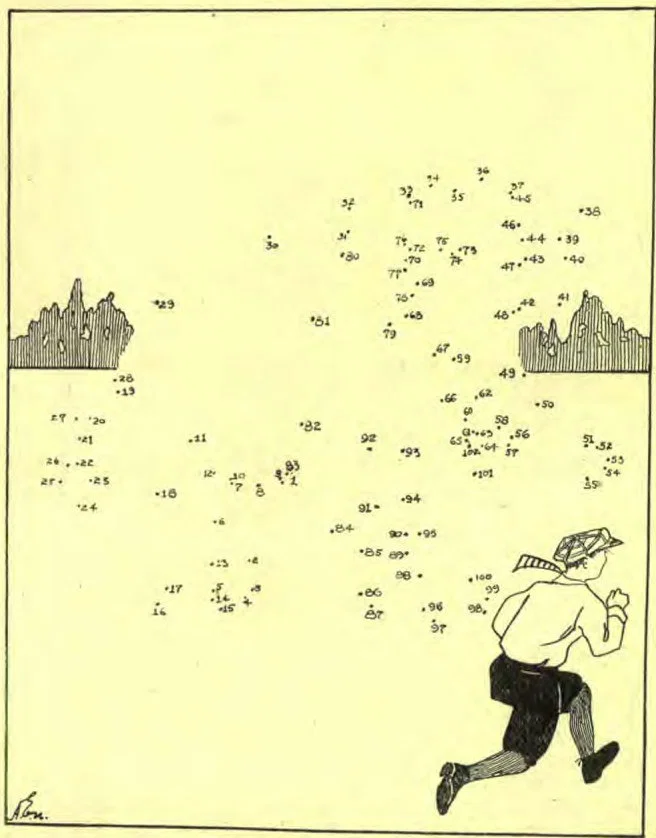
What is it? With a soft pencil start with dot number 1 and draw a straight line to dot 2, then from 2 to 3, and so on.
THE EARLY MORNING OFTEN FOUND JESUS IN SOME SECLUDED PLACE, MEDITATING, SEARCHING THE SCRIPTURES, OR IN PRAYER.

You have reached the end of this edition.

The Youth’s Instructor · May 22, 1917