While Christianity appears relatively to have reached in Japan an abnormal proportion of the higher classes of society, it must be confessed that the total number of followers of Christ in that empire is still lamentably small — say two hundred thousand, even including with the Protestants the members of the Greek and Roman churches. It is, however, stated by Dr. Nakashima, the professor of psychology in the Imperial University, that there are more than one million persons in Japan who are ordering their lives by the Word of God, though as yet unprepared to make a public confession of their faith in Christ. And a Buddhist editor writes: “Look all over Japan; more than forty million have a higher standard of morality than they have ever known. Our ideas of loyalty and obedience are higher than ever, and we inquire the cause of this great moral advance. We can find it in nothing else than the religion of Jesus Christ.”—Selected.
Too Busy
By Worthie Harris Holden
WORTHIE HARRIS HOLDEN
Too busy are we midst the whirl and the
stress
Of our life as the days come and go,—
Too busy to water with prayers and
with tears
The seed we abundantly sow.
Too busy with working for Jesus to
pause
And sit at his footstool of prayer;
Too busy commanding and guarding his
field
To learn what his orders are there.
Too busy with routine of cares in the
home
To seek him alone through the day;
Too busy in striving to faithfully serve
To listen to him and to pray.
How Satan doth gloat o’er his subtle
decoy
Of winding our life in this coil!
He knows when too busy to watch unto
prayer
Our triumph at last he will foil.
O guard us from whirlpools that threaten
to wreck
Our bark, Heavenly Pilot, we pray!
And teach us the blessing of walking
with God
Through holy communion each day.
Portland, Ore.
Lovers Always
THE woman that is a happy wife need not long to be courted again. There is no need—she is won. Nor are many compliments necessary. Mutual devotion is an ever-appreciated compliment. Yet, still, you who are married, do not quite forget those old days which drew you to each other. Be lovers always. Many people are; and those who love are safe. The meeting and parting kiss, the kind look, the appreciative word—never forget these. Never let marriage degenerate into the commonplace. So surely as you do, worse will follow; for the husband and wife who have no tender sentiment toward each other will become foes.—Great Thoughts.
A Life of Pleasure
A LIFE of pleasure makes even the strongest minds frivolous at last.— Bulwer.
The Pua (Chile) Sabbath-School Convention
By Mary T. Westphal
MARY T. WESTPHAL
In the country, about three miles from a small station called Pua, is located our mission school. Each year a canvassers' course is held in connection with it, closing with an institute. This year the Chile Conference committee was called for a session at the close of the institute, so it seemed an opportune time to hold a Sabbath-school convention while all the workers were together. September 10-12 was the date appointed, and we invited the Sabbath-schools in the vicinity to attend.
THE SABBATH-SCHOOL CONVENTION AT PUA, CHILE
We arrived Friday morning. We had Brother T. H. Davis's two motherless little girls with us, so he came with my husband to meet us. Several others from the school were at the station. Our luggage was sent out on the school ox cart, and we walked. When part way out, we were met by some brethren who had arrived before us, and farther on by the lady teacher, her sister, and another sister. They were on horseback, and after greeting us, took the little girls on the horses with them. The custom in Chile of meeting people on the way, and of going a short distance with them when leaving, cheers the heart, and lends sweetness to life.
When we arrived at the grounds, we saw a pretty green arch over the gate. Here the matron of the school and others met us, and as we passed along, we were greeted by the pupils. The porches and rooms were prettily decorated with green and flowers. Everything said to the heart, “Welcome!” Those there had done all they could to prepare for entertaining those coming, and their kind efforts were appreciated.
Among the subjects assigned to various persons were the following: “Importance of Bible Study,” “Object and Importance of Sabbath-school Work,” “The Sabbath-school a Means of Educating Workers,” “Duties of Sabbath-school Officers,” “How to Increase the Sabbath-school Offerings.”
The convention opened Friday evening, with a good sermon from Brother E. Balada, our Spanish minister. Sabbath morning at six o’clock, Brother E. Thomann gave an interesting talk on what he heard and saw at the General Conference. He continued his talk at the same hour Sunday morning. At nine o’clock, Sabbath-school opened, and we tried to make it a model Sabbath-school, bringing in exercises to show how the program can be varied. After the usual opening exercises, Elder G. W. Casebeer, director of the mission school, made a few remarks in regard to Sabbath-school work, then made a freehand illustration on the blackboard: a large river, with many tributaries (dimes and dollars), or small streams, swelling the great stream (the sum total). Another illustration was a thermometer, showing the rise and fall of the financial pulse in the Sabbath-school. All decided they would rather see the pulse rise continually than to drop. The children's division then passed into another room, and was reviewed by Brother Thomann, while the seniors were reviewed by Brother D. Soto, our Chileno minister.
After the class exercise, the children returned, and I had Brother Davis's two little girls, aged five and seven, sing “Once a Shepherd Band,” one stanza of which is:—
“Drop the pennies in, dimes and dollars, too,
Bring the shining gold God has lent to you;
These can cross the sea, these can preach and sing
Of a Saviour's love, of a coming King.”
Then the collection was taken. To bring the kindergarten work before us, we had Sister Reiner give a ten-minute exercise on Abraham's sacrifice. We brought a few of the little children to the front. All were much interested.
We closed with a hymn and a short prayer, or benediction, as is the custom here. Following, Elder F. H. Westphal gave a sermon on conversion, and some of the students arose, expressing their desire to serve the Lord.
In the afternoon, two papers were read and discussed. At five o’clock the young people's society of the school gave a program, closing with a musical trio—organ, violin, and zither. In the evening, the duties of officers was presented, and Brother Balada followed with a Bible talk and blackboard illustration.
The time on Sunday was well utilized. Among the papers presented was one by Brother Davis, director of the canvassing work, on “How the Canvassers Can Assist in the Sabbath-School Work.” At the conclusion of its reading, the colporteurs came to the front, and sang a beautiful hymn appropriate for the occasion. One very interesting paper was given by Sister Casebeer, showing the importance of the home Sabbath-schools. In the evening, a committee which had been appointed to suggest means to further the Sabbath-school interests presented an interesting report.
All the exercises were varied by recitations and music—choruses, quartets, and duets in Spanish, English, and German. The testimonies at the closing praise service Sunday evening showed that the meeting had been a great blessing. All seemed to have been refreshed and encouraged in Sabbath-school effort.
The session was considered such a success that the committee voted to hold another in Santiago in December. Here is located the largest church in Chile, and several other Sabbath-schools are near enough to attend. In January or February we hope to hold another at a church at the seaside, in the south. I thank God for the blessings of Sabbath-school conventions.
Santiago, Chile.
A Trip Through East Bengal
By J. C. Little
J. C. LITTLE
For some time in the past our work in East Bengal has been carried on with Gopalgunje as our headquarters. From this point our Bengali brethren have been sent out in small rowboats with our literature into the country villages for a radius of fifty miles or more. Our plan of work has been to keep these brethren with us for some days while they are instructed in methods of work, and taught our truths for these times, and then send them on a two- or three-weeks' tour to put in practise and teach what they have learned. Then again they are brought in and spend a few days in study, and once more go out among the people. This they have been doing for several months past.
At our Bengali conference in January, 1909, it was thought best to ask Brother J. H. Watson and family to take up work at Gopalgunje, making a trial of the place to see if it was suitable for our work and favorable from a health standpoint for the workers. After a number13of months' experience, it was thought best not to continue work there, but to seek a healthier and better location for a center of work in East Bengal.
Accordingly on the first of November, 1909, Brother Watson, Brother L. G. Mookerjee, and the writer left Calcutta for a short tour through East Bengal, with a view to finding a place that would make a good center for our work, and at the same time be a healthful locality for our workers. East Bengal as a whole is low and damp, and therefore very malarious, and in most places the water is so bad that only distillation will render it fit for the human stomach. Even the people of the country are afflicted very commonly with enteric fever, dysentery, cholera, and other diseases common to low and swampy districts; and to find a place where foreigners can live in health is no small problem.
Our first stop was at Gopalgunje, where we met our Bengali workers who have been selling literature in the villages of East Bengal. We stopped here for two days, and then left on a small boat for Madaripur, about thirty-five miles away. This boat was not built after the latest designs, but was probably the same pattern as those used by the fishermen of Galilee two thousand years ago. Our progress was very slow. Leaving Gopalgunje about 9 A. M., we did not arrive at Madaripur until early the next morning. Our way lay through an old canal constructed no one knows when, but now being dredged at considerable expense by the government. The government officers in charge of the dredging operations, four in all, being in the district alone, miles away from any but the native villagers, were pleased indeed to see us, and invited us aboard the dredging steamer, offering us their hospitality and kindly showing us all about the machinery and work.
About the middle of October East Bengal suffered very severely from a cyclone which did much damage to property, and resulted in the loss of several hundred lives. Everywhere as we went through the country, we saw houses, and sometimes almost whole villages, lying leveled to the ground. Many river steamers were caught suddenly in the storm and capsized at once, with all their passengers. We saw at one place a large flatboat, one half submerged and the other half blown upon the river bank, thus lying at an angle of about forty-five degrees. We did not travel through the worst part of the storm area. Some of our own people have suffered considerable loss financially, but we are thankful that no lives were lost from among them. This disaster we intend to notice in our Bengali paper, Jug Lakhan, to call attention to the times in which we live.
On our way to Madaripur we passed thousands of villages swarming with Bengali people. Probably ninety-nine per cent of these villages have never had a messenger of truth, and the vast majority of them know nothing of Christ and the gospel. As we saw these countless villages, and realized that beyond the mile or two of our vision, on each side, lay hundreds of miles in the same condition, we had brought home to our hearts very forcibly the great work before us, and the need of more laborers for the Lord's harvest. When will these millions for whom Christ died receive the warning? Who will accept the burden, and come over and help us give the last message of mercy before it is too late? My dear brother or sister, as you read of these millions who sit in darkness, ask yourself the question, Have I done my duty by them, or is God calling me to bring to them the light of life?
Madaripur is a small station with not more than a dozen foreigners in it, some of these being jute dealers and some government officials. It is considered one of the most healthful places in East Bengal. The Baptists formerly had a mission station there, but at present have only an outpost. We spent a day there, but found no opening favorable for our work.
From Madaripur we came by steamboat to Barisal. This is one of the best towns in East Bengal. The roads are well laid out, and the drainage of the town is good. Beautiful palms and other tropical trees grow here in abundance. This place has been described to us as the “Sanitarium of East Bengal.” Missionaries of the Church of England, Roman Catholics, and Baptists, which are here, and work from Barisal as a center.
We spent several days looking about, and in earnest prayer that God would guide us in the matter of finding the right location if it were his will that the work should be planted in Barisal. A Bengali Christian gentleman, a member of the Church of England and honorary magistrate at Barisal, took a most kindly interest in us, and did all in his power, even putting himself to no little inconvenience, to help us find a suitable bungalow for our work. His efforts and ours were at last rewarded by finding a bungalow in a good part of the town, which, with a little repairing, seems well adapted to our purposes, at a reasonable rate of rent.
We expect to make Barisal the headquarters of our work in East Bengal. From this point a network of steamer lines runs out to different parts of East Bengal, a large part of which includes the delta of the Ganges. We, with Brother Watson and family, located at Barisal about the first of December. We are the only workers in the whole East Bengal country, which contains about twenty-five million Bengalis, and is one of the most densely populated tracts of country in the world. Dear reader, what are we among so many? Who will come over and help us give the message to these millions?
Barisal.
Meeting at Kobe, Japan
By H. F. Benson
H. F. BENSON
WITH the object in view of reaching the largest possible number of believers, it was thought best this year to hold several district meetings instead of one general meeting. The meeting for the Kobe district was held October 7-14. Quite a large number of believers and workers were present. The report of the General Conference delegates, Elders F. W. Field and H. Kuniya, was exceedingly interesting to all, especially so to the Japanese brethren, as but few of them were able to read the Bulletin. The studies on the Testimonies, by Elder Field, were especially helpful; we all regret that we have not been able to have at least a part of the “Testimonies for the Church” translated into Japanese. There is a call for them, as well as for all our denominational books. Elder Kuniya gave some very timely discourses on the main points of our special message to the world at this time.
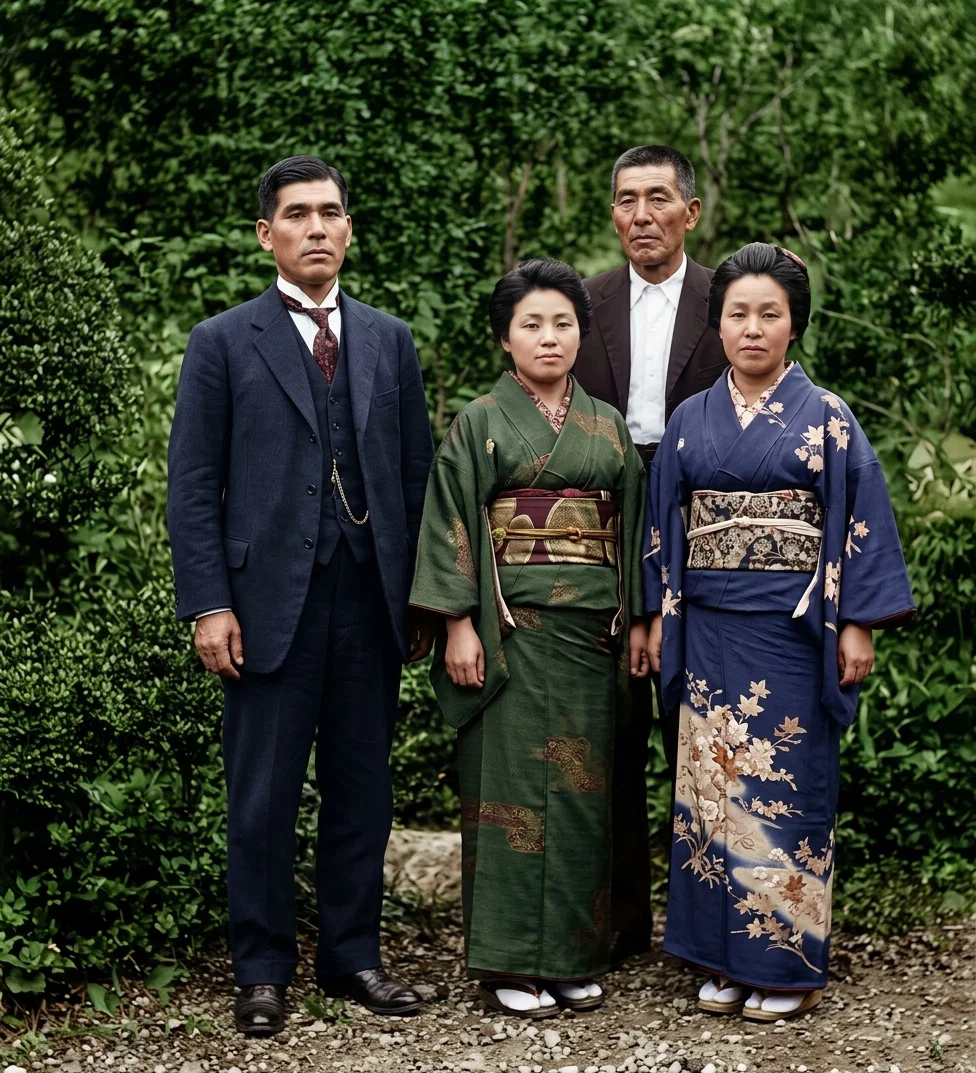
ELDER H. KUNIYA AND WIFE AT THE LEFT, BROTHER NOMA AND WIFE (DR. NOMA) AT THE RIGHT
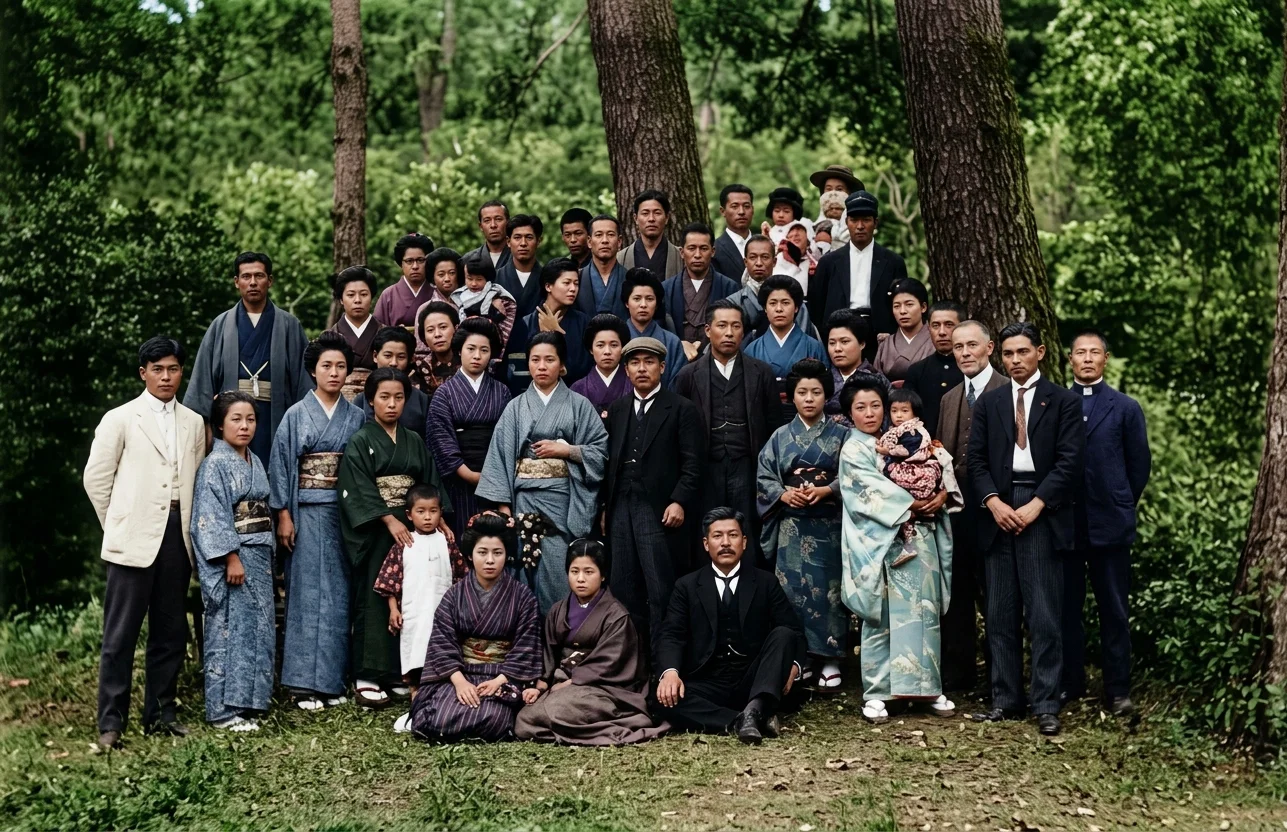
WORKERS AND BELIEVERS ATTENDING THE KOBE MEETING
The workers at the Japanese Sanitarium were very busy, but all managed to attend most of the meetings. We all were pleased with the progress and the14success manifest at the Eisein (Japanese translation of our word sanitarium), and we all know that God has greatly blessed the efforts made by Dr. Kiku Noma and her associates. I believe few who have begun sanitarium work with no more apparatus than a bucket and a fomentation cloth have had more difficulties to overcome than has had Dr. Noma. Her early training did not include instruction in our methods of treating disease; this she has been compelled to obtain from books especially translated for her, and from such other sources as were available. The Japanese have great faith in drugs, and much difficulty is experienced in convincing them that a cure can be effected without their aid. I am sure it would be an inspiration to our workers at home to see Dr. Noma at her work in the sanitarium.
All who attended the meetings were greatly benefited, both by the studies and by the reports from the General Conference; but most of all, by the presence of the Spirit in our meetings.
During this meeting the mission committee met, and it was decided that Brother J. C. Foster be asked to take up work in Wakamatsu, and that Brother J. N. Herboltzheimer be requested to make Nagasaki his field of labor. On account of a class for instruction in nursing which Brother Herboltzheimer was holding at the Japanese Sanitarium, it has since been decided to have Brother Herboltzheimer remain in Kobe for a few months, and for Brother Foster to go to Nagasaki.
Hiroshima.
The Amoy (China) General Meeting
By W. C. Hankins
W. C. HANKINS
WE have just recently closed one of the best workers’ meetings we have ever held in this province. The meeting was called on short notice, so only a few of the brethren from the other companies were present, but all the workers were able to be with us, and quite a few came in from the outside, both from among the heathen and members of other churches, so that we had an average attendance of from thirty-five to forty.
It was not, however, because of numbers that we counted it one of our best meetings, but because of the presence and power of the Holy Spirit. From the very first meeting, the Spirit was felt among us, and continued with us until the very last service. We felt that this was largely in response to the earnest and continuous prayers of some of our number, in which we were soon joined by most of those present. In the early morning prayer-meetings the time was almost wholly taken up by short earnest prayers. In the testimony and praise services many testified of the good they had received, and said they felt that they could go out and do better work for the Master from now on.
The program was so arranged that each one of the workers was given some part in it, and this also added to the interest of the meeting. One of the young evangelists gave one of the best sermons on the seal of God and mark of the beast that I had ever heard.
These meetings were attended by a young preacher from the London Mission who has been interested in the truth for about a year. The Holy Spirit worked upon his heart and led him to take a firm stand for the truth. After a thorough examination, he was baptized, along with one other candidate. There were others who desired to be baptized, but we felt that they had better wait a little longer.
The meetings closed with a strong sermon on the Sabbath question, by Elder N. P. Keh, which was quite well attended by those outside of our own ranks. Our little chapel was filled to its utmost capacity.
We believe that these meetings have not only been the means of giving new spiritual life to our workers and an impetus to our work in general, but that there have been seeds of truth sown in the hearts of some here that will eventually spring up and bear fruit unto eternal life.
Personally, we have learned to trust more in the power of prayer, and we wish to request that every one who reads these lines will especially remember the work here before the throne of grace.
Kulangsu, Amoy.
Harvest Ingathering Notes
I AM glad to say that the Ingathering campaign is onward. One brother, a farmer, who had to use his papers in the country, received $29.30 from distributing one hundred eleven copies of the REVIEW. This I consider a very good average for country work.
A sister, in sending in a remittance of several dollars, says that she thinks the people give more liberally to missions than they did last year, as they seem to understand the work better. I think that is a good testimony to the advisability of following up the work year after year. The ingathering work is certainly educative. Aside from its direct help for foreign missions, I consider it one of the best kinds of home missionary work that our people have ever undertaken. I think the work a grand success.
A. R. OGDEN, Utica, Mo.
Brother E. E. Pennington, located at Little Falls, has sent us a check for fifty-three dollars, the amount received from distributing three hundred copies of the Missions number of the REVIEW.
Mrs. Ella F. Ogden, Swedesboro, took seventy-five papers, and going forth with the earnestness of her first love for the third angel’s message, she was able to secure about forty dollars, making a splendid average of fifty-three cents for each paper distributed.
Mrs. C. E. Tickner, of Newton, reports receiving a check for five dollars from a friend, in return for one paper sent through the mail.
Brother J. E. Layton, of Newton, sings the praises to the “Creator of earth and sky” for his precious experiences while giving away several hundred papers. He received about thirty dollars.
D. K. ROYER, Trenton, N. J.
Your letter to Elder C. B. Stephenson in regard to the Harvest Ingathering campaign was read with interest. I notice that the workers in your general office are sending out their copies of the REVIEW by post. You will be glad to know that we are doing the same here at this office, besides our personal work.
We had one especially interesting experience. In answer to one of our letters, we received a telephone message from a flour-mill, offering to send us some flour as a donation if we would accept it. We, of course, told them we would accept it, by all means. When they brought the flour, the bill was $8.79, marked, “A donation.” As we can get this money out of the flour, we can turn over the full amount to foreign missions.
HELEN D. DOWSETT, Atlanta, Ga.
I am a reader of your paper, the REVIEW AND HERALD, although I am not an adherent of your faith. However, I am, for certain reasons, much interested in your denomination and your work.
During the holidays I received a package of ten papers, and as I am not much of a missionary worker, I left them lying in the lobby of the hotel where I am stopping, and I noticed that several were reading them, and they elicited considerable discussion. In reading the papers a little later on, I discovered that they were to be used in swelling a certain missionary fund, so I am enclosing to you a dollar to pay for the same.
I admire your denomination, for I believe that most of its members are honest and sincere, and you are certainly blessing the world in your promulgation of health principles.
A FRIEND, Sandpoint, Idaho.
I must tell you of my success with the Harvest Ingathering number of the REVIEW. I received my ten copies, but was so busy for the first few weeks that I could not touch them, but they just worried me until December 23, when I felt that I must make a start. So during the noon hour, while at my room, I asked the Lord in prayer to direct me in the way, as I wanted to begin with one of our wealthiest citizens. That afternoon I went across the street to this gentleman, and presented the paper to him. He took it, but when I gave him the solicitor’s card, and he saw that the list had not been started, he objected to putting his name down first. So I turned to his partner and asked him if he would start the list. He responded by giving two dollars. Then the first one put his name down for $2.50. A nephew of his in the same office also gave two dollars.
Then I went to another office and secured a few dollars more, after which I solicited whenever opportunity offered, and finally turned in my card with sixteen names and seventeen dollars. Really I had only one refusal.
A WORKER, Colon, Panama.
Central Union Conference
By Ole Andres Olsen
THIS meeting was held at St. Joseph, Mo., January 13-23, in the Y. M. C. A. building, which had been secured for the occasion. The several conferences of the Central Union were represented with a full delegation, and all the deliberations were characterized with a marked degree of unity and harmony. It was very evident that one leading thought and feeling that held supremacy in every mind was that of bending every effort to meet each requirement to hasten forward the message to a speedy and final glorious consummation.
The Y. M. C. A. building was found to be very convenient, as it not only furnished a spacious auditorium for the meetings, but also a commodious dining-room for the serving of meals for those in attendance, and rooms for the various committees to hold their meetings and councils. So for the ten days of the conference, we virtually lived in the building. This arrangement was both convenient and pleasant, and made the occasion much like a cordial family gathering.
The laborers present from the General Conference were Elder G. A. Irwin, Prof. M. E. Kern, and the writer. Elder Irwin conducted some very practical and instructive studies, which were much appreciated. Professor Kern's labor, especially among the young people, was very helpful. One can only regret that the time given for these meetings did not allow every question to receive all the attention its importance deserved.
These union conferences are filling a very important place in our organized work, as nearly every branch of the work as a whole is represented in these unions. This was very manifest at this gathering, where the various departments of the work, such as publishing, educational, and health work, all came in for careful consideration, as well as the direct conference and field work in the Central Union Conference territory.
The reports from the field and the institutions were all of an encouraging nature. Still we can but feel that we are not realizing all that we might rightly expect from the efforts put forth. We must not hide our faces from the fact that in the multitude of business that necessarily crowds itself in upon us, and in the press and rush that is everywhere present, we are liable to slight the hour of devotion and prayer. This is a matter that must receive full attention, for we all know that no business activity can fill the place of communion with God—the source of all our wisdom and efficiency.
The two Sabbath services of the conference and the morning devotional services day by day, were seasons of blessing and refreshing. It was indeed encouraging to note the readiness on the part of those present to make the most of the opportunity for gaining advanced ground and advanced experience in divine grace. The subjects of the discourses and Bible studies were close and searching, and the Spirit of God witnessed to the truth spoken, which was well received by the congregation.
Discourses presenting the leading features of the message were given every evening during the conference, and we trust the seed thus sown will find lodgment in some good ground and bear fruit to the glory of God.
Elder E. T. Russell was re-elected president of the Central Union Conference, and only slight changes were made in other positions. Harmony and union prevailed during the entire session, and in all the deliberations. The $300,000 Fund was taken hold of with a will and enthusiasm that insure success, and the same can be said of the sanitarium and relief work with “Ministry of Healing,” and of the magazine sales.
The meeting closed with a good spirit, and we trust the coming biennial season may be a prosperous one in the advance of the message in this conference.
O. A. OLSEN.
Greater New York Conference
By W. B. White
THIS conference held its annual session January 18-23 in the hall of the American church in The Bronx. About fifty delegates were present from the several churches of Greater New York, and those present from outside the conference were Elders W. W. Prescott, of Washington, D. C.; O. O. Bernstein, of Philadelphia; H. W. Carr, president of the Western New York Conference; H. C. Hartwell, of Central New England; O. Montgomery, of Maine; R. J. Bryant, field missionary agent of the Atlantic Union Conference; and the writer.
From the first, the presence and power of God were present in the conference, and the greatest unity and harmony prevailed in all the sessions. We do not remember of any action that was taken with a divided vote, and all present seemed desirous of co-operating in every way possible to make the work in this great center a success. As reported in the 1909 Year Book, the Greater New York Conference has a membership of 944, with twenty-three churches. These paid, during 1908, $19,774.42 tithe; in 1909, $18,897.43, a falling off of $876.99. A number of things contributed to bring about this loss the past year, and it is hoped that during 1910 a good increase in tithe may be seen. In 1908 the conference contributed $4,997.08 to the work of foreign missions, and during 1909, $5,267.75, a gain of $360.67. The report of the Sabbath-school and Missionary Volunteer secretary showed substantial gains, and was very encouraging. At a mass-meeting held in the Y. M. C. A. auditorium during the conference, $1,758.43 was pledged on the $300,000 Fund, $706 on the tent fund, and about $540 on the South Lancaster farm fund, making, in all, about $3,000 raised at the meeting.
Elder Prescott, on the recommendation of the General Conference, is now connecting with the work in this field, as is also Elder Bernstein, of the Eastern Pennsylvania Conference. They are receiving a very hearty welcome, and plans are being laid for broad, aggressive work the coming season.
Elder M. L. Andreasen has now started a Bible school at the Fourteenth Street chapel for those speaking the foreign tongue who desire to better prepare for the work, and as soon as possible the conference will open a Bible training-school for English-speaking workers.
By an arrangement made between this conference and the Western New York Conference, Elder and Mrs. L. H. Proctor will in early spring make the Western New York Conference their field of labor. Long and faithfully have they served this field, and God has given them precious souls, and they certainly will be missed in the Greater New York Conference.
On Sunday evening at the close of the conference, Brother J. J. Kennedy, who has fully proved his gift in this field, was ordained to the gospel ministry. The presence of God was manifested in a marked manner during the service, and all felt that God had set his seal to the work done.
Elder R. D. Quinn was elected to the presidency of the conference, and associated with him on the committee are L. W. Graham, M. L. Andreasen, J. K.16Humphrey, A. V. Cotton, O. O. Bernstein, and L. Klebahn.
Prospects in the Greater New York Conference look bright for the coming year, and may the Heavenly Father abundantly bless the work in that great and important center.
W. B. WHITE.
Another Chinaman Won
By Roy F. Cottrell
You may be interested to hear of a little incident which occurred at Mokanshan last summer. It was Sabbath day, and I was staying with Mrs. Cottrell, who was ill. Our brethren and sisters were all away at Dr. H. W. Miller’s cottage for the Sabbath services. One of the coolies who was helping in the treatment-rooms had caused us much trouble by working Sabbath days, although he had repeatedly been told that he must not work. On this occasion, instead of laughing as he had formerly done when forbidden to labor, he became very angry, made violent demonstrations, and finally even came and pounded on our windows and doors, in the attempt to get into the house. We had not seen a soldier around the cottage before during the season; but just as we were becoming quite anxious over the situation, one appeared, who quickly adjusted matters.
He seemed to be a very nice fellow, and I therefore asked him if he was a Christian. He said No, but he had heard some of the missionaries preach. When asked if he believed there was a God, he replied that he felt sure there must be one. We then gave him some reading matter, and he promised to come to our services for the Chinese. We afterward learned that he was the head man on the mountain, for the natives of that province. From that time on he attended our meetings regularly, and soon expressed his desire of becoming a Christian and keeping the Sabbath. One Friday he was called away by an official who lived about ten miles down the mountain. But the next morning he arose early, arriving fifteen minutes before time for our ten-o’clock service. He has since abandoned his soldier life, and is now one of our most faithful men at the mission press. Such experiences as these reward the missionary for any of the so-called sacrifices that he may have made in leaving home or friends.