THE following from a private letter illustrates a point which is well worth considering:—
‘I went down to Mr. — on an errand, and he and his wife began the conversation upon Bible themes. He asked me several questions which I could not answer, but I told him I would furnish him tracts that would. One of his questions was, Who changed the day? This family is probably the wealthiest in our community. ‘Now,’ said he, ‘you people have always been afraid to mention the subject to me, and because of this I have been afraid of you, too.’’
Is it possible, dear reader, that such a statement as this may be made about us when it is too late to answer satisfactorily?
H. H. HALL.
Personal Responsibility and Destiny
“No one else can solve your problem, or work out your riddle. You stand or fall by it. Your happiness, your well-being, your success, and your destiny hang upon your carrying out the program the Creator has given you.”
How to Get on With Disagreeable People
SOONER or later, I suppose, it falls to the lot of all of us to live, for a longer or shorter period, with a disagreeable person. Not that they are really disagreeable in themselves, perhaps they may be even attractive and loveable to some people; but to us, on account of their temperament and tastes differing so widely from ours, they appear difficult to get on with.
It is very important to learn the divine art of living with uncongenial people; for to be continually “rubbed the wrong way,” to daily meet with jars and friction, will slowly but surely wear away our very life. Our health and our spirit will gradually disappear, yes, and it is to be feared, alas! our grace also.
Going through life, I have learned some valuable lessons that have helped me to bear patiently with disagreeable people, when it has been my lot to meet with them.
The first is this: if you find some one trying and hard to live with, you may be almost certain that he also finds things about you that are irritating to him.
I remember that when, as a child, I confided to a mutual friend how difficult I found it to get on with a companion, I was more than surprised when she quietly remarked, “She says that you are so very trying sometimes.” I had never dreamed that I had been in the least to blame! And as the years have rolled by since then, I have noticed again and again that, if there is friction, it is almost invariably felt on both sides. How often it has helped me to be patient, if some one has rubbed me the wrong way, to say to myself: “No doubt, although I am not conscious of doing or saying anything wrong, I am trying her as much as she is trying me.”
Another useful lesson experience has taught me is, that, if persons are irritable and cross and difficult to please, very often the reason is because they are suffering (all unknown perhaps to those around them) in mind or body; and, if we only knew all their pain, we should feel it was pity instead of blame they deserved.
A third lesson I have learned in some measure is, if people are disagreeable, to make allowances for their natural disposition, and not to expect the same sympathy and consideration from those who are not naturally sensitive and tender-hearted, as from those who are. The former can not be expected to know what a little thing will hurt the latter.
I have noticed on different occasions, when some one who had been born, as it were, without sympathy or tact, said what seemed to be an unpleasant or cutting thing, it was not that he meant to be unkind or to wound; it was simply because he had the misfortune to have a bad manner and to possess no natural tact. If we are different from such, let us thank God for it, and say to ourselves: “Who maketh thee to differ from another? and what hast thou that thou didst not receive?”
Mrs. Charles has beautifully expressed what I am trying to say when she wrote: “How many of our resentments would die out by simply realizing that the deeds or words or omissions which wound us were not meant, or that, if indeed they were meant, they arose from a difference of character, or a want of imagination, which prevented the perception of how they would pain!”
But though the three lessons we have mentioned are very useful and precious, they do not go deep enough. If we are to get to the root of the matter, we must learn a more spiritual truth; namely, that our relations with our fellow men largely depend upon our relations with God, that we can only truly keep in touch with those we live with by keeping in touch with God.
This is the most important fact for us to learn, that we keep right with men when we keep right with God.
How searching are Pastor Stockmayer’s words: “When nothing comes between us and God, there will be nothing coming between us and our brethren.” The smallest friction with our friend, our neighbor, or our fellow worker, ought to be an alarm call to awaken us to the fact that all is not right between our soul and God. If we are finding it difficult to “let our yieldingness be known unto all men,” the reason is that we are not sufficiently yielded to God.
One who has had large and long experience in dealing with Christian workers says: “The soul that is filled with the Holy Ghost is adjustable both to God and man. The easiest people to get along with are those most filled with God.” If, then, we have not learned to get on with disagreeable people, and can not yet bear and forbear, we may question if we know what it is to be filled with the Spirit.—The Life of Faith.
Only a Leaf
It was only a little leaf
That hung for a while on its bough;
It danced and fluttered; but life was brief,
And its place is vacant now.
It was only a little leaf;
Did it pay to live at all?
The sun smiled on it, the cold rains came,
And then it was doomed to fall.
It was only a little leaf;
But on it did shine the sun,
The winds did caress it, the birds did sing,
And it lived till its work was done.
It was only a little leaf;
But it took its gladsome part
In the great earth's life, and at the last
Earth clasped it to her heart.
—Selected.
A Weather Rhyme
WHEN the weather is wet,
We must not fret;
When the weather is cold,
We must not scold;
When the weather is dry,
We must not cry;
When the weather is warm,
We must not storm,
But be thankful together
Whatever the weather.
— Selected.
If You Want to Be Loved
DON’T contradict people, even if you are sure you are right.
DON’T be inquisitive about the affairs of even your most intimate friend.
DON’T underrate anything because you don’t possess it.
DON’T believe that everybody in the world is happier than you.
DON’T conclude that you have never had any opportunities in life.
DON’T believe all the evil you hear.
DON’T repeat gossip, even if it does interest a crowd.
DON’T go untidy on the plea that everybody knows you.
DON’T be rude to your inferiors in social position.
DON’T overdress or underdress.
DON’T jeer at anybody’s religious belief.
Learn to laugh. A good laugh is better than medicine.
Learn to hide your aches and pains under a pleasant smile. No one cares whether you have the earache, headache, or rheumatism.
Learn to attend to your own business—a very important point.
DON’T try to be anything but a gentlewoman or a gentleman, and that means one who has consideration for the whole world, and whose life is governed by the golden rule: “Do unto others as you would be done by.”—Christian World.
God Is Love, Whatever the Wind
A FARMER had a weather-vane made for use on his barn, in which were wrought the words, “God is love.” Some one said to him, “You have placed an immutable truth on a changeable thing.” “Well, sir,” replied the man, “I want you to understand that that means God is love whichever way the wind blows.” There is more truth in that saying than in some sermons an hour long.—Selected.
Malaysia
By R. W. MUNSON
R. W. MUNSON
When we come to the flora of this region, human speech ceases to be adequate to the task of telling the wonders that abound here. God has lavished upon the vegetation of Malaysia the most varied and delicate shades of green, the like of which can be found nowhere except in the seas that enclose these islands. The brightest colors of the rainbow are employed to paint the giant flowers of the jungle or the blossoms of the forest trees.
A RIVER SCENE IN JAVA
The density of foliage, the infinite variety of forms, the contrasts presented, the delicacy of foliage, all submerge the newcomer especially, in overwhelming waves of delight. He involuntarily exclaims, if not too sordid or prosaic, “This must have been the site of the garden of Eden.”
The cocoanut palm is the most conspicuous of all the larger plant life of the Indies. It is both fruitful and abundant. There is a dignity and royal bearing about this tree that never fails to impress the stranger, and that ever grows upon the man who comes to stay. It is stately, it is beautiful, it is graceful, and it is eminently useful. I have spent many years in the tropics, yet my love for the palm increases with the years. I can never be happy away from it. Its fascination constitutes one of the important elements of the charm which this land has for me. If it please God, I shall never leave this land where it flourishes, or remain long away from it. If the Lord tarry so long, I hope to be buried beneath its shade. If I live until the Lord comes, I hope to gaze upward through its green fronds, and see my Saviour coming in the skies.
Do not imagine that all this is mere fancy or false sentiment. God pity the missionary who does not feel just this affection for the land to which the Lord has called him, and not for the land only, but for the inhabitants. To the man truly called and sent of God, there is a true love for the people of the country, their language, their faces, and their dress: this is necessary to his happiness. I see the love and wisdom of the Creator here in the luxuriant and sunny tropics as I never saw them in the more barren fields and forms of my native land. God evidently designed me for this land of perpetual sunshine, of gentle seasons, and mild-mannered people. Not a day passes that I do not feel welling up in my heart the profoundest gratitude to God for his great love in calling me to this work and this ‘garden of the gods,’ to devote my life to the work of telling these poor enslaved victims of Satan, of Jesus and his love.
I feel a kind of disgust whenever I read, as now and then I do, expressions of sympathy for missionaries for having exiled themselves ‘from home and friends and all that life holds most dear,’ in order to come to these benighted lands of the Orient. Of course, we love our kindred and country, and it cost us a struggle to decide to leave them, but the joy we felt and still feel in relinquishing what the world ordinarily prizes in order to do the Father’s will, the sweetest thing in heaven or earth, is a thousandfold greater than the joy of seeing our friends or enjoying the conveniences or comforts of life in a country like England or America.
I would to God that I could impress upon the minds of all God’s dear children that where God is, there is paradise, no matter if it be on the burning sands of Arabia or the frozen icebergs of Greenland. Circumstances can not make a man happy. Only those who gladly renounce self and all its ambitions, and sink their own will in the will of God, are truly happy. But happiness, after all, is not what we are after. We can not always be happy, and it does not signify very much whether we are or not. To be right with God and in harmony with his will for us is the great question. How I bless God that we have found this secret of true happiness! It lies in seeking the happiness and welfare of others rather than our own. When a man becomes supremely reckless about his ‘own interests,’ and literally gives himself away for Christ’s sake, then it is that he finds the true joy of living.
But I have wandered from my theme, because I could not resist the temptation to give vent to my feelings concerning the beauty and charm of this country and this work. There are many trials and discouragements, but we thank God for grace to endure the one and overcome the other. In the midst of our sorest difficulties we have had the sense of God’s presence, and have been able to rejoice in the Lord, and to go on our way without losing heart or courage.
One of the most interesting and gratifying features of life in this land is the abundant supply of wholesome and nutritious as well as palatable food available. In some respects it is a paradise for vegetarians; for we have a good variety of excellent foods that are cheap enough to render it possible to live quite economically upon little else than native products. The fruits are very nice, there being in every season of the year some fruit that is plentiful and cheap; and there are bananas the year round, besides pineapples a good part of the year.
The mainstay of the population is rice, that incomparable cereal, so cheap in price that a family can be fed on it for a few shillings a month, so nourishing that little else is needed, so easily digested that dyspepsia is almost unknown. There are many kinds of rice. There is the cooking rice, for the mainstay of the meal, and there is another highly gelatinous kind that is used chiefly in making the puddings or pastries of which the natives are so fond.
The cocoanut enters very largely into the diet of both Malays and foreigners. There are a dozen varieties of bananas, also the pineapple, jack-fruit, papaya, mangosteen, ramutan or ‘hair-fruit,’ sour orange, sweet orange, lime, custard apple, alligator pear, and the notorious as well as famous durian.
I can not pass the durian without something more than a word of description; for it is far famed as the fruit14which is delicious to the sense of taste, but intolerable to that of smell. It is a tall, elm-like tree, and bears a fruit varying in size from a small muskmelon to a six-quart pail. It is rather oblong, and covered with strong spikes, or thorns, thickly spread over its surface. These thorns, from which the fruit takes its name, are broad at the base, but sharp at the extremity, and make them uncomfortable things to handle except by the stem. The interior is always divided into five pod-like pockets similar to the interior of a pea pod. These pods are of a rich satiny white, and are each filled with an oval-shaped seed covered with a thick cream-like pulp. This pulp is the part of the fruit that is eaten, and constitutes only about twenty per cent of the entire mass.
Wallace describes this pulp as follows: “A rich, butter-like custard, highly flavored with almonds, gives the general idea of it; but intermingled with it come wafts of other flavors that call to mind cream cheese, onion sauce, brown sherry, and other incongruities. There is a rich glutinous smoothness in the pulp which nothing else possesses, but which adds to the delicacy. It is neither acid, sweet, nor juicy, yet one feels the want of none of these qualities; for it is perfect as it is. It produces no nausea or other bad effects, and the more you eat of it, the less inclined you feel to stop. Indeed, to eat durian is a new sensation worth a voyage to the East to experience.”
I care little for it, although I like its taste, because it is too difficult of digestion. The most remarkable thing about it is its pervasive, and to newcomers, offensive odor. Mark Twain said that eating durian was “like eating Limburger cheese over a London sewer.”
Besides the foods and fruits already mentioned, we have potatoes, both the Irish and sweet; flour from California and Europe; canned biscuits; California fruits, both dried and canned; and a great variety of canned vegetables. Ground, or monkey, nuts are plentiful, and quite as cheap as at home. White beans are abundant, and form a very important part of our diet. Sugar is cheap, and is a dark kind made from a species of palm that closely resembles in flavor the maple sugar so popular in the States.
So you see we do not go hungry or lack the comforts of life in these ends of the earth.
(To be concluded)
Annual Meeting of the North England Conference
By GUY DAIL
GUY DAIL
The delegates of the North England Conference assembled on the same grounds as last year, at Leicester, August 1-7, for their second annual gathering. The eleven churches and five companies were represented by an attendance of about one hundred and twenty-five. The weather was all one could desire, as the sky was clear, and sumptuous, we were blessed with almost continual sunshine each day of the meeting. The townsfolk showed a good interest, although the attendance from the outside was hardly as large as last season. The brethren gave earnest heed to the word spoken.
All lines of work received attention. The reports showed progress. For the year ending June 30, 1904, there had been eighty-five baptisms, and twenty-nine had been received by vote. The membership had grown from three hundred and seventy-eight to four hundred and one. This is not a very good showing; for in the numbers reported a year ago, some were counted who in reality did not belong to the church at all. Through the earnest efforts of the former secretary and treasurer, Brother C. H. Castle, correct lists were prepared, so that we know now who are united with us, and who are not, at least so far as open profession is concerned.
The work of God does not go forward in the Continental countries without great difficulties, and it must encounter opposition and ridicule and indifference in England. Simple gospel truth is not any more popular in our time than it was in the days of Noah. However, there are some who really are seeking truth, and who will obey God at all hazards. Such recognize his voice as the Scriptures are more fully opened to their understanding. It is from among this class that we have been able to organize five new churches in North England the past year. One of these is a conference church, organized to contain the larger number of the isolated believers. The recently organized congregations in King's Heath, Birkenhead, Manchester, and Leicester were received in the sisterhood of churches at this conference. It was in grateful recognition of the good work done that the first resolution was passed at this meeting:—
“Resolved, That the first resolution of this conference be one of thanks and gratitude to our Father in heaven for the spiritual and financial prosperity during the past year, in that he has given success to all who have labored for him, and added strength and growth to the cause of the third angel’s message in the North England Conference.”
As to the financial prosperity, the tithe for the year was £1076 7s. 1d., an increase of £123. Through the very generous assistance of the California Conference, which gave them £390 5s. 3d., the North England Conference was able to settle with all its laborers, and have a small balance in the treasury.
Creditable work has been done also in the Sabbath-school and church-school departments. At the end of the first quarter of the conference year, there were thirteen Sabbath-schools, with a membership of 355, and at the close of the year, there were seventeen schools, with an enrolment of 490. Their donations had been £93 11s. 3d., and of this sum, £52 11s. 3¾d. was given to missions. A new church-school was opened at Kettering last year. Sister Castle began the work, but was compelled to give it up on account of her health. She was succeeded in March by Sister Raywell. This school is supported by contributions and tuition; it has an enrolment of twenty-six, and an average attendance of twenty-four. It was in reference to the esteem in which the labors of Brother and Sister Castle had been held that the conference passed the second resolution:—
“We desire to express our appreciation of the faithful and able services of Brother and Sister Castle during the time they have been with us, and our deep regret that the state of Brother Castle’s health makes it necessary for him to seek a change of climate and occupation, and our sincere trust that, with the blessing of God, he may soon be restored to health and strength, and be spared to have a part in the giving of the glorious message until Jesus comes.”
Brother Castle sincerely thanked the brethren for their kindly expressed sympathy and well wishes and appreciation of the efforts he had put forth.
Feeling that the highest standard has not yet been reached, however, by the churches and Sabbath-schools, this resolution bearing upon the further improvement of the Sabbath-school Department, was heartily supported:—
“Whereas, The Lord has given very clear instruction concerning the importance and value of the Sabbath-school work; therefore,—
“Resolved, That the conference committee be requested hereby, to make a special effort through this conference year to bring this branch of the work to a higher standard than it has hitherto attained.”
Brother Gillatt has been in charge of the canvassing work in this field the past year. He has been succeeded by Brother Joyce. Probably in no other land are our canvassers doing more to spread the message than they are doing in Great Britain. Forty agents and many of our lay members in the North England Conference have been busy at work scattering our periodicals, and between a dozen and sixteen colporteurs have been selling our bound books. From June 30, 1903, to June 30, 1904, 564,748 papers were distributed, and books to the value of £1084 7s. 6d. were sold. These resolutions expressed the sentiments of the delegates with reference to this branch of the work for these times:—
“We recommend, That every family and each worker in the North England Conference be encouraged to subscribe for the Missionary Worker and the REVIEW AND HERALD, in order that they may keep in touch and in sympathy with the progress of the third angel’s message in all its phases, throughout Great Britain and the entire world.
“Whereas, The Lord has spoken so definitely with regard to distributing our literature; and,—
“Whereas, Experience during the15past year in our conference along this line has demonstrated the wisdom of this plan of work; therefore,—
“Resolved, That we, as ministers, Bible workers, church officers, and lay members, pledge ourselves to an earnest and systematic effort to place before the people our tracts and other literature containing the third angel’s message.
“Whereas, The Lord has set his hand the second time to recover the remnant of his people, and has graciously restored to his church the gift of prophecy; therefore,—
“Resolved, That we put forth a more earnest effort to acquaint ourselves with these writings, and to encourage our brethren and sisters throughout the conference to secure, as far as possible, the volumes of the ‘Testimonies for the Church,’ and especially the more recent volumes, and to make an earnest study of the same.”
Two recommendations were passed with special reference to the raising of funds, the one taking cognizance of the need of yet greater faithfulness in bringing to the Lord his tithe, and the other providing for a tent fund. To assist in accomplishing the first of these ends, the conference is to supply envelopes for the monthly collection of the tithe in order that it may regularly and promptly be forwarded to the treasurer, and as a beginning in carrying out the second suggestion, a collection of £10 5s. 6d. was taken up, and £21 18s. was pledged.
The Leicester Sanitarium, of which we spoke quite fully in our report last year, was formally opened Feb. 8, 1904. It accommodates about a dozen in-patients. Its patronage has not been very large, and yet quite a number who have sought the assistance of the institution have found health and happiness. Dr. F. C. Richards is superintendent.
The following officers were chosen for the coming year: President, E. E. Andross; Secretary, May Loveday; Treasurer, Mrs. M. Barnard; Auditor, W. T. Bartlett; Secretary of Sabbath-school Department, Mrs. M. Barnard; Secretary Tract and Missionary Department, J. Brandt; Executive Committee, E. E. Andross, S. S. Barnard, George Hawkins, J. W. McCord, S. G. Haughey.
In the territory of the North England Conference, which consists of eighteen counties, with a population of 16,158,061, the brethren begin the new conference year with four ministers, two licentiates, seven Bible workers, and fifty colporteurs, who go forth in faith, believing that still greater victories for the truth are in store for them. They should be remembered in the prayers of God’s children, that his Spirit may direct their efforts, and that sinners may be converted to God, and be prepared to meet the Lord at his soon coming.
Hamburg, Germany.
Mission Notes.
THE Church Missionary Society is about to build and equip, at Khartum in the Sudan, a girls’ school, in memory of General Gordon.
THE Japanese government has insisted that interpreters hired by foreign war correspondents must be Christians. It wishes those who go with foreigners to the seat of war to be men who will not soil the Japanese name by dissolute lives. Japanese officials know the high moral influence of the teachings of Jesus Christ.
THE North German Missionary Society, cultivates the idea of self-support in its stations in Togoland, West Africa. Its native Christian constituency numbers 3,790 persons. Reckoning as money the value of materials or work contributed to the church buildings, the contributions of the Togo Christians’ last year to church work amounted to a little more than five thousand dollars.
THE power of caste in India is such that one of the Christian lepers at Kothran, in Berar, refused to come to the communion because a low-caste man had been received into the church. He left the leper village with his family. But in April of this year he returned, worn, feeble, and repentant. He said: “God has punished me for my sin; I confess, and ask him to forgive me. Now I want to obey him, and am ready to take the Lord’s supper at any time that you are willing to give it to me.” The victory over caste gave the poor man perfect peace at last.
Peru Unentered
By H. F. KETRING
H. F. KETRING
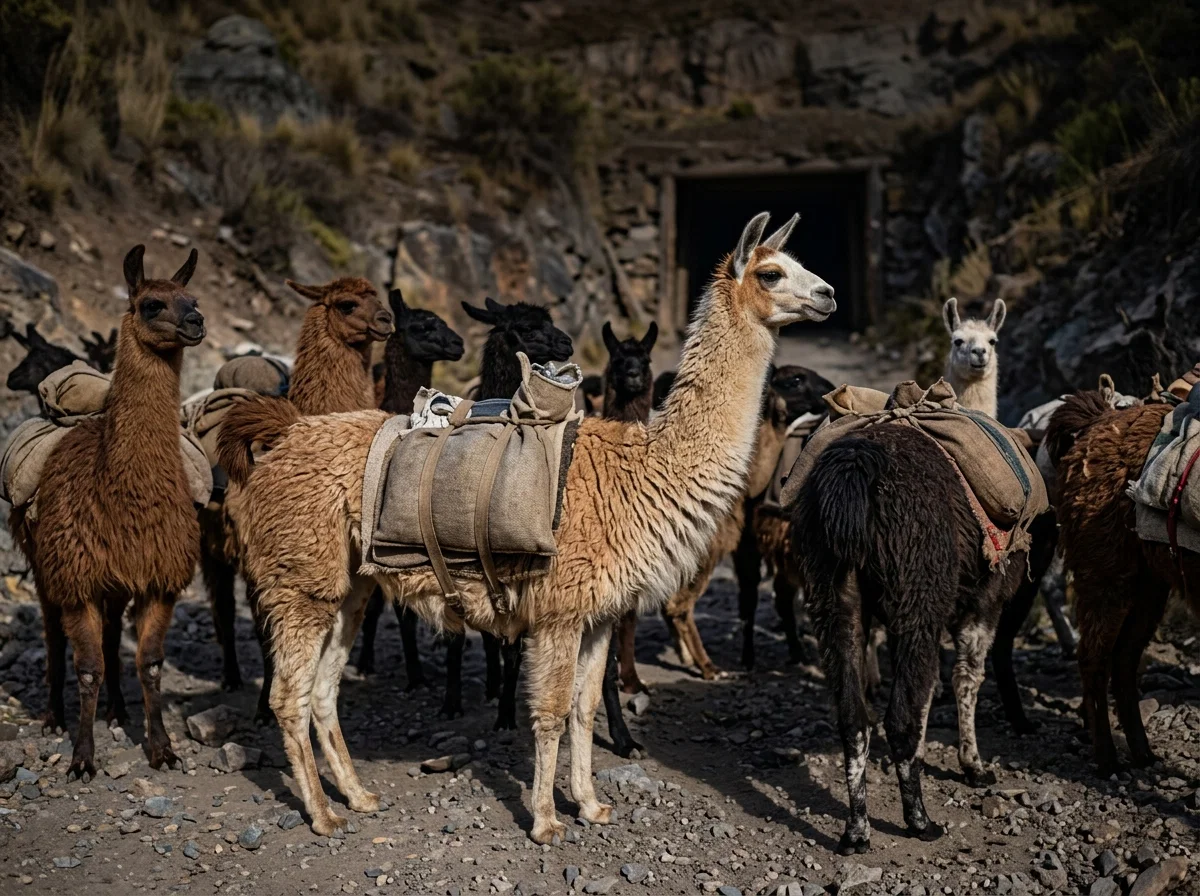
AMONG the dark countries of this neglected continent, the darkest and most intolerant is Peru. In fact, there are few countries in the world whose doors are so tightly closed against the entrance of the gospel. For a long time Ecuador was considered the most intolerant of all South American countries; but a few years ago the liberal spirit gained a footing, and the state was separated from the church, and now there is perfect religious freedom there, the Catholic Church, which for centuries held its people in ignorance and bondage, having no more privilege than any other.
LLAMAS' CARRYING SILVER ORE FROM THE MINES
But here, the Romish priests have absolute control; and they consider themselves extremely benignant because they permit a Protestant to live, after having deprived him of every religious right. Nevertheless, that meager bit of tolerance is not voluntary, but of necessity. One of the laws instituted by the Spaniards says, “Whosoever shall celebrate acts of public worship different from the apostolic Roman Catholic religion, shall be punished with imprisonment in the first degree” (one year). Hence there is no public worship permitted Protestants within the limits of the entire republic.
For the past three weeks I have had secret meetings in a room of a private house, with windows and doors securely fastened. Naturally, the meetings are small, we having to extend personal invitations. But the Lord has met with us, and they have been refreshing seasons, indeed. Eleven are keeping the Sabbath, and are rejoicing in the truth. I hope to leave them thoroughly established in the truth, so that they will stand alone; for, indeed, they must stand alone, if they stand at all, as we have no worker in all this republic of three million souls. I am endeavoring to get them to look to Jesus for their help and strength.
O my brethren, can we not have a worker for Peru? Must these dear souls struggle along here with no one to lead them further into the treasure-house of God’s truth? Is there no one who has had some experience in the home field who will rise up and say, “I will go to Peru, God helping me”? He need not expect an easy field, where he can go out and preach to a large congregation, and report a goodly number of additions to the church. He will have a very different experience here from what he has at home. The first Methodist missionary who came here some years ago was thrown into prison, where he lay in the filth for months. He was, nevertheless, faithful, and, thanks to the few rays of light that have entered since then, it is a little better now.
In the “great multitude, which no man could number, of all nations, and kindreds, and people, and tongues,” that “stood before the throne, and before the Lamb,” do you not think that some will have come from Peru? — There certainly will. O that God would move upon the hearts of some faithful, God-fearing workers to come here to help give the last message of mercy to this people! You, brother, who have not yet decided which field you will enter, ask the Lord if he would be pleased for you to come to this field.
Lima, Peru.
Christianity in Central Africa
LESS than thirty years ago there was not one native Christian in all Central Africa. To-day the native Christians number over ten thousand.
China
By Mrs. Ida Pilquist
LOH SHAN HSIEN.—Although we expect to see greater results than we have seen from the work in slowly progressive China, yet we have reason to be thankful for all the favors received during our short stay in this place. It is about four months since we came here, and some of the time was spent in repairing the houses. At first quite a number of visitors came to see me—more from curiosity than from anything else. It is always expected that there will be many callers in a new place. As a rule, we do not allow them to run about and look at everything, but kindly ask them to be seated in the guest hall, in order that I may have a chance to speak to them on the most important subject—their salvation. Notwithstanding the great heat in June, July, and August, I was glad for the opportunity of receiving them, because I knew very well that many might never come again. Of course it is trying sometimes, when the women interrupt me, and show no interest in religion. To me their curious questions sound strange, indeed, although for over eight years in China I have heard them repeated occasionally. These are some of them:—
“How old are you?” “How many children [sons] have you?” “Do you make your shoes and clothes yourself?” “Do you cultivate the ground in your country?” “Is there any foreign kingdom populated by women only?” “Do you like our country or your own best?” “Are there any people with holes in the chest, carried on a bamboo pole?” Besides these, many, many other strange questions are asked. But I make the best of it, and tell the old, old story of Jesus and his love over and over again. The seed sown falls by the wayside, upon the stony ground, among thorns, and even into good ground.
The people are especially fond of song and music, and as a result we have a class of children in our recently opened school who are now learning to sing about Jesus, both in the day-school and in the Sabbath-school.
An eight-year-old orphan girl has been added to our family. Her father was one of our first converts here in Honan, and died over two months ago. At my request, her mother unbound her daughter’s feet during our stay in San-li-tien last year. Shang Mao Ri is a clever little girl, and if the Lord tarry, we hope to educate her for future usefulness among her benighted sisters.
One of the Chinese sayings, “Man man tih tsiu shi kuai,”—“Slow slow is fast, and vice versa,”—does not agree very well with us, as we wish the Chinese to accept the truth quickly. And had it not been for our slowness in receiving the word of truth and proclaiming it to all nations, the Lord would have come long ago to establish his kingdom. O how we long for the kingdom to come! And how we long to see the King of kings enter many hearts in China and manifest his saving grace!
Dear friends, just think of it—China is nearly four thousand years old! And of her millions, thirty thousand people die every day, most of them without any knowledge of him who died that we might live forever in his presence. What are you now doing to rescue the perishing and care for the dying?
Mrs. Ida PILQUIST.
New Jersey Conference
By H. W. COTTRELL
It was ascertained at the recent session of the New Jersey Conference that there had been an increase of twenty per cent in the membership of their conference during the last term of ten months. Their working force is numerically small, but the Lord has given them souls for their hire. When we call to mind that this conference is in the conservative East, it is gratifying to note this result.
The conference representation at the session was good, and the weather was delightful for the series of meetings. The work and plans of the business department were well in hand, and were executed speedily. Three sermons or lectures, besides praise and revival services, were held each day. A number of individuals whose lights had grown dim, saw great light, and rejoiced in a Saviour’s pardoning love. Two persons came forward for prayers, and professed their belief in the third angel’s message and kindred truths composing the great message of reform for the people of this generation. In answer to the question, “What special thing do you desire of the Lord?” one individual said, “I want you to pray for me that I may have strength to do what I know to be right.” I was much impressed with the form of this request; for there are so many people who have not had the experience in divine things to warrant them to face a frowning world, and do what they know to be right. But the grace of God is sufficient if the sincere heart will accept and trust.
Each department of conference work received its share of attention, and besides this, consideration was given to the great need of consecrated workers, and means for their support, in the regions beyond.
Sabbath afternoon Elder Jayne delivered a discourse on the qualifications of the gospel minister, after which Brother A. R. Bell was ordained to the gospel ministry. Elder C. H. Keslake offered prayer, and the writer gave the charge. The Spirit of the Lord was present, and gave evidence of approval. The occasion was a solemn one, and will be long remembered by those in attendance.