The Youth’s Instructor, Vol. 28, No. 4.

THE MYSTERY ON THE OCEAN-BOTTOM

The Youth’s Instructor

Jan 21, 1880

S. D. A. Publishing Association · Battle Creek, Mich. · Jan 21, 1880

THE MYSTERY ON THE OCEAN-BOTTOM.

Far down in the deep waters of the ocean there are mountains and rocks, and valleys and caves, just as there are upon dry land. Sometimes sailors drop a lead attached to a cord, but it does not sink down very far; and then again at a little distance it will sink down, down to a great depth. In the first place it fell on a mountain, and then in a valley. Were the great ocean dried up, we should see wonders there.
At the foot of one of these mountains in the ocean there once met a kind of tea-party consisting of Mrs. Eel, Mrs. Lobster, Mrs. Cod, Mrs. Flounder, Mrs. Shrimp, and Mrs. Nautilus. The fact was, a curious event had happened, and they were met to discuss it. A long, small thing had come creeping down the mountain and across the valley, and along it went on the ocean’s bottom, so long that they could see no end to it either way. Gently it came down, and lay still on the bottom of the ocean.
“Mrs. Eel,” said Mrs. Lobster, “is not this some relation of yours? It looks more like one of the Eel family than anything else.”
“I would have you to know,” said Mrs. Eel, squirming and twisting herself every way, “that an eel has a head, and a tail, and fins; and don’t you see this has none? An eel keeps moving; and don’t you see this doesn’t move at all? How could you think it was an eel?”
“I thought it was a worm,” said Mrs. Cod, “and I tried to bite it. Whew! it almost broke my teeth out. It’s nothing that I can eat; though you know, Mrs. Lobster, I can eat a whole family of lobsters, if they are not too old.”
“I tell you what I think,” said little Mrs. Shrimp; “it’s a thing for us shrimps to creep on, and cling to, and to lay our eggs and raise our young under.”
“It’s very plain,” said Mrs. Flounder, “it is a scratcher, for just us flounders to swim over and scrape our breasts on.”
“You are all wrong,” said Mrs. Nautilus; “it is a thinking machine.”
“A what?” exclaimed all together.
“A thinking machine, I tell you. There are creatures who live up out of the waters, who think a great deal. They send messages instead of going to carry them. They are curious creatures, and sometimes when I have been up on the top of the water I have seen them. They sail about in great vessels of wood, and when at home have creatures to draw them around.”
“Why, what fables you are telling. Do you expect us to believe that creatures can live out of the water?”
“Yet they do. And instead of fins and tails they have two legs, with which they walk.”
“A very likely story,” said Mrs. Lobster. “When even I, skillful as I am, can’t walk on less than a dozen legs, how can they walk on two? What kind of fins have they?”
“They don’t have fins; they have arms and hands, instead. They seem to be full of thought. Now, this machine, so long that you, Mrs. Lobster, could not creep to the end of it in a lifetime, is one of their contrivances. They will stand at one end of it and send thoughts or messages through to the other end of it in a moment; and thus they talk to each other hundreds and thousands of miles apart. Even now, while we are looking at it, they are sending their thoughts through it.”
“That I don’t believe,” said Mrs. Cod.
“Neither do I,” said Mrs. Eel.
“Why not?”
“Because we can’t see any thought passing through it.”
“No; nor hear it, nor smell it, nor feel it. Now you don’t think that we are such fools as to believe a thing which we can’t see, nor hear, nor smell, nor feel? You don’t expect us to believe that there are creatures who can live out of water, and move without fins, and think all along the bottom of the ocean? Oh, Mrs. Nautilus, we are proud to know we are above being deceived by such stories! We don’t believe there is any world but our ocean world. Pray, what kind of light do they have up there?”
“Oh! it is stronger and purer, and more beautiful than ours. Compared with ours, it is consolidated light. It’s a more glorious state than ours, and the creatures who live there and think so much are far higher in their nature than we.”
“Well, Mrs. Nautilus, that will do for one day. We may as well break up our party. We can’t associate with one who tries to make us believe what we can’t understand. We know too much for that.”
At this, Mrs. Lobster opened her great claws as if she would crush Mrs. Nautilus, and Mrs. Cod rolled her eyes and snapped her great jaws. Mrs. Eel twisted and darted here and there, and Mrs. Shrimp swelled, and Mrs. Flounder turned her eyes and looked sidewise.
Alas, poor creatures! Just as wise as the Sadducees, and such-like people, who say, “There is neither angel nor spirit,” nor a higher state than this, because they cannot comprehend it.—J. T., in Everybody’s Paper.

SONG OF THE SEASONS.

Aunt Winter flings his flakes of snow, Deep burdening field, and wood, and hill; Dim days, dark nights, slow trailing fogs, And bleakened air severe and chill,— And swift the seasons circling run, And still they change till all is done.
Young Spring, with promise in her eyes, And fragrant breath from dewy mouth, Brings magic touches for the nooks Of budding flowers when wind is south,— And swift the seasons circling run, And so they change till all is done.
Then Summer stands erect and tall, With early sunrise for the lawn; Thick foliaged woods and glittering seas, And loud bird chirpings in the dawn,— And swift the seasons circling run, And so they change till all is done.
Brown Autumn, quiet with ripe fruits, And haggards stacked with harvest gold, Brings fiery flushes for the leaves, And silent cloud skies soft outrolled,— And so the seasons circling run, And still they change till all is done.
Swift speeds our life from less to more; The child, the man, the work, the rest, The sobering mind, the ripening soul Till yonder all is bright and blest,— For so the seasons circling run, And swift they change till all is done.
—Chamber's Journal.

From Sea to Sea: Blondin's Tightrope Walk at Niagara

FROM SEA TO SEA.—NO. 21.
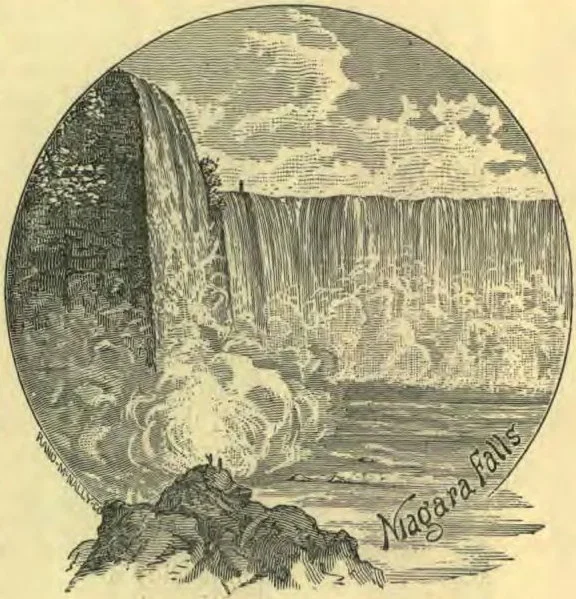
Leaving Suspension Bridge, we walk up to the falls, a distance of two miles, on our way catching occasional glimpses of the river deep down in its channel. Having gone about two-thirds of the distance, we come to “the place where Blondin walked.” Nearly twenty years ago, while the Prince of Wales was making a visit to the falls, Blondin, a tight-rope performer, took advantage of the occasion to get notoriety by walking a tight rope in the presence of the prince and the thousands who had assembled with him. A rope was stretched across the river from bank to bank, over two hundred feet above the water.
After he had walked across once, he returned, bearing a small cooking furnace. When about half-way back he sat down upon the rope, and at this giddy height balanced himself and his furnace, while he kindled a fire, cooked some eggs, and let them down by a cord to a little steamer, called “Maid of the Mist,” which was immediately below.
Going to the shore with his cooking utensils, he next tried walking across perched upon stilts. In the bottom of the stilts he had driven spikes to prevent their slipping off the rope. In this walk he succeeded very well until about half-way across, when, undertaking to jump up from the rope and onto it again, he fell; but fortunately he saved himself from destruction by falling astride the rope. Here he balanced himself, and, regaining his standing on the rope, completed his third trip, the crowd cheering him lustily for his fool-hardy exploits.
What a striking proof of the depraved tastes of mankind is the fact that they take pleasure in seeing how near they can expose themselves to destruction and yet escape with their lives. For ourselves we take more pleasure in viewing the beautiful and wonderful in nature and art.
We pass on a few rods and come to the falls of Niagara, where, for thousands of years, with almost deafening roar, the waters of this mighty cataract have been pouring into the vast abyss below. To gain a nearer view, we go down several hundred steps to the water’s edge, where a foot path has been constructed out onto a huge pile of rocks, which at some time have fallen from the cliffs above. Here we find a constant mist, caused by the spray from the descending waters. Raising an umbrella to prevent getting wet in this mystic shower, we succeed in holding our position until the sun shines out brightly, when, lo! the mist and spray are suddenly ornamented with a most gorgeously resplendent rainbow.
How awe-inspiring is the scene before us! As we look up two hundred feet on either side of the river, we see bare rocks hanging over us, while about thirty feet before us is this massive sheet of water, 1,100 feet wide, pouring down nearly 200 feet into the unfathomable waters below. This, with the over-arching rainbow and the spray and flying drops glistening like pearls and diamonds under the rays of the golden sun, gives a combination of nature that to be enjoyed must be seen.
As we see this rainbow (God’s appointed sign that he will not again deluge the world), so near this roaring cataract, it is no great stretch of the imagination to call to mind the surging of the waters in the flood, when rivers left their channels, fountains of the mighty deep were broken up, and roaring cataracts rushed in mad array to the destruction of sinful man.
This mighty river has undoubtedly poured its waters over these rocks with the same doleful and yet majestic roar for more than four thousand years. Yea, ever since the time when it served as a channel through which the retiring waters of the flood revealed to sight “what desolations” the Lord had made in this part of the earth.
With these thoughts we feel with weight the words of another: “How dreadful is this place; for God is here. His name is graven on the eternal rocks, with iron pen, and diamond point.” But we must now retrace our steps to the bank, take our lunch, and view the falls from another point.
J. N. L.

A SABBATH STONE.

In one of our English coal-mines there is a constant formation of limestone, caused by the trickling of water through the rocks. This water contains a great many particles of lime, which are deposited in the mine; and as the water passes off, these become hard and form limestone.
This stone would always be white, like marble, were it not that men are working in the mine, and that as the black dust rises from the coal it mixes with the soft lime, and in that way a black stone is formed.
Now, in the night, when there is no coal-dust rising, the stone is white; then again, the next day, when the miners are at work, a black layer is formed; and so on, alternately black and white, through the week until Sabbath comes; then, if the miners keep holy the Sabbath, a much larger layer of white stone is formed than before! There will be the white stone of the previous night and the whole of the Sabbath, so that every seventh day the white layer will be about three times as thick as the others. But if they work on the Sabbath they see it marked against them in the stone. Hence the miners call it “the Sabbath stone.” Perhaps many who break the Sabbath would try to spend it better if there were a “Sabbath stone” where they could see their unkept Sabbaths registered with black marks. But God needs no such records on earth to know how all our Sabbaths are kept. His record is kept above. All our Sabbath deeds are written there, and we shall see them at the last. Be very careful to keep your Sabbaths pure and white.—Children’s Friend.

A HIGH STANDARD.

DEAR CHILDREN: I wish to call your attention to the wonderful nature of the life you have just begun, and to your capabilities of improvement. Infancy and childhood are the first stages of human existence. Life consists of living and learning; and you must determine the result of coming years. You can become happy, noble, and true, or you can become miserable, low, and degraded. You have God-given powers; you have materials within reach with which you can build a soul-temple of dazzling purity, beauty, and loveliness; and you were placed in this world for a purpose, the grandeur of which you have never dreamed.
It is impossible for you to succeed in life unless you form in your mind some idea of what you wish to accomplish. Perhaps your standard of happiness is fame; if so, you are deceived. The moment a person gains a high station in life, thousands of envious, jealous, discontented people begin to speak ill of him, and with the deadly poison of slander seek to injure his name and reputation. Evil influences press about him, and he is a conspicuous mark for Satan and wicked men. Cares press heavily, and gloomy unrest fills the soul. Would you know the end of earthly greatness? Go to the silent halls of death, and behold the ashes of the great. The inhabitants of earth are continually changing, and the most noted men soon yield their places to others. Of what avail is honor to those who sleep beneath the sod? A true life is not thus lost. The grassy hillock cannot obliterate deeds of love. Life in its noblest sense is higher than fame and loftier than honor.
It is your privilege to stand upon the very hill-tops of life. Say not within your heart, “I cannot reach those far-off summits.” The blue dome of heaven beckons you on, angels whisper, “come,” and golden rewards await you “up yonder.” The “mists of earth” hide the beauty of the hills, but the good of all ages have climbed the rugged mountains, and the sunshine of eternal glory will soon dispel every cloud of darkness.
My dear young friends, every kind word is a step upward, and every noble deed helps to make a true character; therefore, copy the spirit of the Master and do the work he has commanded. This alone is love; this alone is life. When you reach the eternal world, and behold the great Being seated on the white throne, you will realize your brightest dreams and be satisfied. Aim high, and endeavor always to walk in the elevated pathway that leads to everlasting joy. May God bless you, is the prayer of your friend, ELIZA H. MORTON.
Battle Creek, Mich.

BIBLE LESSONS FOR YOUTH.

LESSON LXXXII.—REVIEW OF LESSONS LXXIX-LXXXI.

1. WHOM did the Lord employ to lead the children of Israel out of Egypt?
2. Who was their leader during the conquest of Canaan?
3. By whom was the government administered for four hundred and fifty years after the death of Joshua?
4. Who was the last of these judges?
5. Who was the first king?
6. How did he meet his death?
7. By whom was he succeeded?
8. Over what part of the country did David rule for the first seven years of his reign?
9. How were the other tribes brought under his dominion?
10. Who reigned next after David?
11. For what was he remarkable?
12. How long did each of these first three kings reign?
13. What causes led to the division of the kingdom?
14. Who was the first king in each of these kingdoms?
15. What were the leading events of Rehoboam’s reign?
16. Who was his successor?
17. Describe the remarkable battle which this king had with Jeroboam.
18. Who succeeded Abijah on the throne of Judah?
19. What king died in the second year of Asa’s reign?
20. How long had he reigned?
21. How long did Asa reign?
22. For what was Asa remarkable?
23. Describe his encounter with Zerah.
24. Repeat the covenant which Asa and his people made with the Lord.
25. What wrong things did Asa do?
26. What changes took place in the kingdom of Israel during Asa’s reign?
27. Who succeeded Asa on the throne of Judah?
28. How long did he reign?
29. How did Jehoshaphat enlighten the people in regard to the requirements of the Lord?
30. Describe his unwise connection with Ahab, and its result.
31. How did Jehoshaphat try to secure the administration of justice among the people?
32. Describe his deliverance from the united hosts of the Moabites, Ammonites, and Edomites.
33. What loss did he meet from joining in a commercial enterprise with Ahaziah king of Israel?
34. How was he punished for joining hands with Jehoram, the successor of Ahaziah?

SCRAPS FROM HISTORY.

THE JEWS CARRIED AWAY INTO BABYLONISH CAPTIVITY.

For a long time after the erection of Solomon’s temple, the children of Judah carried on the service of God in its purity, God especially blessing and prospering them. But at last they ran into idolatry, and so far forsook the worship of God as to place false gods in the temple which had been solemnly dedicated to the service of God. 2 Chron. 33.
They further transgressed the law of God by breaking the Sabbath. Our Heavenly Father did not immediately punish them for committing these grievous sins, but raised up prophets and sent them to Jerusalem to faithfully warn the people to cease sinning against God. The prophet Jeremiah stated to them that if they would cease breaking the Sabbath, the city of old Jerusalem should stand forever; but if they would not, the city should be destroyed. Jer. 17:24–27.
They did not heed the warning voice of the prophets, but mocked them, until God’s wrath was kindled against them, and he permitted Nebuchadnezzar, king of Babylon, to take Jerusalem. His army destroyed Solomon’s beautiful temple, and broke down the walls of Jerusalem; in fact, he destroyed the city, and carried many of the Jews into Babylon, where they served the king of Babylon seventy years.
Just before the seventy years ended, the mighty kingdom of Babylon was overcome by the Medo-Persian empire. The Medes and Persians were friendly to the Jews, and made a decree which permitted them to return to their own land. They then rebuilt the city of Jerusalem and the temple, which remained in existence until destroyed by the Romans A. D. 70. From the time of their return from Babylonish captivity to the destruction of Jerusalem by the Romans, the Jews underwent many vicissitudes.
In 332 B. C., Jerusalem was brought under the rule of Alexander the Great, who was the first king of the Grecian empire. The Greek language, during the reign of the Grecians, became common in the land of Judea.
In our next, we will speak of the second destruction of Jerusalem and the dispersion of the Jews.
S. H. LANE.

Never Insult Misery, Deride Infirmity, or Despise Deformity

NEVER insult misery, deride infirmity, or despise deformity.

LESSONS FOR CHILDREN.

LESSON LVI.—REVIEW OF LESSONS LIII-LV.

1. WHAT was taken into the temple after it and its holy vessels were finished?
2. How was the temple dedicated?
3. By what two miracles did the Lord show that he accepted the house?
4. In what other way did he let Solomon know that he had heard his prayer?
5. What did the Lord say to Solomon about the kingdom of Israel when he appeared to him at this time?
6. What was to be the fate of the temple if the people forsook the Lord?
7. Who came to Jerusalem to prove Solomon’s wisdom?
8. Was she satisfied with the answers that Solomon gave to her hard questions?
9. What did she think of the reports which she had heard concerning Solomon’s wisdom?
10. How did she think the Lord had shown his love for the people of Israel? 1 Kings 10:9.
11. What did she give to Solomon?
12. Did he need her presents?
13. What did he give her?
14. Describe Solomon’s throne.
15. What other costly things did he make?
16. What kind of dishes were used about his house?
17. How was Solomon finally made to forsake the Lord?
18. Do you think he would have been led to worship idols if he had not disobeyed God in marrying these women?
19. How was Solomon punished for his wicked course?
20. What made Solomon seek the life of Jeroboam?
21. Where did Jeroboam go for safety?
22. How long did Solomon reign?
23. Which had the longer reign, David or Solomon?

MY CLASS.

BY A SUPERINTENDENT.
“I HAVE just given myself to the work,” said one of my teachers to me as I passed through the school. “I have just given myself to the work; before, I was ready at any moment to retire. When asked to take the class, it was evenly balanced whether to refuse or consent; then I sat down without any feeling of ownership of that class, and indifferent as to the effect of my teachings. It made but little difference whether the boys liked me or not. If they came or stayed away, it was all the same, except that I liked to have the reports look well. So far, I have held the place to please you; but now, I would not give up my class for a fortune. It is mine. Every boy in it is my own. I have at last given myself to it.”
I said to him, “Just say that in teachers’ meeting. It will explain the difference between successful and discouraged teachers, and the cause of the difference.” I knew just how to sympathize with him, for I held the plough a long while myself without a firm grip. Every provocation or extra weariness brought me to the spirit of resigning. I did not, however, until the work grew to be a part of my life. Like my teacher I gave myself to my school; then it began to thrive. Said a bank president, “Such institutions as ours never thrive till we take them to bed with us.” “I want you to understand,” said a pastor, “that the tie between my church and myself is next to the family tie. It is my church, and my joy is in its love.”
“Try it, teacher. Give yourself to your class, and then reap.”—S. S. World.

SEVEN REASONS FOR ATTENDING TEACHERS' MEETINGS.

1. To ENCOURAGE the Superintendent and teachers by our presence.
2. To get and keep posted on all matters of interest connected with the Sabbath-school, and help in all proposed plans of usefulness.
3. To discipline the mind by study and the contact of other minds.
4. To gain information from the leader and teachers, and get the benefit of their study and research on the lesson.
5. To give the teachers any thoughts, points, or ideas we may have on the lesson.
6. To meet all fellow-teachers at the throne of grace, and with them invoke wisdom from on high for the study of the word of God.
7. And so, by these reasons, be ready to meet our classes, and instruct them in Bible history, geography, commands, invitations, warnings and doctrines, and exalt over all, Jesus Christ, the Redeemer of a lost world, and win souls to Christ.

Pomps and Vanities: A Mission-School Anecdote

A GAYLY-DRESSED young lady teacher asked a class in a mission-school, “What is meant by the pomps and vanities of this world?” “Them flowers in your hat,” was the ready answer of a little girl.

LETTER BUDGET.

FROM the East and West, North and South, the letters come. Although we can not print them all, we are glad to have you write. So let them come, and we will give you as many as we can each week.
DIRVILLE, CANADA.
DEAR EDITORS: I have taken the INSTRUCTOR about seven months, and I like it very much. This is my first letter to the “Budget.” I am eleven years old. I attend Sabbath-school, and learn my lessons out of the INSTRUCTOR. I keep the Sabbath with my father and sister. My mother is dead. We hope to meet her in the first resurrection.
Yours truly, FLUELLA WILLIS.
Fluella, we sympathize with you in the loss of your mother, for no one can fill a mother's place. Take your troubles to Jesus; he is your best friend.
EAGLE LAKE, MINN.
DEAR EDITORS: I have been a reader of your paper for nearly four years, and as I have never seen anything in it from Eagle Lake, I thought I would write a letter for the “Budget.” We have a very interesting Sabbath-school. I get the lessons for youth. There are four in my class. Brother Hill and Brother Ellis held a tent meeting six miles from here, and after that they came here and held meetings in a church. Four families were added to our number, so that we could not hold meetings in a private house any longer. And now they have repaired my grandfather's hall and hold meetings there.
Yours in hope of everlasting life,
KATIE A. CARPENTER.
DANVERS, MASS.
DEAR EDITORS: I have kept the Sabbath two years. I attend Sabbath-school every Sabbath. I take the INSTRUCTOR, and like it very much. When I have read them, I send them to my cousins. I hope to meet the INSTRUCTOR family in the earth made new. Pray for me, that I may be saved when Jesus comes. Yours truly,
HATTIE AYERS.
That is the right way. Circulate the INSTRUCTOR. Don't let it lie idle. Let your cousins and schoolmates read it. Perhaps, if you ask them, they will subscribe for it.
We are glad to hear that your Sabbath-school is in a prosperous condition. If each one does his part, an interesting school will always be the result.
Continue reading: THE HERMIT; OR SOLDIER-CRAB