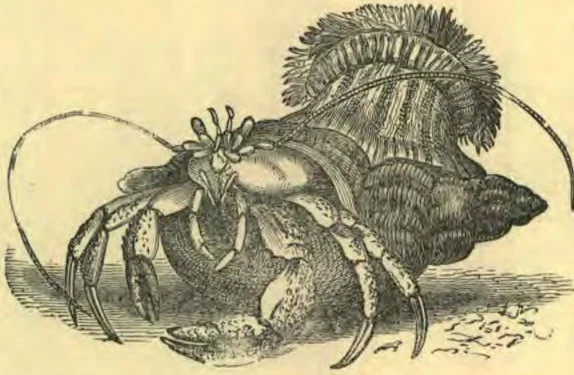
The Hermit, or Soldier-Crab, is a very curious creature. Unlike other shell-fish, it has no shell of its own, which enlarges with its growth, but it selects an empty shell fitted to its size, which it finds on the shore, and into which it establishes itself so firmly that it moves about with it more or less briskly. When it outgrows its first habitation, it sets out in search of another shell a little larger and better suited for its increased size.
When the tide retires, the hermit may be seen leaving the old shell and examining other ones; and it will sometimes go in and try a great number, as a man might try many new clothes before suiting himself. When it finds one that suits its taste and seems to be comfortable, it enters and attaches itself so firmly to it that it cannot be taken out without pulling it to pieces. In no other race of creatures is such a practice known. It makes at the entrance, too, a cunningly devised barricade, and bravely defends its home against all comers; hence its name, Soldier-Crab.
This is a more appropriate name for it than the hermit, for unlike the latter, it likes company, and has attachments, especially for the Anemone, a curious sea animal described in the INSTRUCTOR a few weeks since. The Anemone is sometimes fastened to the outside of the Crab’s shell in the manner shown in the picture, and sometimes their mouths are so combined that they can feed together, agreeing most where others would least agree.
THE ATLANTIC CABLE.
By M. K. W.
The tea-party described in our first-page story this week, we think must have been held about the fifth of August, 1858, as that was the time when the laying of the first Atlantic cable was completed.
This cable consists of seven fine copper wires slightly twisted together, forming a rope; around this rope are three layers of gutta-percha, which are protected by tarred hemp wound around, and the whole is covered by eighteen strands of seven fine iron wires each. The circumference is nearly that of a dime.
Since this was completed, five others have been constructed in a somewhat similar manner, and successfully laid. The sixth and last was completed Nov. 17, 1879.
When Cyrus Field first proposed to join the two hemispheres by means of a cable, the people laughed at the idea, and even Field himself often became discouraged. But after thirteen years of anxious watching and ceaseless toil, the work was accomplished. What a lesson is here taught of perseverance in what we know to be right.
M. K. W.
PAPER FROM COMMON GRASS.
The manufacture of paper pulp and paper from common grass is one of the latest novelties for which a patent has been obtained. Any of the common grasses found in the field, lawn, or meadow, may be used; and it is claimed that the green grass pulp produced from them may be manufactured into paper of great strength and length of fiber, and possessing tenacity, softness, and flexibility; and further, that this paper is even softer and more transparent than that made of linen. One pound of dried grass gives about one-third to one-fourth of a pound of fine, bleached, and finished paper, or 2,911 pounds of finished paper to the acre.
So long as the sap is in circulation, and the chlorophyl, silica, and other inorganic matters are not dried in, in which event the fiber is seriously impaired for the purpose of paper, either old or young grass may be used; but, to avoid danger, it is best to have the grass cut or mown before it begins to bloom.
The first process of manufacture is to pass the grass between the rollers of a press, which crushes or loosens the fiber and squeezes out most of the sap. It is then freed from dirt by being thoroughly agitated or washed by other means in a large tank of water. After sufficient washing, the crushed grass is boiled in an open kettle, or in a steam kettle with lye. With an open kettle the boiling is continued from four to five hours; with a steam kettle two hours will suffice.
From the kettle the material goes into a filtering trough of magnesia for about thirty minutes, then is placed a third time in a solution of carbonate of soda; and, finally, a second time in a solution of sulphuric acid. These operations may be repeated more or less till the pulp is as fine and white as required, after which it is washed in clear water.—The Paper World.
A WELCOME.
We have a good friend, who will visit us,
We hope, every week of the year,
With its fresh, bright face,
To light up every place,
And its words of hope and good cheer.
We hope this good friend will live to be OLD,
And lose none of its worth or zeal,
That its motto may be
Love and purity,
And the truth it may never conceal.
A true friend, you know, is always kind,
And faithful, too, in love;
Then if we stray
From good paths away,
It must not fail to reprove.
We welcome, then, this INSTRUCTOR and friend:
May its future successful be,
With “tidings pure
And lovely,” we're sure,
“Good reports,” it will bring you and me.