READ the following article about heathen women who kill their children from religious or economic principles, after they are duly born, or rather are compelled by public or family sentiments to kill them, the mother's heart protesting against it, and ask wherein they are worse than those so-called "Christian women" of our missionary societies who kill their unborn babes:—
"I had traveled four years in Asia before my last journey, but until that time never came to realize what the awful darkness is which rests upon that part of the world. Darkness pervades the whole social life and whole individual life. There is not an idea they have that is free from darkness, a darkness which surrounds them every moment. In China I have heard the wail of the Chinese mother, for sorrow that a woman is born into the world. I was present at a meeting of Bible women in a district in South China, and, to my horror, I heard that there was not one of these women receiving Christian instruction who had not put an end to the life of from one to five girl babies. I think I may appeal to Christian mothers to be more earnest than they have ever been before in sending forth the Gospel of Christ, the light that shineth in darkness.—Isabella Bird Bishop, in a speech in London, May, 1897."
These heathen only kill girls, while our American killers slay boys and girls alike; and everything indicates that there are more boys thus done away with than girls.
They are killed because of selfishness on the part of the Christian(!) mothers. It is deliberate, cruel murder, because of pleasure or of their own sin. The pain of abortion is often greater than that of birth. It is more disastrous on the health. Birth never hurt the health of any one. Motherhood beautifies.
We think the heathen is a better woman than these disgraces on the name of Christendom; for they are compelled to it. Ages of heathen bondage to men and tradition are back of them. Our women are free; they have the Bible, with its glorification of motherhood, in their hands. Many of them are members of the church and hope to go to heaven, where, according to the creed of their church, they believe all children go, and no murderer does.—The Individual.
Bible Readings.
By W. A. Hall
"Seek ye out of the Book of the Lord, and read."—Isaiah.
"Whoso readeth, let him understand."—Jesus.
AN EXAMPLE OF "ETERNAL FIRE."
1. WILL God's people be ignorant of the time of Christ's coming?
"But ye, brethren, are not in darkness, that that day should overtake you as a thief." 1 Thess. 5: 4.
2. How does God regard those who fear him?
"The secret of the Lord is with them that fear him?" Ps. 25: 14.
3. Did Abraham fear the Lord?
"Lay not thine hand upon the lad; . . . for now I know that thou fearest God." Gen. 22: 12.
4. What did the Lord say with reference to Abraham about the destruction of Sodom and Gomorrah?
"And the Lord said, Shall I hide from Abraham that thing which I do?" Gen. 18: 17.
5. How did he destroy them?
"Then the Lord rained upon Sodom and upon Gomorrah brimstone and fire from the Lord out of heaven." Gen. 19: 24.
6. With what kind of fire were they destroyed?
"Even as Sodom and Gomorrah, . . . are set forth for an example, suffering the vengeance of eternal fire." Jude 7.
7. To whom was this made an example?
"Unto those that after should live ungodly." 2 Peter 2: 6.
8. For whose benefit were these things written?
"They are written for our admonition, upon whom the ends of the world are come." 1 Cor. 10: 11.
W. A. HALL.
OUR CHILDREN.
By Hope Onslow
WHO are so dear to us as our children?—Not our husbands; for we can talk over their faults, and laugh at their foibles with others. We can hear some adverse criticism of them, and, tho somewhat ruffled, can soothe their ire, and calm our own, by saying: 'Never mind, dear. It is all in a lifetime. No one will know it is true of you if you do not make a fuss over it.' But, O, touch the child, and you have touched a spot as tender as that of the apple of the eye! Flesh of our flesh, heart of our heart, memory of our memory, dream of our dream, blossom of our bosom, sent us by Heaven to call forth the most tender reserve of womanhood,—that being, ripened by the warmth of our heart, fed by the tides of our nature, surrounded by every tender dream, planned for by our brain, worked for by our hands, brought forth by our death-like agony, nourished from our bosom, protected, loved, guided, comforted by us. Ah, we need not to go to any philosopher to solve the passion of our tenderness to our child! Rather, how strange it would be if every element of our natures did not surge when some adverse wind touched the flower that God caused to take root in our hearts for time and eternity! To scarcely a less extent is a father touched by what touches his child. In the child, we hope life's best ideal is embodied.
The place of supremacy given to the child by individual affection, results in placing him on the throne of the wide world's interest. Some one has said: 'Unravel from industry, commerce, literature, art, and domestic life, all that pertains to the child, and the whole fabric of society falls into shreds. That baby's stocking growing under your needle is the warp and woof of all human designs.' He who lay in Bethlehem's manger as a child, chose divinely well in not choosing a throne and the crown of a monarch. What attitude could have drawn the world so mightily as that of helpless infancy, before which bowed the shepherds of the hills and the kings of the east?
Longfellow well expresses what children are to the world, when he says:—
'What the leaves are to the forest,
With light and air for food,
Ere their sweet and tender juices
Have been hardened into wood,—
That to the world are children;
Through them it feels the glow
Of a brighter and sunnier climate
Than reaches the trunks below.'
Is it then because of their supreme value to ourselves—for what were lifeless trunks without leaves?—that the world is now turning its attention to child culture? This movement has swept like a tide, and, indeed, from the evils that menace society on every hand, it seems the only movement that promises us a check on the disintegrating forces of corruption. Every argument, every sermon, every treatise for social betterment in this age, begins and ends with our children, and through the child-culture movement thousands have found life spring into new significance. Mothers' clubs, kindergarten schools, training colleges, new schemes for study in scientific and religious lines, have made the world hum with new industries, the mails heavy with new magazines, society buzz with new themes of conversation, designers originate new styles of costume, cooks find a new cuisine. That which has been left aside from this movement, can be readily estimated as of little importance, and more often, as actually hazardous to the world.
We can see that indeed 'the child is in the midst.' This is by no arbitrary ordering, but is the divine plan. When the disciples of old were questioning as to who should be greatest, Jesus took a child and set him in the midst, and called upon them to behold in the little child a type of the greatest in the spiritual kingdom.
The child in the midst has found his true place as the center of human interests, the symbol of the divine Majesty. Angels and men rejoiced at the birth of the divine stranger, for which no preparation had been made. And round the birth of every child something of gladness clusters. How lost, how sad, how despairing must be the heart to which a child's coming brings no hope, no joy! For months the interest of a household have centered around the dainty cradle and delicate robes. Satin and lace, down and perfume, wool and linen, weaving and embroidery, are only outward symbols of the heart's dreams of love.
In spite of all treatises on the results of a beautiful environment, the practical effects are disappointing. Ah, the environment of all the past is too wide, too deep, too penetrating, to leave room for the scanty environment of the passing moment to leave its impress! Some one has said to be well born one must be assured of a good ancestry for at least a hundred years. The parent begins too late at the conception to bring forth the ideal child. Every child comes into the world as his parents did before him, only with added passengers, 'an omnibus in which all his ancestors ride.' The mother who has thought to implant a mild and sunny nature in her babe is horrified at its passionate temper, and she who in her maidenhood boasted that she would order her children aright, finds herself helpless before some unexpected, uninvited ancestor, who steps from her child's omnibus, and confronts her with horrifying manifestations. That which makes her most helpless is the sudden mortifying realization that she is face to face with a part of herself, both in the evil temper, and in the10struggling soul-nature that yearns for good, and makes the child come sobbing to her bosom for forgiveness. Ah, she knows, understands, pities, loves her child, better than if the fair ideal were there, to which she would have but a meager kinship! Is it this knowledge of her child's soul that makes her fly like an enraged hen, to shield that little one from a neighbor's adverse judgement?
It is as true in a good sense as in a bad that our children are omnibuses, in which ride all our ancestors from Adam to John and Jane Smith. The beautiful thoughts, words, ways,—the artist's hand, the poet's insight, the philosopher's reasoning, the singer's song,—are all as much a revelation of some latent longing in ourselves, or unveiling of ancestry, as the forbidding qualities. How dear they make our children to us! How heavily they lie on our hearts as we realize what we are, and may be, to their unfolding souls!
Yet would we shrink from the responsibility?—O, no! With all its burden come great privileges,—the opening out of fields for thought and love. From the child's conception to its death it is a living messenger, an experimental sermon of God's nature in us. Has not a mother a better chance than others to understand the love divine, when life is brought forth by death, love nourished through loss, her child's salvation purchased somewhat by her cross of sacrifice? She of all others can come to Calvary and say, 'I know thee, thou Man of love and sorrow.'
Through our children our hearts are opened in sympathy to the hearts of the world. One young mother said, 'Children were nothing to me before I had one of my own, but now I see that the world is full of them.' Motherhood links the soul with mothers, fathers, and friends. All society finds its unity in the love awakened through the lisping tongue and velvety touch of the helpless babe. Not earth only, but heaven is opened, and a way is cloven to the throne of the Infinite, opening up through the cross of Him who says, 'As one whom his mother comforteth, so will I comfort you,' and asks, 'Can a woman forget her sucking child, that she should not have compassion on the son of her womb?' and answers, 'Yea, they may forget, yet will I not forget thee.'
Can a mother, then, do without God?—Not successfully. Many a mother thinks she does and can; but she is like Cyrus, of whom the Lord said, 'I have girded thee, tho thou hast not known me.' That mother-love is God's girding for the long work of a life discipline.
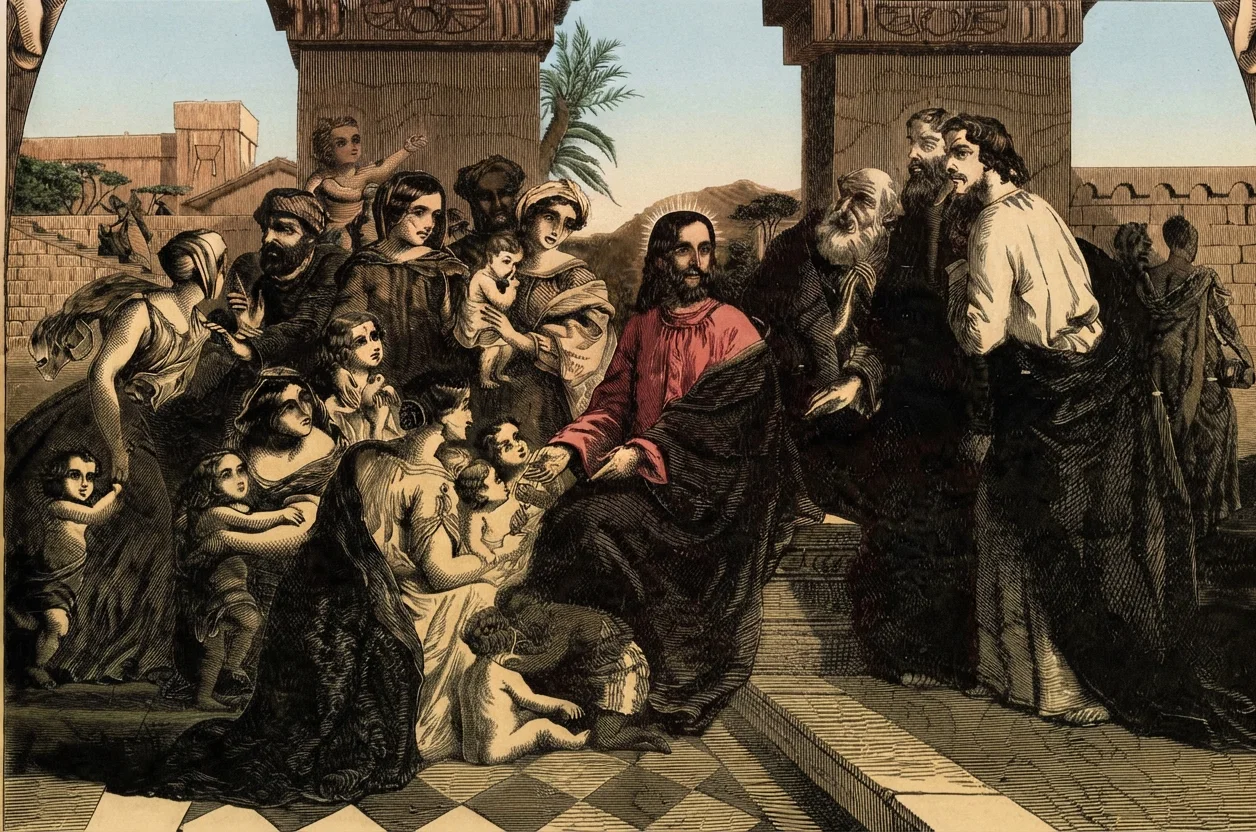
What strikes a mother with more pathos than that story of the Judean women, who sought Jesus with their little ones? or what endears the divine Man more to their hearts than that tenderness which corrected the disciples, made a place for mothers by his side, and a refuge for their children—in his arms and on his bosom? Did not his attitude then show where the mother and the children will find blessing, peace, and rest?
Whatever ancestry has done, and it no doubt has given some godlike traces, there is a place where the divine image may be restored, the ideal beauty regained. It is at Jesus' feet. In that gentle Presence works an almighty love that creates anew. Beholding Love's face, older than that of ancestry, waiting under the beams of that heavenly Dove that of old moved the face of chaos into order and beauty, our souls, and the souls of our children, take on a divine brightness.
How frequently we hear this testimony from efficient men and women in the world, 'If there's anything good in my life, it is due to my mother's influence'! A queen's crown and scepter are not so potent as a mother's influence, nor is a throne so honorable as a home sanctified by a mother's prayer and devotion. That beautiful path trodden by the Judean women is open to all weary-footed mothers. Its gateways open at the child's first question about the world and God. Enter therein, and lead your children to the breast of Him who bids them come and find rest unto their souls.
Gradually we change places. The child becomes father or mother; we sit in the chimney corner, in the dotage of a second childhood; the harvest ripens, and as we have sown in the child's heart, we reap in the years of our infirmity. By and by we lie down amid flowers, tenderly placed in our caskets and over our quiet resting-places by their hands, and dewed with tears of love and sorrow, leaving to them the sweetest or saddest memory that life can have.
By and by the great gates of God will open. Happy then will be the mother who can stand before the Master, and say with joyful smiles, 'Here am I and the children which thou hast given me.' The Master's hand will crown her with a crown gemmed with stars, representing the children saved unto eternal love and life.
This is the vast meaning of the joys, tears, prayers that come to live with us with our children.
HOPE ONSLOW.
THAT "OVERSUPPLY" AGAIN.
By W. N. G.
SOME time ago we mentioned the fact that in high religious circles the Christian ministry was being discussed as though it were an ordinary business profession, and that there was an oversupply of men engaged in the calling. The matter is still being agitated in that conception of ministerial work. The New York Observer recently contained an editorial on "Clerical Salaries," in which it was stated that the low average of such salaries is due in part to an oversupply of ministers. The sentiment called out from one of that journal's readers the following expression:—
"I have claimed and written for the past fifteen years that there are too many ministers, and that the deceptive array of figures giving the number of churches and the number of ministers, does not answer the question. It is both a sin and a shame to deceive parents and candidates with the plea that more ministers are needed, thus leading the latter to spend some of the best years of their lives, only to be turned adrift at last. If I could tell what I know with regard to some splendid men, in character and ability, and a tithe of what they and their families have suffered, none but the most self-denying and entirely consecrated men would enter the ministry. The ministerial world needs to-day just as much of a high tariff and protection as does the political world, for those already in are suffering from an unrighteous and unchristian competition. Neither the board of education nor any minister has a right to ask any one or any church for aid, till the present condition of things is very materially changed. The General Assembly and the religious press should set themselves to remedy these evils, to remove these burdens and charges upon and against the church and ministry. It is not right to lay the blame upon the people for lack of liberality or spirituality, when the ministry itself and the General Assembly are at fault."
When it comes to pass that the ministerial calling is regarded in such a mercenary light as this, is it any wonder that both the pulpit and the press are impelled to deplore the decline of spirituality in the churches? When the strife for place and emolument on the part of the ministry begets such a sentiment, is it any wonder that the pulpit is noted for a decline in spiritual power? And when that power, begotten only of the Spirit and the Word, has departed from the church, is it any wonder that the next resort is to the methods of civil politics? Such has ever been the result in the past, and a like cause must ever have a like effect. W. N. G.
A FABLE WITH A MORAL.
By Editor
THE following fable we clip from the Baptist Argus, with the simple remark, which all Bible Baptists, it seems to us, ought to recognize as truth, that Sunday is not the Sabbath enjoined by divine command. However, as an argumentum ad hominem, the fable is worthy of reproduction:—
'Late on a warm sabbath afternoon, as a Sunday Law was just awakening from a sound sleep, he heard a stealthy step, and, rubbing his eyes, he looked about till he beheld a Sabbath Observance Sermon sneaking by, en route to a daily newspaper office, to be printed in full in Monday's paper.
'Stop,' he shouted, 'you are not consistent; you denounce Sunday work, and then furnish material to compel Sunday work.'
'O,' replied the Sabbath Observance Sermon, 'I was requested for publication, and it pays to comply with a newspaper's request!'
'Then if you were requested to steal, and it would pay, would you comply?'
'Nay, verily.'
'And yet by your present action, you are going to steal the Sunday afternoon and evening of the city editor, the copy editor, the printers, the pressmen, and mailers as they work on you.'
Hec Favula docet [This fable or story teaches]: 'That good people are responsible for some bad work.'
'Moral: "My son, if sinners entice thee, consent thou not." '
Do They Understand What They “Mother”?
By Editor
Do They Understand What They “Mother”?—In the annual address of Mrs. Sturtevant-Peet, president of the California Woman's Christian Temperance Union, delivered on October 5, is the following on legislation, which we take from the Pacific Ensign of October 28:—
“Age of Consent and Sunday Law.—The bill for raising the age of consent from 14 to 16 years has become law, and the bill for Sunday law, altho not introduced by our organization, was mothered and fostered by us. . . . In the next Legislature these same bills will be introduced, with the addition of one for physical culture for our schools, anti-treating and cigaret bills.”
"I WONDER IF EVER."
By Anonymous
I WONDER if ever the children
Who were blessed by the Master of old,
Forgot He had made them His treasures,
The dear little lambs of his fold.
I wonder if, angry and wilful,
They wandered afar and astray—
The children whose feet had been guided
So safe and so soon in the way.
One would think that the mothers at evening,
Soft smoothing the silk-tangled hair,
And low leaning down to the murmur
Of sweet childish voices in prayer,
Oft bade the small pleaders to listen,
If haply again they might hear
The words of the gentle Redeemer
Borne swift to the reverent ear.
And my heart can not cherish the fancy
That ever those children went wrong,
And were lost from the peace and the shelter,
Shut out from the feast and the song.
To the days of gray hairs they remembered,
I think, how the hands that were riven
Were laid on their heads when He uttered,
"Of such is the kingdom of heaven."
He has said it to you, little darling,
Who spell it in God's Word to-day;
You too may be sorry for sinning;
You also believe and obey.
And 'twill grieve the dear Saviour in heaven
If one little child shall go wrong—
Be lost from the fold and the shelter,
Shut out from the feast and the song.
—Anon.
ALL ABOUT MATCHES.
SWEDEN has the oldest and largest match factory in the world. Matches were made there long before the old, roughly trimmed splinter of wood tipped with sulphur was discarded with the tinder boxes for which they were used. In twenty-five years the export trade of Sweden in modern matches increased to 1,000,000 boxes a year. Some of the machines for making the matches which we use in these days make 200 revolutions a minute each, and turn out about 2,500,000 boxes annually. Altogether there are in Europe about 50,000 factories, and they yearly produce matches valued at $50,000,000.—World.
Absalom’s Monument
"ABSALOM built a monument for himself; he couldn't trust posterity to do it."
THE EVANGELIZATION OF SOUTH AMERICA.
By Emil Olsson
BY EMIL OLSSON.
MUCH has been written as to South America's spiritual need, but, as yet, comparatively little done for its immediate evangelization. Here is a continent containing 7,000,000 square miles, and with a population of 37,000,000; a tract of country containing one-eighth of the land surface of the globe, and yet there are more preachers in New York City alone than in the whole of that continent. South America's millions, who are wholly unevangelized, wait to-day for the messengers of Christ. The fourteen benighted countries are here being opened as never before to the Gospel, in spite of all the opposition of atheism, superstition, and priest-craft.
Traveling in South America, over thousands of miles through Argentine, Patagonia, Chile, and Bolivia, I have met multitudes of people who have never before heard the Gospel, nor seen a Bible, tho there are plenty of Romanists, priests, nuns, cathedrals, convents, crosses, and images. One young man said that he had been seeking for a Bible for three years without success. In Bolivia, with 2,000,300 people, without a single missionary, I held a meeting in Oruro, after which the people were so intensely interested that they kept me talking half the night. Many offered their houses as places of worship, to show their appreciation of what they had received. The priests are, of course, very bitter against the work, and often have recourse to violence to stop the preaching of the Gospel. A Bible colporter, Mojardino, lost his life some years ago in Bolivia, but the Word of God will yet prevail in spite of all opposition, difficulties, and persecutions. Persecution is still going on in Peru, but the Lord's work is prospering. The Romish priests are doing all they can to prevent the circulation of the Bible. One of them said that he had already burned twenty Bibles, and wanted all my books that he might burn them. Another wanted to burn me on top of my books, etc. Many steal my Bibles, but I pray that they may read the book and learn to steal no more.
Romanism has blighted this beautiful continent and enthralled its people. Africa is not more benighted than many parts of South America, with all its popish rule and teaching. Ecuador, with her two millions of people, has been in midnight darkness for centuries, but is now, in God's providence, opening her closed doors to the preaching of the Gospel. General Alfaro, who won the battle in the last revolution, a few months ago, is in favor of religious liberty. In Guayaquil the people were so hungry for the Word of God that when I began to distribute Bibles among them, they seemed like hungry wolves, and, in a few moments, the books were all gone. In northern Chile, almost every night that we held meetings, people accepted Christ, and one night thirty anxious souls came forward seeking a Saviour. The people of South America are ready and willing to receive the Gospel as never before. Since God has so much blessed America and England with the heavenly bread, shall we not give some crumbs from the Master's table to our starving sister, South America? The Christian people of America are especially responsible to God for the evangelization of our sister continent.—Missionary Review.
OUR WORK AND WORKERS.
By Editor
BROTHER A. SCHAUPP reports three new Sabbath-keepers at Custer, Mich.
ELDER WM. COVERT baptized two persons at Aztalan, Wis., October 17.
OCTOBER 15 four new members were added to the church at Ellicottville, N. Y.
TEN persons were baptized in the San Francisco church on the 6th inst., by Elder H. H. Dexter.
ELDER J. S. WASHBURN reports the baptism of three persons in the sea, at Plymouth, Eng., September 11.
ELDER B. F. STUREMAN baptized three persons in Fremont, Mich., at the time of the last quarterly meeting of the church in that place.
DURING the general meeting held at Northcreek, Warren County N. Y., last month, sixteen members were added to the church in that place.
A LATE report of Elder Wm. Hutchison, laboring in the tabernacle at Lisburn, Ireland, states that the former strong prejudice seems to have subsided to some extent, and the attendance and interest are the best he has seen in Ireland for several years.
AT Duncombe Hall, North London, October 9, two candidates were baptized, and two others, who were prevented from attendance on that day, awaited another opportunity.
AT Skodsborg, Denmark, nine miles from Copenhagen, a seaside property has been secured for a sanitarium, which is to be under the charge of Dr. Ottosen. Preparations are also being made for the manufacture of health foods.
ELDER E. HILLIARD and Brother E. S. BUTZ are building a schoolhouse in Tonga, Friendly Islands. The school has grown too large to be accommodated in their private apartments. The new house will accommodate about fifty pupils, and is being built with funds earned in that field.
DR. J. H. KELLOGG, of the Battle Creek (Mich.) Sanitarium, has been invited by the Eighth District Convention of the Michigan W. C. T. U. to acquaint the local unions of that district with his method of health club work, and to feel at liberty to seek their co-operation whenever possible.
IN the issue of November 2 of our good church paper, the Review and Herald, published at Battle Creek, Mich., there is a picture of Elder D. U. Hale, and Brother and Sister Kerr, of the Gold Coast, Africa, mission and four native converts. These four—G. F. Grant and F. I. U. Dolphijn and two sons—were baptized last spring, but Brother Dolphijn has been keeping the Lord's Sabbath since 1888.
THE Michigan Tract Society organ, Field Echoes, says: "Elder Ballenger sends an encouraging word from London, Ontario. Two families have recently begun to observe the Sabbath. One man who has just begun to keep the Lord's day has a manufacturing plant in which he employs quite a number of hands. He has closed his place of business on the Sabbath, which is causing many to inquire about the truth."
THE brethren in Colorado have secured a large four-story building in Denver for a medical mission and workingmen's home. It is situated on the corner of Blake and Fifteenth Streets. There are eighty-five rooms in addition to the ground floor. They evidently believe that the time has come for them to go "into the streets and lanes of the city," and bring in to the Master's supper "the maimed, and the halt, and the blind."
THE Polynesian Committee, heretofore known as the Pitcairn Committee, has been enlarged to five members, as follows: C. H. Jones, J. E. Graham, A. J. Breed, M. C. Wilcox, E. A. Chapman. The Pitcairn is to start on another voyage as soon as a crew and corps of missionaries can be secured and other necessary preparations effected. It has been decided that the date of sailing must not be later than March 1, 1898.
MRS. W. C. GRAINGER and daughter, who sailed from San Francisco, October 21, for Japan, to join the husband and father in mission work at Tokio, report their safe arrival at Honolulu on the 28th. They were then in good health and courage, and after a few hours' stop, their vessel steamed on, and the next landing will be on Japanese soil. They report a good degree of prosperity in the sanitarium and in the Chinese school at Honolulu.
A CANVASSER in Huron County, Mich., was recently much encouraged by a lady's saying to him, as he delivered a book she had ordered, "This makes five books you have delivered to me; come again." If canvassers would stick to a field till the people become well acquainted with them and their work—and so conduct themselves and their business that the acquaintance become favorable—there would be many more books sold.
ELDER E. J. WAGGONER relates, in the Missionary Worker of London, an interesting case of conversion in connection with the Bible school held July 13 to September 20 in Frederikshavn, Denmark: "A young lady of education, a theosophist, who is sent out by the city of Christiania to investigate and make reports on the subject of vegetarianism, cookery, etc., visited the class for a few days on her way to Germany, having heard that there was to be instruction in the line of healthful living. While there she attended the Bible class, and became so much interested that her three or four days lengthened into more than twice as many weeks, during which time she was a most earnest student of the Bible. The result was that she heartily embraced the truth, was baptized, and went on her way rejoicing."
TEMPTATION.
By Nels Anderson
"And He [Jesus] was there in the wilderness forty days, tempted of Satan." See Mark 1: 13; Matt. 4: 1-11.
Ah, there was not a tree,
Or flower, or bush, or bird,
Naught but the rock so bare,
Naught but the sky unblurred
Around Him standing there!
Ay, there was one beside,
Who came in angel guise,
And showed the world so wide.
Ay, showed the world so wide.
And all its fame and gold—
"This all I'll give to Thee
And Thou'lt but leave His fold
And come and worship me."
"Get thee hence, Satan! Know
'Tis written thou shalt serve
But God, and naught below."
O sinful, struggling world,
Hear what the Master said—
The foxes have their holes,
The birds their nests o'erhead;
The Son of man hath naught
Where He may lay His head—
And oft He was athirst,
And faint for want of bread!
His body was of man,
As frail and weak as he,
Yet He did well withstand
The tempter's evil plea.
O man, look up and see
The Star that shines on high,
When thy temptation's hour
And evil's cloud are nigh!
O man, look up and see
That shining cross of gold!
There help thou shalt receive
When snares thy soul enfold.
He was more tempted far
Than ever thou can'st be,
Yet was He but of flesh,
And made alike to thee.
NELS ANDERSON.
Parkersburg, Iowa.
Foreign and Home Mission Outlooks
IN the "General Missionary Department" of the Missionary Review we find this significant item: "How painful almost to the shocking is the contrast between the tidings which come from the 'foreign' departments of our societies, and those from the 'home' department! In well-nigh every case, while the former tells continually of deep interest, growth through conversions and need of enlargement, in the latter the main mention relates to lack of funds and the like. That is, tho among the heathen the outlook is most cheering, where Christians abound, the prospect is gloomy. O Lord, how long?"
PUBLICATIONS WANTED.
By Editor
ANY of our denominational publications will be used to good advantage in ship missionary work if sent post-paid to Charles T. Wood, 120 North Mount Street, Baltimore, Md.
20 "Now He was highly displeased with them of Tyre and Sidon; and they came with one accord to him, and, having made Blastus the king's chamberlain their friend, they asked for peace, because their country was fed from the king's country. 21 And upon a set day Herod arrayed himself in royal apparel, and sat on the throne, and made an oration unto them. 22 And the people shouted, saying, The voice of a god, and not of 23 a man. And immediately an angel of the Lord smote him, because he gave not God the glory; and he was eaten of worms, and gave up the ghost. 24 "But the Word of God grew and multiplied. 25 "And Barnabas and Saul returned from Jerusalem, when they had fulfilled their ministration, taking with them John whose surname was Mark.
1 "Now there were at Antioch, in the church that was there, prophets and teachers, Barnabas, and Symeon that was called Niger, and Lucius of Cyrene, and Manaen the foster-brother 2 of Herod the tetrarch, and Saul. And as they ministered to the Lord, and fasted, the Holy Ghost said, Separate me Barnabas and Saul for the work whereunto I have called them. 3 Then, when they had fasted and prayed and laid their hands on them, they sent them away. 4 "So they, being sent forth by the Holy Ghost, went down to 5 Seleucia; and from thence they sailed to Cyprus. And when they were at Salamis, they proclaimed the Word of God in the synagogues of the Jews; and they had also John as their attendant. 6 And when they had gone through the whole island unto Paphos, they found a certain sorcerer, a false prophet, a 7 Jew, whose name was Bar-Jesus; which was with the proconsul, Sergius Paulus, a man of understanding. The same called unto him Barnabas and Saul, and sought to hear the 8 Word of God. But Elymas the sorcerer (for so is his name by interpretation) withstood them, seeking to turn aside the pro- 9 consul from the faith. But Saul, who is also called Paul, filled 10 with the Holy Ghost, fastened his eyes on him, and said, O full of all guile and all villainy, thou son of the devil, thou enemy of all righteousness, wilt thou not cease to pervert the 11 right ways of the Lord? And now, behold, the hand of the Lord is upon thee, and thou shalt be blind, not seeing the sun for a season. And immediately there fell on him a mist and a darkness; and he went about seeking some to lead him by the hand. 12 Then the proconsul, when he saw what was done, believed, being astonished at the teaching of the Lord. 13 "Now Paul and his company set sail from Paphos, and came to Perga in Pamphylia; and John departed from them and returned to Jerusalem.
QUESTIONS.
Relate the story of Peter's imprisonment and escape.
Tell what became of his persecutor.
But what about the Word of God?
What charge had Barnabas and Saul received?
To what place had they been sent, and where did they return?
What workers were there in the church at Antioch?
How did they employ their time? As they were thus engaged, who spoke to them? What did he say to them?
What did the brethren then do?
As Saul and Barnabas departed, by whom were they sent? To what place did they first go? From there where did they sail?
At what place did they land in that island? How and where did they labor in the city? Who was their helper?
To what place did they next proceed? Whom did they find there? What was his character?
To whom had this man attached himself? What was the character of the governor of the island? With what favor did he receive the apostles and their preaching?
What did the false prophet do?
What did Saul then do? What name is here for the first time given him?
How did he address the sorcerer? What question did he ask him?
What did Paul say was upon him? What did he say should happen to him? How came Paul to use this language? What immediately happened to Elymas?
What effect had this on the deputy?
Where did Paul and his company then go? What became of Mark?
SUGGESTIVE QUESTIONS.
What portion of this lesson is an illustration of Isa. 40:6-8?
In what capacity is the Word considered in this statement, "the Word of God multiplied"? Consider Matt. 13:3-8, 18-23.
Who was recognized as the leader in the early church?
By what may a false prophet always be recognized? Give some Scripture texts on this subject.