The Youth’s Instructor, Vol. 27, No. 8.

From Sea to Sea: Across the Western Continent

The Youth’s Instructor

Feb 19, 1879

S. D. A. Publishing Association · Battle Creek, Mich. · Feb 19, 1879

From Sea to Sea: Across the Western Continent

FROM SEA TO SEA.—NO. 1.

It is many months since I closed a series of articles for the INSTRUCTOR, entitled, “Our World.” In those I spoke at some length of the mineral and vegetable productions of the earth,—of curious plants, excellent fruits, and beautiful flowers. I only ceased the pleasant task of writing for want of time. At the earnest request of editors and publishers, I have consented to resume my writing.
In my articles I shall speak more especially of what may be seen, and of what has transpired, in some of the places I have visited.
By the expression, “From sea to sea,” at the head of this article, I mean from the Pacific to the Atlantic Ocean,—across the western continent,—a distance of a little over 3000 miles. This would be a pleasant and interesting trip for any one to make in summer, especially if he has the company of kind friends who are acquainted with the route. Having myself made this trip during the last three months, I will speak of some items of interest by the way. This I do the more readily, because it is presumed that but few of the readers of the INSTRUCTOR will ever pass over this route.
Having stored our lunch basket with wholesome food, including plenty of excellent California fruit, we left the Pacific Ocean, September 19, for our trip “across the continent.” It was our choice to take the slow train, that we might see more of the country through which we passed.
The first one hundred and thirty-eight miles of our route—from San Francisco to Sacramento, the capital of California—led through a diversity of hill and dale, orchard and garden, with cultivated fields, and strips of timber along the banks of the streams, there being no roads or forests in that part of the State. Before our arrival at Lathrop, we passed through a part of the great possessions of Miller and Lux. These men own hundreds of thousands of acres of land in central California. Their farm through which we passed comprised 57,000 acres of a soil adapted to the growth of hay and grain. Such an area of land, when covered as far as the eye can reach with ripening grain, is a beautiful sight.
As we neared Sacramento, we had an opportunity to see the “levee” of the Sacramento River. This levee is a high bank built up on each side of the river for many miles above and below the city, to keep the river, in time of high water, from overflowing its banks and flooding the surrounding country. After this levee had been constructed, it was considered safe to build upon the lowlands near the river. Last winter, in the time of heavy rains and floods, the levee gave way, and this flat section for miles below the city was a vast sea. In many instances, the water came nearly to the chamber floors of the buildings, and the people were obliged to go from house to house and to the higher portions of the city in boats. One day last winter in time of the flood I passed there, and saw some twenty boats in which men and women, and in some cases young ladies alone, were passing from house to house making calls. They seemed rather to enjoy the romance of the situation, and it reminded me of the city of Venice, Italy, with its streets of water.
After passing some twenty-five miles from Sacramento, we began to ascend the Sierra Nevada Mountains. From here to Colfax, a distance of about twenty-five miles, our route lay through a section of gold mines. The railroad passes but a short distance from Sutter’s Mill where William Marshall, in 1848, while digging in a mill-race, first discovered California gold. Since that time millions of dollars have been obtained by digging and washing the soil of California. While some have amassed wealth, others have lost even what money they had in searching for greater wealth; others have sacrificed their health by exposure in the mines, while still others have sacrificed their lives in searching for the shining metal. Such is earthly wealth. How often we see the scripture fulfilled that riches “make themselves wings” and “fly away.”
From the Central Pacific R. R. we get a direct view of the placer and hydraulic works. As we slowly climb the mountain sides we see piles of gravel, and large sections which have been dug over. Upon inquiry, we are told that this is the result of gold washing in the rockers and hydraulics. The rocker is a box placed upon rockers, something like the cradle of our ancestors. Soil is dug up and placed in the box, and then, while water is poured in from a dipper held in the right hand, or supplied from a pipe, the box is rocked with the left hand. This rocking motion causes the soft dirt and water to pass out of the box, while the gold, being heavy, settles to the bottom of the box. Every few hours the contents of the box are emptied on a clean table, and carefully examined, and the gold separated from the gravel. This process is called placer mining. Because there was so much of this kind of mining done in the county through which we passed, it is called Placer County.
In hydraulic mining the water is conducted down the mountain sides through strong iron pipes, and then passing through a rubber hose with a “nozzle” three or four inches in diameter, is thrown with great force against a bank of dirt, which is thus torn down and literally dissolved. Sometimes the water is thrown with such great force, and in such volume, that rocks weighing half a ton are moved by it.
It is so arranged that the water and this dissolved earth pass through long boxes, or troughs, constructed of planks with bottom and sides. These are about 14 inches in width, and 300 feet in length, and are called sluices. In the bottom of these sluices are placed narrow pieces of board lying cross-wise of the box; to each end of these are nailed long narrow strips to aid in taking them out of, and placing them in, the sluices. These sections are called “riffles.”
As the water and dissolved earth pass rapidly through these sluices over the riffles, the gold, being heavier than the dirt or water, sinks to the bottom of the sluices between the slats of the riffles. After the water has passed for a few hours through one sluice, its course may be turned to another. The riffles are then taken out of the first sluice, and all the gold is carefully removed from the bottom of the sluice. This is called cleaning up the sluices.
After this is done, they ascertain the result of their labor, or, as the miner expresses it, “see how it pans out.” This expression originated from the fact that this kind of mining was first done in a common pan. The prospector for gold would dig up a panful of earth containing the precious material, and then stepping into a stream he would hold his pan in the water, at the same time giving it a rocking motion. This caused the dirt gradually to wash out, and the gold to settle at the bottom. He could then decide how his dirt “panned out.” So we see that the expression, “How did the thing pan out?” means, “How did it result?” The gold obtained by the process already described is in the shape of gold dust and “nuggets”—small pieces of gold.
As we continue to ascend the mountains, coming to the stations, New Castle, Auburn, Dutch Flat, etc., we see water running in various directions in ditches, troughs, and pipes, and we are told that it is to supply water for hydraulic mining, and for other mining purposes. In the canyons near and far we also see smoke stacks, which indicate that steam works of some kind have been placed in the solitary places of the mountains. These we are told are quartz mills, and are used in connection with the quartz mines. But night is coming on, the second night of our journey on the slow train, and we will leave the quartz mines for another day.
J. N. LOUGHBOROUGH.
Southampton, England, Jan. 12, 1879.

A MINUTE.

A MINUTE, how soon it has flown! And yet, how important it is! God calls every moment his own, For all our existence is his; And though we may waste them in folly and play, He notices each that we squander away.
'Tis easy to squander our years In idleness, folly, and strife; But, oh! no repentance or tears Can bring back one moment of life! But time, if well spent, and improved as it goes, Will render life pleasant, and peaceful its close.

AN ITEM FOR BOYS.

It is not necessary that a boy who learns a trade should follow it all his life. Gov. Palmer, of Illinois, was a country blacksmith once, and began his political career in Macoupin County. A circuit judge in the central part of Illinois was once a tailor.
Thomas Hoyne, a rich and eminent lawyer of Illinois, was once a book-binder.
Erastus Corning, of New York, too lame to do hard labor, commenced as a shop-boy in Albany. When he applied for employment first, he was asked,— “Why, my little boy, what can you do?” “Can do what I’m bid,” was the answer which secured him a place.
Senator Wilson, of Massachusetts, was a shoe-maker; Thurlow Weed, a canal-driver; ex-Governor Stone, of Iowa, a cabinet-maker, which trade the late Hon. Stephen A. Douglas worked at in his youth.
Large numbers of men of prominence, now living, have risen from humble life by dint of industry, without which talent is as a gold coin on a barren island. Work alone makes men bright; and it does not depend upon the kind of work you have whether you rise or not; it depends upon how you do it.

Wonders of the Air.

Dear Children: As you look around this vast globe, you will find that there are—
“Wonders on earth, and wonders in air, And wonders around you everywhere.”
God’s great “Book of Nature” is full of beautiful pictures and wonderful stories. Many people go through the world with closed ears and eyes, and never see the pictures, nor hear the stories. I mean they do not notice the strange and curious things around them, and make no effort to obtain a knowledge of those things too far off for them to see.
I am going to tell you some interesting facts concerning the atmosphere, or air, which I hope you will read and remember. The air is an invisible, elastic fluid, which surrounds the earth. It is composed of nitrogen, oxygen, carbonic acid gas, and vapor. The two principal elements are nitrogen and oxygen. These words may seem hard to remember, but I trust you will learn them, and always be prepared to answer the question, Of what is the air composed?
Oxygen was formerly called vital air. If this were taken from the universe, every living thing would instantly die. It is found in all animal and vegetable matter, but exists in different forms. In air it is a gas, in water it is a liquid, and in the rust of iron it is a solid. The oxygen in the air, when breathed into the lungs, purifies the blood, gives it a bright red color, and keeps us robust and healthy.
By the process of breathing, we take the oxygen from the air; consequently, air that has been breathed more than once becomes poisonous, and is unfit to be breathed again. Each person needs seven cubic feet of fresh air every minute. If we always lived out of doors, we should have a full supply of fresh air; but as we live in houses much of the time, there is great danger of breathing impure air.
Small chambers, containing hardly air enough to last one person an hour, are often occupied by two persons an entire night. Public rooms, churches, and school-houses are generally poorly ventilated. It is almost impossible to make a house perfectly tight; and it is well that it is so, for a sufficient amount of fresh air forces itself into our dwellings to support life, but not enough to prevent sickness; therefore thousands of people in the world suffer from diseases caused by breathing impure air. It is always best to sleep with the window open, unless the room is ventilated in some other way. Children who work and play much in the open air are healthier than those who stay much of the time within walls.
ELIZA H. MORTON.
Allen’s Corner, Me.

HOW TO BECOME BEAUTIFUL.

How to become beautiful is of such importance with some that it occupies much of their thoughts during their waking hours. They are on the constant lookout for some preparation which shall clear the complexion, give luster to the eyes, or render the hair more attractive.
Well, who does not admire good looks? Would you have us careless and untidy in our habits, neglectful of our persons, with no regard for our looks?
No, indeed! What we condemn is the injurious lotions which are sought after and applied to make beautiful, when they have just the opposite effect, and the ignorance as to what constitutes beauty.
We recommend taste in dress, orderly habits, and cleanliness of person. We urge you to make a free use of Nature’s remedies,—air, water, and sunshine, which will give health, and without which there is no personal beauty.
But genuine beauty does not consist simply in a fair exterior; it is dependent upon beauty of the soul, which consists in “honor, integrity, truthfulness, virtue, and faith.” The possessor of a handsome face without these qualifications is not beautiful, while these, shining out of a homely face, will hide its defects.
It is sin that deforms. Every deformity in God’s work of creation is the result of sin. If we wish to become beautiful, we must get as far away from its pestilential breath as possible. The earlier in our life that we forsake sin, the more beautiful the effect it will have upon our looks and lives. To illustrate,—
An aged man who was very homely, once said to a young man who had a fine face, “You are better looking than I ever was, because you became a Christian while young. I neglected that until after my features became hardened and set with the lines of a sinful life; and though I am now trying to be a good man, I can never be a handsome one.”
The most beautiful character on record is that of Christ. He was never defiled with sin. As the possessor of such disinterested benevolence and love, he must have had a very beautiful countenance. He wants to make us like himself. For this he came to the earth and taught the people how to be good, suffered and died for us. Let us study his life well, pattern after it in every particular, emulating his zeal in the salvation of others, that we may become truly beautiful in this life, and finally be clothed with immortal beauty in the new earth. M. J. C.

LESSONS FOR CHILDREN.

LESSON VIII.—THE SUN AND MOON OBEY JOSHUA.

WHEN the kings of the cities around about Gibeon heard that the Gibeonites had made a league with Joshua, they feared greatly, because Gibeon was a great city, and the men thereof were mighty. So Adoni-zedek, king of Jerusalem, and four other kings gathered themselves together, and went up, they and all their hosts, and encamped before Gibeon, and made war against it.
“And the men of Gibeon sent unto Joshua to the camp to Gilgal, saying, Slack not thy hand from thy servants; come up to us quickly, and save us, and help us: for all the kings of the Amorites that dwell in the mountains are gathered together against us. So Joshua ascended from Gilgal, he, and all the people of war with him, and all the mighty men of valor.”
“And the Lord said unto Joshua, fear them not: for I have delivered them into thine hand; there shall not a man of them stand before thee.”
“Joshua therefore came unto them suddenly, and went up from Gilgal all night.” And the Lord helped Joshua and the men of Israel, so that they prevailed against their enemies and made a great slaughter among them; and the kings and their armies fled from Gibeon; and the children of Israel pursued them. Then the Lord cast down great stones from heaven upon them, so that more were killed by hailstones than were killed by the children of Israel.
Then Joshua commanded the sun and moon to stand still, and they “hasted not to go down about a whole day.” This gave the people time to destroy their enemies.
The five kings fled and hid in a cave. When Joshua heard of this, he said, “Roll great stones upon the mouth of the cave, and set men by it for to keep them.” When the men of Israel returned from pursuing their enemies, these kings were taken from the cave and hung on five trees.
So the Lord was with Joshua, and fought for the children of Israel until nearly all of the cities of the land were taken.

QUESTIONS.

  1. Why did the kings fear when they heard that the Gibeonites had made a league with Joshua?
  2. What did they do?
  3. What word did the men of Gibeon send to Joshua?
  4. What did Joshua do?
  5. What did the Lord say to him?
  6. How did Joshua come upon his enemies?
  7. How did the battle go?
  8. How did God help the children of Israel?
  9. What did Joshua do that the people might have time to destroy their enemies?
  10. Where did the five kings go?
  11. When Joshua heard of this, what command did he give?
  12. What was finally done with these kings?
  13. How did the Lord prosper Joshua and his people?

BIBLE LESSONS FOR YOUTH.

LESSON XXXIV.—REVIEW.

  1. How was the passover instituted?
  2. When was the first passover eaten?
  3. For what purpose was it to be kept in after years?
  4. How were the people troubled at the Red Sea?
  5. How did the Lord protect them?
  6. How was the Egyptian host destroyed?
  7. How did Moses and his people show their gratitude for this great deliverance?
  8. What caused the people to murmur at Marah?
  9. How was the cause of their complaint removed?
  10. What promise did God make them here?
  11. What was their next place of encampment?
  12. What caused them to murmur in the wilderness of Sin?
  13. What did they say in their impatience?
  14. How did God supply their wants?
  15. What was there miraculous about the falling of the manna?
  16. What miracle was performed in regard to keeping it?
  17. What did Moses say when he was told that the people had gathered a double portion on the sixth day?
  18. Where did Israel encamp after leaving the wilderness of Sin?
  19. For what did they murmur at this place?
  20. How were their wants supplied?
  21. Who fought the children of Israel at this place?
  22. Describe the battle.
  23. Who visited Moses soon after this?
  24. What conversation passed between Jethro and Moses?
  25. What excellent counsel did Moses receive from his father-in-law?
  26. Where did the people next encamp?
  27. How long did they remain in this place?
G. H. BELL.

NECESSITY OF THOROUGH BIBLE STUDY.

We are fast entering the perils of the last days, when views which conflict with the word of God will be presented by men of giant intellects, and we ought to be able to show the falsity of their claims. Our children also should be thoroughly furnished with Bible truth, so that they will not be moved by every new doctrine that is presented in their hearing.
Many parents do not see the necessity that their children should be so particular in learning their Sabbath-school lessons, and often neglect to give them the proper assistance or encouragement. The great object of thoroughness in the study of the Bible is that they may understand why they believe as they do, and that when the test shall come and the question be asked, “Will you obey God, or will you yield to the requirements of the world?” they will decide to serve God, because by studying his word they have learned to love him and his truth.
We desire that the youth shall be able to say, We have become familiar with the Scriptures, and we see that it is of the highest importance that we be obedient to the truth of God found in his word. We want the little children to understand the Bible, and grow up in the knowledge of the truth. And we as parents do not wish to be found among those who, do not see the necessity of their children’s understanding the Scriptures for themselves, and who are therefore negligent and cause their children to be negligent; but we want to be in earnest in these matters, and search the Scriptures, and see that our children search them. Christ said, “Search the Scriptures; for in them ye think ye have eternal life, and they are they which testify of me.” We should become firm in the truth, the word of God, which testifies of Him in whom all our hopes of everlasting life are centered. If you would know how to imitate the spotless life and character of Christ, obtain a knowledge of him as presented in the word of God.
The apostle says, “All Scripture is given by inspiration of God, and is profitable for doctrine, for reproof, for correction, for instruction in righteousness, that the man of God may be thoroughly furnished unto all good works.” If, therefore, you would be thus thoroughly furnished, and “ready always to give an answer to every man that asketh you a reason of the hope that is in you, with meekness and fear,” study the Bible with all diligence.
The teachers in our Sabbath-schools should be God-fearing men and women who can have an interest in the spiritual condition of the members of their classes, as well as see that they have good lessons. They should be connected with God, and should feel it a duty to pray with and for each pupil in their classes.
The Sabbath-school teacher who is faithful in little things is preparing himself for a higher responsibility. We should be faithful in everything. It is a sin to forget. Many are heard again and again to excuse themselves for some gross error, by saying that they forgot. Have they not intellectual powers? and is it not a duty to discipline their minds to be retentive? It is a sin to neglect. If you form a habit of negligence you will find at last that you have neglected your own soul’s salvation, and are unready for the kingdom of God.
Parents and teachers, let us awake to our duty; let us sense the responsibility of our position, and take hold of the Sabbath-school work with more zeal and earnestness, that God can approve of our efforts, and that our children may lay up sound knowledge, and with us be prepared for the future immortal life.
E. G. WHITE.

REPORT OF THE MISSOURI S. S. ASSO. FOR QUARTER ENDING DEC., 1878.

Names of Schools Names of Superintendents Membership Average Attendance Number Under 14 Number Over 20 No. Classes 1st Division 2d Division 3d Division 4th Division Held before Meeting Instructors Taken
Avilla Wesly Hoff 32 20 12 14 4 12 8 8 10 Yes —
Clintonville S. McAlexander 18 10 6 6 4 6 6 6 10 Yes —
Index Isham Withers 38 21 14 20 4 6 6 6 10 Yes —
Hamilton N. W. Allen 15 15 8 8 8 8 8 8 10 Yes —
Rockville R. A. Jeffers 26 16 8 17 8 8 8 8 10 Yes —
Rolla Mary B. Moore 16 11 8 8 8 8 8 8 10 Yes —
Nevada Wm. G. Massberger 36 21 16 20 4 6 6 6 10 Yes 20
Utica T. M. Clark 38 27 13 25 3 6 6 6 10 Yes —
Lincoln D. T. Jones 24 18 10 12 4 6 6 6 10 Yes 10
Prairie Valley George Burkdoll 35 21 8 25 3 6 6 6 10 Yes —
Gallatin H. B. Fisher 11 11 4 7 4 6 6 6 10 Yes —
Half Rock J. A. Berkey 35 16 5 26 3 6 6 6 10 Yes 10
Union Point John Cochran, Sen. 46 23 12 22 4 6 6 6 10 Yes —
Sedalia F. C. Pierce 42 — — — — — — — — — —
No. Schools, 14. Total 412 230 125 219 41 90 69 87 125 13 31
The schools at Drywood and Sedalia failed to report this quarter.
Names of unorganized companies of Sabbath-keepers not yet heard from that ought to have Sabbath-schools:— Appleton City, Frohna, Green Ridge, Salisbury, Macon City, St. Joseph, Winigan.
D. C. HUNTER, Secretary.

Trifling Crosses and the Temper of the Mind

THERE are hours in life when the most trifling cross takes the form of a calamity. Our tempers are like an opera glass, which makes the object small or great, according to the end you look through.—Souvestre.

THE HEDGEHOG.

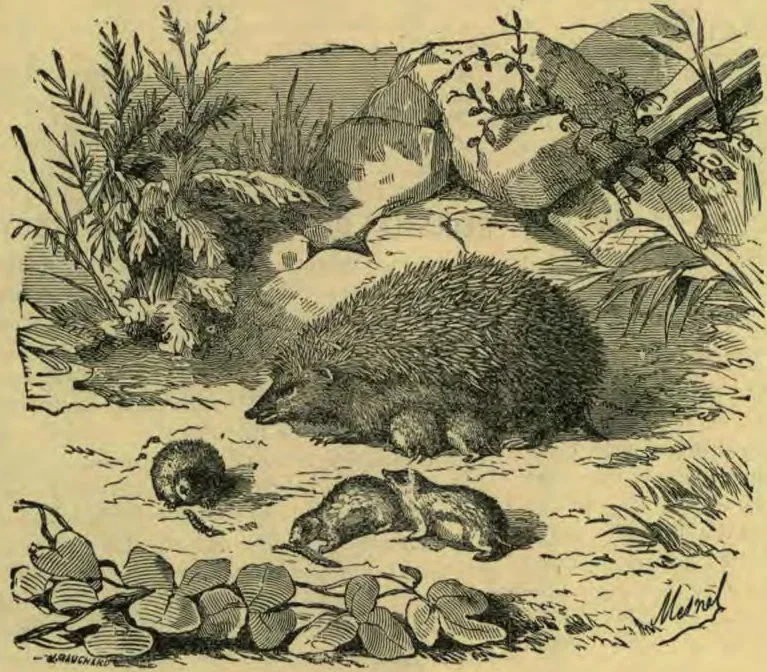
The hedgehog is found on both sides of the Atlantic, and although so common, is considered a curiosity by every one. Its quills, or spines, as they are called, are much shorter than the porcupine’s, being only an inch long; but they are given for the same purpose,—defense. He can also roll himself up like the porcupine, putting his head out of sight, and presenting only an array of sharp spikes for any to take hold of who wishes to hold him.
The quills of the hedgehog enable him to roll off from a precipice without injuring himself. One has been seen repeatedly to throw itself from a wall twelve or fourteen feet in height, and to fall upon the hard ground without appearing to be hurt at all.
The only animal that succeeds in capturing the hedgehog is the crafty fox, and he does so by carefully rolling the little creature into a small pool of water, when the unlucky fellow unfolds itself to see what is the matter, and is at once seized.
Poisons are said to have no effect upon the hedgehog. Deadly poisons have been tried, which proved as harmless to him as so much water. This, if true, is singular indeed, and if the reasons were known, might prove of great value to man.
Its fondness for insects has led to its being tamed, and it is very useful in clearing a house of vermin.

Letter Budget

If we do not occupy a seat in your “Corner” every week it is that you may have the more room to talk with each other. Be assured, dear children, that we have an equal interest in the whole family. Your precious words all find a response in our hearts. We yearn after you, that you may be lambs of Christ’s precious fold. He is such a tender Shepherd,—will carry you in his arms through every difficult place; and if you trust him fully, will finally transplant you to his beautiful kingdom, where nothing can harm; where the wolf and the lamb will lie down together, and a little child shall lead them. Can you find a better friend than He?
Clayton, Minn.
Dear Editors: I have seen your weekly Instructor, and like it so well I thought as I had some money which I earned myself I would subscribe for it. I have not taken the paper before. My papa keeps the Sabbath, and has bought the Child’s Poems for me. For a premium, you may send me School-Boy’s Dinner, or some other little book.
Ira T. Everett.
Bunker Hill, Mich.
Dear Editors: I am a reader of the weekly Instructor and am much pleased with it. I took the monthly last year. I am keeping the Sabbath with my mother. I go to Sabbath-school, but I have to go alone. I have one brother, but father will not let him keep the Sabbath with me. I am twelve years old. I hope to meet all the Instructor family in the kingdom.
Yours truly, Emma Wofle.

A Sick Boy's Missionary Work with the Instructor

I have a true story to tell of a sick boy who lives in Massachusetts. His parents are both dead; they died in the Christian’s hope. He is cared for by friends who have taught him to observe the Sabbath. He has been sick a number of months, and is unable to raise either of his hands from the bed. He has sores, caused by lying in bed, so that in places there is no skin or flesh, but the bones come in contact with the sheets. Notwithstanding this, he is patient in all his suffering, and when asked how he does, says, “Pretty well.” He is anxious to do missionary work, and I quote from a letter received from the secretary of the V. M. Society where he lives:—
“Eugene wishes me to see that he has one number of the weekly INSTRUCTOR which comes in our club to call his own. He has it hung on the back of a chair near his bed so that he can see to read it, and in this way he gets the lessons, and recites them to some one of us. After he has read the paper over and over again he wishes me to send it down to Bro. Hodges of North Carolina. I have written him that it is sent by a little boy who is sick and cannot use either hand. He has written back that three children in their company have read it, and are just delighted with it. Eugene seems much pleased with the thought of doing missionary work while on his sick bed.”
How many children have an interest to take the weekly INSTRUCTOR for missionary work? We entreat parents to encourage their children in this enterprise. S. N. Haskell.

FITLY ANSWERED.

A young city fop, in company with some belles of fashion, was riding into the country for pleasure, when they saw a rustic-looking country lad at work by the roadside. Thinking it a fine opportunity to show his wit to the damsels, by sporting with the poor boy’s ignorance, he accosted him thus:—
“Can you inform me, Mr. Zebedee, how far it is to where I am going, and which is the most direct road?”
Poor Zebby, not the least daunted, but with the most sober and composed face, said,—
“If you are going to the gallows, it is but a short distance; if to jail, it stands but a few rods this side; but if only to poverty and disgrace, you are now approaching your journey’s end; and as for the most direct road to either, you are now in it, and cannot miss the way.”
The dandy dropped his head and drove on.
When fine clothes won’t treat rusty ones politely, it’s a sure sign there’s a fool in them.

Maxims on Wisdom, Strength, Wealth, and Honor

Who is wise? He that is teachable. Who is mighty? He that conquers himself. Who is rich? He that is contented. Who is honored? He that honoreth others.

THE LITTLE BOY'S WATCH.

Dear little Dick, curled up by the fire, Sat watching the shadows come and go, As the dancing flames leaped higher and higher, Flooding the room with a mellow glow.
His chubby hand on his side was pressed, And he turned for a moment a listening ear; “Mother,” he cried, “I've got a watch! I can feel it ticking right under here.”
“Yes, Dick; ’t is a watch that God has made, To mark your hours as they fly away; He holds the key in his mighty hand, And keeps it in order night and day.
“Should he put aside the mystic key, Or lay his hand on the tiny spring, The wheels would stop, your watch run down, And lie in your bosom a lifeless thing.
He crept to my side, and whispered soft, While his baby voice had an awe-struck sound: “I wish you would ask Him, mamma, dear, To be sure and remember to keep it wound!”
—The Little Sower.

You have reached the end of this edition.

The Youth’s Instructor · Feb 19, 1879