The Youth’s Instructor, Vol. 33, No. 51.

CHRISTMAS RHYMES

The Youth’s Instructor

Jan 6, 1886

S. D. A. Publishing Association · Battle Creek, Mich. · Jan 6, 1886

CHRISTMAS RHYMES.

THE bells ring clear as bugle note, Sweet song is thrilling every throat, 'Tis welcome Christmas morning. Oh, never yet was morn so fair, Such silent music in the air; 'Tis merry Christmas morning.
Dear day of all days in the year; Dear day of song, good will, and cheer; 'Tis golden Christmas morning. The hope, the faith, the love that is, The peace, the holy promises, 'Tis glorious Christmas morning.
Bitterly chill is the winter wind, Biting our cheeks as we go; Gray is the sky, and the silent fields Are white with December snow. But the message we bear makes warm our hearts With the joy of the Christmas-tide; It is, “May God's grace, and Christ's sweet peace With you and yours abide.”
Keep the feast with gladness! Take we the tablets of the past To wipe recorded woes away; Now, merry bells, ring out at last For us and the Christmas day.
Even while we sing, he smiles his last, And leaves our sphere behind. The good old year is with the past, Oh, be the new as kind.

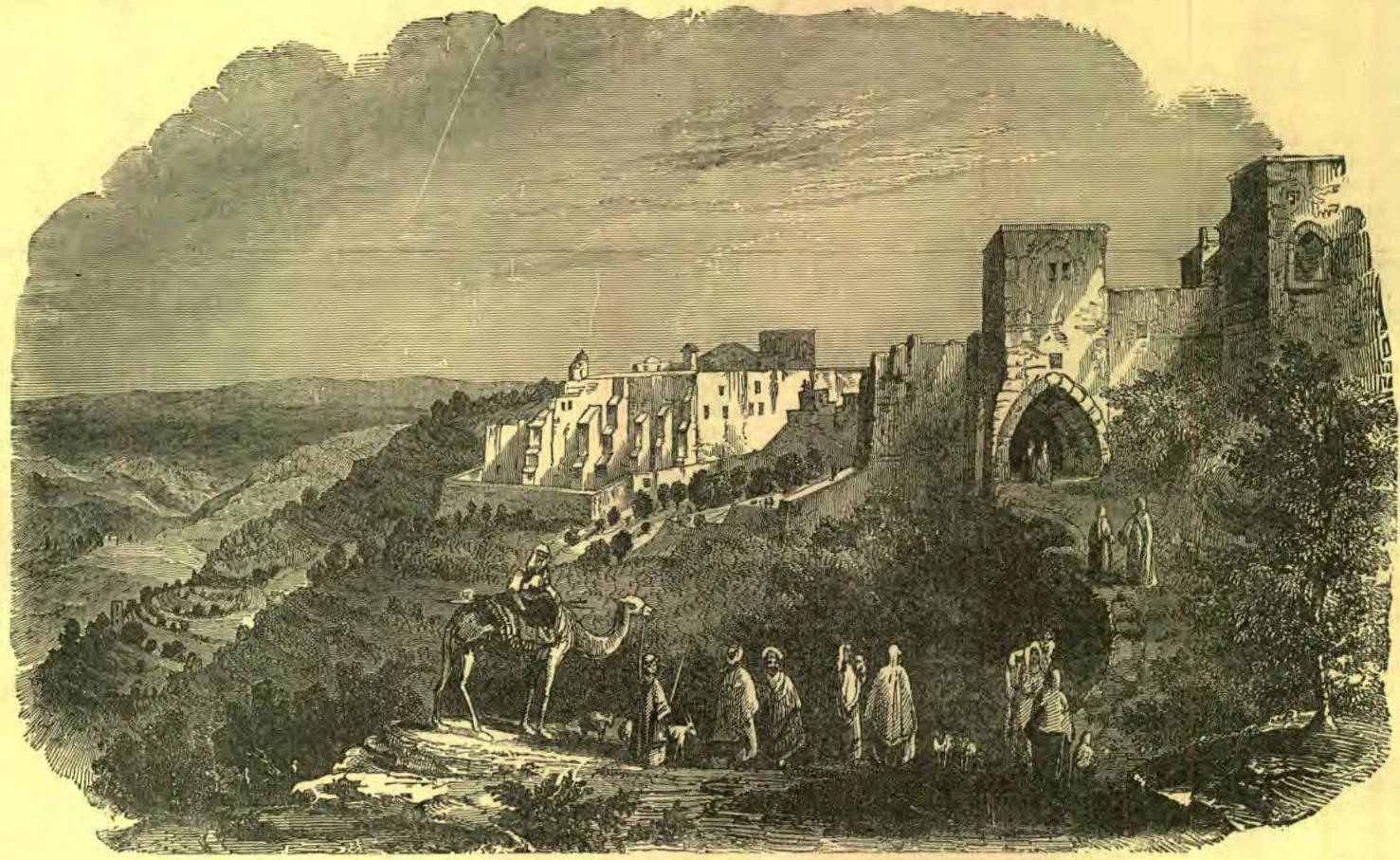
THE GATE OF BETHLEHEM.

What memories are awakened, as we look at the old gate-way in the picture before us! What emotions arise, as we think how Ruth, Samuel, David and even Mary, the mother of Jesus, have passed in and out under that arch, and up and down the roadway that leads to it!
A peculiar charm pertains to the birthplace of noble men. We love the ground which our dear ones have trod, and the same tendency leads us to hold sacred everything pertaining to the benefactors of our race,—men who have touched the great heart of the people, and caused it to vibrate with pulsations that shall never cease while time continues.
How many patriotic hearts have beat with emotion and gratitude, as they lingered about the home and final resting place of Washington, at Mt. Vernon! Stratford-on-Avon is every year affectionately visited by thousands whose only interest in the place comes from its being connected with the birth, life, and death, of the poet Shakspeare.
But far away in the almost deserted land of Palestine, is a spot dearer than any other birthplace on earth. Rome is called the Eternal City, because it has existed so long; but this old town was mentioned in Scripture a thousand years before the fabulous twin brothers traced the intended boundary of the rude town which was to perpetuate their name for so many centuries. For more than three thousand years, Bethlehem has maintained an uninterrupted existence, and is as substantial to-day as ever it was. It is a small town with but a single street extending for half a mile east and west along a ridge that strikes out into a small, but fertile plain. On the north side, and at the east end, the abrupt descent is terraced, and planted with a rich variety of fruit trees. The white stone houses, perched upon the summit of the ridge, and gleaming through the foliage of the trees, present a beautiful picture when seen from a distance by the approaching traveler.
Just over that little hill to the north, and not half a mile away, a small white dome may be seen, standing all alone.
Thirty-five centuries ago there was a funeral at that place. The patriarch Jacob, with his numerous family, had traveled from the far-distant country of Padan-aram, and was within fifteen miles of Hebron, his point of destination, when his beloved Rachel, the mother of Joseph, died by the way, and was buried on the spot now covered by the simple monument just described.
Four hundred years later, two sad women, one young and beautiful, the other somewhat stricken with years, but far more by sorrow, toiled slowly up the hill, and entered through the dark gate-way which we see in this picture. The people of the place gazed upon the strangers, and finally said to the elder, “Is this Naomi?” But a few years before, she had gone out from them to the land of Moab. There she buried her husband and her two sons, and had now returned with her daughter-in-law, the faithful Ruth. In those days the plain before the town was covered with harvests, and there Ruth gleaned in the fields of Boaz, who was so attracted by her beauty and modesty that he soon made her his wife.
Two more centuries rolled by, when Bethlehem witnessed a strange scene in the home of Jesse, the grandson of Boaz and Ruth. Although Saul was still reigning, Samuel, the prophet of God, had come by divine command, to anoint one of the sons of Jesse to be king over Israel. Samuel was about to err in his choice; but God checked him, saying, “The Lord seeth not as man seeth; for man looketh on the outward appearance, but the Lord looketh on the heart.” But when David, the youngest son, was brought in from tending the sheep, the Lord said to Samuel, “Arise and anoint him; for this is he.”
Those hills and mountains seen in the background of the picture, still abound in fierce beasts, which hide in the caves and deep ravines of that wild region, and prowl upon its borders to prey upon unguarded flocks. Forth from these rocky fastnesses must have come the lion and the bear that were slain by the unaided hand of David.
Near the gate of Bethlehem is a remarkable well of pure water. We cannot distinguish the spot, but it must have been in the foreground of the picture before us. Many a time had David in boyhood and youth cooled his brow, and quenched his thirst at this copious fountain. At one time when the Philistines had a garrison in Bethlehem, and their hosts filled the plain of Rephaim between Bethlehem and Jerusalem, David, who was hiding from his enemies in the caves of the mountains, longed for water from the well of Bethlehem, and said, “O, that one would give me drink of the water of the well of Bethlehem, which is by the gate!” Then three of the mighty men who were with David, departed secretly, broke through the hosts of the Philistines, braved the garrison at Bethlehem, drew water from the well by the gate, and took it to David. The heart of David was deeply moved by this daring act of devotion, and almost perishing for water, as he was, he deliberately poured it upon the ground, saying, “Be it far from me, O Lord, that I should do this; is not this the blood of the men that went in jeopardy of their lives?”
David was one of the noblest of earthly kings, one of whom the Lord said, “I have found David the son of Jesse a man after mine own heart.” It would seem honor enough for one town to be the birthplace of such a man; but a mightier king was to begin his earthly career within the humble walls of Bethlehem.
For a thousand years the bones of king David had been moldering in the grave. The glory of Solomon had blazed forth, and departed. The people of God had been scattered in distant lands. A remnant had returned, and rebuilt Jerusalem and the temple. Again they had suffered the most cruel abasement from their persecutors, and were now under the iron rule of the Romans. Out upon the fertile plain of Bethlehem, just where the youthful David had so faithfully kept his charge, a band of shepherds were guarding their flocks by night, when, “Lo, the angel of the Lord came upon them, and the glory of the Lord shone about them; and they were sore afraid. And the angel said unto them, Fear not; for, behold, I bring you good tidings of great joy, which shall be to all people. For unto you is born this day in the city of David a Saviour, which is Christ the Lord.” . . . “And suddenly there was with the angel a multitude of the heavenly host, praising God, and saying, Glory to God in the highest, and on earth peace, good will toward men.” On going into Bethlehem, the shepherds found the child Jesus lying in a manger, just as the angel had said.
Thus has the little town of Bethlehem been hallowed by associations that will make it sacred forever to the hearts of those who love the Prince of the house of David, the Saviour of mankind. Though the birth of that Saviour was heralded by angels, he was despised, rejected, and crucified; but the time is at hand when he shall come in the glory of his Father, and all the holy angels with him. Then shall the righteous rejoice; but the wicked will call upon the rocks and mountains to fall on them, and hide them from the glory that none can look upon but those who are made immortal. G. H. BELL.

A Lad Guides an Old Man onto the Train

The locomotive came puffing into the depot, and everybody was in a hurry to step on the train, so that it was not so strange that an old man who was groping his way nervously through the crowd should be overlooked. He was bent nearly double with age and infirmity, and his sight was evidently impaired. A lad of seventeen years did, however, notice him. Recognizing the old gentleman’s helplessness, he took him tenderly by the arm, and gently led him into the car. The respectful action attracted attention. Young and old paused for a moment to gaze upon youth guiding old age. I did not know the lad, but I said heartily, “God bless him!”—Companion.

MERRY CHRISTMAS.

Christmas is at last here,—good, merry old Christmas, that season looked forward to by boys and girls the world over, as a time of merry-making and feasting, and of giving and receiving gifts. The Germans call it the “children’s festival,” and delight the hearts of the little folks with Christmas trees. On Christmas eve they set up a large bough from a yew tree in the best room, light it with tapers, and hang it full of pretty ornaments and gifts, just as we do in our own country.
After the gifts are distributed, there follows a ceremony that I fancy the little people sometimes dread. The mother takes her daughters aside, and the father his sons, and they talk over with them privately what has been most praiseworthy or most faulty in their conduct. I think that when they have been particularly bad, they do not look on Christmas with such unbounded delight as they might otherwise have done.
But there is a more ancient custom, still practiced in some parts of Germany. All the parents send their presents to the Knecht Rupert, or Santa Claus. The Knecht Rupert, dressed in high buskins, white robe, huge mask, and great flaxen wig, goes round from house to house with a pack of presents on his shoulders. The parents show him the greatest reverence. At each door he asks for the children, and inquires whether they have been good or bad. Can you not imagine the great anxiety with which each little fellow listens to the report made to the Knecht Rupert, and his relief when that mysterious being gives him his present? You may be sure the saint asks very close questions, and no child can pass lightly over the longed-for, yet dreaded ordeal.
The little boys and girls of Rome have a similar bugbear to dread in the person of a tall, dark woman, ugly and terrible, called the Befana, who, they believe, comes down the chimney Christmas night, with jingling bells, to put playthings in the stockings of the good children, and bags of ashes in those of the bad ones.
In the old, old days in England, Christmas used to be a much more jovial festival than it is at the present time. The huge yule-log was dragged in to the wide-mouthed fireplace with much pomp and ceremony, and lighted with a brand from the last year’s burning. The houses were gaily decked with bay, holly, ivy, and mistletoe; and feasting, games, and revelry were the order of the day.
“Then opened wide the baron’s hall, To vassal, tenant, serf, and all; Power laid his rod of rule aside, And ceremony doffed his pride. All hailed with uncontrolled delight And general voice, the happy night That to the cottage, as the crown, Brought tidings of salvation down. England was merry England when Old Christmas brought his sports again.”
Little remains to remind one of the hearty customs of old times, except the waits who carol from door to door, their songs sometimes breaking the stillness of night like music from another sphere.
But Christmas, however kept, is a peculiarly joyful season. An almost hallowed influence seems to pervade all things. It used to be the belief among the simple-hearted of the Middle Ages, that all nature was in harmony with this sacred time; and the great poet Milton has beautifully put the superstition in verse:—
“Some say that ever ’gainst that season comes Wherein our Saviour’s birth was celebrated, The bird of dawning singeth all night long: And then, they say, no sprite dares stir abroad; The nights are wholesome—then no planets strike, No fairy takes, no witch hath power to charm, So hallowed and so gracious is the time.”
In our own country, thirty or forty years ago, Christmas was attended with more ceremonies than at present. Every child once believed in good Saint Nicholas, that jolly fellow with a round, rosy face, snow-white hair, and merry, twinkling eyes, who came all the way from fairy land in a fantastic little sleigh drawn by eight tiny reindeer and sliding down the chimney, filled the stockings hanging expectantly by the open fireplace, full to the brim with goodies and toys. Indeed, I have heard these children, now older grown, say they heard, or thought they heard, the jingling of his tiny sleigh-bells and the pawing of his reindeer on the roof. However, they were not able to find out if it were true; for the child who peeped at Santa Claus on that night would have an empty stocking. But since the wide-mouthed fireplace has gone out of existence, the little folks have hard work to believe that he can come down the narrow chimneys and stove-pipes, and they seriously doubt if there is any such good saint. Perhaps their parents have concluded that it is not wise to teach them such fables.
But if the Christmas that we now keep is less jocund than that our fathers kept, so that we have not so much merriment to look back upon, we may have just as much good feeling and just as many pleasant memories to hallow the time, if we keep it in the right way. Christmas commemorates the time when God the Father gave to man the priceless gift of his beloved Son. Christ, in his pure, unselfish life, taught us how to live. And how can we better show our gratitude for this great gift, than by following the pattern set us in giving, not alone to our own home friends, but to the poor, the sick, and the suffering, to the needy everywhere, out of the abundance with which God has blessed us? May all the great INSTRUCTOR family keep the festival in very deed and truth. W. E. L.

THE RIGHT SPIRIT.

We do not doubt that the following touching little story is quite true. There is a lesson and a moral in it for boys and girls disposed to shirk even the light duties imposed upon them in the way of “chores” and errands. Think of this courageous little fellow, taking upon himself the responsibilities of the head of a family, and so manfully discharging them!
“Oh, yes, I have all kinds of tenants,” said a kind-faced old gentleman; “but the one I like the best is a child not more than ten years of age. A few years ago I got a chance to buy a piece of land over on the West Side, and did so. I noticed that there was an old coop of a house on it, but paid no attention to it. After awhile a man came to me, and wanted to know if I would rent it to him.
“‘What do you want it for?’ said I.
“‘To live in,’ he replied.
“‘Well,’ I said, ‘you can have it. Pay me what you think it is worth to you.’
“The first month he brought two dollars, and the second month a little boy, who said he was the man’s son, came with three dollars. After that I saw the man once in awhile; but in the course of time the boy paid the rent regularly, sometimes two dollars, and sometimes three dollars. One day I asked the boy what had become of his father.
“‘He’s dead, sir,’ was the reply.
“‘Is that so?’ said I. ‘How long since?’
“‘More’n a year,’ he answered.
“I took his money; but I made up my mind that I would go over and investigate, and the next day I went there. The old shed looked quite decent. I knocked at the door, and a little girl let me in. I asked for her mother.
“‘Where is she?’ said I.
“‘We don’t know, sir. She went away after my father died, and we’ve never seen her since.’
“Just then a little girl about three years old came in, and I learned that these three children had been keeping house together for a year and a half, the boy supporting his two little sisters by blacking boots, and selling newspapers, and the elder girl managing the house, and taking care of the baby.
“The next time the boy came with the rent, I said,—
“‘My boy, you are a little man! You keep right on as you have begun, and you will never be sorry. Keep your sisters together, and never leave them. Now look at this.’
“I showed him a ledger in which I had entered up all the money that he had paid me for rent, and I told him it was all his with interest. ‘You keep right on,’ said I, ‘and I’ll be your banker; and when this amounts to a little more, I’ll see that you get a house somewhere of your own.’ That’s the kind of tenant to have.”—Selected.

KINDNESS

The world is full of kindness that never was spoken; and that is not much better than no kindness at all. The fuel in the stove makes the room warm; but there are great piles of fallen trees lying on rocks and on tops of hills where nobody can get them; these do not make anybody warm. You might freeze to death for want of wood in plain sight of these fallen trees if you had no means of getting the wood home and making a fire of it.
Just so in a family; love is what makes the parents and children, the brothers and sisters happy. But if they take care never to say a word about it; if they keep it a profound secret as if it were a crime, they will not be much happier than if there was not any love among them; the house will seem cool even in summer; and if you live there, you will envy the dog when anybody calls him poor fellow.—Doctor Holland.

Angels as Guests: Hospitality and Heavenly Company

WHAT a fine thing it would be if we could return to the old custom of having angels call upon us, and occasionally stay all night with us! They did so at Abraham’s house, and were pleased with their entertainment. Would they be at our house? If they would call often, they would sometimes find us tired and disappointed, and, perhaps, not in an angelic temper of mind. And yet may it not be that they do call on us, sit beside us, walk with us, sympathize with us, and in ways that we do not know, help us? We ought always to be prepared for company like this.

CHRISTMAS

LAST night, as I lay on the clover, While the clouds in the west were piled, The nightwind sighed like a lover, As I lay like a tired child.
And I thought how the pain would soften In the weary hearts upon earth, If they'd study the story often Of the blessed Redeemer's birth;
How he came to the earth a stranger, Away from his home on high; How he toiled in sorrow and danger; How he gave himself up to die;
How he stood as a lamb for the slaughter In the pure, sweet air of the morn; How the soldiers, with brutal laughter, Wreathed his brow with the cruel thorn,
While the jeers of the heartless soldiers Were more keen than the cruel sword; How the purple robe was folded Round the form of creation's Lord;
How he carried the cross till he fainted, And sank in the place where he stepped— No pencil has ever painted The place where the women wept—
How his feet were raised from the sod And nailed to the cruel tree. O tender, compassionate Christ of God, That anguish was borne for me!
And many a time in the winter, When Christmas is drawing nigh, I have pictured the death of Jesus, I have thought of his dying cry.
I have heard sweet Christmas bells ringing, I have heard them time and again; I have read what the angels were singing Of peace and good will unto men.
And while Christmas joys in December Are precious and dear unto me, I think of that babe sweet and tender As the Lamb of Mount Calvary. L. D. SANTEE.
Written for the INSTRUCTOR.

HOW TO STUDY THE LESSON.

To lay down a rule which could be profitably followed by every one in preparing a lesson, would be a difficult if not an impossible undertaking; yet there are certain general principles which, if carefully observed, will be of great benefit to the student.
Some one takes up the paper, and the first idea that he has of the lesson, if not the only one, is this: “Now here is a lesson, and I must get it;” and at it he goes. Without giving a thought as to what the lesson may be about, or what connection it may have to preceding lessons, he reads the first question, and proceeds to find the answer; then the next one, and so on through the entire list, when the paper is thrown down, and he considers the lesson learned. The principal idea, in this process of studying the lesson, has been to find something that will answer the questions; and quite frequently it happens that the question and answer are as foreign as was the answer of the boy to the question, “Who built the ark?” when he replied, “Christopher Columbus.”
By studying the lesson in this manner, one not only fails to get the proper connection of the lesson with those which have been previously learned, as well as the relation of the different questions, but he also fails to secure that discipline of mind which might be secured by a well directed method of study. And again, by studying the lesson in this way, the interest and enthusiasm so necessary to a live scholar and a live Sabbath-school, is not awakened; and the exercise, instead of drawing out thought, and leading out the mind, becomes dry and formal.
How, then, shall we study the lesson? It would seem that the first thing necessary in preparing to learn the lesson, would be to ask one’s self the question, “What is this lesson about? What object have I in learning it?” Before looking at a question, get these points firmly fixed in the mind. By neglecting to get the general idea of the lesson in the mind when first beginning to learn it, one works at random, so to speak, and a great deal of his effort may be misdirected, and consequently lost. But how shall I get the general plan of the lesson, says one, without first learning it? There are various ways, and first of all we would recommend that the heading be read before beginning to study the questions. The heading is supposed to give the subject of the lesson, and in trying to learn a lesson without first knowing what it is about, one is like a traveler going on an unknown road toward a place of which he does not know the name. The chances are that he will lose his way. Quite frequently we have seen almost a whole school unable to tell what the subject of the lesson was, on being questioned in the general exercise; and yet they thought they had the lesson learned pretty well.
By reading the heading of the lesson, thoughts are suggested to the mind which enable the learner to grasp ideas that otherwise would have seemed dark. But if the general plan of the lesson is not sufficiently brought out in the heading, it may be learned, perhaps, by first reading over the questions without trying to find the answers. The relation of the different questions to each other, and to the subject of the lesson, is thus seen, and the lesson can be more readily acquired.
Try to find what connection the lesson has with those which have been previously learned. By observing this direction a double object is gained. The general plan of the whole series of lessons is kept before the mind, and, what is more important, the student is stimulated to review back lessons. The Sabbath-school should not be regarded as a place of recreation, where we can go and be amused for an hour, by getting up a discussion on some trivial question which may have little to do with the lesson, but as a place where useful information can be acquired regarding our soul’s highest interests; and it can be made such a place only by a hearty co-operation of all concerned in trying to have perfect lessons,—the reviews, as well as those for the special occasion.
With these general ideas of the lesson in mind, the student is prepared to take it up in detail; and as he studies the questions, he almost anticipates the answers. An interest is aroused which could, perhaps, be awakened in no other way, and the result is a live Sabbath-school.
EUGENE LELAND.

MAKING A DOLLAR.

You were told in a recent INSTRUCTOR how the paper dollar is made; here is what a late Companion says of the manufacture of the silver dollar:—
“On the corner of Chestnut and Juniper Streets in Philadelphia, is a square, ugly building, with a bed or two of red geraniums in front, and a United States flag flying overhead. In the center of this building, in an open court-yard, are piled up crates covered with stout wire net, and guarded by men under arms.
“These crates contain partially refined silver ore from Colorado, and the value of each is about a thousand dollars.
“Some thirteen or fourteen thousand pounds of silver is melted every day, and comes out of the grimy smelting-room in glittering ingots. These long bars are held, each in turn, under the topping machine, a heavy steel shaft with a knife edge that smooths off the ends of the metal bars as easily as if it were paring an apple.
“The ingots then have the shape, and a good deal the appearance, of a bar of white cream candy in the confectioners’ jars. Each one is next put under rollers, like dough, and flattened out to the thickness of a dollar.
“The precious dough is then heated, and handed over to a gigantic cook made of revolving wheels and steel bars, that swiftly cuts it into tiny biscuit, two hundred and fifty in the minute. These little cakes are seized by another machine, which mills the edges, and then pass into a trough filled with acid to wash them, and from that to a revolving tub of sawdust. They are now smooth, bright discs of silver with milled edges.
“The press that makes them into coins is like a monstrous, dumb, intelligent creature. It is waited on by a pretty young girl, who drops the discs into a long tube, from which this dumb monster (who seems to be thinking of something greater than its work) picks each one out with its claw-like fingers, places it between its lips, on one of which is a head of Liberty, and the other an eagle. The mouth shuts on it with terrific force, and spits it forth, a dollar.
“Each dollar is weighed, and if too light or too heavy, is rejected, and sent back to the melting furnace.
“The Government is a thrifty manufacturer; the fragments, we may be sure, are carefully gathered up, that nothing be lost. The pieces out of which the coins are cut, and the silver filings from the milling machine, all go back, of course, to be melted over. The floors and walls of the mint are covered with iron grating, through which the scrapings and precious dust sift. These amount in value to thirty or forty thousand dollars a year. At certain intervals the grating itself is melted down, and yields its prey of the precious metal.”

IMPORTANT BIBLE SUBJECTS.

LESSON 18.—THE KINGDOM OF GRACE.

[NOTE TO THE STUDENT.—Do not consider the lesson learned until you can give at least the substance of every text, with the correct reference for each. The references in black letters indicate those texts that should be committed to memory. A little diligent application each day will enable you to learn them, although this need not be considered a test of scholarship.]
1. For what are we to look, after the fires of the last day have swept away all traces of the curse? 2 Pet. 3:13.
2. Where is this promise found? Isaiah 65:17; 66:22.
3. What does John say about it? Rev. 21:1.
4. Who will accompany the saints when they return to the earth? Jude 14.
5. What descends from heaven with them? Rev. 21:2.
6. What will be the condition of those who are thus brought back to earth by the King of glory? Rev. 5:10; 21:3, 4.
7. Who will be assembled in the New Jerusalem? Heb. 12:22-24.
8. How long will the saints remain in this happy state? Dan. 7:14, 18, 27.
9. Will the Sabbath be recognized in the new earth? Isaiah 66:23.
10. What throne will be there? Rev. 22:3.
11. In what two ways is the throne of God sometimes spoken of in the Scriptures? Heb. 4:16; Matt. 25:31.
12. What does a throne represent?—The kingdom, and the government of the kingdom.
13. Why are different names applied to the throne of heaven?—Because the relation between mankind and the kingdom of heaven is different in this life from what it will be in the life to come.
14. In what relation are we now?—We belong to a race that is in rebellion against the government of heaven.
15. How must we be saved, if saved at all, from the destruction that awaits the wicked?—By the grace of God, who has given his Son to die for us.
16. What do we understand by grace, as spoken of here?—Unmerited favor.
17. Why may the heavenly throne be fitly called the throne of grace?—Because it is the throne from which grace proceeds.
18. What do we understand by the kingdom of grace?—The entire plan for the salvation of men by grace, through faith in Jesus Christ.
19. What fitness is there in applying the term “kingdom of grace,” or “kingdom of heaven,” to the work of saving men?—The King of heaven and all his subjects are engaged in that work.
20. What relation exists between the kingdom of grace and the kingdom of glory?—The former prepares subjects for the latter.
21. What conditions does the King of heaven make for us who have been in rebellion against his government?—We are to renounce our allegiance to Satan, and by faith and obedience prove our loyalty to our heavenly King until he shall come to take us to the kingdom of glory.
22. Will the kingdom of grace exist after the kingdom of glory is established?
23. Which of these kingdoms did we learn about in lesson 17?
24. As found in the New Testament, how is the term “kingdom of God,” or “kingdom of heaven,” to be understood?—Sometimes it means the kingdom of grace, while in other passages it means the kingdom of glory.
25. When was the kingdom of grace established?—When salvation by grace, through faith in a promised Saviour, was first offered to sinful man.

THE WONDERFUL SONG.

THERE is a song that ne’er is still’d, Though centuries since that blessed morn; The song by heavenly Father will’d— The angels’ song when Christ was born. To-day we hear that song again Of “Peace on earth, good will to men.” —George Birdseye.

THIBETAN COSTUME.

The Tibetan’s habit of making their bedding serve as garments for their daily wear may at times be very convenient, yet it differs much from American ideas of cleanliness and healthfulness. None who have enjoyed the luxury of well-aired beds could be persuaded to accept their fashion for any convenience it might afford. However, it is interesting to know the customs of other nations, even if we do not care to adopt them. We clip the following from a late exchange:—
“The men wear the tchru ba, a long and thick woolen robe, sheepskin in winter, descending down till it would drag considerably on the ground if let loose. It is doubled well across the chest and front till the ends or edges almost meet the shoulders, where one edge is fastened under the right arm with a tape or string bow. In dressing, the man, having on his tchru ba hanging loose about him, holds his sash or belt about on a level with the knees, or a little above them, and this he draws in to make a gather, and then the belt, with all of the robe above it, is drawn up and the belt fastened round the waist. This leaves a large pouch, of course, falling over the belt all round, and leaves the foot of the robe about half-way between the knee and the calf. Into the pouch so formed they put anything they have to carry, such as their tsam pa cup, and even little dogs, and sometimes little pigs. At night, before lying down to rest, they take off their boots and belt, and with these make a pillow. Then they judge their distance from the ‘pillow’ and kick that part of their robe (now trailing on the ground after removing the belt) which they intend to lie on toward the ‘pillow,’ thus by a kick converting one side of their tchru ba into a mattress, and by this arrangement leaving themselves still the other side of the robe to act as a complete bed-covering on lying down; and all without undressing. Only the rich indulge in a carpet to sleep on, and rich people sometimes use a Chinese carpet. The above system of bed-making is almost universally practiced throughout Thibet, or at all events throughout Eastern Thibet.”

A CURIOUS ARTESIAN WELL.

A SAN FRANCISCO paper gives an interesting account of a curious well sunk by Cutlar Salmon who lives near French Camp, a small settlement not far from Stockton, Cal. Others had been boring Artesian wells, and he determined to try his luck. He sank a well with a seven-inch tube to a depth of about 80 feet, and struck a copious stream of excellent water. Desiring to learn whether he could increase the flow by going deeper, and fearing that, should he continue the well the same size, he might injure the quality of the upper strata of water, Mr. Salmon hit on the plan of sinking a four-inch tube inside the seven-inch one, and then making what might be called the experimental well four inches in diameter. This inner one he bored to a depth of 1,250 feet, and then came to water again. This lower stream came to the surface, and, indeed, rose in a tube twenty-two feet above the ground. The last water found was unfit for drinking, and but for an accidental discovery of its wonderful properties, might have been considered a nuisance, as many things are, the uses of which we do not know. It was found that there was a large amount of gas in this water from the lower depth. This came bubbling to the surface, making one think of a gigantic soda fountain.
Some one suggested the idea of seeing if the gas would burn. A coal-oil can was put over the top of the tubing, and having a few holes punched in it, an improvised gas fixture was at hand. Only a match was required to complete the preparations. The match was lighted and applied to a hole in the pan, and a flame shot up three or four feet into the air and burned steadily. The gas would burn, and Mr. Salmon had fire and water coming out of the same hole in the ground.—Exchange.
Continue reading: REMARKABLE ANCIENT RUINS