The Youth’s Instructor, Vol. 33, No. 51.

CHRISTMAS RHYMES
Earlier text: CHRISTMAS RHYMES

REMARKABLE ANCIENT RUINS.

The Chihuahua (Mexico) Enterprise reports the discovery of some remarkable ancient ruins on a hill, or mountain, four leagues south of Magdalena, in Sonora. The hill is about 700 feet high; and half way up there is a layer of gypsum, which is as white as snow, and may be cut into any conceivable shape, yet sufficiently hard to retain its shape after being cut. In this layer of stone are cut hundreds upon hundreds of rooms from 6x10 to 16x18 feet square. So even and true are the walls, floor, and ceiling, so plumb and level, as to defy variation. There are no windows in the rooms, and but one entrance, which is always from the top. The rooms are but eight feet high from floor to ceiling. The stone is so white that it seems almost transparent, and the rooms are not at all dark. On the walls of these rooms are numerous hieroglyphics and representations of human beings cut in the stone in different places; but, strange to say, all the hands have five fingers and a thumb, and the feet have six toes. Charcoal is found on the floors of many of the rooms; implements of every description are to be found. The houses, or rooms, are one above the other, to three or more stories high; but between each story there is a jog, or recess, the full width of the room below, so that they present the appearance of large steps leading up the mountain.—Selected.

COMFORT AND MUDDLE.

COMFORT is the daughter of Order, and is descended in a right line from Wisdom; she is closely allied to Carefulness, Thrift, Honesty, and Religion; she has been educated by Good Sense, Benevolence, Observation, and Experience; and she is the mother of Cleanliness, Economy, Forethought, Virtue, and Domestic Happiness. Muddle is descended from the ancient but dishonorable family of Chaos; she is the child of Indifference and Want of Principle; educated alternately by Dawdling, Haste, Stupidity, Obstinacy, Meanness, and Extravagance; secretly united at an early age to Self-Conceit; and parent of Procrastination, Falsehood, Dirt, Waste, Disorder, Destruction, and Desolation.

Largest Daily Circulation: La Petite Journal of Paris
The Parisian paper, La Petite Journal, is said to have a daily circulation of upward of 300,000 copies—the greatest of any paper in the world.—Golden Days.

THE LITTLE EMIGRANT'S CHRISTMAS.

CHRISTMAS time was rapidly drawing on. Happy voices in happy homes proclaimed it, and even nature joined in the proclamation. The snow came down in the softest flakes, and seemed to say in the faintest whisper, “Peace, peace.” The sleigh bells rang in jubilant tones, and at times seemed almost frantic with a joy they could not express. The sun shone brightly on the snow-covered roofs, until every tiny crystal caught its rays, and transformed them into thousands of gleaming jewels; while at night, when the stars came out, they shone with a clearer light, as if they reflected the beams of that star that rose so many years ago, and guided the wise men from afar; at least, so the children thought, and eagerly looked forward to the day.
But there was one sad little heart in all that great city, which these Christmas heralds served only to make the sadder. Niels Sörensen was a poor orphan. Only a short year before, he had been happy in a father's and a mother's love in a dear but humble home in Norway. His father was killed suddenly in a mine accident, and Niels and his mother were left destitute. His father's eldest brother, for whom Niels was named, had years before emigrated to America, and, prospering in business, had often written for them to join him. But Niels's father had become so attached to the old home that he was loth to leave it. Now, however, his mother determined to go to him, their nearest relative; for her health was so poor that she feared she might not long be spared to care for her boy, and could not bear the thought of leaving him to strangers.
It had been a year or more since they had heard from Uncle Niels. They knew he lived in New York City, and that it was quite a large place; but as neither had been beyond the little village of Trones, where they lived, and where every one knew one another for miles around, they supposed that every one would know Niels Sörensen, and that just by inquiring for him, they would readily find him.
So they sold off their cow and their scanty furniture, and found they could barely buy their emigrant tickets; but rejoicing in the hope of soon being with friends, they set sail one bright autumn day for America.
They made friends on board the steamer with other Norwegian emigrants, who, although as poor and ignorant of the world as themselves, possessed kind and friendly hearts.
The excitement of preparing for the voyage being over, Niels's mother rapidly grew weaker; and when, after a few days out on the ocean, a storm arose, the heavy motion of the steamer as it plowed its way through the white-capped waves, so affected her that it soon became evident to all around her that she could not last long. Poor Niels was too seasick himself to notice any great change; and when, after several days' illness, he rose from his bed of rugs and bundles of clothing, which kind hands had made for him, and found his mother with only strength to breathe a whispered prayer to God to guide her son, before she died, his grief knew no bounds. They comforted him as best they could with assurances of soon finding his uncle; and it was with this hope that he at last set foot in America, after a long and tedious voyage of two weeks.
But alas for Niels's hopes, and those of his kind friends! No one in that great city had ever heard of Niels Sörensen. “Why,” sobbed poor Niels, “he's got almost a thousand kroner, for he wrote us so. I should think everybody must know him.” Two hundred dollars seemed a vast sum of money to Niels.
Day after day wore on, but still he could find no uncle. His friends yet kept him with them, though with a large family of their own, they could ill afford to do so. They could no longer help him in his search, for they could spare no idle moments in their toil for daily bread. So Niels searched alone. Every day he would go out on the street, and whenever he met a friendly face, repeat the only English words he knew, and which he had learned from hearing them so often spoken by the others, “Do you know Niels Sörensen?”
It was the night before Christmas. All day Niels had been on the streets; and now tired and spiritless, he wandered from place to place, peeping in at dazzling shop windows with their showy array of toys and trinkets, peering through curtains at happy children, clustered around bright fireplaces with brighter faces. He had eaten nothing since morning; for young as he was, he knew the scanty fare, though willingly given him, but made their own portion less, and had resolved not to go home till after the evening meal, when he would slip off to bed unnoticed. As he looked in at these homes of plenty, he almost rebelled against his kind heavenly Father,—the father his mother had taught him to love. “God is not good to me,” he said, “or why did he take away my father, and my mother, and leave these rich children theirs? and why does he not let me find my uncle? He does not care for me and guide me as mother said he would.”
With falling tears he turned and wandered on, when the sound of sweet music reached his ears, as he neared a large church. A choir of singers were practicing for the morrow's service, and to Niels's unaccustomed ears, heavenly music could not have been more sweet. He entered unnoticed, and breathlessly listened till the anthem was ended, and the singers had departed.
He could not understand the words of the song, but he could the music, and it comforted him. A man was putting the last touches to the evergreens and holly with which the church was decorated, and clearing away the scattered pieces. Niels gathered a few to take to the children at home, and binding them in a bundle, left the church.
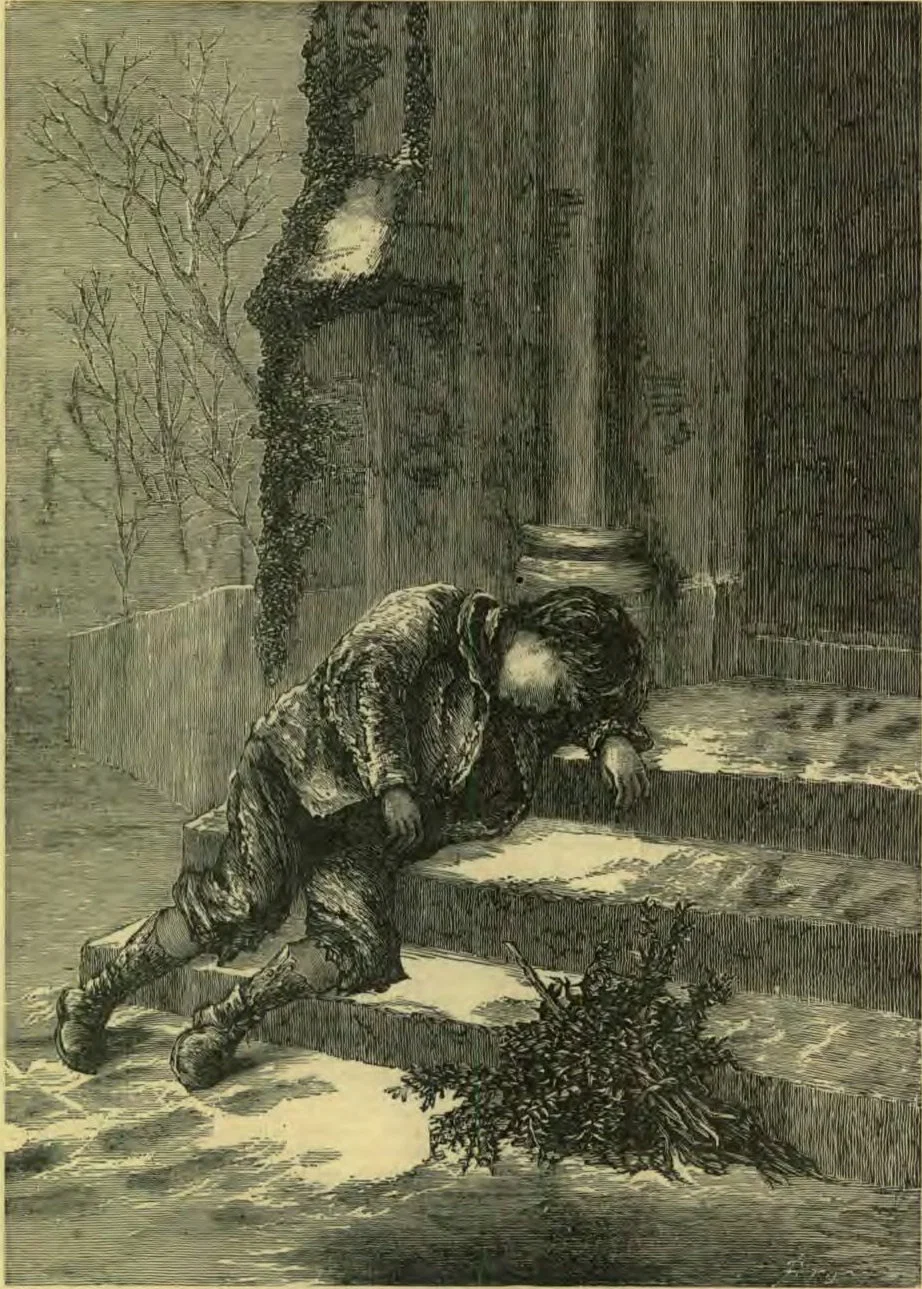
As he descended the steps, he remembered with what an ungrateful heart he had ascended them, and then with falling tears he knelt and asked God's forgiveness for his wicked words, and thanked him that he had been given such kind friends in this strange land, and most of all, that he had directed his steps there to listen to the beautiful music that had made him so much happier. Then, worn out with his wanderings and sorrow, Niels fell asleep.
An hour later, when the sexton had finished his work and turned the great key in the church door, he found him lying there, with his cap thrown off, and the bundle of branches as it had fallen from his grasp.
“Poor boy,” said the sexton, a fine-looking, kind-hearted man, as he touched Niels on the shoulder.
Niels roused up, and, rubbing his eyes, hardly knowing what he was saying, sleepily repeated what he had said all day, “Do you know Niels Sörensen?”
“Why, to be sure I do!” said the sexton, “that is my name.”
Sure enough, Niels had found his uncle, or rather his uncle had found him. As the rest of their conversation was carried on in Danish, we cannot understand them; but as the sexton took him home with him after rewarding his friends for their kindness, we are certain that he was convinced of Niels's identity. As for Niels, in his prosperity he did not forget to thank God, and never said again that He did not care for him. He often helped his uncle in his care of the church, but he never listened to the beautiful music there without thinking how wonderfully he had been guided.
S. ISADORE MINER.

Letter Budget.

VIVIAN L. HOWARD, of Oxford Co., Me., writes, “Dear Editors: Last May I sent you a box of trailing arbutus, and was glad to receive a letter from you. I am a little boy eleven years old. I am very fond of flowers. The trailing arbutus looks very pretty growing, peeping up among the moss and dry leaves before the snow has hardly gone. I made about forty-five cents in selling this plant. I have written two letters for the INSTRUCTOR, and have seen them both in print. I like the paper very much. I have taken it five years, and have paid for it myself. I am a friend to you for making such a nice paper for us. I save my papers, and mamma binds them for me so I can have them to read and reread. If you could see me at my home almost any Sabbath, you would see me with my papers around me, reading until I was real tired. We do not have the privilege of Sabbath meetings or Sabbath-school, except our family school. I have no brothers or sisters. I can wash the dishes and make my own bed, wash, and sweep the floor, and do lots of things to help mamma, because she is real feeble. I love her so dearly I want to do all I can. I have some fine times coasting. I have had my sled seven years. Papa gave me a pair of ice skates on my last birthday, Nov. 1. I can take care of the horse, cow, and hens. I can harness the horse, and take mamma out to ride when it is pleasant. I live on the side of a pleasant hill overlooking a very pretty village. It is not far from the village, so I have a good chance to play all by myself, and can roam over the fields and in the woods, and gather the wild flowers, berries, etc. When I want to go to the postoffice, or to town to do errands, I can get onto my sled and slide into the village in five minutes. Mother does not want me to go to the village school, because she thinks the influence is not good; so she teaches me at home. I read and spell and study the elementary arithmetic and the comprehensive geography. I have quite a large natural history (Woods). I have read it nearly through, and am reading the history of England. I live in sight of the pretty village of Paris Hill, where Eld. White first published ‘Present Truth.’”
Vivian has given such a life-like description of his home surroundings that his letter is very entertaining. It is as good as a real visit with him. We shall hope to hear from him again.
HECTOR MAXSON, of Nebraska City, Neb., says: “I like to read the INSTRUCTOR very much. As I read the Budget, I thought I would write a letter too. I do not go to school; mamma teaches us at home. I cannot write very good, so I will get her to copy this. We do not have any Sabbath-school. We learn the lessons in the INSTRUCTOR, and try to spend the Sabbath in a way to please God. It would be so nice to have Sabbath-school again. I am trying to be a good boy, and to help my two brothers and sisters, who are younger than I am, to be good. We want to be ready when Jesus comes, so he will take us to meet the INSTRUCTOR family in the new earth. I am eleven years old.”
One faithful boy or girl in a family of children may do the best kind of missionary work; and it is the little home missionaries that make the best workmen for foreign missions.

You have reached the end of this edition.

The Youth’s Instructor · Jan 6, 1886