The Youth’s Instructor, Vol. 31, No. 11.

SOME THINGS ABOUT EGYPT

The Youth’s Instructor

Mar 14, 1883

S. D. A. Publishing Association · Battle Creek, Mich. · Mar 14, 1883

SOME THINGS ABOUT EGYPT.
IN the north-eastern part of Africa lies the fertile land of Egypt. Egypt is not so large a country as one might suppose from the vast numbers that found a home there in the days of the Israelites. It is only a narrow strip of land on each side of the Nile, and is shut in on either hand by the sands of the desert; in some places the valley is several miles wide, and in others the sands creep down to the water’s edge.
This country has but one river, the Nile, which, rising far south in the highlands of Central Africa, flows north, smooth and slow but with a strong current, toward the Mediterranean. As the river nears Cairo, it branches off into several streams, that empty into the Great Sea. This river forms a broad highway for travel, not only down but up the stream; for, by a wise provision of nature, a strong north wind blows almost constantly for three-fourths of the year, so that it is as easy to sail one way as the other.
Very little rain falls in Egypt, and the fertility of the land is wholly dependent on the waters of the Nile. About June the river begins to rise and overflow its banks, reaching the highest point near the middle of September; and by the end of November the fields are left dry so that they can be cultivated. The receding waters leave a deposit of slime over the land, which so greatly enriches it that it needs no other fertilizing. It is said that the slime which for ages has been accumulating on the land, is thirty or forty feet deep.
As soon as the river falls back into its proper channel, the husbandman goes into the field to plant his crop. The seed is sown broadcast, and then, in the lower lands, pigs, sheep, or goats are turned in to trample the seed into the ground. Sometimes it is dragged in with bushes. On the higher grounds, a rude plow is used to break up the earth.
The soil furnishes abundant crops of wheat, maize, and millet. There is a large variety of garden vegetables, together with grapes, figs, dates, olives, oranges, bananas, and other tropical fruits.
Along the sides of the high causeways, that are built up above the summer floods, are little water-wheels, forcing tiny streams of water up from the Nile to moisten the parched earth in the dry season. These rills fall off into canals, or furrows, made by the foot, that everywhere intersect the land like a vast net-work. It may be that Moses referred to this custom of watering the land by artificial means when he said to the children of Israel: “For the land, whither thou goest in to possess it, is not as the land of Egypt, from whence ye came out, where thou sowedst thy seed, and wateredst it with thy foot, as a garden of herbs; but the land whither ye go to possess it, is a land of hills and valleys, and drinketh water of the rain of heaven.”
The ancient Egyptians were highly civilized. Shut in on all sides by the sands of the desert or by the sea, they were not easily approached by an enemy, and so were left to pursue the arts and industries for which they were so famous. They built vast pyramids, obelisks, and tombs, and reared magnificent palaces. Many of their monuments are standing at the present day; and one huge granite shaft has recently been brought over to America, and set up in Central Park, New York City. In the pictures painted on their monuments and in their tombs are seen scribes with inkhorns at their sides and pens behind their ears. Glass-blowing was well known among them, and some of their richly colored bottles are still preserved. But, most interesting of all, on the monuments is pictured the whole process of brick-making,—the slaves at work with the taskmasters over them, no doubt just the same as when the lives of the children of Israel were made “bitter with hard bondage, in mortar, and in brick, and in all manner of service in the field.” Neither did they fall behind in medical science, for the mummies embalmed thousands of years ago are still in as good a condition as then.
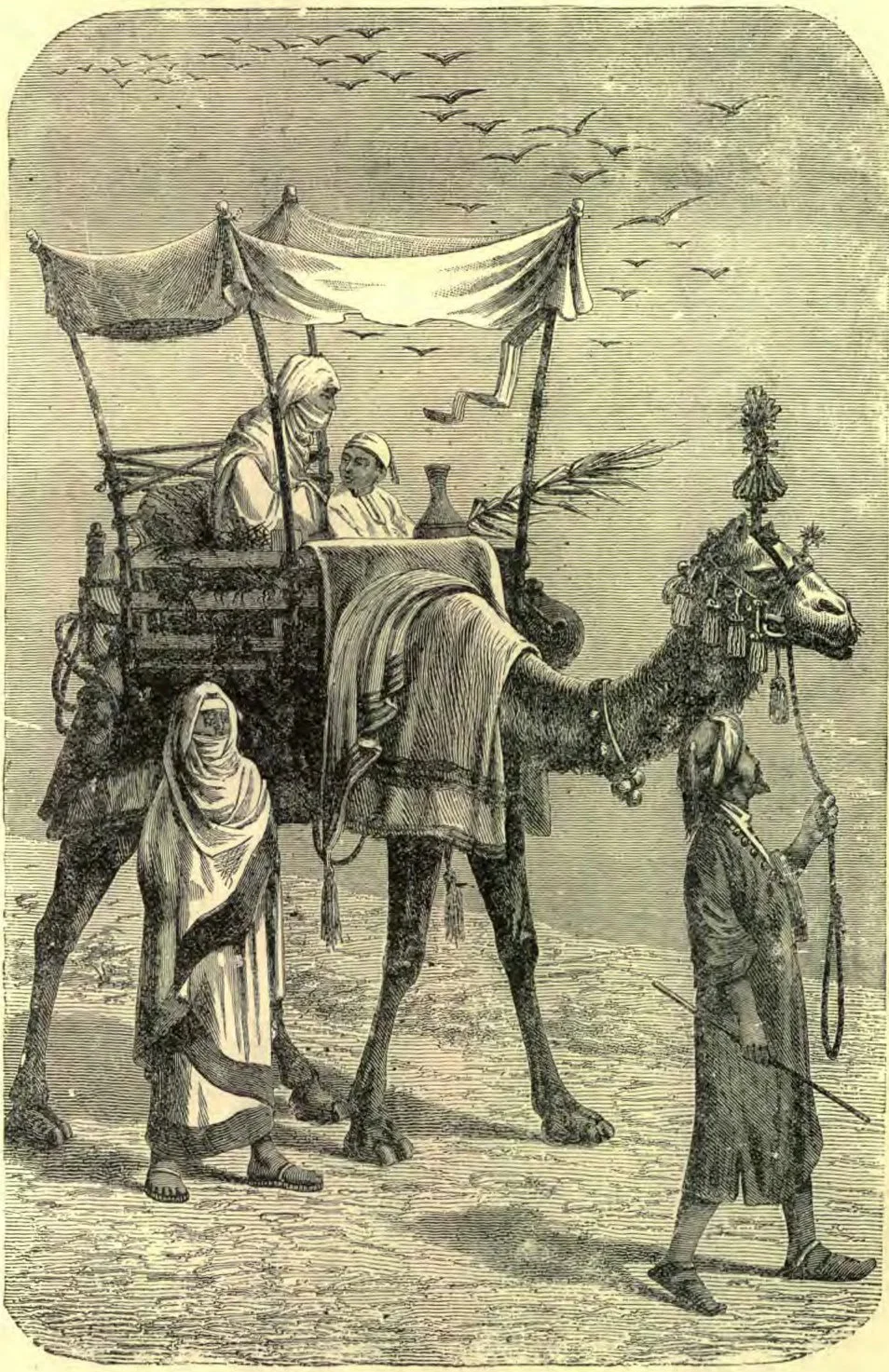
Very few of the present inhabitants of Egypt are the real descendants of the old race. The people who claim to have sprung from them are nothing more than miserable beggars. The greater part of those who now live there are Turks and Arabs. The chief religion is that of Mohammedanism, and vast caravans pass yearly through Egypt on a pilgrimage to Mecca, the holy city of the Mohammedans. Perhaps the family in the picture have started on such a journey. The women hardly ever go out without their faces entirely covered except their eyes, as it is thought to be a great disgrace for them to be seen with uncovered faces.
Egypt is not the proud nation that it once was; for by the misrule of the Turks, misery and squalor are to be met on every hand. Little or no protection is afforded the inhabitants, and their most sacred relics, their monuments, and their tombs have been destroyed or carried away, and the people are powerless to help themselves. Truly here is a striking fulfillment of the sure word of prophecy, spoken by the prophet Ezekiel concerning Egypt: “They shall be a base kingdom. It shall be the basest of kingdoms; neither shall it exalt itself any more above the nations: for I will diminish them, that they shall no more rule over the nations.” Ezek. 29:14, 15. W. E. L.

BUILD WELL.

High on the granite wall the builder, toiling, Heaved up the massive blocks and slabs to place, With swart and steaming brows and straining sinews, Under the summer’s blaze.
And higher yet, amid the chills of autumn, Tier upon tier and arch on arch arose; And still crept upward, coldly, wearily, ’Mid winter’s sifting snows.
From stage to stage upsprings the master-builder, Instructing, cheering, chiding, here and there; Scanning with scrutiny severe and rigid, Each lusty laborer’s share.
Anon his voice to those most distant shouting, Through the hoarse trumpet makes his orders swell; Or utters words like these to rouse and hearten: “Build well, my men, build well!”
“The ropes are strong, and new and sound the pulleys; The derrick’s beams are equal to the strain; Unerring are the level, line, and plummet; Let naught be done in vain!”
“Build that these walls to coming generations Your skill, your strength, your faithfulness shall tell; That all may say, as storms and centuries test them, ‘The men of old built well!’”
And ever thus speaks the Great Master Builder To us, where’er our “journey-work” may be: “Whate’er the toil, the season, or the structure, Build well—build worthily!”
—S. H. Browne.

A PUBLIC READING.

A BAND of young men, with hands and faces blackened, and dressed in very queer costumes, sang some comic songs at Mr. Carr’s door one day; and then one young man asked for some pennies.
Mr. Carr, taking up a Bible, said, “See here, young man, I will give you a shilling, and this book besides, if you will read some of it to your comrades, in the hearing of the by-standers.”
“Here’s a shilling for an easy job!” he chuckled out to his mates. “I’m going to give you a public reading!”
Mr. Carr opened at the fifteenth chapter of St. Luke, and pointed to the eleventh verse. The young man took the book and read: “And he said, A certain man had two sons; and the younger of them said to his father, Father, give me the portion of goods that falleth to me. And not many days after, the younger son gathered all together, and took his journey into a far country, and there wasted his substance with riotous living.”
“That’s thee, Jim!” cried one of his comrades. “It’s just what you told me of yourself and your father!”
The reader continued: “And when he had spent all, there arose a mighty famine in that land; and he began to be in want.”
“Why, that’s thee again, Jim!” said a voice; “go on.”
“And he went and joined himself to a citizen of that country; and he sent him into his fields to feed swine. And he would fain have filled his belly with the husks that the swine did eat; and no man gave unto him.”
“That’s like us all!” said the voice once more; “we’re all beggars, and might be better off than we are! Go on; let’s hear what came of it!”
The young man read on, and as he read, his voice trembled: “And when he came to himself, he said, How many hired servants of my father’s have bread enough and to spare, and I perish with hunger! I will arise and go to my father!”
At this point he fairly broke down, and could read no more. All were impressed and moved. The whole reality of the past rose up to view, and in the clear story of the gospel a ray of hope dawned upon him for his future. His father—his father’s house—and his mother too; and the plenty and the love ever bestowed upon him there; and the hired servants all having enough; and then himself, his father’s son, and his present state, his habits, his sins, his poverty, his outcast condition, his mode of living—all these came into his mind, and fairly overcame him.
That day proved the turning point in his life. It resulted in this long-lost and yet dearly-loved son’s returning to his home, and still better, to his heavenly Father!—Selected.

THE ROYAL OAK

Written for the INSTRUCTOR.

THE ROYAL OAK.

Over two hundred years ago England was governed by King Charles the First. His reign was characterized by a long and obstinate contest between himself and his people, resulting in a civil war, in which the king was defeated and taken prisoner, and in the end beheaded on a block, before one of his own palaces. Some time before the war began, he was a fugitive and an outlaw in his own dominions. His successor was Charles, his oldest son, who then became King Charles the Second. He was only seventeen when he became king in name, and was with his mother in France. She, being a sister of the French king, had gone there for protection during her husband's war with the people of England.
Charles the Second did not obtain his crown, however, until he was thirty years of age, although he made great efforts for it. He went to his dominion of Scotland when he was twenty years old, raised an army there, and marched into England with the intention of subduing that portion of his realm. But he was defeated, and to save his life, was obliged to conceal himself for a long time, until he could finally make his escape from the country. The king's enemies were so persevering in their search that he found it extremely difficult to keep out of their way. He was always in disguise, and at one time stayed for two days in the woods during a rain. His friends carried him food, but he dared not go to the house to dry his clothes. His pursuers finally suspected his hiding-place, and determined to hunt the wood. He was informed by friends of other places to hide, but none was thought safe except an oak tree, which had a very dense foliage, and stood in the midst of a field. In the morning before daylight the king, with an officer, climbed into the top, where they stayed during the day, and watched the men who were hunting the king.
Charles endured a great many other hardships and privations, but at last succeeded in returning safely to France, where he remained until his subjects called him back to England, and crowned him their king. Then his political troubles were ended.
From that time the tree which sheltered the king so faithfully has been called the Royal Oak. In after years, when the monarch was restored to his throne, and the story of his dangers and escape was known, thousands of visitors came to look at the tree which had so effectually concealed his Majesty. Every one took away a leaf or a sprig as a memorial, until there was danger of its being all carried away, and the proprietors found it necessary to build a defense around it. The Royal Oak has been the subject of many narratives, and its praises have been sung by many bards. It is still standing, about twenty-two miles from the city of Worcester. L. R.

“BY HEART.”

FRED said he knew his Sabbath-school lesson all by heart.
“Why, Fred!” said Cousin Mary, quietly, “you surprise me!”
Now, Fred liked to have Cousin Mary think well of him, and he looked about an inch taller, as he replied, with a show of humility,—
“It seems as if anybody might learn such a short lesson as that! Only ten verses!”
“Oh, it was not the length of the lesson, but the breadth of it, that I was thinking of, my dear boy. It is a great thing to learn a lesson like that by heart.”
“What do you mean, Cousin Mary?”
“I was just thinking about this little verse, ‘If ye do not forgive, neither will your Father which is in heaven forgive your trespasses.’ That is a part of the lesson which you say you know by heart; but I heard you declare a few moments ago that you would never forgive Ralph Hastings as long as you lived!”
Fred was silent. He had never thought about this way of learning a lesson by heart. When he had it all in his head, and could say it off glibly with his tongue, he had supposed that he knew it by heart. But Cousin Mary opened a new world of thought on the subject.
Was Cousin Mary right? Do we ever really know a thing until we do it? Fred learned this morning the meaning of that little word “forgive,” by just forgiving Ralph, in the most real and practical manner possible. For Fred is trying to be a Christian boy, and when he once saw that the words of Jesus were meant to be done and not said merely, he honestly set about doing them.
This must be the way, then, to learn a lesson “by heart”; to put it into practice! We don’t always do that, when we learn a lesson by heart.
Jesus must have meant something very practical when he said,—
“Why call ye me Lord, Lord, and do not the things which I say!”—Selected.

Children and Parents: Following Christ's Example

CHILDREN AND PARENTS.—“Let all children remember,” says Dr. Dwight, “if ever they are weary of laboring for their parents, that Christ labored for his; if impatient of their commands, that Christ cheerfully obeyed; if reluctant to provide for their parents, that Christ forgot himself and provided for his mother amid the agonies of the crucifixion. The affectionate language of this divine example to every child is, ‘Go thou and do likewise.’”

SCENES IN THE LIFE OF CHRIST.

LESSON 112.—CLOSING SCENES.
Not long after the events described in our last lesson, Peter, James, and John, together with Thomas, Nathaniel, and two other disciples, went fishing on the Sea of Galilee. All night they beat about upon the lake, but caught nothing. In the morning they saw Jesus standing on the shore, but did not know who he was. He said to them, “Children, have ye any meat?” They answered him, “No.” Then Jesus told them to cast the net on the right side of the ship, and they should find. When they had done so, they were not able to draw in the net, on account of the great number of fishes that were caught in it. Then John said to Peter, “It is the Lord.” When Peter heard this, he girded his fisher’s coat about him, and casting himself into the sea, swam to the shore, while the other disciples followed, dragging the net after them. When they came to land, they saw there a fire of coals, with bread and fish thereon; but Jesus said to them, “Bring of the fish which ye have now caught.” Then Peter laid hold upon the net, and they drew it to land “full of great fishes, an hundred and fifty and three;” and yet the net was not broken.
When they had taken out the fish, and counted them, Jesus invited the disciples to come and dine. Although the disciples knew that he was their Lord, they did not dare to ask him who he was, as he gave them of the bread and fish that he had cooked upon the coals. When they had finished their repast, Jesus said to Peter, “Simon, son of Jonas, lovest thou me more than these?” Peter said, “Yea, Lord, thou knowest that I love thee.” Jesus said, “Feed my lambs.” On asking the same question the second time, and receiving the same answer, Jesus said, “Feed my sheep.” Then he said unto him the third time, “Simon, son of Jonas, lovest thou me?” And Peter was grieved to have the question asked so many times, and said, “Lord, thou knowest all things; thou knowest that I love thee.” Jesus said to him, “Feed my sheep. Verily, verily I say unto thee, When thou wast young, thou girdedst thyself, and walkedst whither thou wouldest; but when thou shalt be old, thou shalt stretch forth thy hands, and another shall gird thee, and carry thee whither thou wouldest not.” By these words Jesus meant to signify by what death Peter should glorify God. When he had thus spoken, he said, “Follow me.” But Peter, turning about, saw John following them, and said, “What shall this man do?” Jesus said, “If I will that he tarry till I come, what is that to thee?” Then went the saying abroad that that disciple should not die. Yet Jesus did not say, “He shall not die;” but, “If I will that he tarry till I come, what is that to thee?”
After this, Jesus, according to previous appointment, met with his disciples, and many more, on a mountain in Galilee. When they saw him, they worshiped; and Jesus spoke to them, saying, “All power is given me in heaven and in earth. Go ye therefore, and teach all nations, baptizing them in the name of the Father, and of the Son, and of the Holy Ghost; teaching them to observe all things whatsoever I have commanded; and lo, I am with you alway, even unto the end of the world.” “He that believeth and is baptized shall be saved; but he that believeth not shall be damned. And these signs shall follow them that believe; in my name shall they cast out devils; they shall speak with new tongues; they shall take up serpents; and if they drink any deadly thing, it shall not hurt them; they shall lay hands on the sick, and they shall recover.”
After this meeting in Galilee, the apostles returned to Jerusalem, where Jesus not many days after met with them, and gave them still further instruction about the work that they were to do. He told them that all which had been written concerning him in the Scriptures should certainly be fulfilled. Then he opened their understanding with regard to the Scriptures, and said unto them, “Thus it is written, that Christ should suffer, and rise again from the dead the third day, and that repentance and remission of sins should be preached in his name unto all the nations, beginning from Jerusalem. . . . And, behold, I send forth the promise of my Father upon you; but tarry ye in the city, until ye be clothed with power from on high.”
Then the disciples said, “Lord, wilt thou at this time restore again the kingdom to Israel?” And he said unto them, “It is not for you to know the times or the seasons, which the Father hath put in his own power. But ye shall receive power after that the Holy Ghost is come upon you; and ye shall be witnesses unto me both in Jerusalem, and in all Judea, and in Samaria, and unto the uttermost part of the earth.”
Having led his disciples over the mount of Olives to a place near Bethany, Jesus lifted up his hands, and blessed them; and while he was doing so, he was parted from them, and a cloud received him out of their sight. As they stood gazing earnestly toward heaven, two angels stood by them in shining garments, and said, Ye men of Galilee, why stand ye gazing up into heaven? this same Jesus, which is taken up from you into heaven, shall so come in like manner as ye have seen him go into heaven.” Then the disciples returned to Jerusalem, praising God.

QUESTIONS.

  1. How were some of the disciples employed at the Sea of Galilee, soon after the events described in our last lesson? John 21.
  2. With what success did they meet?
  3. Whom did they see standing on the shore in the morning?
  4. What did he say to them?
  5. When they had answered him, what did he tell them to do?
  6. What was the result of their obedience to his instructions?
  7. What did John say when he saw the miracle that had been performed?
  8. What did this cause Peter to do?
  9. Did they at first know that it was Jesus who was talking to them?
  10. What did the other disciples do while Peter made haste to reach the shore?
  11. What did they see as they came to land?
  12. What did Jesus say to them?
  13. How was their astonishment increased when they emptied the net?
  14. What did Jesus then invite them to do?
  15. What restraint did the disciples feel while they were eating the bread and fish that Jesus had prepared for them?
  16. When they had finished their repast, what question did Jesus ask Peter?
  17. How many times did he ask him the same question?
  18. What reply did Peter make each time?
  19. What solemn admonition did Jesus repeat to him?
  20. By what remark did Jesus indicate the death by which Peter should finally glorify God?
  21. After speaking these words, what invitation did he give Peter?
  22. What did Peter say when he saw John following them?
  23. How did Jesus answer him?
  24. To what saying did this give rise?
  25. Where did Jesus next meet his disciples? Matt. 28:16.
  26. What did they do when they had assembled there?
  27. Repeat some of the words which Jesus spoke to his disciples. Matt. 28:18.
  28. What did he say about the fate of those who should hear their gospel? Mark 16:16.
  29. What signs did he say should follow them that should believe?
  30. Where did the apostles go after this meeting in Galilee?
  31. What did Jesus do for them there?
  32. What did he say about the things that had been written of him in the Scriptures?
  33. With reference to what subject did he enlighten their minds? Luke 24:44, 45.
  34. To what particular theme did he direct their attention?
  35. How long did he tell them to tarry in Jerusalem before going out to preach?
  36. What question did the disciples ask him? Acts 1:6.
  37. What answer did he give them?
  38. To what place did Jesus lead his disciples just before his ascension? Luke 24:50.
  39. What did he there do?
  40. What happened as he was blessing them?
  41. Who appeared to them as they stood earnestly gazing toward heaven?
  42. What did the angels say to them?
  43. What did the disciples then do?

NEW-TESTAMENT HISTORY.

LESSON 126.—REVIEW: FROM THE RAISING OF LAZARUS, TO THE LAST SUPPER.

1. How was Jesus called from his work beyond the Jordan to Bethany? John 11.
2. Describe the wonderful miracle performed by him at Bethany.
3. What results followed this miracle?
4. How did Jesus encourage persistency in prayer? Luke 18:1–8.
5. How did he reprove self-righteousness? Verses 9–14.
6. What instructions did he give concerning divorce? Matt. 19:3–12; Mark 10:2–12.
7. Tell how Jesus blessed little children. Matt. 19:13–15; Mark 10:13–16; Luke 18:15–17.
8. Relate the conversation between Jesus and the rich young man. Matt. 19:16–22; Mark 10:17–22; Luke 18:18–23.
9. What remarks did Jesus make at the close of this conversation?
10. Relate the parable of the laborers. Matt. 20.
11. Where did Jesus go soon after he raised Lazarus from the dead? John 11:54.
12. Now, as he was on his way back to Jerusalem, what did he foretell? Mark 10:32–34; Matt. 20:17–19; Luke 18:31–34.
13. Why did he reprove the sons of Zebedee?
14. Tell how the two blind men were healed near Jericho. Matt. 20:29–34; Mark 10:46–52; Luke 18.
15. Describe our Lord’s interview with Zaccheus. Luke 19.
16. Relate the parable of the talents. Matt. 25:14–30; Luke 19.
17. On arriving at Bethany, six days before the Passover, how was Jesus entertained? John 12:1–11; Mark 14:3–9; Matt. 26:6–16.
18. Describe our Lord’s triumphal entry into Jerusalem on the first day of the week. Matt. 21; Mark 11; Luke 19; John 12.
19. Tell how the fig-tree was cursed.
20. What did Jesus do when he arrived at the temple on the morning of the second day of the week?
21. As Jesus came into the temple the next day, how did the Jews question his authority? Matt. 21:23–27; Mark 11:27–33; Luke 20:1–8.
22. Explain the parable of the two sons. Matt. 21:28–32.
23. What other cutting parable did our Lord speak to the Jews? Matt. 21:33–46; Mark 12:1–12; Luke 20:9–19.
24. How did the Jews show that they understood the application of this parable?—By being so enraged at it that they sought to lay hands on him and kill him.
25. What noted parable is recorded in Matt. 22:1–14?
26. How were the Jews foiled in their attempts to entangle Jesus in his talk? Matt. 22:15–22; Mark 12:13–17; Luke 20:20–26.
27. How did Jesus refute the arguments of the Sadducees?
28. What conversation had Jesus with a lawyer, concerning the great commandment?
29. What questions did Jesus ask in return?
30. What warning did Jesus give his disciples against the scribes and Pharisees? Matt. 23:1–3; Mark 12:38–40; Luke 20:45–47.
31. What lesson did Jesus draw from the poor widow’s offering? Mark 12:41–44; Luke 21:1–4.
32. Who sought an interview with Jesus on this same day? John 12:20.
33. On what subject did Jesus discourse to them?
34. What evidence was given to show these men that Jesus was the Son of God?
35. How did the Jews manifest their hardness of heart?
36. What questions did the disciples ask Jesus that night as they sat upon the brow of Olivet? Matt. 24.
37. Of what did he then give them a brief outline? Verses 4–14.
38. What did he then say about the destruction of Jerusalem? Luke 21:20–22.
39. How did he refer to the Papal Persecution? Mark 13:19–23.
40. What predictions did he make concerning his second coming? Matt. 24:29–31; Luke 21:25–27.
41. What instructions and warnings did he then give? Luke 21:28–33; Mark 13:28–33; Matt. 24:32–42.
42. Relate the parable of the ten virgins. Matt. 25.
43. What parable is found in Matt. 25:31–46?
44. How did the Jews conspire to kill Jesus? Matt. 26; Mark 14; Luke 22.
45. How did the disciples prepare for the Passover? Matt. 26; Mark 14; Luke 22.

THE KING OF BIRDS.

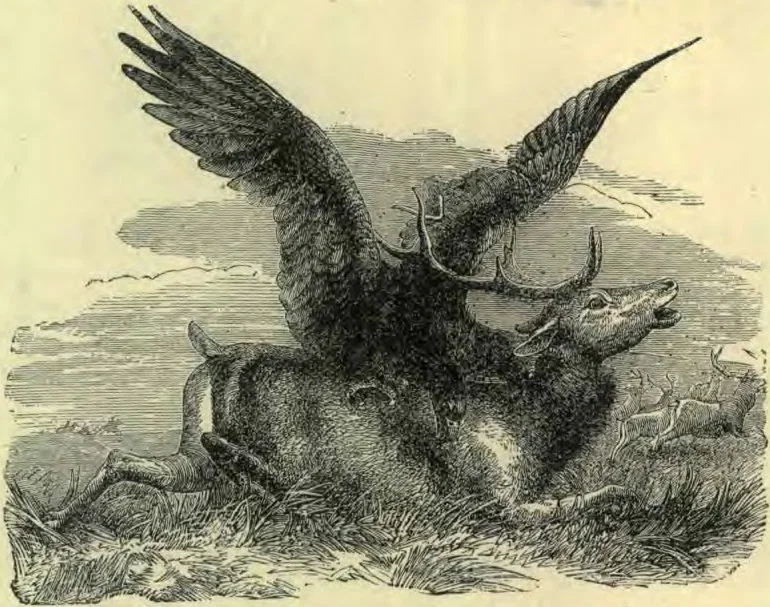
Here we have a picture of the eagle, the king of birds. Would you not like to hear something about him? Eagles are very large birds, quite often measuring three and one-half feet from the head to the tail, and nine feet from the tip of one wing to the other. You can see in the picture that they have very strong, hooked beaks, and powerful claws. The tail is short and stiff, and their legs are feathered down to the toes. The head and neck are so thickly covered with feathers that they come out over the eyes, making a kind of roof to protect them from the sun. The beak is covered at its base by a yellow skin, and in this skin are the nostrils, through which the bird breathes. You can see them in the picture.
Did you ever watch a bird asleep, and see how well he kept his balance, and did not fall off from his round perch? And you have often wondered how he could sit there so easily, haven’t you?
Perhaps you have watched some of your hens when they were walking across the barn-yard. If so, you have noticed that when biddy raised her leg, her toes all drew in, and that as soon as she put her leg down straight, her toes all flattened out again. People who have studied a great deal about birds and fowls tell us that the cords in a bird’s leg are so fixed that when he bends his leg, he cannot keep his toes straight if he should want to, and that when he puts his leg out straight, his toes will straighten out too.
Now, when the bird is asleep on his perch, his weight bends his legs, and so makes his toes curl round the roost all the tighter; and the sounder asleep the bird gets, the tighter he will cling to his perch.
This curious power of his claws is what enables the eagle to hold his prey so firmly. When he is away up almost out of sight, he can see down on the plain, and know when there is anything there for him to eat. Should he see any game, he comes down so silently and rapidly that he captures his prey before they are aware. If you look in the picture, you may see the hunters in the distance, almost specks, they are so far away. They are on a deer hunt, and the eagle is on one, too. He has probably been sailing up above the hunters’ heads for a long time, watching for a chance to get a meal. At length he pounces down upon this deer. He strikes his claws, or talons, as they are called, into the deer, and sinking down with all his weight, clasps them far into the sides of the animal. He does not let go his hold until the deer has ceased to breathe; then he commences to tear him to pieces. The eagle’s mate is probably close by to help him eat the deer. The eagle hardly ever uses his beak to kill his prey.
He is very fond of fish, but is not a good fisher, so he steals from other birds. Soaring far above a river or lake, he sees below him a company of fish hawks quietly fishing in the water. With a piercing scream the eagle swoops down and lights on the top of a tall tree. He keeps quiet now, and the fish hawks think there is no danger. Watching his chance, he soon sees a fish hawk rising out of the water with a silvery fish in his claws. Suddenly darting toward the fish, the eagle seizes it in his talons, and flies away with his prize. He is so much stronger than the hawk that the poor bird is glad to get rid of his enemy so easily.
Eagles build very curious nests. They usually choose for a building spot some ledge of rock or the top of a tall pine, where nothing can climb up to disturb them. Their nests are made of sticks rudely put together, with an inside lining of moss or hay. They do not build new nests every year, as many birds do, but come back to the old one, and build another on top of that, so that after a time their nests are piled up several feet deep.
They lay but two or three eggs. The little eaglets are rather homely, the beak and claws being much larger accordingly than the rest of the body. The eagle is very good to his family, and keeps them well supplied with food. He never quarrels with his wife, and they live together to a great age very happily. W. E. L.

HONORING FATHER.

A LADY was walking along a road near a large town, when she overtook three ragged children. The eldest, a boy of about ten years, carried a little infant wrapped in a piece of old carpet. It was not the tattered garments, shoeless feet, and pale countenances which attracted her attention, but the pleasant manner in which they talked together as they walked before her. The baby seemed the point of attraction to the group, and many means were resorted to to keep it happy and make it comfortable. James tried to whistle for it and to rock it gently, and the bit of old carpet was pulled this way and that to make it cover the little creature.
The lady walked slowly, in order to keep behind them and to listen to their pleasant voices, for their words were words of love. No angry reply or sullen voice did she hear. At length, coming near a cake shop, she called them in. She bought them each a bun, and gave them a penny apiece. They thanked her with looks of delight. She watched them, expecting and hoping to see them eat their buns; but to her surprise, after a little talk among themselves, they put them into an old basket, and walked off. She overtook them, and asked,—
“Are you not hungry, my children? Why do you not eat your buns?”
The pure joy of benevolence lighted up their pale faces, as one replied: “O yes, we are hungry, but we are keeping the buns for father. Poor father has been ill and lost his teeth, and he can’t eat the hard bread.”
These children lived in a cellar in a large town. Their father was a street-sweeper, and, though very poor, he had what many people lack,—the love of his children. It was a little act, but we may believe that the poor father was rich, for his children loved him. The lady visited the cellar where the poor children lived, and though lacking almost every comfort, it was a home where love dwelt; and she could add that she believed that cellar-home was not destitute of the love of God.
Far happier were these children, whose love to their father so filled their hearts as to make them willing to lay aside the tempting bun, than are those whose only thought is to gratify their own desires.—Selected.

WHICH ARE YOU?

THERE are some little folks that we never can please: They fret about trifles, and trouble and tease, Discontented whenever at play, Till their friends are worn out, and are heartily glad When bed-time has come, and each cross lass or lad Is quiet, and out of the way.
There are some little folks so good-tempered and sweet, That to see their bright faces is always a treat, And every one likes them, you know; They amuse themselves, smiling, with some pleasant play, And take care not to worry or get in the way, And are welcome wherever they go.
—Child’s Paper.

LITTLE PATTY.

Cross little Patty sat under a tree, As fretful as ever a child could be.
“Keep still!” to a singing-bird she said; “You are out of tune, and you hurt my head.”
“Do stop!” she cried, to a dancing brook. A lamb and a pussy-cat came to look
At cross little Patty beneath the tree, As fretful as ever a child could be.
The pussy-cat wondered to see her pout, And the frisky lambkin skipped about;
But the brook tripped on over stones and moss, And never found out that Patty was cross.
The bird in the tree-top sang away, And these were the words she meant to say:
“You poor little girl, why can’t you see That there’s nothing at all the matter with me!”
“Mend your manners, my dearie, soon, Or you’ll find the whole world out of tune.”
Somehow the wind in the leafy tree And the rippling water so wild and free,
The bird on the bough, and the snow-white lamb, And the gentle pussy so mild and calm,
Made Patty ashamed of her naughty mood; She shook herself well, and said, “I’ll be good.”
And, presto! the Patty beneath the tree Was just as sweet as a child could be.
—Christian Chronicle.

Daily Reading: Fifteen Minutes a Day

RESOLVE to edge in a little reading every day, if it is but a single sentence. If you gain fifteen minutes a day, it will make itself felt at the end of the year.—Horace Mann.

You have reached the end of this edition.

The Youth’s Instructor · Mar 14, 1883