He Carefully Taught the Twelve—The Disciples an Inner Circle—The Leading Spirits Among the Apostles—Transformation of the Self-Confident and the Sons of Thunder
By the late MRS. E. G. WHITE
THE most complete illustration of Christ’s methods as a teacher is found in His training of the twelve first disciples. Upon these men were to rest weighty responsibilities. He had chosen them as men whom He could imbue with His Spirit, and who could be fitted to carry forward His work on earth when He should leave it. To them, above all others, He gave the advantage of His own companionship. Through personal association, He impressed Himself upon these chosen colaborers. “The Life was manifested,” says John the beloved, “and we have seen it, and bear witness.” 1 John 1:2.
GAVE THEM CONSTANT COMPANIONSHIP
Only by such communion,—the communion of mind with mind, and heart with heart, of the human with the divine,—can be communicated that vitalizing energy which it is the work of true education to impart. It is only life that begets life.
In the training of His disciples, the Saviour followed the system of education established at the beginning. The twelve first chosen, with a few others who through ministry to their needs were from time to time connected with them, formed the family of Jesus. They were with Him in the house, at the table, in the closet, in the field. They accompanied Him on His journeys, shared His trials and hardships, and, as much as in them was, entered into His work.
THE DISCIPLES THE INNER CIRCLE
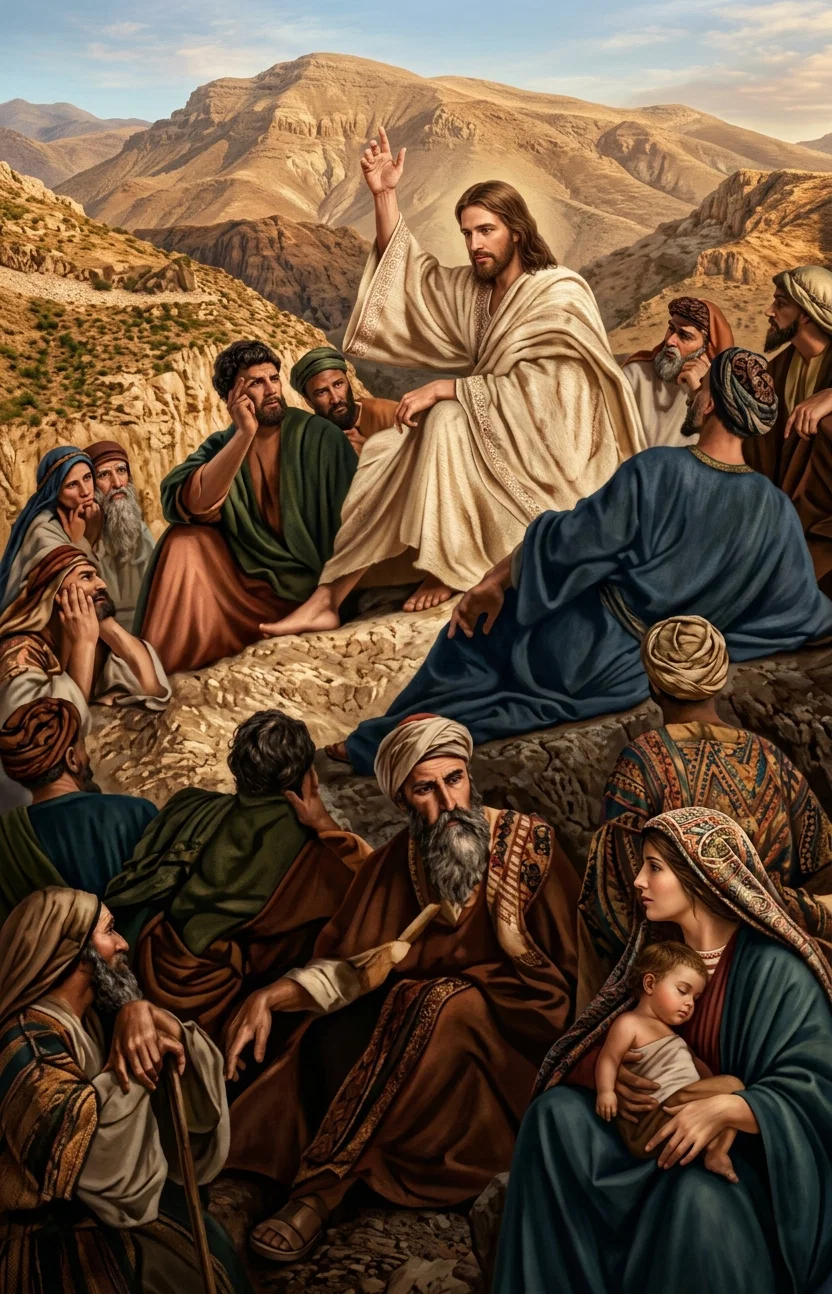
Sometimes He taught them as they sat together on the mountain side, sometimes beside the sea or from the fisherman’s boat, sometimes as they walked by the way. Whenever He spoke to the multitude, the disciples formed the inner circle. They pressed close beside Him, that they might lose nothing of His instruction. They were attentive listeners, eager to understand the truths they were to teach in all lands and to all ages.
NATIVE ABILITY, BUT UNSCHOOLED
The first pupils of Jesus were chosen from the ranks of the common people. They were humble, unlettered men, these fishers of Galilee; men unschooled in the learning and customs of the rabbis, but trained by the stern discipline of toil and hardship. They were men of native ability and of teachable spirit; men who could be instructed and molded for the Saviour’s work.
DIVERSIFIED CHARACTERS OF THE APOSTLES
In these first disciples was presented a marked diversity. They were to be the world’s teachers, and they represented widely varied types of character. There was Levi-Matthew the publican, called from a life of business activity and subservience to Rome; the zealot Simon, the uncompromising foe of the imperial authority; the impulsive, self-sufficient, warm-hearted Peter, with Andrew his brother; Judas the Judean, polished, capable, and mean-spirited; Philip and Thomas, faithful and earnest, yet slow of heart to believe; James the Less and Jude, of less prominence among the brethren, but men of force, positive both in their faults and in their virtues; Nathanael, a child in sincerity and trust; and the ambitious, loving-hearted sons of Zebedee.
In order successfully to carry forward the work to which they had been called, these disciples, differing so widely in natural characteristics, in training, and in habits of life, needed to come into unity of feeling, thought, and action. This unity it was Christ’s object to secure. To this end He sought to bring them into unity with Himself. The burden of His labor for them is expressed in His prayer to the Father, “that they all may be one; as Thou, Father, art in Me, and I in Thee, that they also may be one in Us: . . . that the world may know that Thou hast sent Me, and hast loved them, as Thou hast loved Me.” John 17:21, 23.
THE FOUR LEADING SPIRITED APOSTLES
Of the twelve disciples, four were to act a leading part, each in a distinct line. In preparation for this, Christ taught them, foreseeing all,—James, destined to swift-coming death by the sword; John, longest of the brethren to follow his Master in labor and persecution; Peter, the pioneer in breaking through the barriers of ages, and teaching the heathen world; and Judas, in service capable of preeminence above his brethren, yet brooding in his soul purposes of whose ripening he little dreamed.
“He taught them as they sat together on the mountain side.”
Peter, James, and John sought every opportunity of coming into close contact with their Master, and their desire was granted. Of all the twelve, their relationship to Him was closest.
BY NATURE A SON OF THUNDER, YET BECOMES THE BELOVED
John could be satisfied only with a still nearer intimacy, and this he obtained. At that first conference beside the Jordan, when Andrew, having heard Jesus, hurried away to call his brother, John sat silent, rapt in the contemplation of wondrous themes. He followed the Saviour, ever an eager, absorbed listener.
Yet John’s was no faultless character. He was no gentle, dreamy enthusiast. He and his brother were called “the sons of thunder.” John was proud, ambitious, combative; but beneath all this, the divine Teacher discerned the ardent, sincere, loving heart. Jesus rebuked his self-seeking, disappointed his ambitions, tested his faith; but He revealed to him that for which his soul longed,—the beauty of holiness, His own transforming love.
John’s was a nature that longed for love, for sympathy and companionship. He pressed close to Jesus, sat by His side, leaned upon His breast. As a flower the sun and dew, so did he drink in the divine light and life. In adoration and love he beheld the Saviour, until likeness to Christ and fellowship with Him became his one desire, and in his character was reflected the character of his Master.
TEACHING SELF-CONFIDENT PETER
The history of no one of the disciples better illustrates Christ’s method of training than does the history of Peter. Bold, aggressive, and self-confident, quick to perceive and forward to act, prompt in retaliation yet generous in forgiving, Peter often erred, and often received reproof. Nor were his warm-hearted loyalty and devotion to Christ the less decidedly recognized and commended. Patiently, with discriminating love, the Saviour dealt with His impetuous disciple, seeking to check his self-confidence, and to teach him humility, obedience, and trust.
But only in part was the lesson learned. Self-assurance was not uprooted.
Often Jesus, the burden heavy upon His own heart, sought to open to the disciples the scenes of His trial and suffering. But their eyes were holden. The knowledge was unwelcome, and they did not see. Self-pity, that shrank from fellowship with Christ in suffering, prompted Peter’s remonstrance, “Pity Thyself, Lord: this shall not be unto Thee.” Matt. 16:22, margin. His words expressed the thought and feeling of the twelve.
SELF-TRUST DEFEATED IN TRIAL
For them all, Peter’s experience had a lesson. To self-trust, trial is defeat. The sure outworking of evil still unforeseen, Christ could not prevent. But as His hand had been outstretched to save when the waves were about to sweep over Peter, so did His love reach out for his rescue when the deep waters swept over his soul. Over and over again, on the very verge of ruin, Peter’s words of boasting brought him nearer and still nearer to the brink. Over and over again was given the warning, “Thou shalt . . . deny that thou knowest Me.” It was the grieved, loving heart of the disciple that spoke out in the avowal, “Lord, I am ready to go with Thee, both into prison, and to death;” and He who reads the heart gave to Peter the message, little valued then, but that in the swift-falling darkness would shed a ray of hope: “Simon, Simon, behold, Satan hath desired to have you, that he may sift you as wheat: but I have prayed for thee, that thy faith fail not: and when thou art converted, strengthen thy brethren.” Luke 22:31-34.
CHRIST’S PRAYER A STAY TO HIS SOUL
When, in the judgment hall, the words of denial had been spoken; when Peter’s love and loyalty, awakened under the Saviour’s glance of pity and love and sorrow, had sent him forth to the garden where Christ had wept and prayed; when his tears of remorse dropped upon the sod that had been moistened with the blood drops of His agony,—then the Saviour’s words, “I have prayed for thee: . . . when thou art converted, strengthen thy brethren,” were a stay to his soul. Christ, though foreseeing his sin, had not abandoned him to despair.
If the look that Jesus cast upon him had spoken condemnation instead of pity; if, in foretelling the sin, He had failed of speaking hope,—how dense would have been the727darkness that encompassed Peter! how reckless the despair of that tortured soul!
TAKE THIS MESSAGE TO PETER
It was not John, the one who watched with Him in the judgment hall, who stood beside His cross, and who of the twelve was first at the tomb,—it was not John, but Peter, that was mentioned by name in the first message sent to the disciples by Christ after His resurrection. “Tell His disciples and Peter,” the angel said, “that He goeth before you into Galilee: there shall ye see Him.” At the last meeting of Christ with the disciples by the sea, Peter, tested by the thrice-given question, “Lovest thou Me?” was restored to his place among the twelve. His work was appointed him; he was to feed the Lord’s flock. Then, as His last personal direction, Jesus bade him, “Follow thou Me.” John 21:15-22.
SENSED HIS WEAKNESS AND CHRIST’S POWER
Now he could appreciate the words. The lesson Christ had given when He set a little child in the midst of the disciples and bade them become like him, Peter could now better understand. Knowing more fully both his own weakness and Christ’s power, he was ready to trust and to obey. In His strength, he could follow his Master.
And at the close of his experience of labor and sacrifice, the disciple once so unready to discern the cross, counted it a joy to yield up his life for the gospel, feeling only that, for him who had denied the Lord, to die in the same manner as his Master died was too great an honor.
A miracle of divine tenderness was Peter’s transformation. It is a life lesson to all who seek to follow in the steps of the Master Teacher.
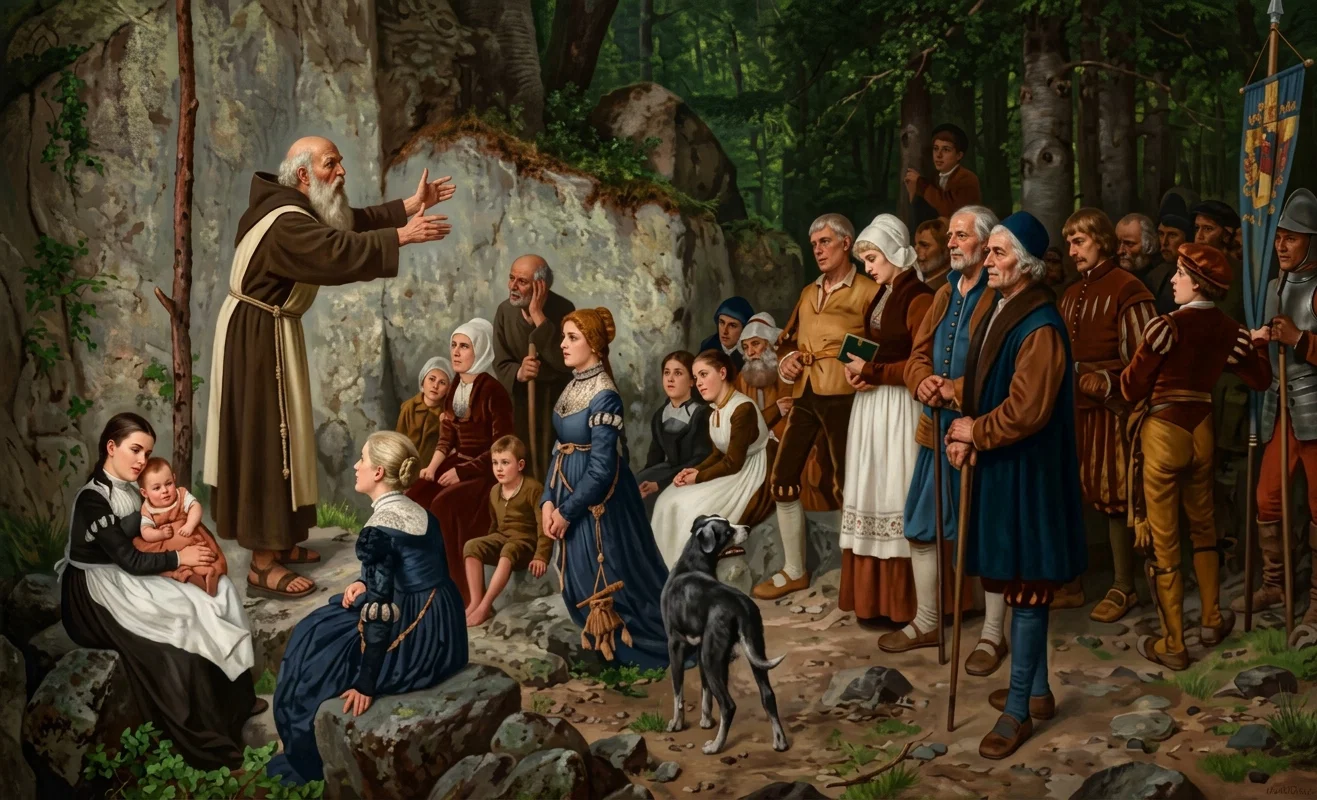
“Then in the providence of God the Reformation arose.”
The Conflict of the Church Foretold
By A. R. Bell
The Contest Between Christ and Satan—The Twice Defeated Foe—Prophetic Supremacy of Rome—Persecutions of the Dark Ages—The Struggle Before the Remnant Church
By A. R. BELL.
This is the first of some nine articles by A. R. Bell on that interesting portion of the book of Revelation which speaks particularly of the religious despotism to come into renewed life and power away throughout the world just before the second coming of Christ. His article this week shows the struggle of the church as represented in the life work of Christ when He was here in person, and in the conflict through which she passed in stemming the tide of apostasy during the Dark Ages.
Next week will appear the first of three articles on the thirteenth chapter of Revelation. That article will deal particularly with the phase of the prophecy which has to do with the image to be formed to the papal beast. It will tell the nation that will take the lead in this work, and it will lay the foundation for the article the week following, which will tell how the Protestant power is organizing to support and aid the papacy in its persecuting and despotic work.
EDITOR.
The great crisis of a woman’s life, the most critical in her experience, is brought to our attention in Rev. 12:1-5 as a figure by which we may understand the travail of the church in the dark trial through which she was passing; and then her joy that a Man, the One upon whom her every hope was centered, “was born into the world.”
The expectation of the centuries was realized. To the church a Child was born, to the woman a Son was given. The Christ of God was manifested in the flesh for the purpose of unmasking the devices and plans of Satan and of unfolding the love of God to men.
INSPIRED TO DESTROY HIM
The machinery of hell was put into operation. The power through which Satan was working in the earth was inspired to raise its hand to destroy the Son of man as soon as He should be born. But He “who was to rule all nations” was not brought forth for destruction; and though Satan finally succeeded in accomplishing His death through the priests and the Roman power, yet neither death nor the grave could hold Him. Christ came forth from the grave in triumph, and “was caught up unto God, and to His throne.”
The host of heaven broke forth with gladness of heart in the cry, “Now is come salvation, and strength, and the kingdom of our God, and the power of His Christ: for the accuser of our brethren is cast down, which accused them before our God day and night.” Verse 10.
Christ met Satan as a man, in all the frailty and weakness known to sinful human flesh; and by the grace of God, through faith, and the coöperation of heaven (see Heb. 1:14 and Luke 22:42, 43), which is open to every son and daughter of Adam, He prevailed against the great adversary.
A TWICE DEFEATED FOE
It is encouraging to know, in our conflict with this same adversary, that we are fighting a twice defeated foe. God overthrew him in the heavenly courts, and cast him out; and Christ, in our flesh, overthrew him in the earth. He came and dwelt in our sinful human flesh, and overcame sin and Satan, that by His indwelling in our sinful human flesh, we might overcome sin and Satan.
Failing in his efforts to destroy the Son of God, Satan now seeks the total destruction of His followers, the church. In Rev. 12:6, 14, she is represented as fleeing from the persecution of the evil one.
SATAN’S CHANNEL OF OPERATIONS
It is ever through the human agent Satan operates. Following the ascension of Christ, came great persecution to the church. The instruments of Satan, apostate Judaism and paganism, sought to stamp out the followers of Jesus; but it was a hopeless task. Failing also in this by persecution, he turned the world into the church. He seduced the woman into changing her robe of white for the scarlet and the purple.
Christianity was making its impress upon the world. The church at Rome, which in Paul’s day was preeminent in faith (see Rom. 1:8), became the special object of Satan’s effort. He seduced her into leaning upon the arm of flesh, and her heart departed from the Lord. She lost the favor and power of the living God, and courted the favor and power of the state. She lorded it over all her sister churches throughout the world. She mounted the throne of the Cæsars; and through her illicit relationship with the state, her bishop became “the head of all the churches,” and “the corrector of heretics.” The church that had been preeminent in faith, became preeminent in apostasy; and a dark night of woe settled down upon the world.
MARKED THE PROPHETIC SUPREMACY OF ROME
History and prophecy mark the year A. D. 538 as the time when the Church of Rome began to rule supreme. The conquest of Rome by Justinian’s forces under the leadership of Belisarius was practically the winding up of the history of the ancient city, and the beginning of the Middle Ages. See “Greece Under the Romans,” George Finley, London, 1844, page 295.
In the year A. D. 538, Vigilius was seated in papal supremacy under the military protection of Belisarius. See “History of the Christian Church,” Schaff, volume 3, page 327.
Another historian writes, “If the papacy were blotted out from the world’s chronicle, the Middle Ages would vanish with it.”—“The Papal Monarchy,” Dr. Barry, page 4.
THE MIDDLE AGES BEGAN
Grouping these statements together, we see that with the overthrow of ancient Rome, A. D. 538, the history of the Middle Ages began. If there were no papacy, there would be no Middle Ages. The papacy was seated in world supremacy on the throne of Rome in 538, by Belisarius, the satellite of the emperor Justinian.
The year A. D. 538 therefore surely marks the time when the Church of Rome, in her apostasy an instrument in the hands of Satan for the accomplishment of his purposes, connects with the prophecy in verses 6 and 14.728
The twelve hundred sixty prophetic days, or literal years, bring us down through the centuries from A. D. 538 to A. D. 1798. For twelve hundred sixty years, the papacy practically ruled the world. We shall not dwell upon the fearful experiences of the Dark Ages. Suffice it to say that Jesus, when He was on earth, speaking of that “great tribulation,” said, “Except those days should be shortened, there should no flesh be saved.” Matt. 24:21, 22.
THE CHURCH BECOMES A PERSECUTOR
Standing before the world as the true church of Christ, yet proving false to every principle dear to the heart of Christ, the papacy is an object lesson of the possibilities of sin in the human heart. Satan could not destroy the Christ of God, but he lays hold upon the dearest thing on earth to Christ, His church, and by his superhuman craft and cunning, leads it to deny the God whom it professes to serve, and to persecute and torture, even to the death, any one who will not recognize its arrogant claims.
With prophetic eye, the apostle Paul looked beyond his time when he declared: “After my departing shall grievous wolves enter in among you, not sparing the flock. Also of your own selves shall men arise, speaking perverse things, to draw away disciples after them.” Acts 20:29, 30.
The story of all apostasy from Christ is revealed in that utterance. When the church turned from leading souls to Christ, and followed after men, it turned from its God-appointed work; and in that turning, it surrendered every right and title to its place as God’s agent in the world for the saving of men. The sad story reveals the professed church going deeper and deeper into apostasy, and away from God, until the prophecy of 2 Thess. 2:1-4 reaches fulfillment, and the “man of sin,” “the son of perdition,” is developed, who is a living contradiction of every characteristic of the Christ whom he professes to represent.
GOD’S POWER BROKE THE PERSECUTIONS
But God watches over His own. We read, “The earth helped the woman.” Rev. 12:16. Though persecution “as a flood” (verse 15) swept almost every faithful soul off the earth, God patiently waits. Every avenue to God’s great grace must remain open until man himself shall close it. Until Rome had “judged herself unworthy” to the very last detail, God bore with her. Then, in the providence of God, the Reformation arose, the power of the great apostasy was broken, relief came to the honest in heart, and persecution for conscience’ sake was stayed.
Finally the year 1798 was reached—the end of the twelve hundred sixty days—and Rome’s power over the nations ceased. When the clock of God struck the hour reached in the prophecy, Rome fell by the bayonets of France, and her temporal power vanished with her overthrow.
A SPECIAL WAR FROM SATAN
In verse 17, however, we find that Satan has not given up the fight. He is still angry with “the woman.” In this verse, we have reached the time of the end—the time when God’s last people, His remnant, are seen. With this “remnant” Satan makes war.
From the reading of the text, the remnant are seen to be the special objects of his malice. And why? Ah, the lives of that people are the answer. In spite of the fact “that in the last days . . . evil men and seducers shall wax worse and worse, deceiving, and being deceived,” and the professed people of God are marked as again “having a form of godliness, but denying the power thereof” (2 Tim. 3:1-13), and that in the time of the end, “iniquity shall be multiplied” (Matt. 24:12), a remnant will be saved who will render to God a loyal, loving service of obedience. They have learned that the gospel “is the power of God unto salvation” from sin (Rom. 1:16; Matt. 1:21), and that sin, of whatever sort, is the transgression of God’s holy law (1 John 3:4). They have learned that the call of faith is to the keeping of God’s commandments (Rev. 14:12), and that the call of God to eternal life is by the pathway of obedience (Rom. 16:25, 26); and according to Rev. 12:17, they are found obedient to every divine requirement.
WHAT THEIR OBEDIENCE INVOLVES
This being true, their obedience must include the acknowledgment of the fourth commandment Sabbath—the seventh day—and the keeping of it as the practice of their lives.
And we read that they “have the testimony of Jesus Christ.” This, we are told in Rev. 19:10, “is the spirit of prophecy.”
From 1 Cor. 1:5-8, we learn that God’s people who are “waiting for the coming of our Lord Jesus Christ” shall “come behind in no gift.” All the gifts of the Spirit of God are to be manifested in God’s remnant church. Among these gifts is prophecy (see 1 Cor. 12:8-10; Eph. 4:11); and 1 Cor. 1:6, 7 shows that “the testimony of Christ,” “the spirit of prophecy,” is confirmed in God’s remnant people so that they “come behind in no gift; waiting for the coming of our Lord Jesus Christ.”
In other words, the spirit of prophecy given is God’s pledge to His commandment-keeping remnant church that every other gift of the Holy Spirit will be theirs before the coming of Him for whom they are waiting.
THE TEST OF COMMANDMENT KEEPING
Thus Sabbath keeping (for that is practically the test of commandment keeping) and the spirit of prophecy become God’s own distinguishing marks of His remnant church.
In the days long past, when Israel listened to God’s prophets, they prospered. 2 Chron. 20:20. So to-day, under the same counsel, God’s work is going forward by leaps and bounds over the whole wide harvest field; and men and women are found in every land and clime, who are turning, in spite of every opposition and persecution, in full obedience, and with absolute surrender to God.
SATAN WILL SUFFER ANOTHER DEFEAT
This is why Satan, the dragon, is “wroth.” This is why he makes war. But as surely as God lives and His word is true, Satan will suffer another defeat. In spite of all his efforts, notwithstanding all his malice and infernal hate manifested in a last supreme attempt to destroy utterly the worship of God and the church of God, he will miserably fail. A faithful remnant will spoil his plans. He will not be able to turn the whole human race to sin and apostasy. A remnant church will stand against every device of the enemy of all righteousness, and will demonstrate in their lives the power of God to save, and His power to keep.
The Bible View of Soul and Spirit
By W. G. Gosmer
Soul and Spirit Defined — The Creation of Man — A Vision of the Resurrection — Luther on the Immortality of the Soul
By W. G. GOSMER
This is the second of Professor Gosmer’s articles on the relation of man to the question of immortality. In his article last week, he showed that the leading nations, from the remotest antiquity, without any exception, had held to the doctrine of the immortality of the soul. And the question was very appropriately raised whether or not such a doctrine, so universally held by pagans, could at the same time be a part of the true teaching of the Bible. In his article next week, he will examine certain Bible texts that many persons have relied upon as proof of the inherent immortality of men. EDITOR.
If we search the sacred volume from beginning to end, in any accepted version, or in the original Hebrew and Greek, we shall nowhere find, even in one instance, the term “immortal soul” or its equivalent. And in no case can we find a definition of the word “soul” or “spirit” that proves for those terms a conscious, immortal, or immaterial being, separate from the body. In proof of this, we submit the following definitions of the principal words in the Bible commonly rendered “soul” and “spirit.”
SOUL DEFINED
The Hebrew nephesh (soul) occurs hundreds of times in the Old Testament. It has been generally translated “soul,” though in numbers of instances it has been rendered “life,” while in others it has been translated “mind,” “person,” “heart,” “body,” “dead body,” “breath,” “beast,” “creature,” etc. Nephesh is never rendered “spirit.” As will be seen by the following definition of the word by Gesenius, a standard Hebrew lexicographer, there is not even the slightest implication of immortality attached to it: “Nephesh. 1. Breath. 2. The vital spirit, as the Greek psuche, and the Latin anima, through which the body lives; i. e., the principle of life manifested in the breath. 3. The rational soul, mind, animus, as the seat of feelings, affections, and emotions. 4. Concrete living thing, animal in which is the nephesh,—life.”
The Greek word psuche, from which the word “soul” in the New Testament is derived, is defined thus: “Psuche. 1. The breath. 2. The principle of life manifested in the breath. Hebrew, nephesh.”—Robinson.
It will be noticed that the primary definition is in both instances “breath,” and none of the secondary definitions give the least sanction to the immortal-soul idea.
SPIRIT DEFINED
The word “spirit” in the New Testament is invariably derived from the Greek pneuma. Defined by Robinson, it stands: “1. A breathing, breath, breath of air, and in motion. 2. The spirit of man; i. e., the vital spirit, life, soul, the principle of life residing in the breath breathed into man from God, and again returning to God.”
The Hebrew word for “spirit” is ruah, having substantially the same definition and meaning as the foregoing words, but with an additional secondary definition, “the Spirit of God.”
PRIMARILY THE LIFE PRINCIPLE
Thus in all the words considered, we find the primary definition invariably to be “breath”—the principle of life through which the body lives. We therefore see how difficult is the task of even reconciling the theory of an immortal soul with the Scriptures, to say nothing of proving it thereby. Evidently men have read the doctrine into the Bible, instead of reading it from the sacred page. In the reading of any book, it is paramount to know what the book says. We should therefore read the heaven-born Word with at least as much consideration as we would give to a treatise on law or surgery.729
THE FORMATION OF MAN
Let us, then, in the light of the holy oracles, go a little farther into the question of the soul or spirit. When God formed man out of the dust of the earth, and “breathed into his nostrils the breath of life,” it was, according to the record, the man who became the “living soul.” Gen. 2:7. Simultaneously with the entrance of the life principle, the lifeless form of clay became animated. Accordingly, when the life forces cease in death, the dust returns “to the earth as it was,” and the spirit (breath) returns “unto God who gave it.” Eccl. 12:7. “For as the body without the spirit [margin, ‘breath’] is dead, so faith without works is dead also.” James 2:26. “His breath goeth forth, he returneth to his earth; in that very day his thoughts perish.” Ps. 146:4.
EZEKIEL’S VISION OF THE RESURRECTION
In Ezekiel’s vision of the resurrection, he beheld a “valley which was full of bones.” Let us note the record. “Thus saith the Lord God unto these bones; Behold, I will cause breath to enter into you, and ye shall live; and I will lay sinews upon you, and will bring up flesh upon you, and cover you with skin, and put breath in you, and ye shall live; and ye shall know that I am the Lord. So I prophesied as I was commanded: and as I prophesied, there was a noise, and behold a shaking, and the bones came together, bone to his bone. And when I beheld, lo, the sinews and the flesh came up upon them, and the skin covered them above: but there was no breath in them. Then said He unto me, Prophecy unto the wind, prophesy, son of man, and say to the wind, Thus saith the Lord God; Come from the four winds, O breath, and breathe upon these slain, that they may live. So I prophesied as He commanded me, and the breath came into them, and they lived, and stood up upon their feet, an exceeding great army.” Ezek. 37:5-10.
Here it is seen again that the breath is the life element; and this fully corroborates what is said of the creation of Adam, and it abundantly substantiates the fact that “the breath of the spirit of life” (Gen. 7:22, margin) is the vital element, the life principle, the soul, of man.
EXPERIMENTS OF SCIENTISTS
Bearing directly upon this point are the experiments of some scientists a few years ago. They observed that the human soul has weight, as the body suddenly becomes lighter at death. For a time, scientific experiment seemed to be giving a degree of sanction to the soul theory; but subsequently, still another scientist ascertained that cats and mice also have souls, as the same phenomenon was observed by experiment upon them. Truly, therefore, has the wise man said: “That which befalleth the sons of men befalleth beasts; even one thing befalleth them: as the one dieth, so dieth the other; yea, they have all one breath” (“spirit,” A. R. V., margin). Eccl. 3:19.
MARTIN LUTHER’S TEACHING ON IMMORTALITY
Speaking of the immortality of the soul, Martin Luther says: “But I permit the pope to make articles of faith for himself and his faithful, such as, the pope is emperor of the world, and the king of heaven, and God upon earth; the soul is immortal; with all those monstrous opinions to be found in the Roman dunghill of decretals.”
Luther’s characterization of the doctrine of the immortal soul is entirely consonant with truth. Upon that “monstrous opinion” rests the fearful doctrine of everlasting punishment, by which thousands have been driven to infidelity and skepticism, because they were unable to reconcile this teaching of eternal torment either with the nature of God, or with the teachings of His word, or yet with enlightened reason, or even with the common instincts of humanity; and but for this illogical theory of the immortal soul, Mariolatry, purgatory, and spiritualism, and other like errors, could not exist. In fact, the sane, Scriptural view of the unconscious state of the dead is the only safeguard known by which to meet these deceptions successfully.
Temperance Battle in Minneapolis
By David Paulson
Woe to the Man with the Bottle — The Bad Fruit of the Saloon — An Enthusiastic Campaign
By DAVID PAULSON, M. D.
The question of whether Minneapolis, Minnesota, should be a dry or a wet town, was voted upon October 4. It was the largest city in America that had voted upon this question by itself, and so the struggle there naturally attracted national attention.
I was invited to participate, in the last three days before the election, in the whirlwind closing campaign. On Sunday morning, I lectured in the Bethlehem Presbyterian Church. There was a responsive audience, who felt deeply the call of the hour.
WOE TO THE WHISKY DEALER
This temperance campaign had been waged largely on the economic issue. I felt specially impressed of the Lord to present the question from the Bible and a moral standpoint. God says, “Woe unto him that giveth his neighbor drink, that puttest thy bottle to him, and makest him drunken.” Hab. 2:15.
That settles the saloon keeper’s status with me. He may ride in an automobile here. He may live on Prospect Hill, and his wife belong to the women’s clubs, and his children move in the best society in the city; but God has pronounced a curse upon him, and that can no more be reversed than can the law of gravitation. Unless he repents of his sin, and abandons his business, that curse will be ratified at the bar of God.
NO DRUNKARD THERE
Twice the Bible declares that no drunkard shall inherit the kingdom of God. I am interested in getting men ready for heaven, and the product of the saloon cannot be admitted there. The Saviour Himself said, “Every plant, which My heavenly Father hath not planted, shall be rooted up.” Matt. 15:13.
I know God never planted the saloon; and so I know He wants it rooted up; and I propose to be earnestly at work pulling it up; and if the job is not entirely completed when the Master returns, He will certainly say, for what has been accomplished, “Well done, thou good and faithful servant.”
ITS FRUIT IS BAD
John the Baptist said, “Every tree which bringeth not forth good fruit is hewn down, and cast into the fire.” I have had abundant opportunity to sample the fruit of the saloon. I have heard the unearthly shriek of the victim of delirium tremens. I have seen the poor drunkard’s wife beaten into a pulp by her insane and infuriated husband while he was under the influence of drink. I have seen the children driven to the “home of the friendless” by this accursed traffic.
I know the fruit, by personal observation, and I know it is not good fruit. I know God wants that tree cut down; and God being my helper, I am going to spend my spare time hacking away at it. If the tree should not be entirely cut down when the Master returns, I will have been in a good deal better business than if I had been watering it, defending it, and building it up.
THE MOST ENTHUSIASTIC CAMPAIGN
Sunday afternoon, I spoke in the Oliver Presbyterian Church; and in the evening, at the Walker Methodist Church. The Lord added His blessing to each of these efforts.
I believe the dry forces had nearly a hundred street meetings in operation that same Sunday evening. Minneapolis was stirred as it never had been before. The newspapers said that no political campaign in the memory of the oldest inhabitant had been one tenth as enthusiastic.
EVIDENCES OF FRAUD
The dry forces believe they have abundant evidence that men voted illegally, and that much corruption was utilized to win the day. The whisky forces spent thousands and thousands of dollars for expensive advertising and in importing great speakers to deceive the working men into believing that if Minneapolis went dry, they would lose their positions, and grass would grow on the main streets. The devil not only has a special gift for originating lies, but he can also make a host of people actually believe those lies.
I was glad to contribute my mite to this splendid campaign. My heart was wrung, the next morning, on my return home, to learn that Minneapolis had gone wet by a majority of something like nine thousand votes. Nevertheless, I believe that much good was accomplished. The temperance forces were aroused as never before. The next time they have an opportunity, they will no doubt sweep this accursed traffic from that beautiful northwestern city, if not from the entire state.