The Youth’s Instructor, Vol. L, No. 13

Through the Orange Free State

The Youth’s Instructor

March 27, 1902

Review and Herald Publishing Company · Battle Creek, Mich. · March 27, 1902

Through the Orange Free State
It was with an experienced Basuto driver and a South African “buggy,” in times of peace and under the most favorable circumstances for observing the life of the land, that I made this journey through the Boer Republic. Having spent a number of weeks in the vicinity of Aliwal in 1894, I felt less a stranger when I went again to that border village in September, 1898. Aliwal is a quiet country burg, lying on the south bank of the Orange River, where it forms the boundary-line of the very southernmost point of the Free State. Being the railway terminus, it holds some importance as a trading centre between Cape Colony, Basutoland, and the Free State. It is also something of a health resort, having warm mineral springs and a pleasant climate.
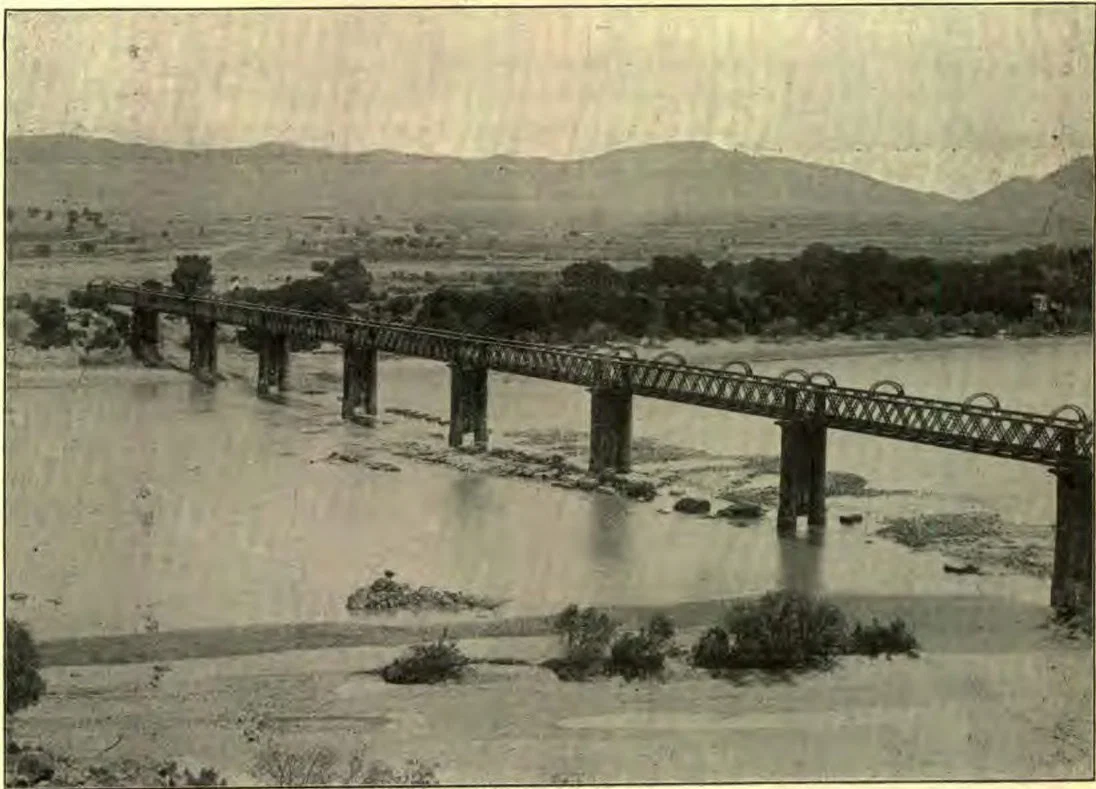
The river here cuts deep into the sandy soil between the hills of the Free State on the north and the Colony on the south. The high river banks are joined by a splendid span named “Frere Bridge,” after Sir Bartle Frere, one of the early English governors of Cape Colony. Aliwal lies scattered along the south bank above and below the bridge, while on the Free State side there is only a little square sheet-iron shanty, inhabited by the lone customs collector. From the shanty at the north end of the bridge there is a gradual ascent to the westward, reaching up to the plains and high hills through which the Orange cuts its way. After crossing the bridge the road to Basutoland climbs over a rocky bluff to the eastward. In sight of this road, a mile or more above the village, stands a stone gristmill, with its mill-race and turbine, while farmhouses occupied by Dutch and English are seen here and there on each side of the river.
It was only natural that the Boers should seize this convenient border village, which they did soon after the war began. From here they pushed on south through Burghersdorp to Stormberg, where a few hundred of them dealt such a signal blow to the British under General Gatacre on the tenth of December, 1899. Aliwal was left by the Boers only after the relief of Kimberley and Ladysmith, having been held by them four months. Though having ample time to destroy them, the Boers left both the village and the beautiful Frere Bridge undamaged to the advancing British army.
One bright morning a little more than a year before the thrilling scenes of this war began, I was hurrying around the quiet streets of Aliwal securing the provisions necessary for the long journey into Basutoland. It was nearly nine o’clock, and I had directed my friend Kalaka, the driver, to go on over the bridge, where I would overtake him. Crossing the smoothly flowing river on this still September morning, one could not but feel the impressive peacefulness of the place,—the village behind, the farmhouses above and below, the mill and the river, all uniting to form a picture of calm content. There had been no recent heavy rains, so only a little stream wound its way along through the wide river-bed sixty feet below the solid roadway of the bridge.
I was soon on Free State soil, and in a few minutes’ time, while talking, we were ready to start. Our “buggy” was simply a cart with two wheels, heavier and stronger than those of an ordinary lumber wagon, strong springs carrying the box with its single seat, and a tent top, which was not raised on this trip. My bicycle was fastened to the rear of the cart, and my satchel strapped onto a small rack behind the box. Several little sheaves of oats fastened against the inner side of the dashboard served to balance our cart so that the tongue would not weigh too heavily upon the necks of the horses. Our two gray Basuto ponies, though in bad flesh on account of the continued drought, were tough and sure-footed.
THE ORANGE RIVER BRIDGE
From Aliwal through the southeast corner of the Free State the road makes a constant ascent, leading directly up into the Maluti Mountains of Basutoland, which are among the higher ranges of the Great Draken Berg. This part of the Boer State is hilly, and, like most of South Africa, treeless. Small bushes grow here and there; and in dry seasons, sheep and goats, kept here in large numbers, feed upon the leaves. The soil is fairly good, being a reddish or dark, sandy loam. But for the irregularity of rains and the abundance of locusts, fine crops of wheat and other grains might be produced. As it is, one rides for miles over naked hills and plains, possibly seeing one or two little patches of wheat or barley where a fountain is found. The following lines illustrate well the prevailing barrenness of this land:—
“Where neither tree, nor cloud, nor misty mount Appears to refresh the aching eye; But the barren earth and the burning sky, And the blank horizon round and round, Spread — void of living sight or sound.”
The roads are made by one wagon following another over the veld until the trail becomes slightly smoother than its surroundings. Anthills are crushed by heavy wagons, and stones remain where nature placed them, to be hit or missed according to the vigilance of the driver. Three hours of traveling after this fashion brought us within sight of Rouxville. As we approached from the hilltop two miles distant, the sight of this little village with its tall poplars and willows was cheering indeed. It stands alone in a wide-spreading valley, and has no protection, natural or otherwise. No Boer commando would ever attempt to hold this dorp against a superior force, its threescore houses being entirely at the mercy of an enemy. However, it will be historic; for it has been taken, retaken, and taken again, being now occupied by the English, after being twice forsaken by the Dutch.
Dining here, we hastened on, leaving the post-road for a shorter cut, toward Bushman’s Kop, some thirty miles distant. An hour brought us to the first mountain, extending for several miles along the course of our journey. Fatherly old Kalaka had many stories to tell of the time when this mountain and all the district around it were taken away from the Basutos by the Boer farmers. In the valley through which we were now passing, the road began to be cut by the deep dongas eaten into the yielding soil at the foot of almost every mountain and across the plains right down to the bank of all the rivers in South Africa. With perpendicular sides, eight, ten, or even twelve feet in depth, these holes make the country exceedingly difficult to cross, and render a night journey most unpleasant and dangerous.
Living on our road was a French family whom Kalaka had known for many years, and at their home we hoped to find lodgings for the night. At nine o’clock we drove into the large grove of willows surrounding the farmhouse, and were soon made welcome by Mrs. Bisseux and her two manly sons. This family are old residents of the Free State, being descendants of early French missionaries. Receiving every kind hospitality that night in her home, the following day’s travel over miles of prairie-like hill-country brought us at sunset to Bushman’s Kop. This place has only a country store, a blacksmith shop, and a sort of wayside inn. It gets its name from a commanding hill once inhabited by some of the Bushman race.
From this place the traveler has in full view the serried peaks of Basutoland, called the “Switzerland of South Africa;” and the chilly air, even of a September morning, reminds him that he is nearing a region of snows. The last few miles of our journey were rougher than what had preceded; and as we started up a long incline toward a ridge where a man and several boys were plowing, we noticed two road tracks, one on the right appearing preferable. Some small stones were laid across the right-hand track, and the driver, avoiding the stones, chose this side. A wire fence stretched along the top of the ridge, with a gateway across the road. The plowmen were beyond the fence at the left. As we were about to open the gate, we were met by these men, who quietly explained in Dutch that we were trespassing by driving on the veld, and must wait until the owner was sent for. Our protestations of innocence were in vain, and the determined look on the face of this sturdy Dutchman gave us to understand that we must settle with the owner, who, we soon learned, was the landrost, or sheriff, of that district.
To avoid unnecessary delay, Kalaka, who could speak Dutch, proceeded to the sheriff’s, a mile or more over the hills, escorted by one of his young sons, who was among the plowmen. An hour later he returned, poorer by a five-shillings’ fine. From this place a few minutes’ drive brought us to another fence, where stood a little corrugated iron hut, guarded by a native customs collector, who wore as black a face as men have even in Africa; and here we passed out of the Boer Republic into the land of the Basutos.
J. C. ROGERS.

A Twice-Told Tale

IN an obscure corner of a little unknown paper my eyes fell not long ago on an old, old legend; and as it has come back to me over and over since then, it has seemed each time to bring a message of love and charity to our fellow men, which is well worth thinking of.
It told in quaint phrases of three aged pilgrims along the road of life, who met one winter’s day at the crossing of the roads, and paused a moment to talk. Each man was old and bent, gray and heavily laden; for each carried two big sacks, one hanging before him, the other slung behind his back.
“You seem heavily laden, friend,” the first traveler said, as the second staggered wearily under his load.
The bleak-faced old man replied, “Yes, and the longer I carry my sack, the heavier it grows; but,” with a smile of satisfaction crossing his wrinkled face, his wicked old eyes gleaming, “you see it is worth all the trouble of carrying it, for in here I put every one of the sins committed by the people I know, and though my load grows bigger and heavier every time I turn it over to look at it, yet it is a great satisfaction to me to know how much worse every one else in the world is than I am myself. The sack behind me is not very heavy; for into it I toss all the good deeds of my friends, and I soon forget all about them.”
“You are a very foolish old fellow to bother with other people,” the first speaker said, nodding his head wisely as he spoke. “I do not fill mine that way. See,” pointing with a complacent smile to the sack in front of him, “into this front sack where I can see them all the time, I carefully store away all my own good deeds, and they help to keep me in a good humor with myself. Just see how full it is! There is a penny I gave to a beggar not long ago; by and by, if I keep looking at it and telling of it, it will grow into a dime, and then maybe into a dollar, and people will all see what a good, generous fellow I am. In this sack behind me,” he added, carelessly, pointing over his shoulder, “I drop all my little misdeeds. I can not see them, you know, so I very soon forget all about them,” and as he peered at the dingy penny on top of his load, he smiled in a well-satisfied way.
The third traveler, a clear-eyed old man, had not spoken yet, but had stood leaning on his staff, listening to the others.
They now glanced interrogatively at him, and setting the immense sack before him, he spoke, his pleasant voice ringing out cheerily over the world of glistening snow: “Once, long ago, I tried each of your sacks in turn for a while; but, comrades, I found they did not pay. They soon grew so large they shut out all God’s bright sunlight, and were so heavy they bowed me down so close to the earth that by and by I failed to see any of the beauties in this wonderful world of ours. Then, one day, with the dear Lord’s help, I threw them both away forever, and I now carry two that seem to grow lighter and easier to carry the fuller they become. Whenever I grow sour in temper, and am tempted to think this world an evil place, I straightway go through my front sack, and it soon drives away all my discontent.”
“But what do you carry? What is this wonderful load of yours?” the other two cried.
With a sudden look of earnestness crossing his beaming old face, the aged pilgrim replied: “My sack is filled to overflowing with the good deeds of the people I meet along the way. It would astonish you to know how many I pop in each day, for I find them lying around thick wherever I look; but as many as I put in, there is always room at the top for more.”
“And this sack hanging so limp behind you?” the first traveler said, in a low tone.
With the wrinkles and smiles running criss-cross all over his face, the old man replied in a tone of profound satisfaction: “That is the very best sack of all to carry through the world. Into it I drop all the evil I hear of people; and that it may not linger near a moment, I have cut the entire bottom out of the sack, so it soon falls through and is lost.”
As I read the quaint little story, it seemed to me the old man with his cheery face and bottomless sack sent a good message to us all,—a message telling us how much wiser and happier we would be, how much better this busy world would be, if we kept before our eyes constantly the good deeds of others; and if into a bottomless sack behind our backs we toss all their mistakes and evil deeds.—Young People.

The Landing at Jaffa

THE landing most dreaded by timid travelers in all the world, probably, is at Jaffa, the port of Jerusalem. This is the Joppa of ancient Scripture, from which Jonah set sail on his rebellious and ill-fated trip to Tarshish. The Mediterranean is as uncomfortable a sea in these days as it was in the times of the prophet, and very often the waves run high off the historic little town. There is no harbor for a craft larger than a rowboat, and the steamers that transport pilgrims to Jerusalem must often anchor two or three miles from shore.
Large boats, rowed by a dozen evil-looking Arabs, come out to meet the steamer; and while some of the boatmen keep their craft from being dashed to pieces against the hull of the steamer, others seize the passenger round the waist, and half drag him down the gangway ladder at the opportune moment when the rowboat, lifted on the crest of the wave, is nearest to the deck. It is an exciting and unpleasant means of disembarkation, but is the best attainable until the crafty sultan allows a harbor for large boats to be built at Jaffa. This harbor several foreign companies have offered to build, but the rapacious Abdul-Hamid II has not yet been offered a large enough sum for the concession which would so greatly benefit Palestine.—Selected.

Prescience

It comes in the hush of dawning, When heaven and earth are gray,— A murmur of far-off music Drifting near with the day; Warm, in the heart of storm winds, Blossoming, under the sleet,— The promise of unknown blessing Waiting for me at His feet.
Noonday and night I hear it, Under the brooding sky, As if an angel had whispered His message in passing by,— Tender, as when men knew him In the breaking of the bread; Holy, as when his blessing Rested on Mary's head.
Will it be joy that waits me, Veiled in the morrow dim? Will it be peace in labor, Drawing me close to him? Gift of an added blessing, Or crown of a sacred loss? The light of his face transfigured, Or the shadow under the cross? — Mabel Earle, in Well Spring.

Making God Glad

EVERY one who loves God should be happy to make the heart of the great Creator of the universe glad. Here is a text that shows it is in the power of every child of his, young or old, to do this: “My son, be wise, and make my heart glad, that I may answer him that reproacheth me.” Prov. 27:11.
This is a direct appeal from God to every son and daughter of his. Whatever the circumstances, however apparently adverse they may be, the Lord expects us to be loyal to him, to maintain righteous principles, to act discreetly, wisely, as his children should. Remember, young friends, that every time you do wrong, you give the adversary occasion to reproach God.
You are familiar with the story of Job. He had given himself to the Creator, to represent him in the earth. God loved Job. He had caused blessings to abound toward him. All that Job did prospered, because God was with him, and had surrounded him with his protecting care as with a hedge.
But Satan accused Job before God. He maligned every motive. He watched him as a caged lion watches, anxious to seize upon him. “Doth Job fear God for naught?” he asked, sneeringly.
What joy it must have been for God to present Job’s case to Satan! For Job had so loved and obeyed the Lord that in the hour when the prince of darkness was railing upon him, the Lord could maintain his cause.
Because the earth is more corrupt and sinful than in the days of Job, we have an even greater opportunity for loyalty to Heaven, and causing the Lord to be glad because of the upright lives and sterling characters we present to the world.
T. E. BOWEN.

The Robin's Food

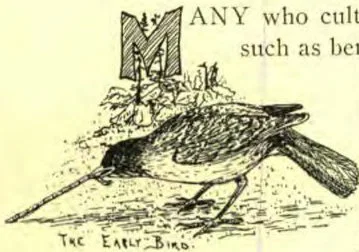
MANY who cultivate small fruits, such as berries, grapes, cherries, and the like, are greatly prejudiced against the Robin, thinking the bird destructive to their crops.
But, as a matter of fact, fruit forms but a small part of the Robin's bill of fare, and whatever he does eat, he more than pays for by the large number of injurious worms and insects he devours. All through the spring, when the insects are at work to do our fruit and vegetables all the damage they can, Mr. Robin spends most of his time catching them. He eats a great many himself, and besides there are the little ones to be fed.
And what a quantity the little birds seem to need! How many worms do you think a young Robin will eat? One man experimented on some Robins he had captured, and he found that each bird required sixty-eight worms a day. If these worms were laid end to end, they would make a line fourteen feet long! If we were to eat as much in proportion to our size, it would be necessary for us to devour seventy pounds of meat a day, and drink five or six gallons of water.
The Robin eats bugs, spiders, earthworms, many grasshoppers, crickets, caterpillars, and even wasps; he destroys the March-fly larvae, so injurious to the grass in the hay-fields, and will also eat the army-worm. We ought to allow him a few cherries and apples in return for all his useful work; but he will eat much less of the cherries if you will provide a few Russian mulberry bushes, whose fruit ripens at about the same time as the cherries, and which Robin and many of his friends dearly love. Professor Bruner has well said: “He is a poor business man who pays ten dollars for that which he knows must later be sold for fifteen cents or even less. Yet I have known instances where a Robin, which had saved from ten to fifteen bushels of apples, worth a dollar a bushel, by clearing the trees from cankerworms in the spring, was shot when he simply pecked one of the apples that he had saved for the ungrateful fruit-grower.”
Although over half of the Robin's food in summer is made up of bugs, insects, larvae, etc., he is also particularly fond of wild fruit; and where there are plenty of wild berries, he will linger as long as they last. Indeed, if there are enough of the dried berries for the winter, he will not go South at all.
Robins become very tame if well treated. A family in Michigan observed a pair of these birds which nested close to their house for fourteen years. It was plainly to be seen that they were the same birds; for they were very friendly with the family, but not so with strangers. One day a man passing the house picked up one of the young birds just out of the nest, which was fluttering about on the ground as a young Robin will. The moment he picked up the young bird, the parents uttered loud cries of alarm and distress until they had brought all the Robins in the neighborhood to their assistance. They scolded, and cried, and flew at the intruder, who, as they thought, was trying to rob them of their baby. A member of the family heard the noise, came out of the house, claimed the Robin, and the man handed it over. As soon as the little bird was in the hands of the person they knew, the birds ceased their cries. Not only the parents of the bird, but all the Robins, seemed to understand that the little thing was safe.
Description.—Upper parts blackish-brown; under parts reddish-brown; throat striped black-and-white; corners of tail white. Length, ten inches.

The Cardinal Grosbeak

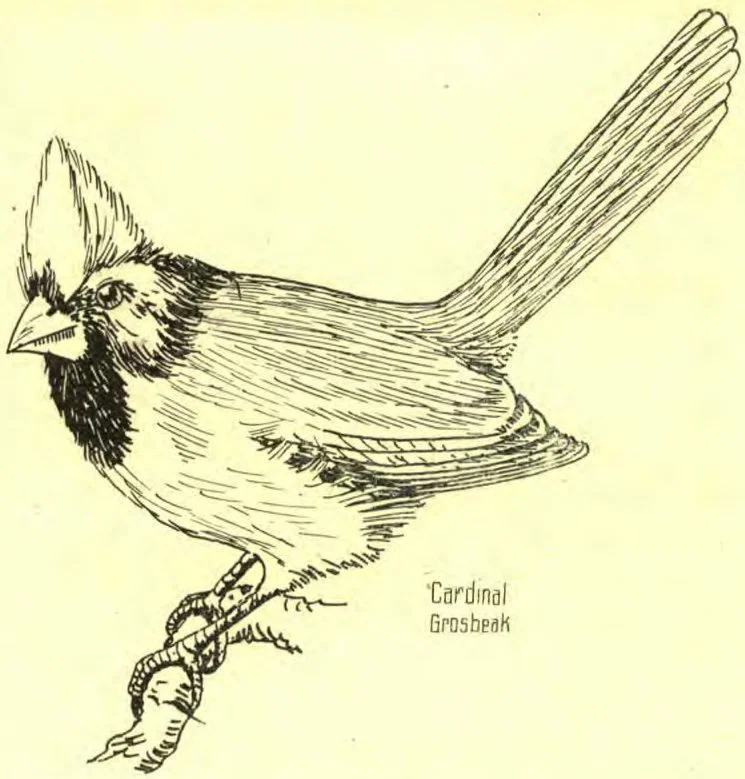
Another interesting bird which may be seen in winter as far north as New Jersey, Ohio, and part of Illinois, is the Cardinal. In my part of the country he is usually called by the simple name of Redbird. By some, I understand, he is called the Virginia nightingale. He is to be met with all over the Southern States, and as far north as southern New England and New York. He is quite common in central Illinois. He is a beautiful bird, easily seen for his brilliant plumage, which is of a magnificent red color. He has a conspicuous crest, or topknot. The throat is black, and there is a band of the same color around the beak. His mate is much duller in color.
Although easily seen, the Cardinal knows pretty well how to take care of himself. I have followed the bird for many a mile, trying to get one good glimpse of him through an opera-glass; but he was afraid of me, and I could not get within gunshot of him, though I had no gun, and sought to do him no harm. But at Jerseyville, where birds seem to be well treated, I have observed him often; and several times in Springfield he has alighted quite close to me, and poured forth his melodious song.
When nesting, the Cardinal is said to be something of a fighter. If a snake comes about, he rouses the whole neighborhood of birds, bringing them to help defend the nest. They will fly at the snake with loud cries, and even attack it if it does not leave.
But wary as the Cardinal is, he will become quite tame if well treated. A lady once had one of these birds in a cage with a pair of the little green parrots called “love birds” from their habit of putting their bills together as if kissing. Apparently the Cardinal did not approve. After watching the loving little birds a while, he seemed to lose patience, and dashed right down between them, driving them apart. Then he went back to his perch. This he kept up; and whenever the two parrots began their caresses, down the Cardinal would drive again. He never disturbed them at any other time, or about anything else, but that one thing he would not tolerate.
The song of the Cardinal is a “rich, rolling whistle,” impossible properly to describe. He is a great singer. Some birds sing only during the nesting season, but the Cardinal sings all through the year. When, during the summer, the mother bird broods upon the nest, he often sings to her by the hour, and at the same time sees that no harm comes near. And when bleak winter has come, he still sings his merry notes. More than once, when the afternoons were sharp and biting cold, just as the day was fading, I have heard his clear, merry whistle. It plainly said to everybody, “Three cheers! three cheers! three cheers!” Cold weather could not make him gloomy; he was not worried; he was singing. God give me freedom from care like the Grosbeak. God give me a mood to make well of things as he does. And God help me to face drear aspects with a heart as glad as his, and a tune as cheery.
L. A. REED.

The Birds of March

CHICKADEES, woodpeckers, nuthatches, brown creepers, juncos, and others of our winter birds, are still with us during the month of March, but our keen interest in them begins to wane when the time comes for the summer residents to begin to arrive.
“Pretty soon, pretty quick!” calls the robin in the garden on a bright March morning, and, sure enough, “pretty soon” the prophecy is fulfilled, and familiar notes are heard in the greening meadows, and from the bare trees.
Cardinal Grassbeak
Cardinal Grassbeak
The bluebird, with “the earth tinge on his breast and the sky tinge on his back,” as John Burroughs so aptly puts it, greets us early in the month, and the song-sparrows are not far behind. To a casual observer they are not much unlike the English sparrows in appearance, but the song-sparrow has streaks of black and brown on his whitish breast and sides, his wings are shorter, and his tail longer, than those of his English cousin. The principal difference between them, however, is one of spirit, and this is expressed in their notes. Instead of the noisy, scolding chatter of the English sparrow, the song-sparrow pours out his free, joyous soul in a song so sweet and cheery that it makes one ashamed of any but courageous thoughts and high hopes to hear it,—a little song, just one high, clear note, three times repeated, and followed by a sort of cadenza.
Early in March, also come the purple grackles, or crow blackbirds. What a stir and a breeze they make as large flocks arrive together, and clamor and creak (I know of no more musical words with which to indicate their calls) in flapping companies among the tall trees, or walk proudly about the lawns! The grackles are over twelve inches long, a little larger than the robin, which measures ten inches. They are glossy black all over, but their backs shine with iridescent colors in the sun. The red-winged blackbirds appear at about the same time. They are not so large as the crow blackbirds. The general color is black, but on the “shoulders” are gleaming epaulets of scarlet, edged with gold.
Soon after the tenth of the month, a near relative of these blackbirds appears,—the meadow-lark. The meadow-lark is about the length of the robin. The upper parts are brown, mottled with black; the breast bright yellow, with a conspicuous black crescent on it; there are yellow stripes over the eye and through the crown. He is most easily identified, however, by the white of the outer tail feathers, which is very noticeable when he flies. Like their relatives the blackbirds, the meadow-larks are walkers, and one may often see them walking in the bare March fields. If you draw too near, there will be a flapping of wings, a sudden sailing flight, and off goes your bird to alight on a fence-post, very likely, with a nasal call, “Peent!” This is not at all like the song, which is a high, clear whistle, unusually sweet. Some one has syllabled the notes, “I see you—can't see me,” which is very good English for it.
During the last ten days of the month you may have the fortune, if you will take a walk along a quiet road late in the afternoon, to catch a glimpse of a rather dimly marked and pale-colored sparrow, that will fly ahead of you from one low bush to another, showing, as he flies, a white feather on either side of his tail. You may see him at any time of day, but if your hour is late afternoon, he will probably treat you to a delightful song, sweet and loud and clear,—a really soul-stirring performance. This is the vesper-sparrow, so named from the fact that he usually chooses this late hour of the day for his service of song.—Sunday School Times.

Spring Song

Now willows have their pussies, Now ferns in meadow lands Hold little downy leaflets, Like clinging baby hands. Like rosy baby fingers Show oak leaves ’gainst the blue; The little ones of nature Are everywhere in view.
There’s purring in a sunbeam Where Tabby’s babies play. The hen is softly brooding; Her chickens came to-day. Up in the crimson maple The mother robin sings; The world is full of caring For little, helpless things.
— From “Songs of Happy Life.”

Studies in the Message

Lesson II—The New Order of Beings

(March 30 to April 5)
DESIRING to enlarge the circle of joy and love, God said to his Son: “Let us make man in our image, after our likeness,” who will appreciate the divine character, and reflect the beauty of our glory, and so increase the happiness of the universe. The plan was to place these new beings in a home of their own, and allow them to develop a tried character, in full view of all creation, that when they should be exalted to heaven, all would see the wisdom of the divine plan.
So the earth was formed, and man was created, and placed upon it. The new atom-world shone with the light of God’s favor, and sparkled with joy and gladness. “The morning stars sang together, and all the sons of God shouted for joy.” But the rebel prince and his outcast followers looked on with envy and hatred. With remorse they viewed the peace and innocence of Eden. Forever shut out from all part in the sweetness of life,—the joy that comes from making others happy,—they determined to drag down these favored ones to share their misery.
But God’s watchful care was over his children. Man was warned, and angels were sent to protect him from danger. Only one restriction had been placed on the rulers of Eden. In the center of the garden were two trees,—the tree of life and the tree of death. Of the one they might freely eat; the other was to be left entirely alone. This was to be the test of their love and loyalty. Not a blot marred the perfection of man’s glorious kingdom. They were in open communion with the Father and his dear Son. Every day brought an increase of knowledge and joy. Glad songs of loyal praise ascended to the great Creator for all his kindness and love.

Questions

  1. What new creation did God propose to his Son? Gen. 1:26.
  2. How large a dominion was given to man? Gen. 1:26; Heb. 2:6-8.
  3. What home was prepared for him? Gen. 2:8-10, 15.
  4. What was the only test of man’s love? Gen. 2:17.
  5. How did other created beings show their joy at man’s creation? Job 38:4-7.
  6. How many created beings are permitted to watch men? 1 Cor. 4:9.

Prayer, Plans, Pains, Anticipation

THE main thing about a meeting is its atmosphere. The arrangement may be ever so ample, the plans ever so perfect, and yet the meeting fall short of its full measure of helpfulness. Given the arrangements and the audience, we must still have proper atmosphere to make the meeting a spiritual success.
Every leader wants this kind of meeting, and every leader can have it. Preparation in various ways is essential, of course. A good meeting means prayer, plans, pains, and more prayer.
But there is one preparation which in no little degree determines the success of your meeting. You may pray and plan and work earnestly; yet, if this preparation is lacking, your meeting will miss the mark. It is the preparation of anticipation. If you expect a good meeting, you will be likely to experience a good meeting; for your prayers, your plans, and your pains are determined by your expectation. If you are faithful, your meeting will be fruitful.
Your meeting is an event,—an event not for your little honor, but for your largest helpfulness,—an event that, no matter how many times you may lead, will never come again. Anticipate it in its blessing to each member. Anticipate it so heartily that you will seek to bring under its influence those who come seldom or never. Get others to look forward to it with you. Anticipate the presence and power of God. We can do very well at times with a leaderless meeting. We never can do at all with a Lord-less meeting.
And, when your hopes have been realized, and your meeting has been a benediction, and has become a happy memory, anticipate God’s power and your part with hope as great and faith as full when your brother leads.—Selected.

Importance of the Young People’s Work

“THERE are three things that should be accomplished by the Young People’s Societies:—
“1. They should give the young people an opportunity for work and for testimony.
“2. They should teach the young the needs of missionary work in all lands.
“3. They ought to establish the young in the doctrines we teach, so that they can prove them clearly from the Bible.
“Unless these objects are attained, unless the young people do become versed in these things, the Young People’s Societies are accomplishing little if anything.”
These sentiments were expressed by James H. Chapman, president of the Baptist Young People’s Union of America, at Willard Hotel, Chicago, in a Young People’s Missionary Rally, at which various denominations were represented, on February 22.
This simple statement expresses the true object and aim of our own work as young people. The light that we have, being so far in advance of that of other denominations, should be spread with much greater earnestness; and in view of the trust God has committed to this people, and the fact that he has given to the young the work of pushing this message, our efforts to become efficient in work at home, in knowledge of the needs in all lands, and in an understanding of the truths of the Bible, should be as much greater than the efforts of the young people of other denominations as our work is more important than theirs.
The speaker called special attention to the third point,—that of teaching the young, from the Bible, the doctrines taught by the denomination. This certainly is an important matter; but if important for the Baptists, why not much more important for Seventh-day Adventists? But some, the speaker said, object to making the Young People’s Societies study classes; yet, he declared, there is no other way by which they can learn except by study. If individuals are not sufficiently interested to study, they may not be expected to receive much real benefit from the meetings. Young People’s Societies in the church are not for social entertainment; they are to have a perceptible influence for good upon its members. If this is not accomplished, the Societies might as well be discontinued.
Another speaker presented the matter of securing a good missionary library in every society; and I believe it would be profitable for our own Young People’s Societies to consider this, especially where the church has no library. The speaker upon this subject dwelt at length upon the need of missionary books and papers for all young people; and said that one work which members can do is to interest other young people in reading and subscribing for such publications.
Let us, as Seventh-day Adventist young people, consider these things carefully, and not be behind in any way. Let us study to show ourselves approved unto God. RUPERT C. SPOHN.

Extracts from Letters

DELLA WALLACE, DES MOINES: “We have two new Young People's Societies organized, and prospects for one at Atlantic. I feel greatly encouraged about this work in Iowa. We are encouraging the movement to have the young people in Iowa raise the one thousand dollars called for by Professor Wilkinson to begin the work in France. The Society here in Des Moines has started it, and will enlist all the other Societies in our State in the work.”
C. H. Bates, Pueblo, Colo.: “We are having very interesting young people's meetings. We did hold them on Friday evening, but have changed the time to Sabbath afternoon, as this will accommodate more of our members. We try to make the meetings as interesting as possible, and at the same time educational and spiritual.”
Bertha Tyler, Reeve, Wis.: “We are a band of young people living seven miles southeast of Clear Lake. Last year the number attending our meetings was larger than at present, but we hope to see more coming in again. A short time ago we sent for fifteen Membership Cards, and twelve have been signed. The lessons in the INSTRUCTOR are just what we need, and I believe that much good will result from their study.”
Continue reading: Little Guide-Posts on the Footpath to Peace