“To be glad of life because it gives you the chance to love and to work and to pray and to look up at the stars; to be satisfied with your possessions, but not contented with yourself until you have made the best of them; to despise nothing in the world except falsehood and meanness, and to fear nothing except cowardice; to be governed by your admirations rather than by your disgusts; to covet nothing that is your neighbor’s except his kindness of heart and gentleness of manners; to think seldom of your enemies, often of your friends, and every day of Christ; and to spend as much time as you can with body and with spirit in God’s out-of-doors,— these are little guide-posts on the footpath to peace.”
Queer Storehouses Built by Little People
By Floyd Bralliar
If one will look in the meadows and hazel thickets of the States, bordering the upper Mississippi, he will see many curious, well-beaten highways leading in all directions. These are not over an inch and a half wide, and are usually arched, and thus protected, by grass and leaves; but they are, nevertheless, regular highways, and are better kept than many public roads. No ruts nor débris are allowed in them.
Here is one that looks as if it is more used than the others, so we will follow it. We wind in and out among the mountains and hills (tussocks of grass), always keeping on the low ground; and when we reach a low, flat prairie, we cross it in a straight line. At short intervals, roads branch off the main thoroughfare; and from these, in turn other roads branch till there are highways leading in every direction.
Our road becomes less and less plain as we follow it, though it still bears evidence of much use, till at last it ends under a jack-oak tree, where the acorns lie thick on every hand. We turn, and follow it back; and after winding in and out for a hundred yards or more, we come to a place where the path runs under a large tussock of hazel brush; but on the other side it emerges, and leads here and there in the hazel thicket. If we cared to follow it, we might go all over the field, and never come to an end, as the roads of the whole community are connected; so we will examine this apparent tunnel. On looking closely, we notice that there are a number of roads entering this same clump of brush from various directions, and that there is considerable dirt lying about, which has been taken
from the holes. This must be the headquarters of something. We will investigate.
Carefully, and with considerable effort, we cut away the sod and brush following one of the roads. When we get into the middle, we find under the largest brush and heaviest roots a great nest made of grass, hair, and feathers; and out jump half a dozen large bobtailed bull mice, which disappear down the road so quickly the eye can scarcely follow them. It is late autumn. Had we looked a month earlier, we should have found one or two families of babies.
Removing the remainder of the sod, we note the work it has taken to build it all, roads included. Why so much work?—The home was placed under the largest bush the mice could find, that no skunk nor fox could dig it out. The roads were built in order that the mice might be better hidden, and that nothing might be in the way when they must run for their lives.
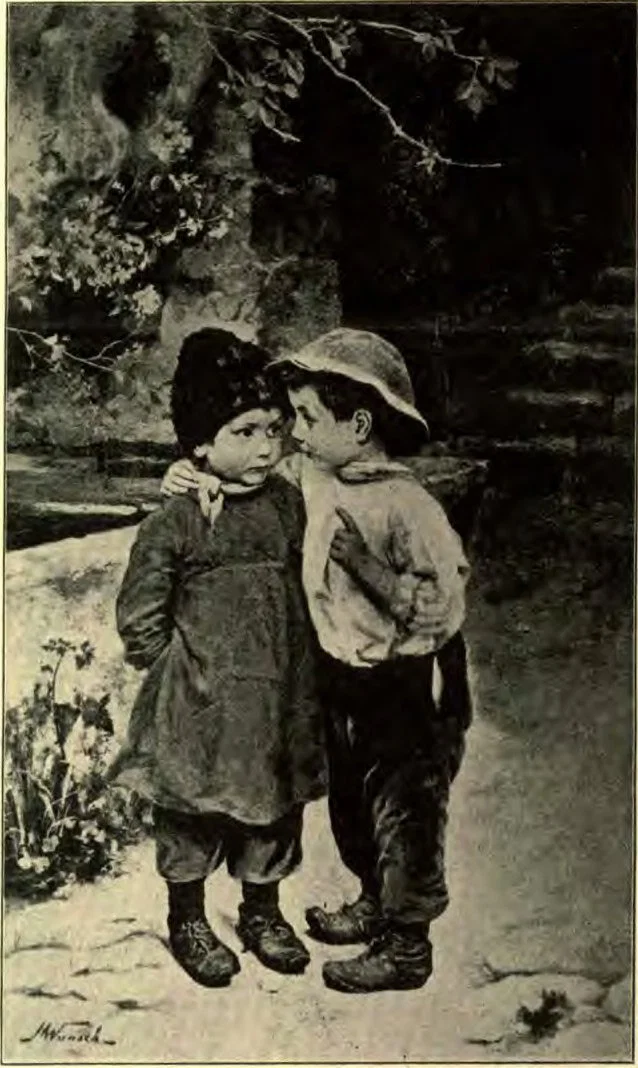
I'M GOING TO HAVE A GARDEN, FRED!
As we think of all this, and admire the workmanship of the roads, a mouse comes running down one with a hazelnut in his mouth. So intent is he on his business that he does not see us till he is so near that we have a good look at him. When he sees us, he drops his nut, and scampers off. But no matter. We begin to look about, and soon notice a hole leading underground. We follow it a few feet, and there under the blue-grass sod find a large room arched with a perfection that the best mason in the world could only equal, and with a drain running from its lowest part. This is almost full of thorn-apples, laid in perfect order, and fitting so closely that we can scarcely get them started out. Not one is wormy or inferior in any way. These are placed near the surface, so they will freeze; otherwise they would rot before spring.
But our mouse had a hazelnut in his mouth: we will look further. Finding another hole, we follow it a foot or so in a tunnel sloping obliquely downward, and soon reach another room. This is egg-shaped (the first was more shallow and oven-shaped), and is full to overflowing with acorns,—a gallon or more. Though there are not so many acorns as there were thorn-apples, this store represents a large amount of work, when one remembers that they were carried, one at a time, at least a hundred and fifty yards.
But we have not found our hazelnuts yet. We hunt for some time, and finally, after following a tunnel a yard or more, and getting at least a foot below the surface, we find the top of the royal storehouse—an oval pocket. We uncover it carefully, pausing a moment to admire its treasures,—rich, brown nuts, all of a size, all perfect, and packed so tightly that at first they must be removed one by one. This pocket has more than a bushel of nuts in it,—not one small one, not one that is bad. After the nuts are removed, the room walls stand as firmly as if they had been built up by a mason, and the dents of the hazelnuts make it look as if it had been molded.
I have described one of the many such storehouses that I have dug out. This was on a hill, and was one of the most typical I have ever seen. Sometimes they have several small pockets containing nuts, instead of one large room; and very few as well stocked as was this. Once or twice I have seen nuts and acorns mixed in the same room, though this is unusual, and must mean that a lazy, slovenly mouse lives there; for the supply is always small in such cases. Corn is also often stored up in this way, as are also oats, weed-seed, etc.
Truly we can say, with the wise man, “All things are full of labor.”
FLOYD BRALLIAR.
Little ‘Scotch Granite’
BURT and Johnnie Lee were delighted when their Scotch cousin came to live with them.
He was small, but very bright and full of fun. He could tell curious things about his home in Scotland, and his voyage across the ocean.
In his studies he was as far advanced as they were; and the first day he went to school, they thought him remarkably good.
He wasted no time in play when he should have been studying, and he advanced finely.
At night, before the close of school, the teacher called the roll, and the boys began to answer, “Ten.” When Willie understood that he was to say ten, if he had not whispered during the day, he replied, “I have whispered.”
“More than once?” asked the teacher.
“Yes, sir,” answered Willie.
“As many as ten times?”
“Maybe I have,” faltered Willie.
“Then I shall mark you zero,” said the teacher, sternly; “and that is a great disgrace.”
“Why, I did not see you whisper once,” said Johnnie, that night after school.
“Well, I did,” said Willie. “I saw others whisper, and so I asked to borrow a book; then I lent a slate-pencil, and asked a boy for a knife, and did several such things. I supposed it was allowed.”102
“O, we all whisper,” said Burt, reddening. “There isn’t any sense in the old rule. Nobody could keep it; nobody does.”
“I will, or else I shall say I haven’t,” said Willie. “Do you suppose I would tell ten lies in one heap?”
“O, we don’t call them lies,” muttered Johnnie. “There wouldn’t be a credit among us at night, if we were so strict.”
“What of that, if you told the truth?” laughed Willie, bravely.
In a short time, the boys all saw how it was with him.
He studied hard, played with all his might during play-time, but, according to his own account, he lost more credits than any of the others.
After a few weeks the boys answered, “Nine” and “Eight” oftener than they used to.
Yet the schoolroom seemed to have grown quieter. Sometimes, when Willie Grant’s mark was even lower than usual, the teacher would smile peculiarly, but he said no more of disgrace. Willie never preached at them, nor “told tales,” but somehow it made the boys ashamed of themselves, just to hear this sturdy, blue-eyed boy tell the truth. It was putting the clean cloth by the half-soiled one, you see; and they felt like cheats and story-tellers. They talked of him, and loved him, even if they did nickname him “Scotch Granite” because he was so firm about his promise.
At the end of the term Willie’s name was very low down on the credit list. When it was read, he had hard work not to cry; for he was very sensitive, and he had tried hard to be perfect. But the last thing that day was a speech by the teacher, who told of once seeing a man muffled up in a cloak. He was passing him without a look, when he was told the man was General ——, a great hero.
“The signs of his rank were hidden, but the hero was there just the same,” said the teacher.
“And now, boys, you will see what I mean when I give a little gold medal to the most faithful boy,—the one really the most conscientiously perfect in his department,—among you. Who shall have it?”
“Little Scotch Granite!” shouted forty boys at once; for the child whose name was so low on the credit list had made truth noble in their eyes.—Selected.
Little Gardeners
By Elizabeth Rosser
Willis:—
I'm going to have a garden, Fred,—
A garden full of roses,
And pinks, and pansies, mignonette,
And other pretty posies.
And when the plants are full of bloom,
My basket I will heap,
And, selling them in yonder town,
A crop of pennies reap.
Fred:—
I think I'll have a garden, too:
I'm going to plant potatoes,
And peas, and beans, and salsify,
And carrots, and tomatoes;
And when they're grown, I'll sell them for
As much as they are worth:
I'll have my pockets brimming full
Of money for the Fourth.
Willis:—
I know a better plan than that,—
I learned it from Aunt Mary.
You know that in a far-off land
She was a missionary:
And to the heathen children there
She taught the way to live;
And to that work my garden-plot
Most willingly I'll give.
Both:—
O, yes; we'll plant our garden-plots
With useful plants and flowers,
And God, who giveth all, will send
His sunshine and his showers;
And on such little boys as we
His blessing rich will rest,
Although our offering may be small,
If we but do our best.
Elizabeth Rosser.
Some Old Houses
At the entrance to the harbor of San Pedro, in California, lies a little island known as Isla de los Muertos, or Dead Men's Island. It is composed of layers of sand and clay full of fossil shells.
A long time ago these mollusks were living on the old sea-bottom; and when they died, their shells became buried in the sand and ooze, and covered with the accumulating sediment. At the present time, the sea in storms is undermining the island, and the fossil shells are washed out, and mingled with the shells of living mollusks in the rock-pools which surround its base.
It is here that a curious and interesting thing takes place, and the oldest houses of which I have any knowledge are to be found. The little hermit crabs, hunting for empty univalve shells in which to make their homes, seize the fossil ones as readily as the living, and scurry off, bearing upon their backs houses so old that, compared with them, the ancient ruins of human habitations were built but yesterday.
And these little houses of the hermit-crabs, although so old, are not in ruins or decay, but as strong and perfect to their minutest detail as when occupied by their original owners.—Selected.
Division II — Astronomy
By Dr. O. C. Godsmark
Chapter XXIII — Stars: Their Distances and Size
§ 228. Of the eight hundred thousand catalogued stars recognizable to the ordinary observer, few are near enough to our planet to enable us to gain any adequate idea of either their size or their distance. The immensity of space is incomprehensible to mortal man. Never until this mortal shall have “put on immortality,” shall we comprehend the vastness of God’s created universe.
§ 229. As figures mean comparatively little in dealing with these great distances, we will illustrate simply. Suppose our earth reduced to a sphere the size of a marble one inch in diameter, with all the other worlds, and suns, and all distances reduced to the same scale. That would make our sun a ball only nine feet in diameter; and to have the distances in proportion, the marble would be placed about sixty rods from the ball. With the whole universe brought down to this small scale, how far away do you suppose Alpha Centauri, the very nearest star (not planet) would be? (Remember that Alpha Centauri is only about one third, or perhaps one half, as far away from us as are the rest of the stars). In order to have the illustration proportionately correct, the ball representing this star would have to be placed fifty thousand miles from the marble that stands for the earth.
§ 230. To fix this illustration a little more firmly in mind, suppose you were required to build a world the size of ours out of marbles an inch in diameter. Begin with one, placing the distance of the nearest star at fifty thousand miles; then add another, and place the star fifty thousand miles farther away; then another, and place the star still another fifty thousand miles farther away; and so keep on, adding fifty thousand miles to the distance of your star for every additional marble required until a world the size of ours is builded. How far away, then, will Alpha Centauri be? Can you grasp the distance? Can you comprehend it?
§ 231. Light travels, to be exact, at the rate of 186,000 miles a second. There are 86,400 seconds in twenty-four hours. Counting three hundred and sixty-five days to the year, we find that it will require the light shining from Alpha Centauri three years and seven months to travel the distance between him and us. This interesting star is seen low down in the southern heavens in the early evenings of May and June.
§ 232. The brightest star—we are now speaking entirely of stars, not planets—of all in the heavens is Sirius, the dog-star. It lies to the south and east of Orion, and may be seen during the early evenings of January and February. It is more than six times as far away as Alpha Centauri, and its light requires twenty-two years to reach our earth. This star has a diameter of twelve million miles, and is three million three hundred and seventy-five thousand miles farther from our sun than we are.
§ 233. According to our measurements, the most magnificent star, as far as size is concerned, is Arcturus. This bright star, which is nearly over our heads in June, is so far away that the light by which we shall see it during the coming summer started on its journey toward our earth in 1721, soon after Watt discovered the power of steam, and Franklin flew his historic kite. If the inhabitants of those distant worlds depend upon the light reflected to them from us for their knowledge of the events occurring upon this earth, they would not as yet have learned the story of our national independence, or the history of Napoleon and the French Revolution.
May not Job have referred to this very matter of the time required by light to travel to other systems of worlds when he, in the depths of his sorrow, desired that the light of the day in which he was born should be forever blotted out? See Job 3. It is a fact that if the inhabitants of these distant systems of worlds behold, by means of light, the scenes of sin and wretchedness caused by the fall of Satan, then even now our world’s history, from its very first creation, is somewhere to be seen in all its fullness.
§ 234. That Arcturus is a sun, and has a system of worlds revolving about him, is evident from the statement in Job 38:32, where the Lord inquires, “Canst thou guide Arcturus with his sons?”—his planets being his “sons,” as the ancients regarded our solar planets as the sons and daughters of the sun itself. Reference is also here made to his onward movement among the stars. “Canst thou guide?” Arcturus is emphatically a runaway star. He is rushing southward, bearing down upon us at the enormous rate of fifty miles a second. The stars all have an onward course of their own, some going in one direction, some in another, with rates of speed averaging from one to thirty miles a second. All is activity, life, motion. Sirius is traveling onward at the rate of fourteen miles a second; while our sun moves onward toward a point located in Hercules with a speed of sixteen miles a second.
§ 235. It is only by the power of God, that these great suns, with their accompanying worlds, speed onward at such terrific rates, each in a different direction, yet clash not one against another. “Lift up your eyes on high, and behold who hath created these things, that bringeth out their host by number: he calleth them all by the greatness of his might, for that he is strong in power; not one falleth.” Isa. 40: 26. Arcturus is one million times as large as our sun, and gives out five hundred and eighty-five thousand times as much light. Why, then, does he look so small to us? Consider, if you can, his great distance. Our sun is only 93,000,000 miles away; while Arcturus is estimated as being 149,730,000,000,000,000,000 miles away, and the amount of light we receive from him is diminished exactly as the square of the distance from us increases. DR. O. C. GODSMARK.
2005 Magazine St., Louisville, Ky.
The Runaway
By Harriet Brewer Sterling
A LITTLE white cloud was sailing high,
A little white cloud in the wide blue sky.
She hurried along, nor dared to stay,
This little white cloud was running away!
The sun went down, and the stars came out;
The little cloud saw them all about;
And they frightened her so, the shining train,
She cried herself into a shower of rain.
— Harriet Brewer Sterling.
An Old Vine
By David Paulson
A SHORT distance from the ancient San Gabriel Mission near Los Angeles, California, is a noted and historic vine. It is known to have been growing there a hundred years ago; and how much older it is, no one can tell. At present it spreads over an arbor which contains three thousand square feet; but it has been known to spread over three times this area. Its roots extend across the street on either side, and a considerable distance into the adjoining blocks, which is a fair indication that the top would have grown as far, had it not been cut back at times.
The trunk comes up in three parts. Their combined circumference is too large for a full-grown person to reach around. That this old vine has not outlived its usefulness, in spite of its age, is plainly indicated by the fact that it recently bore a crop of five tons of excellent grapes.
DAVID PAULSON, M. D.
The Heavens Proclaim the Goodness of God
THE heavens proclaim the goodness of God.
THE INTERMEDIATE LESSON
I — The Beginning
(April 5)
“In the beginning God created the heaven and the earth.” Gen. 1:1.
“In the beginning was the Word, and the Word was with God, and the Word was God. The same was in the beginning with God. All things were made by him; and without him was not anything made that was made.” John 1:1–3.
“For by him were all things created, that are in heaven, and that are in earth, visible and invisible, whether they be thrones, or dominions, or principalities, or powers: all things were created by him, . . . who is the beginning.” Col. 1:16–18.
“I am Alpha and Omega, the beginning and the ending, . . . the first and the last.” Rev. 1: 8, 11.
(The Scripture texts are the lesson to be studied. Go over these carefully every day, until you know just what each one teaches. Then the following notes will help to a fuller understanding of the lesson. Read them carefully several times. Lastly go over all the questions, and be sure you can answer each one in the words of Scripture.)
This is the first lesson written for us in the Book of God. If we would learn anything rightly, we must begin at the beginning. So God takes us right to the beginning: “In the beginning God created the heaven and the earth.”
He who thus created all things is the Lord Jesus Christ. He is the One “whose name is called the Word of God,”—the Word who was in the beginning with God, and without whom was not anything made that was made.
Jesus called himself “the Beginning of the creation of God.” Everything that has ever been created, in heaven, in earth, in all the worlds, had its beginning in him, and came forth from him. So when we read, “In the beginning God created the heaven and the earth,” we know that it was in Jesus; for “God created all things by Jesus Christ.”
“Alpha and Omega” are the first and last letters of the Greek alphabet. So when Jesus says that he is the Alpha and Omega, he means that he is the Alphabet of God. All words are made up of the letters of the alphabet, put together in different ways; so this is but another way of saying that Jesus is the beginning and the ending of the Word of God.
Before we can learn to read, we must know the alphabet. So if we would learn to read aright the books of God,—the great book of nature, as well as his Holy Word that we call the Bible,—we must know God’s Alphabet, Jesus Christ.
A word is a spoken thought. God’s Word is the expression of God’s thoughts. It is through Jesus that God makes known all his thoughts; this is why he is called the Word of God.
In what we call the book of nature, Jesus, the Word, has written out the thoughts of God. In this beautiful earth, with its green, flower-decked carpet, the home of millions of living creatures—insects, birds, animals, and human beings; the sea, “wherein are things creeping innumerable, both small and great beasts;” the blue heaven with its floating, fleecy clouds, and countless host of stars,—in all God’s works, we see his thoughts unfolding. And the first lesson in this great, beautiful book, as well as in the Bible, is that “in the beginning God created the heaven and the earth.”
If we would know the truth about all the living things on the earth, the plants and the animals, we must remember that all their life and power and wisdom and beauty come from Christ. He is the beginning and the ending of all things; so now, just as at the beginning of the creation, every blade of grass, every plant and animal, has its beginning in Jesus. When we learn this, we shall know that “in him we live, and move, and have our being.” Thus everything that we see will remind us that God is with us, and this will give us power to do the things that please him.
Questions
What is the first thing that the Bible tells us about God?
What did he create?
By whom did he make all things?
Of what is Jesus, therefore, the beginning?
What is Jesus called in the first verse of the Gospel by John?
What are we there told about him?
What are words for?
Why is Jesus called the Word of God?
What are words made up of?
What names given to Jesus show that he is God’s Alphabet?
Then what must we do if we would rightly read the books of God?
Where has Jesus written God’s thoughts for us to read?
Where does everything that we see in nature come from?
What does it all teach us?
What will it help us do when we know that God is with us?
I—The Gospel of the Kingdom
(April 5)
MEMORY VERSE: “Fear God, and keep his commandments: for this is the whole duty of man.” Eccl. 12:13.
In the fourteenth chapter of Revelation is given a brief statement of the gospel message to be preached just before the second coming of Christ. The message itself sheds light as to the time when the movement will take place,—the hour of God’s judgment. The gospel has been preached in all ages: there is only one, and it is everlasting. But in this message, that part of the gospel is emphasized which can be proclaimed only in the last days; for only then is it true that the Judgment has come. In this very hour the controversy over the commandments of God comes to its climax. Shall the Creator be worshiped or his creatures,—the beast and his image?
“No such message has ever been given in past ages, and this one contains God’s final warning to the whole world. No more are to follow. No more invitations of mercy are to be given after this one has done its work. What a trust! Those who understand and receive this message will be kept from being swept away by Satan’s delusions.”—Testimony 31.
Questions
1. How extensively is the gospel to be preached just before the coming of the Lord?
2. What gospel is it? What is said of it in Gal. 1:7, 8?
3. What does the fact that the angel was flying show? Read Ps. 147:15.
4. Who unites with him in doing this work? See note.
5. What warning is given? In what power is it proclaimed?
6. What time is announced?
7. Who is commanded to be worshiped?
8. What message follows the first?
9. Why is Babylon fallen?
10. Concerning whom does the third angel give warning?
11. What terrible threatening is pronounced against every man who worships the beast and his image?
12. At the very time, then, when the whole world are commanded to worship their Creator, what powers are evidently seeking for the honor that belongs to him alone?
13. How does the third angel close his message?
14. From the fact that the saints are spoken of as “they that keep the commandments,” what is shown as regards the real point of controversy between the Creator and these other powers?
15. What event is closely connected with the settlement of this question? Rev. 14:14.
16. What words show that the Son of man comes as a king?
Conclusion
17. Whose worship does this gospel message demand?
18. What is the exalted position of our Creator? Read Jer. 10:10–12.
19. If the gospel,—then, restores the Creator’s kingdom, by what name should it also be known? Matt. 24:14.
20. Who only can belong to this kingdom? Matt. 18:4.
Note
In speaking of this angel, “Testimony 31” says: “Here is shown the nature of the work of the people of God. They have a message of so great importance that they are represented as flying in the presentation of it to the world.” Read Ps. 68:11.
Boy's Watch, Free
To introduce E-Z Washing Tablets, we will give to every boy who will sell 32 bars at 10 cents a bar a guaranteed nickle-plated watch and chain; value, $1.50. Send your name and address, and we will send the Tablets prepaid; and when you have sold them, send us the $3.20, and you shall receive the watch and chain by return mail. E-Z Washing Tablets wash clothes without rubbing. Ladies, send for circular. Three samples, 10 cents. Write to-day to Mallett Novelty Co., 710 East 171st Street, New York City.
Shorthand by Mail
YOUR spare time can be well improved by studying shorthand, and this can be done at small expense to you by taking a mail course at your home. We are using “The Rogers Compendium of the Graham System of Shorthand,” a method arranged especially for home study, and giving an epitome of a system of shorthand acknowledged to be the best, the briefest, and the most complete. The only presentation of Standard Phonography in which all shorthand outlines are written as first learned, thus greatly abbreviating the work on the part of the student. A complete course in thirty lessons, illustrated by facsimile notes, with key. The correction of all students’ papers given special attention by experts. Reasonable tuition rates. If interested, write for full particulars. Practicing stenographers wishing to prepare for rapid reporting work should secure the last twenty lessons.
FIRESIDE CORRESPONDENCE SCHOOL,
Battle Creek, Mich.
SOLID THROUGH TRAINS OF
WIDE VESTIBULE COACHES and PULLMAN SLEEPING CARS BETWEEN
Battle Creek and Chicago, Buffalo, New York, Philadelphia, Toronto, Montreal, Boston
For time-tables, descriptive matter, and information, apply to any representative of the company.
The Fourth Convention of the Student Volunteer Movement
By Estella Houser
THE gathering together of so large a number of young people bent upon the accomplishment of one purpose,—the evangelization of the world in this generation,—was singularly prophetic.
In this great convention, four hundred and sixty-five educational institutions, of all classes, were represented, by twenty-two hundred and sixty-nine students and two hundred and twelve professors. The entire registered delegation reached twenty-nine hundred and fifty-five, including students, professors, missionaries, mission board secretaries, editors, and representatives of religious and missionary journals.
If the vast crowds that thronged the great Massey Music Hall of Toronto at every session, regardless of wind, slush, and rain, may be taken as an evidence, these young people appreciated the rare privilege which this great gathering afforded.
Opening Meeting
The entire meeting was marked by a deep sense of the presence of God. The first meeting was entirely of a devotional character. Mr. Robert E. Speer, of the Presbyterian Mission Board, gave the opening address. It was made very plain that if all received the blessing which they should from this convention, it would mean an outgoing of self. “Every higher hold on Christ means a letting go of the earthly.” He spoke with great earnestness upon the need of a continually surrendered and humble heart. Some, I am sure, will lead holier, purer, more devoted lives, as the result of that service.
In the opening session, proper, of the convention, which followed this devotional service, Mr. John Mott, the chairman, made this significant statement: “This convention is a mighty protest and challenge to the anti-missionary spirit of indifference and unbelief now so prevalent in many churches. I believe this convention will incite the church to greater immediate efforts for the heathen world.”
Every phase of missionary work was treated, from the missionary’s qualifications to the great Macedonian calls, which are sounding to-day from every quarter of the globe, bidding the church to answer in this generation.
How significant the following statements in the light of the prophetic word:—
“The fields are white, the time is short. Send volunteers full of faith power.”—India.
“One million student leaders of four hundred million people suddenly awakened. Pray.”—China.
“North China calls, ‘Fill up the gap; victory ahead.’”
These are some of the messages from distant fields that were read at the closing session of the convention.
The spirit of immediate action, of going forth to-day in these opened fields, lest to-morrow should be too late, pervaded all the plans. Surely God is using this movement to arouse those who are faithful to him to do the great work that must be done in gathering out a people for his name from every nation.
Sectional Conferences
Besides the general meetings which were held morning and evening in the large hall, sectional conferences were held each afternoon. These were rather informal meetings, taking up the fields, the kinds of workers needed, and the agencies at home. One interesting feature of this class of meetings was that each one had the privilege of hearing from the field, or studying the line of work, in which he was most interested.
The report of the executive committee showed that about nine hundred institutions of higher learning in the United States and Canada had been visited during the past four years, and forty-seven hundred and ninety-seven students had been enrolled in three hundred and twenty-five mission-study classes. One striking fact in connection with this was that the sale of missionary literature had largely increased, and students were the principal purchasers,—an indication of the real strength of the interest of the higher educational institutions in missions.
Up to the present time, nineteen hundred and fifty-three student volunteers have actually sailed to the foreign field, under fifty different missionary societies. Twenty-seven of the forty-six leaders of the movement are among these, and nine more are under appointment or have applied to the boards. Of the remainder, four are still in preparation.
During the convention the need of larger resources to carry the work forward more extensively during the next four years, was presented; and in a remarkably short time these volunteers, as an earnest of their devotion to the work to which they have consecrated their lives, pledged sixty thousand dollars. This was later raised to seventy-five thousand.
Spiritual Resources
It is impossible to outline any of the excellent addresses, but one on the abounding resources of the Christian church was most remarkable. The material wealth of Germany, Great Britain, Canada, and the United States, was contrasted with the meager giving of the Christian church. Then, compared with what the church might do with all these resources at her command, was shown her vast spiritual resources,—that if she accepted the power of God, which awaits her demand and reception, a far greater work could be accomplished than all the world’s wealth could ever do without it.
The closing session was a most interesting one. A number of speakers addressed the meeting. One gentleman from Toronto reported the immediate results of the convention in his church. In their morning service that day they had pledged a sum sufficiently large to support one worker, with the expectation that they would soon be able to support a second, in some needy field. More than twenty other churches were considering the same thing.
Two Significant Statements
Two significant statements of the convention I must mention. “The man and the hour are made to meet.” In this great time of awakening among the nations, when fields are ripe everywhere to the harvest, God is laying upon hearts whom he can trust the great work he would have them do. Literally, “The call of the hour is answered by the coming of the man.” Was it not so in the beginning of the century, when Carey and Marshman and Duff were called to India, and all down through the years? God raised up William Miller for the work that his hour demanded. Shall we not to-day seek God, that he may make plain to us our place in his plan, and then give power that we may not cross that plan, but fall into line?
Then, again: “This is an intense age, and the non-Christian nations are intense nations,—a different form of intensity besides that of fever heat and development. An intense nation is a nation whose people are absorbed.” Is this different from the word that came to us ten years ago: “Intensity is taking hold of every earthly element”? What we witness among those who do not even see in the word that this gospel shall be preached in all the world in this generation, because it is the last generation, is truly an earnest of what God will do with us and for us when we yield ourselves unreservedly to him and his work. Can we longer hold back any part of the price? ESTELLA HOUSER.