Your ShelfYour Projects

Review and Herald, Vol. 85, No. 22.

A Prayer
Earlier text: Circumscribing the Gospel

The Tobacco Habit

S. H. CARNAHAN
ALTHOUGH the modern word “tobacco” is nowhere mentioned in the Bible, the spirit of the Holy Scriptures condemns the habitual use of tobacco, as illustrated by the texts referred to below. And to the gentler sex I would say, Consider well whether gum-chewing, especially in the excess to which it is carried, is not also condemned therein. Almost invariably when they speak their honest convictions, users of tobacco acknowledge the habit to be injurious and uncleanly, and one which becomes master of the user.
In this light let us consider the following Scripture statements, warnings, and admonitions:—
“Know ye not, that to whom ye yield yourselves servants to obey, his servants ye are to whom ye obey, whether of sin unto death, or of obedience unto righteousness?” Rom. 6:16.
“No servant can serve two masters.” Luke 16:13.
“For when ye were the servants of sin, ye were free from righteousness.” Rom. 6:20. But blessed thought! we may be “made free from sin, and become servants to God,” having our “fruit unto holiness, and the end everlasting life.” Verse 22.
The habit may seem to some to be harmless; but “there is a way which seemeth right unto a man, but the end thereof are the ways of death.” Prov. 14:12.
The devotees to this habit “are all gone aside, they are all together become filthy” (Ps. 14:3), “full of vomit and filthiness, so that there is no place clean.” Isa. 28:8. For all such this cry might be appropriate: “My breath is corrupt, my days are extinct, the graves are ready for me” (Job 17:1), as perhaps no other thing is so undermin­ing the health of the people to-day. Statistics show that this habit has unfitted many young men for service in various occupations.
The woe pronounced in Hab. 2:16 against him who furnishes his neighbor strong drink would apply also to him who furnishes opium or tobacco; for the users will have it even if their families must go destitute of clothing and food. This is truly a species of idolatry, and is condemned by the command: “Thou shalt have no other gods before me.” Ex. 20:3.
It is well known that tobacco impoverishes the soil on which it is grown. And when burned in closely confined rooms, it is a good insecticide because of the deadly poison which it contains.
Moses admonished the people against permitting a poisonous herb among them. See Deut. 29:18, margin. Notice carefully these words, given by our Lord and Saviour to his apostles for us:—
“I beseech you therefore, brethren, by the mercies of God, that ye present your bodies a living sacrifice, holy, acceptable unto God, which is your reasonable service.” Rom. 12:1.
“Having therefore these promises, dearly beloved, let us cleanse ourselves from all filthiness of the flesh and spirit, perfecting holiness in the fear of God.” 1 Cor. 7:1.
“For God hath not called us unto uncleanness, but unto holiness.” 1 Thess. 4:7.
“Lay hands suddenly on no man, neither be partaker of other men’s sins: keep thyself pure.” 1 Tim. 5:22.
“For ye are bought with a price: therefore glorify God in your body, and in your spirit, which are God’s.” 1 Cor. 6:20.
“If any man defile the temple of God, him shall God destroy; for the temple of God is holy, which temple ye are.” 1 Cor. 3:17.
“Wherefore, my dearly beloved, flee from idolatry.” 1 Cor. 10:14.
“And every man that striveth for the mastery is temperate in all things. Now they do it to obtain a corruptible crown; but we an incorruptible. . . . But I keep under my body, and bring it into subjection: lest that by any means, when I have preached to others, I myself should be a castaway.” 1 Cor. 9:25, 27.
“Wherefore come out from among them, and be ye separate, saith the Lord, and touch not the unclean thing; and I will receive you.” 2 Cor. 6:17.
“Whose end is destruction, whose God is their belly, and whose glory is in their shame, who mind earthly things.” Phil. 3:19.
“Whether therefore ye eat, or drink, or whatsoever ye do, do all to the glory of God.” 1 Cor. 10:31.
Of the metropolis of the new earth, the capital of the universe, the Revelator says: “And there shall in no wise enter into it anything that defileth, neither whatsoever worketh abomination. . . . Blessed are they that do his commandments, that they may have right to the tree of life, and may enter in through the gates into the city.”
College Place, Wash.

Genuineness Gives Power

THERE is nothing which will add so much to one's power, as the consciousness of being absolutely sincere, genuine. If your life is a perpetual lie, if you are conscious that you are not what you pretend to be,—that you are really a very different person from what the world regards you,—you are not strong. There is a restraint, a perpetual fighting against truth going on within you, a struggle which saps your energy and warps your conduct.
If there is a mote at the bottom of your eye, you can not look the world squarely in the face. Your vision is not clear. Everybody sees that you are not transparent. There is a cloudiness, a haze, about your character, which raises the interrogation point wherever you go.
Character alone is strength; deceit is weakness; sham and shoddy are powerless; only the genuine and the true are worth while.— O. S. Marden.

Be Considerate

SOME of us have special gifts for seeing the evil that is in our neighbors. If some commendable trait in another is mentioned, we say, “Yes, but!” and then proceed to amplify the evil. It is hard, apparently, for many to proclaim the good in another and suppress the evil. And yet one of the sanest ways to defeat the worst that is in men is to praise them when they do well. The bad is bad no doubt, always and everywhere bad; but the good is still good. We discover this when our neighbor dies, and we are gathered at his funeral. We then exalt the good features of his life, and say nothing about the evil. “He had his good points.” And the minister dwells on that which is commendable. But it does not help the man in the coffin! Maybe he would have lived longer and died happier if we had come around with our praise a little earlier. “Ten thousand bad traits can not make a single good one any less good.”— United Presbyterian.

The Uruguay General Meeting

F. W. SPIES
IMMEDIATELY after the close of the second session of the South American Union conference, which was held at the Camarero training-school, Argentine, Elder J. W. Westphal, president of the union, with several ministering brethren from the west coast, and Elder John Lipke and the writer, who were on their way to Brazil, set out for Rosario, Uruguay, to attend the general meeting of that mission field.
The meeting was held in an empty warehouse which had been rented and fitted up for the purpose. The warehouse was very large, so a number of apartments were made by using the wall of the large tent for partitions. In this manner a spacious meeting room, dining-room, and a number of sleeping apartments were made, thus accommodating all who attended the meeting.
On the Sabbath fifty-three brethren were present. This was about one half of all the Sabbath-keepers in the field. According to the testimonies given, it was evident that many of the brethren had received great blessing at the meeting, and we hope it may have been a source of strength to the whole work. Meetings were held for the young people. During the course of the meeting the brethren contributed one hundred fifteen dollars toward the Camarero school, one hundred forty dollars for the new sanitarium that has been started at Camarero, and eighty dollars toward opening up a work among the Indians on the west coast.
The Rio Grande do Sul conference came very soon after the Uruguay meeting, so we had to leave the latter ere it closed. As the train came into Rosario on the morning of our departure, it seemed rather strange to see three soldiers stationed on the engine, and others on the cars. As we traveled on, we found similar guards stationed along the line, and especially at the bridges. The reason for this was that there was a strike on among the employees of the railroads, and as the companies had employed new men, mostly from Argentine, the former employees had made an attempt at blowing up railroad bridges, and thus, to protect the property of the railroad companies, and also to insure safety of travel, the government had taken this measure.
As we see these labor troubles spreading, and developing such proportions even here in these South American countries that are generally so far behind in progress, it is plain that we have come to the time when the carrying of this message is growing more and more difficult, and that the Lord’s people need to make haste to improve the time of the peace yet granted us in order to finish the work. We are now at Santa Maria, Brazil, in the midst of the annual meeting of the Rio Grande do Sul conference.

C. E. RENTFRO

Portugal

C. E. RENTFRO

For some time we have decided that summer is nigh; for we have seen the fig-tree and other trees putting forth their leaves. Before we left our home State, Iowa, and before we saw a fig-tree, we were told that this tree was one of the last to put forth leaves. But as we look from our study window, we have watched the progress of the fig and other trees, and now we say that it is among the first. It seems that the almond and English walnut trees blossom and put forth leaves, to be soon followed by the fig-tree, then by apple-trees.
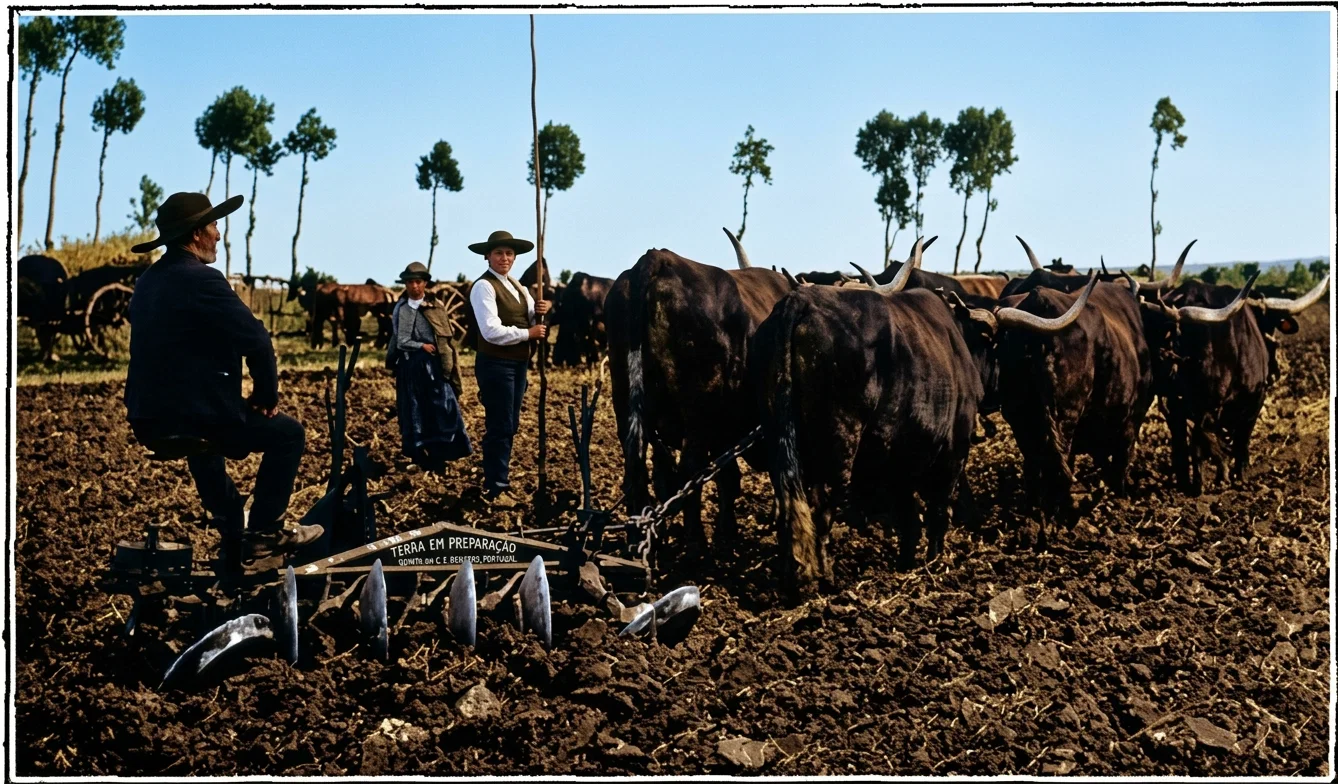
PREPARING THE SOIL IN PORTUGAL
So we, at least in this climate and latitude, will be obliged to interpret our Saviour’s prophecy according to Luke’s testimony: “Behold the fig-tree and all the trees,” to know that summer is nigh. Yes, all the signs tell us that the coming of Jesus is nigh. This, however, is not a summer to blight the winter and spring growths by its cruel hot winds, but it is the summer that merely ripens the growing grain, and brings the reapers to gather into the heavenly garner. May we all be among the chosen grains of wheat!
If an Iowan should be placed in this climate, to see the wheat, oats, or rye springing up and growing beautifully, and the flowers, both in the field and garden all watered by what would seem to him to be March rain or April showers, he would be somewhat bewildered. This is all to be seen here in January, which would be midwinter in Iowa. So the only proof of coming summer is to see the fig-tree and other trees, putting forth their leaves. On emerging from the cruel darkness at the beginning of the Reformation, one might have thought, “Behold the summer is nigh at hand.” But no; the true signs were yet to be seen. Already have they appeared, and Jesus will soon come, and will not tarry.
In this country the ancient and modern methods of farming seem to be engaged in a last struggle. In our trips by rail to Porto we have seen the traction engine pulling a number of plows, but looking out of our windows or taking a short walk we may see two yoke of oxen hitched to an ancient plow, which appears to be a tree trunk for the beam, and a root for the lay, being pointed with iron. This strange machine tears up the ground after the manner of a hog in its pasture, leaving large clods to be broken up by men, women, and children with heavy hoes.
The grain is sown, and when it is well headed out, women and children work from sunrise to sunset, earning ten or twelve cents a day, by going through the grain to pull out the weeds. I used to pull weeds when a boy, but only to throw them down again; but here every green plant is precious. Some wild thistles are for burros; but other tame, cultivated ones are eaten by the people. Other weeds are for the cattle or pigs.
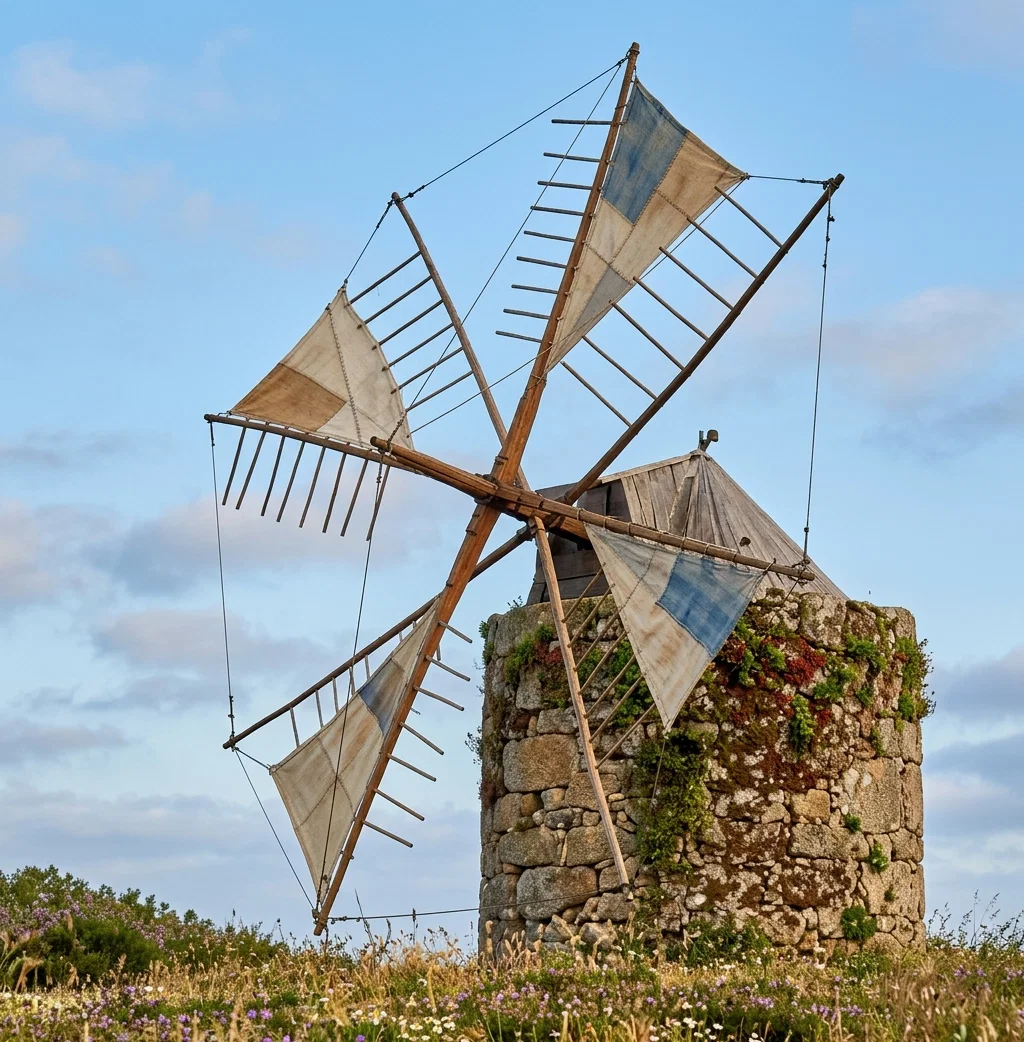
THE WIND GRISTMILL
THE WIND GRISTMILL
Some small patches of oats or wheat are to make green feed for the cows, and this is cut down by men with the small curved sickle grasped in one hand, to reap a bunch of grain in the other.
Soon a cartload is ready, and loading up, the worker is off to other duties. If the grain ripens, it is gathered into sheaves and hauled to the threshing-floor, where as in King David’s day, the grain is trampled out by oxen, while men with forks toss the straw up in the air, thus blowing away the chaff.
The wheat, when ready for the market, is loaded either on a donkey’s back or by other means of conveyance, carried either direct to a mill, and exchanged for flour or traded in the city for other necessary articles. We have three kinds of gristmills,—air, water, and steam for power. The wind-mill is a round stone and cement building, to be found on a hilltop, where its huge arms bearing great sails go squeaking away, grinding out the flour. We often grind between our teeth little pebbles or particles off the large mill-stones.
The writer was visiting at the home of a friend one Sunday, where some men were stretching a barbed-wire fence. One man was tugging away at the spool, turning and rolling it over and over. I picked up a Portuguese hoe, and thrust the handle through the hole of the spool, saying, “Take hold here, man.” He did so, and in a moment the work was missed done. His only remark was, “Ah, you are a foreigner,” conveying the idea that Portuguese can not think of such things.
As we look out of our window on the handiwork of our Creator, we return him thanks for the oxygen provided for us in the green verdure on all sides. We thank him for his bountiful hand of love, in providing such a great variety of food in fruits, grains, and nuts, to satisfy our need.
“To him that overcometh will I give us to eat of the tree of life.”
Lisbon, Portugal.

Tinnevelly, South India

J. S. JAMES
AFTER a residence of fourteen months of ministerial labor and Tamil language study in Bangalore, we bound off our work there and are now located among the Tamil Sabbath-keepers of the Tinnevelly district. Leaving Bangalore the evening of March 15, we arrived at Tinnevelly Bridge station, after a journey of two days and nights. This is the nearest railway station to the neighborhood of our future labors. The rest of the journey is made by bullock carts, twenty-three miles to the southeast.
We were met at the station by friends who had previously arranged for bullock carts to convey ourselves and luggage out to our future home. After a few hours’ rest at the home of a friend in Palamcottah, the carts were made ready for the drive which was to occupy the entire night. The first cart carried our luggage. The second was prepared for my two boys and the man who came to meet us, and the third cart carried Mrs. James and myself. These carts were about six feet long, and three feet wide, covered with palmyra-leaf mats, and drawn by two bullocks. By using a good supply of hay and bedding we managed to make ourselves comfortable so we could sleep a part of the night.
A bullock-cart ride in India is always more interesting on paper than in reality. The same is true with a few other things. About two miles of it over the average Indian road is sufficient to wear off all the novelty that should chance to go with it. Bullock-cart rides never fail of mention in the recollections of Indian missionaries. All night long one hears the shouts and cries of the driver as he half pushes and half urges his lazy bullocks along. While he usually carries a whip, its use is a waste of energy. Tail-twisting is the favorite method of persuasion; the driver sits on the cart-tongue conveniently near this appendage, where it can be grasped at a moment’s notice.
We arrived at the end of our journey the next morning at half-past seven, and were greeted in the usual manner accorded to missionaries. Some two weeks before this, I made a visit to this place and endeavored to secure a dwelling-house in some of the near-by villages. These houses had been vacant for some time and were owned by members of the Anglican Church. As soon as it became known that we were in search of a house, the lord bishop of the district issued strict orders that any member of his church who rented us houses or in any way assisted us in our efforts to start mission work in their territory would be expelled from the church at once. This served to close these places against us, but other means were provided. God’s opportunity had come.
Seeing there was no other opening for us nearer than twenty-three miles, and greatly desiring our immediate presence among them, the Sabbath-keepers heartily consented to vacate their school building and fix it up for our habitation as best they could until a suitable dwelling-house can be erected. This building is located in the heart of the two combined villages. It is closely hemmed in on every side by native mud huts and foul-smelling stables. The building itself is constructed of sun-dried brick, surrounded on all sides by a five-foot veranda and covered with a tile roof. Our greatest inconvenience is lack of room for exercise and fresh air. We have little or no privacy unless we close the doors and windows against the curious crowd who are constantly peering in at every opening. We can not blame them, for they are ignorant, and our ways of living and the furniture of our home appear just as strange to them as theirs do to us at first sight. We are the first white people who have ever lived in the village, and our presence excites a great deal of interest.
Notwithstanding the fact we are over eight hundred miles from our nearest worker, and fifteen hundred miles from our field headquarters, surrounded on every side with black faces and a language we do not yet understand, we feel no less secure than when we were comfortably situated in our home in Minnesota. We feel that we are among a class of people who are as truly our friends as were those of former associations. We have every evidence of this in the way they go about to seek our comfort and convenience. For all this we are extremely thankful to God, and we feel greatly encouraged in our efforts to prepare ourselves so that we may be able to acquaint them with the joy and riches to be found in the truths we have for all nations. That we may have the wisdom, patience, and understanding to do this in the right way, is our constant prayer.
In a number of ways their doctrines resemble a few principles which we hold, but they are a long way from being Seventh-day Adventists. Their church polity is a strange mixture of Hinduism, Judaism, and Christianity. Many things connected with their domestic life and church ritual are identical with those of the Brahmins. Their conception of the laws and customs of Judaism allows of all the evils of the caste system; the laws of pollution and defilement contained in the Judaic system are cited as support for such things. These things are the idols of the unregenerate heart which delights itself in a religion of self-righteousness, and revels in an abundance of ceremonies and forms. They have scrupulously held to these things for fifty years, and it is too much to expect them to leave it without a struggle. There are, however, a number of the leaders who are anxious for a reform and are working to effect it. I hope to be able to work through them for the benefit of others. While I am writing these lines (April 7, which they reckon as the beginning of the passover week) the trumpets are blowing, calling the people to assemble for a service which lost its significance in the death of Christ on the cross two thousand years ago. We earnestly hope that ere another year rolls around, these people will be supplied with the truth in their own language, and will not desire to carry forward these meaningless forms any longer.
Quite frequently different leaders of the congregation come to my house, and together we study the Bible on these points. I am happy to see that they take kindly to my explanations of controverted points. I avoid giving them too much at a time. The method described by Isaiah is best. Isa. 28: 10-11. Ever since they left their founder in 1883, they have been much in the same condition as Israel in the time of Asa,—“without the true God, and without a teaching priest, and without law” See 2 Chron. 15: 3-5. As sheep without a shepherd they have wandered about in the darkness of surrounding idolatry, with no one to instruct them. Like the Ethiopian whom Philip met on his way to Gaza from Jerusalem, they read and reverence the Scriptures, but how can they understand except some man should guide them?
They are a people belonging to a caste that takes pride in their generosity. They have hearts of sympathy and tenderness that respond quickly to every sincere effort to help them. When they see that we love them, and are willing to sacrifice for their sakes, there is nothing they will not do in return to show their appreciation.
Their needs, as well as our own, should have a daily remembrance in your prayers.
Mukkupiri, Nazareth, P. O.

Dedicatory Exercises at the Foreign Mission Seminary

The new building of the Washington Foreign Mission Seminary, designed for use as a recitation and lecture hall, was dedicated with appropriate exercises on Tuesday evening, May 19. The halls and principal rooms of the building were attractively decorated with palms and wild flowers, presenting a very inviting appearance. The pleasant chapel was filled with an audience composed of the faculty and students of the Seminary and their friends, the faculty, patients, and nurses of the Sanitarium, and others interested in the work of the Seminary.
The exercises opened with a hymn by the congregation and prayer by Dr. D. H. Kress of the Washington Sanitarium. Following this there was a song by the Seminary male quartet; then Elder A. G. Daniells, president of the board of trustees, made a general statement concerning the work of the institution and the circumstances which led up to the construction of the building. The modification of the original plans for an educational institution at Washington grew out of the constant and increasing calls for workers for the mission fields, and as the Mission Board faced these demands, the necessity for an institution for the training of workers who should respond to these calls seemed imperative. He felt that the providence of God had been over the work, and had guided to the present moment when this building, so necessary for carrying out the general plan of work, was ready for dedication.
Prof. H. R. Salisbury, the treasurer of the board, submitted a financial statement showing that in constructing the building the cost had been kept within the original appropriation, a fact which afforded him much satisfaction to report. The figures were presented which told the financial story and indicated the cost of the various materials entering into the construction of the building, as well as of the items of labor. At the close of his remarks, speaking as the president of the faculty, he expressed, in behalf of himself and his associates, their great satisfaction that the Seminary was now provided with such facilities as would enable them to carry forward their work to advantage.
Prof. Frederick Griggs, the chairman of the Educational Department of the General Conference, gave a brief review of the history of the educational work of the denomination, showing how the colleges and academies were first established, followed by the church-schools, and later by the industrial schools. He felt that the establishment of the Foreign Mission Seminary was the last, but not the least important, step in the development of the educational system of the denomination. He expected to see many well-trained workers go forth to all parts of the harvest-field, bound together by a common interest in a great work, and by the ties of personal friendship formed in their association together at the Seminary.
A selection of instrumental music was then rendered by the Seminary orchestra, after which Elder I. H. Evans, in a brief address, emphasized the need of making the Seminary especially strong in the lines of Biblical research and in the teaching of the Holy Scriptures. He declared that the reputation of the Moody Bible Institute at Chicago was due to the fact that they made the earnest study and the teaching of the English Bible the leading feature of their work. He deplored the lack of scholarly Bible teachers in the denomination, and earnestly urged that the Seminary should give especial attention to this feature in the education of gospel workers.
Prof. B. G. Wilkinson was then introduced, and in his remarks recalled some of the experiences in conducting the work of the Washington Training College, now the Foreign Mission Seminary, when the proper facilities were wholly lacking. It was a source of great gratification to him that the completion of this new building placed the Seminary in a position to conduct its work on a basis most satisfactory both to students and instructors, and he hoped to see well-trained workers from the Seminary carrying the closing message to the various nations of the earth.
The concluding address was made by Prof. W. W. Prescott, editor of the REVIEW, who spoke of the need of such an institution as the Foreign Mission Seminary from the standpoint of the field, and suggested three general reasons which would not only justify, but call for, the establishment of such a place for the training of workers: (1) in order to determine the general fitness of the candidate for mission work; (2) in order that candidates for the mission field might be able to breathe a missionary atmosphere while preparing for their work; (3) in order that those under appointment to specific fields might receive such special instruction as would enable them to cope with the difficulties which would confront them, and to preserve both life and health. Enlarging upon these reasons he declared that something more substantial than the transitory halo which in many minds surrounds the foreign-mission idea, was necessary in order to prepare the candidate for work in heathen lands so that he would remain permanently in the field under adverse circumstances, facing influences which tend to depress and discourage. The opportunity of associating with instructors who had themselves had experience in the foreign fields; and of becoming acquainted to some degree with the countries, and peoples, and their conditions; and of acquiring such knowledge of the diseases peculiar to the several countries and the methods of successfully treating them, would place the candidate for foreign work upon vantage-ground and would make his success much more assured. He closed by referring to the urgent calls from the great centers of darkness and heathenism for missionaries of the true gospel, and expressed the hope that at the Seminary many would be trained who would respond to these calls.
Brother A. S. Baird, the architect and builder, responded to the chairman's call for a few remarks, and expressed gratitude for the privilege of having had a part in constructing the buildings for the use of the Seminary. He spoke appreciatively of the work done by the students in the erection of the buildings, and of the advantage which such a training would be to them in the mission field.
The dedicatory prayer was then offered by Elder G. B. Thompson, who invoked the special blessing of God upon the Seminary, that it might fill its place in the great work of carrying the last message to the ends of the earth. The exercises closed with a song by the Seminary male quartet and the benediction by Dr. W. A. Ruble.
In response to the invitation to inspect the building, the friends visited the various rooms. The building is pleasing both in its exterior appearance and in its interior arrangement, and is a credit to those who planned it and to those who constructed it. By this addition to its facilities, the Seminary is now prepared to carry forward its important work in a manner satisfactory both to the management and the students. W. W. P.

Victoria, Australia

As I write these lines, I can not help praising the Lord for five weeks filled with the grandest experiences of my life. During that time he has graciously returned to me that burden for souls which I had when I accepted this glorious truth, about four years ago. I had allowed the oil in my lamp to burn out, and after groping in darkness for a long time with many and varied experiences, I was advised just before camp-meeting this year, to take the shining light of God’s Word and the “Coming King” away into the hill country of the Upper Murray in Victoria, and look for that which I had lost.
A few of my experiences here may be interesting. I met the Methodist minister on the road one day, who said, in a sneering way, “Yes, I have seen the book [“Coming King”] before, in fact, read it from beginning to end, as I did ‘Bible Readings’ and ‘Desire of Ages.’ I gave the people the contents of those books from the pulpit in my church. Yes, I advised them very strongly to burn such contaminating literature, and if they did not do that, to put the books away out of sight so that the people would not know that they were harboring such rubbish.”
I felt Christ’s presence with me, and he refreshed my memory with texts of Scripture, quotations from “Bible Readings,” “Great Controversy,” and other books, so that I completely vanquished all his theories and sentimentalisms regarding the Sabbath question, and the present-day condition of the churches. At last he admitted that his feeling against us was to a great degree prejudice, because of the way the books were sold, and that this made him denounce them. He said, “I’ll admit there is not a tittle of evidence to be found in the Bible for keeping Sunday sacred.”
Despite the opposition, I find a good many to sympathize with me, because they think the books are good ones. One woman after she had finished telling me what the minister had said, remarked, “It is real persecution, that is what it is; but never mind, keep up your courage and go ahead against all opposition, for I believe it is God’s work you are doing.” Others say, “Well, God speed you on your way,” or, “I hope you have good success.”
One gentleman, after I had shown him the book, said, “Well, the parsons say these books are wrong. I suppose this is from the same place as the one I have, ‘Bible Readings;’ but come inside, I would like you to give me some idea of what is in that book.” I spent two hours with him explaining different portions, and secured an order from him; and on my leaving he said, “I do not profess to be religious, but I wish you were living near, so that I might hear more of these things. We will have another talk when you come back.” It was then I felt that God had intrusted with me a knowledge that is life to others, and I must not withhold it from them. Still, I know a canvasser should not preach, but do as the Waldensian missionary, who spoke where he could without impeding the cause.
I honestly believe and earnestly pray that a good company of sincere people in this district will eventually heed the call, “Come out of her, my people.”
W. FOWLER.

Ohio

CLEVELAND.—April 19 and 20 we had baptism in this church, and fourteen precious souls were buried with their Lord in baptism. Six of these are Germans from the West Side. Four of our converts did not go forward for various reasons. A number of others are deeply interested, and are contemplating keeping the Sabbath.
Elder H. F. Graf and wife are now here to take up the German work in Ohio. We have been able, with the Lord's help, to secure a pleasant church on the West Side, where nearly all the Germans live, for a very cheap rent. We can now invite outsiders to come to a respectable place to hear the third angel's message in their own tongue, which can but assure success for the German work in this great city. We have reorganized our Sabbath-school, and elected new officers. Our membership is forty-five, with five classes. With the Lord's blessing we expect to gather in many more. We have been sowing the seed by scattering papers, tracts, and books which will surely bring its results in due season. We are all of good courage. Pray for the work in Cleveland, that it may prosper. G. P. GAEDE.
Continue reading: ***Atlantic Union Conference