Attempts Made to Destroy All Righteous Men from the Earth—God's Interposing Hand
This is one of several articles by Elder Reaser on the general theme of the eternal purpose of God concerning this earth and its people. In previous articles, he has shown that it is God's plan to have this earth peopled with righteous men and women; and while the fall of man and his course of sin may delay the divine purpose, yet it cannot overthrow it. Some of the attempts that have been made by Satan to overthrow God's plan are interesting topics for study. Editor.
ALTHOUGH, before the Deluge, the Lord preserved a godly line, a "righteous seed," through whom Christ — the Seed upon whom hope centered for making God's eternal purpose effectual — could eventually make His appearance in the human family, yet not till after the Flood did He organize His people into a government, separate from all other peoples.
THE CALL OF ABRAHAM
Preliminary to the launching of the commonwealth of the godly line, later known as the Hebrew people, or the nation of Israel, was the call of Abraham, about 367 years after the Deluge. Gen. 12: 1-3.
The chief purposes of this organization were, first, to prevent the calamity of the amalgamation of the godly seed with the ungodly, and thus the pollution of the people of God; second, to preserve God's name and His truth in the earth; third, that His people might be a factor in the evangelization of the world; and fourth, that through the godly line, a channel might be provided for the coming of the Deliverer into the human family.
Connected with the call of Abraham was the promise that in him would all the families of the earth be blessed, thus revealing that the thing uppermost in the mind of the Lord was the carrying to completion of His eternal purpose, the filling of the earth with a people all righteous. Gen. 12: 3.
It is manifest to the student of Bible history that when Abraham was called to depart from his kindred, to become the head of Jehovah's nation, the race of Adam was fast drifting into idolatry. So far as the inspired record relates, Abraham and his nephew, Lot, seem to have been the only survivors of the race whose religion was not corrupted with paganism. It was therefore high time that they and their families should be separated from the ungodly line. After the severe test of the faith of Abraham in waiting a full quarter of a century for a son promised by Jehovah, when the son of promise had finally come to manhood, one of the greatest perplexities that confronted Abraham was, to secure for that son a wife as nearly as possible in the godly line. Genesis 24. A similar problem perplexed the next generation (Gen. 26: 34, 35; 27: 46), and the situation was not relieved until there was a larger increase of the godly seed.
PHARAOH SEEKS TO DEFEAT THE ETERNAL PURPOSE
Still following the history of the godly line, we find the second and third generations after Abraham in Egypt. While they were there, Satan made special effort to effect the amalgamation of the godly line with the ungodly. The decree of Pharaoh that all the male children of the Hebrews should be killed at birth, would soon have compelled the marriage of the daughters of God with the sons of men, if the seed of Abraham was to be preserved. But before this satanic plan for corrupting the godly line could be carried out, Jehovah, to make His eternal purpose carry, raised up a deliverer in the person of Moses, and led His people out of bondage.
In still another way, the godly line had been all but overwhelmed in Egypt. The central object of worship of the Egyptians was the so-called "sacred bull." Israel had been so far swept from their bearings by this false worship, that, even after beholding the mighty miracles by which they had experienced deliverance from Egypt, yet with few exceptions they united in the making and in the worship of a golden calf, the nearest approach to the gods of Egypt that their resources permitted them to create.
Moses had not been swerved from his allegiance to God by the influences of Egypt. Thus one man in the godly line still remained loyal. Knowing that His eternal purpose could only carry through the preservation of the godly seed, yet beholding the deflection of His people, Jehovah suggested cutting them off, disinheriting them; declaring that with the one righteous survivor, Moses, He could still carry His eternal purpose to completion. He based His determination so to do, upon the fact of His own existence, as it is recorded, "But as truly as I live, all the earth shall be filled with the glory of the Lord." Num. 14: 12, 21. All but a single individual of His chosen people might fail; but the plan, never. Jehovah cannot be surprised nor His plans defeated. He "worketh all things after the counsel of His own will."
Full seven centuries after the establishment of Israel as a nation, with the kingdom of Assyria dominating the world, and God's people divided into two nations, Assyria's king sent an army and carried away the ten tribes of Israel. This occurred in 721 B. C. 2 Kings 17: 6, 7. Thereafter Israel as a nation is lost to sacred history.
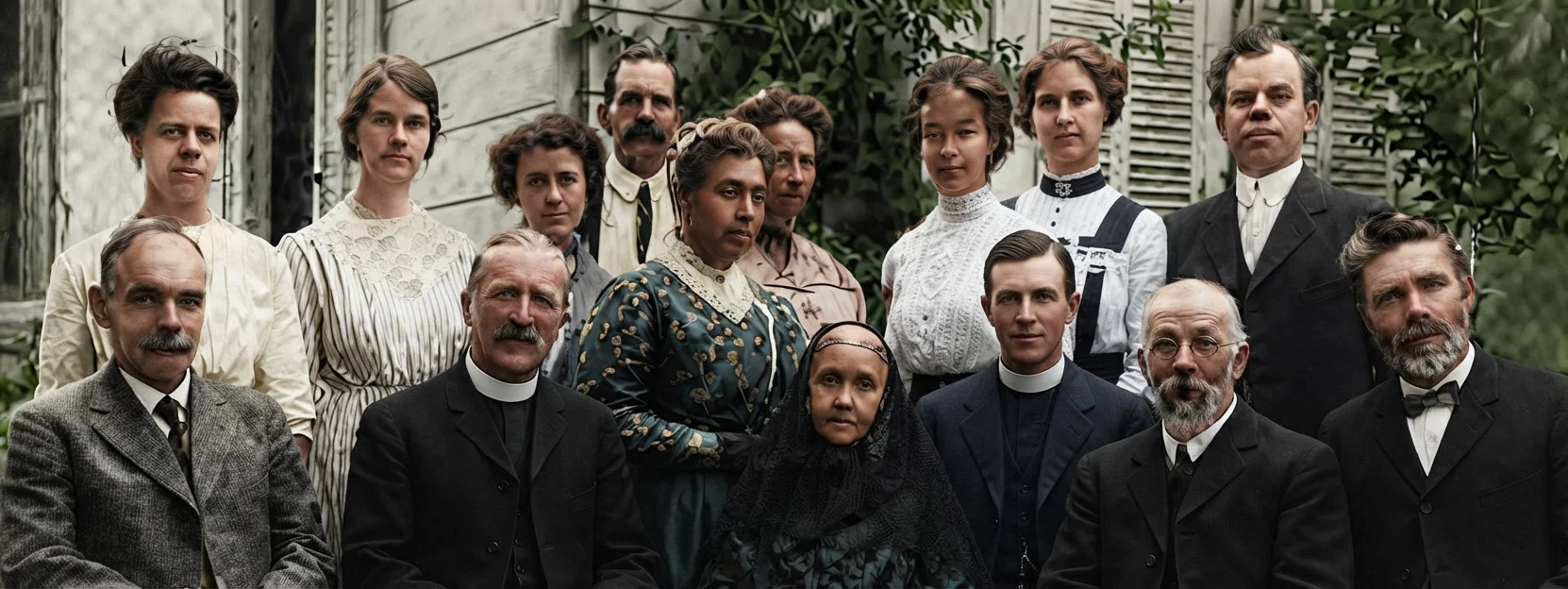
The last photograph of Mrs. White, taken at her home. Some of her secretaries and other helpers standing. Seated, from left to right, Prof. G. A. Grauer, the late Elder O. A. Olsen, Mrs. White, Elder W. C. White, and Prof. M. S. Reppe.
Only a few years after the captivity of Israel, the same world power sent a mighty army to subjugate Judah. The godly line being in Judah, the latter must be preserved in order that the eternal purpose shall carry, by the coming into the world of the Lion of the tribe of Judah. Jehovah declared that for His own sake, He would save Judah. The crisis demanded the intervention of Heaven to avert the overthrow of the godly line. It is written that the angel of the Lord went forth in the camp of the Assyrians, and smote 185,000. 2 Kings. 19: 32-37.
AN UNALTERABLE DECREE REVERSED
Two centuries pass; and under the rule of Medo-Persia, Haman, the prime minister, a deadly foe of the godly line, secured the passing of an "unalterable decree" that all the people of God — then in captivity — should be destroyed in one day. Esther 3: 12-14. Again Heaven intervened to preserve the godly line, and a counter decree resulted not only in the saving of the people of God, but also in the complete overthrow of their enemies. Esther 8, 9.
SATAN DEFEATED IN HIS EFFORT TO DEVOUR THE DELIVERER
Forty centuries of futile effort on the part of Satan to extinguish the godly line, brings us to the birth of the God-man, upon whom is focused the hope of the human family for replenishing the earth. If the great rebel, the author of death, the desolator of the earth, can destroy the Seed of the woman, then he can defeat God's eternal purpose. We find him, therefore, standing before the woman — the godly line — to devour her Child as soon as He is born. Matt. 2: 16 with Rev. 12: 1-4. But the Child was caught up to God and to His throne.
The escape of "the Child" from being devoured by the dragon; His subsequent victory over Satan in temptation; His sinless life; His vicarious death; and, finally, His glorious triumph over the grave, assured beyond question the ultimate success of God's eternal purpose, the replenishing of the earth with a people all righteous.
When this assurance was given, there went up a mighty shout in heaven, "Now is come salvation, and strength, and the kingdom of our God, and the power of His Christ." Rev. 12: 10.
THE LION OF THE TRIBE OF JUDAH HATH PREVAILED
Not only did the arches of heaven ring with this joyful chorus, indicating that the angels now had full assurance of the triumph of God's eternal purpose, but "a door was opened in heaven," and to a member of Adam's race the invitation was extended in these words: "Come up hither, and I will show thee things which must be hereafter." Rev. 4: 1. Accepting the invitation, John saw a vision of the eternal Father seated upon His throne, holding a book "sealed with seven seals." It is evident, from the context, that in this book was bound up the knowledge of the final destiny of the human family, — the outcome of God's eternal purpose. A question was then proclaimed in heaven, as to who was worthy to open the book and to loose the seals thereof. To make an impression on the mind of John, for a time no one came forward to open the book. Realizing that the eternal destiny of the race of which John was a representative was bound up in the sealed book, the prophet says that he "wept much."
Who was there in heaven to comfort him? Was an unfallen angel best calculated to offer the comfort? — Not so. When Christ triumphed over death, it was fitting that He demonstrate to the universe His power to accomplish God's eternal purpose, even by wrestling from their graves a certain number of those who had, through grace, developed such characters that in the final replenishing of the earth, they might be the subjects of His eternal kingdom. And, too, having Himself taken all the preliminary steps to become the High Priest for the race, and being qualified, by becoming a member470of our human family, by sinless character, and by the offering of Himself as an all-sufficient sacrifice for sinful men, to begin His work as our great High Priest in the sanctuary in heaven, He needed, apparently, the same number of men to coöperate in the sanctuary service above as officiated in the same service on earth.
One of these, better calculated than an angel for the purpose, came to John, saying: "Weep not: behold, the Lion of the tribe of Judah, the Root of David, hath prevailed to open the book, and to loose the seven seals thereof."
THE SONG OF TRIUMPH
The One mentioned as "the Lion of the tribe of Judah" was Christ. Thus introduced, He came forward and took the book, preparatory to breaking the seals. At once "a new song" was raised by those who had been rescued from their graves, ascribing all worthiness to the One who had redeemed them by His blood. Please note that one strain in the song was, that we are not only kings and priests to our God now, but "we shall reign on the earth." Rev. 5: 1-10. In this last statement we have an expression of the full confidence of the representatives of our human family now in heaven, that God's eternal purpose for our world — its replenishing with the sinless and deathless survivors of Adam's race — will be accomplished by "the Seed of the woman," upon whom help was laid when Adam defaulted.
Note again the words, "The Lion of the tribe of Judah . . . hath prevailed to open the book." Over what must He prevail to assure the success of God's eternal purpose? — Over "the gates of hell," or the grave. Christ declared to Peter that upon the eternal rock, the sure foundation, that He was the Son of the living God, He would build His church, and the gates of hell, the grave, should not prevail against it. The final proof that He was the Son of the living God was the creative act of His resurrection from the dead; as it is written, "Declared to be the Son of God with power, . . . by the resurrection from the dead." Rom. 1: 4. In giving His commission to John to write the book of Revelation, He declares, "I am He that liveth, and was dead; and, behold, I am alive forevermore, amen; and have the keys of hell and of death" — the power to unlock. Rev. 1: 18.
We now see the force of the expression, "The Lion of the tribe of Judah . . . hath prevailed to open the book." The opening of the seals reveals the outcome of God's eternal purpose. John supplies the prophetic description of the children of Adam whose character development entitles them to places in Jehovah's completed purpose. He says: "After this I beheld, and, lo, a great multitude, which no man could number, of all nations, and kindreds, and people, and tongues, stood before the throne, and before the Lamb; . . . and cried with a loud voice, saying, Salvation to our God which sitteth upon the throne, and unto the Lamb." Rev. 7: 9, 10.
Possibly the reader has never considered that after the coming of Christ into the world, by the conquest of the cross the gospel work by which God's eternal purpose must be accomplished, received so much impetus, obtained such a strong foothold in the earth, that the utter extinction of the godly line by the forces of evil never reached such a danger point, the completion of the eternal purpose never was in such a crisis, that Jehovah was compelled to perform a "strange act" in sweeping away the ungodly as in the former dispensation.
To defeat the eternal purpose, Satan persistently refuses to release from the grave those who have fallen asleep in Jesus — the godly line, cut down by the hand of death. Isa. 14: 17, margin; Jude 9. But by virtue of the prospective triumph of Jesus over the grave that the eternal purpose might carry, we find the prophetic announcement, "Thus saith the Lord God; Behold, O My people, I will open your graves, and cause you to come up out of your graves, and bring you into the land of Israel, . . . and shall put My Spirit in you, and ye shall live, and I shall place you in your own land." Eze. 37: 12-14. See also Rev. 1: 18.
ATTEMPTED EXTINCTION OF THE GODLY LINE THWARTED
Following the history of the godly line down the stream of time, as prophetically foretold, we discover the righteous seed during the "Dark Ages," desolated by the persecution of that great apostate church styled "the woman drunken with the blood of the saints." Rev. 17: 6. But as in ages past, even so now, the omnipotent hand of God is over His own, to save them from destruction. Descriptive of the divine protection provided at that time are the words of Jesus: "Then shall be great tribulation. . . . And except those days should be shortened, there should no flesh be saved: but for the elect's sake those days shall be shortened." Matt. 24: 21, 22. The "elect" are the godly line. For their sake, Heaven interposed, and stayed the hand of "the woman drunken with the blood of the saints."
It would be difficult to find uninspired language more beautifully expressive of God's watchcare over His people for the completion of His eternal purpose, than the following well-known lines from the pen of James Russell Lowell:
"Truth forever on the scaffold,
Wrong forever on the throne.
Yet that scaffold sways the future;
And behind the dim unknown
Standeth God within the shadow,
Keeping watch above His own."
The Prophet's View of Paganized Christianity
By Jean Vuilleumier
Paganism Absorbed but Not Converted — A Long Prophetic Period — The Two Desolating Powers and Their Work — The Two Hosts
This is the second of some four articles by Mr. Vuilleumier on the prophecy of the eighth chapter of Daniel. The article this week introduces the ecclesiastical power of the papacy, and the article next week will give a further development of the subject. EDITOR.
THE vision of Daniel 8 reaches down to the end of human history. In verse 25 we read, "He [the Roman horn] shall also stand up against the Prince of princes; but he shall be broken without hand." This latter expression refers to the violent destruction of earthly kingdoms at the coming of the Son of God in glory. See Dan. 2: 44, 45, where similar words are applied to the world. This fact is positively stated by the angel Gabriel when he comes to Daniel to explain the vision: "Understand, O son of man; for the vision belongeth to the time of the end." "I will make thee know what shall be in the latter time of the indignation; for it belongeth to the appointed time of the end." Dan. 8: 17, 19.
"Elmshaven," the home of Mrs. E. G. White, near St. Helena, California
WHAT THE LITTLE HORN INCLUDES
From this, the evident conclusion follows that the "little horn, which waxed exceeding great," includes not only the pagan phase of the Roman power, but also its papal phase. In other words, the history of the world, from the days of Cæsar to the end of time, is all embraced under one symbol, compassed in one power. As the God of heaven views human affairs, not only is there a political but also a religious unity between pagan and papal Rome. Therefore the description of the "exceeding great" horn must include the entire history of the papal hierarchy and political supremacy during the Dark Ages and modern times. This conception is the undoubted teaching of the prophecy; and an interpretation which does not recognize it, cannot be correct.
Differences may spring up as to where the dividing line must be drawn between the statements of the prophecy belonging to pagan and those belonging to papal Rome; but the transition, no matter how imperceptible or how sudden, is there somewhere.
This is not the only place in prophecy where this fact is presented and this form of symbolism used. In Daniel 2, the whole history of the world from the beginning of the Roman Empire to the end of time is called one kingdom, though a "divided" one. Dan. 2: 40, 41. In Daniel 7, the ten barbarian kingdoms under papal domination are made inseparable parts of the fourth beast, or the Roman Empire. In Revelation 12 also, we see, from the first advent of Christ to His second coming, the whole political and religious history of the world summed up under one single symbol, the great red dragon.
TOOK AN ECCLESIASTICAL FORM
Nor is this fact unnoticed by historians. Says Chateaubriand, in his Etudes Historiques: "The Latin-Roman empire had become the barbarian-Roman empire. . . . The entire society took an ecclesiastical form; all was governed by the church and for the church, from the nations up to the kings themselves."
"Singular phenomenon!" says M. Guizot, the Protestant prime minister and historian under Napoleon III. "It was at the very time when the empire tottered and disappeared, that the Christian [Catholic] church definitely gathered its fragments and shaped itself. Political unity perished, religious unity appeared."
"As the one [the old Rome] disappears, the other [the new Rome] expands and takes possession of the ground," says a Catholic writer. "Throughout this change, the original idea attaching to Rome as the earth's capital remains unchanged. She does continue to be mistress of a world, but, by the grace of God, mistress no longer of a heathen but of a Christian world. The sway acquired by ancient Rome was but to foreshadow Rome's supernatural destiny in Christendom. The Christian hierarchy is, in all its essentials, of divine origin. But now, in its accidental development it adapted itself to the system of imperial government. The system was ready to hand, practical, efficient, and easily understood by all."—"Rome and the Popes," translated from the German of Dr. Karl Brandes by the Rev. W. G. Wiseman, Benziger Brothers, New York, 1868, page 63.
HOW LONG SHALL BE THE VISION?
But there is still another side to this prophetic prism; that is, its chronology, as pointed out by two heavenly beings speaking in the hearing of the prophet, thus showing the intense interest taken by heaven itself in these solemn revelations. This is found in Dan. 8: 13, 14.
The question of the holy one: "How long shall be the vision concerning the continual [the words "burnt offerings" or "sacrifice" are not in the original], and the transgression that maketh desolate, to give both the sanctuary and the host to be trodden underfoot?"
The answer of the other holy one: "And he said unto me, Unto two thousand and three hundred evenings and mornings; then shall the sanctuary be cleansed."
Thus by two heavenly students of prophecy, the whole field of the vision is divided among two powers or religions, named "the continual" and "the transgression that maketh desolate"; both are engaged in one and the same enterprise, that is, treading underfoot "both the sanctuary and the host"; and this long, nefarious, heaven-daring campaign, or drama in two acts, is to last 2,300 prophetic days, or as many literal years, according to the prophetic year-day rule. Eze. 4: 4-6.
THE PROPHETIC PERIOD IN FULFILLMENT
This period, if started in the year 457 B. C.,— for which good reasons will be given later,— would end in 1844.
Let us see now if this bird's-eye view of the vision given by angels is confirmed by human history and chronology, reckoned in round numbers.
The three world empires embraced in the vision (the Persians, the Greeks, and the Romans), which began 500 B. C., and ended 500 A. D., lasted together . . . . . 1,000 years
The barbarian or Latin phase of the Roman Empire, which began in the early part of the sixth century, and ended at the close of the eighteenth century, lasted . . . . . 1,300 years
Total . . . . . 2,300 years
And now, how does the history of the world, from the standpoint of religions, agree with this 2300-year period?
The paganism of the Persians, the Greeks, and the Romans held sway for nearly . . . . . 1,000 years
The papal religion, which ruled the world from the destruction of paganism to 1798, lasted about . . . . . 1,300 years
Total . . . . . 2,300 years
In the rough, then, the vision of Daniel as summed up by the two angels is wonderfully confirmed by history and chronology. We are now prepared to enter into the detailed study of verses 11-13, which deal with the second, and, to us, most interesting phase of the vision.
THE TWO DESOLATIONS AND THE TWO SANCTUARIES
These verses contain a few expressions which must be studied before we can apply them correctly. These are the two desolations, the two sanctuaries, and the two hosts. In order to lay the whole problem before the reader, we will quote Dan. 8: 11-13, with two other passages in the book of Daniel where the same words are used, and evidently the same subject dealt with. We quote from the Revised Version:471
Dan. 8: 11: "Yea, it magnified itself, even to the prince of the host; and it took away from him the continual, and the place of his sanctuary was cast down." We purposely leave out the words "burnt offering," or "sacrifice," after the word "continual," as they are not found in the original.
CAST DOWN THE TRUTH AND PROSPERED
Dan. 8: 12, 13: "And the host was given over to it together with the continual through transgression; and it cast down truth to the ground, and it did its pleasure and prospered. Then I heard a holy one speaking; and another holy one said unto that certain one who spake, How long shall be the vision concerning the continual, and the transgression that maketh desolate, to give both the sanctuary and the host to be trodden underfoot?"
Dan. 11: 31: "And forces shall stand on his part, and they shall profane the sanctuary, even the fortress, and shall take away the continual, and they shall set up the abomination that maketh desolate."
Dan. 12: 11: "And from the time that the continual shall be taken away, and the abomination that maketh desolate set up, there shall be a thousand two hundred and ninety days."
THE CONTINUAL AND THE DESOLATING TRANSGRESSION
Four questions are now to be answered:
1. What relation is there between "the continual" and "the transgression that maketh desolate"? On this point, we will give U. Smith's grammatical criticism on verse 13: "We have [here] two desolating powers, which for a long period oppress or desolate the church. The Hebrew justifies this construction, the last word, shomem, 'desolation,' having a common relation to the two preceding nouns, the 'perpetual' and the 'transgression,' which are connected by the conjunction 'and.' Literally, it may be rendered, 'How long the vision [concerning] the continuance and the transgression of desolation?' the word 'desolation' being related to both continuance and transgression, as though it were expressed in full, thus: 'The continuance of desolation and the transgression of desolation.'"—"Thoughts on Daniel," chapter 8.
WHAT ARE THE DESOLATIONS?
2. What are these two desolations? On this question, we quote from J. N. Andrews, "The Sanctuary and 2300 Days," second edition, 1872, pages 33-39:
"It is plain that the sanctuary and the host were to be trodden underfoot by the daily and the transgression of desolation. The careful reading of verse 13 settles this point. And this fact establishes another; namely, that these two desolations are the two grand forms under which Satan has attempted to overthrow the worship and the cause of Jehovah. . . .
"It needs no argument to prove that the two grand forms of opposition by which Satan has desolated the church and trodden underfoot the sanctuary of the living God, are none other than paganism and popery. It is also a clear point that the change from one of these desolations to the other did occur under the Roman power. Paganism, from the days of the kings of Assyria down to the period when it became so far modified that it took the name of 'popery,' had been the daily, or, as Professor Whiting renders it, 'the continual' desolation, by which Satan had stood up against the cause of Jehovah. And indeed, in its priests, its altars, and its sacrifices, it bore resemblance to the Levitical form of Jehovah's worship. When the Christian form of worship took the place of the Levitical, a change in Satan's form of opposition and counterfeit worship became necessary, if he would successfully oppose the worship of the great God. . . . Nor was it a very great change of character when Satan transformed his counterfeit worship from paganism to popery. The same temples, altars, incense, priests, and worshipers were ready, with little change, to serve as the appendages of the papal abomination. The statue of Jupiter readily changed to that of Peter, the prince of the apostles; and the pantheon, which had been the temple of all the gods, without difficulty became the sanctuary of all the saints. Thus the same abomination that desolated Jerusalem, in a degree changed and modified, became the wonderful desolater of the saints and martyrs of Jesus. And in its so-called temple of God, it set at naught and trod underfoot the true temple of Jehovah, and Him who is its minister, Jesus Christ."
VAULT IN THE OFFICE OF MRS. E. G. WHITE, WHERE HER MANY TREASURED MANUSCRIPTS ARE KEPT
"From a religious point of view, says U. Smith, the world has presented only these two phases of opposition against the Lord's work in the earth. Hence although three earthly governments are introduced in the prophecy as oppressors of the church, they are here ranged under two heads; 'the daily' and the 'transgression of desolation.' Medo-Persia was pagan; Grecia was pagan; Rome in its first phase was pagan. These all were embraced in the 'daily.' Then comes the papal form,—the 'transgression of desolation.'"
THE TWO OPPOSING SANCTUARIES
3. What are the two opposing sanctuaries? Says J. N. Andrews, in the work previously quoted: "They are as follows: First, the sanctuary of the daily desolation. Verses 11; 11: 31. Second, the sanctuary which the daily and the transgression of desolation were to tread underfoot. Verses 13, 14. The one is the sanctuary of Satan; the other is the sanctuary of the Lord of hosts. The one is the dwelling place of 'all the gods'; the other is the habitation of the only living and true God. If it be said that a sanctuary is never connected with heathen and idolatrous worship, we cite the direct testimony of the Bible. Heathen Moab had a sanctuary. And that sanctuary was a place of prayer and worship for that heathen nation. Isa. 16: 12. The chapel erected by the king of Israel at Bethel, as a rival to the temple of God at Jerusalem (1 Kings 12: 27, 31-33), was called his sanctuary. Amos 7: 13, margin. And the places in which idolatrous Israel, the ten tribes, worshiped, are called sanctuaries. Amos 7: 9. The same is true of idolatrous Tyre. Eze. 28: 18."
Note the following from a Catholic writer: "The particular motive which induced Constantine to give up Rome as the capital of the empire, and transfer his court to Byzantium, has never transpired. No historian informs us what it was. The feeling at the time grew general that the sway of the Cæsars at Rome had come to an end; and perhaps this, and the knowledge Constantine had that the spiritual empire whose prince he had recognized in Pope Sylvester, should far outstretch and overshadow the temporal, moved him to the step. At any rate, the finger of God [or some occult power.—J. V.] is clearly discernible in the event."—Dr. Karl Brandes.
THE TWO HOSTS
4. What are the two hosts in Dan. 8: 9-13? "The one," says J. N. Andrews, "is the host that was given to the little horn against the daily, when it had filled its measure of transgression; and by the aid of this host, the little horn was able to cast down the truth. Verse 12. This host is mentioned in Dan. 11: 31. By this host, the sanctuary of the daily desolation, and its services, were transferred to the transgression, or abomination of desolation. This host is the forces of Satan, and it is intimately associated with his sanctuary. The other host is 'the host of heaven.' Verse 10. Michael is the Prince of this host. Dan. 10: 21."
We have seen that soon after the conversion, so called, of Constantine to Christianity, the majority of the population of the empire changed religion with him. Paganism, the "continual" or "daily," found itself in the minority, and had to face the same persecution it had inflicted upon Christianity when it was in power. It was abolished by law, its temples were destroyed, and its practice forbidden under severe penalty, including death. The facts will be brought out further on, as we come to treat the question of persecution under papal rule. And it was the power of the Roman Empire itself that was used472
against the old pagan religion. "Forces" or "troops coming from him shall stand," says Dan. 11: 31, "and shall take away the continual, and they shall set up the abomination that maketh desolate." But this opposition, this power of the state, this "host," or these "forces" or "troops" wielded by the "Christian emperors," were instigated and guided by the popes.
Now we are ready to sum up the whole question: One horn, one power which reaches to the time of the end, but under two separate forms of worship, two desolations treading underfoot the sanctuary and the host of the saints. How did the change come about? It must have been imperceptible and stealthy, until the new form was the stronger; then it rudely crushed the other out. Let us stop a moment to see how insidiously the change was brought about. Says the author of Great Controversy:
PAGANISM STEALS IN
"Almost imperceptibly the customs of heathenism found their way into the Christian church. The spirit of compromise and conformity was restrained for a time by the fierce persecutions which the church endured under paganism. But as persecution ceased, and Christianity entered the courts and palaces of kings, she laid aside the humble simplicity of Christ and His apostles for the pomp and pride of pagan priests and rulers; and in place of the requirements of God, she substituted human theories and traditions. The nominal conversion of Constantine, in the early part of the fourth century, caused great rejoicing; and the world, cloaked in a form of righteousness, walked into the church. Now the work of corruption rapidly progressed. Paganism, while appearing to be vanquished, became the conqueror."—Pages 49, 50.
"Entire populations," says a Catholic historian, "which, notwithstanding their abjuration, were pagan in their modes of life, their tastes, their prejudices, and their ignorance, . . . passed under the Christian banners, but they did so, taking with them their baggage of senseless beliefs and superstitious practices. Christianity adopted a part of the ancient cult."—A. Beugnot, "Destruction of Paganism," volume 2, pages 264-266.
And now that this mysterious, marvelous transition from paganism to Romanism has been consummated exactly as foretold, we are ready to look at the "exceeding great" horn in its second phase, or under its new garb.
The Continuing and Its Translation
The active sentence, "And it took away from him the continual," can also be translated in the passive form, "And the continual was taken away from him," according as one follows the vowelless text called by scholars the kethib, or the Masoretic, official text, called kere. The vowelless text gives the active form, while the Masoretic text gives the passive form. The Authorized Version has the passive form in the text, and the active form in the margin; while the Revised Version gives the active form in the text, and the passive in the margin.