Your ShelfYour Projects

Signs of the Times, Vol. 19, No. 38.

Editorial
Earlier text: THE OTHER SIDE OF THINGS

TESTIMONY OF AN ARCTIC BROTHER.

At the recent camp meeting of Seventh-day Adventists at Moss, Norway, Brother Jon Eisen, a Lapp from the northern part of Norway, gave a very interesting testimony. His remarks were translated into English by Brother Knud Brorsen, whose death was noted last week, and by favor of Elder S. N. Haskell we are enabled to present the matter to our readers:—
"I feel thankful that I can speak in behalf of my people. We have no government or country of our own, but are wanderers like Abraham, pilgrims and strangers, having no abiding city. Neither have we an independent language. In this too we represent Abraham, for he mingled with the Egyptians, Chaldeans, and Canaanites. We live principally in the northern parts of Sweden and Norway. Our language is in three dialects,—one is a mixture of the Finnish, another of the Norwegian, and a third of the Swedish. There are about 28,000 in Norway and Sweden, of which about 16,000 are in Norway. Those living in the mountains live somewhat differently from the others. In the summer we eat the flesh of the reindeer and a kind of grass cooked in reindeer milk. In the winter we use some flour instead of grass. As the feed for the reindeer varies in different parts, we go where the reindeer go, and thus are with them.
"We wear a peaked-top hat, and our women wear a short tunic that comes a little below the knees. The women usually wear brass buttons as ornaments, while the wealthy wear gold and silver. We live in tents. They are round, with a hole in the top, and we build our fires in the center. In the winter we put deerskins on the outside of the tents, and sometimes on the inside also. If the ground be wet, we cover it with brush or grass. We have no sickness such as the civilized Christians have, unless we come in contact with them. We drink the blood of the reindeer, and eat their flesh. In severe snowstorms the deer lay under the snow for days. Once I did this, and stayed with the deer under the snow three days. As I finally grew very hungry, I took my lasso rope and drew a deer near to me, cut his throat, drank his blood, and ate his flesh.
"In the winter the children are protected from the cold by young deerskins. Most of our clothing is made of deerskins. We have no chairs or tables. Our people are very superstitious, and believe that there are people living under the ground or somewhere where we cannot see them. These we are afraid of. The Bible is in each of the three dialects, and some of us can read it and some cannot. Of late most of us can read. There is a mission in Northern Sweden free for Lapps, but they do not encourage their children to go, and the children do not like to go, because they are not encouraged.
"Nearly all boys and girls learn to use tobacco when sixteen or seventeen years of age, and even chew and swallow it. They smoke, chew, and snuff tobacco. It is about sixty years since tobacco was first introduced among us. Drunkenness also prevails, and we use much coffee. At the age of 21 I was engaged to be married to a girl of 20. We lived in a place where brandy was kept close by. We drank together till she vomited and it ran down on my clothes.
"Nearly all the Norwegian Lapps can read, and would purchase books, but we wander so the books would have to be delivered at the time the orders are taken. In the summer they are more together than in the winter. They are easily impressed, and would embrace the truth but the Lutheran priests oppose us. We all respect the Bible as sacred. In Norway eleven Lapps have been baptized and twenty are keeping the Sabbath; including the children there are thirty. We want that you should do missionary work among us.
"I was an infidel and opposed to all religion, and after I had read a little of your papers I would not read any more. But it worked on my mind, and finally I said to my wife, 'Well, I will keep the Sabbath; will you do that too?' She said, 'Yes, I will do that, papa.' Then we got down on our knees and began to pray and to keep the Sabbath; but we had many things to contend with. When I was baptized, I drank no more liquor and used no more tobacco. And since I came down here I say I will never drink any more coffee."

FIELD NOTES.

WE have just received intelligence that the wife of Elder Ira J. Hankins, missionary to South Africa, died at Claremont, near Cape Town, June 8.
ELDER G. C. TENNEY accompanied Elder Olsen to Europe, being one of the company noted last week as having sailed from New York on the 12th inst.
THE church at Beaverton, Oregon, recently gave letters to eleven of their members in order that they might form a church at Dilley, but ten new members were added at Beaverton to take their places.
AT College View, Nebraska, where Union College is located, 100 persons were baptized during the past year, although there was no special revival at any time. During the year three active missionary societies were conducted by students,—English, Scandinavian, and German.
ON the 26th of June two more of our brethren, M. A. Bryan and Geo. W. Marvell, were arrested at Ford's Store, Queen Anne County, Md., for Sunday work. The warrants for both arrests were sworn out by members of other churches, who, like Saul of Tarsus before his conversion, thought they were doing God service in persecuting Christians. The case against Sister Hettie Mansfield, of the same church, who was arrested for using a sewing machine on Sunday, has been dismissed by the court, on account of the prosecuting witness failing to appear.
SISTER HOPE, who recently returned from this city to Belfast, Ireland, where her husband, Elder Francis Hope, and Elder O. O. Farnsworth are holding tent meetings, writes to her friends here as follows:
"I went twice to the tent yesterday. The Sabbath subject had been well advertised, and we were encouraged in having the tent filled both times. During my husband's sermon Elder Farnsworth went to hear another minister on the same subject. Questions were invited by this minister, so Elder F. went forward and questioned him for half an hour, and then spoke to the crowd of a thousand people,"
ELDER GEORGE I. BUTLER, who was for thirteen years president of the General Conference, and who for the last four years has been obliged to retire from active service on account of ill health, is rallying once more. The following note from him, dated at Bowling Green, Florida, appears in the Des Moines, Iowa, Bulletin:
"I have begun to preach a little once more. The Campbellites invited me to preach every Sunday in their new church in the village. I have spoken three times already. As I begin again after four years of silence, the old fire kindles in my heart. I am thinking seriously of getting me a tent, and taking mother in my family tent, and holding meetings hereabouts, within a reasonable distance so that we could go back and forth with our team. I don't know as I could stand it to preach all the time, but I shall be glad to labor once more to bring souls to the truth. I really think I shall get to work again on a small scale."

Special Kindergarten Material

• • TO ACCOMPANY • •

Bible Object Lessons & Songs for Little Ones,
Book 1.—The Life and Words of Christ.
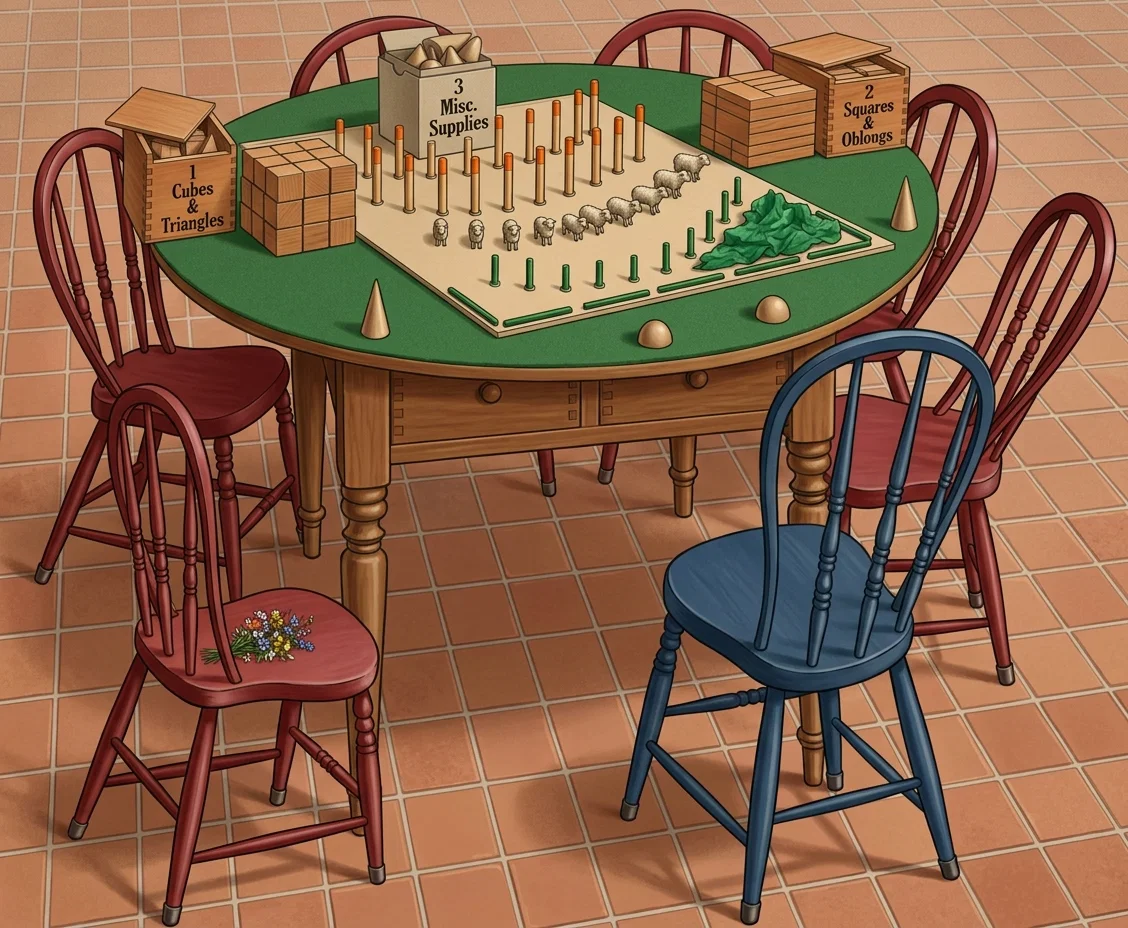
The material for this book consists of three boxes.—(1) Cubes and Triangles; (2) Squares and Oblongs; (3) Miscellaneous Supplies: two Cones and two Domes; ten 1-inch and twenty 2-inch Mounted Orange Sticks, to represent people; thirty-six 2-inch and twenty-four 1-inch Unmounted Green Sticks for Outline and Tree Building; ten Miniature Sheep, and Crumpled Green French Tissue Paper, to represent water.
Boxes 1 and 2 are made of finished cherry, 3x3x3 in., with locked corners and sliding top. The blocks are of hard maple. Box 3 is of pasteboard, with double sides.
Price of the Three Boxes, by mail, . . . $1.75 Delivered by canvasser, . . . 1.50 In lots of 6 sets or more for Sabbath-Schools, 10 per cent discount. Freight or express, extra.
ROUND TABLES, 20 inches high, felt top, 30 inches in diameter (to seat from 5 to 8), lock drawer large enough to hold all the material needed for the entire series of books, . . . $3.75 Drayage and freight or express, extra. In lots of 6 or more for Sabbath-Schools, 10 per ct discount.
SMALL CHAIRS, ornamental, strong, bent rim, RED, 12 inches high, for children, each, 50 cts. BLUE, 14 inches high, for teachers, each, 60 cts. Drayage and freight or express, extra. In lots of twelve 12-inch and two 14-inch, for the Sabbath-School, 10 per ct discount. Noiseless Rubber Tips for chairs, 12 cents per chair additional.
Address, Pacific Press Publishing Co., Oakland, Cal., Or, 43 Bond St., New York. Sole Agents for California, Oregon, Washington, Montana, Idaho, Utah, Nevada, Arizona, Massachusetts, Rhode Island, Connecticut, New York City, Long Island, New Jersey, and Delaware.
Orders from outside the above-named territory should be addressed to F. E. Belden, 5007 Calumet Avenue, Chicago, Ills.

CAMP MEETINGS FOR 1893.

DISTRICT NUMBER ONE.

Virginia, Harrisonburgh........July 26 to Aug. 8. Atlantic, Newark, Del. ............... Aug. 17-27 Vermont, Waterbury .............Aug. 24 to Sept. 3 Maine, Bath..................................Sept. 1-10 New England, West Lynn, Mass...... Sept. 7-17

DISTRICT NUMBER TWO.

Tennessee, Nashville....................Sept. 5-12

DISTRICT NUMBER THREE.

Indiana, Indianapolis....................Aug. 8-14 Ohio, Mt. Vernon........................ Aug. 11-21 Michigan (State), Lansing.......Sept. 21 to Oct. 1 Michigan (northern), Traverse City....Aug. 21-28 Illinois (State).......................Aug. 28 to Sept. 4 Illinois (northern), Streator ......................... Illinois (southern), Olney ...............Sept. 13-19

DISTRICT NUMBER FOUR.

Nebraska, Seward....................... Aug. 22-29

DISTRICT NUMBER FIVE.

Texas........................................ Aug. 10-20 Arkansas, Clarksville............ Aug. 24 to Sept. 3 Colorado............................ Aug. 30 to Sept. 10 Kansas, Phillipsburgh, Phillips Co....July 20-30 Kansas (southeastern), Thayer, Neosho Co............................................. Aug. 3-13 Kansas (southwestern), Turon, Reno Co ........................................... Aug. 17-27 Kansas, Herrington......................Sept. 7-17 Missouri, Sedalia......................Sept. 13-24 Oklahoma................................... Oct. 3-9
GEN. CONF. COM.

OUR GENERAL AGENTS.

Arkansas Tract Society—H. Clay Griffin, Van Buren, Ark. Atlantic Tract Society—T. A. Kilgore, Sec., 43 Bond St., N. Y. Australia—Echo Publishing House, North Fitzroy, Victoria. and A. Reekie, 2 Cook Street, Glebe Point, Sydney, N. S. W. California Tract Society—1059 Castro St., Oakland, Cal. Canada—Mrs. A. E. Taylor, 97 Plymouth Grove, Montreal, Canada, and G. W. Morse, 20 Melbourne Ave., Toronto, Ontario. China and Japan—A. LaRue, International Tract Society Queens Road 219, Hongkong, China. Colorado Tract Society—Miss Leah Vandermark, Sec., 920 W. Sixth Ave., Denver, Col. Dakota Tract Society—Mrs. A. H. Robinson, Vilas, S. Dak. England—International Tract Society, 48 Paternoster Row, and 451 Holloway Road, London. Illinois Tract Society—125 W. Monroe St., Springfield, Ill. Indiana Tract Society—J. W. Moore, Sec., 175 Central Ave., Indianapolis, Ind. Iowa Tract Society—J. V. Willson Sec., 603 East 12th St., Des Moines, Iowa. Kansas Tract Society—Lucy M. Olds, Sec., 821 West 5th St., Topeka, Kan. Maine Tract Society—B. F. Davis, Box 181, Hartland, Me. Maritime Provinces Tract Society—Mrs. I. H. Cowie, Sec., Box 85, Moncton, N. B. Michigan Tract Society—J. S. Hall, Sec., Review and Herald Office, Battle Creek, Mich. Minnesota Tract Society—C. N. Woodward, 336 East Lake St., Minneapolis, Minn., P. O. Box 989. Missouri Tract Society.—Vita Morrow, Sec., 2010 East 23d St., Kansas City, Mo. Montana—Mrs. Emma Emmons, Sec., Box 97, Livingston, Mont. Nebraska Tract Society—Mary F. Beatty, Sec., 1505 E St., Lincoln, Neb. Nevada—Cal. Tract Society, 1059 Castro St., Oakland, Cal. New England—N. E. Tract Society, Mrs. E. T. Palmer, Sec., South Lancaster, Mass. New Jersey, Del., Md., New York City, and Brooklyn, N. Y., and Dist. Col.—T. A. Kilgore, No. 43 Bond St., New York. New York State—E. N. Washbond, Sec., N. Y. Tract Society, 317 West Bloomfield St., Rome, N. Y. New Zealand Tract Society, M. H. Tuxford, Agent, Banks' Terrace, Wellington, N. Z. North Pacific—Geo. E. Henton, Sec., 727 East Taylor St., East Portland, Oregon. Ohio Tract Society—L. T. Dysert, Sec., 74 Kinsman St., Cleve- land, O. Pennsylvania Tract Society—W. M. Lee, Sec., Box 644, Wil- liamsport, Penn. Scandinavian Tract Society—Akersgaden 74, Christiania, Nor. South Africa—International Tract Society, Somerset House, Roeland St., Cape Town. Southern District Tract Society—L. Dyo Chambers, 23 Early St., Chattanooga, Tenn. Switzerland—Imprimerie Polyglotte, 48 Weiherweg, Basel. Tennessee—Miss. M. G. Mason, Sec., Nashville, Tenn. Texas Tract Society—T. T. Stevenson, Sec., Box 9, Oak Cliff, Dallas Co., Texas. Upper Columbia—Mrs. M. E. Ford, College Place, Wash. Utah—J. J. Ireland, 1059 Castro St., Oakland, Cal. Vancouver Island—B. Robb, 231 Pandora St., Victoria, B. C. Vermont—Lizzie A. Stone, lock box 237, Essex Junction, Vt. Virginia—Amy A. Neff, Quicksburg, Va. West Virginia.—T. E. Bowen, Newburg, W. Va. Wisconsin Tract Society—Geo. M. Brown, Sec., 865 Fifth St., Milwaukee, Wis.

"EVERYBODY'S LAW BOOK"

Is the title of the new 768 page work prepared by J. Alexander Koones, LL.B., member of the New York Bar.
It enables every man and woman to be their own lawyer. It teaches what are your rights and how to maintain them, when to begin a lawsuit and when to shun one. It contains the useful information every business man needs in every State in the Union. It contains business forms of every variety useful to the lawyer as well as to all who have legal business to transact.
Inclose two dollars for a copy, or inclose two-cent postage stamp for a table of contents and terms to agents. Address BENJ. W. HITCHCOCK, Publisher, 385 Sixth Avenue, New York.

HEALDSBURG COLLEGE.

A select boarding school, open to students of both sexes who present testimonials of good moral character. No others need to apply.
Four courses of study: Normal, Biblical, Scientific, and Classical, with a Preparatory course for those who are not qualified to enter upon the regular courses.
Careful attention is given to the manners and morals of the students, that they may develop those traits of character which distinguish the Christian gentleman and lady.
The discipline of the school is strict, but parental and reasonable.
It will enter upon its 12th year Wednesday, August 16, 1893. Length of session, 38 weeks.
Terms: For board, tuition, room, etc., $142.50 to $161.50. " tuition only, from $30.00 to $47.50.
For further particulars, or catalogue, address W. C. Grainger, M.S., President, Healdsburg, California.

BIBLE SANCTIFICATION:

A CONTRAST OF

TRUE AND FALSE THEORIES.

BY MRS. E. G. WHITE.
This is a pamphlet of only 84 pages, but its value is not to be judged by its size. It is just what its title indicates: a faithful presentation of Bible truth on this important subject, and an exposure of the false theories prevailing in regard to it. Every believer in Bible truth should read it. Buy it, read it, and lend it to your neighbor. Price, 10 cents.
Address, PACIFIC PRESS, Oakland, Cal.

LESSON VII.—SUNDAY, AUGUST 13, 1893.

PAUL AT JERUSALEM.

[NOTE.—The questions which follow are merely suggestive for the student on the leading points of the lesson; it is presumed that the thorough student will think of many more as he studies the subject. References, where verses alone are given, always refer to the lesson scripture printed above. All other references are given in book, chapter, and verse. The text printed is that of the Revised Version, not because it is especially preferred, but because it is not found in every family, as is the common version.]

Lesson Scripture, Acts 21: 27-39.

  1. And when the seven days were almost completed, the Jews from Asia, when they saw him in the temple, stirred up all the multitude, and laid hands on him,
  2. Crying out. Men of Israel, help: This is the man, that teacheth all men everywhere against the people, and the law, and this place; and moreover he brought Greeks also into the temple, and hath defiled this holy place.
  3. For they had before seen with him in the city Trophimus the Ephesian, whom they supposed that Paul had brought into the temple.
  4. And all the city was moved, and the people ran together; and they laid hold on Paul, and dragged him out of the temple; and straightway the doors were shut.
  5. And as they were seeking to kill him, tidings came up to the chief captain of the band, that all Jerusalem was in confusion.
  6. And forthwith he took soldiers and centurions, and ran down upon them; and they, when they saw the chief captain and the soldiers, left off beating Paul.
  7. Then the chief captain came near, and laid hold on him, and commanded him to be bound with two chains; and inquired who he was, and what he had done.
  8. And some shouted one thing, and some another, among the crowd; and when he could not know the certainty for the uproar, he commanded him to be brought into the castle.
  9. And when he came upon the stairs, so it was, that he was borne of the soldiers for the violence of the crowd.
  10. For the multitude of the people followed after, crying out, Away with him.
  11. And as Paul was about to be brought into the castle, he saith unto the chief captain, May I say something unto thee? And he said, Dost thou know Greek?
  12. Art thou not then the Egyptian, which before these days stirred up to sedition and led out into the wilderness the four thousand men of the assassins?
  13. But Paul said, I am a Jew, of Tarsus in Cilicia, a citizen of no mean city; and I beseech thee, give me leave to speak unto the people.
Golden Text.—"For unto you it is given in the behalf of Christ, not only to believe on him, but also to suffer for his sake." Phil. 1: 29.

SUGGESTIVE QUESTIONS.

  1. Briefly mention the events intervening between this and the last lesson. Note 1.
  2. What occurred before the seven days of the purification were completed? Verses 27, 28.
  3. What charge did they bring against him? Verse 28.
  4. What reason had they for the charge that he had defiled the temple by bringing Gentiles into it? Verse 29. Note 2.
  5. What effect had this charge upon the sin-blinded populace? Verse 30.
  6. What did they seek to do? and how were they prevented from doing it? Verses 31, 32.
  7. What did the chief captain do? Verse 33. Note 3.
  8. When he could not find out his crime, what did the captain do with Paul? Verse 34.
  9. What difficulties did he have? and what spirit was shown by the mob? Verses 35, 36.
  10. What question did Paul ask the chief captain? Verse 37.
  11. What reply did he receive? Verses 37, 38.
  12. What did Paul say of himself? Verse 39.
  13. What truth uttered through Paul was exemplified in these sufferings of his? Golden text.

NOTES.

1. The events occurring during the time between this lesson and our last are described in Acts 21: 1-26. The apostle Paul and his companions leave Miletus for Jerusalem. They sailed with a fair wind past Co'os and Rhodes to Pat'ara, where they changed vessels and embarked on one sailing direct to Syria. On this voyage they sighted the island of Cyprus, sailing south of it, their first stop being Tyre, where the ship discharged her cargo. Here Paul remained seven days, and was warned of brethren not to go to Jerusalem. When he departed, the disciples there accompanied him to the sea, where all knelt on the beach and prayed, and bade each other farewell. The apostle proceeded to Ptolemais (Acre), remaining one day; from thence he sailed to Cæsarea, where he stayed many days with Philip, and where Agabus, a prophet, foretold Paul's imprisonment. From thence, accompanied by Mnason (pronounced Nā-son), with whom they were to lodge, Paul's party proceeded by land to Jerusalem. There they were received by the brethren gladly, and Paul rehearsed before James and the elders what God had wrought among the Gentiles. The brethren at Jerusalem, on account of the prejudices of Jewish brethren, wrongly persuaded Paul for policy's sake to enter in with several men who had a vow, to perform the ceremonies connected therewith and pay the expenses thereof. Worldly wisdom thought that this would save him from persecution, but it was just what hastened it.
2. Whom they supposed.—Most of the suppositions of this world are suggested by the devil. They had seen Trophimus with Paul in the city, and they therefore supposed, forsooth! that Paul must have taken him into the temple. They had no business to suppose any such thing. The only right they had to suppose aught against him was what they knew. But they were blind. The temple was already accursed, because they had driven from it the presence of God. They were accursed, because they had shut his presence from their heart; and now they were as ready to kill Paul on a supposition as they had been to crucify Christ without cause. The same spirit of uncharity exists in religious bigotry to-day.
3. Bound with two chains.—He supposed Paul to be a dangerous criminal; see verse 38. He supposed him to be ignorant; see his question in verse 38. But the Roman idolater was more merciful than the bigoted Jews.

LESSON VII.—SABBATH, AUGUST 12, 1893.

PRACTICAL DUTIES. 1 PETER 3:1-11.

REVIEW QUESTIONS.—(a) Who suffered on our behalf? (b) What do these sufferings do for us? (c) How should we bear sufferings for his sake? (d) To whom should we commit our cause?

I. Duties of Wives.

Verses 1-6: "In like manner, ye wives, be in subjection to your own husbands; that, even if any obey not the word, they may without the word be gained by the behavior of their wives; beholding your chaste behavior coupled with fear. Whose adorning let it not be the outward adorning of plaiting the hair, and of wearing jewels of gold, or of putting on apparel; but let it be the hidden man of the heart, in the incorruptible apparel of a meek and quiet spirit, which is in the sight of God of great price. For after this manner aforetime the holy women also, who hoped in God, adorned themselves, being in subjection to their own husbands; as Sarah obeyed Abraham, calling him lord; whose children ye now are, if ye do well, and are not put in fear by any terror."
  1. How should the believing wife regard the husband? Note 1.
  2. Does this imply that it would be right for her to sin?
  3. What should be one object in such faithful conduct?
  4. What adornment is forbidden? Note 2.
  5. What adornment is approved?
  6. What examples are referred to?
  7. Whose daughters are those who thus adorn themselves?

II. Duties of Husbands.

Verse 7: "Ye husbands, in like manner, dwell with your wives according to knowledge, giving honor unto the woman, as unto the weaker vessel, as being also joint heirs of the grace of life; to the end that your prayers be not hindered."
  1. According to what knowledge should the husband dwell with the wife?
  2. Why should he honor her?
  3. What reason is given why both husband and wife should heed these instructions?

III. Duties of All.

Verses 8-11: "Finally, be ye all likeminded, compassionate, loving as brethren, tender hearted, humble minded; not rendering evil for evil, or reviling for reviling; but contrariwise blessing; for hereunto were ye called, that ye should inherit a blessing. For, he that would love life, and see good days, let him refrain his tongue from evil, and his lips that they speak no guile; and let him turn away from evil, and do good; let him seek peace, and pursue it."
  1. What spirit should be manifested among brethren? Note 3.
  2. With what spirit should evil and railing be met?
  3. What does God design that such opposition shall bring us?
  4. What instructions are given him who loves life and good days?
  5. How is the only way to seek peace?—Absolute faith in God. Rom. 5:1. Note 4.

NOTES.

1. Wives, husbands.—Such instructions as are here given are frequently laughed at or sneered about even by those who profess the name of Christ. An unwise, overbearing husband has pressed them too far, or an obstinate, self-willed, worldly-minded wife has rebelled against them; but it is well to remember that these words are the words of God, to be listened to or studied with reverence, knowing that we must meet them in the judgment. Subjection to a husband does not mean slavish homage, but the simple respect due to him whom God and nature have placed first as head and protector of the family. The very name husband—houseband—indicates a binding together, not a lording over. Husbands should love their wives as their own selves (Eph. 5:25, 28), and should not be bitter against them (Col. 3:19), dwelling with them, not as objects of their lust, or slaves to their passions or whims, but according to the knowledge revealed in the word of God and the condition of the wife, giving them honor (1) because they are the weaker sex; (2) because they are heirs together of the grace of life. Wives are to submit to their husbands as is fit in the Lord (Col. 3:18), to defer to them in matters that do not violate conscience or cause the wife to dishonor God, never disparaging them in the eyes of their children or others. She should be modest, prudent, economical. If these feelings and affections exist, God will be honored, and their united prayers put up to him for their children and various blessings will not be hindered. 2. Whose adorning.—Let not this be the object of your life; let not this be the means by which you will be commended to men. This does not imply that the dress should not be neat, neatly made, and appropriate to the wearer. The very spirit of order in the Christian religion demands this. Slovenliness and disorder are not of God any more than are the foibles of fashion. The force of this text is that Christian women should not seek to commend themselves, win their way, appear well to others, by outward adornment. Let the chief attraction be that of character, even the adornment of a meek and quiet spirit, which, if not in the sight of men, is "in the sight of God of great price" or worth. With this compare 1 Tim. 2:9 and Isaiah 5. Vincent says on the text: "The Roman women of the day were addicted to ridiculous extravagance in the adornment of the hair. Juvenal ("Satire," VI) satirizes these customs. He says: 'The attendants will vote on the dressing of the hair as if a question of reputation or of life were at stake, so great is the trouble she takes in quest of beauty; with so many tiers does she load, with so many continuous stories does she build upon high her head. She is tall as Andromache in front, behind she is shorter. You would think her another person.' The hair was dyed, and secured with costly pins and with nets of gold thread. False hair and blonde wigs were worn." "Our words, our actions, and our dress are daily, living preachers, gathering with Christ, or scattering abroad. This is no trivial matter to be passed off with a jest. The subject of dress demands serious reflection and much prayer. Many unbelievers have felt that they were not doing right in permitting themselves to be slaves of fashion; but when they see some who make a high profession of godliness dressing as worldlings dress, enjoying frivolous society, they decide that there can be no wrong in such a course. 'We are,' said the inspired apostle, 'made a spectacle unto the world, and to angels, and to men.' All Heaven is marking the daily influence which the professed followers of Christ exert upon the world. My sisters, your dress is telling either in favor of Christ and the sacred truth or in favor of the world. Which is it? Remember we must all answer to God for the influence we exert." "There is an ornament that will never perish, that will promote the happiness of all around us in this life, and will shine with undimmed luster in the immortal future. It is the adorning of a meek and lowly spirit. God has bidden us wear the richest dress upon the soul. By every look into the mirror, the worshipers of fashion should be reminded of the neglected soul. Every hour squandered over the toilet should reprove them for leaving the intellect to lie waste. Then there might be a reformation that would elevate and ennoble all the aims and purposes of life. Instead of seeking golden ornaments for the exterior, an earnest effort would be put forth to secure that wisdom which is of more value than fine gold, yea, which is more precious than rubies." 3. Of one mind.—The only way to be of one mind is to have the mind of Christ (Phil. 2:5); this mind will take possession of us when we fully renounce self and let Christ in; this unites us with Christ, and through Christ with one another (John 17:21-23). Union of each soul with God is the only way possible to have union with one another. 4. Peace.—The only requisite to peace is faith in God. Faith brings peace. "Therefore being justified by faith, we have peace with God through our Lord Jesus Christ." Rom. 5:1. But faith in God means complete submission to God's will. It means repentance of sin, obedience to God. It means the reception of that righteousness which takes the place of all sins and brings the peace of Christ. WORD THOUGHTS.—In like manner (v. 1), in common version "likewise," having reference to the instruction given in chapter 2:18 to servants; likewise as the servants be in subjection, or "submitting yourselves."—Gained, common version, "be won." The word is the same translated "gained" in Matt. 18:15, "gained thy brother."—Behold (v. 2), giving the idea of an eyewitness, looking upon one's self.—Plaiting, the original word occurs only here in the New Testament.—Putting on, of apparel; that is, more than is necessary for comfort or propriety.—Meek (v. 4), used in classical Greek with reference to men only, having respect to outward acts alone. Christianity has ennobled the word. It is a grace founded in humility and self-control, the outgrowth of a regenerate heart. It indicates mildness, gentleness, teachableness.—Of great price, the very word used in 1 Tim. 2:9 to describe costly raiment.—Terror (v. 6), a scare or nervous excitement, without terror, but loving, trusting submission.—Hindered (v. 7), literally, "knocked in;" that your prayers be not knocked in, or hindered, that is, by division and strife.

RELIGIOUS.

—The butchers and bakers of Indianapolis have decided to close their shops on Sunday.
—The pope has issued an encyclical on the subject of a native Catholic clergy in India, exhorting the Catholics of Europe to cooperate with him in the work of founding Indian seminaries.
—A recent London dispatch states that Facham Pasha, the governor of Cesarea, who personally inflicted inhuman tortures on Christian prisoners at Cesarea, has been decorated by the Sultan of Turkey and will soon be promoted.
—The Boston Pilot, a Catholic journal, is thus quoted by the Cynosure: "No good government can exist without religion, and there can be no religion without an Inquisition, which is wisely designed for the protection and promotion of the true church."
—Prof. Charles A. Briggs, of Union Theological Seminary, recently deposed from the Presbyterian ministry by the General Assembly for heresy, has declined an offer of a testimonial of $50,000 which Chaplain Parker, of San Diego, Cal., proposed to raise for him.
—The functions of the ministry are constantly widening. The latest appeal to their supposed powers and influence is by the dry goods clerks of this city, who are seeking to induce their employers to close their stores on Sundays. Having obtained the consent of all the merchants but two, the clerks invoked the aid of the ministry, who were asked to preach on the subject in their churches in order to whip the stubborn merchants into the Sunday traces.
—The London Present Truth says that on the 29th of June the ceremony of placing England under the patronage of St. Peter and the Virgin Mary was performed by Cardinal Vaughan, assisted by all the Catholic bishops of England but two. It was stated that the ceremony was one of "reconsecration," as it is claimed that Peter was from the earliest times the patron saint of England. The cardinal had previously published a statement to the effect that no slight to St. George was intended in handing the country over to St. Peter. St. George is still to be the military protector, and St. Peter the spiritual protector.
—The Board of Managers of the Missionary Society of the M. E. Church will petition Congress to repeal the Chinese Exclusion Law, on account of the alleged imminent danger to the missionaries and property of the society in China. All the Methodist Conferences are asked to send in petitions.
—Catholic papers claim, with some show of reason, that Lord Beaconsfield, once premier of England, died in the Catholic faith. He was born a Jew, but for the most part reared in the Church of England. At the time of his death it was wondered why there was no religious consolation administered. However, it is now stated that a certain Father Clare, a Jesuit priest and personal friend of the earl, was privately called and administered to him the last rites.
—The churches and religious societies having religious exhibits at the World's Fair were exceedingly illogical in covering up their exhibits on Sundays while the Fair was open. Claiming, as they do, that Sunday is the Christian Sabbath, if their exhibits are of a Christian character, that was the day of all others that they should have been displayed before an irreligious public. Do they not take Sunday to preach their theories of the gospel elsewhere? Why not also on the Fair ground?
—The Catholic News says: "Every Catholic should get the principle firmly into his head that the church is the only educator of its children. The State has duties but no rights in the matter except of seeing that its duties are efficiently performed. Its duties are to assist education by the proper persons whose right it is to educate. It has no right to appoint these persons or to dictate what shall or shall not be taught within certain narrow lines." This expression on the part of the News indicates the Church and State theory in full,—that the State exists principally as an executive officer of the church, to enforce its dictum. The principle is the same, whether advocated by Catholic or Protestant theorists, and where fully successful the result must be the same.
Continue reading: SECULAR