The Youth’s Instructor, Vol. 63, No. 46.

Mistakes in Conversation

The Youth’s Instructor

Nov 16, 1915

Review and Herald Publishing Assn. · Takoma Park Station, Washington, D. C. · Nov 16, 1915

Mistakes in Conversation

If some one were to tell you that your language was crude, uncultivated, slovenly, inaccurate, your pride would be wounded, and you would challenge the truth of the statement. But marshal the army of words and phrases with which you fought your battles of yesterday; pass them in review; do you recognize any of the following as having been in your service? Did your child behave himself? Did your friend live on Maple Street? Did you have your photo taken? Was the play a success? Did you do like some one else did? Were you real happy? Was your friend overly strong? Did you see five fish in the brook, sit side of some one, or find those kind of books at Martin’s? Or, worse than these, did you put your foot in it? Were your friends awfully jolly, mighty sorry, or dead tired? Did you give yourself away, have a cinch, jump on the girl, or lay her out in great shape? Were you up against it?—Harper’s Bazar.

Minutiae

HAVE you noticed the amount of time taken by some persons in narrating events? One will tell you in just what corner a fire originated and exactly the time by the clock, the probable cause or causes, just how many kettles were on the stove at the moment the gasoline tank exploded, and why they were there; that if John had not been late to dinner and had not stopped to adjust his new necktie, the accident might not have happened; and then, the accident having happened, how she took that beautiful rug that her cousin gave her and that she had been so careful of, and ran through two or three rooms into the kitchen and smothered the fire.
The moral is this: The relation of events is usually more interesting if some of the minor details are omitted. MRS. D. A. FITCH.

Astor Cup Race Won at Sheepshead Bay

THE man who won the Astor cup race at the Sheepshead Bay Speedway, Long Island, on October 9, made a speed of 102.6 miles an hour, and drove a Stutz car.
BEAUTY depends more upon the movement of the face than upon the form of the features when at rest. Thus a countenance habitually under the influence of amiable feelings acquires a beauty of the highest order, from the frequency with which such feelings are the originating causes of the movement or expressions which stamp their character upon it.—Mrs. S. C. Hall.
“THE Kafateria Shoe Store,” probably the latest adventure in the retail store line, has just made its appearance in Pasadena, California. It is just what its name applies, a store where the customers wait on themselves. The proprietor argues that this “wait on yourself” plan has been successful in the “eating” line, and there is no reason why it should not win out in the shoe business.
THE port of Saloniki, the most important city acquired by Greece in the Balkan wars, is the Biblical Thessalonica, and is the southern gateway to the Balkans. The railroad running from Saloniki north through Uskup and Nish to Belgrade will be the objective of both invaders and defenders of Serbia, and strategy and convenience led the Allies to land their expeditionary force there.
THANKSGIVING Day is an annual festival of thanksgiving to God for his mercies and blessings of the year. The first thanksgiving was kept in 1621 by the Pilgrim fathers at Plymouth, Massachusetts. President Washington appointed two such days to be observed, one in 1789 and one in 1795. Since 1864 the presidents have annually issued proclamations appointing the last Thursday in November as Thanksgiving Day. President Lincoln was the first to appoint Thursday. Since no special significance attaches to Thursday, there is a movement on foot to substitute Saturday for Thursday, that a week-end holiday may be obtained.
ACCORDING to the outline of the future movements of the European armies given in a recent Independent, under the heading “The Battlefield of Armageddon,” “the decisive conflict of the great war is to be fought out on Serbian soil.” This is what German papers claim. “Here,” says the Independent, “the forces of the Allied and of the Teutonic powers are about to meet in a battle that will at least determine the fate of Constantinople, if not the war. German, Austrian, and Hungarian armies have crossed the Danube, Save, and Drina Rivers on the north of Serbia. French and British troops are crossing Greece to enter Serbia from the south, in spite of the protest of the Greek government against this violation of neutral territory. The Bulgarian Army has been mobilized and massed upon the Serbian and Greek frontiers. Seven nationalities will meet in the valley of the Vardar and of the Morava in the endeavor to secure the railroad line which runs from Belgrade to Saloniki. German officers are engaged in fortifying the Bulgarian port of Dedeagatch. Russian cruisers are said to have bombarded the Bulgarian port of Varna.”

Thought Pearls

A GOOD book is the precious lifeblood of a master spirit, embalmed and treasured up on purpose to a life beyond life.—Milton.
NEVER shrink from doing anything which your business calls you to do. The man who is above his business may one day find his business above him.—Drew.
SMALL causes are sufficient to make a man uneasy, when great ones are not in the way; for want of a block he will stumble at a straw.—Swift.

Thanksgiving

THANKS be to God, to whom earth owes Sunshine and breeze, The heath-clad hills, the vale's repose, Streamlet and seas, The snowdrop and the summer rose, The many-voiced trees.
Thanks for the darkness that reveals Night's starry dower, And for the sable cloud that heals Each fevered flower, And for the rushing stream that peals Our weakness and thy power.
Thanks for thine own thrice-blessed Word, And Sabbath rest; Thanks for the hope of glory stored In mansions blest; Thanks for the Spirit's comfort poured Into the trembling breast.
Thanks, more thanks, to him ascend, Who died to win Our life, and every trophy rend From death and sin; Till, when the thanks of earth shall end, The thanks of heaven begin.
— Frances Ridley Havergal.

Fighting Discouragement and Despondency

T. E. BOWEN
THE church today is facing a crisis. Mighty foes are to be met and vanquished. Strongholds are to be taken. If it were a question of ascending the fortifications of our common foe in one final, desperate charge, no doubt every soldier of the cross would muster enough strength and courage to join his comrades in scaling the heights. But it is not thus we are called upon to battle. It is more of a single-handed-ambush-day-after-day affair. This is wearing. This is the tactic of the foe, a wearing-out-of-the-saints process.
Like the lion, our foe does not attack the herd of cattle in a bunch. He knows they together would be too much for him. He stalks his prey. He roars to frighten them, and then singles them out, one or two, chasing them until away from the herd, then seizes upon them. Our safety is in “pressing together” and resolutely resisting the temptation to yield to discouragement and despondency.
We must take as a personal message to our hearts from Jesus almost daily his oft-repeated admonition, “Be of good cheer.” How often, in their perplexities, he greeted his disciples with these words, yea, even when they were doing what he had bidden them to do, and were sorely perplexed and tried.
That stormy night when the disciples were toiling on the sea, Jesus came to them walking on the waves, and his first words were, “Be of good cheer; it is I.”
Sending down to us the same message, John records: “These things I have spoken unto you, that in me ye might have peace. In the world ye shall have tribulation: but be of good cheer; I have overcome the world.”
Blessed assurance! As we become weary, storm-tossed, and often baffled in our struggles with the world, what a precious message to us is this one, “Be of good cheer; I have overcome the world.” Yes, Jesus was bruised, too. He bled and died that he might say this to you and me. He only, among all the sons of men, overcame the world; and then he turns it all to our account by giving us his victory to comfort and cheer us in our struggles.
Give not up. Face the enemy with the repetition of Jesus’ words, “Be of good cheer; I have overcome.” Keep the breastplate of his righteousness facing the foe. Say, “I will not give up. I will not become discouraged, whatever comes. I will not yield to despondency.”
Some one has well stated our everyday situation in these words:—
“Did you ever notice that when the Lord told the discouraged fishermen to cast their nets again, it was right in the same old place where they had been working all night and had caught nothing? If we could only go off to some new place every time we get discouraged, trying again would be an easier thing. If we could be somebody else, or do something else, or go somewhere else, it might not be hard to have fresh faith and courage; but it is the same old net in the same old pond for most of us. The old temptations are to be overcome, the old faults to be conquered, the old trials and discouragements before which we failed yesterday, to be faced again today. We must win success where we are if we win it at all, and it is the Master himself who, after all these toilful, disheartening efforts that we call failures, bids us, Try again.”
Yes, try again. “Be of good cheer.” “To him that overcometh,” is Jesus’ message to us, “will I grant to sit with me in my throne, even as I also overcame, and am set down with my Father in his throne.”

A Crystalline Stream

THERE is a river, clear as crystal, flowing through a land of mire and filth. Dark and heavy foliage, noxious with the miasma of fetid glades and swamps, droops over it, and threatens here and there to choke it. Luxuriant and waxlike blossoms, peculiar and strange as growths of some nether world, dip their petals in its waters, and poisonous serpents trail through it. But it is not defiled; it does not partake of their deadly slime and ooze, or inhale the witching aroma. It flows on serenely, widening, and sparkling, and drinking eagerly the sunbeams that light on its breast. It keeps its purity unsullied, its rippling murmur unperverted. Its force is irresistible, and its destination is the great unknown—the infinite meadows that surround the luminous throne of God. It will mingle there with the waters of the river of life that proceeds from beneath the throne, and go on forever. It cannot stop.
This river is the people of God. It is flowing even now through a thirsty land, and singing to all wayside streamlets to come to its heart. To be one atom in it is worth all the medals, all the loving cups, all the jewels and classified knowledge and regal positions this poor world ever held out. To be an atom in it is to be a part of eternity. Mortal man in all his strivings cannot attain to anything greater. Leap, leap, and listen closely; for a grand anthem is sweeping over the river! ELVIRA ANDREWS WEBBER.

The Appearance of Evil

It is not enough to shun evil, to keep out of the clutches of actual wrongdoing. We are taught that we must avoid the very appearance of evil. There is a blight even in the shadow of sin.
The boy or young man who lounges in front of a saloon, chatting with his acquaintances, may not intentionally be doing wrong. He may have no inclination to enter the door before which he lingers. It may be that no careless word passes his lips, no impure thought enters his heart. And yet he is in a dangerous position. He is not avoiding the appearance of evil, and the result is likely to be harmful to others as well as himself.
And is there no lesson to the girls here, the girls who sometimes are in danger of thinking they have no part or lot in this temperance question? We once heard a sweet young voice sing a drink song, extolling wine as if it were humanity’s best friend, lending the charm of music to the thought of the evil which is the greatest hindrance to the advance of God’s kingdom. And yet the singer would have been indignant at criticism. It was only a song. Certainly every one knew that her temperance principles were sound. She had simply forgotten that the appearance of evil is to be avoided by Christians.
In some things where the welfare of others as well as ourselves is concerned, it is not well to come too near to the line of safety. And above everything else, there is no compromise possible on the temperance question. Leave no doubts in the minds of others as to your position on the matter. Even at the risk of being considered fanatical, be true to what you know is right. Falseness to one’s belief in these supreme questions is falseness to God.—Young People’s Weekly.

Your Share

ASIDE from the great sacrifice of life, it almost staggers one to realize something of the enormous expenditure of money in this great war of the nations. England’s expenses are estimated now to be $15,000,000 a day, to say nothing of the eleven other nations actively engaged in the war. Why all this waste? This has been called a “causeless war.” Whether it had no adequate cause, or whether there was a great underlying cause which made the war inevitable, the facts are that the nations are making untold and indescribable sacrifices to keep it up. And the results! As far as can now be seen—hatred, poverty, destruction, and death.
These things are omens of the soon coming of Jesus. And the whole world wonders what is coming next. Even Cardinal Gibbons is reported to have said, “Does it not seem that the Scriptures are being fulfilled—nation shall rise against nation, and there shall be sorrow throughout the world, and then shall the end come?”
We are engaged in a warfare to save men. Aside from the work to be done all about us, as Missionary Volunteers of North America we have undertaken to support workers and enterprises in the mission fields of Africa and India. The share of each is $2.50. Have you given your share? All that you give outside of the Sabbath school counts on this goal, if you report it.
Twenty-five thousand dollars is the grand total we are trying to raise. Shall we not do that and more for a sin-sick, suffering world? If a sheep were in a pit, you would lift it out. Our brothers and sisters are in the miry pit of sin. The money we give enables missionaries to work and rescue them. We have only a few more weeks left to reach our goal.
“It takes a little courage, And a little self-control, And some grim determination, If you want to reach the goal.”
Have you done your share? M. E. Kern.

Children May Work in a Revival

“OUT of the mouth of babes and sucklings thou hast perfected praise.”
A native king in West Africa was induced by a missionary to lay aside his royalty for a time and attend a Christian educational institution. He was graduated with honors, but went back to his tribe, put on his heathen clothes, took a half-dozen wives, and sank back into degradation. Bishop Taylor preached to him one day for fully two hours, but left him still in darkness. Soon after, the bishop established a mission station on the bank of the river opposite the king’s palace. A woman opened a nursery, and soon had twenty native children under her care. In less than two years most of them were genuinely converted, and at a public meeting were called upon to testify, from personal experience, to the reality of the salvation of Jesus. One by one these children stood on a box, and told the story with such simple clearness and evident truthfulness that the heathen were convinced. The king and several of his chiefs were brought to God, and he became the native pastor of the church erected in his village.
There is a place in revival work for the testimony of children.—Expositor.

My Prayer

I wait For Thee to shape mine earthly fate. No fame I want, but as I should Let me thee serve. Make others great, But make me good!
I ask Naught but my own appointed task— To cheer the weary if I could; Nor seek my life or deeds to mask. O, make me good!
I leave With thee the rest, nor will I grieve At what is sent. Not as I would! Let others unto wealth achieve, But make me good!
I rest Serene, and know thy way is best, And I am ransomed with thy blood. Make others all the world calls blest, But make me good!
LLEWELLYN A. WILCOX.

The Story of the Rebellion Against the Government of King Jehovah

The Great War—No. 13

The Story of the Rebellion Against the Government of King Jehovah

The Center of the Truth Attacked (Concluded)
CARLYLE B. HAYNES
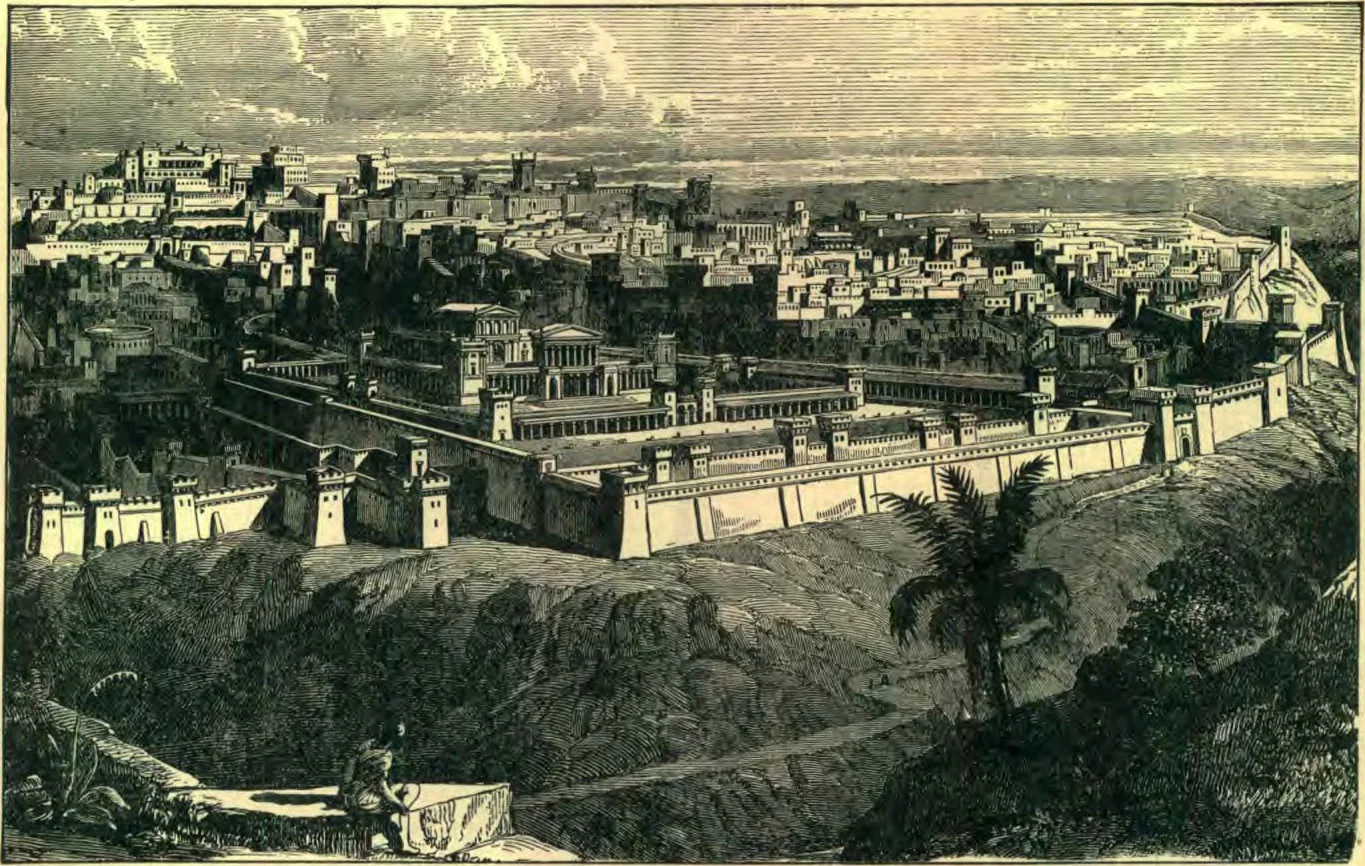
JERUSALEM, “THE CITY OF THE GREAT KING”
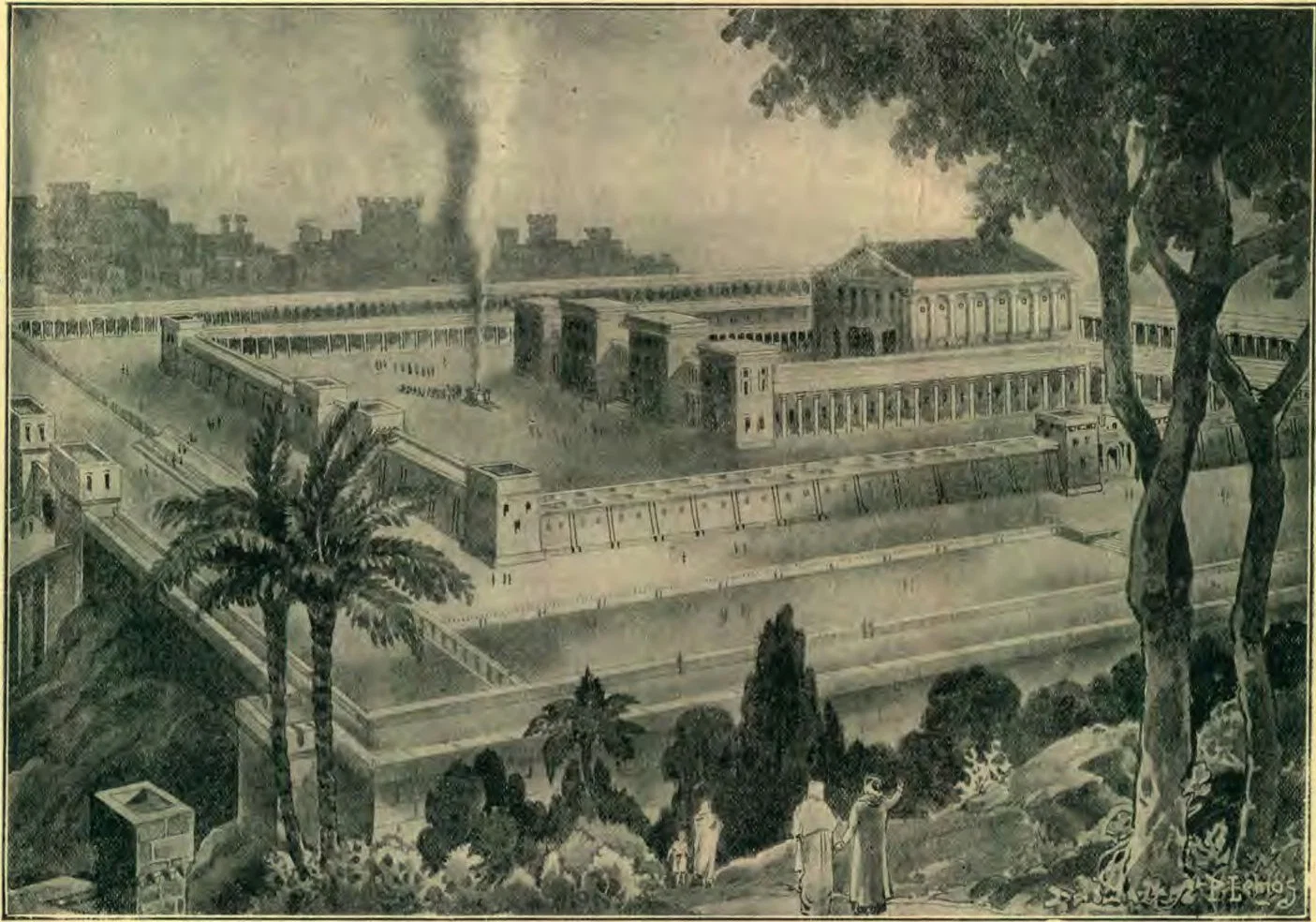
The sanctuary described in the last article was ultimately merged into the great temple of Solomon at Jerusalem. By reason of this fact the city of Jerusalem became “the city of the great King.” Ps. 48:2.
By reason of this fact also it became the center of the truth of God on earth, the only place in all the earth where the fullness of God’s truth was revealed. There was no other city where God was worshiped as he was in Jerusalem.
And the truth of the Lord was set down in this place because of its ideal location for spreading over all the earth the knowledge of the God of heaven. Let the reader look at a map of the Old World, and see that Jerusalem is nearly in the heart of the earth. Any movement of caravans from Egypt to the eastward must pass through Palestine and Jerusalem. Any caravan going from the east to Egypt, or from the north to Egypt, or coming from Europe to Egypt, or from Egypt to any place in Asia or Europe, would naturally pass through Jerusalem. And there they would come into contact with the worship of the true God, and then passing on would carry the knowledge they had gained there out to every place where they stopped. Thus Jerusalem was to be a light to the nations, a great beacon set at the very highway of the nations.

Satan’s Attempts to Destroy Jerusalem

Satan naturally would attempt to foil this plan of the Lord by destroying the city of Jerusalem. And in accordance with this thought the Old Testament contains many records of numerous attempts of various nations to destroy the Holy City and the temple. The Syrians, the Philistines, the Assyrians, the Egyptians, and finally the Babylonians, came against the city, but on every occasion these attempts of the devil to blot out the truth of God from the earth were foiled by Jehovah, until at last his people forsook him, and then Babylon succeeded in destroying the city and the temple.
But the city of Jerusalem was the center of the truth of God on the earth only because the temple of God was the center of the city. The thought and worship of all the people of the city and the surrounding provinces centered in the temple, which was the dwelling place of God, the one place where his worship on earth was carried forward.

The Law the Center of the Truth

And the temple itself had a center, with reference to which all its services and sacrifices were performed. This was the law of God, which was in the ark, in the most holy place. When any one in the city or in all Palestine or anywhere else committed sin, he broke the law which was in the most holy place of the temple, for “sin is the transgression of the law.” 1 John 3:4. No man could sin without the law of God being broken.
Now “the wages of sin is death.” Rom. 6:23. Therefore when the man out in the city or the provinces committed sin, he not only broke that law which was in the most holy place, but that law also condemned him to death. It demanded his life, his blood. For “without shedding of blood is no remission” for sin. Heb. 9:22. The law demanded that he die to atone for his sin. But the man did not want to die. And God had provided a remedy for him that he need not die.
The man who had committed the sin and thus broken the law and fallen under its condemnation, brought a sin offering to the gate of the court, a lamb or a goat, and standing there at the gate, before the broken law which was just within the most holy place, he placed his hands upon the head of the animal and confessed upon it his sin. The sin then in type passed from the man to the animal. The animal now stood in the place of the sinner. It was now the animal that the law condemned for the sin of man, and it was the blood of the animal which was now demanded by the law. So with his own hand the man drew a knife across the throat of the lamb, taking its life, and the blood was caught in a basin by the priest and taken in before the law and sprinkled there, to show the law that its demands had been met, and that blood had been shed for the remission of the sin committed by the man. Thus the man was saved “by the blood of the lamb.”

Why Satan Hates God’s Law

It will be plain from what has been said that the services and offerings and sacrifices of the temple were all carried forward with reference to the law which was in the most holy place. It was that law which pointed out sin, and it was because of sin that all the temple service was made necessary. The law of God, the ten commandments, was the center of the temple, which in turn was the center of Jerusalem, which was the center of the worship of the true God on the earth.
And from all this it is plain why Satan has always hated the law of God. It is the center of God’s government, and has always been the great object of Satan’s attacks. If he could get rid of the law of God, it would not take him long to lead the people of the world into idolatry, and destroy them. The law has ever been the great bulwark of the truth of Jehovah.

The Center of the Law

And, finally, the law had a center of its own, a center which gave validity to the entire law. This was that part of the law which distinguished the true God from all false gods. It is that part of the law which points out the true God. It is that part of the law which informs us who the Lawgiver is.
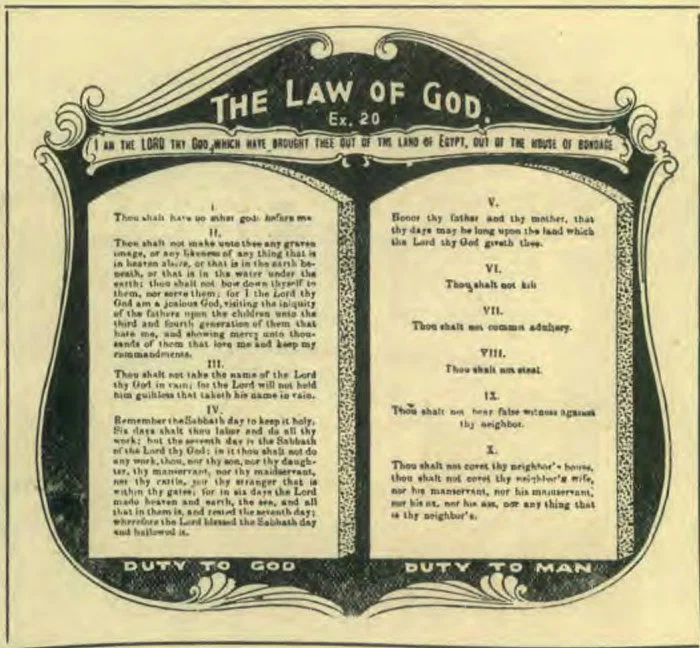
There is nothing in the first commandment which reveals who it is that gives the law. It declares, “Thou shalt have no other gods before me.” But it does not tell us who it is that speaks. The worshiper of Confucius or of Buddha or of any other god might claim that this was the law of his god, and from this commandment alone he could not be convinced of his error. The second commandment uses the expression “the Lord thy God,” but does not say who this God is; and as there are many so-called gods, it would still be impossible to tell which God this is. The third commandment uses the same expression, but does not enlighten us as to the identity of the true God. The fifth commandment fails in this same respect. And the sixth, seventh, eighth, ninth, and tenth commandments do not even contain the name of God. If the ten commandments were without the fourth, the law would contain no signature, no seal.

The Sabbath the Heart of the Law

But in the fourth commandment the true God is pointed out as the One who “in six days . . . made heaven and earth, the sea, and all that in them is, and rested the seventh day: wherefore the Lord blessed the Sabbath day, and hallowed it.” Ex. 20:11. Here the true God, the God who gave the ten commandments, is pointed out as the God who created the world and all that is in it. The Creator is the true God, and it is his power to create that distinguishes him from all false gods. Therefore, in order that his people may ever worship him, he gives them a perpetual reminder of his power to create by establishing the seventh-day Sabbath, which is the memorial of his work of creation. The Sabbath was ever to stand before the people of the earth as a monument of creative power, and thus lead the minds of the people of the earth every seventh day to the Creator himself.
If the people of the earth had always observed the seventh-day Sabbath, there never could have been an idolater, for every week, as the Sabbath returned, all would have been reminded of the true God. Their minds would thus have been drawn out in the worship of the Creator, and they never could have worshiped an idol, the work of their own hands.
The Sabbath is a “sign” between the Creator and his people “forever.” Ex. 31:12-17; Eze. 20:12, 20. And it is so covered by the fourth commandment that that commandment becomes the one thing in the law which distinguishes the true God from all false gods. It is the very heart of the law.

The System of Centers

Notice, now, this system of centers. Jerusalem was the center of the worship of the true God in all the earth. The temple was the center of Jerusalem. The law was the center of the temple, and the Sabbath was the center of the law. It was the center of centers.
Satan, desiring to sweep away this whole system of truth from the earth, and thus destroy the knowledge of the true God from among men, would naturally strike first at the Sabbath commandment, the center of the whole system. He would naturally corrupt the people of God in their observance of the Sabbath. This is just what he did, and this is the reason why he has always been opposed to the Sabbath of the Lord, and has ever tried his hardest to cause the people of God to lose sight of it.
Before the city of Jerusalem was overthrown and the temple destroyed by the king of Babylon, from “the land of Shinar,” God sent this plain message to his people: “If ye diligently hearken unto me, saith the Lord, to bring in no burden through the gates of this city on the Sabbath day, but hallow the Sabbath day, to do no work therein; then shall there enter into the gates of the city kings and princes sitting upon the throne of David, riding in chariots and on horses, they, and their princes, the men of Judah, and the inhabitants of Jerusalem; and this city shall remain forever. . . . But if ye will not hearken unto me to hallow the Sabbath day, and not to bear a burden, even entering in at the gates of Jerusalem on the Sabbath day; then will I kindle a fire in the gates thereof, and it shall devour the palaces of Jerusalem, and it shall not be quenched.” Jer. 17:19-27.
From this passage it is clear where Satan would begin his corrupting work. He led the people to violate the Sabbath. From this it was easy to lead them on until they would forsake the worship of the true God, whom the Sabbath commandment pointed out, and go into idolatry, in which they would break all the ten commandments. Then, having drawn them away from the Sabbath and the law, he could bring his servants against their city and temple, and thus destroy the whole system of truth from the earth. And this is just what Sabbath breaking ultimately resulted in. This is the very procedure followed by Satan, which resulted in the destruction of Jerusalem; for we read, speaking of the Babylonians, “And they burned the house of God, and brake down the wall of Jerusalem, and burnt all the palaces thereof with fire, and destroyed all the goodly vessels thereof. . . . To fulfill the word of the Lord by the mouth of Jeremiah, until the land had enjoyed her sabbaths.” 2 Chron. 36:19-21.

Why Satan Hates the Sabbath

Satan has always been antagonistic to the Sabbath of Jehovah. Many times he has attempted to destroy it altogether, and there is an excellent reason for this antagonism. He recognizes that the Sabbath is the great memorial of God’s creative power, the power which distinguishes Jehovah from all false gods, and he knows that his first step in blotting out the knowledge of the true God from the earth is to get rid of the binding obligation to observe the Sabbath; and therefore he has used all his shrewdness and power to lead the people of God away from the Sabbath, and cause them to think it is of no worth or importance. He is doing it today, and with many he has succeeded but too well. Every argument used against the necessity of observing the Sabbath of the Lord has been taken from the arsenal of Satan, and has been fashioned by him for use in his warfare against God.
“Easy Steps”
“Easy Steps”

Believing and Living

A NATIVE in India once came to a missionary in a lone station, and asked to be baptized. The missionary inquired where he had heard the gospel preached and how he had come to that knowledge and desire. The man replied, “I have not heard the gospel preached, but I have lived near a man who lived it.” What must I do to be saved? would be more frequently asked if the gospel were more generally lived.—Sunday School Times.
Continue reading: Trapped