The Youth’s Instructor, Vol. 63, No. 46.

Mistakes in Conversation
Earlier text: Trapped

Our Dumb Friends

A GENTLE word will help along the road The noble beast that drags a heavy load.
A kindly deed to soothe or ease his pain, His faithful love and gratitude will gain.
A little sympathy or thoughtful care Will ofttimes lift a burden hard to bear.
A loving touch—it is not much to give To those who help and serve us while they live.
They give to us their strength, their life, their all; Their loyal love is ours whate’er befall.
With sweet obedience and patient will, They do our bidding, uncomplaining still.
No truer friends than these to man are given; Pray we be worthy of this gift from heaven.
— Marion Waller-Tatam.

Forty-Seventh Week

November 21. 1 Corinthians 12 to 14: Love never faileth.
November 22. 1 Corinthians 15, 16: Victory.
November 23. 2 Corinthians 1 to 4: Forgive; living epistles; etc. Read the notes.
November 24. 2 Corinthians 5 to 7: A new creature; etc.
November 25. 2 Corinthians 8 to 10: Liberality and almsgiving.
November 26. 2 Corinthians 11 to 13: Suffering for Christ; etc.
November 27. Review Romans and First and Second Corinthians. Go over the circumstances attending the writing of these inspired letters. Compare the different New Testament accounts of the instituting of the Lord’s Supper.

To Think About as You Read

Sunday.—To what extent does the wonderful love portrayed in chapter 13 pervade my life?
Monday.—The reward of the faithful.
Tuesday.—What do “all men” read from the “living epistle” of my life?
Wednesday.—“The love of Christ constraineth us.”
Thursday.—Having received of God his “unspeakable gift,” what can we withhold from him?
Friday.—“My grace is sufficient for thee.”
Sabbath.—Do I appreciate as I should the treasures of divine truth provided in the Bible?

Second Corinthians

“Forced from Ephesus by the riot, Paul went to Macedonia, where Titus found him, and told him of the effect of his first letter to Corinth. In the main his reproofs and injunctions had been heeded, but the Jewish party, reenforced by some high authority, had been attacking him with great violence and malice. Thereupon Paul wrote this sturdy epistle as a defense. It constitutes a magnificent picture of his strenuous life. The date was early in A. D. 58, and the place of writing was probably Philippi.”—Wells.
“Paul was now full of faith and hope. He felt that Satan was not to triumph over the work of God in Corinth, and in words of praise he poured forth the gratitude of his heart. He and his fellow laborers would celebrate their victory over the enemies of Christ and the truth by going forth with new zeal to extend the knowledge of the Saviour. Like incense, the fragrance of the gospel was to be diffused throughout the world.”—Mrs. E. G. White.

IX — Self-Seeking; Asking and Receiving

(November 27)
LESSON SCRIPTURE: Matt. 20:17-34.
MEMORY VERSE: “And whosoever will be chief among you, let him be your servant.” Matt. 20:27.

Questions

1. To what city was Jesus now going? Where did he take the disciples? Matt. 20:17. Note 1.
2. What did he tell the disciples would take place at Jerusalem? Verses 18, 19. Note 2.
3. On the way to Jerusalem, who came to Jesus with a special request? Verse 20. Note 3.
4. What was this request? Verse 21. Note 4.
5. What answer did the mother receive? Verse 22, first part.
6. What did Jesus then ask the two sons? What did they declare they were able to do? Verse 22. Note 5.
7. What did Jesus say would indeed come to pass? Verse 23, first part. Note 6.
8. What did he say of the positions on his right and on his left? Verse 23, last part. Note 7.
9. When the other disciples heard what James and John had asked, how did they feel? Verse 24. Note 8.
10. What did Jesus tell them are the ways of the world? Verse 25.
11. What contrast did he draw for his followers? Verses 26, 27.
12. To what example did he refer? Verse 28.
13. What unfortunate men next came to Jesus for help? Near what city were they? Verses 29, 30.
14. Who attempted to hinder them? Yet what did they do all the more? Verse 31.
15. How did Jesus reward their persevering faith? Verses 32-34.
16. How did they show their gratitude? Verse 34, last part.

Notes

1. This was Jesus’ last journey to Jerusalem. The feast of the Passover was drawing near, when the true Lamb of God would be slain for the sins of the world. All Jewish men were required to be at this feast. “The roads, therefore, . . . would probably be thronged. It is probable, also, that they would travel in companies, or that whole neighborhoods would go together.”
2. “He is more particular here in foretelling his sufferings than any time before. He had said (chap. 16:21) that he would suffer many things, and be killed; and (chap. 17:22) that he would be betrayed into the hands of men, and they should kill him; but here he adds that he shall be condemned, and delivered to the Gentiles, that they should mock him, and scourge him, and crucify him.” For the comfort of his disciples, then and now, he repeats the glad promise that he will rise again on the third day.
3. We were first introduced to these two sons of Zebedee in Matt. 4:21.
“John, the son of Zebedee, had been one of the first two disciples who had followed Jesus. He and his brother James had been among the first group who had left all for his service. . . . At every possible opportunity, John took his place next the Saviour, and James longed to be honored with as close connection with him.”—The Desire of Ages, page 548.
4. “In thy kingdom” had no reference to the kingdom of heaven, but only to the kingdom which the disciples supposed Jesus was about to set up on the earth.
5. Jesus thus tried to remind John and James that his kingdom was not like the kingdoms of earth. Earthly kingdoms come by wars, and fightings, and overturning others, and taking the best places by force. To have a place in the kingdom of heaven means forgetting self, loving others, and becoming the servant of all, as Jesus did. The Lord had just told them of the suffering and death soon to come to him in Jerusalem. Would they be able to drink of the cup of suffering held out to every one who would enter the kingdom of glory? Would they be able to endure the baptism of persecution through which every follower of the Lamb must pass?
6. “John and James were to share with their Master in suffering; the one, first of the brethren to perish with the sword; the other, longest of all to endure toil, and reproach, and persecution.” See Acts 12:1, 2; Rev. 1:9.
7. “The one who stands nearest to Christ will be he who on earth has drunk most deeply of the spirit of his self-sacrificing love.” The character is what decides the position.
8. “When the ten heard of the request of James and John, they were much displeased. The highest place in the kingdom was just what every one of them was seeking for himself, and they were angry that the two disciples had gained a seeming advantage over them.”—Id., page 549.

IX — Self-Seeking; Asking and Receiving

(November 27)

Daily-Study Outline

Sab. . . . . . Read the lesson scripture.
Sun. . . . . . “He shall rise again.” Read “The Desire of Ages,” page 547. Questions 1-3.
Mon. . . . . . Taking our desires to Jesus. Read “The Desire of Ages,” pages 548, 549. Questions 4-8.
Tues. . . . “Not to be ministered unto, but to minister.” Read “The Desire of Ages,” pages 550, 551. Questions 9-13.
Wed. . . . “Have mercy on us.” Questions 14-17.
Thurs. . . The compassion of Jesus. Questions 18-20.
Fri. . . . . . Review the lesson.
LESSON SCRIPTURE: Matt. 20: 17-34.

Questions

1. On the way to Jerusalem what did Jesus do with the disciples? Matt. 20: 17.
2. What did Jesus tell them would happen to him at Jerusalem? Verse 18.
3. What would be the outcome? Verse 19.
4. Who then came to Jesus? Verse 20.
5. What request did the mother make of Jesus? Verse 21.
6. What was Jesus’ answer? Verse 22, first part.
7. What question did he ask them? What was their answer? Verse 22, last part.
8. What did Jesus then say to them? Verse 23.
9. How did this conversation cause the ten other disciples to feel? Verse 24.
10. What did Jesus tell them are the ways of the world? Verse 25.
11. What contrast did he draw for his followers? Verse 26.
12. In what other words does he contrast the Christian and the worldly way? Verse 27.
13. To what example does he appeal? Verse 28.
14. Who followed Jesus from Jericho? Verse 29.
15. Who heard that Jesus was passing by? Verse 30, first part.
16. What did they cry out? Verse 30, last part.
17. How did the rebuke by the multitude affect them? Verse 31.
18. After calling them, what did Jesus say? Verse 32.
19. What was their answer? Verse 33.
20. When Jesus in compassion touched their eyes, what took place? What did they then do? Verse 34.

Notes

Praise God

PRAISE God for a home. Tens of thousands of boys and girls will go to sleep tonight without a mother to tuck them into bed, and without any one of the pleasures of home about them. Praise God for food and clothes. Millions of persons are hungry today, and many of them are suffering for want of clothing.
Praise God that you do not lift up blind eyes to a sky you have never seen. Be grateful for your sight, through which many of your pleasures come. Praise the kind Father in heaven, too, for your hearing and speech. Are not the sun, the moon, the stars, the air, the water, the rain, the trees, the flowers, worth a word of praise? Yet how seldom do we thank God for these common blessings!
Praise God for books and for the pleasure and power which come from reading and education. Praise God for the wonderful inventions and progressive spirit which make today the best time in all the world's history to be alive. The comforts, the conveniences, the pleasures, and the blessings that are possible to all of us in the modern days are surely worth a “Thank you!” to the great Giver of them all. Praise God most of all for the blessed Bible and the loving Saviour. Jesus is the theme of the praises that are sung in heaven; shall he not be our chiefest cause for praise here? How shall we do all this praising?—With our lips; in our hearts; by our lives. Just to be glad and grateful is praise that pleases God. Then, to give another person reason to be glad and grateful, is still a better way of praising God.—Young People's Weekly.

The Right to Civility in Speech

A MAN has no more right to say an uncivil thing than to act one; no more right to say a rude thing to another than to knock him down.—Johnson.

The Greatest of Religious Massacres

THE Independent of October 18 gives a graphic description of the terrible conditions now existing in the land of the Armenians,—the land where Noah and his descendants lived, the land where the ark found a resting place after the water subsided. It is a part of Asia Minor, the land of the apostle Paul's solicitude and missionary efforts, where were Ephesus, Lystra, Derbe, Tarsus, and many other places familiar to Bible students. Armenia is portioned among Russia, Persia, and Turkey. But its present as well as its past troubles have come through the Mohammedan Turks, the greatest foe of Christianity.
In 1894 there was a terrible slaughter of Armenians, which aroused the indignation of all Europe. In the same year a commission of inquiry accompanied by the consular delegates of Britain, France, and Russia, was sent to Armenia. They gave the verdict that the barbaric atrocities were without justification. But the massacres continued. In 1896, and again in 1909, despite all that the European powers had done to persuade the Turkish government to put a stop to the atrocities, there were appalling massacres. It is claimed that at least 30,000 were slain in 1909, 6,500 being slain in Adana alone.
But according to the Independent, “the most extensive, the most atrocious of religious massacres which the world has seen for centuries is now being perpetrated in Turkey. It had seemed that the measure of her iniquity was full. Almost before she had had time to get over the first intoxication of her revolution which promised liberty, equality, and fraternity to Moslem, Christian, and Jew alike, the massacres of Adana and the vicinity occurred. But now the fury of slaughter has spread from the Mediterranean to the Caucasus. This is no frenzied dream, but the authenticated fact. We have it from many sources which must be credited. Our mission boards are receiving the story. Very slow were they to publish the facts, for missionaries must not be involved in political affairs, and massacre is political. Our old friend, Ambassador Bryce, confirms the unmentionable details, and calls on America to do anything she can to save those who remain. This is no local affair; it is so general that it is intended, planned, and ordered, through the opportunity of war, to exterminate the Christians, Greek and Armenian, Protestant and Catholic. The tale comes from Marash and Ruitab on the west, from Trebizond on the north, from Bitlis and Van on the east, of men slaughtered by the tens of thousands, of women and girls buried in Moslem harems to bear future soldiers for the Turkish government and the Moslem faith. Others are driven in herds from their homes, families separated, to go they know not where, and to perish by hunger on the road—first deprived of property and then of life. No massacre of modern times compares with this.”
The world looks to Germany to stop the slaughter; for she alone is in a position to call a halt to the implacable Turk. May she make haste to give her ultimatum.

The Power of a Common Word of Comfort

“It is a little thing to speak a phrase Of common comfort, which by daily use Has almost lost its sense; yet on the ear Of him who thought to die unmourned 'twill fall Like choicest music.”

Our Cousin Maggie

“I WENT down to the station with Cousin Maggie this morning, and had a whole sermon preached to me on the way,” remarked a young girl to her brother.
He gave a low whistle. “What a bore!” he exclaimed. “But she never struck me as that kind at all.”
“What kind?”
“Oh, goody-goody, you know! the sort that talks and talks about what one ought to do and what one ought not to do.”
“But she never said a word about what I or any one else should do. It was not that type of sermon at all. It was her kind and considerate deeds all along the way that I am referring to. Listen! First, she stopped at the little news stand on the corner and left a post card to pay for one the woman had let her have when she was in a great rush to catch the post and found she hadn’t any change. She took pains to stamp it, although the one she had received had not been stamped. The woman said, ‘Oh, you are too kind!’ but she looked pleased. It was a graceful thing to do, wasn’t it? I am sure she does not find too many who ever do more than pay up to the letter.”
“Going a little farther, we met the washerwoman’s boy, and nothing would do but she must give him an apple out of the bag of fruit she had for her luncheon. Then we stopped at her seamstress’s to pay for a blouse. When the woman said it was a dollar, Cousin Maggie took out a dollar and a half, saying that was little enough for such good work. The woman thanked her with tears streaming down her cheeks. ‘If more were like you,’ she told her, ‘it would not be so hard for honest, struggling workers to get along.’”
“But this was not all. Just as we were going up the steps to the station, a baby’s bonnet ahead of us fell off. The woman carrying it tried to stoop and pick it up, but quick as a flash Cousin Maggie had it in her hand and was putting it on the child’s head. She never let a single opportunity of doing a kindness pass during the whole walk. Of course, she was lovely to all of us during her visit—but then almost any one is to the family that is entertaining her. The test comes when she meets humble outsiders, I think.”
The girl’s conclusion was absolutely right. How many of us, who strive to be consistent in thought and deed, make it our habitual practice to preach such “sermons”?—Young People.
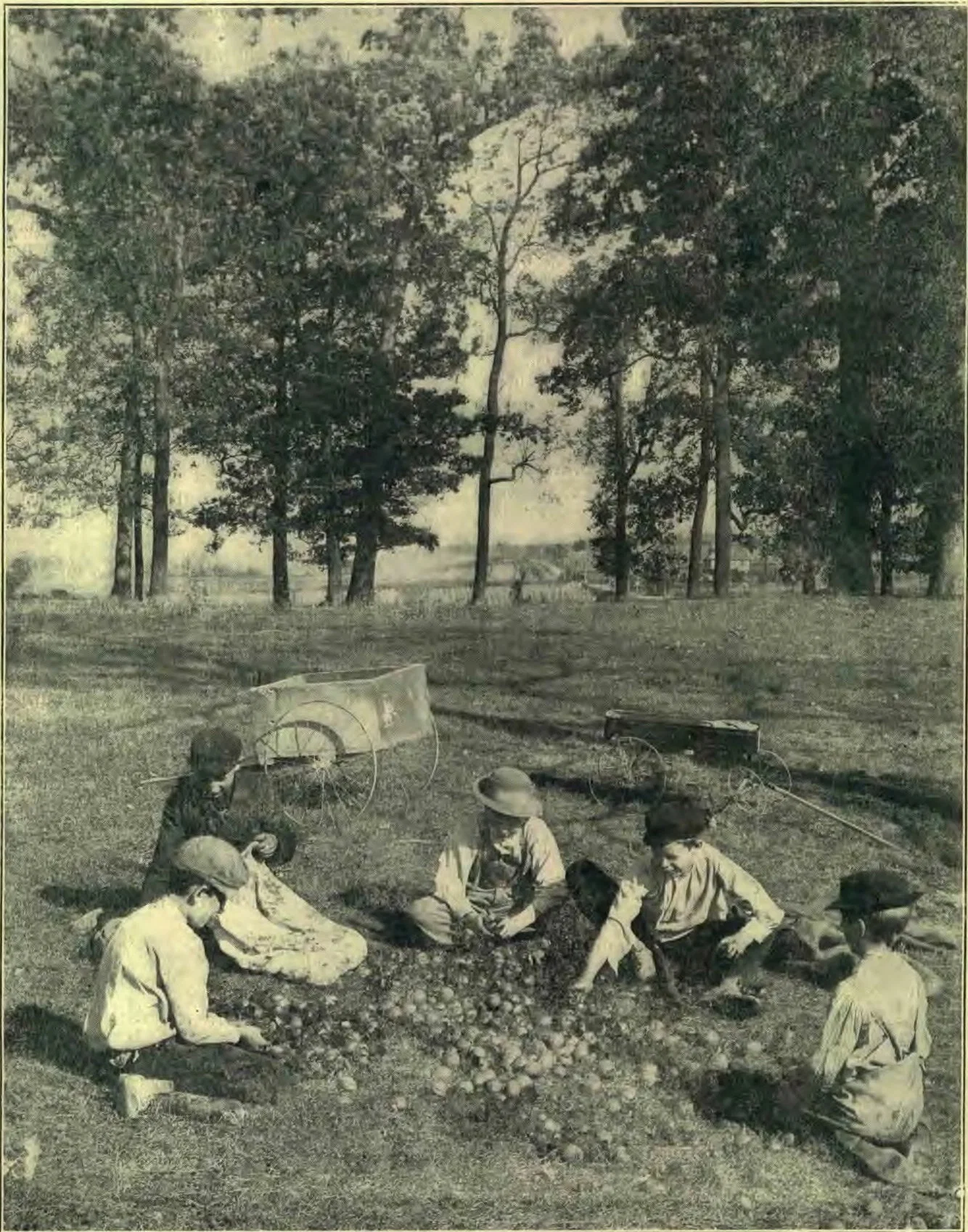
THERE IS A SNAP OF FROST WITHIN THE AIR. WHICH SENDS THE NUTS A SCATTERING TO THE GROUND

You have reached the end of this edition.

The Youth’s Instructor · Nov 16, 1915