The Youth’s Instructor, Youth’s Instructor, Vol. L, No. 34
Mother's Song
Page 1
The Youth’s Instructor
August 21, 1902
Review and Herald Publishing Company · Battle Creek, Mich. · August 21, 1902
Mother's Song
By Elizabeth Rosser
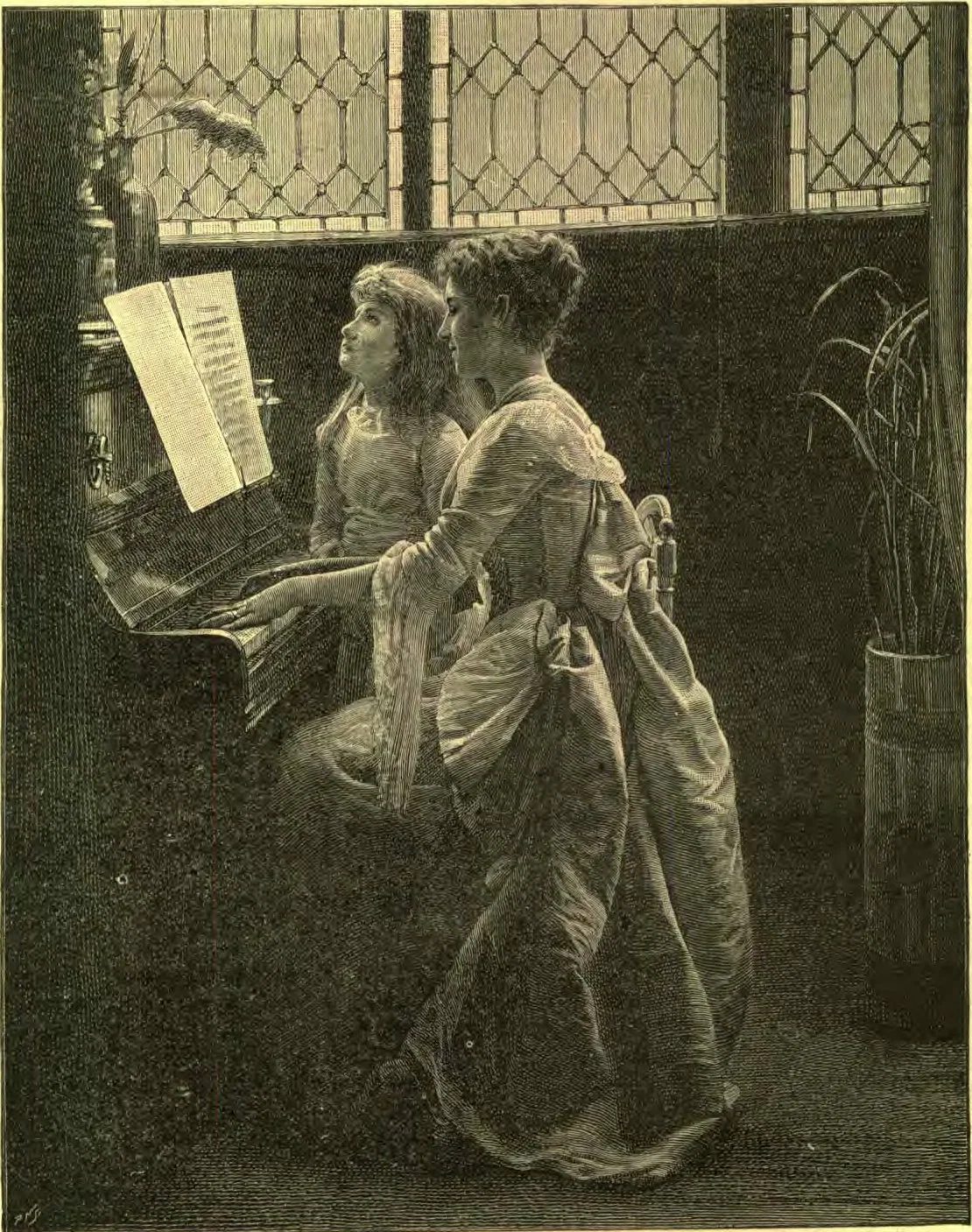
O, SING me a song like mother's, When I am glad and gay, From glittering earthly pleasures To call my soul away. And let the words be pleading, A song of pardoning love,— Of Jesus and the angels In the harping choir above.
O, sing me a song like mother's, When I am sad and lone,— A song of the tender mercy, Like a rainbow ’round the throne; And let the words be hopeful,— A song of strength and love,— ’Till I seem to hear the chorus Of the shining choir above.
O, sing me a song like mother's, When I go down the vale, While earth fades in the distance, And its joys and hopes shall fail. The last earth-sound to reach me Be that song of keeping love, Till I hear the song triumphant Of the white-robed choir above.
ELIZABETH ROSSER.
Liberty in Christ
By Ellen G. White
“BEHOLD what manner of love the Father hath bestowed upon us, that we should be called the sons of God.”
John can not find words to describe the great love that God has bestowed upon us. He can only call upon us to behold it. That God should consent to let his only begotten Son come to a world all seared and marred with the curse, to walk a man among men, and to suffer death by crucifixion,— does not this bear eloquent witness to the power of God’s love?
God’s love is as high as heaven and as broad as eternity. Why was it bestowed on us?— That we might be called his sons. “But,” says the young man, “I am not ready to be a Christian. I have not yet sown my wild oats.”
I once spoke to a company of prisoners. One of their number was a young man who had just been graduated from college. During his school life he had studied hard, and he had planned to have a good time after his graduation. He came in contact with evil companions; a crime was committed; they were brought before the court; and this young man was imprisoned for seven years. A sad result of his sowing of wild oats!
Young man, are you one of those who believe in sowing wild oats? Remember that the harvest time is coming, and that as you have sown, so you will reap. No frost will blight the crop, no storm blast it, no cankerworm destroy it. You are sure of a bountiful yield. If you spend your time in idleness, in amusement, in self-gratification, you will reap a harvest of sorrow. When adversity comes, you will find that the service of Satan is indeed bitter.
“AND LET THE WORDS BE PLEADING, A SONG OF PARDONING LOVE”
As I was pleading with a young man to turn to the Saviour, he said: “I am not ready. This band of music would be broken up should I leave it. I am needed in this circle of society. And besides, I want my liberty.” But he did not know of what he was talking. There is no liberty save that which has been brought to us by Christ. We can find in sin nothing but slavery. What was Adam after he had disobeyed?—A captive to sin, his dark future illuminated only by the promise of the Saviour to come.
Those who think that a surrender to Christ means loss of liberty are in bondage to the worst of all tyrants. Satan binds them in chains of darkness, and exults in their ruin. And yet they talk of liberty! Liberty to sin, when the wages of sin is death!
Christ gives us all the blessings we enjoy. The beautiful things of nature are the work of his hands. Every breath we draw is an evidence of what we owe to divine power. But where is our devotion, our love for God? Many who profess to serve him are Christians in name only.
God has done so much to make it possible for us to be free in Christ, free from the slavery of wrong habits and evil inclinations. Dear young friends, will you not strive to be free in Christ? You point to this and that professed Christian, saying, We have no confidence in them. If their lives are examples of Christianity, we want none of it. Look not at those around you. Look instead at the only perfect pattern, the man Christ Jesus. Beholding him, you will be changed into the same image.
Will you not try to show those with whom you come in contact the better way, even the way which leads to the city whose builder and maker is God? If you walk humbly with God, the Holy Spirit will be your efficiency. As you let your light shine in good works, those with whom you associate will see light in your light. Let not your light grow dim; for this is dangerous not only to your own soul, but to the souls of others. Keep your light burning brightly. Be cheerful, hopeful, and steadfast. Gather266grace and strength, daily becoming more trustful and hopeful. Pray and watch and work, lest the day of the Lord come on you as a thief in the night. Duties and responsibilities will increase with success. Satan will try to divert your mind from Jesus. He will try to make you believe that you will not reap what you have sown. Listen not to him. Make God supreme. Hide self in Christ. Welcome the Saviour into the heart as a cherished guest. You can do nothing without him, but with him you can do “all things.” He is the Mighty God, the Everlasting Father, the Prince of Peace. He is invincible, and those who work in his strength will be more than conquerors. Mrs. E. G. White.
The Story of Our Matabele Mission
By Estella Houser
Some Progress Is Made
THE Sabbath dawned bright and clear. The sun shone out as if to cause the travelers to forget the discomfort of the heavy rains of the few preceding days. It rarely rains in that part of South Africa at that season, but more than eight inches of water fell while they were in camp. All participated in and enjoyed the Sabbath-school and meeting. The dinner consisted of beans and guinea-fowl, which might have tasted better if it could have been cooked with clear water. The muddy water added little to its flavor.
Again inspanning, they hoped to resume the journey; but scarcely had they traveled six miles when a new disaster overtook them. The ox-wagon stood level with the axletree in mud, and no amount of whipping and screaming seemed to make any impression on the animals. An hour was lost in this way; then an effort was made to draw the wagon backward. After breaking the chain several times, this too was given up as a hopeless task. Then with a jack they raised the wagon, and filled under the wheels with stones. About the length of the wagon was passed, when down it went again, apparently deeper and firmer than before. This was repeated three times, with the same result. Cold, tired, wet, and muddy, some went to bed, hoping to get warm, while others still worked in the mud-hole, making a road of stones. And thus they continued for ten hours, almost all this time at night. When finally the wagon was extricated, they were able to go only about six miles, and this over deep mud-holes, when all were so worn and hungry that they stopped for a quick breakfast, and lay down to get some rest, if possible.
It was evident that the company must have more animals, as at the rate they had gone from Mafeking, the ox-wagon was making but slow progress.
On Sunday afternoon they made another start, soon reaching a little village. To their surprise, they found two oxen for sale; and although it was Sunday, and the owner did not care to break that day by selling to them, yet as he needed the money as badly as they needed the oxen, a bargain was finally made, and they were soon on their journey again, better equipped.
Monday morning was clear and cold. A heavy frost had fallen during the night, and it required some courage to start at four o’clock, with almost everything still damp from the recent rains. An extra dish—boiled pumpkin—awaited them for breakfast this morning, and it was relished by all.
There was little to break the monotony of their journey outside of three or four experiences similar to that of being stuck in the mud, unloading the wagons, dragging them out, reloading, soon to pass through the same ordeal again. These experiences only caused the missionaries to draw nearer the Lord, and seek his guidance at every step of the way. Family worship morning and evening was enjoyed by all, and in the most difficult times was not neglected.
Better things were in store for them. On Wednesday morning they came into such a beautiful country that all exclaimed, with one accord, “How grand!” They could scarcely resist the temptation to stop where they were, and go no farther. The roads were good. There were flowers on all sides. Even the trees were laden with blossoms, and the air was fragrant with sweet perfume. There was plenty of timber of all kinds, and wild fruit trees were seen in every direction,—plum, orange, fig, and many small fruit shrubs which they did not know. Even the breakfast this morning seemed good—venison, birds, pumpkins, and porridge.
Near the close of the week they passed through another Kafir city very early in the morning. The natives were going in every direction to work on their farms. The country all around the place looked like a field of Kafir corn. The city was more than a mile in length, and contained more than six thousand inhabitants, all natives. The streets were quite clean, and some of the houses not to be despised. The name of the city was Rammontso, near the Notawana River.
They were now in the country where lions and tigers were troublesome, and they had to take some precaution to keep them at a distance. As they camped for the night near a Kafir settlement, they heard the tigers scream. One scream followed another, when all the dogs in the village—and they were not a few—began to bark. When they were quiet again, no tiger was heard.
The next Sabbath they camped near a mud-hole, as this was all the water they could find. They dug a large well, hoping it would fill; but there was not enough water for that. So from the mud-hole they had to get their supply of water for cooking, bathing, and for the animals, and they were grateful that they did not have to spend the day entirely without water. The frequent rains, although rendering the roads almost impassable, provided them with water.
They held their Sabbath-school at the same hour that it was held at home. The Lord came very near as they studied the precious lessons of trust from the life of Christ as given in the book of Luke. After the Sabbath-school they had a prayer-meeting, and the remainder of the day was spent in reading, singing, and talking over the many blessings they had thus far received on their journey. ESTELLA HOUSER.
Be Ye Perfect
By Agnes H. Brown
Jesus, Master, can it be,
I shall ever perfect be,—
Not a stain without, within,
Pure and spotless, white and clean?
Always ready to obey
Whatsoever thou dost say,
Daily striving to fulfill
Without questioning thy will?
Just to take, and murmur not,
As thou sendst my earthly lot—
Patient shouldst sore sickness be,
Calmly leaving all with thee?
May I never, Lord, be heard
To speak one complaining word,
But with cheerful, happy song
Glorify thee all day long.
AGNES H. BROWN.
A Sensible Suggestion
“If I could only be of some use in the world, or fill some place in it,” cried Frances, impatiently, “I would not complain.”
“Well,” suggested Cousin Patty, “making beds is very useful work, and your mother seems to need some one to fill the place of mender-in-ordinary to the family. Why not begin where you are? I never saw anybody willing to be of use who couldn’t be used right where he stood. And as for filling places—did you ever think that you are put in your own place so as to fill it? This business of wanting to climb out of your own place before you’ve filled it, to go hunting for an empty one somewhere else, never did seem sensible to me. Start right in to be of use, and you’ll be useful, never fear.”
It was a sensible suggestion. There are many useless people excusing themselves to-day by saying that they would rejoice to be of use—somewhere else. Our own place, after all, is the only one we can ever fill. The moment we fill it full, we shall overflow it into wider bounds. Mending and making beds, running errands, doing chores—the large careers begin by these small usefulnesses, and widen irrepressibly as the man and the woman develop into broader activities. “Begin where you are” is common sense. As a matter of fact, we can not begin anywhere else. Only from what we are can develop what we shall be—only from where we stand can the first forward step be made. Shirking and complaining belong together. They are a poor pair of twins to have about, and the sooner we turn them out of doors, and determine to be thoroughly useful in our own present place, the better.—Well Spring.
The Marvelous Power of Prayer
“It is a marvelous power that is ours in the privilege of prayer. We may reach up our hand, and take gifts out of heaven. We may call down legions of angels to defend and protect our own souls and the souls of our friends. We may bring out of heaven all blessings, all comfort, all peace, all joy, all strength. Why, then, shall we remain weak and faint and impoverished, and be defeated and perish, when we might pray, and get all the grace we need for the asking? Marvelous and infinite are the possibilities of prayer.”
“Love Me Too!”
By Irene Barnes
“LOVE me too!”
The speaker was a little dark-haired maiden, and her big brown eyes were welling up with tears. She was one of the deserted child-wives of India’s shadowed households. Lame and helpless, from a diseased knee-joint, and so, useless as a slave to him, her husband had turned her out upon the roadside to die. The pitiable little crouching figure drew the attention of a police officer, who brought her to the nearest Christian mission hospital, where now she was being tenderly and speedily nursed back to health.
It was the hour of evening prayer, and the doctor, Miss Sahiba, had lifted upon her knee the baby of the ward, also a deserted girl, whose mother, having vainly tried to sell her for twenty rupees, had left her behind as a worthless impediment. The little child-wife hungrily watched the gentle caresses of the white hand on the wee brown head that nestled confidingly on the missionary’s shoulder, and slipping off the hospital bed, she crept up to the pair. Taking the good doctor’s hand in hers, she laid it on her own bare head, and uttered the cry, “Love me too!”
“Love me too!” It is the cry uttered or unexpressed of each little sufferer who enters our wards. . . . Yet it must not be imagined that parental love is rarely shown by the Indian or Chinese father or mother. Far from this being the case, intense love for their children is exhibited again and again; and an apparent want of affection and tenderness in nearly all cases may be traced not to callousness or cruelty, so much as to ignorance, gross superstition, and bondage to caste and custom. The children’s lives are cursed by the same blight that envelops their parents.—From “Between Life and Death” by Irene Barnes.
Asking the Way
By Frank Walcott Hutt
Boys in earnest ask their way
Through the problems of to-day,
Just as boys have always done,
Who have earnestly begun;
Just as boys must always do
Who would battle safely through.
Men of action, who have won
In the races nobly run;
Men of honor, who attain
Place and glory without stain;
Men of will and men of might,
Who have championed the right;—
These were, not so long ago,
Eager boys, who sought to know;
Earnest boys, who asked the way,
Step by step and day by day.
— Frank Walcott Hutt.
Habit
By Aunt Betty
I WALKED, one beautiful morning, in the Vale of Life; and the part where I walked was called Youth. The country thereabout was very beautiful; the sky was of the purest blue; the grass was greener than elsewhere, and studded with a greater profusion of wild flowers. The trees were laden with luscious fruit, and full of singing birds. Clear streams, in whose depths played pretty speckled fishes, flowed through the pleasant meadows; and rabbits, lambs, and other gentle creatures raced about in the joy that Youth gives to all.
In this beautiful place I saw a youth lying asleep in an arbor by the way. Going toward him, I noticed that he was bound by cords as fine as silk. I took his hand, and called to him, “Awake, my son, awake! Cast off these cords that bind thee. Call on the name of thy Father, and be made free.”
But he only laughed at me, and bade me go my way.
“I have no fear,” said he, “that cords as light as these will ever prove any hurt to me. I can break them at any time I desire, if ever I do wish to be rid of them,” and he turned from me to sleep again.
But even as I left him, I saw an evil spirit reach out from the vines of the arbor, and strengthen the bonds on the boy, as a great spider might entangle a foolish fly.
At noon I found myself in that part of the Vale called Labor; and here were fields of grain, flocks and herds, laden ships, glowing forges, and the ceaseless roar of machinery.
And here again I saw the Youth I had seen in the morning. The fine cords that had bound him had become heavy, and he was still asleep. Taking his arm, I cried out to him, “Awake! awake! Call upon thine Elder Brother, and he will strengthen thee, and thou shalt be made free.”
But I seemed to him as one that mocked. “Have no fear for me,” said he; “I am a man and my own master. These bonds I can cast off at any time that it shall seem good to me.” And he turned and slept again; and I called to him: “What meanest thou, O sleeper? Thou art as he that lieth down in the midst of the sea, or as he that lieth upon the top of a mast.”
But he only said: “They have stricken me, and I was not sick; they have beaten me, and I felt it not; when shall I awake? I will seek it yet again.”
And again I saw the evil spirit busily and stealthily adding to his bonds, and strengthening them.
When it was evening, I was at the farther end of the Vale, in a place called Age. And here the singing of the birds of morning had ceased, and the flowers were gone. The busy toil of noon was over; for the grasshopper was a burden, and every man had his staff in his hand for very age.
And here again I saw the Youth I had found asleep in the morning, the strong man I had failed to rouse at noon. But the cords had become fetters of iron. And I said to him, “Flee from the wrath to come; to him that is joined to all the living there is hope.”
“I have found no place of repentance,” said he, “though I have sought it earnestly, with tears. For me there is henceforward but a certain fearful looking forward unto judgment.”
And the evil spirit no longer hid himself; for his work was done. AUNT BETTY.
Ted's Luck
“If Ted Morris doesn't have the luck!” exclaimed Phil Carter, coming in from school, and throwing his books on the table.
“What is it now, Phil?” asked Aunt Grace from her wheel-chair by the window.
“Why, Ted's plan won the prize in our drawing class! I had set my heart on having it.”
“What prize?”
“O, I forgot you didn't know! Professor Harcourt is offering prizes every month in one class or another. This month it was for drawing. I didn't try for any of the others; but I'm good at drawing, and thought I was sure of that prize at least. Ted doesn't like drawing, and I do. It's just his luck!”
“Not quite so fast, Phil. You say Ted is always lucky?”
“Always. He never fails to win. He is so sure he will succeed. That is the aggravating part of it.”
“Maybe there's a reason for what you call luck, Phil. Look and see if you can not find it. I suppose he is just as lucky at play?”
“Y-e-s. He's poring over his old books most of the time; but when he does play, he wins every time.”
Aunt Grace gave a peculiar smile.
“What is it?” asked Phil.
“I was thinking of Ted's luck. How much time did you spend on your drawing? What was it?”
“A plan for a schoolhouse; we have architectural work this term, and it was a beauty. It had a cupola, and a roof garden for stormy days. I felt sure I'd win.”
“And I suppose you were very careful to have your measurements exact, your windows just above each other, your staircases and closets in the best places?”
“Why, I don't know as to that. But I do know I made a fine front, and I guess the rest was all right.”
“And did Ted guess his was all right?” was the next question.
“I never knew Ted to guess at anything. Everything has to be just so with him. But I had the handsomest plan.”
“And yet Ted won. Suppose you watch Ted closely for a week, Phil, and then tell me what you think of his luck.”
“All right,” and Phil went off with Aunt Grace's questions still in his mind. He would watch Ted now to some purpose. Was it possible—
Next morning Phil waited at the corner for Ted to come up.
“Have you got those problems?” he asked, carelessly.
“Yes, every one of them!” replied Ted, exultantly. “They kept me home from gym., but I was bound to conquer them.”
Phil gave a quick thought to his own wasted evening, which he had not even spent at gym., and his own half-worked problems. Was that the secret of Ted's luck—his determination to conquer all obstacles? Of course he deserved a good mark after grinding all the evening.
After school the boys were going over to the woods after arbutus. Phil wondered if Ted would go.
“Of course I will! I was up an hour earlier this morning and put in good time. I have earned some fun now.”
Was it a sense of well-earned freedom, or was it simply luck, that made Ted such a favorite with his companions? He found the first arbutus; he won the race home.
“Well, Phil, what about Ted's luck?” asked Aunt Grace, a week later.
“Why, it isn't luck at all; it's just hard work,” replied Phil. “He just bones right down to a thing until it's done, and then he plays just as hard as he has worked.”
“And has no conscience to spoil his fun by reminding him of some neglected duty,” said Aunt Grace, softly.
“That hits me, auntie, and I know it. But I'm going to try Ted's way, and see if I can't have luck, too.”
“If you spell luck ‘w-o-r-k,’ you will succeed,” replied Aunt Grace.—Selected.
To Provide a Summer’s Pleasure
By Floyd Bralliar
A good way to provide a summer’s amusement and pleasure is to take a tub or half-barrel, and set it in the shade of a tree not too near the house, and yet in sight of a window or porch. Keep this full of water all the time. If you do not allow them to be frightened, you will be surprised to see how many birds of various kinds will come there for their daily bath. All through the hot, dry summer afternoons your free bath will be in constant use. It will be an unfailing source of pleasure to watch the little creatures splash, and flutter, and primp, and plume their feathers. Sometimes they will come singly, sometimes in troops. A piece of board kept floating in the water will be a great help to the birds in their bath.
This seems a little thing to do for the birds; but it pays, provided one loves them, and desires to cultivate their acquaintance. It costs time and trouble to procure young birds and make pets of them; but by providing a free bath-tub for their use, we gain their good will, and they will nest nearer us the next year. They will not make the least objection to our studying their habits; and they will act “natural.” The birds are the materialization of some of God’s thoughts, and surely we should wish to become acquainted with them. FLOYD BRALLIAR.
Sparrows' Nests
By Will Spring
JOHN is a young collegian, and thinks it a mark of superiority and broadness to dabble in many new theories and isms; “investigating for himself,” he calls it.
“There are fragments of truth everywhere, and I like to assimilate what suits me,” says John, complacently. “To some minds there might be danger of being carried away with such things, but all my training and grounding have been too solid for that.”
Uncle Isaac’s eyes twinkle, but he shakes his head. “Makes me think of our old court-house,” he observes, slowly. “Pretty strong court-house that was, too,—solid foundation, and built up of stone well laid. It had a slate roof. Practically fireproof we called it, and we were all so certain of its qualities that when a fire broke out in the middle of the town, nobody thought it worth while to move books out of the court-house.
“But a lot of sparrows had built their nests at the top of it for years,—bits of straw and rubbish,—and when the sparks began to shower down pretty lively, there was a blaze started that had eaten its way up under the roof before any one could stop it. All the good foundations and walls didn’t save it from ruin inside. The flimsy little sparrows’ nests were a bit of danger tacked onto the strength, and they finished it.”—Will Spring.
Does This Mean You?
THE following earnest words are taken from a letter written to the editor by a young friend, who is spending her college vacation in Chicago—not in pleasure-seeking, but in earnest service for the Master. As she becomes acquainted with the opportunities, sees the lack of laborers, and realizes a little of the work to be done, not only in Chicago, but all over the world, she longs to have others of our young people join those who are carrying forward this work:—
“It is a sad state of things when work in large cities and in the conferences has to lie idle, the people just waiting for some one to come to them. I am more and more convinced that we have something that the world wants, something they are looking for; and when they see it properly, become acquainted with our work, and find that we have it, they will seize it. Many are doing this very thing. I need not tell you that I am heart and soul in this work, that I can not see anything else in life but this. I do not mean this Chicago work in particular; I mean in this message of salvation to a lost world. And I want to do everything within the range of my talents and powers to help. That is all. I can not do anything more that I can do, neither can any of our young people; but they are not doing one tenth of what they are capable of doing, if only they had the spirit to work.”
Battles between Truth and Falsehood
STUDY PREPARED FOR THE YOUNG PEOPLE'S MEETINGS
Lesson XVIII—God's Gift
(August 24-30)
HOW TO STUDY THESE LESSONS.—(1) Read the lesson story; (2) try to recall or find scriptures in proof of each statement; (3) study the texts; (4) see how many missing links you can supply; (5) give the lesson to some one else. You will keep only what you give away.
Jesus is God's gift to us.
As our Creator, Jesus made this earth, and all things in it. He made man in his own image.
He is also the sustainer—the upholder—of all things. All things exist, and stay in their places, by his power. We can not draw a breath or move a muscle without him.
As our Redeemer, he bought man, and man's property, out of the hand of the enemy, at the price of his own precious life-blood.
As our Example, he lived a perfect life here on earth, to prove that we can do the same thing.
As our Sacrifice, he died on the cross, making a complete atonement for all our sins. He bore our sins on the cross. Justice is satisfied, and we are released.
As our High Priest, he now ministers in the presence of God for us, offering the merits of his own life and death in our behalf.
As our Judge, he will acquit us, and present us faultless to his Father.
As our King, he will soon come in the clouds of heaven to take us to himself.
As our Brother, he will divide all his riches and honors with us.
All this is only the beginning. Study all the names of our Wonderful Jesus. Truly he is the “I AM” to us,—the “All in All.”
It is with deep interest that I have noticed the many encouraging reports from our Young People’s Societies.
The presence of Brother Yarnell, our enthusiastic church-school teacher, was a valuable aid in the organization of our Society in Pomona, which took place October 12, with a membership of twenty-four. We are also grateful to have with us, as superintendent, Dr. Bond, who manifests a heartfelt interest in the young people.
The meetings of our Society are held at the church on Sabbath afternoon. Preceded by a song service, the program as outlined in the INSTRUCTOR is found both interesting and profitable. Sometimes at the close of this service a company of our young people visit the sick, and cheer them with song, reading, and prayer.
At present our Society is contributing to the fund being raised to build our new dispensary for medical missionary work in San Francisco. We are glad to see the active interest manifested by two of our younger members in the work with the Signs of the Times. Already we know of one reader who pronounces this paper the best she has ever seen, and through its weekly perusal is willing to read books on kindred subjects.
It is the duty of one of our members to supply two paper racks in the post-office and station with clean literature as often as they are emptied. Another leaves the Signs each week at two of the most practical to make, and a great variety missionary trip to an adjoining town with reading-matter to fill a paper rack at that place.
As this church has taken its full quota of “Christ’s Object Lessons,” our Society has an excellent opportunity to gain an experience in this work. We rejoice in the privilege of being co-workers with heavenly intelligences, and in the promise, “My grace is sufficient for thee.” What an inspiring thought!