The Youth’s Instructor, Vol. 50, No. 34.

Mother's Song
Earlier text: Mother's Song

Battles between Truth and Falsehood

STUDY PREPARED FOR THE YOUNG PEOPLE’S MEETINGS

Lesson XIX — Jesus Gives Back to God

(August 31 to September 6)
HOW TO STUDY THESE LESSONS.—(1) Read the lesson story; (2) try to recall or find scriptures in proof of each statement; (3) study the texts; (4) see how many missing links you can supply; (5) give the lesson to some one else. You will keep only what you give away.
After Jesus had lived his perfect life here among men, he died on the cross for our sins. But it was impossible for death to hold him.
God raised him from the dead. He stayed with the disciples forty days after the resurrection. Then he went to heaven, to be our High Priest before the throne of God.
Before he went away, he told his disciples that he was going. He said that he would get a place ready for them. Then he would come back for them. His disciples watched him as he went away. And while they were watching, he sent back word that he would come again, in like manner as he went away.
His people saw him go. They will see him come again. He has been in heaven for more than eighteen hundred years.
He has the place all ready, and he has sent his people word to get ready.
The place is ready for the people, but the people are not ready for the place.
We must tell every person in the world about this wonderful Saviour, and his soon coming; and when every one knows about it, so all can be ready who care to go, he will come again.

Outline

Christ died on the cross for our sins. I Cor. 15:3.
He was buried, but rose the third day. I Cor. 15:4.
He was with the disciples forty days. Acts 1:1–3.
Then he went to heaven. Luke 24:49–51.
The disciples saw him go. Acts 1:9–11.
He promised to get a place ready, and then return. John 14:1–3.
All will see him when he returns. Rev. 1:7.
His people will be looking for him. Heb. 9:28.
He told his disciples to tell every one this good news. Mark 16:15.
When this is done, he will come. Matt. 24:14.

Black and White Figures (Concluded)

THE articles already described are the ones most practical to make, and a great variety of patterns may be secured by varying them to suit the taste or requirements. They are not the only ones that can be made, but in the others there are no new principles involved, so it will not be necessary to describe them in detail.
Alternate black and white rings that extend entirely around the base are very pretty on small work. The edges of the rings, however, must be serrated. To make them smooth it would be necessary to change all the threads on one circle; and if this is done, the two circles of warp will be crowded apart, and there will be a crease between the black and the white. If you will refer again to Fig. 20 in last week’s paper, you will see on the end of the piece where the work was begun, a white ring, with the inner edge serrated, while at the other end is a black ring with serrated inner edge. It will not be necessary to make the notches as deep as here shown, however. If each alternate thread is changed, the remaining ones will be sufficient to bind the circles of warp together. In this way the change from black to white, or vice versa, will be made in working twice around the base.
Short, pointed stripes of one color, inserted in a ground of another, is a pretty pattern, and not difficult to make. If the stripes are spiral, it will be well to use both the regular and the forward stitch, so that each alternate circle of stripes may curve in the opposite direction.
Squares that contain but two or three threads each, can be made without serrating the edges. But there is a great deal of work about making squares in this manner, and the end will not justify the means. By serrating the edges, however, the making of squares presents no great difficulty.
Some of the figures described I have never seen except in my own work. They are all that I have ever tried to make; but I feel sure that if one masters them, he will know enough about weaving horsehair to be able to trace any simple design that he cares to undertake. The weaving of one’s initials or monogram would be a task of no great difficulty. The best way to do this would be to mark the design on the base before beginning to weave. This would serve as a guide, and the worker would then know just where to change the threads from white to black or from black to white. You may not be able to follow every line exactly, for there is no middle ground between threads of woof. Each must occupy its allotted place; but unless both warp and woof are unusually large, it will not be necessary to go far from the mark.
The most beautiful piece of woven hair work I ever saw was a riding-whip, and next week I will tell you how to make one. If you are fortunate enough to secure hair of such a bright variegated sorrel color as that used in weaving the whip to which I refer, there is no reason why you should not make one every whit as good. If you do not have such hair, you can substitute what you do have. In the articles to be described hereafter, I will deal with them as if woven of one solid color, and leave my readers to follow whatever design they choose.
J. EDGAR ROSS.

What a Boy Can Do

A boy can make the world more bright By kindly word and deed; As blossoms call for nature’s light, So hearts love’s sunshine need.
A boy can make the world more pure By lips kept ever clean; Silence an influence has as sure As speech — oft more doth mean.
A boy can make the world more true, By an exalted aim; Let one a given end pursue, Others will seek the same.
Full simple things, indeed, these three, Thus stated in my rhyme: Yet what, dear lad, could greater be — What grander, more sublime? — Crusader.

Children of India at Play

It is said that the children of India do not have as playful a childhood as do our own children. That is true. Boys and girls in India must grow up quicker, and be at work. Little girls must leave school, and be married off and settled down at about the age of twelve. The joys of a long and happy childhood of preparation for usefulness in life are surely cut short.
But the little folk of India have their happy time, after all, however short the years. No brighter eyes nor more pleasant faces can be found anywhere in the world. There are games and romps over field and hill, and trees to climb. In the cities, marbles and kite-flying are the chief delight of the boys. The kites of India are generally four-cornered ones, without tails. In the late afternoon and evening, during the kite season, the sky above Calcutta is full of bobbing kites. The flat roofs of the houses are the playground. A part of the game in kite-flying, I believe, is to saw one another’s strings in two, by crossing them in the air. Watching from the roof of our mission house in Bow Bazaar, I have noticed that men as well as boys fly kites.
The little girls like to play with dolls,— English dolls dressed like memsahibs, as the European ladies are called. I can not say just how they play with them. Perhaps they often hang them on the walls as ornaments. At any rate I know the little ones in our girls’ school expected each a doll at the end of the year, a very cheap one being thought a grand prize.
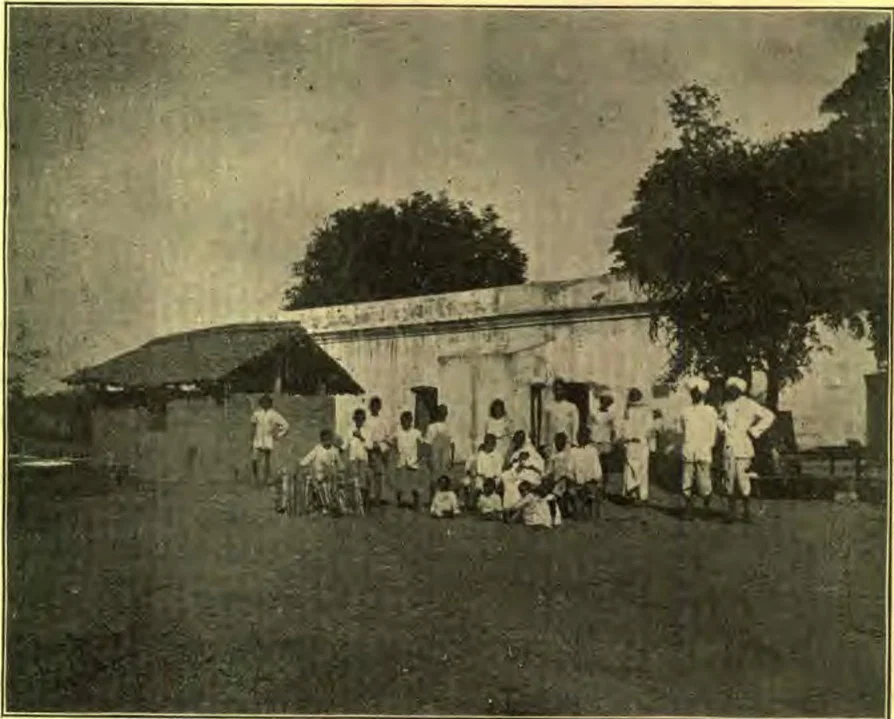
You would heartily enjoy watching our children at the Karmatar Orphanage school, in the play hours. The favorite game, I think, is ghoolie dunda, played very much as the American boys’ game of tip-cat, with a small stick as a bat, and a sharp-pointed block as a ball.
Marbles are called ghoolies, and the Indian boy shoots the marble by holding it with the thumb and forefinger, bending it back like a catapult, and then letting go suddenly. They aim very surely, too.
Sometimes, on visiting Karmatar, I would find it the fashion on the playground to favor bows and arrows. Then every boy and girl, even to the babies four, besought the mem for the strings about her parcels from the city, for use as bowstrings. Then again the cry was for slings. This form of amusement had to be somewhat severely kept down; for Juman, a little lad who came into the family from the wide world, where he had fought his way alone, could throw stones so far as to endanger heads on the village road. By piercing a joint of the green bamboo, which is easily cut, the boys make very effective squirt-guns, and sometimes, I fear, the water flew where it ought not. Boys will be boys, the world over, and it is a very nice thing to know just where to stop.
An interesting game is managed after this manner: The children join hands, and form a circle. One of their number remains outside, and comes up to the circle as the rajah, or king. The children challenge him:— “Rajah, rajah, where are you going?” “To bathe,” he answers. “Come into our tank,” the children in the circle cry. “There is but little water.” “Throw some money into it,” they respond. The boy throws a stone into the circle, and is allowed to enter. Then he dashes about, trying to find where hands are so loosely clasped that he can break out, saying, as he is held back, that he will tell their uncle, or tell their aunt, and so on, naming, if necessary, all the many relations that compose an Indian family. At last he breaks out, and all the members of the circle take after him to catch the running rajah.
ON THE PLAYGROUND AT KARMATAR
You could not help loving the Indian boys and girls. Amid all the evil influences of that heathen land, I believe many of them will yet be trained into useful workers in this cause that we love.
W. A. SPICER.

The Life Story of Bobby Fuzzy

THE first that Bobby Fuzzy knew was that he was curled round in a place that was so small that it squeezed him. “I don’t like this at all,” he thought. He wriggled and squirmed until, when he rubbed his head very hard against the wall that was all around him, he rubbed a hole through the wall, and crawled out. All around him was a beautiful, cool green. He rubbed his head against the smooth green, and somehow he rubbed a piece off, and tasted it. It was good. Then Bobby forgot everything except that he was hungry. How fast he did eat!
There were other small caterpillars on the leaf, all nibbling. Soon the leaf was nibbled all over,— tiny nibbles that did not go all through, but only took the under side. The caterpillars were too small to bite through. Bobby walked all over it, looking for something to eat. He saw a long, narrow stem, and at the end of it there was another leaf, that tasted just as good as the one he had left.
One day Bobby felt sick. He could eat nothing. He fastened his feet to the leaf and held on. Now and then he raised his head, and turned it first one side, and then the other. All the morning he stood there, and nearly all the long, warm afternoon. “I feel,” said Bobbie, “as I did when I was fast in that small round house. I pushed then, I’ll push now.” Just then the skin on Bobby’s head parted, and Bobby pushed his head out. Under the old skin was a new suit of fur. “I feel better,” said Bobby. Then he crawled out of the old skin, carefully drawing out each little foot, and leaving the skin fast to the leaf. For a while he rested. Then he began to eat. He could eat faster than before; for his mouth was larger.
Three times after this Bobby changed his skin. The third time he ate all the soft fur, or hair, that was on the old skin. The last time he did the same thing again.
Bobby grew very fast. He was so strong that he could even eat a way through the big, thick midrib. It was very pleasant in Bobby Fuzzy’s world, with just enough sunshine to make it warm.
One day a cold wind blew through the trees. “Ugh!” said Bobby, and shivered a little. “I think I don’t wish to eat any more,” said Bobby. “I am so very sleepy. I think I’ll go to sleep.” He walked all along the limb, looking for a place that suited him. Out on the end, where two twigs grew close together, he stopped. “I think I will make my bed here,” he said.
Then, from his mouth, he drew fine, silk-like threads, and fastened them back and forth between the two twigs. Then he spun them round and round, over himself, until he was all covered. By the time night came, there was no Bobby Fuzzy to be seen, only a small, brown cradle, that swung to and fro as the wind moved the branches.
After that it grew very much colder. The leaves of the tree turned to beautiful reds and yellows. Then a cold wind came. The leaves fluttered to the ground. Soon the tree itself was bare,—only here and there, on the twigs, were little, hard, brown buds. But Bobby Fuzzy did not feel the cold. All through the long winter he slept safe and warm in his cradle.
By and by the warm winds blew again. The buds on the trees swelled and burst. Inside the tiny hard buds were fresh green leaves.
One very warm day, Bobby Fuzzy waked, “Oh!” he said, sleepily, “I’ve slept long enough. It’s too warm in here.” As he had done so long ago in the small round house, Bobby Fuzzy pushed again,—pushed until he pushed his head through the end of the cradle he had made. Then he crawled carefully out. On the branch he stopped to rest.
“Somehow I feel as if I were different from what I was when I went to sleep,” thought Bobby. And so he was. He had gone to sleep a fuzzy caterpillar. Now, in place of the small, fat feet, he had long, slender legs, with tiny hooks on the feet to help him to hold fast. His body was more slender, and covered with something soft and beautifully colored. He had two eyes that were made of many smaller eyes close together, so that he could see up or down or sidewise. Most wonderful of all, he had four beautiful wings, covered with the same soft down, and spotted and marked with bright colors.
At first the wings hung moist and limp at his sides, but soon the sun dried them, and Bobby raised them over his back, and shut and opened them very slowly. Just then a breeze came, and somehow, he did not know why, Bobby let go his hold of the tree. But he did not fall. He flapped his wings, and found that he could stay in the air. Soon he was flying straight up toward the beautiful blue sky.
Then he looked down, and saw something very bright and beautiful. He flew toward it. It was a lily. Bobby unrolled his long tongue, and put it away down into the heart of the flower. Through it he drew the sweet honey. From one to another he flew. Then he would take long flights far away over the fields.
One bright summer day, Bobby felt suddenly dizzy. He flew to a white lily near, and stopped. “I’m sleepy,” he said. He put his head down close to the flower. When the last sunset rays touched him, he was still there, and when morning came, he had not moved. His bright, brief, joyous butterfly life was over, and he slept among the flowers.—S. S. Times.

THE INTERMEDIATE LESSON

IX — Sodom and Gomorrah

(August, 30)
MEMORY VERSE: “Where your treasure is, there will your heart be also.” Matt. 6: 21.
(The chapter given as the Lesson Scripture is the lesson to be studied. Read this every day, and think over it until you know just what it teaches. Then the following notes, which should be read several times, will help to a fuller understanding of the lesson. Lastly, go over the questions carefully, and be sure that you can answer each in the words of Scripture.)
The first time that Sodom is spoken of in the Bible, when Lot left his uncle Abram and “pitched his tent toward Sodom,” we are told that “the men of Sodom were wicked and sinners before the Lord exceedingly.”
The next time we hear of Lot, he was living inside this wicked city. But he was not happy there. Peter says that he was “vexed with the filthy conversation of the wicked. For that righteous man dwelling among them, in seeing and hearing, vexed his righteous soul with their unlawful deeds.”
At last the Lord could no longer leave these wicked cities of the plain to spread their evil influence over the earth; for they would soon have made the whole world as bad as it was before the flood.
Jesus said that his people are the salt of the earth; they keep the world from becoming altogether corrupt. Many wicked are spared for the sake of a few righteous, in the hope that they will be saved through their good influence. God would have spared the wicked cities of Sodom and Gomorrah if only ten righteous persons could have been found in them to influence them for good.
The apostle Paul, in Heb. 13: 2, tells us not to be “forgetful to entertain strangers: for thereby some have entertained angels unawares.” This is what Abram and Lot did. They did not know that the men whom they treated with such courtesy and hospitality were angels. They entertained strangers with the same kindness whenever they had the opportunity.
Lot knew that in that wicked place no strangers would be safe in the street all night. Some harm would be sure to come to them before morning. This is why he pressed them so earnestly to go home with him.
Noah’s family were saved in the ark for his sake, and God would have saved the family of Lot also if they would have let him. But when Lot warned them, “he seemed to them as one that mocked.” Although Lot’s wife left the city with him, yet her heart was behind in wicked Sodom, even when she saw that it was so bad a place that God was obliged to wipe it off the face of the earth, in order to save the world. So she did not obey the angel’s command: “Escape for thy life; look not behind thee!” She was changed into a pillar of salt—turned into ashes, like the people who stayed behind in Sodom—a warning to all not to look back, but to press onward in the way of salvation.
When Jesus was speaking about his second coming, he said it would be as it was in the days of Lot: “The same day that Lot went out of Sodom it rained fire and brimstone from heaven, and destroyed them all. Even thus shall it be in the day when the Son of man is revealed.” And then he gave the solemn warning, “Remember Lot’s wife.” If our hearts and our treasures are in this world, we shall then perish with the rest of the ungodly, even though we may have outwardly made a start from “the City of Destruction.”
Lot had gone to live in Sodom for the sake of worldly gain, but he lost everything that he had. “Seek ye first the kingdom of God, and his righteousness; and all these things shall be added unto you.”
By turning the cities and the people of Sodom and Gomorrah into ashes, God made them an example, so that all might see what will at last be done with all who live unholy lives.

Questions

  1. When is Sodom first spoken of in the Bible? What are we told about it? Gen. 13: 12, 13.
  2. Where was Lot the next time we hear of him? Gen. 14: 12.
  3. Was Lot happy in Sodom? Why not? 2 Peter 2: 8.
  4. Who came to Abram’s tent in the form of men? Gen. 18: 2. How did he treat them? Verses 3-8.
  5. When God told Abram about Sodom, what petition did he make? Verses 23, 24.
  6. What did God promise him? Verse 26. How small a number of righteous people would have saved Sodom? Verse 32.
  7. What are God’s people called because they preserve the earth? Matt. 5: 13.
  8. Where did the angels go when they left Abram? Gen. 19: 1.
  9. Who met them at the gate of Sodom? What did he ask them to do? Verses 1, 2.
  10. Why did Lot not want them to stay in the street?
  11. What did the angels send Lot out to do? Verse 12.
  12. How did his family treat his warnings? Verse 14.
  13. What did the angels say to Lot in the morning? Verse 15.
  14. What did they do to hurry him when he lingered? Verse 16.
  15. Tell what the angels said when they brought them out of Sodom. Verse 17.
  16. Who disobeyed, and what was the consequence? Verse 26.
  17. What did God do as soon as Lot was out of Sodom? Verses 24, 25.
  18. What were these wicked cities turned into? To whom are they an example? 2 Peter 2: 6.

X — The Birth of Isaac

(September 6)
LESSON SCRIPTURE: Gen. 21: 1-20.
MEMORY VERSE: “When the poor and needy seek water, and there is none, and their tongue faileth for thirst, I the Lord will hear them. . . . I will make the wilderness a pool of water, and the dry land springs of water.” Isa. 41: 17, 18.
(The chapter given as the Lesson Scripture is the lesson to be studied. Read this every day, and think over it until you know just what it teaches. Then the following notes, which should be read several times, will help to a fuller understanding of the lesson. Lastly, go over the questions carefully, and be sure that you can answer each in the words of Scripture.)
One day when God was talking with Abram, he said to him, “Thy name shall no more be called Abram, but thy name shall be Abraham; for a father of many nations have I made thee.” Abraham means “father of a multitude.”
And God said unto Abraham, “As for Sarai thy wife, thou shalt not call her name Sarai, but Sarah shall her name be.” Sarah means “princess,” and God said of her: “She shall be a mother of nations; kings of people shall be of her.”
At this time Abraham was ninety-nine years old and Sarah was nearly ninety. They had waited patiently for nearly twenty-five years for God to give them the child he had promised. Now they were so old that there was no hope of their ever having a child, except as the special gift of God.
But Abraham was “strong in faith, giving glory to God,” believing “that what he had promised, he was able also to perform.” And Sarah also “judged him faithful that had promised.” So at last God rewarded their faith by giving them Isaac, the child of promise.
The name Isaac means “laughter.” His mother was very happy when at last, after all the years of waiting, she held him in her arms. She said, “God hath made me to laugh, so that all they that hear will laugh with me.”
But there was one bitter drop in Sarah’s cup of happiness, and it came from her own wrong act of giving her maid to Abram for a second wife. Hagar and Ishmael were not glad when Isaac was born. Ishmael had been looked upon as the heir to all Abraham’s riches, but now he was set aside by Isaac.
Isaac was about three years old when he was weaned, and his father made him a great feast. Ishmael’s conduct during this feast made Sarah see that there would be no peace for Isaac as long as Ishmael stayed there. This was why she told Abraham to send him away. Abraham did not know what would become of the lad if he should turn him out of his home; but after God had talked with him about it, and promised to care for Ishmael, he was quite willing to let him go. Once before Hagar had been in trouble in the wilderness: God had comforted her then, and he did not forsake her now. When Ishmael was dying of thirst, “God heard the voice of the lad.”
There is no moan of pain, no cry of need, that God does not hear. His loving Father heart is always touched with the needs of his creatures. He is the only one who can supply these needs, so every cry of trouble is a cry to him. He told Job that the young ravens “cry unto God” for their food. Also the young lions when they “roar after their prey,” “seek their meat from God.” And if he hears the cry of the ravens and the lions, will he not much more listen to the cry of his human children when they are in trouble?
God opened Hagar’s eyes so that she saw a well of water. God himself is “the fountain of living waters,” and he is able to open rivers in dry places to give drink to those who thirst. If our eyes are opened by faith to see him ever with us everywhere, we shall know that we have in him an abundant supply for every need.

Questions

1. What change did God make in the names of Abram and Sarai, and why? Gen. 17: 5, 15.
2. What special promise did he make them when he first called Abraham? Gen. 12: 2.
3. How many years did he keep them waiting? Gen. 12: 4 and 21: 5.
4. Who named the child that was at last born to them? Gen. 17: 19. What is the meaning of this name?
5. What did Sarah say when Isaac was born? Gen. 21: 6.
6. Were there any who did not rejoice with her? Tell the reason.
7. What did Abraham do when Isaac was weaned?
8. What did Sarah see during this feast?
9. What did she ask Abraham to do? How did he feel about it?
10. Tell what God said to Abraham about the matter. What did he promise to do for Ishmael?
11. What did Abraham give to Hagar and Ishmael when he sent them away?
12. What did Hagar do when the water was spent?
13. How did God comfort her? What did he show her?
14. What did God then promise to make of Ishmael? Verse 18.
15. Where did he dwell? What did he become? Verse 20.

Sabbath School Lessons Printed in This Issue

Save this paper to study the lesson for Sabbath, September 6. Two lessons for both the Intermediate and the Junior division are printed in this number of the INSTRUCTOR, as one paper will be omitted. The next paper will contain the lesson for Sabbath, September 13. See note on page 8.

How We Set Our Watches by a Star

THE following interesting description of the way the world’s time is accurately determined is taken from an article by W. S. Harwood, in St. Nicholas for January:—
While we know a good many things about the mysterious in our modern life, yet perhaps many do not know much about one of the very common acts of their life—the setting of their timepieces. Whenever you are in doubt as to whether your watch is keeping good time or not, you set it by a star. You might have a sundial, and try to set it by that, or you might have an hour-glass, and let the sand run in and out of its cone-like sections, or you might try to keep your timepiece in good running order by the rising and the setting of the sun, as recorded in the almanac; but any one of these methods would, in these days of precision, be apt to throw you out of gear with the rest of the world. You couldn’t catch trains on such time, and the tardy-list in the schools would be black with names if boys and girls attempted to go to school on such time as this.
No; you must set your watch by a star, if you wish to be up with the times these days.
Out of the vast number of stars in the heavens, and visible to the eye at night, and out of the much greater multitude that celestial photography is bringing forth on its negatives, there are some six hundred that may be depended upon, stars that have so long been watched by the astronomers that they are known to be practically invariable.
For about two centuries most of these six hundred stars have been under the critical eyes of the astronomers, who have measured their exact places in the skies again and again. It has thus come to be known that these stars cross the meridian of any place at certain times every night. The meridian of any place is the line the sun crosses there at noon—an imaginary line from pole to pole, directly overhead, dividing east and west. The times when the stars so cross the meridian are predicted by the astronomer years in advance, and tables are made which are exact to a small fraction of a second. After the astronomers, through long series of years of testing, found this out, it occurred to somebody that here was a perfect test for timepieces.
It is three minutes to nine o’clock at night. The official in charge of the Goodsell Observatory, Northfield, Minnesota, is preparing to send out the time to the people living in his section of America. For sixty seconds he rattles away on a telegraph instrument at his desk, spelling out the word “time, time, time;” then he waits an instant. Then he turns to his telegraph-key again. Eleven thousand miles of wire are open to him; he is ruler of them all. Every telegraph-instrument in all the vast territory of which the Goodsell Observatory is the center is silent; every operator has taken his hand from his key; throughout the whole length of these thousands of miles there is a strange silence.
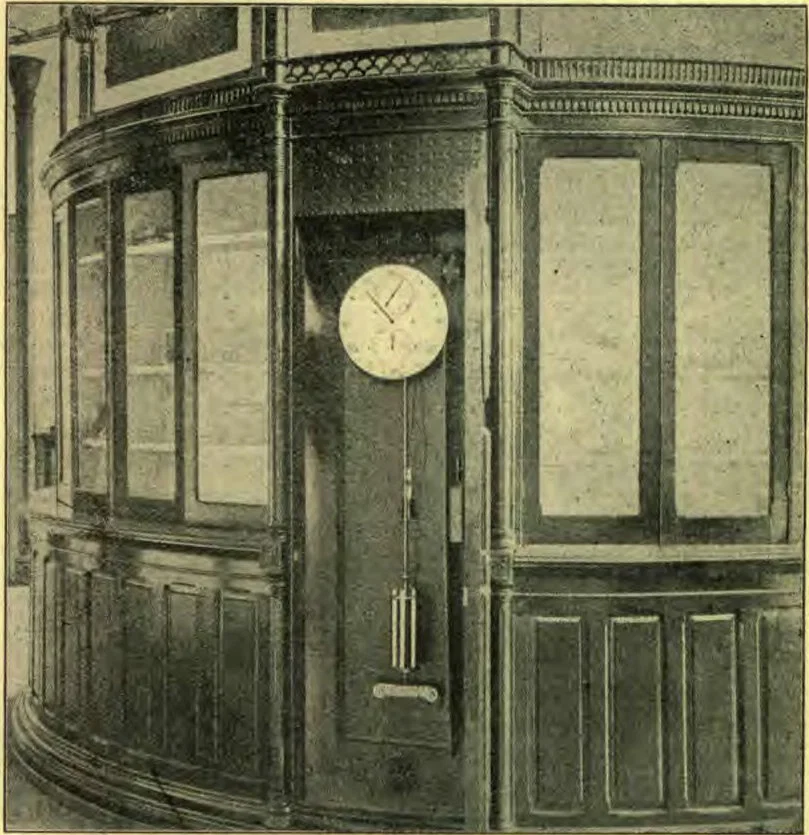
The seconds are slowly ticking away. Above the head of the observer there is a great observatory clock. At precisely two minutes to nine, the wires are switched into a connection with the very clock itself, and all along the eleven thousand miles there is no sound but the tick, tick, tick of the observatory clock.
Something strangely solemn is in one’s thoughts as he stands beside the observer amid the silent seconds while the clock ticks on. Whoever is listening at the wire along its course, waiting to set his watch, whether he be a railroad employee, or some man in a large jeweler’s establishment, where the people go to get their timepieces regulated, knows the system, and knows that there is a sudden pause just before the exact stroke of nine o’clock—a broken beat in the ticking. Then all carefully note their timepieces as the clock in the observatory ticks the nine-o’clock second. They can tell to the second whether their watches are fast or slow or precisely right.
But the best-made clock in the world is not infallible; even our splendidly constructed observatory timepiece has its faults, and so somewhere there must be something to regulate even the regulator. This “somewhere” is the silent clock-setting star in the far heavens,—something that never changes, that has no shadow of variations amid the changes of earth, a second-hand on the dial of God. The astronomer picks out a star chosen from the six hundred. He knows by his catalogue the exact moment the star sweeps over its meridian at a certain time of night. The star has been on time, to the hundredth of a second, these many centuries.
Going into another room, the observer sits down at a telescope of medium size—perhaps five feet in length. It is so mounted that it can not be moved, like one of the great telescopes, but must always be pointed directly at the meridian, through a narrow slit in the roof of the observatory. In the telescope, just back of the eye-piece, is a series of very fine, thread-like wires. The observer has no step-ladder tall enough for him to stand on its top and draw a chalk-mark across the sky, a meridian line for the star to cross, so he must have these wires inside the telescope, serving the purpose of lines on the sky. There are eleven of these wires, and the middle one is the exact meridian—when the star crosses that line, it is the precise instant of its meridian time, the time to a hundredth of a second which is recorded in the catalogue of stars.
The observer holds in his hand, as he sits below the telescope, the telegraphic key attached to a long wire running out into another room, where the wire is attached to a little instrument called the chronograph, that is, time-writer. The chronograph has a cylinder about a foot in length and perhaps six inches or so in diameter. This cylinder is covered with white paper, and when you look at it, you see many lines on it all running parallel to one another. Attached to a tiny framework is a fountain-pen, the point resting on the paper. The cylinder slowly revolves, and as it does so, the pen traces a line upon it. This line would be straight all the way around but for the fact that an electric connection is made with the clock, so that every second time the clock ticks it jars the pen, or interrupts it in its course, and it makes a little jog in the line.
THE OBSERVATORY CLOCK THAT TICKS A MESSAGE FROM A STAR
The clock was set the night before, by the star when it crossed the meridian; but, for one reason or another, it may have lost or gained the fraction of a second. The observer at the eye-piece of the telescope watches the oncoming star with the very closest attention. The instant it comes into his field of vision, just as it begins crawling across the wires, he gives a squeeze to the telegraphic key. At the moment of this squeeze the fountain-pen, attached to the key by the wire, gives a tiny jump, and makes a slight bending in the line. As the star crosses each wire, the observer presses the key, so that there are eleven indentations made as the star crosses the field, and passes out of sight on its celestial way. It has not been stopped a fraction of an inch in its journey through space, but the observer has timed it in transit, and no matter how fast it may have been fleeing through the heavens, it has yet been closely watched by the man at the telescope until he could record its movements. As the star passed the sixth wire, the pressure for that line, its meridian line, registered the precise fraction of a second at which the star crosses the line. Then, as the clock has been marking its own time off on the cylinder second by second, the observer compares the time the clock has been making with the indentation the instrument recorded as the star crossed the meridian. Thus he can tell to the fractional part of a second the gain or loss in the time of the clock, and it is readjusted, or “set,” as we say, to the unvarying time of the star.
The time is taken from this observatory for a large section of the country, reaching as far west as the Pacific Coast, north to Winnipeg, east to Chicago, and southwest to Kansas City, Missouri. The time is sent out each week-day at ten in the morning as well as nine at night. From the Washington University in St. Louis the time is sent out over extensive railroad systems to the south. In the East the Naval Observatory at Georgetown Heights, in the city of Washington, is the center of the time service, and, indeed, time is sent out from this observatory over the whole United States.
The great clock in the Naval Observatory is called the Master Clock. By means of the repeating-apparatus, the time is repeated over eighteen different circuits to the various parts of the country. New York City automatically repeats the time to all points east and north; Chicago and Cincinnati repeat to all points west and southwest; Richmond, Augusta, and Atlanta to all points south. . . .
Truly it is a wonderful time in which we live. All nature joins man in the working of his miracles, and even the eternal stars in their marvelous sweep through the glittering night are willing to give us an answer far down through the infinite spaces of God to our oft-repeated question: What time is it?

IX — The Dream

(August 30)
LESSON SCRIPTURE: Dan. 2: 30-35.
MEMORY VERSE: “Behold, God exalteth by his power: who teacheth like him?” Job 36: 22.

Questions

1. What humble acknowledgment did Daniel make to Nebuchadnezzar concerning the secret which had been revealed to him?
2. For what purpose had Daniel been intrusted with the secret? Notice marginal reading of verse 30.
3. Besides making Nebuchadnezzar to know his own heart, whom did the secret reveal to him? Note 1.
4. What did Nebuchadnezzar see in his dream?
5. In what position was this great image?
6. What is said of its brightness? What of its form?
7. From the fact that the image had a head, arms, trunk, legs, and feet, what must it have represented?
8. Which part of the image was of fine gold?
9. Of what did the breast and arms consist?
10. What composed the trunk? Describe the legs and feet.
11. Which part of the image was the most glorious? Which the strongest? Which the weakest?
12. What else did Nebuchadnezzar see in his dream?
13. How did the stone come to be?
14. What did it do?
15. Where did it smite the image first?
16. What other parts did it then break in pieces? Compare verses 35 and 45.
17. How completely was the image broken up?
18. What became of its dust?
19. What did the stone then become?
20. Where was this great mountain?
21. What encouragement is there for every youth in these experiences of Daniel and his fellows in the court of Babylon? Note 2.

Notes

1. Two things in this lesson show that by this experience the king of Babylon was to learn who the true God is, and what he does. In making the secret known to him, Daniel made him acquainted with the One whose name is Secret (Judges 13: 18), and Nebuchadnezzar at once acknowledged God to be a revealer of secrets, and a Lord of kings. It is God’s work to reveal secret things. Sometimes he does this by parables (Matt. 13: 35), sometimes by dreams (as in the case of Nebuchadnezzar); but in whatever way God reveals himself, his secret is only “for them that fear him.” Moreover, that Nebuchadnezzar should by this same experience be made to know his own heart, again connects him with the One whose mission it is to reveal the thoughts of the heart. Luke 2: 35. That One is Christ; and wherever his work is carried on, men take sides, and the thoughts of their hearts are revealed.
2. “If the curtain could have been rolled back, men would have seen the heavenly universe looking with admiration upon these youth, who, amid temptation and moral corruption, made God their trust. . . . All heaven rejoiced. These representative youth are an illustration of the unanswerable question, ‘Who teacheth like him?’ For the youth of this time who will read the will and purposes of God, these Hebrew youth are a testimony of what all may become when connected with the living God.” “His [Daniel’s] life is given us as a bright example of what man may become, even in this life, if he will make God his strength, and wisely improve the opportunities and privileges within his reach.”—Review, June 10, 1899.
Continue reading: X — The Interpretation