The Youth’s Instructor, Vol. 48, No. 45.

THE POWER OF GOD'S WORD

The Youth’s Instructor

Nov 15, 1900

Review and Herald Publishing Company · Battle Creek, Mich. · Nov 15, 1900

THE POWER OF GOD'S WORD

The Lord says that “where the word of a king is, there is power.” Eccl. 8:4. A king's word has power because the king himself has power. And the measure of the power in a king's word is according to the power which he possesses.
Above all the kings and rulers of the great universe is one, even the Lord, who is “a great King.” Ps. 47:2. He is “King of kings, and Lord of lords.” Rev. 19:16. He “ruleth over all.”
The Lord, as king over all, is a king of infinite power. David says, “Power belongeth unto God.” He is the source of power. By his power he made the heavens and the earth, and all that is in them. The things that God has made reveal his power. In them it appears in a “tangible form.” Rom. 1:19.
The Bible not only tells us that the Lord made all things by his power, but it tells us the way he did this. He did not work with his hands, nor did he use machinery. “By the word of the Lord were the heavens made.” “For he spake, and it was; he commanded, and it stood fast.” Ps. 33:6, 9.
What a wonderful word was that! There was nothing. All was blank nothingness. God spoke, and the worlds were framed. Darkness covered the earth. He commanded the light to shine out of that darkness, and there was light. The earth was barren. There was not a blade of grass nor a single living creature. The Lord spoke, and the earth was robed in unspeakable beauty, and peopled with myriads of living creatures. And by that same word of power the Lord upholds all that he has created. Heb. 1:3.
Because God's power is enshrined in his word and imparted through it, that word is called “the word of his power.” Whatever is created by that word, whether it be a world, a blade of grass, or a new heart in a sinner, receives the power of God. In the tiny seed is wrapped the power of God that was imparted to it at creation.
Every created thing about us is continually revealing this power, but we do not always recognize it. Now and then we see such remarkable manifestations of it that we can not help perceiving the power that is everywhere at work. The picture that accompanies this article illustrates this point. It is a picture of a grave visited by the writer a few weeks ago in the city of Hanover, Germany.
This grave is a little more than one hundred years old. It is made of nine separate stones. Four of these are laid on the top of the ground for a foundation. They are six feet long, sixteen inches wide, and four inches deep. On the top of these are placed four other stones four feet long, sixteen inches wide, and twelve inches deep. These four stones were fastened together with iron bands. On top of these, and over the opening, is placed a large block of stone four feet six inches long, two feet six inches wide, and two feet deep. It is estimated that this block weighs at least a ton and a half. On the front of this block are inscribed these words: “Henriette von Ruling. Born Jan. 19th, 1756. Died April 15th, 1782.” On the front foundation-stone is chiseled the following remarkable statement: “This grave is purchased for eternity. It shall never be opened.”
But the grave has been opened, and stands open to-day. The iron bands have been broken, every stone has been moved, and the heavy block has been lifted up on one side, so that one can look into the open space it once covered and made secret.
This work was not done by the ruthless hands of grave-robbers, nor by the violent force of an earthquake shock. It was done by the silent working of the mighty force wrapped in a tiny seed.
It appears that a seed from a poplar tree had been deposited in the soil inclosed in the tomb. This seed sprouted, and sent up a tender twig, which was drawn to a small crevice where two of the stones joined, and through which light and air penetrated the grave. In some way the twig succeeded in pushing its slender form through the crevice into the open world. It managed to live, and, of course, to grow and expand. So great was its hidden power, that neither the iron bands nor the heavy stones could restrain it. The bands were broken asunder, and every stone was moved from its original position. The tree grew up, and lifted the heavy block from its resting-place, thus opening the grave, and setting at naught the declaration that this grave “shall never be opened.” The tree is still living, and is triumphantly waving its bright, leafy branches over the rent tomb.
The power of that seed is the power of God's word; for it was that word that made the seed. That power is nothing else than the power of the living God. And as the Lord changes not, but is the same yesterday, to-day, and forever, his word remains the same. All that it has ever been it still is, and all it has ever done it can still do. In the beginning it created all things. It has ever since upheld all that it created. Some day it will open every grave that has ever been made, and bring forth every human body that has ever been buried.
To-day that word is able to save our souls. It can break every band with which Satan has bound us. It proclaims liberty to every captive. It speaks life to every one dead in trespasses and sin. Only let that word enter your heart, and it will do a more marvelous work with you that it did with that grave at Hanover.
“Receive with meekness the engrafted word, which is able to save your souls.” James 1:21.
A. G. DANIELLS.

FROM PERSECUTOR TO DISCIPLE

I
CHRIST had suffered an ignominious death; and, in the most positive terms, the Sanhedrin had forbidden the disciples to preach the doctrines of Christianity. But every effort to put down the new religion seemed only to increase its strength, till it threatened to destroy the rites of the temple, and the customs which for generations had been followed by the Jewish nation.
Saul was aroused. He saw that decisive measures must be taken to suppress the new faith. A sensation had been created in Jerusalem by the death of Stephen. The persecution that followed drove the disciples abroad, and the priests and rulers hoped that by vigilant efforts and stern discipline the heresy might be suppressed.
In Damascus the new faith seemed to have acquired fresh life and energy. The work of suppression must be begun there, and Saul was selected for this work. “Breathing out threatenings and slaughter against the disciples of the Lord,” he went to the high priest, “and desired of him letters to Damascus to the synagogues, that if he found any of this way, whether they were men or women, he might bring them bound up to Jerusalem.”
As Saul journeyed, “suddenly there shined round about him a light from heaven.” Frightened, bewildered, and blinded, he fell to the earth. As he fell, he heard a voice saying to him: “Saul, Saul, why persecutest thou me? And he said, Who art thou, Lord? And the Lord said, I am Jesus whom thou persecutest: it is hard for thee to kick against the pricks.”
A general slain in battle is a loss to his army, but his death gives no additional strength to the enemy. But when a man of integrity and sterling principle joins the opposing force, not only are his services lost, but those to whom he joins himself gain a decided advantage. Saul of Tarsus might easily have been struck dead by the Lord, as he was on his way to Damascus, and much force would have been withdrawn from the persecuting power. But his life was spared, and by the mighty power of God he was carried from the side of the enemy to the side of Christ.
Saul had talents that would have enabled him to serve in any position. He was courageous, independent, and persevering. His reasoning powers were of no ordinary value. By his withering sarcasm he could place an opponent in no enviable position. He was an eloquent speaker and a severe critic. A man of stern purpose and undaunted courage, he possessed the very qualifications needed in the Christian church.
After Paul’s conversion, he spent some time in Damascus, showing his brethren there the genuineness of his experience. Then he went to Arabia. Returning to Jerusalem, he tried to join himself to the disciples, that he might be recognized as a follower of the Saviour. But they were all afraid of him, not believing that he was a disciple. So great had been his zeal in persecuting the church, that the believers thought his conversion only a pretense. It was difficult for them to believe that so bigoted a Pharisee, one who had done so much to destroy the church, could become a sincere follower of Jesus.
“But Barnabas took him, and brought him to the apostles, and declared unto them how he had seen the Lord in the way, and that he had spoken to him, and how he had preached boldly at Damascus in the name of Jesus. And he was with them coming in and going out at Jerusalem. And he spake boldly in the name of the Lord Jesus, and disputed against the Grecians: but they went about to slay him. Which when the brethren knew, they brought him down to Cæsarea, and sent him forth to Tarsus.”
In the past the labors of the apostles had been put forth wholly in Palestine. Round this place their hopes had clustered. They regarded the Jews as the covenant people of God. Paul was raised up by God to preach the gospel to the Gentiles. Of him God said to Ananias, “He is a chosen vessel unto me, to bear my name before the Gentiles, and kings, and the children of Israel.” While Paul and Barnabas were laboring in Antioch, the Holy Spirit gave direction, “Separate unto me Barnabas and Saul for the work whereunto I have called them. And when they had fasted and prayed, and laid their hands on them, they sent them away.”
Paul went to Greece to proclaim as the Christ a Jew of lowly origin, brought up in a town proverbial for its wickedness, a man who had been rejected by his own nation, and crucified as a malefactor. How could Paul awaken an interest in this man?
The Greeks looked upon philosophy and science as the only road to true elevation and honor. They believed that there was need of elevating the race; but could Paul lead them to believe that the cross of Christ would do this? There is to us a sacredness about the cross of Calvary. The scenes and associations connected with it are hallowed. But when Paul preached the gospel in Corinth, the cross was regarded with the same feeling of repulsion as the gibbet of to-day. Any reference to a Saviour who had met his death on the cross would naturally meet with opposition.
Paul knew how his message would be regarded by the Greeks. “We preach Christ crucified,” he said, “unto the Jews a stumbling-block, and unto the Greeks foolishness.” In the estimation of the Greeks his words would be absurd folly. They would look upon Paul as weak-minded for endeavoring to show how the cross could have any connection with the elevation of the race or the salvation of men.
But the cross was to Paul the one object of interest in the world. He determined to know nothing among the Corinthians “save Jesus Christ, and him crucified.” He presented the cross to them as the only means of salvation. He stood forth before them declaring: “The preaching of the cross is to them that perish foolishness; but unto us which are saved it is the power of God.”
By Paul’s labors in Corinth a church was established. Many were turned from the worship of idols.
Mrs. E. G. WHITE.

HOP TOADS AND TROUBLES

“There’s a hop toad in my garden!” cried a little voice in distress; and in front of the piazza where grandfather was sitting appeared a child with blue eyes full of trouble. In her hands she carried a diminutive rake and hoe, and her whole figure drooped with disappointment. It was evident that all the pleasure of gardening was spoiled for her by the presence of the hop toad.
“There’s a hop toad in my garden, grandfather, and I can’t make him get out,” repeated the little voice.
Grandfather put down his paper, and looked over his glasses. “Don’t you know what the hop toad is for, little one?”
“No,” said the child.
“It’s to eat up all the worms, so they will not eat up your little plants. There was danger threatening the little seeds you had planted, so the toad was sent to hunt out all the worms and eat them up.”
“Oh!” said the child, gravely. “But, grandfather, I don’t like the toad. I’m afraid of him.”
“But the toad can’t hurt you, little one; he can only do you good. He has come to help you do what you could not do for yourself. You could not go through your garden, and find all the worms and insects and destroy them; but the hop toad can, and though he may be ugly, he will do you only good. Go back to your planting, little one.”
“There’s a trouble come into my life!” cried the child, one day, grown older. “I can not bear it. I’m afraid of it.”
“Fear not, my little one,” says the tender Heavenly Father, “I have sent it for your good. You do not know what it is for now; but by and by you shall see how it was to help you get rid of some enemies in your own heart, which you could not find and kill alone. The trouble is hard, my child, I know, and you do not like it, but fear not. It can not hurt you, it can only do you good. Go back and be cheerful. When the trouble shall have done its work and gone, you will be glad for it, and feel that it was good. Fear not, for I have sent it in love to you.”—Grace Livingstone Hill.

THE BLESSING OF BEING BROKEN

SOMETIMES when our cherished plans are broken, we are apt to become discouraged and fretful; but at such times we should remember that Mary's alabaster box of precious ointment emitted no fragrance until it was broken. We are in this world to manifest the savor, or fragrance, of His knowledge in every place.
If we are good only when everybody is kind to us, we shall not make any striking impression on those with whom we are associated. When Christians realize that all things work together for good to them that love the Lord, there will be about their lives, even when broken and crushed, a fragrance that will be noticed by all who come within the sphere of their influence.
We have this treasure in earthen vessels; and if occasionally God finds it necessary to break the vessels, in order that the excellency of his power may be made manifest, we ought rather to rejoice than to murmur.
“Now no chastening for the present seemeth to be joyous, but grievous: nevertheless afterward [sometimes a long time afterward] it yieldeth the peaceable fruit of righteousness unto them which are exercised thereby.” As we learn this blessed truth in our own experience, we are prepared to act out the next verse: “Wherefore lift up the hands which hang down, and the feeble knees.” DAVID PAULSON, M. D.

A SONG OF THANKS

THANKFUL for strength in strife; For faith more steadfast than the stars above; Thankful that life is life, And love is love.
Thankful for homes, and herds That hide the hills; for harvests ultimate; For the sweet, prattling words Of children at the gate.
For Hope’s “Good morning,” and Faith’s sweet “Good night,” when we are realmed in rest, Led by the Father’s hand Safe to his loving breast.
—Frank L. Stanton.

LESSON 3—TECHNIQUE

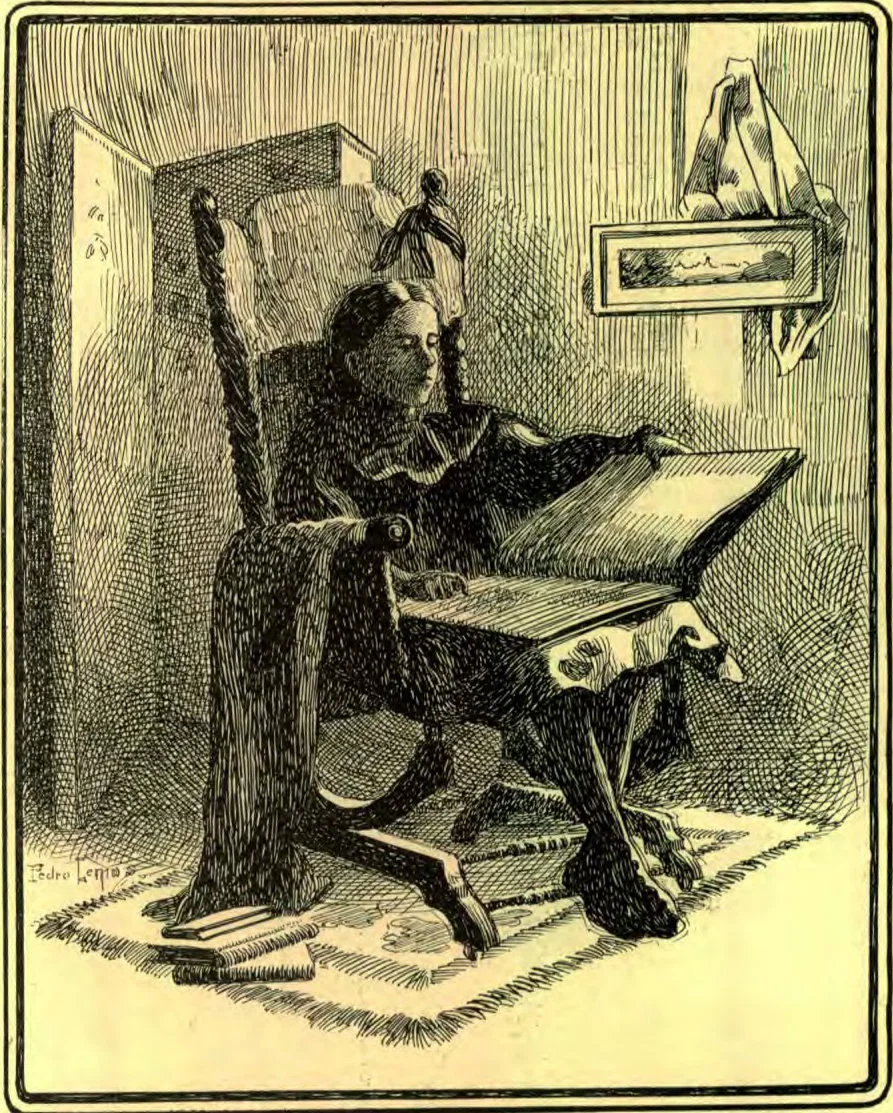
An excellent way to practice is to make an original drawing from an object, using a good example of pen-and-ink work that some artist has applied to a similar object, copying the technique, but not the drawing. Or else draw the object with an entirely different technique, endeavoring to get as true an effect as possible.
You will observe that some artists use a combination of the three methods explained in the last lesson. In the accompanying illustration you will see how crosshatching has been used in the background, while in the lighter portions of the background an entirely different technique has been used than in the figure. The student will understand that he is not bound to confine himself to one method of technique throughout a picture.
Make your lines strong, full, and vigorous, but not too heavy; let each line stand for something. Freedom in sketching is an artistic quality that beginners will do well to put into their work; but this must not be carried to an extreme. Students should be “carefully careless” after they have gained freedom in handling the pen; but at the beginning, when they must imitate technique, they should be more exact.
Do not fill your work with meaningless dots and dashes, hoping they will lend artistic grace to your drawing; they will not. Learn to draw objects as simply, and with as few lines, as possible.
An artist once remarked that two persons were necessary to the successful painting of a picture,—one to do the work, and the other to stand over him with a club, and tell him when to stop. It is highly important to stop at the right place; many an otherwise good picture has been spoiled by overwork. A pen-picture, of all others, especially if intended for publication, should be simple, as too much detail will interfere with a clear reproduction.
At first it is best to confine yourself to easy and simple subjects. Be careful not to attempt anything beyond you. As we study, and develop our powers of observation, our artistic sense deepens, and there come into our work, qualities that can never be attained by endeavoring to represent that which we are unprepared to grasp. Do not bother yourself too much about any special kind of technique. Try to avoid thinking about your lines as lines, otherwise than to keep them open. Think, instead, of the subject you wish to represent. When you write, you do not stop to consider how you may shape your letters; you select, almost unconsciously, the words from your vocabulary, and the fewest with which you can best express your thoughts. Select from the many lines of an object just those that will best suggest its character.
Make your lines in whatever direction will best express the subject before you. Try experiments; take the lines horizontally, vertically,—in whatever direction will best represent the surface or texture with which you are dealing. Never put in your picture all that you see in an object or scene. The mission of art is to “represent nature, not to imitate her.” Only that which is necessary to complete the idea, to finish the impression received, should be drawn. I once heard an excellent artist remark that “it takes as much knowledge to know what to omit from a picture as to know what to put in.”
The student will find that this is true. Many persons think that the picture that is filled with detail, that shows that a large amount of work has been expended upon it, is a greater work of art than some simpler drawing; but one who has a trained eye will criticize such pictures as unnatural. A picture should record only the impression of a scene. Just as it tires us to hear needless detail in a description, so the eye is wearied by seeing the same in a picture. We admire the orator or writer who expresses great thoughts in few words. The best authors sum up their descriptions in a few well-chosen, strong sentences; likewise, the best pictures are those that describe their subjects in the fewest lines and with the least detail.
“In art tell the truth, but not the whole truth.”
PEDRO LEMOS.

THE HOLY SPIRIT AND HOLY ANGELS HELP US DEVELOP CHARACTER

Christ said of the Holy Spirit that when he should come, he would reprove the world of sin, of righteousness, and of judgment. The Lord would not send the Holy Spirit to show us our sins, without at the same time providing a way to escape from sin. God never makes us hungry without supplying the food to satisfy our appetite. “He satisfieth the longing soul.” The Lord points out our weaknesses of character only as an evidence of his willingness to supply strength to overcome them. And his strength is made perfect in our weakness. So the Holy Spirit and ministering angels are not engaged in the work of pointing out defects in human character, simply to produce sorrow, regret, and remorse on our part. The pointing out of these defects should be regarded by us as a hand that points to the promises of God, who is both able and willing to remedy the defects, and to make and keep us perfect.
Jesus watches the character that is being tested in the fiery furnace of temptation. The angels are interested beholders; and the Holy Spirit himself, understanding the eternal purposes of God, co-operates with the Father and the Son in their work of making our characters what they ought to be. No matter how severe the trial, or how painful the struggle, we should press on in the assurance that all heaven is interested in the work of training, purifying, and developing character. A realization of this truth should lead us to bend every energy, put forth every effort, to co-operate with the heavenly intelligences as they seek to hew and polish and chisel the stone, thus making it ready to occupy its place as “a lively stone” in God’s eternal building.
W. S. SADLER.

KEEP THANKSGIVING DAY

Rest awhile, O weary worker! Life is flitting by too fast. Rest, and let the heart remember All the blessings of the past. Gather up the gleams of sunshine While the shadows roll away; With a smile and song of gladness Let us keep Thanksgiving day.
Has the year been full of sorrow, Toil, and pain, and grief, and care? Look beyond the present trials, Hope and joy are waiting there. There's a light for every shadow— Treasure well each shining ray, That with praise for every mercy We may keep Thanksgiving day.
Heedless of the common blessings, So abundant and so free, We forget our Father's mercy, Boundless as a shoreless sea; In the cold and storm of winter We forget the smiling May;— Lest we grieve the Love that guides us, Let us keep Thanksgiving day.
Life has many compensations For its days of toil and care, And full many a priceless blessing For the griefs we all must bear. Let us read the tender tokens Of God's love, along the way, That with faith and hope undaunted We may keep Thanksgiving day.
—Selected.

Stinginess and the Fear of Doing Wrong

THERE is a stingy caution, which will do nothing for fear of doing wrong, and so does wrong all the time.—Phillips Brooks.

KIM SAN, OR GOLDEN HILL

(Concluded)
It was at this time, when everything appeared to be going against him, that Song Liang became so desperate that he resolved to take his own life. With his reputation gone, his baby dying by inches, and he apparently helpless, the poor fellow thought it was better to die than to live. But God restrained him, and he was led to pray. He had not heard from us (for the missionary called Mr. Smith was the writer) since our hasty farewell in May, 1896, on the wharf at Singapore; and if he thought of us at all, it was only to say to himself, “I shall never see my adopted father and mother again.”
But he cried to God in his distress, and proved again that “man's extremity is God's opportunity.” One day, while crouching in a friendly corner of the street, thinking of his troubles, the postman approached, and handed Song Liang a post-card dated at Padang, Sumatra. He hastily read it, and learned that we had reached that place, and would like to see him. With joyful heart, he rushed home to inform his wife of the good news that his best friends on earth, whom he had despaired of ever seeing again, had been in Padang nearly a month, and had called for him to come down and help them in their work. He resigned his situation at the hospital, and pawning a few articles of clothing, managed to raise enough money to pay his way to Padang, a distance of about one hundred miles by rail.
One day when I was about to start out on my bicycle, a vehicle drove up, and out jumped our Chinese boy. Though much changed in the four years since I had last seen him, still the same countenance, the same sunny smile, greeted me as of yore. As a family we had made few acquaintances, being indeed strangers in a strange land, where we seldom heard the familiar accent of our mother tongue. Heavy hearted and lonely, the sight of a familiar face, which we had longed and prayed to see, but which we did not suppose was so near us, was an unspeakable joy.
We spent three days in prayer and Scripture study, and in talking over the years that had intervened; and finally, after replenishing his purse, I sent him back to bring his wife and baby.
Several days, a week, passed; two weeks had nearly slipped away; and we began to fear that the enemy of all good had caused Song Liang some new trouble, and that we were not to have his fellowship and help. But one day several two-wheeled carts rolled into the yard from the station, loaded with bedding, boxes, and clothing. With them came the young wife and the famine baby. The first had a comely, pleasing face, while the latter looked for all the world like a baby monkey, so bony and skinny were his small features. A more pitiable object I never saw. The child's fingers were bird's claws; his wrists were pipe-stems; his general appearance bat-like in the extreme. He certainly looked like an animated Egyptian mummy; and we had, humanly speaking, no hope of his living three months. But since we believe that nothing happens, and that, in this case, God had certainly some providential purpose, we prayed—and altered at once the little scarecrow's diet. His name is “Golden Hill;” but just then almost any other name seemed more appropriate. But without joking about his name, we seriously addressed ourselves to the task of saving the child's life, not only for Christ's sake and his own, but also for his mother's; for we felt that if our efforts were successful, the mother would be more easily won to love and trust her Saviour.
We had brought a quantity of nut foods with us, and several bottles of malted nuts remained. It cost us a sacrifice, but we gladly made it in order to make this mother and father happy, and perhaps to save the baby for some useful service. We boldly claimed the promise, “Ask, and it shall be given you.” We asked definitely and specifically, and put God's word to a test; and our faith was abundantly rewarded. We prepared the malted nuts with boiling water, and prohibited the mother (for the little family live in the same house with us) from feeding the child rice mush. We also saw that the little fellow was properly bathed every day. Very slowly he improved. First he ceased to be peevish and fretful, and slept soundly, and as long as a five-months'-old sick baby should. Gradually he grew stronger. His head, which at first hung as limp as a frost-bitten squash blossom, began to lift itself. The lifeless form began to move, and little by little, the much-wrinkled skin began to fill out. Now, after five and one-half months, he is as plump as a cherub, and as jolly a baby as you would care to see. There is one remarkable thing about him for a Chinese baby; and that is that his flesh is almost as hard and solid as wood. Wherever his proud father takes him, the Chinese express amazement when they feel of him; and they at once ask, “What do you feed him?” Song Liang invariably replies, “We feed him on prayer.” Even the unbelieving mother has greatly changed, and is convinced that our prayers saved the child.
Thus for the present ends the story of Kim San, or “Golden Hill.”
Since coming to us, Song Liang has been faithfully preaching the gospel among his relatives, and some of them have believed on the Lord Jesus Christ, and will soon be baptized.
Kim San's aunt, a Mohammedan girl about twenty years of age, is among the recent accessions to our home. Her husband abandoned her, leaving her with a little child. She then entered Islam, and recently has come to live with us as a helper in the home. One great object in our bringing her from Benkulen, three hundred miles down the coast, was to show her a better faith than Islam, and a better hope than that held out by Mohammed. She is a good girl, very devout and sincere in her prayers, which she performs faithfully every day. It is indeed a performance; for it consists of a religious bath, followed by a long prayer toward Mecca, in a white robe.
Will not my young readers remember Tachay (“Elder Sister”), as we call her, that the Spirit of God will bless our efforts, and penetrate her dark mind with the rays of gospel light and truth? She already loves to hear us talk of the gospel. She is learning to read in Malay; and when she is proficient in that, we shall put the New Testament into her hands.
R. W. MUNSON.
Padang, Sumatra.

LEARN TO FORGET YOUR TRIALS

If you do not think much of your small trials, says the Woman's Home Companion, you will talk little of them, and so your friends will be spared a trouble as well as yourself.
Next to making complaints there is nothing so unprofitable as listening to them.
Learn to forget.
Forget the slights, errors in taste, gossip, and scandals you see or hear. Forget to remember the puzzles and wrongs you have had to meet, as soon as you have done your best to straighten them out. Forget worries, small and great. They only wear out heart and brain. Forget humiliations, cares, and trials. Let your mind and heart be filled with the goodness and justice and beauty that are in the world.
Do not be like the soldier who has fought one hard battle, and who spends the rest of his life thinking and telling about it.
There is nothing so inspiring as to meet a wholesome, unselfishly happy human being; and there is nothing so depressing as to meet one who insists upon dwelling in misery, and sharing it all with you.
Learn to forget your troubles, small and great, and to allow others to forget them.

MANNERS

Manners are not a garment to be taken off; they are the flesh and blood of life itself. They are a person's habitual ways of doing everything; they show in the smallest details and in the largest matters alike. They are so intimate, and so essentially part of us, that they express us better than we know. “The most fugitive deed and word, the mere air of doing a thing, the intimated purpose, expresses character,” says Emerson. “The world is full of judgment-days, and into every assembly that a man enters, in every action he attempts, he is gauged and stamped.” Our manners are the measures of our real selves.
A person with truly good manners, then, to begin with, must be a good person, kind and gentle. Mere polish does not make manners, though many foolish minds appear to think so; for selfishness and even evil can be veneered and polished, inch-deep, into a very fair imitation of the real thing, though it can never be more than an imitation. Real manners stand the test of any searching occasion; for they go as deep as character itself.
The manners that keep their gentle courtesy through defeat or ill luck, that claim no advantage over an adversary, that do not unduly exult in victory, are a testimonial to their possessor's thorough good breeding that exceeds any framed pedigree or crested note-paper.—Selected.

Patience in Every Trial and Burden

We have need of patience with ourselves and with others; for the greatest things and the least; against sudden inroads of trouble, and under our daily burdens; in the weariness of the body, or the wearing of the soul; in every-day wants; in the aching of sickness or the decay of age; in disappointments, bereavements, losses, injuries, reproaches; in heaviness of the heart, or its sickness amid delayed hopes. In all these things, from childhood’s little troubles to the martyr’s sufferings, patience is the grace of God, whereby we endure evil for the love of God. — E. B. Pusey.

ONE DROP OF RED PAINT

A boy walked into a house-painter’s shop one day, and stood looking at the different colors. Here were lampblack, white lead, yellow ocher, verdigris, Indian red, and everything needed in mixing any tint or shade that could be desired.
The painter had gone out for something, and the boy thought he would investigate a little. Some of the paints were mixed, thinned, and ready to use; some, like the white lead, were thick and stiff, and would need to be diluted with oil before they could be spread with a brush; while others were in the form of a dry powder.
On the floor stood a keg containing fifty pounds of thick white lead, and close beside it was a smaller one, filled with Indian red, all ready for the brush. In each was a wooden paddle for stirring up the paint. The boy took hold of the paddle in the smaller keg, and held it up, watching the thin red stream that flowed from the end. Something startled him, and he turned quickly, and let a single drop fall into the white lead. There it lay, one little red spot in the white mass.
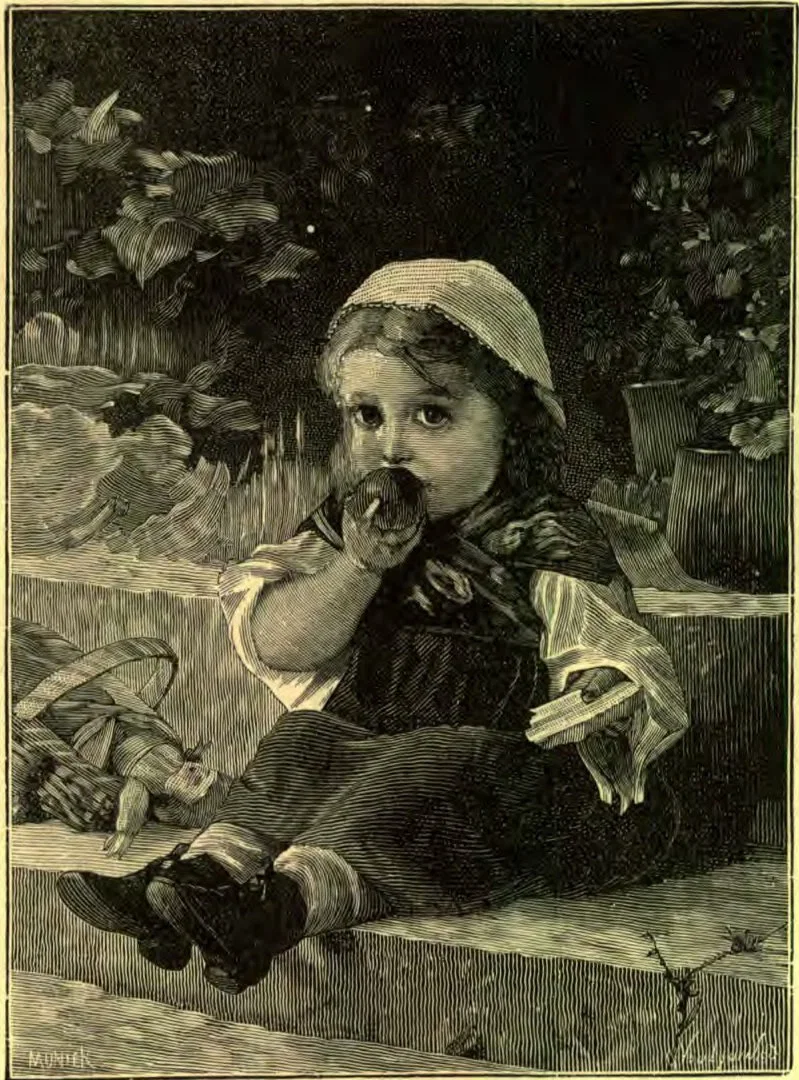
LUNCHEON TIME
LUNCHEON TIME
The boy was frightened, and wanted to repair the mischief he had done, but he went at it the wrong way. The red paint had not mixed with the white; for the white was too stiff. If he had taken a little stick, or the point of his pocket-knife, he might easily have lifted it out, and there would have been no harm done. Instead, he tried to hide it by stirring it in. At first a little red streak followed the paddle round and round; soon it disappeared, but some of the lead was stained a very light pink. The boy stirred deeper and deeper, and at last he thought the red drop was completely hidden. Every spot and streak was gone, and it seemed to him that it was all as clean and pure as ever.
But the first thing the painter said, when he came in and looked at it, was: “That keg of white lead isn’t very white. I wonder what’s the matter with it.”
Some of us have tried to do, with the spots in our characters, the same thing that the boy did with the spot in the white paint. Instead of removing them, we seek to hide them by mixing them up with good deeds and high motives. It’s a very poor way. Root a sin out, and you are rid of it; leave it there, and, no matter how well it is covered up, the Painter will find it if no one else does. But “the blood of Jesus Christ his Son cleanseth us from all sin.”— W. D. Hulbert.

IN NATURE'S SCHOOL

ANIMALS no less than people sometimes have difficulty in training their children. And the greatest trouble among birds and beasts seems to be in getting the little ones to rely on themselves.
I saw an old hen chase her son all over the garden the other day, just to teach the little fellow to scratch for himself.
Then I saw the cat giving her young one the same lesson. She would walk past Tabkins, and Tab would trail along after, his tail held high, like a flag of truce. Suddenly the mother would turn, and give a few low growls, which plainly meant, “Tab, aren’t you ashamed of yourself—expecting your old mother to keep on providing for you!” This was usually followed by a sound cuff on the ear, and a hiss that said, as plain as words, “Get out!” Of course it wasn’t long till this little fellow had learned his lesson.
Not long ago I made the acquaintance of a mocking-bird and her young one. From her I learned how birds teach their children self-reliance. All the youngsters except this one were great birds then, and had gone out into the world to shift for themselves; but this lazy fellow would sidle up to his mother on a branch, open his little yellow mouth, and flutter and “cheep” for food. The mother-bird stood it for a while, but one day her patience gave out, and she chased the astonished young one till his little wings grew weary. After that he kept pretty much out of her way. But often when eating berries in the garden, he would forget himself, open his beak, and “cheep” and flutter as if to tempt the luscious fruit to walk down his throat.
Edison J. Driver.

ALL THE TIME IS PLEASANT TIME

SING a song of blossom-time, when we roam and ramble, Seeking early buds ablow under bush and bramble, Rows of willow “pussy cats,” arbutus a-shiver, Jack in pulpit canopied, down beside the river — Oh, for blossom-time!
Sing a song of picnic-time, when we seek the shadow Of the woods’ green parasol just beyond the meadow; First a boat-ride, then a swing on wild grape-vine slender, Till it parts beneath the strain on its tendrils tender — Oh, for picnic-time!
Sing a song of nutting-time, while soft sunshine lingers On the walnuts gathered up, staining little fingers; Hazel copses sheltering round, plump little fellows Clad in scalloped, ruffled coats, tinted browns and yellows — Oh, for nutting-time!
Sing a song of snowball-time, skating bee, and sleigh-ride, Snow against the fences piled, snow men by the wayside; Coats with snowflake polka-dots, snow-birds faintly calling In the pines, while on their boughs, snow is softly falling — Oh, for snowball time!
Blossom-time, summer-time, nutting-time, winter-time, Which is the pleasantest for little lad and lass? Blossom-time is lovely till summer-time advances; Winter-time seems best of all when nutting days are past.
MINNIE ROSILLA STEVENS.
Continue reading: MORNING TOWN