The first one up in the house can hear
The bells of the Morning Town,
When breezes blow from the woodland near,
And over the meadows brown.
A bird in the wood and a brook in the dells
Give voice and song to the morning bells.
The first one up in the house can find
The way to the Morning Town;
The oriole at the gates is kind
To carol his welcome down;
And many a citizen, passing along,
Will greet you fair in the streets of song.
The first one up in the house may see
The day with its shining crown;
For early-to-rise is the golden key
That opens the Morning Town.
Oh, who would be lazy? Can any one take
One more wee nap, when the morn’s awake?
— Frank Walcott Hutt.
WE THANK THEE
For the fruit upon the tree,
For the birds that sing of Thee,
For the earth in beauty dressed,
Father, mother, and the rest;
For thy precious, loving care,
For thy bounty everywhere,
Father in heaven, we thank thee.
For the sunshine, warm and bright,
For the day and for the night,
For the lessons of our youth,
Honor, gratitude, and truth;
For the love that met us here,
For the home and for the cheer,
Father in heaven, we thank thee.
For our comrades, and our plays,
And our happy holidays;
For our lives but just begun,
For the great gift of thy Son;
For the joyful work and true
That a little child may do,
Father in heaven, we thank thee.
— Selected.
BEREAN LIBRARY STUDY
Revelation 5; “Thoughts on the Revelation,” pages 391-401
NOTES ON LESSON 5
(November 18-24, 1900)
Behold.— This word has the same force when used in the Bible as when spoken in ordinary conversation. If a friend looking out at a window suddenly exclaims, “Behold!” your attention is instantly arrested. You know he wishes to call your mind to something special. When you find the word “behold” in the Scriptures, you may always be sure that God designs especially to rivet the attention to the thought that follows. “Behold” is used twenty-six times in the book of Revelation. Watch for it, and do not lose the thoughts that God designs should especially arrest your attention.
Lion of the Tribe of Judah.— The lion is the king of beasts. The ravenous nature of the lion, before which none can stand, is described in Hosea 5:14. Christ is the Lion of the tribe of Judah, the King of kings. When he comes to the earth, he will exercise his kingly power, and break the heathen “with a rod of iron,” and “dash them in pieces like a potter’s vessel.” As all flee from the ravenous lion, so none of the wicked can stand in Christ’s presence when he comes as the Lion of the tribe of Judah, the King of kings. But the same kingly power that destroys his enemies will protect his loyal subjects.
The Root of David.— The root is the strongest thing in the vegetable kingdom. It forces its way into the crevices of the rocks, and bursts them asunder. How often as we pass along the street, we see the heavy stone or cement pavement forced up out of place by a hidden root. Hidden beneath the soil, it supports the mighty tree, which towers aloft, and defies storm and wind. All this work is performed out of sight, hidden beneath the dark earth. What so fitly represents the power of “Christ in you, the hope of glory,” as the hidden root? Christ’s life and power in the soul will overcome the fiercest temptations, and keep us safely through the darkest hours, enabling us to overcome what would seem to be insurmountable difficulties, just as his life in the root will burst the heavy rock or hard cement.
Power in the Root.— Many times we have seen a tiny blade of corn or wheat lifting a hard clod of earth that stood in its way as it reached upward toward the sun. In childhood I have raised such a clod to see if some insect was not lifting it; and when I found it was only the tiny spear of corn, I have carefully placed the clod in its former position, expecting to see it still supported. But lo, the blade was crushed by the same weight, which, a few moments before, it was upholding so bravely. How wonderfully this proclaims the power of the “Root of David,” which “prevailed to open the book.” The root can surmount any obstacle; but it must do the work. If we seek to control the Root, and place the weight upon it with our own hands, the mighty power vanishes, and we are left to fall in our own weakness. We can not control the Spirit of God; but the Spirit of God must control us, if we would see its mighty power in our lives. Every trial may be met by the power of the “Root of David;” and without this power we shall be stony-ground hearers, of whom the Saviour said, “Because they had no root, they withered away.”
A Grand Chorus.— People go into ecstasy over choruses rendered by a few hundred voices; but notice carefully the singing described in Revelation 5. Nothing ever heard by mortals can compare with that glorious melody. First the four beasts and the four and twenty elders sing a new song. Vs. 8-10. Then the innumerable host of angels sing another part. Vs. 11, 12. Every creature in heaven and earth then joins in the third part of that heavenly song. The four beasts close with “Amen.”
The first thing to notice in the study of this lesson is the close connection with the latter part of the third chapter, especially verses 22-29. We are in the bondage of sin till Christ sets us free. We are like the boy under the pedagogue: when he becomes a man, he is free; so are we free from the law when we become children of God by faith. Review these verses carefully before studying the lesson text proper. A number of review questions are given on these verses.
QUESTIONS
1. What is the condition of all men, according to the Scripture? Gal. 3: 22. Under what were we kept during this time? V. 23. What escape from this bondage is provided? Vs. 22, 23.
2. What is the law called in verse 24? What does it do? For what purpose? Same verse. Then what are we no longer under? V. 25. What do we become? V. 26. And if children, then what? V. 29.
3. What is said of an heir while he is a child? Though a servant, what may he be? Gal. 4: 1; note 1.
4. What is the heir placed under during his childhood? Till what time? V. 2; note 2.
5. Who are represented by the heir? At what time in our experience? What was our condition then? Under what were we in bondage? V. 3; note 3.
6. What is it that brings us into bondage? John 8: 33, 34. What keeps us there? Gal. 3: 23. What things of the world separate us from the Father? John 2: 14, 15; note 4.
7. In the fullness of time, what did God do? How was the Son made, or born? Under what? Gal. 4: 4; note 5.
8. Why did the Father send the Son? Why are we redeemed? V. 5; note 6.
NOTES
1. The illustration here used is that of an heir before he becomes of age. During this time, though he may be lord, or heir, of all his father's359possessions, he is not different from a servant. The word “servant” is bondservant in the Revised Version, and means a slave.
2. The second verse explains in what sense the heir is no different from a slave. He is kept under the control of teachers and governors; he is not at liberty to use any part of his inheritance. Of course this is all meant for his own good; for in his inexperience he would be wholly incompetent to manage the affairs of the estate, and would most likely misuse and waste his means. Then comes the time appointed of the father, when the son is declared of age, and comes into possession of his inheritance.
3. In the third verse we come to the application. We are likened to the heir before he becomes of age. “When we were children” refers to the time when we were in bondage, before we became free in Christ as sons of God.
4. It is sin that brings us into bondage; and the law, as our jailer, holds us there. So the two expressions, “in bondage,” and “under the law,” mean the same. The elements of the world are the things of the world that are opposed to both the Father and Christ. See also Col. 2: 8, 20.
5. “The fullness of the time” evidently refers to the time when Christ came into the world. But Christ was “slain from the foundation of the world.” Rev. 13: 8. So the time of our redemption, as a personal experience, comes whenever we accept the deliverance he offers. The Revised Version reads, “born of a woman, born under the law.” Christ came to redeem every person born into the world. We are all “redeemed by the blood of the Lamb,” though many do not accept the deliverance.
6. As Christ was made a curse for us, that he might redeem us from the curse of the law, so he was born under the law that he might redeem us who are under the law. Notice that according to the illustration in verses 1, 2, we are heirs all the time. But we do not know how to use and enjoy our inheritance till we attain to the freedom there is in Christ. Then we receive the adoption of sons.
MAKING WALL-PAPER
THE manufacture of wall-paper is extremely interesting. First a web of blank paper is set in a reel behind a blotching-machine; two cylinders bring the free end of the paper into the machine, where a roller working in a color-pan puts a large quantity of color upon the paper in blotches. Then a set of flat brushes, called “jiggers,” brush quickly back and forth, thus spreading the coloring-matter evenly over the surface of the paper. As the paper comes from the blotching-machine, a workman takes one end of it, wraps it around a stick, and places the stick across two parallel endless chains, and the paper is thus carried up an incline. When eighteen feet of it has run out, the chains take up another stick that lies across them, and carry it up as they did the first. A third stick soon follows the second; and thus the work continues until the entire web has been run out of the blotching-machine.
The chains, in their working, hang the paper in loops over a system of steam-pipes; and it is thus thoroughly dried before it reaches the end of the chain, where it is again wound into a web. Wall-paper designs are first sketched on paper, and then transferred to rollers of the size required. It is necessary to prepare as many rollers as there are colors in the design; thus, if the design requires printing in eight colors, eight rollers must be prepared. When all the rollers are ready, the artist directs the rollers, and each one is given a color. A workman, to whom a certain color has been given, takes a roller to his bench, sets it firmly in the grasp of a vise, and with hammers, files, brass ribbons, and brass rods, goes to work. Every bit of the design that is to be in green is traced out for him, and he carefully reproduces it in relief on the roller.
When his work is finished, the roller bears on its face, in raised brass, the stems, leaves, etc., and at the proper time and place will put the green coloring and shading just where the designer intended it to be. In like manner the other rollers are made ready for use. They are then taken to a press that has a large cylinder of the width of ordinary wall-paper. There are grooves around the sides and bottom of this cylinder, into which are fitted the rods on the ends of the rollers, and when in position, the faces of the rollers just touch the cylinder. An endless cloth band comes to each of the rollers from below. Each of these bands works in a color-pan, which contains, in liquid form, the coloring-matter to be carried on the roller to which the band belongs. Each roller is placed in such a position that the part of the design upon it will strike exactly in the spot necessitated by the relative position of the other rollers. When all is ready, the paper that has passed through the blotching-machine is placed between the cylinder and the first roller, the cylinder and rollers revolve rapidly, and soon the paper is beautifully printed.
A wall-paper press throws off ten rolls of paper a minute, and each roll contains sixteen yards. It is said that stamped paper for walls was first manufactured in Holland, about the year 1555. Some of the very costly wall-paper in use nowadays is beautifully embossed and painted by hand.—Selected.
The Power of Words
“’Tis a strange mystery, the power of words!
Life is in them, and death. A word can send
The crimson color hurrying to the cheek,—
Or can turn the current
Cold and deadly to the heart.
Anger and fear are in them; grief and joy
Are in their sound; yet slight, impalpable,
A word is but a breath of passing air.”
THE HOUSE WE LIVE IN.
By Vesta J. Farnsworth
By Vesta J. Farnsworth.
This book tells how the human body is made, comparing its parts to the different parts of a house. It also tells how to care for the body. In doing so, many other interesting things are told in a pleasing way. It is printed in large, clear type, with many instructive pictures. It contains 218 pages, and is nicely bound in cloth, with a home scene on the front cover. Price, 75c.
We offer the YOUTH'S INSTRUCTOR for one year and this beautiful book, postpaid, for $1.15; or, we will send the book, postpaid, for five new subscriptions at 75 cents each. Address—
The Youth’s Instructor,
Battle Creek, Mich.
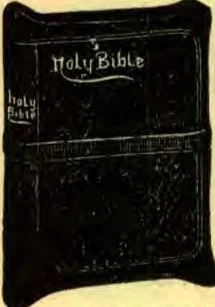
SELF-PRONOUNCING S.S. Teachers' Reference Bible
By Editor
Contains the Celebrated Teachers' Helps, comprising nearly 400 pages. Also a complete series of fifteen new maps.
DESCRIPTION
IMPERIAL SEAL BINDING, TUCK EDGES, known as "DIVINITY CIRCUIT," ROUNDED CORNERS, FULL RED UNDER GILT EDGES.
We offer this Bible, postpaid, for only six new yearly subscriptions at 75 cents; or twelve new six months' subscriptions at 40 cents.
We will also send it, postpaid, with the INSTRUCTOR one year for $2.25. For 20 cents extra we will stamp your name in gold upon the cover. Address—
THE YOUTH'S INSTRUCTOR, Battle Creek, Mich.
Charity Is a Virtue of the Heart
“CHARITY is a virtue of the heart and not of the hands.”
Our Premium Testament
By Editor
As an aid to daily Bible study, and to memorizing the Scriptures, there is nothing better than a pocket-edition. We have secured a beautiful Vest-pocket New Testament, size 4 x 2¾ in., that we offer, postpaid, with the INSTRUCTOR one year, for only $1.00. Well printed, in ruby type, as shown; Flexible Covers, Round Corners, Red under Gold Edges,—a splendid little book.
St. Matthew, 13.
42 The queen of the south shall rise up in the judgment with this generation, and shall condemn it: for she came from the uttermost parts of the earth to hear the wisdom of Solomon; and, behold, a greater than Solomon is here. 43 When the unclean spirit is gone out of a man, he walketh through dry places, seeking rest, and findeth none. 44 Then he saith, I will return into my house from whence I came out; and when he is come, he findeth it empty, swept, and garnished. 45 Then goeth he, and tak-
50 For whosoever shall do the will of my Father which is in heaven, the same is my brother, and sister, and mother.
CHAPTER 13.
3 The parable of the sower and the seed; 18 the exposition. 24 The parable of the tares, 31 of the mustard seed, 33 of the leaven, 44 of the hid treasure, 45 of the pearl, 47 of the dragnet. 53 Christ is contemned of his own countrymen.
1 The same day went Jesus out of the house, and sat by the sea side. 2 And great multitudes were gathered together unto him, so that he went into a ship, and sat; and the whole multitude stood on the shore.
This offer is made to both renewals and new subscribers. Address—
THE YOUTH'S INSTRUCTOR,
BATTLE CREEK, MICH.
The MODERN WEBSTER'S Pronouncing and Defining Dictionary of the English Language.
By Editor
SIZE, 5¼ x 4¼ INCHES
This dictionary includes English words in common use, collection of classical and modern words and phrases and maxims, and instruction in proofreading.
In its compact form it has a thoroughness and clearness of its own, and is especially adapted to the use of students, and in the library, office, and home.
We will send the YOUTH'S INSTRUCTOR one year with this dictionary bound in stiff silk cloth, indexed, postpaid, for $1.10; or, we will send the INSTRUCTOR one year, with same book, limp cover, not indexed, for $1.00. This offer applies to both new subscriptions and renewals. Address—
THE YOUTH'S INSTRUCTOR, Battle Creek, Mich.
CHICAGO & GRAND TRUNK R'Y
E. W. Meddaugh and Henry B. Joy, Receivers.
CHICAGO & GRAND TRUNK R'Y.
Trains leave Battle Creek.
WEST-BOUND FROM BATTLE CREEK.
No. 9, Mail and Express, to Chicago ................. 12.15 P. M.
No. 1, Chicago Express, to Chicago ................... 8.30 A. M.
No. 3, Lehigh Valley Express, to Chicago .............. 3.50 P. M.
No. 5, International Express .......................... 2.15 A. M.
No. 75, Mixed, to South Bend .......................... 8.30 A. M.
Nos. 9 and 75, daily, except Sunday.
Nos. 1, 3, and 5, daily.
EAST-BOUND FROM BATTLE CREEK.
No. 8, Mail and Express, East and Detroit ............. 3.45 P. M.
No. 4, Lehigh Express, East and Canada ................. 8.27 P. M.
No. 6, Atlantic Express, East and Detroit .............. 2.25 A. M.
No. 2, Express, East and Detroit ....................... 6.50 A. M.
No. 74, Mixed (starts from Nichols) .................... 7.15 A. M.
Nos. 8 and 74, daily, except Sunday.
Nos. 4, 6, and 2, daily.
G. W. VAUX,
G. P. A., CHICAGO.
W. C. CUNLIFFE, Agent,
BATTLE CREEK.
Notes and Comments
By A. J. Bourdeau
Leopold's Gift to Belgium.—King Leopold, of Belgium, who has been a life-long patron of gardening, has given “the whole of his real estate in that country for parks and pleasure-grounds for the people forever.”
Chicago's Automobile Club.—Chicago now has an active automobile club, having enrolled among its members most of the automobilists of the city. It is estimated that there are fully four hundred automobiles in that city to-day.
Soldiers Carrying Umbrellas.—It is stated by an army officer that the Chinese are the only soldiers who will consent to carry an umbrella. “Officers and soldiers alike,” he says, “carry umbrellas as a protection from the sun; and during the Japanese-Chinese war a few years ago, I saw Chinese troops marching into a battle, which proved to be a very serious one, every one of them carrying a sun umbrella.”
A Sensible Chinese Custom.—“The Chinese physician receives a salary from his patients as long as they are well,” says Will Carleton's Magazine, “and as soon as they get ill, his pay stops. Some American families, not disdaining to learn something from the other side of the world, have partially adopted the same plan; that is, they pay the salary whether they are sick or well; and it is, of course, to the interest of the doctor to keep them well as much as he can, so as to save himself the trouble of attending them.”
A Dog's Sense of Humor.—The following bit of news from New York City certainly proves that dogs think, and that they are sometimes struck with a sense of humor, as are human beings: It is related that “the proprietor of a Third Avenue store owns a little black kitten, that cultivates a habit of squatting on its haunches, like a bear or a kangaroo, and then sparring with its forepaws, as if it had taken lessons from a pugilist. A gentleman took into the store, the other evening, an enormous black dog, half Newfoundland, half collie, fat, good-natured, and intelligent. The tiny black kitten, instead of bolting at once for shelter, retreated a few paces, sat erect on its hind legs, and ‘put its fists’ in an attitude of defiance. The contrast in size between the two was intensely amusing. Slowly, and without a sign of excitability, the huge dog walked as far as his chain would allow him, and gazed intently at the kitten and its odd posture. Then, as the comicality of the situation struck him, he turned his head and shoulders around to the spectators; and if animal ever laughed in the world, that dog assuredly did so then and there. He neither barked nor growled, but indulged in a low chuckle, while eyes and mouth beamed with merriment.” It is nonsense for people to maintain that animals do not reason.
A. J. BOURDEAU.
THE WAY IT IS DONE
To confer a favor so gracefully and kindly that the recipient is made to preserve his self-respect, requires broad sympathy and ready tact. The following story, told by David Christie Murray, the well-known author, concerning the hardships of his first years in London, shows how one man had learned “to do and say the kindest thing in the kindest way:” —
“After carrying about his manuscripts in vain from one publishing house to another, Murray found himself penniless and homeless. He slept upon the Thames embankment for two nights. For two days he had not eaten food. On the third morning he was standing on London Bridge, looking gloomily into the black water, when a newspaper editor, who knew him, passed with a hasty nod. He hesitated, looked at him, and came back.
“‘O Murray!’ he cried, ‘you are just the man I want! Can you spare a couple of hours?’
“‘Yes,’ said Murray, dryly.
“‘I want an article on—on Columbus for tomorrow. Birthday article. Nothing labored—no dry dates. Something light, fanciful—you understand? Go to the office. You’ll find paper and pens ready. Send it to my desk. And, oh, by the way, I may not be there in time. We’ll settle in advance,’ thrusting a couple of sovereigns into his hand.
“‘I wrote the article,’ said Murray, ‘and found out long afterward that the birthday of Christopher Columbus did not come for months. From that day success came to me. That man saved my life.’”
Words Spoken in Jest Wound
WORDS spoken in jest often become arrows that wound.
The Face as the Mirror of the Soul
THE face is the mirror of the soul. What do our faces reflect?
Volunteers Sought for Revelation Study Commitment
By Editor
Already several who are determined to commit the book of Revelation have sent in their names. We are sure there are many others whom we have not yet heard from. This task is one that will bring its own blessing with it, and will become a joy in the doing.
A "MACHINE"
“Might as well be a machine, and have done with it!” exclaimed Harry, impatiently.
When asked the reason for this outburst, it developed that he was “tired to death” of his position as door-opener and telephone-boy in a certain large office where he had, after months of waiting, finally been given a place.
Promptness and politeness ought not to be a rare combination in a boy, though they go far toward winning success in whatever he may undertake; but there is another that is just as necessary, and that is what is sometimes called stick-to-it-iveness. The first two qualities I knew Harry to have; and I knew also that he was doing his work well, and, incidentally and perhaps unconsciously, much to make people “feel pleasant” as they passed his desk.
The details of the work were not difficult—nothing that any bright boy could not master in an hour. And therein lay the difficulty. Boy after boy gladly accepted the place, only to beg, in a longer or shorter time, to be taken into one of the departments. “Might just as well be a machine as to do nothing but open a door and answer tiresome calls all day,” each complained, in turn.
And thinking of their words—they are very familiar: one hears them in every walk of life—the thought has come, Is to be a machine the worst thing that could possibly happen to one? Look at a watch. Just a machine—yet how delicately it is adjusted; how accurately its several parts, down to the minutest wheel, perform their work; how faithfully it serves its owner. Many a careless, slipshod, “good-enough” human servant—and we are all servants—might learn a lesson from that bit of machinery.
Go into a press-room, and observe how the great printed sheets are lifted up by the set of long wooden arms, called the “fly,” carried a little way, and laid carefully, one on top of another, in a neat pile. The same work to do, hour after hour, day after day, year after year,—yet how well it is done; the moment one sheet is safely placed, back the wooden arms fly for the next. No impatience, no slamming and banging, no complaints, no giving up in disgust at the routine of the task.
A boy might be many things that would be more to his discredit than to be like a well-regulated machine in accuracy, promptitude, and faithfulness. But a boy who is prompt, accurate, and faithful, and who is willing to be all this day after day at an irksome task, can never become a mere machine. For he will think. His thoughts will not be spent in self-pity, however, but in how to improve his work, how to do it better. And no position that is too small for such a boy can ever hold him. Soon or late he will find the place that is meant for him.